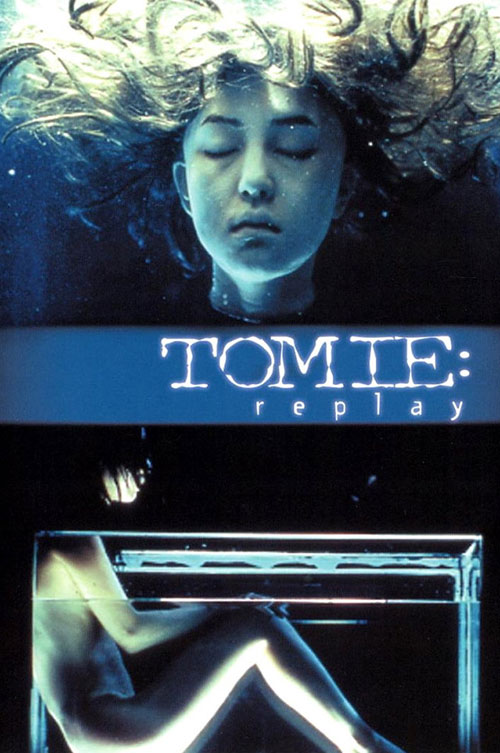
The second part of Tomie — the first sequel was the TV version called Tomie: Another Face — this story takes its inspiration from the Basement section of the original manga. It was directed by Fujirō Mitsuishi, with this movie as his only IMDB credit.
It was released on a double bill with Uzumaki, another movie adaption of the manga work of Junji Ito.
At the very beginning of the film, a six-year-old girl is taken into a surgical room where the head of Tomie is found — still alive — inside her stomach. It is placed in the basement and everyone in the room disappears, as the head grows into a full Tomie and starts her spell on a boy named Takeshi.
Meanwhile, the disappearance of the doctors is solved as Tomie’s blood has infected theirs and they’ve all gone insane. Speaking of crazy, Takeshi has already decapitated Tomie in an act of jealousy, watched her regrow that head and he is committed to a mental ward.
The daughter of the head of the hospital — who has also been driven to death by Tomie — is called to the hospital by Tomie, who wants another young boy, Fumihito, to kill her. However, at the last moment, he beheads Tomie instead and they burn her body. Has no one learned anything?
This version, however, looks like a proper horror movie and has a better budget. The idea that Tomie isn’t just some kind of monster, but really an infection, is a much deeper idea.
David Twohy started his time in Hollywood as a writer on films like Warlock, Timescape and Critters 2: The Main Course before graduating to big budget films like The Fugitive, The Arrival, Waterworld and G.I. Jane. He started directing with the aforementioned Timescape and then really kicked his directing career into high gear with this sleeper of a movie.
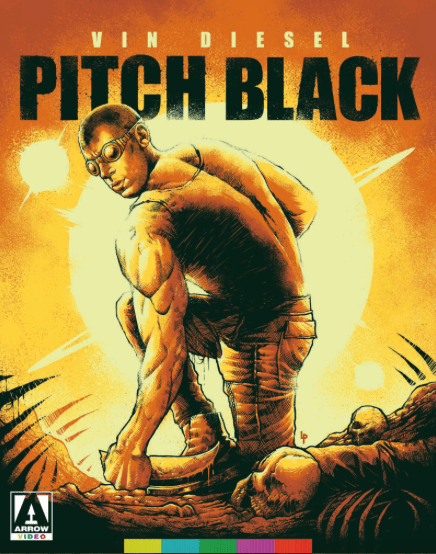
The first of four appearances of the Riddick character* — which launched the career of Vin Diesel — this movie owes plenty to the Alien franchise but comes into its own thanks to plenty of suspense and great effects.
The ship Hunter-Gratzner is transporting passengers as they sleep, including a Muslim preacher named Abu ‘Imam’ al-Walid (Keith David) and his three sons, an arms dealer named Paris, a teenager named Jack (keep in mind the gender neutrality of the name), some settlers named Zeke and Shazza, as well as a bounty hunter named William J. John (Cole Hauser, the son of Wings) who is transporting a Furyan alien who can see in the dark named Riddick. Meteors bring their ship down on a planet of near-constant daylight — or so it seems — yet when underground creatures attack Riddick is offer amnesty if he can help everyone get out alive.
That wouldn’t be easy even if the planet wasn’t headed for an apocalypse that will allow the photo-sensitive monsters to run wild anything and everywhere they want to go.
The intriguing part of this movie is the journey that pilot Carolyn Fry (Radha Mitchell, the …Has Fallen movies) makes from someone willing to jettison the passengers to save her own life to someone who convinces Riddick to stay behind and help others, despite his criminal nature.
Originally, this was a stand-alone movie and Riddick was supposed to die, but Vin Diesel and the cast and crew fell in love with the character and saw the potential for more. In the original Nightfall script, Riddick wasn’t even a guy; she was called Tara Krieg.
PS: If you want to see the wreck of the Hunter-Gratzner, it’s still in the Australian desert and visible on Google maps. This is also the same area where The Blood of Heroesand Mad Max Beyond Thunderdome were made.
PPS: The Robert Heinlein story Tunnel in the Sky has characters marooned on a planet threatened by a once-a-year danger and a character named Jack who is really female. Luckily, Heinlein wrote that and not Harlan Ellison.
The new Arrow Video release of Pitch Black is absolutely overloaded with all the extras you expect from this great company. It starts with a brand new 4K restoration by Arrow Films of the Theatrical and Director’s Cuts of the film, which were approved by director David Twohy. Then, you get two sets of archival commentary, a newly filmed making-of documentary, as well as new interviews with Rhiana Griffith, cinematographer David Eggby, visual effects supervisor Peter Chian and composer Graeme Revell. Plus, there’s behind the scenes footage, special effects tests, an introduction by Twohy, a Chronicles of Riddick Visual Encyclopedia, a short prequel narrated by Cole Hauser telling the tale of his character’s hunt for Riddick, the Dark Fury animated short (as well as the bonus features from that release), the Slam City motion comic, the Into Pitch Black TV special with further information of what happened before and after the events of the movie, a dance event that promoted Pitch Black and trailers for all of the sequels and video games.
You can get this from Arrow, who was kind enough to send us a review copy.
*The others are The Chronicles of Riddick, Riddick and the animated The Chronicles of Riddick: Dark Fury (you can also count the shorts Pitch Black: Slam City and Riddick: Blindsided, as well as the video games The Chronicles of Riddick: Escape from Butcher Bay and The Chronicles of Riddick: Assault on Dark Athena. As stated above, all of these are shown on this incredible release.
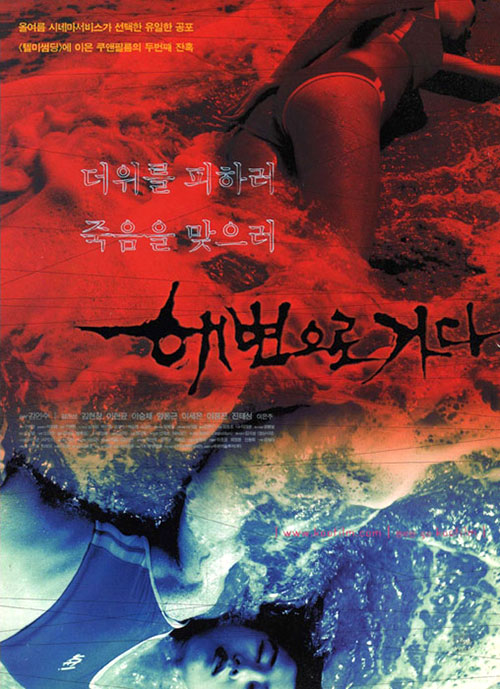
Remember the 2000 internet? Get ready to relive it in this South Korean slasher, which posits a chatroom meet-up in the sun and fun, where great looking teens who just happen to use the internet — not everyone was on it like this in 2000 and trust me, as someone who did many meet-ups, not everyone was this gorgeous — all get together to have sex and die.
Everyone except for Nam-kyeong is gruesomely murdered by a slasher named Sandmanzz, who has two z’s in his name because he’s either from the streets or this is how we talked in the 2K.
Supposedly, Sandmanz committed suicide when he was kicked out from the chatroom, a subject which has divided the group. Some think that he was ousted for no reason, but most think he had it coming. Regardless, like a cyber Korean I Know What You Did Last Summer, emails start coming from the killer, as do the bodies.
This has seriously the cheeriest soundtrack and the happiest teens ever. And it could have been filmed here and wouldn’t rate a second look, but that fact that it’s been transplanted to the other side of the world is pretty interesting.
Shot at 60i fps on the Sony HDW-700A HD video format digital camera, which proved problematic for theatrical distribution, this film was originally intended to be a Dogma 95 movie.
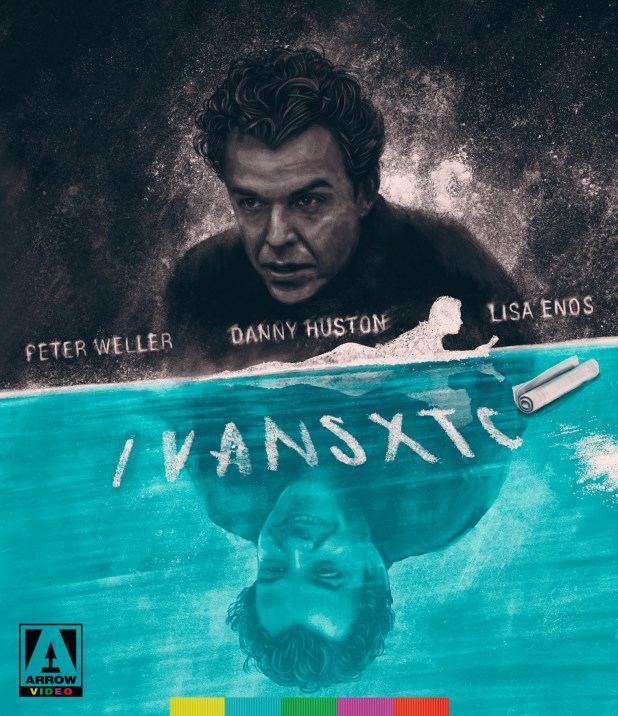
It’s a rough satire on Hollywood, filled with booze and excess, and comes from director Bernard Rose, who you may know from Candymanand Paperhouse. It’s also based on Leo Tolstoy’s novella The Death of Ivan Ilyich, so if you have a low tolerance for art films, you may not enjoy this. We sure did.
Danny Huston (half-brother of Anjelica Huston) plays Ivan Beckman, a doped up and driven agent who starts the film by dying. We go back to see just how he got to the grave — thanks to an early cancer diagnosis — and the lives he’s touched along the way, including Peter Weller as his sleazy client, SLC Punk director James Merendino as a director (typecasting?) and numerous hangers-on. Writer and producer Lisa Enos acted is in this as well and look for an appearance by Tiffani Amber-Thiessen.
Huston is the main reason to show up for this, as he makes you care despite the grainy looking footage and grabs you directly by the collar and forces you to watch.
Like most Arrow releases, this is packed with extras, like extended party sequence outtakes, a new documentary on the movie called Charlotte’s Story, interviews, trailers, and two cuts — the preferred director’s version and the producer’s version — with brand new commentary for the Extended Cut with co-writer/producer/ actor Lisa Enos and filmmaker Richard Wolstencroft.
You can get this from Arrow, who were kind enough to send us a copy.
“The gospel according to the Ayatollah Malcolm.” — Johnny Rotten
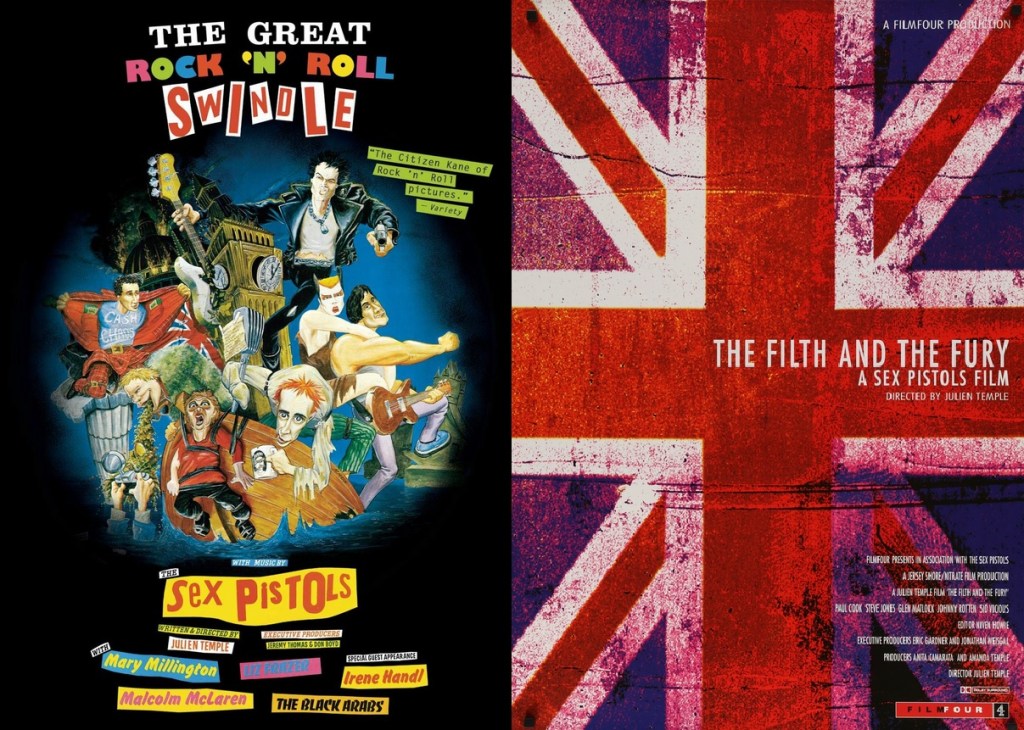
So agent provocateur and clandestine entrepreneur Malcolm McLaren owns a London fashion shop called Sex . . . eh, we don’t need to go that far back. . . . So co-founder/bassist/chief songwriter Glen Matlock is kicked out the Sex Pistols for “liking the Beatles. . . .” No, we don’t need to go that far back. . . .
When it came to the Sex Pistols, it was all about the marketing manipulation and McLaren the Machiavellian squeezed out every last drop of the group’s nihilistic sociopolitical ejaculate from their fourteen-month existence (November 1976 to January 1978). Regardless of their extensive discography that, by 1990, swelled to 20-plus albums, the group recorded only one actual studio album: the high-expectation and commercially-disappointing Never Mind the Bollocks, Here’s the Sex Pistols (1977). (The “flop” in the U.K. and Euro-markets was result of the album’s composition from the band’s already released 45-rpms and a “legal” 1977 bootleg album, Spunk.) And part of McLaren’s high-profile manipulations was to create a punk version of Richard Lester’s A Hard Day’s Night—with Johnny Rotten refusing to have anything to do with the project. The “project” was initially developed by—of all peoples—Russ Meyer, with snobby film critic Roger Ebert as the screenwriter, in tow—both who had a little experience in the rock ‘n’ roll genre with their “epic” about the rise and fall of the Carrie Nations, 1970’s Beyond the Valley of the Dolls . . . but Meyer also had lots of experience with large-breasted women (1965’s Motor Psycho and 1966’s Faster Pussycat! Kill! Kill!).
Yeah, this is going to work just fine. . . .
Well, it didn’t.
So, two-plus years later of false starts and stops with an array of people and footage shot here and there—which produced the Meyer-unfinished Who Killed Bambi?, British music video-artist, filmmaker, and ‘Pistols running mate Julien Temple (1989’s Earth Girls are Easy) got the Alan Sacks job of “doin’ a duBeat-eo” with the hours upon hours of narrative footage and concert clips of the Pistols during their heyday, along with surreal Kentucky Fried Movie-esque skits (that go beyond the funny into the silly . . . and the outright stupid).
Now, for those of you wondering: “What da frack does ‘Doin’ a duBeat-eo’ mean . . . and who is Alan Sacks . . . and what does this all have to do with the friggin’ Sex Pistols?” Well, impatient one, here’s your answer:
Alan Sacks came to fame as the creator of ’70 TV’s Welcome Back, Kotter; you know, that’s the show with the “Ooo! Ooo! Mr. Kotter!” pop culture catch phrase . . . the show that gave John Travolta his start. (He was most recently in the one-two punch bombs The Fanatic and Gotti.) And Alan Sacks got the job of taking the analogously dead pet-project of America’s Malcolm McLaren-doppelganger, record producer-songwriter Svengali Kim Fowley who, ironically ripping off McLaren’s idea, wanted to put his own “female” version of the ‘Pistols, the Runaways, into a “Beatlesesque” movie. (Remember: the ‘Pistols had “Anarchy in the U.K.” while the Runaways had “Cherry Bomb” as their signature tune.) Failed-developed as We’re All Crazy Now, Sacks got the Julien Temple-job of creating coherency out of chaos—and came up with duBeat-e-o, a film that has as much to do with the Runaways as The Great Rock ‘n’ Roll Swindle has to do with the Sex Pistols.
So, what did Temple come up with?
Well, he cut Who Killed Bambi? into the film. Sid Vicious—post-Sex Pistols—cut an album, Sid Sings (1979), and cut a video for that album’s centerpiece: a cover Elvis’s and Frank Sinatra’s signature tune, “My Way”—so Temple cut that into the film. (Warning: Sid pulls a gun and shoots into the audience.) And since Johnny Rotten wanted nothing to do with the project from the get-go, Temple opens the film with the snotty lead singer burned in effigy . . . and created an animated sequence that chronicles a beating the vocalist behind “God Save the Queen” took at the hands of Queen Mum-lovin’ thugs. And guitarist Steve Jones’s Rio de Janero visit with infamous British bank robber Ronnie Biggs is cut in. (Jones, ironically, along with Paul Cook and Glen Matlock, worked with Joan Jett on her self-titled solo debut, aka Bad Reputation.) And yeah, and Kurt Cobain Sid Vicious and Courtney Love Nancy Spungen, aka the punk rock John and Yoko, go through their own little psychodrama safety-pin voguing on screen. And, instead of Sex Pistols tunes: you get disco versions of Sex Pistols tunes by a group called the Black Arabs.
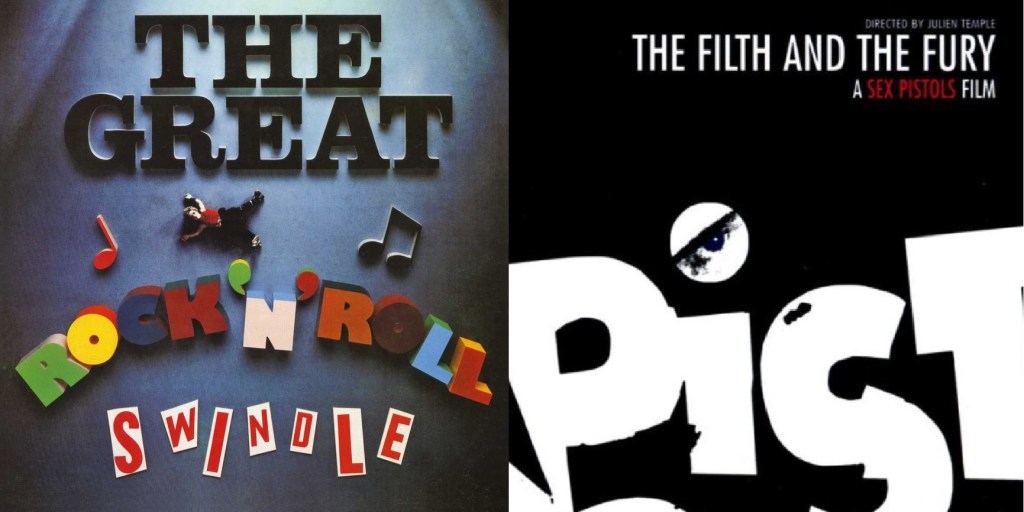
You can check out the track listings for each soundtrack on Discogs: Swindle and Fury.
. . . and the ‘swindle’ continues . . .
So Temple decided to commemorate the 20th anniversary of the film with a “sequel”. . . that cut TheGreat Rock ‘n’ Roll Swindle’s footage into the—admittedly—more coherent The Filth and the Fury (1990). And, if you’re keeping track . . . marks the third film chronicling punk’s most notorious band: the second was Alex Cox’s (Repo Man, Tombstone Rashomon) spunky, but not wholly historically accurate, Sid and Nancy (1986)—which Johnny Rotten also hated, natch.
With The Filth and the Fury—and without Malcolm McLaren’s marketing imperialism (. . . did you know he embarked on a “solo” career: with producer Trevor Horn, he assembled (McLaren never creates; he can’t. He thieves.) 1983’s Duck Soup)—Temple secured the full cooperation of Johnny Rotten, along with drummer Paul Cook, guitarist Steve Jones, and ex-bassist Glen Matlock, each who provide a new series of interviews, along with “new” interview footage of the late Sid Vicious not seen in Swindle. The interviews are well-executed: Temple peels Rotten-Lydon’s acidic layers and exposes his emotions over Sid’s decline and death. And there’s plenty of “new” footage, albeit, sometimes (most times) with grainy and out-of-sync sound, but kudos for Temple preserving those decrepit 16 mm and shot-on-videotape analog artifacts for the now, digital generations.
Temple was also able to circumcise McLaren’s cultural plundering of punk’s esthetics by showing us that punk rock wasn’t just about flogging the dead horse of Black Sabbath-inspired progressive rock and replenishing the wheezing lungs of rock ‘n’ roll. Punk was an artistic expression of the frustrations the British working class and unemployed (which include Rotten-Lydon’s contemporaries) against the stodgy and greedy British class system (a country where everyone’s on the dole, in poverty; meanwhile, Princess Di and Prince Charles have a huge matrimonial blowout). To that end, Temple also includes new footage of the protests, riots and unrest of the times (think of today’s Black Lives Matter movement and the upheaval in today’s Portland, Oregeon). So while Swindle was a “Swindle” to a point—which wasn’t Temple’s fault, he did a great job with whom and what he had to work with—Fury gets the facts straight and conveys the spirit of the times. So, as you watch both films as a double feature all these years later: you get Malcolm McLaren’s side . . . and the Sex Pistols side. And the twain shall never meet. Not even in the hands of Alex Cox.
The Great Rock ‘n Roll Music Trivia Swindle (you knew there was going to be a trivia sidebar): Before McLaren sunk his incisors into the Sex Pistols, he managed a down-and-out and ready-to-implode New York Dolls, which culminated with the 1975-recorded live, Euro-only album, Red Patent Leather (1984; which features new tunes not available on their two Mercury studio albums).
Also in Mal’s Svengali-stable was the burgeoning Adam and the Ants, who he subsequently “broke up” to provide musical backing for his own “Runaway” embodied in fifteen-year-old singer Annabella Lwin. Upon the eventual implosion of Bow Wow Wow (You do remember “I Want Candy,” right?)—as McLaren turned his Runaway into a singular-named solo artist, you know, like Madonna (not!)—guitarist Matthew Ashman formed Chiefs of Relief. And that band features another musician from the McLaren stables: Sex Pistols’ drummer Paul Cook (produced one eponymous debut album for Sire in 1988).
Prior to the Chiefs—and post-Sex Pistols (by the end of that band, only Steve Jones and Paul Cook were left to finish off a light smattering of tracks to close out that band’s career)—Jones and Cook formed the Professionals (with guitarist Ray McVeigh and bassist Paul Meyers). And, if you’re keeping track of your rock ‘n’ roll flicks, the “band” appeared—sans McVeigh and Meyers—with Paul Simonon of the Clash and British actor Ray Winston in their places, in Ladies and Gentleman, the Fabulous Stains.
Steve Jones’s solo career culminated with his forming a band around Iggy Pop, which recorded a couple of “comeback” albums for Detroit’s Jim Osterberg in the burgeoning years of the Year of our Lord Kurt Cobain. Johnny Rotten, as you know, reverted to his given name of Lydon and created the band Public Image, Ltd. with ex-Clash guitarist Keith Levene. Ex-Pistols’ bassist Glen Matlock formed the less-punk-more-Knacky new wave the Rich Kids with future Visage and Ultravox members Midge Ure and Rusty Egan, which scored a minor hit single with the title cut song from their lone album, 1983 Ghosts of Princes in Towers. Matlock eventually ended up in Concrete Bulletproof Invisible (an outgrowth of Doll by Doll that recorded one album for MCA Records) which released one pre-grunge album, Big Tears (1988).
Both films and their related soundtracks are easily available as DVDs and CDs, with the films as VODs and PPVs on multiple, international online platforms (hopefully, since these are “official trailers,” we won’t lose them to the black box of death!).
Update, August 2022: Our gratitude for the kindness and positive vibes from Aaron Hunter and his You Tube-based video blog on film (1.7 million followers and counting!), citing this review in his materials.
About the Author: You can learn more about the writings of R.D Francis on Facebook.He also writes forB&S About Movies.
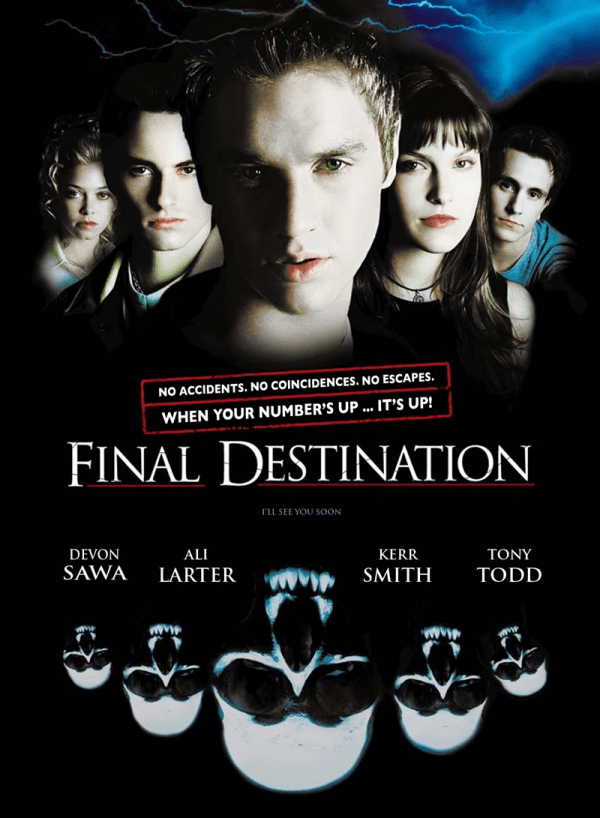
Originally written as an episode of The X-Files, Jeffrey Reddick ended up turning his script into a movie that became five films, two comic books, and nine novels. Not bad for a guy who sent in his first script to New Line at age fourteen, which led to a phone and mail friendship with studio head Robert Shaye.
It was directed by James Wong, who also made The One and the 2006 version of Black Christmas. He would say, “One thing we were all in agreement on from the start is that we didn’t want to do a slasher movie. We didn’t want a guy in a dark cloak or some kind of monster chasing after these kids. That’s been done again and again.”
On May 13, 2000, Alex Browning (Devon Sawa) and his classmates are supposed to take a senior trip to France. Before the plane takes off, he has a vision of the plane crashing and panics until Carter Horton (Kerr Smith) fights him. This gets both of them kicked off the place, as well as Tod Waggner (Chad E. Donella), Terry Chaney (Amanda Detmer), Billy Hitchcock (Seann Willam Scott), Clear Rivers (Ali Larter) and teacher Valerie Lewton (Kristen Cloke, named for famous horror producer Val Lewton). The plane crashes and everyone dies, but Death won’t give up.
It pays them back in exaggerated set pieces — stay tuned on those, they get even crazier — as Death must take them off the board. They learn exactly what they’re in store for from William Bludworth (Tony Todd), who is pretty much the personification of life being snuffed out.
In case you wonder, “Hey, where have I seen this before?” The answer is 1983’s Sole Survivor and The Twilight Zone episode “Twenty-Two.”
Alternate titles in other countries included Destination in South Korea, The Death God Comes in China, Last Station in Turkey and it was almost called Flight 180.
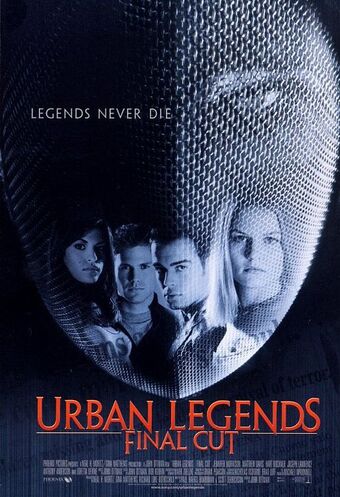
John Ottman is a man of many skills, including editing (The Usual Suspects, Bryan Singer’s X-Men movies) and composing (Bohemian Rhapsody, Halloween H2O). This is the only film that he directed.
That’s a shame because while most critics hated this movie, I really enjoyed it. Then again, any movie that has shout outs to Peeping Tom, Black Christmas and a killer who looks like he walked out of a giallo is going to win me over.
Reese Wilson — yes, the security guard from the first movie — tells Amy Mayfield (Jennifer Morrison, TV’s House) about the murders that happened at the last school she worked for. This inspires her to create a movie all about a serial killer inspired by urban legends, which is ironic, as one of her classmates is soon killed after her organs are harvested. She wakes up in a bathtub of ice and is chased by the killer before being decapitated by a window. And here you thought I was making up the Argento influence. To top that off, there’s a scene where everyone thinks they’re watching the film when they are all watching a real murder, a nice subversion that is classic giallo.
To top that off, at the end of the thrill ride of murder in this one, the close ties it in quite well with the first movie. Trust me. I won’t spoil it for you.
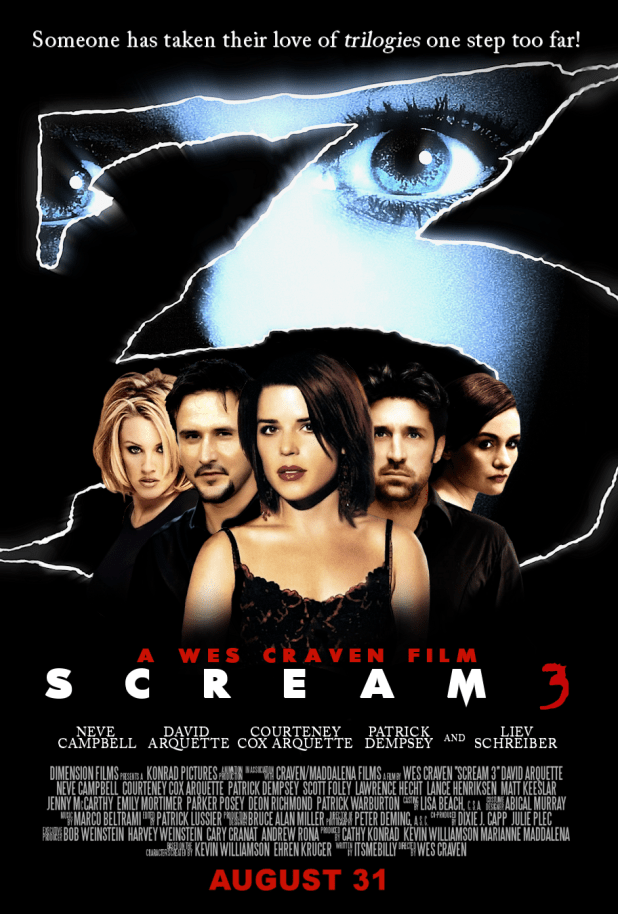
Writer Kevin Williamson had created a five-page outline for two sequels to Scream when selling his original script, hoping that one film could become a franchise. Ehren Kruger, who wrote the American versions of The Ring threw out most of those notes. He’d finish script pages the day they were shot, which led to Wes Craven rewriting them so that the characters would at least resemble who they were in the first two films.
This being a Wes Craven movie, it’s at this point of the write-up that I discuss that “production was troubled with script rewrites, occasions when pages were only ready on the day of filming, and scheduling difficulties.” Did Wes ever have a movie go smoothly?
Following the Columbine High School massacre and increase worry about the impact of violent media, the script kept getting toned down. Supposedly, there was even a version where Matthew Lillard would return as Stu Macher, having survived the first film and using high schoolers to attack Sidney from prison. What they ended up with was a movie within a movie about Stab, the film version of the movie we watched in 1996.
Detective Mark Kincaid (Patrick Dempsey) contacts Gale Weathers (Courtney Cox) to discuss the murder of Cotton Weary (Liev Schreiber) and his girlfriend Christine (Kelly Rutherford, who while being known to many from Melrose Place also played a salesgirl in Phantom of the Mall: Eric’s Revenge when she was just starting her career). She decides to go to Hollywood to learn more about the story and visit the set of Stab 3, a film based on the Ghostface killings. It’s also where Dewey (David Arquette) is working as an adviser.
Sidney (Neve Campbell) is trying to hide out as a crisis counselor, but all the calls start again and she’s pulled back to the set where most of the cast of the movie — not Scream 3, Stab 3 — get killed, like Tom Prinze (Matt Keeslar, who left acting behind to teach urology), Sarah Darling (Jenny McCarthy), Jennifer Jolie (Parker Posey), Angelina Tyler and Tyson Fox.
I do have to say, having Posey play Cox was a genius idea and one of the few bright spots to this film (she even wore the same green dress Cox wore in the first movie), along with the conceit that someone in Hollywood pushed the original murderers over the edge. The house where this film ends is the same domicile as Halloween H20.
The film never had a test screening, with the cast and crew seeing the movie for the first time at its premiere due to worries that spoilers would ruin the movie. Craven also shot three different endings, so they didn’t know how the movie would wrap up.
Roger Ebert would call out the reason why I disliked this movie so much. For a series that started as a smart send-up of slasher tropes, things really were rote by this point. He’d write, “The characters are so thin, they’re transparent. They function primarily to scream, split up when they should stick together, go alone into basements and dark rooms, and make ironic references to horror cliches and earlier movies in the series.”
That said, Wes Craven and Roger Corman show up, as does Lance Henriksen and Jay and Silent Bob, earning this movie a mention on our list of Ten Movie Crossovers.
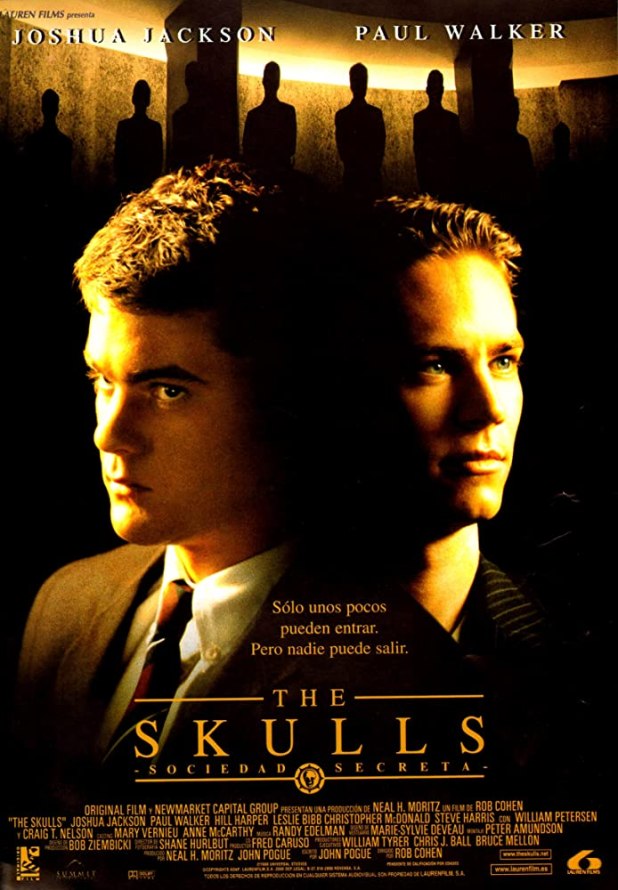
You know when a conspiracy theory — like Yale University’s Skull and Bones student society — becomes true? When Hollywood makes a movie about it. Here’s the real conspiracy. This movie is pretty much the 1970 made-for-TV movie The Brotherhood of the Bell. That said, this is where Rob Cohen met Paul Walker, so that’s how this movie has ended up in the middle of our The Fast and the Furious theme week.
Walker is Caleb Mandrake, a name that only exists in movies, and Joshua Jackson is Luke McNamara. They’re the two newest members of The Skulls, which prepares its members through war. It barely takes any time for this alignment to cause Luke’s best friend Will (Hill Harper, CSI: NY) to stop talking to him. But hey — he feels like he needs an edge to stay with his rich girlfriend Chloe (Leslie Bibb).
Speaking of CSI, William Petersen plays the leader of the inner circle and Caleb’s dad is played by Craig T. Nelson. They’re powerful because of the group and will crush anyone who gets in their way.
Another conspiracy: this movie was shot in Toronto and not Yale. Imagine being from that city and seeing your landmarks all over this movie and someone saying, “No, that’s really America.”
They made a whole bunch more of these — well, OK, two more — that went direct to video. Rob Cohen went to Harvard, so he was probably in a group just like this that allowed him to keep making films after xXx and Stealth.
Someone on IMDB noticed this — and I thought it was funny — that every Skull gets a watch for their left hand. Which means they are all right handed. At least they don’t show them masturbating in a coffin while other members watch. Not that I know tons of Skull and Bones stories or anything.
Much like how The Fast and The Furious would take the familiar title of a past film and make something new, this movie is a loose remake of the 1974 H.B. Halicki movie. Also, much like the Paul Walker/Vin Diesel film, critics absolutely hated this movie, which cried all the way to nearly tripling its production costs at the box office.
It has something that every single The Fast and the Furious movie lacks: Nicolas Cage as Randall “Memphis” Raines.
Memphis has the job of stealing fifty luxury cars for Raymond Calitri (Christopher Eccleston, who played both Dr. Who and Destro). He wanted out of this life, but his moron brother Kip (noted film idiot Giovanni Ribisi) screwed up and will get killed if his big brother doesn’t fix things.
Along with his mentor Otto Halliwell (Robert Duvall), Memphis assembles his crew again, including Donny Astricky (Chi McBride), Sphinx (former football star Vinnie Jones) and Sara “Sway” Wayland (Angelina Jolie, probably the main reason other than Cage to watch this movie).
I love that the cop, Detective Roland Castlebeck, is played by Delroy Lindo. That guy should be in more movies. Plus you get Scott Caan, James Duval from Gregg Araki’s movies, Timothy Olyphant, Grace Zabriskie (Sarah Palmer!), Trevor Goddard (Kano!), Mater P (Hootie hoo!) and John Carroll Lynch, who should also be in more movies.
Remember up top when I said this was a success? The truth is that its high production and marketing cost lost Disney around $90 million, who used Hollywood math to write it off as a $212 million loss. I guess that explains why there was no sequel.
Director Dominick Sena made music videos for everyone from E.G. Daily (“Sat It Say It”), Peter Cetera and Amy Grant (“The Next Time I Fall In Love”) and Richard Marx (“Don’t Mean Nothing”, “Should’ve Known Better”) to Janet Jackson (“Rhythm Nation”, “If”, “Miss You Much”, “Come Back to Me” and “The Pleasure Principle”) and Pia Zadora (“Heartbeat of Love”) before making movies like Kalifornia, Swordfish and Season of the Witch, which reunited him with Cage.
And what in the hell is this about? “Nic Cage Bitch” is our Nicolas Cage blowout written by Paul Andolina of Wrestling with Film. It’s a must read for all fans of the Cage, so check it out and learn about some Cage films you may have missed, such as A Score to Settle, Between Worlds, Kill Chain, Outcast, Rage, and Seeking Justice.




 B&S About Movies
You must be logged in to post a comment.