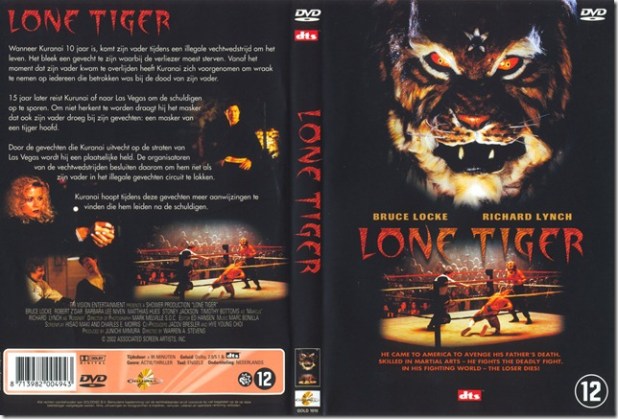
While searching Las Vegas for the man who killed his famous father — a wrestler known for his trademark tiger mask who is totally not Naoto Date, the Tiger Mask of anime and pro wrestling fame, despite this being written by Hisao Maki (Joe vs. Joe, Bodyguard Kiba), the younger brother of Ikki Kajiwara, who actually did create Tiger Mask — Chuji Kurenai (Bruce Locke, Shang Tsung from the Mortal Kombat: Conquest series and Otomo in RoboCop 3) discovers a world of fighters that battle to the death, which gets in the way of his quest to defeat Dark Tiger (Matthias Hues, Oscar the Lion Tamer in Big Top Pee-wee, as well as Kickboxer 2, TC 2000 and Puppet Master: The Littlest Reich), the pro wrestler who killed his father.
Meanwhile, Bruce Rossner (Richard Lynch) wants him as his main fighter, using money as motivation, as Hisao is taking care of some runaways — kind of like how Naoto Date would take care of the orphange (and to this day, Japanese fans of the manga and anime anonymously donate to childrens’ charities using Date’s name). He asks his main fighter, King (Robert Z’Dar) to train Hisao to be a killing machine, which takes all of one wacky montage.
Somehow, Tomothy Bottoms is in this. Yes, the same Timothy Bottoms from The Last Picture Show, Johnny Got His Gun and The Paper Chase. Then again, this is also the same Timothy Bottoms that was in Total Force, In the Shadow of Kilimanjaro and The Crocodile Hunter: Collision Course, in which he played President George Bush. The George Walker Bush President Bush.
Warren A. Stevens also directed Dragonfight and Eagles Law, but spent most of his career doing stunts, like Cannon’s Lambada and Super Mario Bros.
As for the movie, well, instead of spending time showing us pro wrestling or fighting to the death, there’s an extended fried chicken eating scene. And the tiger mask of this Nise Tiger Mask is poofy and goofy and the fight scenes seem shot underwater, but then again, seeing Z’Dar spit out fake blood and a character scream, “I love to pee!” are the better parts of the film, so maybe it could have used more fried chicken eating.
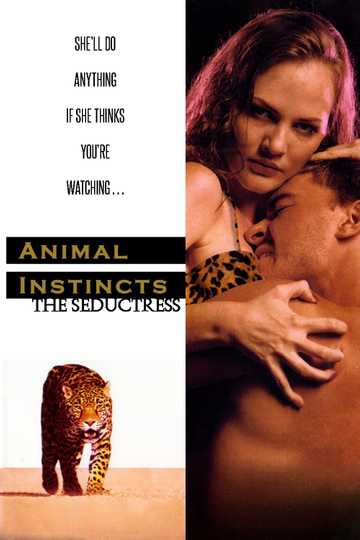
When Joanna Coles falls for blind rock promoter Alex Savage she finds the man who satisfies her desire for experimentation, as he’s a voyeur. But he’s also blind. Can I Do It Until I Need Glasses?
Oh yeah. He’s also a blind knifethrower.
There’s also some music industry ridiculousness — director Gregory Dark would know, seeing as how he directed videos for everyone from Sublime to Britney Spears — and lots of the voodoo masks and rituals that made up so much of the look of Dark’s even dirtier films.
But the most charming thing about this movie is that it was written by Selwyn Harris, whose name combines the Selwyn Theater on 229 West 42nd Street and the Harris Theater on 226 West 42nd Street, a man who also wrote The Devil in Miss Jones 5: The Inferno for Dark. And, in case you didn’t know, Selwyn was really Mike McPadden, perhaps the finest writer on not only 42nd Street, but heavy metal movies, teen movies and just life.
Sadly, Mike is no longer with us, but the books and movies and words he wrote are. He was a major inspiration to me, so seeing his other name appear in the credits made me so overjoyed.
Mike told The Daily Grindhouse so much about this movie: “Greg was a nut. He was a dear friend, a terrific talent, a great guy to work with, and, very much, a nut. At the time we started Animal Instincts III, Greg was heavily into hip-hop music and had expanded his intense martial arts regimen to include knife fighting. So his ONLY instructions to me were: “Make sure the movie has hip hop music and knife fighting.”
And thus the plot centered on a record producer who was an expert knife thrower. The fact that he was supposed to be blind, too, plays into the challenge of showcasing new variations on the oldest form of human interaction. When his wife fucks people in front of him while thinking he can’t see, it adds a deeper component to her exhibitionism and his voyeurism — in theory, at least. The finished movie is an apocalypse.
As a porn screenwriter, both hard and softcore, the sex scenes function as the posts from which the whole rest of the movie hangs. Like haiku, you can write whatever you want, as long as it fits into the form’s singularly defined structure.
One of the movies I wrote for Greg, Devil In Miss Jones 5: The Inferno is great. The rest meander from one near miss, Sex Freaks, to a couple of negligible efforts. Animal Instincts III stands alone as gloriously horrendous.”
Thanks for so much Mike. You still make me laugh and still will, long after you have been gone.
ABOUT THE AUTHOR: Nick Vaught has worked in the entertainment industry for several years. Nick currently serves as an Associate Producer on the upcoming horror documentary In Search of Darkness: Part III. Nick also worked on the long-running CW series Supernatural. In 2019 he co-wrote the well-received episode “Don’t Go in the Woods.” In addition, Nick has written punch up jokes on multiple TV pilots and teamed with actor Jason Mewes to help write his biography.
Seemingly no movie genre lives and dies more than horror and in the mid 90’s, the horror genre was as dead as the asshole jock character that populates these movies. Popular franchises such as Friday the 13th, Halloween and A Nightmare on Elm Street had run out of steam with both critics and fans alike. Let’s face it, sequels had killed our beloved franchises. The genre was in much need of an originality boost and that’s where ironically, Dimension Films came in. I say ironically because Dimension Films was part of the sequel-itis that was plaguing horror films. The Bob Weinstein-led subsidiary of Miramax was primarily known for its horror and sci-fi films. They scooped up the rights to Children of the Corn, Hellraiser and Halloween and began producing subpar (putting it mildly) sequels to the once-powerful franchises.
Then, in 1995, they optioned a script by an unknown writer named Kevin Williamson. The script was called Scary Movie (before it was changed to Scream) and it was strong enough to attract the attention of horror master Wes Craven, who was in desperate need of a hit. The script focused on a masked killer terrorizing a group of high school friends. The cast was comprised of a lot of up-and-coming actors: David Arquette, Skeet Ulrich, Rose McGowan, Jamie Kennedy, Matthew Lillard; as well as tv stars, Neve Campbell and Courtney Cox. The biggest name in the cast was Drew Barrymore, who played “Casey Becker.” Barrymore was initially offered the role of “Sidney Prescott,” which would ultimately be played by Campbell.
It didn’t take long after cameras began to roll for issues to begin to rise. Weinstein was incredibly unhappy with the first round of footage that came in; the footage of the opening scene with Barrymore. Editor Patrick Lussier scrambled to put together the scene in its entirety and get it to Weinstein, who was pleased enough with what he saw to spare Craven’s job.
After filming was completed, Dimension Films made an odd choice by giving the film a December 20th release date in 1996. Horror films simply weren’t released during the holidays; only blockbusters and feel-good comedies were. I suppose Weinstein was hoping for Scream to end up as counter programming Well, it didn’t work and Scream only made around $6 million in its opening weekend; it was dead, or so it seemed. Something almost unheard of happened the next weekend, the gross went up and up and up until the movie topped out at a whopping $103 million at the end of its run. How did this happen?
Word of mouth happened. The people that did see it on that opening weekend loved it and told others. The before mentioned opening scene became one of the most iconic opening scenes not only in horror history, but cinema history. Barrymore’s character finds herself alone in her parent’s house in the middle of nowhere making Jiffy Pop. She gets a call from what she assumes is a wrong number, but is actually a deranged killer with a cell phone and a penchant for horror movie trivia. The Jiffy Pop begins to rise as the tension does; a master stroke by Craven. Shockingly, Barrymore’s character is killed off and the movie never lets up after that. From that point, Scream focuses on Campbell’s “Sidney Prescott,” who gives a strong, grounded performance as the movie’s final girl.
Personally, I had only gotten into horror the year before and when I saw Scream for the first time it cemented my love of horror. Even though I was relatively new to the genre I had never seen anything like this. The filmmakers invited us to be part of the movie; we were watching ourselves onscreen. We were screaming the answers to “Ghostface’s” questions during Drew Barrymore’s scenes. We were yelling at Jamie Kennedy’s character “Randy” to turn around as he was saying the same thing to Jamie Lee Curtis’ character while he was watching Halloween. The characters were well aware that their situation mirrored that of a slasher movie; in fact, they would mock their predicament. The movie also introduces the rules of surviving a horror movie, some which hold true, but then subverts one of the biggest rules by taking Campbell’s virgin character, having her have sex and still outwitting the killers in the end. It was meta before the term would enter our cultural zeitgeist.
Metaness aside there was plenty else to like about the movie. For starters, the movie was a well-crafted whodunit with elaborate death scenes. There were several red herrings throughout the movie and while many in the audience may have guessed that the character of “Billy” was a killer, nobody in the audience could’ve guessed that there were two killers. I can still remember the audible gasps in the theater when Matthew Lillard’s “Stu,” the lovable, goofy sidekick was revealed as the second killer. The character of “Stu” was so popular that there’s still clamoring to bring him back, despite you know, him being a murderer.
Speaking of the lovable “Stu”, strong, three-dimensional supporting characters is another area where Scream excels. Most scary movies just throw a bunch of thinly written characters in the middle of the woods just for the sake of adding to the body count; you usually don’t even care whether they live or die. Scream gave us fully realized, grounded, characters that we had a vested interest in their fate. Rose McGowan’s death scene is a highlight of the movie, but we’re generally disappointed when her strong-willed, character bites the dust.
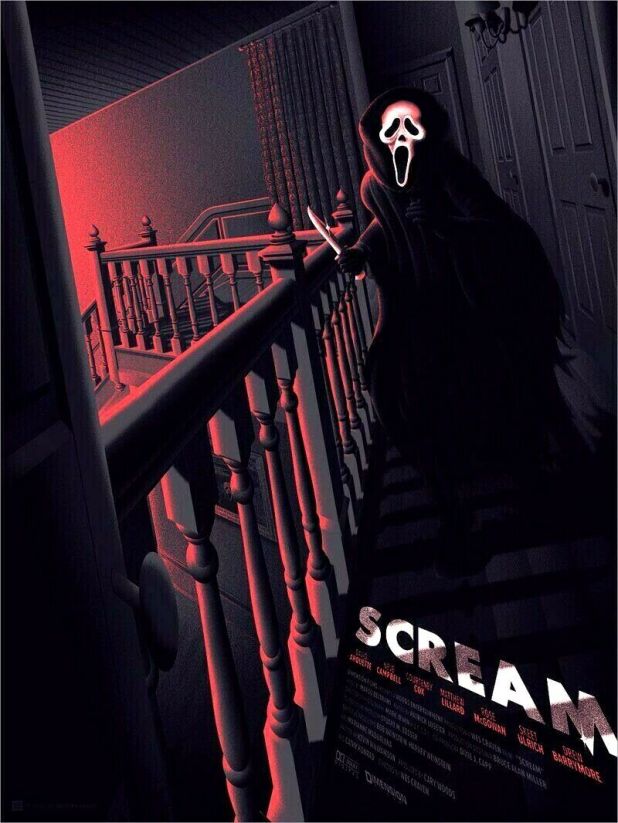
And let us not forget the now iconic “Ghostface” mask. Every villain needs a killer look, pun intended. The Scream mask was instantly terrifying the first time we saw it and it gave the killers a sense of personality as well. I think it’s safe to say that people who haven’t even seen the movies know where the mask is from.
Scream turned 25 years old on December 20th and not only are we still talking about it, but a new Scream movie is due to be released on January 14th of this year, which will give us a Scream movie in four straight decades. For many of us, Scream is a pinnacle entry in the horror genre and if you’re like me, it’s a major reason you have a diehard love for horror. Thanks to this franchise for keeping me screaming a quarter of a century later.
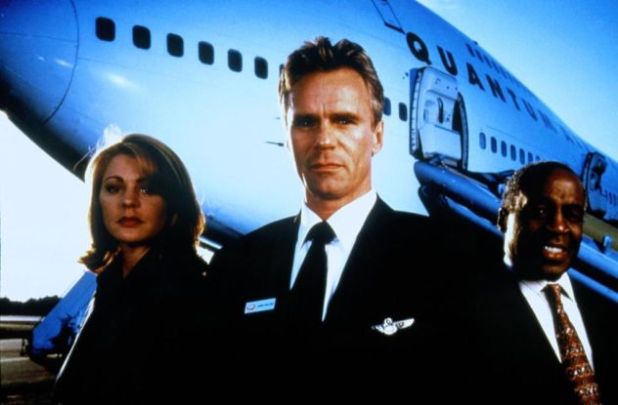
Based on the book Pandora’s Clock by John J. Nance, this movie draws on the author’s experiences as a Braniff Airlines pilot by telling the story of a deadly virus on a Boeing 747-200. The governments of the world have left the passengers — including Ambassador Lee Lancaster (Robert Guillaume) — to die, but Captain James Holland (Richard Dean Anderson) and his crew are struggling to save them all.
Nance shows up as a high-ranking Air Force official, plus there’s Daphne Zuniga, Jane Leeves, Robert Loggia and Stephen Root on hand.
One could argue my smarts in watching a movie about quarantines and pandemics and viruses while the Omnicron variant is in the news. There are so many disease of the week movies that now are not as much fun to watch as they once were.
You can watch this on YouTube if you feel like dealing with some dread.
Some terrorists think they’re stealing uranium. Nope, it’s frozen dinosaurs.
Some cops think they’re going after drug dealers. Nope, they find dead terrorists and then get killed by two velociraptors and a Tyrannosaurus Rex.
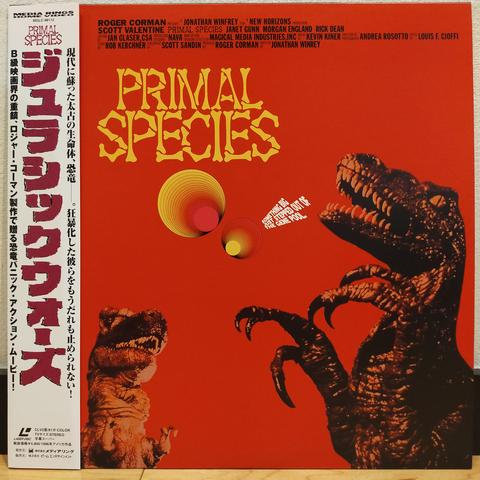
As for you, you’re here for the third Carnosaur movie, one that stars Scott Valentine, who went from being Nick Moore on Family Ties — a character so popular that they tried to spin him off three times* — to My Demon Lover, Roger Corman’s Black Scorpion movies and The Unborn 2.
He’s Colonel Rance Higgins, who must team with Dr. Hodges (Janet Gunn, Silk Stalkings) to escape the dinosaurs.
Seeing as how this was once called Primal Species, it was not made to be a Carnosaur movie. But we all know how 90s direct to video sequels work. I also have been made aware that 2001’sRaptor has footage from these films — and stars Eric Roberts — which means I will have to watch it, as does the 2006 movie The Eden Formula which also has the much better title Tyrannosaurus Wrecks.
*Taking It Home was canceled when Valentine’s co-star, Herschel Bernardi, died. Anther was a Friends style sitcom and the third was The Art of Being Nick, which did air unlike the other two pilots but was not picked up.
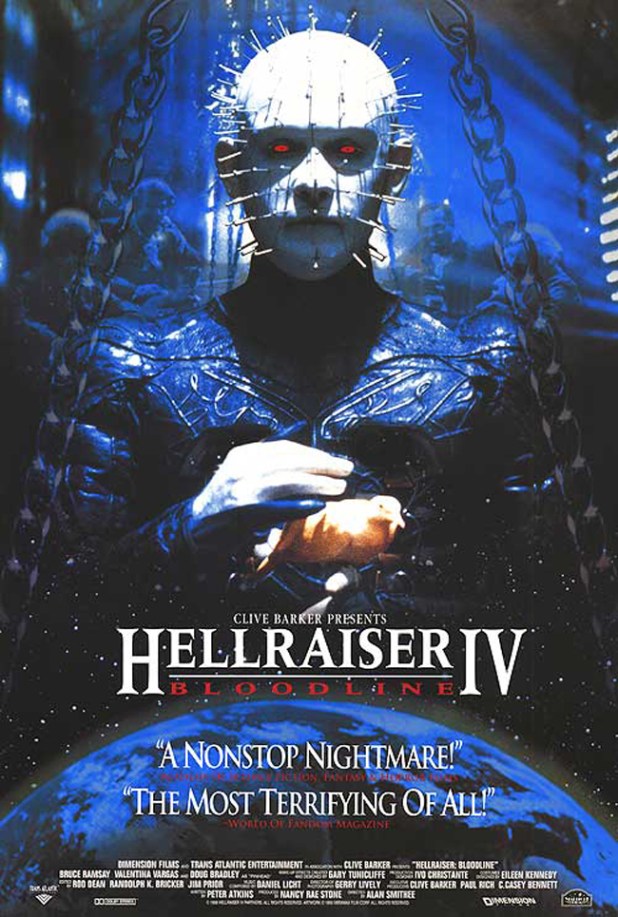
Directed by Kevin Yagher and Joe Chappelle, this is the last Hellraiser to play theaters, only has one returning character in Pinhead (Doug Bradley), the last to involve Clive Barker and is both a prequel and a sequel.
Yagher left the production after Miramax demanded new scenes be shot. This is a theme that will appear in nearly every 90s horror movie that Miramax got their weird creepy hands on. The new scenes and re-shoots changed several characters’ relationships, gave the film a happy ending, introduced Pinhead earlier and cut 25 minutes of the original cut Yagher turned in. These were enough changes that he was able to use the Alan Smithee credit.
Dr. Paul Merchant has designed a space station to be in the shape of a giant Lament Configuration. Yes, within four movies, the Hellraiser franchise does what it took Jason Vorhees ten to arrive at. Yes, we’re in space. And we’re also going back in time, as Merchant’s ancestor creates the original box that starts all of these demonic events.
The Merchant bloodline has been cursed ever since they helped open the gates to Hell. There’s also a new Cenobite, Angelique, who tempts people and this puts her into conflict with Pinhead, who only believes in pain. There’s also a Merchant ancestor in 1996 that has created The Elysium Configuration, an anti-Lament Configuration that creates perpetual light and will close the pathways to Hell forever.
Bruce Ramsay ended up playing all of the Merchants and I kind of like that the end of this movie attempts to close the story. But come on. They already made four of these movies and there was no way this would all end here.
How crazy is it that this was Adam Scott’s film debut?
One of the hardest things about a week of D’Amato films is finding SFW box cover art that won’t get flagged by Facebook. So if you see a lot of pictures of Joe’s smiling face instead of the actual poster art, that’s why.
A period drama set in the 1920s, Provocation is about Carlo (Gianni De Martis, who is in a bunch of Tinto Brass movies), an inn owner at odds with his sexually curious grandson Gianni. While they try and keep the inn in business, Carlo’s wife is sleeping with a guest while her husband sleeps with every woman that stays there — while his grandson secretly watches.
Then Marilena (Erika Savastani, who was also in plenty of Brass movies and Zora the Vampire) visits the hotel and people lose their minds. Like they can’t even look at her without starting to go insane. I mean, I get it, but they turn into wolves from a Tex Avery cartoon.
Man, I feel like a broken record but the 90s softcore D’Amato films are rough to get through because you can see the talent is there. However, he’s just going through the motions now. In the last three years of his life, D’Amato would make nearly a hundred adult films. That’s an insane schedule to be on, but he did it, and he wasn’t really worried with making art.
“Five miles below the surface of planet Earth, a new fear is born.” — Most boring tagline, ever
“I feel like I am in a bad episode of The X-Files.” — Dialog from the film that should have been the tagline for the film
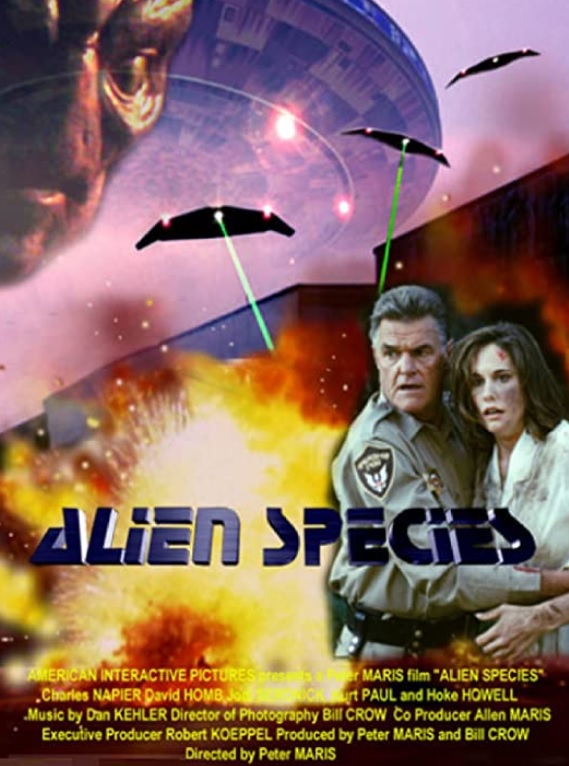
Well, forget the tagline snafu. Look at that box art!
Made NOT by American International Pictures, but American INTERACTIVE Pictures.
No, Alien Species isn’t a lost film from the ’70s or ’80s repacked for the ’90s DVD market. Alien Species is, in fact, a sad, very sad, present-day ripoff of Independence Day and Species — all released in 1996 — made as a quickie-cash-in on those films. And to fill that 12th and 50th slot on one of Mill Creek’s many bargain box sets.
Yep! That’s Charles Napier (from another film, we’re almost sure of it) as the military officer — only, ugh, budget: they could only afford a Sheriff’s uniform.
Hey! That’s ’70s character actor extraordinaire Hoke Howell as the professor — of too many to mention Fred Olen Ray flicks!
Hey! Oh, ugh . . . that’s Jodi Seronick — the totally cute, but worst-ever, one-and-done actress committed to a Mill Creek box set — thepsin’ alongside Izzy from Shock Em’ Dead. (Plot spoiler alert: he’s one of the prisoners, and he dies.)
David Homb asIzzy, rocking’ the ’88s for Spastic Colon.
Wait . . . what the hell? The dude that gave us the ’80s apoc-romp Land of Doom — the movie with the cross-bow glove?!?! Hey, he’s also the producer of the Christian apoc-rocker Raging Angels with Eddie Wilson! You rock, Peter Maris! Wait, what . . . Maris made his debut in 1979 with the U.K. “Video Nasty” Delirium?
Load. The. Tape. I’m celluloid delirious.
LOAD THE TAPE!
When everyone bowed to the altar of John Carpenter.
From an Independence Day ripto a Road Warrior clone: it’s the B&S About Movies way.
STOP! Hit the fast forward button. No, just hit the stop button. Eject! Eject!
What the hell? The guy who made my cherished Delirium, made this? What went off the rails, here?
The awful cinematography. The insipid scripting (one of its golden lines: “We’re not in Kansas, anymore!”). A worse soundtrack. Poorly staged action sequences. CGI that’s an embarrassment to CGI. Charles I-love-him-in-everything Napier sleepwalking it — again, from what seems an unrelated film.
So . . . as with this film’s raison d’être: aliens show up circling the Earth, but with none of the dramatic or effects impact of a Roland Emmerich production. Er, uh, because this is more like an Ed Wood production — as two astronomers peck at keyboards at a desk in an office building tracking an object.
Then a fleet of ersatz Cylon Raiders appear in the sky.
Invasion over.
So one of the scientists from behind the desk — racing (or was it Hoke, don’t care) to somewhere to warn about the invasion (since there are no phones, cell or hardline, in 1996; an embarrassing plot gag that didn’t jive in the two-years later asteroid slopper Deep Impact) — ends up in a fender bender with a prison transport bus. Now, said scientist is part of a ragtag band of humans (both deputies and criminals), led by the Sheriff (cue Charles Napier to the set) because, well, the production couldn’t afford a piper cub and a cargo plane to do a Con-Air meets Independence Day ripoff. Uh, er, wait a sec . . . Napier isn’t in this part of the film, because he’s actually in “the other film” that’s cut into this film — we think.
Anyway, our human revolutionaries — not led by Will Smith and Jeff Goldblum — stumble around the woods and hide out in cave . . . the very cave that leads to the aliens invading Earth. Then errant cows and backwoods rubes sucked yonder by a transporter beam, found just-when-we-need-’em bazookas, shotguns that never require reloading, compatible alien-to-human computer software interfaces, saucers with no force fields, green force-field prison cells, the worst day-for-night/night-for-night cinematography, ever, and educated, Polyanna female leads hooking up for grungy, prisoner romance, ensues.
Ugh.
This ain’t an on-purpose nostalgia piece to honor Bill Rebane: Alien Species is just an incompetent, just-like-a-Bill Rebane alien invasion flick of old (see Invasion from Inner Earth and The Alpha Incident for more information), where we have people running around the woods and stumble-bumbling through caves (but not drinking a lot of coffee or smoking, as in a Bill Rebane flick) as they hurl insults at each other, that is . . . when we don’t have ol’ Hoke Howell (or whomever) pecking at keyboards (his niece, his daughter, or whatever-she-is, is the thepsy-screechy Jodi Seronick; Hoke’s students are the two behind-the-desk nerds; Jodi is friends with the unrequited-crushing male nerd that takes out saucers with a laptop, just like Jeff Goldblum).
“So, do any, actual aliens show up?”
Well, a couple guys in rubber-zipper suits appear in a darkly lit cave — if you haven’t already fast-forwarded through that part.
“Do we ever get a peek inside the mothership or a saucer cockpit?”
No.
“Why do the aliens attack a small town instead of say, New York City — besides budget issues?”
The cave.
“The cave?”
Yeah, it’s all always been about that backwoods cave. Weren’t you following along with the plot: the aliens started their Earth colony, down there — which was teased in Bill Rebane’s Invasion from Inner Earth, but never delivered. So, at least Alien Species lived up to its tagline in that regards.
You know what?
I’m not even sure if my “plot” description is accurate. But it’s damn close. Not that my review is steering your wrong. Not in the least.
Hey, when I’m stuck reviewing a film that looks like pieces-parts of three films cut together (the two desk dorks, Napier’s sheriff in town shenanigans, the prison bus crash out in the sticks), I’m wishing I was watching the piecemeal efforts Evil Town or Night Train to Terror. Or Spookies. Or Fright House.
At least Peter Maris has the sense to put Jodi Seronick in sensible, flat shoes and not have her running around in designer heels like some Paul Naschy Spanish-cum-Italian zombie flick.
Yeah . . . why am I watching this instead of a Naschy or Amando de Ossorio flick? Boy, some robed monks with Omega Man eyes sure would have helped, here.
Anyway, there’s no trailer to share . . . but, if you must watch Alien Species, in full, you must. We found a copy on You Tube. And don’t go surfing for the end credits-announced Alien Species 2: The Invasion. It was — for all the obvious reasons — never produced. If you’d like a bargain-priced version of Alien Species for your collection, you can have it as part of Mill Creek’s Nightmare Worlds 50-Film Pack/IMDb alongside UFO: Target Earth and Invasion from Inner Earth — both which we also reviewed this week.
At least his review isn’t a total loss: your movie knowledge has expanded by knowing of not only one — but two — films each, of Peter Maris and David Homb. Well, three for Maris, as we suggest your checking out Delirium (which you can, on You Tube).
You can check out the trailers for Delirium and Land of Doom on You Tube, as well as this new-and-condensed review of Alien Species for our November 2022 “Mill Creek Month” of reviews for the Nightmare Worlds box set.
Ugh. If I would have know Peter Maris would reappear 40 years after the fact via the new, January 2022 Blu-ray reissue of Delirium, I would have been nicer to Alien Species and not funned Peter so much in this review. Eh, you live and learn in the digital age. I should have known better. Don’t hate me, Pete! Blame Mill Creek and their confounded box sets for the review inspiration!
Get your copy! Image courtesy of JohnGrit/Unisquare.
About the Author: You can learn more about the writings of R.D Francis on Facebook.He also writes forB&S About Movies.
ABOUT THE AUTHOR: Sean Mitus grew up watching Chiller Theater & Pittsburgh UHF channels and has been a drive-in enthusiast for the last seven years. Sean enjoys all genres but has recently become interested in Italian Giallo and Poliziotteschi genres.
“A young policewoman slowly goes insane while tracking down an elusive serial rapist/killer through Italy when she herself becomes a victim of the brutal man’s obsession.” – IMDB
After licking his wounds from back-to-back underperforming releases filmed in the US (Two Evil Eyes and Trauma), Dario Argento returned to Italy (and some say to peak form) with The Stendhal Syndrome, hereafter referred as Stendhal Syndrome. The film stars his daughter, Asia Argento, as Detective Anna Manni and then Euro-star Thomas Krestchmann as Alfredo Grossi. Argento’s Stendhal Syndrome is a fascinating inversion of the usual giallo tropes.
The film opens with a cold open of Anna Mani and we have no idea who she is. We see here have a transcendent experience while touring the Uffizi Art Gallery in Florence, Italy. The experience is a purported psychosomatic phenomenon known as the Stendhal Syndrome and is visually realized in early CGI with visual flair by Sergio Stivaletti. Anna is helped by a stranger, Alfredo. Anna develops amnesia and begins to recover small details. As she investigates the latest rape and murder crime scene, Anna is attacked and raped by Alfredo who turns out to be a wanted serial rapist and killer. What follows is another visual set piece of the rape and murder of another victim.
Anna escapes and attempts to put her life back together. As she does, Anna has sudden shifts in her personality, appearance, and behavior. She has another Stendhal experience before being reinstated to limited duties as a Detective with mandated counseling sessions. Anna becomes obsessed in finding Alfredo and his visage begins to dominate her every thought. She returns a colleague’s romantic advances with a simulation of her sexual assault by Alfredo.
Anna returns to her hometown and family for a more supportive environment. However, her distant relationship with her father doesn’t help any. Anna tries painting as therapy without rrelief It actually seems to drive her deeper into mental instability. While this goes on, we see Alfredo target, rape and murder another victim in a harsh set piece. As Anna contacts early victims who attest to Alfredo’s brutality and devastating impact, Alfredo calls Anna from within her apartment and kidnaps her once again.
Alfredo brings Anna to his lair and in the harshest set piece brutally assaults and rapes Anna. He keeps her captive, and Anna has another Stendhal fugue of sexual torment. Alfredo returns for another assault, when Anna manages to turn the tables on him. She fights viscously and recovers her gun. In Alfredo’s attempt to exert psychological dominance, Anna manages to shoot Alfredo and disables him in a cathartic beating. She taunts Alfredo before dumping him helpless into a waterfall and raging waters below.
The final third of the film finds Anna unable to shake Alfredo’s psychological scars, even as she flips back to a feminine persona and appearance. The investigation into Alfredo’s background reveals a distorted obsession with Anna. She claims to be recovered from her visions and their effects. She meets a French art student and the budding romance seems to put her on the path to recovery. Suddenly, Anna is getting phone calls from Alfredo, and Anna’s new lover is mysteriously murdered. Anna is notified that Alfredo’s body has been recovered and she seeks clarity from her psychologist who instead challenges her distorted point-of-view on Alfredo’s influence over her.
In the film’s climax, Anna’s colleague Marco rushes to see Anna as we see Anna fully transform to her feminine, protective self. We see the body of her psychologist who was brutally murdered by Anna. We along with Marco see Anna finally revealed as the murderer of her psychologist and lover. Anna has finally succumbed to Alfredo’s madness in full. She lures Marco to her car and kills him. Anna attempts to flee, but we know she never will be free of Alfredo as the film ends.
As I mentioned, the Stendhal Syndrome is dominated by the theme of inversions:
The story upends the usual giallo tropes with the killer being known early in the film.
The killer, Alfredo, is dispatched at the midpoint of the film.
Anna becomes predator a la rape revenge movies (Call Her One Eye; Repulsion; I Spit on Your Grave).
Anna becomes more aggressive both sexually and personality, dresses more masculine, and later seeks out and repeats her degradation on Alfredo
Anna later flips back to her feminine side to but continues to lose control of her sanity and ultimately descends into madness a la Repulsion
The Stendhal Syndrome is a strong entry in the giallo pantheon. Argento’s aggressively misogynistic treatment of how women are assaulted and murdered, rivaling Fulci’s The New York Ripper) and Asia Argento’s relatively young age in the role (just 21 during release) may put off some. I argue that by this time Argento had included more slasher-style set pieces as with Tenebrae, Traumaand Opera so this shouldn’t come as a surprise and that Asia Argento’s performance does not limit her character development.
Further strengthening the viewer’s experience is Thomas Krestchmann’s sublime performance as the sociopath Alfredo, the moody cinematography by Giuseppe Rotunno, and Ennio Morricone’s usual nuanced score. I recommend The Stendhal Syndrome for giallo and Argento fans who have seen his earlier works. Seek out Blue Underground’s 3-Disc Limited Edition for a full treatment of this deserved gem!
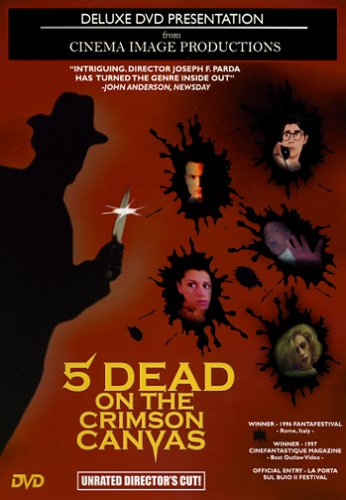
Man, a Super-8 looking movie made in 1996 that’s supposed to look like a scuzzy 1971 Italian film? Yes, that’s pretty much exactly the kind of movie that I’m looking for. And sure, the music is over the dialogue and nothing really makes sense, but if I worried about films making sense, I would have stopped this site long ago.
I mean, a beatnik poet spells out the title of the film and all of the dialogue is way off from the peope speaking it and there are big stretches where nothing happens, but hey — it’s basically an American crew trying to make something that hasn’t been made for a quarter of a century.
I don’t know how good the rest of writer/director Joseph F. Parda’s films are but with titles like Evil Streets and Machines of Love and Hate, they are wonderous if only in my imagination.
So yeah — it’s about an artist obsessed with death getting killed, his body disappearing and his brother searching for it through a sexually twisted underground. You know — what we call Tuesday around here.



 B&S About Movies
You must be logged in to post a comment.