WATCH THE SERIES: A Nightmare on Elm Street part two

In our last post, we got into the origin of the Nightmare on Elm Street films. Now, sadly, we start to discover why — and when — the series started to go downhill.
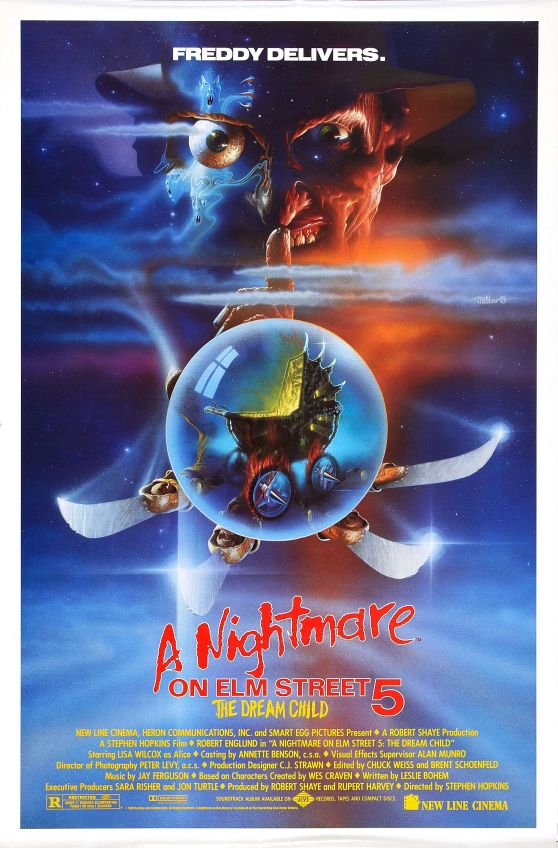
A Nightmare on Elm Street 5: The Dream Child – 1989

What can you say about a movie where the director, Stephen Hopkins (Predator 2Judgement Night), says “What started out as an OK film with a few good bits turned into a total embarrassment. I can’t even watch it anymore.”?

A year after the last film, the returning Alice (Lisa Wilcox) and Dan (Danny Hassel) have been dating and seen no sign of Freddy until a shower turns into Alice going back in time to witness the creation of Freddy by the maniacs of the asylum. She tries to forget the dream as she’s graduating high school the next day, along with comic book lover Mark, model Greta (Erika Anderson, Twin Peaks) and aspiring nurse Yvonne (Kelly Jo Minter, Maria, the video store clerk from The Lost Boys).

The dreams don’t go away, with Alice witnessing the birth of a Freddy baby that makes its way to the church from the last film. He tells her he’s learned how to come back to life, just at the moment that he kills Dan. At the same time, she also learns that she’s pregnant with her dead boyfriend’s child.

No one believes that Freddy is after Alice, but Greta soon is killed by being forced to overeat in her dreams. Oh yeah — Alice is also seeing a fully grown boy she calls Jacob who she believes is her future son. Freddy is feeding his victims to her unborn baby — who yes, is also Jacob — to make him evil.

There is an imaginative scene where Freddy kills Mark within a comic book world, as well as the world that Freddy lives in now. But the ending, where Amanda Krueger seals away Freddy and Jacob decides to stay with his mother amidst strange puppet heads gets a little ridiculous. Actually, this entire movie is, supposing that teens we’d want to watch a movie about the terrors of teen pregnancy mixed with the terrors of being an Elm Street teenager.

Supposedly, there’s an uncut version of this movie that’s never been released that would change a lot of people’s opinions on the film. I’ll watch it again if that ever comes out. Yes, I know there was an unrate VHS release but supposedly there’s even more missing.

Maybe it’d be a better film if New Line had given the director more than four weeks to work on it. And get this — the poster was released before the producers had a clear idea what the movie was going to be about, other than the idea that Freddy would be a fetus and the title would be The Dream Child.

Somewhere between the fourth and fifth movies, Freddy’s Nightmares began airing on syndicated TV. The pilot episode, which tells Freddy’s origin story in great detail was directed by Tobe Hooper. After this, every episode would tell two stories about the city of Springwood, Ohio. The second tale in each episode would usually expand upon a character from the first story. Freddy may or may not be directly involved, but he’d appear in the beginning and end to do a wraparound sequence.

Directors like Tom McLoughlin (Jason Lives: Friday the 13th Part VI ), Mick Garris (Sleepwalkers), Ken Wiederhorn (Shock Waves), John Lafia (writer of Child’s Play and director of Child’s Play 2), Dwight H. Little, who delighted my wife’s childhood with the fourth and part of the fifth segments of Halloween as well as Murder at 1600 and even Englund himself (he’s Freddy in every episode and let’s not forget that he directed 976-EVIL).
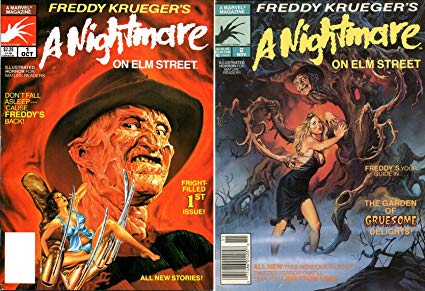
Let’s face it — Freddy was entering massive saturation, being on TV every week, appearing in a black and white Marvel comic book written by Howard the Duck creator Steve Gerber that was pulled after two issues due to internal concerns with its violent content, a video game from LJN (of course) and a line of toys that caused great controversy.
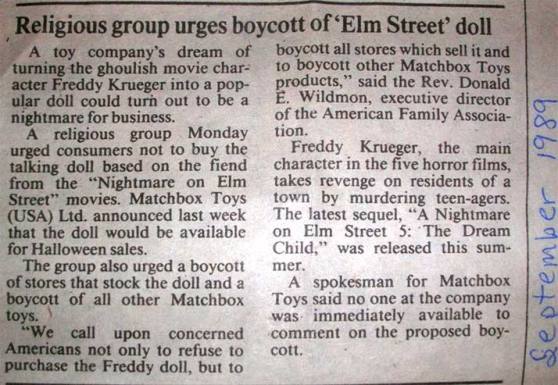
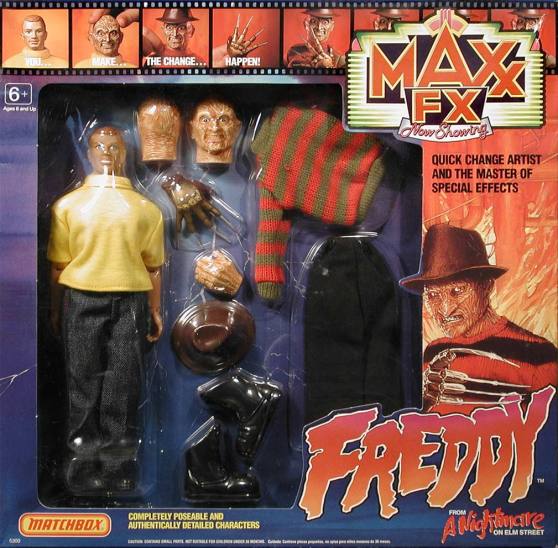
The Maxx FX line is one of sadness. Conceived by Mel Birnkrant, the creator and designer of toy lines like Outer Space Men and Baby Face.

Maxx FX was to be toys that had a special effects creator action figure as well as all of the costumes to make him into different monsters, from Universal classics to the Alien, Jason and Freddy. Check out the article on the creator’s site — where the videos and image above were taken — to learn more. I have the Freddy Maxx FX in storage, having found it for only $10 at a closeout store a year after it was to be released.

Thanks for indulging me on that trip to the memory lane section of the toy aisle. Let’s get back to the movies!
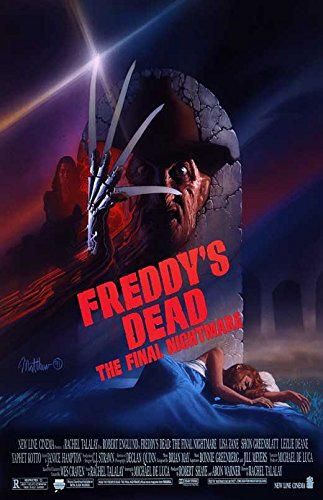
Freddy’s Dead: The Final Nightmare – 1991

Look, any horror movie that starts off with a Goo Goo Dolls song is just going to inspire my ire. But let’s try to be objective and not consider some of the better ideas for this sequel, including Jacob coming back to lead the Dream Warriors and a Peter Jackon screenplay where Freddy would stop being a threat and have the Elm Street kids even taking sleeping pills to screw with him.

Instead, this one starts ten years after where we left off, with Freddy having killed every single child from Springwood except for one teenager, John Doe. Waking up outside the city, he has no memories of why he’s there or even who he is.

He’s taken to a youth shelter, where he meets Spencer (Breckin Meyer), Carlos and Tracy (Lezlie Deane, 976-EVIL), who want to skip town. Part of Dr. Maggie Burroughs’ (Lisa Zane, sister of Billy) treatment is to take John to Springwood to cure his amnesia. The other kids all hide in the van and we’re off to the home of Freddy, just in time for John to have a nightmare and the van to wreck.

The abandoned house that the teens find turns into Freddy’s former home on 1428 Elm Street and we soon learn that Freddy has a child. After spending most of the film thinking John is the hero, he’s killed by Freddy, who reveals that he has a daughter.

Around here, Yaphet Kotto shows up and explains that he can control his dreams and how to defeat Freddy — drag him into the real world. If you’re screaming at your TV because this didn’t really work in the first film, you aren’t alone. And if Maggie being Freddy’s kid doesn’t hit you over the head with the sledgehammer of subtlety, then you just aren’t paying attention.

The last ten minutes of this movie — where Maggie goes into Freddy’s dimension to battle the dream demons that power him — were shot for 3D. Freddy gets blown up real good after Maggie gets off a kiss off line, saying “Happy Father’s Day!” Actually, no one feels good about this movie or this ending. Then again, the original theatrical version ran for 100 minutes while every home video release has run for 88, so obviously, big chunks were edited out of the film.

In the place of a decent tale, we’re given cameos by Johnny Depp, Tom Arnold, Roseanne Barr, Elinor Donahue and Alice Cooper as Freddy’s abusive father. That makes two 80’s slasher franchises that Alice has been involved with now.

This is the only Elm Street film to feature a female director — Rachel Talalay — and no female victims. Talalay would go on to direct episodes of Sherlock and Dr. Who, as well as Tank Girl.

Where can you take Freddy after all of these trials and tribulations? How can you make him more relevant? You have three choices, really. Go outside of the canon, a crossover or a remake. In the next chapter, we’ll discover how the Elm Street series would eventually do all three.

BTW — I figure this is a good place as any to mention some songs inspired by Freddy Krueger. Join me, why don’t you?

Also released on their album “Back for the Attack,” Dokken’s “Dream Warriors” is one catchy song and the entire reason I wanted to watch the third film. Don’t get me started or I’ll be singing it all day.

Prince Markie Dee of the Fat Boys Uncle Frederick has died and a lawyer claims that he has to spend one night in his haunted house to get his inheritance. If you ever wanted to hear Robert Englund rap, well, here you go.

Tracey Knight didn’t just star in The Dream Master, she’s also fond of singing this little ditty, which opens the movie.

Before Will Smith was a huge star, New Line actually sued him and his partner DJ Jazzy Jeff over this song and a planned music video, forcing a sticker onto all copies of their album “He’s the DJ, I’m the Rapper” stating that this “[This song] is not part of the soundtrack…and is not authorized, licensed, or affiliated with the Nightmare on Elm Street films.”

Stormtroopers of Death was a group made up of Anthrax’s Scott Ian and Charlie Benante along with former bandmate Danny Lilker and Billy Milano, who likes Freddy so much that his next band, M.O.D. would record “Man of Your Dreams.”

Former KISS guitarist Vinnie Vincent got into the Freddy action with this song and video from the fourth film. Man, how about the days when bands got budgets like this to produce music videos?

An album packed with dream related songs, both originals and covers, this also has Robert Englund doing intros to every song. They’re all redone by studio musicians, the Elm Street Group.
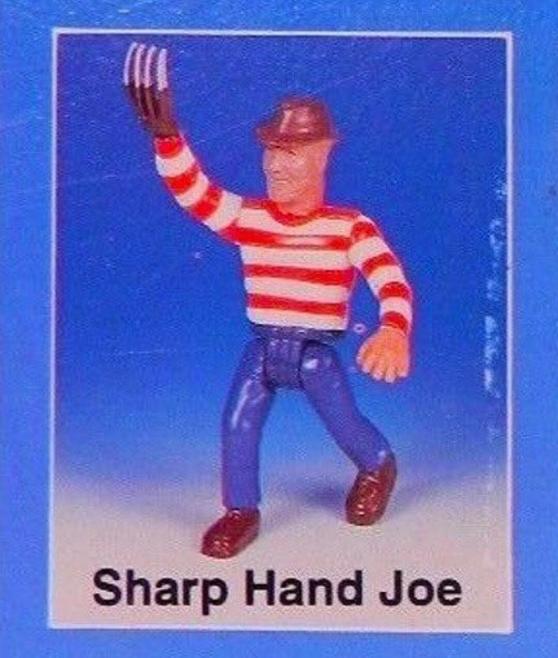
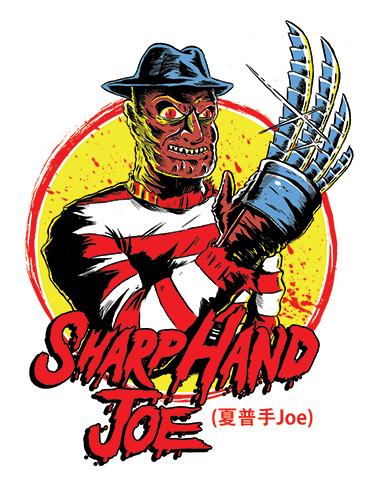
Finally, one more PS — the image for today’s Elm Street series comes from Sungold’s line of bootleg Monster toys. Their version of Freddy has an even better name: Sharp Hand Joe! You can even get a t-shirt of this from the awesome folks at Pizza Party Printing!
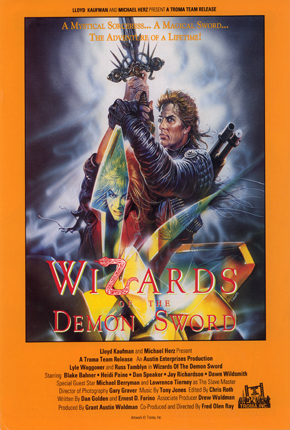
Wizards of the Demon Sword (1991)

My search for new movies leads me many places. Sometimes, you see the names Russ Tamblyn (Satan’s Sadists) and Lyle Waggoner (Love Me Deadly) and you say, let’s take a chance. And then you regret it in the way one regrets saying, “OK, just nine more slices of pizza.”

Lord Khoura (Waggoner) and Ulric (Tamblyn) have battled over the Blade of Aktar for years. Now, Ulric’s daughter Melina has enlisted a swordsman called Thane to get the sword and her father back.

There are exactly three reasons to watch this: Lawrence Tierney from Pulp Fiction as a slavemaster, Michael Berryman shows up and stop-motion dinosaurs.

According to director Fred Olen Ray, there were sets left over from Roger Corman’s The Masque of the Red Death remake. Before they were taken down, he wrote a film, hired actors and shot the film in four days, then shot Bad Girls from Mars in the day that he had left.

Make no mistake. This movie is a complete waste of time. And not even an interesting one. If anything, please use my painful time enduring this film as a warning to never suffer through it yourself. If you really want to watch it, it’s on Amazon Prime.

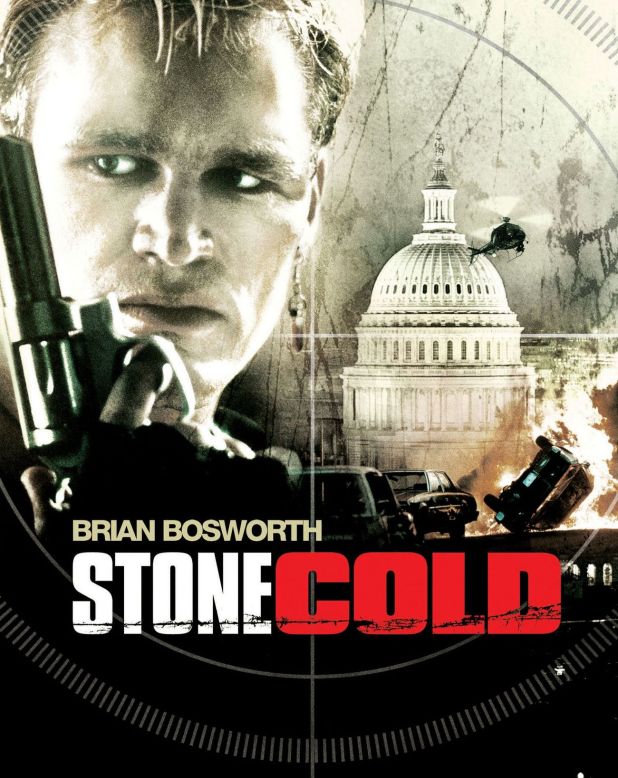
BIKER WEEK: Stone Cold (1991)

In the 80’s, Brian Bosworth was a big deal. A two time All-American with the Barry Switzer-coached Oklahoma Sooners, he wrote his autobiography during his first season with the Seattle Seahawks. Bosworth was a pro wrestler in real life, talking shit on the NCAA, publically claiming he would contain Bo Jackson (he didn’t) and trash talking John Elway so much that 10,000 Denver fans bought and wore “Ban the Boz” t-shirts. And those T-shirts? He manufactured and sold them.

Yep, Bosworth knew how to play the media game, even if his NFL career ended after three seasons. But what was next?

Acting. Of course! And the first film that Bosworth starred in was Stone Cold, a tough cop versus evil bikers epic.

Joe Huff (Bosworth) has been suspended for how rough he is on criminals. In fact, the film starts with him decimating several crooks that are robbing a supermarket. A government agent blackmails him into going undercover to stop a white supremacist biker gang, The Brotherhood.

The gang is led by Chains Cooper (Lance Henriksen, Near Dark), who is over the top insane. Just seeing the stuff the gang does in the opening montage will give you an idea of how amazing this film is going to be — they shotgun a priest through a stained glass window seconds into the start of the movie.

Joe becomes John Stone, but the rest of the gang doesn’t accept him. And his FBI contact Lance (Sam McMurray, Raising Arizona) is a germophobe who is really no help at all.

To finally be part of the gang, Joe/John has to kill a man. The FBI helps him fake the kill, but Chains’ top guy, Ice (William Forsythe, The Devil’s Rejects) still doesn’t believe in him. Luckily, a high-speed motorcycle chase leads to his death and our hero is in.

The gang has one goal: to kill DA Brent “The Whip” Whipperton, who has announced that he is going to become Governor of Mississippi and get tough on crime. They’ve stolen military weapons and plan on attacking the Supreme Court to save one of their own, the guy who killed that priest.

Joe/John falls in love with Nancy, Chains’ girl and offers her immunity if she cooperates. But then the man our hero had supposedly killed shows back up and the Brotherhood declares war on him. Chains takes the news that Nancy is cheating on him by shooting her, while he plans on putting a bomb on Joe/John’s body and dropping him from a helicopter onto the courthouse.

The gang manages to kill the DA, but our hero survives and kicks the shit out of Chains. Yet he is merciful and lets the man live. Bad idea — the villain grabs a gun and comes back for Joe/John, who is saved by Lance.

Stone Cold was originally going to be directed by Bruce Malmuth (Hard to KillNighthawks), but personal problems led to the backstory of Bosworth’s character being removed from the movie and Craig R. Baxley (Action JacksonI Come in Peace) taking over.

This movie is everything awesome about 80’s and 90’s action films and their cliches. Yet it’s even better, because you have Lance Henriksen writing all of his own dialogue, plenty of explosions, even more nudity, Bosworth’s impressive hair and outfits, and a fight scene between WWE’s one time heir apparent to Hulk Hogan, Tom Magee (seriously, he had a try out against Bret Hart that convinced everyone that he was going to be someone until everyone realized that Bret was the reason the match was so good) and Bosworth. And hey, how did Bosworth never get into pro wrestling, what with him coming from the same school as Steve “Dr. Death” Williams and being friends with Jim Ross?

I have no idea how this isn’t a movie that is treasured and celebrated by genre geeks, as is Patrick Swayze’s Road House. It’s such a time capsule of how one man captivated our attention and became a major star before disappearing.

You can grab it from Olive Films. And you definitely should.

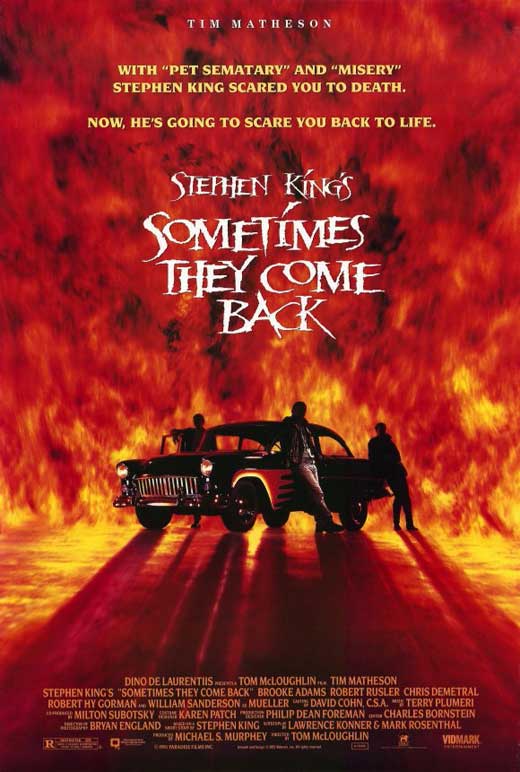
STEPHEN KING WEEK: Sometimes They Come Back (1991)

Originally airing on May 7, 1991 on CBS, this TV movie adaption of King’s short story was originally going to be part of Cat’s Eye. The story was originally published in Cavalier Magazine and is part of the short story collection Night Shift.

Jim Norman (Tim Matheson, Buried Alive) has moved back home to become a teacher, years after he watched his little brother Wayne get killed by a teen gang. Soon after, the murderers were killed by an oncoming train, but the nightmares have stayed with Jim for twenty-seven years.

One by one, his students kill themselves and the greaser gang returns from Hell. All Jim has to do is reenact the murder by killing the last surviving member of the gang Carl (William Sanderson, TV’s Newhart) and they will leave his family alone.

Jim wants to bring his brother back from the dead too and is trying to find a way to make it happen. He and Carl try to fool the gang, but their leader stabs Carl and Jim’s brother Wayne returns. The greasers try to escape again, but their car is struck by a ghost train. Wayne asks Jim to join him in heaven, but he decides to stay alive.

The book and novel differ greatly, with Jim’s wife Sally (Brook Adams, The Dead Zone) being killed by the gang and his brother Wayne being a demon that he calls for revenge.

Two sequels followed, Sometimes They Come Back…Again (which Becca recommends more than this film and I’ve been trying to buy her a copy, but it’s near impossible to find on DVD) and Sometimes They Come Back for More.

This is a decent film, directed by Tom McLoughlin, who also directed Friday the 13th Part VI: Jason Lives. It has all the trademark King tropes and moves quickly.

FULCI WEEK: Voices from Beyond (1991)

This is Fulci’s next to last movie, dedicated “to my few real friends, in particular to Clive Barker and Claudio Carabba.” At this point, Fulci was shooting TV movies and direct to video stuff, often lending his name to lesser directors.

Giorgio Mainardi lies dying, surrounded by his uncaring family, wondering why. He has an internal hemorrhage from an ulcer and nothing can be done. His daughter Rosie comes for the funeral and the reading of Giogio’s will, which has caused a family rift. Giogio’s stepmother refuses an autopsy. Giorgio’s father is on death’s door from a stroke. And Giogio’s stepbrother was having an affair with his third wife. It’s Fulci, the soap opera!

Giogio is rotting away in his coffin, but his spirit communicates with Rosie. At the funeral, everyone remembers the dead man and how he treated them. Lucy remembers that he hated how frigid she was. Mario remembers being humiliated. Hilda remembers how cheap he was. And Rita, his mistress, remembers him going back to his wife and cutting her off. In short, Giogrio loved — and was loved by — nobody. It gets worse — Rosie gets the entire will, but Lucy is allowed to stay in the house. However, there is no money for David, Lucy’s son who Giogio would not claim as his own.

An autopsy happens despite protests and the pathologist (hello, Fulci!) discovers the small intestines are damaged. And those intestines — kept for further observation — are destroyed.

Despite Hilda’s objections, an autopsy on Giorgio goes ahead. The pathologist (Lucio Fulci) takes a sample of his small intestines and discovers some lacerations to the interior wall. He puts the sample in a jar of formaldehyde for later inspection. A little later, Rosie and her college boyfriend Gianni (Lorenzo Flaherty) discover that the jar containing the organ pieces removed from Giorgio’s corpse has been “accidentally” smashed. But Gianni, a medical student with access to the pathology lab, tells Rosie that he’d found tiny splinters of glass in the intestines before the accident accrued later that night. He suggests that they go the police with their suspicions, but Rosie, who is now frequently and telepathically in touch with the spirit of her dead father, insists they investigate themselves rather than attract a public scandal.

After some twists and turns, Hilda is revealed to be the culprit, using David as her patsy. She created a game where he would use a mortar and pestle to smash up light bulbs and put them in Giogio’s ice cubes. However, instead of informing the police, Rosie tells the family that her father will haunt them for the rest of their lives.

There are plenty of gory dream sequences, a decomposing corpse and lots of blood being vomited. It’s not his best film, but it’s interesting. And definitely worth watching.

UPDATE: You can watch this for free with an Amazon Prime membership.

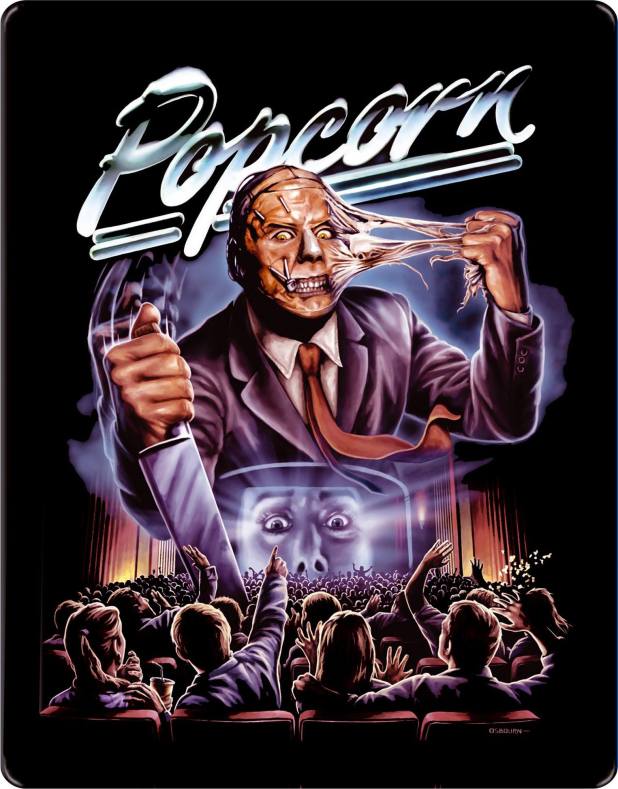
Popcorn (1991)

Sometimes, you end up loving a movie for what it could be way more than for what it is.

Popcorn would be one of those films.

Buried somewhere in its slasher framing story and four films within a film, there are some great ideas that should have been explored further. And the closer the film gets to its conclusion, the more it starts to explain itself. I’m more in the John Carpenter camp when it comes to too much information — I’m often just fine not needing to know every motivation of a film’s villain. To wit — I don’t need to know that Michael Myers made papier-mache masks to assuage his pain. I don’t even need to know that he’s a human being. I just want the story to thrill me.

Popcorn was filmed entirely in Kingston, Jamaica — which explains the later dance numbers. That’s right. Dance numbers. The more you watch this film, the more incongruous it becomes. The production was also fraught with changes, as Alan Ormsby was originally the film’s director, before being replaced by Porky’s actor Mark Herrier several weeks into filming.

Ormsby has a crazy bio — in addition to working with Bob Clark on Children Shouldn’t Play with Dead Things, Deranged and Death Dream, he also wrote Paul Schrader’s remake of Cat People and My Bodyguard. And strangely, he’s also credited with creating Kenner’s 1975 action figure Hugo: Man of a Thousand Faces!

At the same time, Jill Schoelen (The Stepfather) replaced original lead, Amy O’Neill. In fact, Schoelen barely was in scenes with the rest of the cast because so much had already been filmed, so she mostly appeared in reshoots! Even the title had something to do with a plot element that was edited from the final film, but the producers and distributor liked it so much, it was retained.

The film begins with Maggie Butler (Schoelen), an aspiring movie writer and college student, who has recurring nightmares that she is a young girl named Sarah. These dreams — in which a strange man stalks her — happen so often that she has an audio diary of them. Those very same dreams may or may not be connected to the prank phone calls that her mom Suzanne (Dee Wallace Stone, The Howling, E.T., Critters and many more) has been getting.

Sarah is also dating Mark (Derek Rydall, Eric from Phantom of the Mall: Eric’s Revenge), who tries to get her to come to his dorm room. She can’t — the script that she’s writing based on her dreams is more important. And so is the all-night horrorthon (JOIN US FOR THE HORRO-RITUAL!) that the school’s film department is putting on. It’s all Toby D’Amato’s (Tom Villard, who was one of the first 90s actors to openly admit that he was dying from AIDS) idea — with the goal of purchasing new editing equipment. NOTE: One assumes that Toby is named for Joe D’Amato, director of Emanuelle and the Last Cannibals, Antropophagus, Absurd, Troll 2 and the Ator the Fighting Eagle series, plus 200 or more films.

The kids convert the Dreamland Theater — due to be destroyed in three weeks — with the help of Professor Davis (Tony Roberts, Annie Hall, Amityville 3-D) and a quick cameo from Ray Walston as Dr. Mnesyne, the provider of the props that will go with the films.

Ah, those films — these movies-within-a-movie provide the best part of Popcorn. They are:

Mosquito: This 3-D film is a tribute to nature gone wild and nuclear terror movies of the 1950s. Even better, it pays tribute to Emergo, the technology (well, as far as sliding a skeleton down a rope can be called technology) that William Castle used to gimmick up The House on Haunted Hill.

The Attack of the Amazing Electrified Man: A callback to films like The Amazing Colossal Man, while at the same time it’s a nod to German expressionistic camera angles (certainly an odd blend). There’s a great scene here where the Electrified Man battles a gang of greasers armed with switchblades. There’s another gimmick here called “Shock-o-Scope” which is another tribute to William Castle and his film The Tingler.

The Stench: This is obviously a dubbed Japanese film, ala The Green Slime, but with the added gimmick of Odorama. There have been actual movies that use this technology, such as Scent of Mystery and, more dear to this author’s heart, John Waters’ Polyester.

Possessor: Found within Dr. Mnesyne’s — his name translates as memory — equipment, this short film is the most interesting part of Popcorn. It’s supposed to be a snuff film made by a Mansonesque cult of acidheads, but it looks and feels like something straight out of José Mojica Marins’ oeuvre (known as Coffin Joe, he’s made some of the strangest and best-titled films ever, such as At Midnight I’ll Take Your Soul and This Night I Will Possess Your Corpse). Seriously, this strange little film, in which a voice just says “possessor” over and over and over while blood fills the screen is awesome. If only the rest of the film — and one scene I’ll get to shortly — had been as imaginative and odd as this, we’d have a real winner on our hands.

Just by watching Possessor, Maggie passes out and has another nightmare. Upon awakening, Professor Davis informs the class that the film comes from Lanyard Gates (Bruce Glover, father of Crispin Hellion Glover), the leader of the aforementioned cult who ended his final film by killing his family onstage while the theater burned down in flames around the audience. There were no survivors and no explanation for why the film survived.

As Maggie grows more and more obsessed with the film, her mother becomes upset, telling her to just quit the film festival. That night, her mother gets a call from Lanyard Gates, telling her to meet him at the festival and to bring a gun.

The next day, when Maggie mans the box office, a man buys a ticket and calls her Sarah. She freaks, thinking it’s Gates. Meanwhile, just as the Professor is about to launch the mosquito prop during the film cue, a shadowy figure takes control of it, impaling him. Then, we see the same figure making a mask of the dead man’s face.

Oh yeah — Maggie’s mom shows up to the theater with a gun and in the best scene of the film, Gates takes over reality, transforming the marquee to read “POSSESSOR.” That said — this scene has NOTHING to do with the rest of the film, as our villain has no such psychic or reality warping powers.

No one will believe Maggie’s story and the films continue. A student named Tina (Freddie Marie Simpson, who along with Megan Cavanagh and Tracy Reiner, appeared in both the movie and TV series A League of Their Own) has been having an affair with the Professor, whose doppelganger kills her and then uses her body to electrocute wheelchair bound Bud while he sets off the buzzing seats during the next film.

When Maggie finds his body, she runs into Gates and has a flashback. Turns out that she’s really his daughter, Sarah Gates and Suzanne is not her mother, but her aunt who saved her. She tells all to Toby, who turns out to not be Gates, but his imitator. He was badly burned at the only showing of Possessor and holds Maggie and her aunt responsible. He prepares them both for his final act…of murder!

While setting up the Odorama, Leon is killed by Toby (but not before he pees all over him), yet he stops from killing Joanie when she confesses her unrequited love for him — an odd choice for a slasher film.

Whew. There are so many unnecessary characters and extra girlfriends and weird asides like a landlord who wants to be an actor which, honestly, take away from the film. Long story short, Toby reenacts the end of Possessor to the jeers of the crowd, revealing his full face — a gruesome visage of wires and burned flesh. Luckily, he’s killed by the Mosquito prop just in time to save everyone — which is either a cheap repeat or a previous kill or a sly comment on sequels. Let’s go with the former. That said — it has a really nice pre-Go Pro mounted camera effect as Toby dies, but not before hearing the cheers of the crowd.

Honestly, Popcorn is a mess. But it’s an enjoyable mess. It’s simultaneously a tribute to 1950s black and white gimmick films while attempting to be meta commentary on the slasher genre, with none of the teeth of a film like Scream. There are ridiculous parts, like death by toilet and a way too long musical number where a reggae band plays while a cosplay heavy crowd dances and Toby going from quiet kid to Freddy Krueger clone in the too quick conclusion to the tale. Throw in a balls out bonkers end song — “Scary Scary Movies” — that features lyrics like “psycho on the move got a blade two feet long, kisses for his wife while he slices the bitch….so long!” screamed at the top the rapper’s lungs and you have something worth watching.

As an aside, the rapper Kabal has been doing entire albums of cheesy rap songs from horror movies. He even covered the theme from Popcorn!

There’s a heart and inventiveness to the film. There’s a real love for movies in here, particularly the fun promotional style of William Castle. It’s definitely worth a watch, as the 90 minute or so runtime practically flies by. And while this film was impossible to find for years, Synapse Pictures has finally released a Blu Ray, so no need to buy bootlegs!

This article originally appeared in Drive-In Asylum.

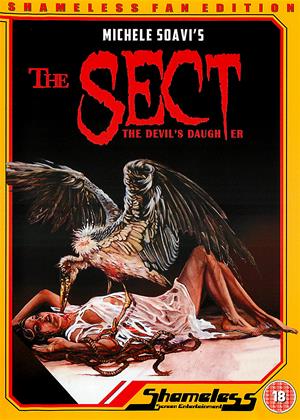
The Sect (1991)

Between Ed Sanders’ book The Family — which examines the origins of Manson’s Family — and Maury Terry’s The Ultimate Evil — which suggests that a worldwide network of Satanists is responsible for the Manson family and Son of Sam murders, we’ve come to accept the notion of an organized army of evil. But who are they?

In the revised 2002 edition of The Family, Sanders referenced the Process Chuch of the Final Judgement as the “satanic group of English origin” behind these killings. The Process successfully sued Sanders’ publisher to remove this reference.

That said the die was cast. By 1980, books like Michelle Remembers suggested a deep conspiracy of Satanic ritual abuse. The Satanic Panic of the 80’s found sacrifice and worship around every corner. Perhaps the author you’re reading now was targeted. Yet no real evidence has ever been found.

Michele Soavi’s The Sect concerns that network of Satan as they prepare the way for the Antichrist. From a commune being slaughtered in the early 1970’s — a scene with references to the Rolling Stones that repeat throughout the film — to multiple modern murders that follow, including a heart being left on a train and a suicide in public, the devil’s helpers are organized, know how to plan and are well ahead of the rest of society.

Just a note — as cheesy as Sympathy for the Devil reads today — The Rolling Stones were at the forefront of the occult 60’s thanks to their association with Kenneth Anger.  If you’re interested in learning more, I’d heartily recommend Gary Lachman’s Turn Off Your Mind: The Mystic Sixties and the Dark Side of the Age of Aquarius.

But let’s get back to The Sect. In modern Germany, schoolteacher Miriam Kreisl (Kelly Curtis, sister of Jamie Lee) saves Moebius Kelly (Herbert Lom, Hammer’s The Phantom of the Opera) after an accident and brings him back to her house. Within a few hours, he’s injecting her and shoving beetles up her nose while she sleeps and giving her nightmares of a giant bird having sex with her.

From there, the film descends into more of a series of nightmares than a fixed narrative. That makes sense once you realize that its origins in three different scripts that producer Dario Argento, director Michele Soavi and writer Gianni Romoli couldn’t finish. So you’re left with a film with a giant glowing blue gateway to Hell in the basement, a plot to conceive the Antichrist much like Rosemary’s Baby, an evil Shroud of Turin that can kill and bring people back from the dead and, oh yeah, a super smart rabbit named Rabbit who can use a TV remote.

The Sect has some references to other films, with the first victim being named Marion Crane (Psycho) and another named Martin Romero (obviously, George Romero and his Braddock vampire film Martin).

Following Soavi’s Stagefright and The Church, this film offers less of the pure insanity that he’d bring to bear in his next film (and sadly, final horror film) Cemetery Man. Yet a restrained Soavi is still more visually inventive than a hundred lesser directors. From images of animal-masked children to the evil Jesus that smokes up and annihilates hippies in the flashback, there’s a continual undercurrent of menace and doom.

Strange symbols just appear. People disappear even after we see them arrive. Or they die in airplane accidents and still appear. Kathryn (Mariangela Giordano, Evelyn from Burial Ground, she of the incestual zombie child relationship) shows up to get smothered by the previously mentioned evil shroud. Worms show up in the water. A possessed Kathryn convinces a trucker to kill her. Rabbit symbolism abounds. Kathryn gets back up off the operating table and attacks Miriam before killing herself again, which a doctor tries to explain as a commonplace thing. Long black tunnels lead to a sinister mortuary. The doctor who couldn’t save Kathryn and Damon, the Jesus-like killer from the opening, are working together. A woman’s face is ripped clean off, Hellraiser-style. Even trusted detective Frank is taken over and wants to kill Kathryn now that he knows her secret. Whew. I hope these short bursts of words give you an idea of just how much happens in this movie. It never really lets up, becoming more and more unreal.

Moebius comes back to life to tell Miriam that every moment of her life has been planned, that they own her, that everything has been for this moment of indescribable joy. The cult gathers as the doctor injects her, sending her to sleep.

Finally, the devil comes to take Miriam. In shadow form, he appears to be human, but what attacks her is a giant bird that pecks at her neck and has his way with her. The cult lowers her into a pit as Moebius raves, screaming that he is her father and that she will give birth to the Antichrist. As she waits in the blue basement water, midwives swim around her, facilitating the birth as the moon slowly goes dark.

A giant amniotic sac with a child inside is lifted as the moon goes completely black.

In a shot straight out of Rosemary’s Baby, Miriam moves through the crowd to see what Moebius refers to as their “revenge against God.” He offers her the chance to raise the child.

Cut to her kneeling, beatific in white, as she stares into the blue waters of the well below. The doctor attempts to be tender to her, but Miriam tosses her down the pit.  She makes her way to the rest of the cult and accepts her child, running with it as a motorcyclist chases her and crashes, creating a giant wall of fire.

Moebius screams that they are ger family now. Miriam kneels into the flames of the crashed motorcycle and sacrifices herself to destroy the baby and Moebius.

Fire crews put out the bodies as we see their charred remains wash away — except Miriam is still alive under all of the ash. An eagle circles the sky as Miriam believes that her son saved her.

The Sect is crazy, but it still doesn’t feel as strange as The Church or Stagefright. Yet again, when compared to any other film, it’s odd as hell. It flies by, a mix of imagery and ideas that takes you on a whirling dervish of a ride. It’s hard to find — Shameless put out a UK only DVD this year — but there are plenty of not so legal ways to find a copy. I’d recommend that you do so.

UPDATE: You can get The Sect from RoninFlix.