Disciples of the Crow (1983)

A year before Children of the Corn was released, director John Woodward took Stephen King up on his offer to film makers and independent filmmakers. He’d allow them to adapt any of his short stories for just $1*.

Originally appearing in March 1977 issue of Penthouse before it was printed in the short story collection Night Shift, this is the story of the darkness in a small town, particularly the cornfield.

Taking place in Jonah, Oklahoma instead of Gatlin, Nebraska in the novel, this version of the story shows more of the events that take place before a couple on the edge of divorce roll through town.

Made for a sliver of the budget afforded the Hollywood version and with around a third the running time. Disciples of the Crow is an effective slice of horror made by folks from around the very same region where the story was set. It also changes the film and instead of trying to explain exactly why things went so wrong, it takes a more chilling approach: who knows why things happen?

Woodward also appears as Bobby, the adult leader of the children who is a mix of the characters Isaac and Malachai.

I’m always a big fan of smaller budget affairs that take place in broad daylight. This would be a great example.

*Other King $1 shorts include Jeffrey C. Schiro’s The Boogeyman — not the 1980 Ulli Lomme slasher — and Frank Darabont’s The Woman in the Room.

You can watch this on YouTube.

Still Smokin (1983)

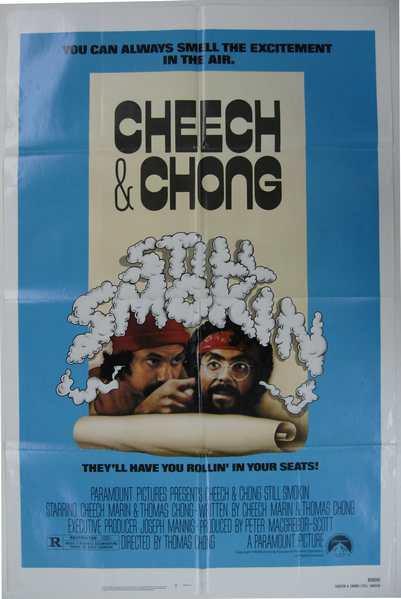
As Cheech and Chong would make their fifth movie in five years, they went back to the routines that had made them stars on their old comedy albums, with a story that they were in Amsterdam for a Burt Reynolds and Dolly Parton festival, with the promoters believing that Cheech is Burt.

After a series of skits, including a parody of The Harder They Come, the last twenty minutes of this movie is concert footage from Cheech and Chong’s show at the Tuschinski Theatre.

Susan Hahn, who played the hotel maid in this, was only in one other movieMassacre in Dinosaur Valley, which is a very strange film trajectory. You can also look out for cameos from Kay Parker (yes, from Taboo), Linnea Quigley (her second Cheech and Chong appearance) and Victoria Wells (in her third Cheech and Chong appearance; she’s the woman who discovered the body of Bob Crane).

I can be honest and say that this is not the team’s finest work, but as films made to fulfill a contract or get a free trip to Amsterdam go, it’s not the worst.

THE EXCELLENT EIGHTIES: Savage Journey (1983)

This movie made this entire month worth it.

That’s because it unlocks another part of the saga that is my fascination with the utterly strange and mysterious Night Train to Terror, a movie that I have written about more than once.

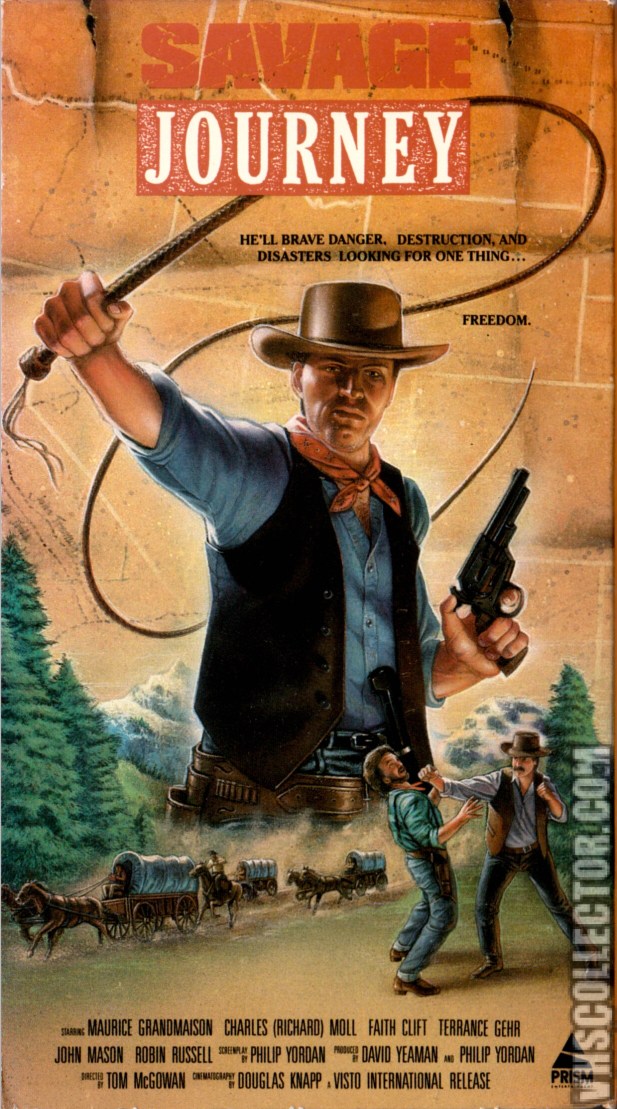
While this movie is listed on IMDB as a 1983 made for TV movie, the truth is that this movie was originally released six years earlier as Brigham. I love this comment on the movie from Mormon Literature and Creative Arts, which stated that the film came about as David Yeaman wanted to “create a film billed as authentic and sympathetic to the LDS view. Top Hollywood brass was involved, primarily Oscar-winning screenwriter Philip Yordan, and the LDS public grew excited to finally see themselves depicted accurately on screen.”

Oh man. Let’s take a break from this quote just to remind everyone who Phillip Yordan was. In The Phillip Yordan Story, a Hollywood urban legend is just part of his legend. It was claimed that Yordan hired someone else to go through law school for him so that he could get a degree without doing the work.

While Yordan is the listed writer on nearly a hundred movies, including DillingerDetective Story and Broken Lance*, the jury is out on what films he actually wrote. Some believe that many of the movies he wrote were actually a front for blacklisted writers, who still wanted to make films, giving Yordan all the credit and half the paycheck.

In the late 1950s, Yordan finally got caught. He mixed up two scripts, delivering a Fox script to Warner Brothers and vice versa. Seeing as how he was under contract at Fox, Darryl F. Zanuck threatened to get him blackballed at all the major studios. A few years later, his secretary would claim that she was the real writer of The Rise and Fall of Legs Diamond and things got so bad that Columbia demanded that he have an office on their lot where they could watch him write, guaranteeing that he was the author. Despite this new contract, he was still hustling scripts at other studios and was fired and forced to return his paycheck. This time, he really was told you’ll never eat lunch in this town again.

Yordan then showed up in Spain, working for Samuel L. Bronston, using folks like Ray Bradbury, Ben Barzman Arnaud D’Usseau, Julian Halevy and Bernard Gordon, who really wrote The Day of the Triffids, not Yordan.

By the mid 60s, he was back in Hollywood, a survivor of everything from being blackballed to going bakrupt, working as a script doctor on movies like Horror Express — also a horror movie set on a train — and Psychomania.

At the end of his life, he worked as an adjunct screenwriting instructor at San Diego State University and was writing scripts for movies like The UnholyMarilyn Alive and Behind Bars (which is also part of Night Train to Terror), Cataclysm (ditto), Cry Wilderness and this movie.

Back to our friends at Mormon Literature and Creative Arts, who wrote that “Unfortunatley, when released, Brigham proved a critical fiasco. It was criticized for poor acting, incomprehensible chronology, sensationalized violence, incredibly poor casting, lack of dramatic focus, and even for recycling wagon train footage from earlier films like Brigham Young itself. The film was quickly withdrawn, reedited, and re-released early the following, billed as The New Brigham. Similar attempts at repackaging continued as it was apparently again revamped and christened Savage Journey a few years later (perhaps to parallel the 1983 handcart film Perilous Journey). Despite this, Brigham remained a critical flop, and modern Mormons, if they remember it all, do so with humor or derision.”

Yes, this was a movie that Yordan made specifically for the Mormon Chuch and along the way, he brought director Tom McGowan, who — yes, you got it — also directed Cataclysm, and Richard Moll, who would star in that film and Marilyn Behind Bars. Seeing as how both movies are segments in Night Train, it gets really disconcerting watching Moll have hair, not have hair and be played by a double with astoundingly hairy arms.

Other actors who appear in both films include Maurice Grandmaison, who plays Brigham Young himself and Papini, the homeless Catholic priest who attempts to help the heroine Claire Hansen; Stephen Cracroft, Phineas in this one and a first AD on Night Train; Lou Edwards, Brother Becker in Mormon times and a production manager on Night Train; Faith Clift, who was Claire Rudley in this movie and appears as Claire Hansen in Night Train (she was also Yordan’s wife, showing up in his movies Captain ApacheHorror Express and Cry Wilderness); an uncredited Marc Lawrence (yes, the very same man who made Pigs and appears in Night Train as Abraham Weiss) and most importantly, Yordan’s son Byron, who is the song and dance man doomed to die on Satan’s Cannonball, but not before he sings “dance with me, dance with me” more times than you can count.

I’m astounded that this film exists. Actually, I’m so into the fact that Yordan did, a flimflam man who claimed to have never read a newspaper before the age of fifty, yet somehow was a lawyer who became an Oscar-winning writer, a producer and the connection between so many movies that are just plain strange.

So how’s the movie?

Moll, who used the named Charles Moll for this film, sums up Savage Journey best in the movie The Work and the Story, saying “All independent films suck, all Mormon films suck, and, ergo, an independent Mormon film must royally suck.”

*A movie he won an Best Original Story Oscar for, despite it being a remake of 1949’s House of Strangers and the fact that he probably didn’t write a single word of the actual script.
THE EXCELLENT EIGHTIES: Somewhere, Tomorrow (1983)

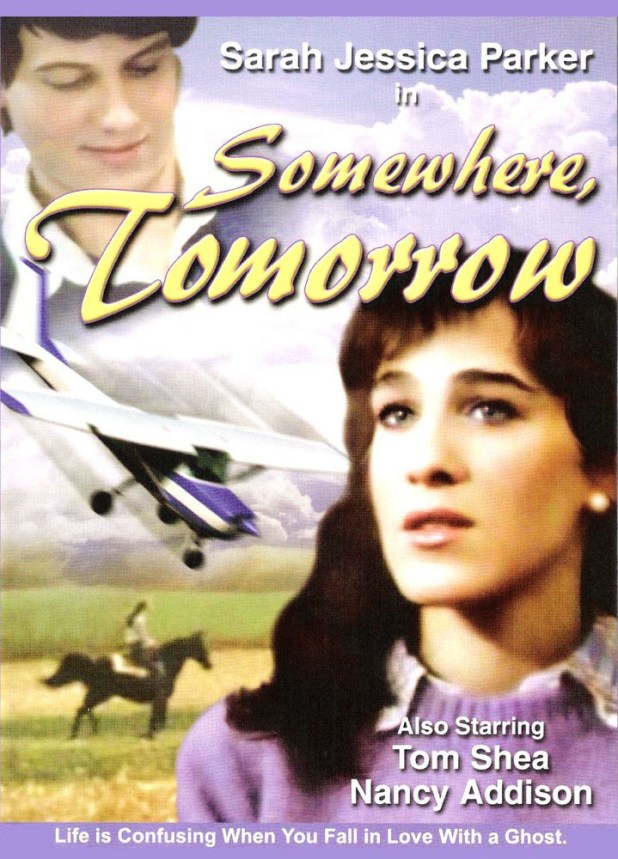
A very young Sarah Jessica Parker — this was made right after Square Pegs went off the air — plays Lori Anderson, a girl who has lost her father in a plane crash. While her mother is moving on — she’s selling the family farm and hooking up with the local lawman — Lori is lost. She turns to her father’s esoteric journals for answers.

Meanwhile, Terry Stockton, a client coming to purchase a horse from Lori’s mother, dies in a plane crash. Somehow, Lori is able to see and touch him. She believes that she can help him cross over to the next plane of existence, if she doesn’t fall in love with him first.

Wrier/director Robert Wiemer also made the supernatural film Anna to the Infinite Power and The Night Train to Kathmandu, another movie where a young girl comes of age. I guess that’s his bread and butter.

This also features a really young Elisabeth Shue and has a ghost who likes to take showers, which I did not realize was a thing. Also, spoilers and all, but speaking of showers, this totally has a Patrick Duffy ending.

So yeah. Some people cover Sundance and I write about Sarah Jessica Parker as a horsegirl who has near shower sex with an apparition. I accept my role.

You can watch this on Tubi.

THE EXCELLENT EIGHTIES: Saigon Year of the Cat (1983)

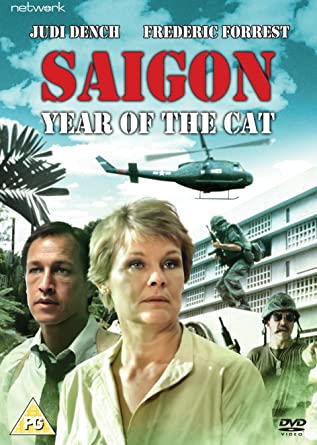
At the end of 1974, as American forces withdraw from Saigon, only a few CIA advisors remain. In this strange end of the war era, one of those advisors named Bob Chesneau (Frederic Forrest, who was in another better known Vietnam movie, Apocalypse Now) is having an affair with a bank analyst, Barbara Dean (Dame Judi Dench).

Written by David Hare (The Hours) and directed by Stephen Frears (Dangerous Liaisons, High Fidelity), this Thames Television film also has a strong cast with E.G. Marshall (Creepshow), Wallace Shawn (The Princess Bride), British comedian Chic  Murray, Manning Redwood (The ShiningShock Treatment) and Josef Sommer (Witness).

It’s pretty amazing the places that Hare and Frears went after this movie, which doesn’t show much of the promise that they would later display. But here it is, one of the many British made for TV movies that are all over this giant brick of a Mill Creek collection.

You can watch this on YouTube.

THE EXCELLENT EIGHTIES: Vladukt (1983)

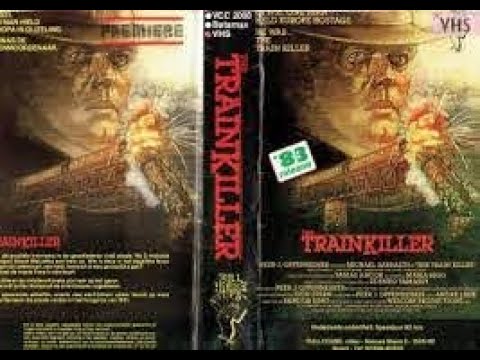
Based on a true story of Szilveszter Matuska, who said  “I wrecked trains because I like to see people die. I like to hear them scream.”  Yes, the man literally orgasmed when he wrecked trains, including his most brutal crime, when he killed twenty-two people and injured a hundred and twenty when he derailed the Vienna Express with dynamite, sending the engine and nine of the eleven coaches to plunge down a hill.

Matuska reportedly escaped from jail in 1945. He may have served as an explosives expert during the latter stages of World War II. No one is sure, as he was never recaptured. Some believe that he served on the Communist side in the Korean War.

Michael Sarrazin plays him in this Hungarian/German made for TV movie directed by Sándor Simó. Somehow, Sarrazin has been in two movies I’ve watched this week.

While history claims — as stated above — that Matsuka only really achieved bliss thanks to train destruction, he sure gets a lot of action in this movie. I think what happened after — even if the film only guessed at what happened — would have made for a better movie.

The band Lard recorded a song about Matsuka in which they sang:

Remember this:
No matter how many books you ban
No matter how many records you burn
The seeds of fertile fetishes
Are planted at an early age
And somewhere out there
Someone amongst you
May at this very moment lust
For derailing trains

THE EXCELLENT EIGHTIES: A Minor Miracle (1983)

After everyone took the Mill Creek picks that they wanted, I jumped in and picked up the stragglers, the survivors, the movies no one else wanted to watch.

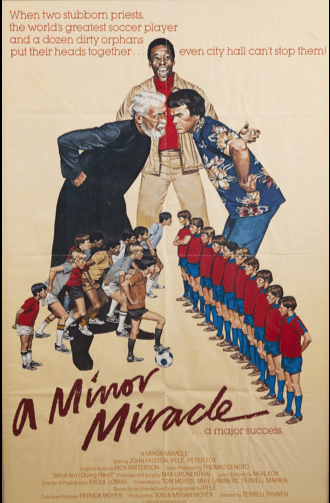
A movie with a bunch of orphans who turn to John Huston as a kindly priest and the game of soccer to save their orphanage? Why would anyone have picked anything else? And an appearance by Pele? What is wrong with all the other writers on this site?

Director Terrell Tannen edited The Boogeyman and The Boogeyman II, which was really like only directing one movie if you’ve seen the second one. He also produced, edited and second unit directed Olivia, which is one of the strangest movies I’ve ever seen. I have no idea how this prepared him to make a religious soccer movie.

Between this and Victory, I have now seen two soccer movies with Pele in them. And John Huston too, now that I think about it.

THE EXCELLENT EIGHTIES: Intimate Agony (1983)

Somehow, the Excellent Eighties set has taken a break from showing us the best, the worst and the somewhere in between of Crown International Pictures to take us back to the days of made for TV movies, a place that this site knows all too well.

Originally airing March 21, 1983 and also known as the sexier title Doctor In Paradise, this is all about a young doctor named Dr. Kyle Richards(Anthony Geary) who is managing a doctor’s office in the Hamptons.

That sexy title is not so appropriate because this is a movie all about the heartbreak of herpes, which was the worst thing that could happen in 1983. Dr. Kyle decides to go public with the news that this town is getting more than just cold sores.

Most of the fun of this movie comes from spotting the stars amongst the cast, like Who’s the Boss star Judith Light, NCIS protagonist Mark Harmon, Robert Vaughn and Shawn Schepps, who went on to write Encino ManSon In Law and Drumline. Did you know they made a TV movie sequel to Encino Man called Encino Woman? Yep. They sure did.

You know who taught me about herpes? Paul Bartel. I think I did OK.

You can watch this on YouTube.

Panic Beats (1983)

EDITOR’S NOTE: R. D Francis first covered this for our site on June 26, 2019. I think it may have actually been the first thing he contributed. I’m excited to watch the new Mondo Macabro release of this, which is a great reason to cover this film for the site. 

In case you didn’t guess from all the films of his we’ve covered, we kind of love Paul Naschy around here.

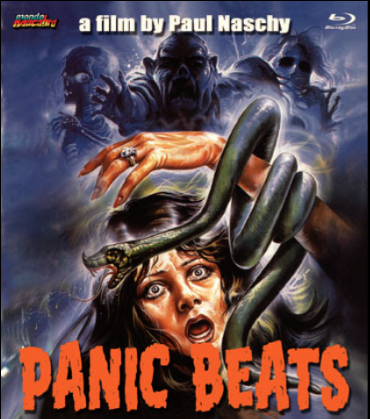
Sort of a sequel and a remake of 1973’s Horror Rises from the Tomb, this Naschy effort was written and directed under his real name, Jacinto Molina. Naschy also brings back the same role he played in that movie, Alaric de Marnac.

Within moments of the film starting, Alaric is already chasing women down while in horseback and caving in their skulls with a mace. Fast-forward a few hundred years and we meet Paul Marnac (also Naschy), who brings his infirm wife Geneviève (Night of the WerewolfThe People Who Own the Dark) to his family’s ancestral home. Of course, you know that this home was built above the ruins of Alaric’s castle and that Marnac’s ancestor comes back every hundred years or so to ruin his relatives’ lives, starting with scaring Marnac’s wife literally to death.

Or was it all a ruse? Did Paul really just want to get with his younger lover Mireille all along? Is Paul also sleeping with the maid’s niece Julie? Is Alaric real and coming for everyone? Yes, yes, yes and oh yes, just wait until the absolutely gore-drenched last ten minutes,

Somehow, this movie goes from a twist and turn tale of lovers getting people out of the way to a Fulci-level splatterfest by the end of the film. Bravo!

Also, if you love the body of Naschy — and I know who you are and I think you do — he’s nude in a bathtub for your viewing enjoyment.

Naschy also played Marnac in The Devil’s Possessed. Most people would worry about typecasting. Not Naschy — he also played the werewolf by night Count Waldemar Daninsky twelve times in his career.

Mondo Macabro’s blu ray release has a new 4k transfer from a film negative, making this movie sparkle. I’m used to seeing Naschy in the grainiest of quality. This is really something else. It also includes two interviews with Paul Naschy and audio commentary from The Naschycast (Troy Guinn & Rod Barnett).

You better believe that this movie has my absolute recommendation. If I came to your house and it wasn’t in your collection, I would silently judge you.

You can now order the all-region Blu-ray of Panic Beats from Mondo Macabro or through Diabolik DVD.

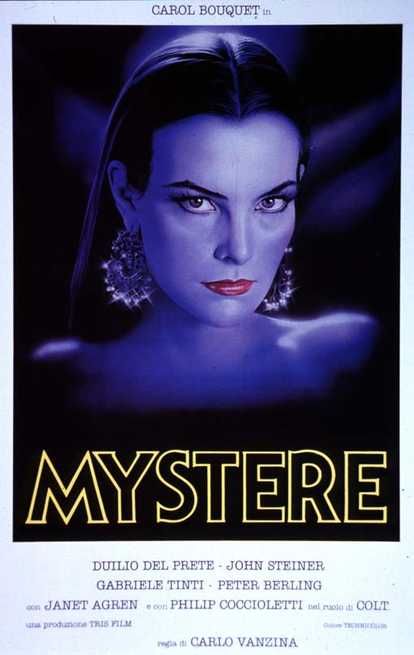
Mystère (1983)

1983 is pretty late for the giallo, but hey — I’ve been trying to expand into the period before and after the major years for the genre.

Also known as Dagger Eyes and Murder Near Perfect, this film was written and directed by the Vanzina brothers, Carlo and Enrico. They loved the 1981 French thriller Diva, a film that moved away from the realist 1970s French cinema to the more colorful style of cinéma du look.

Mystère is divided into chapters, starting with a prologue, then each section is one of the four days that follows, then an epilogue. The producers demanded this happy ending, while the brothers wanted something more cynical.

Mystère (Carole Bouquet, For Your Eyes Only and the face of Chanel No. 5 from 1986 to 1997) is a high class call girl in Rome who comes into the possession of a mysterious lighter when her friend Pamela (Janet Ågren, City of the Living Dead) and one of her customers are killed over it, as inside the lighter are images of a political assassination.

Unlike the normal giallo — or adjacent giallo or whatever this is — the hero, Inspector Colt, ends up killing the assassin (John Steiner, Shock) and his bosses and then leaves behind our heroine, who ends up tracking him down to Thailand and making up with him. He was good with nunchucks, maybe?

I mean, how many movies are you going to see that somehow take the spirit of the good parts of 1970’s giallo, mix in the Zapruder film, throw in some Eurospy and still end up looking like a super expensive perfume ad?

Also — thanks to BodyBoy on Letterboxd who called out that Mystère’s apartment looks like something straight out of Messiah of Evil.

You can watch this on YouTube.