FVI WEEK: Race for the Yankee Zephyr (1981)

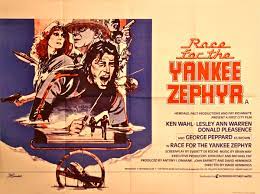
Directed by actor David Hemmings and written by Everett De Roche (Patrick, Harlequin, Link), Race for the Yankee Zephyr is the tale of a World War II-era plane found in the mountains of New Zealand by Gilbert Carson (Donald Pleasence), who runs the hunting lodge with his daughter Sally (Lesley Ann Warren) where Barney Whitaker (Ken Wahl) is visiting.

Once the locals learn that there could be money in the plane, Theo Brown (George Peppard) leads a gang of men who want to take the treasure and get rid of Carson. The money they are after includes a shipment of gold war medals, Christmas mail correspondence, a crate of 100 bottles of Kentucky-made Old Crow bourbon whiskey, 1000 gold-bars in gold bullion and the entire payroll in cash for the American South Pacific Fleet which adds up to $15 million in the film and adjusted for inflation, that would be $50 million in 2024.

Richard Franklin was the original director, but after the cast didn’t have enough Australia actors — three Americans and a British one had the lead roles — it couldn’t get a permit to be shot there. The producers took the film to New Zealand and Hemmings came on. After he was behind schedule directing, Brian Trenchard-Smith was brought in as a potential second unit director. As this was an implied threat of replacement, Hemmings finished the movie on time. He also directed The Survivor that same year.

It’s also the reason why Donald Pleasence wasn’t in The Thing as this went over schedule.

You can watch this on Tubi.

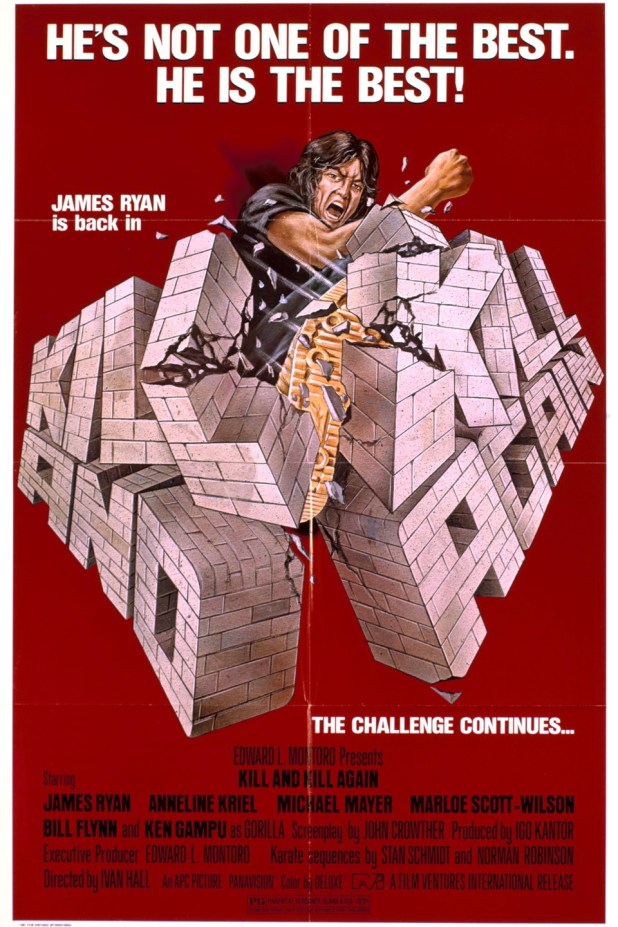
FVI WEEK: Kill and Kill Again (1981)

Kill and Kill Again is a sequel to the film Kill or Be Killed and tells another adventure of Steve Chase (James Ryan), a secret agent martial artist who has been hired by Kandy Kane (Anneline Kriel, whose life should be a movie, between having singer Richard Loring writing the song “Sweet Anneline” about her, followed by nude photos she took for his friend Roy Hilligenn being leaked — in 1977 — as well as being present when boyfriend Henke Pistorius — father of Oscar Pistorius, the legless South African athlete who would shoot and kill his girlfriend — shot himself while cleaning his pistol, as well as a singer and Playboy South Africa cover girl, as well as Miss South Africa 1974 and was later crowned Miss World 1974) to find her father Dr. Horatio Kane (John Ramsbottom), a scientist who has learned how to control minds while trying to turn potatoes into an energy source.

Yes, if you thought Kill and Kill Again would be normal, oh no. Oh no.

The government gives Steve $5 million dollars to pick his own team of super agents, which includes former martial arts champion Gypsy Billy (Norman Robinson), the mystic mystery man who only answers to The Fly (Stan Schmidt, a South African master of Shotokan karate), the goofball Hot Dog (Bill Flynn) who when we first meet him is challenging men to stand in a room while he shoots bullets at them and the former pro wrestler and now construction worker gorilla (Ken Gampu, King Solomon’s Mines).

They’re sent to stop Wellington Forsyth III, a billionaire who has now become Marduk (Michael Mayer), who has taken over the town of Ironville and is looking to create an army of warriors to take over the world. He has wanted Steve to come to challenge his champion, The Optimus (Eddie Dori), an unstoppable fighter.

Yes, in the world of South African martial arts, white men are the greatest fighters in the world.

In the commentary track for this movie, James Ryan said that the third film would have been called Most Dangerous Man and had him appear opposite Sharon Stone. However, FVI went out of business and he headed back to South Africa.

This comes from the same director, Ivan Hall, and was written by John Crowther, who also wrote The Evil That Men Do, Missing In Action and Hands of Steel.

You can watch this on Tubi.

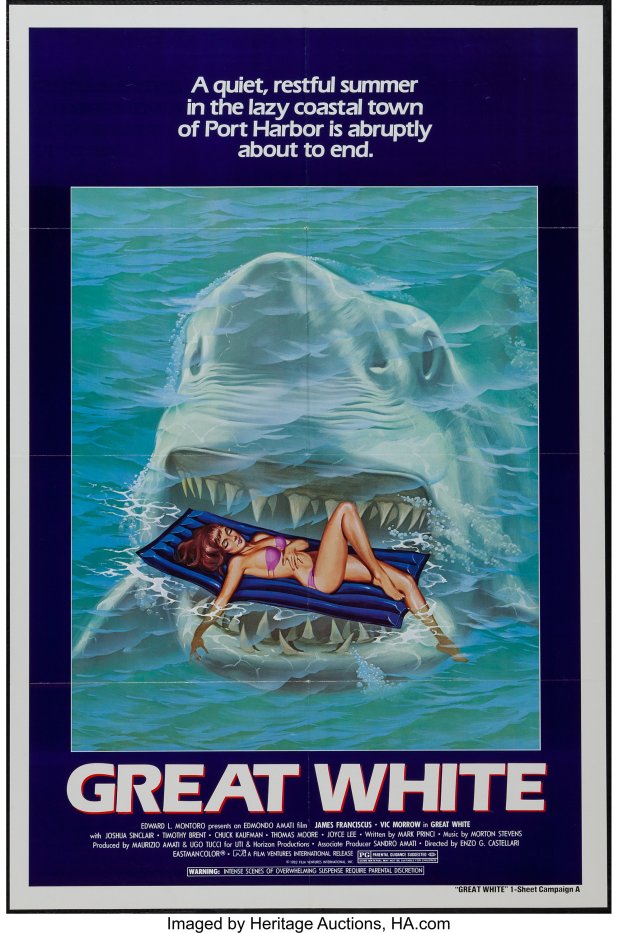
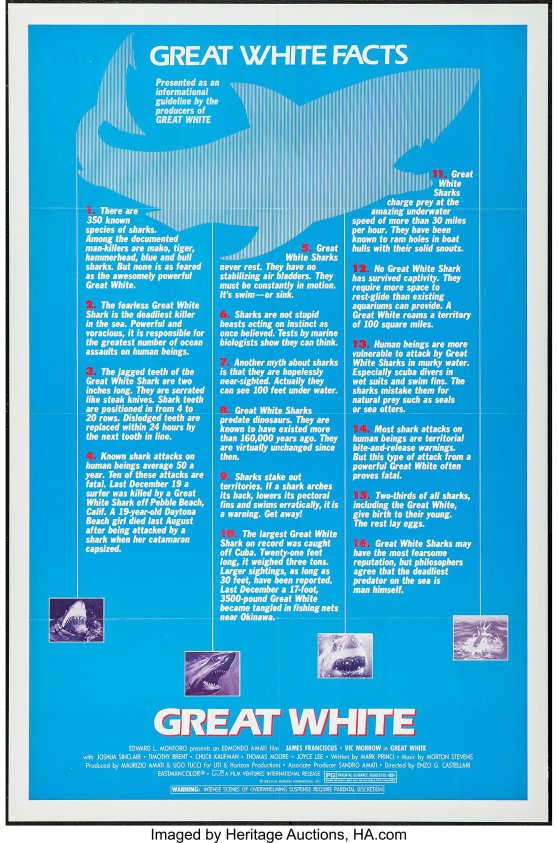
FVI WEEK: The Last Shark (1981)

Appearing under a variety of titles, like Great White, The Last JawsJaws Returns and L’ultimo Squalo, this movie made $18 million in its first month of U.S. release. Universal Pictures had been trying to block Film Ventures International from even releasing the film in America, but the request was denied in U.S. District Court. However, about a month into the film’s run, federal judge David V. Kenyon ruled that it was too similar to Jaws and the film was banned from theaters. Guess what? He was totally right.

After watching a windsurfer surf his little heart out over the opening credits, we get to watch a Great White Shark ruin his fun by eating him. That’s when we make our way to the resort town of Amity — I mean, Port Harbor — where Mayor Larry Vaughn — sorry, I meant to say governor William Wells (Joshua Sinclair, Ice from 1990: The Bronx Warriors) — refuses to believe that a shark is attacking his beach.

That’s when horror writer Peter Benton (James Franciscus, Butterfly and the voice of Jonathan Livingston Seagull) and shark hunter Ron Hamer (Vic Morrow, who has delighted us in so many movies, such as Message from Space) realize they gotta do something. In my wildest dreams, Hamer’s son will grow up to be the evil Hammer from 1990: The Bronx Warriors, another Morrow role.

The governor refuses to cancel the windsurfing regatta (you gotta regatta!) because he feels like that will hurt his political ambitions. Yes, in the bizarre universe of Italian shark movies, the windsurfing lobby is incredibly powerful. That said, Wells did put in shark nets, but all the splashing around makes the shark nuts, so it tears through the nets. The next day, as the windsurfers line up to compete, the shark appears to the sounds of the guitar from the Torso trailer and treats all these teens on their boards as if I’d treat a sushi buffet. And for dessert, may we recommend the governor’s aide? Mmm.

Benton and Hamer head out to sea with some dynamite, but the shark goes off Spielberg’s shooting script and traps them in a cave. While they’re figuring out why the shark would go into business for itself, Benton’s daughter Jenny (Stefania Girolami Goodwin, who is Ann in 1990: The Bronx Warriors, a radio operator in Moses’ group in Warriors of the Wasteland and would go on to be an assistant director on Empire Records and Super Mario Brothers) and her friends head out on a yacht with some steaks and a shotgun, which seems like the worst plan ever. The shark also stops the boat by using its own body to jam the motor of the boat, which seems patently ridiculous.

Of course, the shark yanks her off the boat and ends up eating her leg, which is done as tastefully as Italian scum cinema will allow. In the hospital, she screams at their father to kill the shark. In an attempt to finally get something right and make it up to Benton — his son was the reason why Benton’s daughter was out there in the first place — Governor Welles grabs more steak (was this movie endorsed by Italy’s beef council, who remind you “Manzo è quello che è per cena”?) and heads out on a helicopter with dynamite to blow up the shark real good. Of course, the shark messes up the best plans and drags the governor into the ocean, biting him in half and dragging his helicopter into the unforgiving ocean. This scene is both astoundingly satisfying and completely stupid, which is what I demand from every movie that I love.

Benton and Hamer try one more time to blow the shark up, because much like pro wrestling, Italian ripoff shark fighting also works in threes. This fails — this shark will not get any memos — and Hamer is killed.

There’s another shark hunter who decides to change the game by using spare ribs (the Italian National Pork Board would like to remind you “carne di maiale l’altra carne bianca”) and chaining them to the dock, but of course the shark won’t listen to reason and decides to drag every single person into the ocean and make a meal of the hunter, a cameraman and assorted rubbernecking beachcombers.

While all these shenanigans are going on, Hamer’s dead body floats on by and Benton (who is wearing a jaunty red wetsuit that seems like it would only enrage a crazed shark further and yes, sharks can see tones of colors depending on their species, I looked this up on Google because I really do care about the facts, dear reader) remembers that he has the detonator, so he blows his friend’s body up and takes the shark’s head with it. He then walks over and punches out a reporter played by Giancarlo Prete, who we all know and love as the hapless Scorpion from Warriors of the Wasteland!

It took four writers — Ramón Bravo (who also wrote Tintorera: Killer Shark), Vincenzo Mannino (who helped write Devil FishMiami GolemMurder Rock and The New York Ripper), Marc Princi and Ugo Tucci — to completely rip off the first two Jaws films. But it only took one director to create this carbon copy carnage. That man was Enzo G. Castellari and if you can’t guess by the related credits of the crew, he’s the man who brought us such magic as 1990: The Bronx WarriorsWarriors of the WastelandEscape from the Bronx and the original The Inglorious Bastards. He’s brought me such joy in my life and if IMDB is to be believed, he’s ready to bring even more, as he has a film called The Fourth Horseman in pre-production. This thing has to be a fever dream or a made up story, because it has Sid Haig, Michael Berryman, Bill Moseley, Kane Hodder, Franco Nero (as Keoma!), Fabio Testi, George Hilton and Gianni Garko (as Sartana!) in it. Sometimes, life can surprise you.

No matter what you call it, The Last Shark is anything but boring. You’re not going to see anything you haven’t seen before, but if you want to see b-roll footage, model helicopters and a shark that honestly may be better than Bruce was in the first movie (also it’s a shark smart enough to stop boats and grab ropes in its teeth so it can take out docks full of people), then this is the movie for you.

My only issue with this film: Castellari had not yet met Mark Gregory yet. If Mark was in this movie, I may have lost my mind. I mean, even more than I already have.

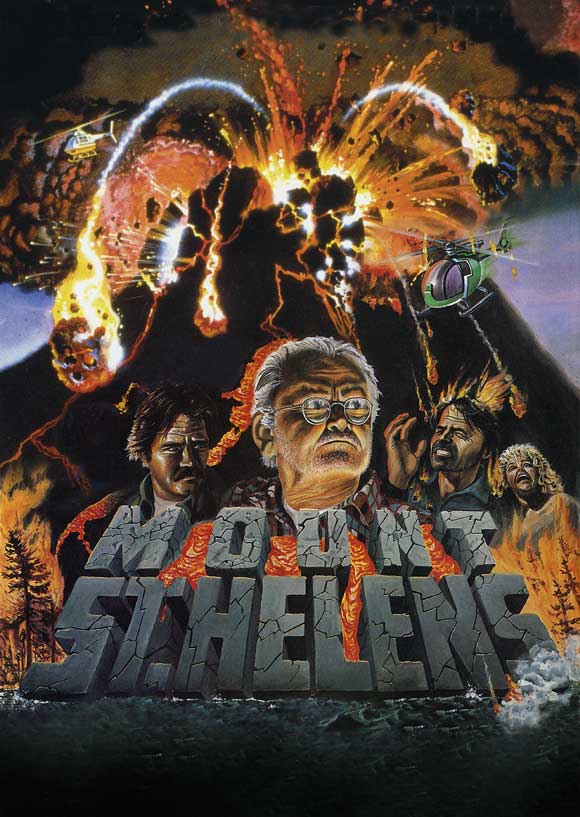
St. Helens (1981)

Directed by Ernest Pintoff, written by Peter Bellwood and Larry Ferguson and based on a story by Michael Timothy Murphy and Larry Sturholm, St. Helens aired on HBO on May 18, 1981, a little more than a year after the real eruption.

St. Helens begins on March 20, 1980 with an earthquake measuring 5.1 on the Richter scale being unleashing by the volcano, the first activity in more than a hundred years. It causes Otis Kaylor (Ron O’Neal) to nearly crash into some loggers as he makes an emergency landing.

United States Geological Survey volcanologist David Jackson (David Huffman) soon shows up to learn more. He’s actually playing someone very close to David Johnston, a scientist who died in the actual volcanic eruption. His parents were angry that not only was her son portrayed as a daredevil but also how much the movie got wrong about the science. Before the movie aired, 36 scientists who knew Johnston signed a letter of protest against the film, saying that “Dave’s life was too meritorious to require fictional embellishments” and that he “was a superbly conscientious and creative scientist.”

He soon becomes friends with a waitress and single mom named Linda Steele (Cassie Yates) and upsets her boss Clyde Whittaker (Albert Salmi) and the locals at Whittaker’s Inn about the danger of the eruption, all while Sheriff Dwayne Temple (Tim Thomerson) tries to keep law and order.

Watching this movie in 2024, it’s amazing how MAGA the people of the town are. It’s no accident that Bill McKinney from Deliverance is one of them. The loudest is the owner of the Mount St. Helens Lodge, Harry R. Truman (Art Carney), who refuses to leave the blast radius and becomes so famous for his stand that he basically can’t leave if he wants to live up to the character that he has created for himself. His sister, Gerri Whiting, served as a historical consultant for the film. According to her, Harry Truman and David Johnston were friends.

At 8:32 a.m. PDT on May 18, 1980, David hikes to find a massive bulge that has been growing on the north face of the mountain while Harry goes fishing in Spirit Lake. As David promised to the locals, they are both annihilated by a force similar to a nuclear bomb going off in their faces.

Sadly, the David who played David — David Huffman — died a sad death as well. He was only 39 years old when he was stabbed twice in the chest while fighting with a would be car thief. He died near instantly.

Why would I watch a movie so surrounded by death and sadness? Because it’s the first Hollywood movie scored by Goblin. Let me tell you, there’s nothing that says the Pacific Northwest more than Italian prog rock.

You can watch this on YouTube.

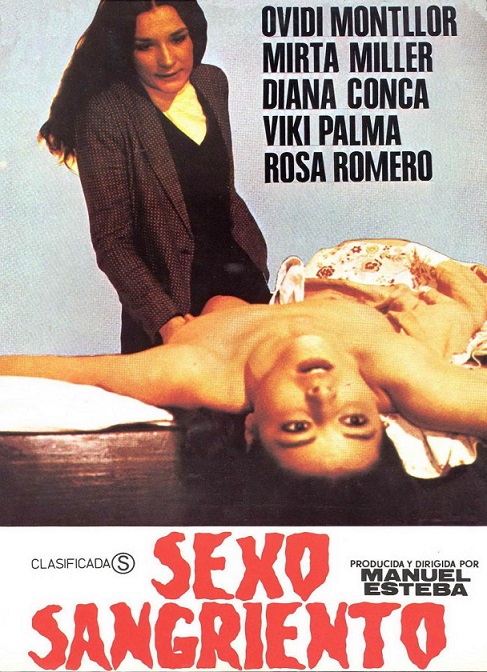
Sexo sangriento (1981)

Directed by Manuel Esteba (El E.T.E. y el Oto), who wrote the story with Xavier Flores, Sexo Sangriento is about the home of María Domènech (Mirta Miller), a place where she lives with her strange son (Ovidi Montllor). Psychology student Norma (Rosa Romero) convinces her friends Laura (Diana Conca) and Andrea (Viki Palma) to go to that house, thinking that it has been empty since the end of the Second World War. They have the plan to do a seance there before breaking down — bad omen — and having María, a painter, offer to host them in her ancient manor — even worse omen — for the evening.

Shot mostly handheld, this feels a bit Italian gothic as well as giallo what with the ghost in the basement. Then again, it also has someone wandering around before death with a knife stuck in their stomach, strange bloody paintings and a tomb beneath it all. This has the reputation for being sleazy but it’s actually a decent movie. Maybe because it has a lead lesbian couple? Then again, one of the murders does get rather rough.

A lot of the music in Bloody Sex comes from the CAM Music Library, selecting some of the same songs that are in Pieces and Ring of Darkness. And you’ll recognize Goblin’s “L’alba dei morti vivirti” from Dawn of the Dead/Zombi, which Mattei reused for Virus – l’inferno dei morti viventi.


The Monster’s Christmas (1981)

What are the holidays like in New Zealand? Maybe this movie will tell us all we need to know.

A little girl reads The Monster’s Christmas to her teddy bear before she hears Santa. Except that it’s not him. It’s one of the monsters from her book and he needs her help to get the voices of his friends back so that they can all sing Christmas carols again, as an evil witch was jealous of their singing and has stolen their voices.

Every monster in this is awesome looking, as is the witch, who has turned her hair into a hat and also wears a t-shirt that says WITCHES RULE. Yes, they do. So does the weird synth by Dave Fraser, who played on the soundtrack of The Quiet Earth and Battletruck.

Director Yvonne Mackay has mainly worked in New Zealand TV. Writer Burton Silver also made the book Why Paint Cats and was the creator of New Zealand’s longest-running published cartoon series Bogor.

My words won’t tell you how amazingly wild and frightening this movie for children is. I mean, there are monsters everywhere on the level of Yokoi Monsters but they’re also singing and dancing. At the end, they all get together to sing “Silent Night” and the idea that somewhere out there there’s a savior monster that died for them — or did Jesus die for all of us — is something I’d love to see a movie all about. I can only imagine that this movie warped every child from New Zealand — the country that gave us Flight of the Conchords, Dead Alive and The Bushwhackers — whenever the season came around again. “Look kids, it’s the man dressed as a bat walking backward! It won’t be long until Santa is here!”

You can watch this on Tubi.

Notturno con grida (1981)

The only copy I can find of Screams In the Night is, as nicely as I can put it, beat to shit. Whole sections of it turn into static and digital noise, the quality is at least fifth generation and the sound is barely listenable. There are no subtitles, either. And yet, in a world of 4K everything, I appreciate these analog moments when a movie looks bad and you need to fit to make it matter.

A medium named Brigitte (Mara Maryl, the wife of co-director and writer Ernesto Gastaldi), her husband Paul (Luciano Pigozzi, the Peter Lorre of Italy) and their friends Gerard (Gerardo Amato, The Red Monks), his fiancée Eileen (Martine Brochard, Top Model) and Sheena (Gioia Scola, Obsession: A Taste for Fear) have invoked the spirit of the long dead Christian (Franco Molè), who was killed ten years ago in this very room. He was once the husband of Eileen and in a few days, he will finally be declared dead, so she can use his money to build residential spaces on his property with Gerard.

Everyone has a secret. As for Gerard, he’s sleeping with Sheena and plans to kill Eileen. Paul used to be a priest. And Brigitte? Well, as everyone dies around them, she just may be a witch.

Gastaldi, who was the writer of so many Italian films, joined director Vittorio Salerno (he directed Libido as Julian Berry Storff), who hadn’t made a movie in five years. One day, while hunting in the woods — according to Roberto Curti’s Italian Gothic Horror Films 1980-1989 — he found a gigantic petrified formation known as a trembling stone. He couldn’t stop thinking about it until one night, he finally had an idea. Five people — lost in the woods and who all hate each other —  find the stone. It becomes “the amplifier of their bad desires, their projects of mutual duplicity … and mysteriously, no one will get out of the woods alive.”

To fund the movie, they got a 60 million lire grant from the Ministry of Spectacle by submitting the movie as La coscienza and pretending it was an art film. After they got the money, they formed a co-op with the cast, basing their salaries on the money the movie made from distribution.

Shot in three weeks with just four technicians, which included director of photography and cameraman Benito Frattari, his nephew Marco, a sound man and a local handyman to carry things who was provided for free by the mayor of the town where they shot, Soriano nel Cimino. Unlike many Italian exploitation movies, it was shot with direct sound. It also has nearly all natural light, which may be why it was set and shot outside. It is a frugal film, as you can tell.

If you have seen Libido, this is something of a spiritual sequel. It takes scenes from that movie and treats them in sepia, using them as flashbacks. In 1965, Mara Maryl was tied to a bed, an image that appears on that film’s poster. In 1981, it’s a rock in the woods. Pigozzi fell off a cliff to his death in the earlier film; here he claims it just broke his legs.

Perhaps most strange here is how much this movie prefigures the ideas within The Blair Witch Project. I’m not insinuating theft, just that the collective unconsciousness is a strange place. The woods are constantly changing, reality is shifting and there is no way out. However, this was shot on 16mm, not video, and even with a small crew looks professional and not the work of twentysomethings in the woods with a handheld.

As for the score, it has material lifted from The Suspicious Death of a Minor and improvised flute music by Severino Gazzelloni, whose ode to Pan was composed and recorded in six hours, giving the movie an hour of music to use.

I would treat this as a curiosity unless you have an obsession — you know me — with Italian film.

You can try to watch this on YouTube.

Fantasma d’amore (1981)

Nino (Marcello Mastroianni) is a married man who does taxes. His life is, well, quiet and somewhat boring. And then one day he sees Anna (Romy Schneider), a woman he was in love with decades ago. Time has not been kind to her. He pays for her busfare and she disappears, only to call him that night and offers to repay him. He meets her at her dilapidated apartment, only to learn that she has died three years ago.

His wife Teresa (Eva Maria Meineke) is growing upset with his obsession with the past. Despite him being sure that she is gone, she calls again and asks him to visit her mansion. When she answers the door, she is the same woman he knew years ago, young and vital. She tells him that she still loves him, but can’t make love to him, as she is married to the man who owns this gigantic home, Conte Zighi (Wolfgang Preiss). She changes her mind and says that they should take a boat to where they once would get away to be with one another, except that she disappears by falling into the water. When Nino informs the police, his wife leaves him and a tearful Conte Zighi tells him that his wife died three years before. His servant even takes him to see her gravestone.

At the end, Nino is in a wheelchair in his senior home, watching the sun set. A gorgeous woman comes to bring him inside. It is Anna.

Directed by Dino Risi (Anima persa), who wrote the script with Bernardino Zapponi based on the book by Mino Milani, Fantasma d’amore is about a man who has no passion left, a life which has no joy and only memories, which have become colored by the idea that they are the past, of a great love lost for good to keep him warm in the dark nights of the soul. Yet Anna says to him, “You really believe time exists…time which makes us age, which consumes us, that indeed exists. But inside of me, I’m not aged at all.” The fact that this woman, for a time, loved him is enough to sustain him all the way to the loneliness of the grave.

Speaking of age and remaining young through memory, the Riz Ortolani score features a 72-year-old Benny Goodman playing clarinet.

Bollenti spiriti (1981)

Giovanni (Johnny Dorelli) has inherited a castle from his uncle Ubezio and this will help him escape all his many creditors as a company already wants to buy it for a luxury hotel. The problem? The nurse who took care of his uncle, Marta (Gloria Guida, La casa stregata), has been given a percentage of the property. He works on talking her out of her share so that he can sell, but falls in love. There’s also the problem of the randy ghost of his ancestor Guiscardo (also played by Dorelli) who has had sex and has stayed in the castle for three centuries. And oh yeah — the buyer of the castle? His wife Nicole (Lia Tanzi) is Giovanni’s latest girlfriend.

Directed by Giorgio Capitani and written by Franco Marotta and Laura Toscano, this feels a lot like the other sexy haunted house movies of this time, C’è un fantasma nel mio letto and La casa stregata. There’s also some funny — and sexy — moments with Lory Del Santo (The Great Alligator) as a sex worker hired to relieve the ghost of his virginal burden.

C’è un fantasma nel mio letto (1981)

There Is a Ghost in My Bed was directed by Claudio Giorgi, who worked as an actor in fotoromanzi or photo comic books. It was written by Luis Maria Delgado and Jesus Rodriguez Folga and it’s in the genre of both Italian Gothic and commedia sexy all’italiana.

Camillo (Vincenzo Crocitti) and Adelaide (Lilli Carati) are on their honeymoon in Scotland. They can’t find a place to stay and get lost in the fog, finally finding the ancient castle of the Baron of Black Castle (Renzo Montagnani) and his servant Angus (Guerrino Crivello). Despite being a ghost, the Baron still wants to make love to Adelaide and I mean, have you seen Lilli Carati? Can you blame him? How did Camillo keep from sleeping with her during their five-year engagement?

Carati started her career as the runner-up for the 1975 Miss Italy contest. She started work as a fashion model before starting her career with La professoressa di scienze naturali. Her work was mainly in “school” movies where she was a young teacher or a student who was often nude. She also starred with Tomas Milan in Squadra antifurto and had her biggest success in the film Avere vent’anni (To Be Twenty). She was in four Joe D’Amato movies —  La Alcova, Christina, The Pleasure and A Lustful Mind — before acting in adult films in the late 80s. At that point, she was addicted to cocaine and heroin. She retired from public life in 1990 but returned to acting to play an occultist in Violent Shit: The Movie, which was dedicated to her as she died before it was released.