Cinematic Void January Giallo 2025: Dressed to Kill (1980)

EDITOR’S NOTE: Cinematic Void will be playing this film on Friday, Jan. 24 at 10:30 p.m. at the Guild Cinema in Albuquerque, NM (tickets here). For more information, visit Cinematic Void.

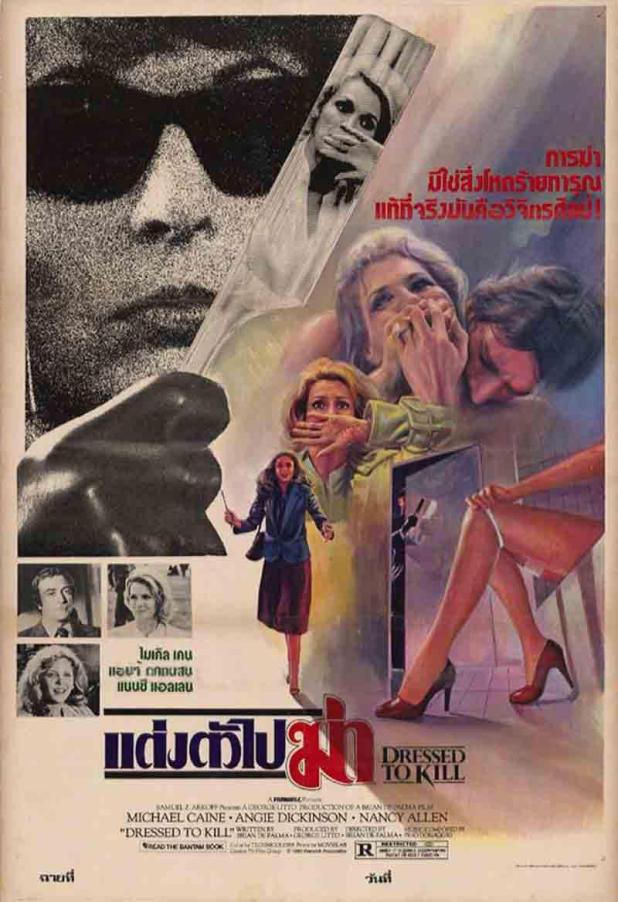
Let’s get this out of the way: Brian De Palma, much like Giallo, was heavily influenced by Hitchcock. In fact, when an interviewer asked Hitchcock if he saw the film as an homage, he replied, “You mean fromage.” That said — Hitchcock died three months before the film was released, so that story could be apocryphal (it’s been said that the famous director made this comment to either a reporter or John Landis).

What is true is the interview that De Palma did after Dressed to Kill (Rolling Stone, October 16, 1980).  The director claimed, “My style is very different from Hitchcock’s. I am dealing with surrealistic, erotic imagery. Hitchcock never got into that too much. Psycho is basically about a heist. A girl steals money for her boyfriend so they can get married. Dressed to Kill is about a woman’s secret erotic life. If anything, Dressed to Kill has more of a Buñuel feeling.”

However, I’d argue that this film has more in common with Giallo than anything the “Master of Suspense” directly created. That’s because—to agree with DePalma above—this film does not exist in our reality. Much like Argento’s The Bird with the Crystal Plumage, it exists in its dream reality, where the way we perceive time can shift and change based on the storyteller’s whims.

Yet what of DePalma being dismissive of Argento in interviews, claiming that while he saw the director as having talent, he’d only seen one of his films? Or should we believe his ex-muse/wife Nancy Allen, who claims that when she told DePalma that she was auditioning for Argento’s Inferno, he said, “Oh, he’s goooood.”

Contrast that with this very simple fact (and spoilers ahead, for those of you who worry about that sort of thing, but face facts, this movie is 37 years old): DePalma rips off one of Hitchcock’s best tricks from Psycho: he kills his main character off early in the film, forcing us to suddenly choose who we see as the new lead, placing the killer several steps ahead of not just our protagonists, but the audience itself.

And yet there are so many other giallo staples within this film: fashion is at the forefront, with a fetishistic devotion to gloves, dresses, spiked high heels, and lingerie being displayed and removed and lying in piles all over an apartment or doctor’s office. This is the kind of film that makes you stop and notice an outfit, such as what Kate Miller (Angie Dickinson, Big Bad Mama, TV’s Police Woman) wears to the Metropolitan Museum of Art or the blue coat that Liz Blake (Nancy Allen, CarrieStrange Invaders) wears to meet Dr. Robert Elliot (Michael Caine, how could we pick any movie other than Jaws 4: The Revenge).

Then there are the music cues from Pino Donaggio, who also scored Don’t Look Now, Fulci’s The Black Cat, and Argento’s Do You Like Hitchcock? The film not only looks the part, but it has intense sound, too.

We also have characters trying to prove their innocence, investigating ahead of the police. Or the son of the murder victim who wants to discover why his mother really died. Or her doctor, who has an insane patient named Bobbi who has stolen his straight razor and demands that she give him more time than the rest of her patients. All of them could be the killer. Giallo gives us no assurances that just because we see someone as the protagonist, there’s no reason they couldn’t also be the antagonist.

Let’s toss in a little moral ambiguity here, too. Kate is a woman who is bored with her life. She’s raised a son and seen her marriage lose any hope of sexual frisson. Liz is a prostitute — no slut shaming here, she’s a strong businesswoman more than anything  — but she’s also a practiced liar, as a scene shows her deftly manipulating several people via phone to get the money she needs to buy stock based off an insider tip she receives from a client. Dr. Elliot is obviously attracted to Kate but claims that his marriage prevents him from having sex with her. Yet it seems like he has secrets beyond informing the police of the threats of his obviously unbalanced patient, Bobbi. And then there’s Peter, Kate’s son, who has no issues using his surveillance equipment to spy on the police or Liz. If this character seems the most sympathetic, remember that he is the closest to the heart of DePalma, whose mother once asked him to follow and record his father to prove that he was cheating on her.

Finally, we have the color palette of Bava’s takes on giallo mixed with extreme zooms, split screens and attention to the eyes of our characters. The blood cannot be redder.

The film opens with Kate in the shower. While the producers asked Dickinson to claim that it’s her body, it’s really Victoria Johnson (Grizzly) as a body double. Her husband comes into the shower to make love to her, but she finds it robotic and not the passion she feels she deserves. Directly after, she tells Dr. Elliot that she’s frustrated and attempts to seduce him, but he rejects her.

More depressed than before the appointment started, she heads to the Metropolitan Museum of Art. Despite being surrounded by inspiration, such as the statue of Diana by Saint-Guadens, West Interior by Alex Katz and Reclining Nude by Tom Palmore (a tip of the hat to the amazing I Talk You Bored blog for an insightful take on the film and the research as to what each work of art is), she absentmindedly writes entries in her schedule. Planning the holiday meal gets her through the mindlessness of her life, flowing penmanship reminding her to “pick up turkey” instead of slowing down and appreciating not just the artwork around her but the people. There’s a young couple in lust if not love. There’s a young family. And then, a man with dark glasses catches her eye before brazenly sitting down next to her.

We are used to male characters chasing after female characters who aren’t defined by anything other than being sex objects. Instead, we have Kate pursuing the man, making the first, second, and even third moves until we realize that she was just following the man’s breadcrumbs.

Of note here is that color plays an essential role in the scene, as do expected manners. Kate is a wife and mother. She is who society expects to have virtue, and she is clad in all white, but her intentions are anything but pure. She finally has what she wants—the thrilling sex life that she may have only read about in trashy paperbacks.

This scene is a master class in pacing and movement. Imagine, if you will, the words on the page: Kate follows a mystery man through the museum. And yet, those are just eight words. We get nearly nine minutes of wordless pursuit, yet it never grows dull.

Finally, Kate follows the man out of the museum, but she loses him until she looks up and sees her glove dangled from a taxi. But blink, and you miss death in the background as Bobbi blurs past the camera.

When we catch up with Kate, it’s hours for her but seconds for us because this movie is a dream universe. She wakes up in bed with a stranger. There’s a gorgeous camera move here as DePalma moves the camera backward, an inverse of how a lesser director would have treated this scene. Instead of showing the two lovers tumbling through the apartment and removing clothes at every turn, we see Kate reassembling herself to move from her fantasy world to reality and toward her real world, which will soon become a nightmare. The camera slides slowly backward as she gets dressed, remembering via split-screen and sly smile how she doesn’t even remember where her panties have gone. She’s still wearing white, but under it all, she’s bare, her garments lost in a strange man’s house. A man whose name she doesn’t even know.

So now, as she emerges from realizing her sexual fantasies, she feels that she must make sense of it. She wants to write a note to say goodbye but doesn’t want to overthink it. Maybe she doesn’t even want it to happen again. And then she learns more about the man. It starts with his name and then becomes more than she ever wished to find out: his health report shows that he has multiple STDs.

Kate leaves the apartment and makes her way to the elevator, where she tries to avoid anyone’s eyes. In the background, we see an ominous red light, ala Bava. Bobbi—death and punishment for sin—is coming.

The death scene — I hold fast to my claim that The New York Ripper is close to this film but made by a director who doesn’t have the sense to cut away from violence — DePalma stages his version of the shower scene. But more than Psycho, we’ve come to identify with Kate. She’s a woman fast approaching middle age who wants a thrill, and yet, she’s punished by disease and death. She didn’t deserve this, and her eyes pleaded not to the killer as much as they did to the camera. And to us.

Here’s where we have to wonder aloud about DePalma’s long-discussed misogyny. This film was protested by women’s groups, who stated in this leaflet that “FROM THE INSIDIOUS COMBINATION OF VIOLENCE AND SEXUALITY IN ITS PROMOTIONAL MATERIAL TO SCENE AFTER SCENE OF WOMEN RAPED, KILLED, OR NEARLY KILLED, DRESSED TO KILL IS A MASTER WORK OF MISOGYNY.” Is DePalma guilty of the slasher film trope of “you fuck, and you die?” Maybe. Perhaps if she had remembered her marriage, at best, she wouldn’t be here. At worst, she wouldn’t have forgotten her ring in the stranger’s apartment and would have survived.

The way I see it, the death of Kate allows us to make the transition from past protagonist to new heroine, as the doors open post-murder to reveal a grisly scene to Liz and her john. The older man runs while Liz reaches out to Kate, their eyes meeting and fingers nearly touching. Kate’s white purity has been decimated by the razor slashes of Bobbi, the killer. As their transference is almost complete, Liz notices Bobbi in the mirror. Remember that we’re in a dream state? Time completely stops here, so we get an extreme zoom of both the mirror and Liz’s face. She escapes just in time, grasping the murder weapon and standing in the hallway, blood on her hands as a woman screams in the background, figuring her for the killer.

At this point, the film switches its protagonist. Unlike the films of David Lynch, like Mulholland Drive, this transference is not a changed version of the main character, but her exact opposite. Kate wore white, was older, and had a marriage and child, yet she slowly came to feel like an object to the men in her life. Liz wore black, was young and single, but was wise to the games of sex and power. She isn’t manipulated, turning the tables on men by using their needs for personal gain. Kate may have seen sexual fantasy as her greatest need, but for Liz, it’s just a means to an end.

Kate and Liz are as different as can be. For example, Kate goes to the museum to find inspiration. Liz only sees art as commerce, and she spends plenty of time explaining to Peter how much money she could make by acquiring a painting.

Dr. Elliott discovers a message from Bobbi on his answering machine (these machines and the narrative devices they enable must seem quaint and perhaps even anachronistic to today’s moviegoers). Once, Bobbi was his patient, but he refused to sign the paperwork for their (as the pronoun hasn’t been defined, so I’ll use they/their) sex change. In fact, Dr. Elliot has gone so far as to convince Bobbi’s new doctor that they are a danger to herself and others.

The police, however, have arrested Liz, and Detective Marino (Dennis Franz, TV’s Hill Street Blues and NYPD Blue) doesn’t believe a word she has to say. There’s a great moment here where Liz goes from wide-eyed ingenue to knowing cynic in the face of Marino’s misogynistic tone. Meanwhile, Kate’s son Peter (Keith Gordon, Jaws 2Christine) uses his listening devices in the station to learn more about his mother’s death than the police are willing to let on.

He begins tracking Liz, obsessively noting the times that she comes and goes from her apartment. He’s doing the same to Elliot’s office. But he’s not the only one tracking people. Bobbi has been stalking Liz, including a sequence where our heroine goes from being chased by a gang of black men to talking with an unbelieving police officer to Peter saving her from Bobbi with a spray of mace.

Because Peter has seen Bobbi also emerging from Dr. Elliott’s office, so he joins forces with Liz to discover who she is. That means that Liz uses her chief weapon — sex — to distract the doctor long enough to discover Bobbi’s real name and information. We learn that Liz’s mental sex game is as strong as her physical attributes here — she says that she must be good to be paid as well as she is. She knows precisely the fantasy Dr. Elliott wants to hear. But perhaps she also knows the fantasy that the mainly male slasher/giallo viewer wants: the woman submitting to the killer holding the knife.

Peter watches outside in the rain when a tall blonde pulls him away. Has he been taken by Bobbi? No — Liz returns to have sex with Dr. Elliott; he has been replaced by the killer. Bobbi lifts the razor as Liz helplessly crosses her arms in front of her face for protection. But at the last minute, the blonde who grabbed Peter outside is revealed to be a police officer, as she shoots Bobbi through the glass. That shattered pane also breaks Bobbi’s illusion and mask, revealing that Dr. Elliott is the man under the makeup and clothes.

The killer is arrested and goes into an insane asylum; Dr. Levy explains that while the Bobbi side of his personality wanted to be free, the Dr. Elliott side would not allow them to become a true woman. Therefore, whenever a woman broke through and aroused the male side of the persona, the female side would emerge and kill the offending female.

Inside the mental asylum, a buxom nurse attends to the male patients. The room is bathed in blue light, a cool lighting scheme that echoes Mario Bava’s films. The movie has moved from a dream version of reality to a pure dream sequence. It intrigues me that Carrie and Dressed to Kill both start with a shower scene and end with a dream threat to the surviving secondary heroine.

Within the asylum, Dr. Elliott overcomes the nurse and slowly, methodically, folds her clothing over her nude form. As he begins to either dress in her clothes — or worse, molest her dead body — the camera slowly moves upward as we realize that there is a gallery of other patients all watching and screaming. This scene reminds me of the gallery of residents watching a doctor perform surgery, yet inverted (have you caught this theme yet?) and perverted.

Bobbi emerges once again, and because she is dead, she cannot be stopped. Liz is bare and helpless in the shower, and nothing can protect her from being slashed and sliced and murdered — except that none of this is real. She awakens, screaming in bed, and Peter rushes in to protect her. And for the first time in the film (again, thanks to I Talk You Bored for noticing), she is wearing white.

Many find this a hard movie to stomach due to its misogyny. I’ll see you that and tell you it’s a misanthropic film that presents all of humanity, male and female, negatively. The men in this film are actually treated the way women usually are in films, as either silent sex objects (Warren Lockman), sexless enemies (Kate’s husband), shrill harpies that need to be defeated (Detective Marino) or sexless best friends who provide the hero with the tools they need to save the day (Peter). Seriously, in another film, one would think Peter would have a sexual interest in Liz, but despite her double entendres and come-ons, he remains more concerned with schedules and numbers and evidence.

Bobbi, the combination of male and female, comes across as a puritan punisher of females who benefit from sex, either emotionally or monetarily. Or perhaps they are just destroying the sex objects that they know that the male side of their brain will never allow them to become. Interestingly, Bobbi’s voice doesn’t come from Michael Caine but from De Palma regular William Finley (The Phantom of Phantom of the Paradise).

What else makes this a giallo? The police seem either unwilling to help at best or ineffectual at worst until they tie things up neatly at the end. And the conclusion, when the hand emerges not from the doorway — but the medicine cabinet — to slash Liz echoes the more fantastic films in the genre, such as SuspiriaAll the Colors of the Dark and Stagefright, where reality just ceases to exist. At the end of all three films, the heroine has confronted the fantastic and may never be the same.

In the first, Suzy narrowly escapes from hell on earth and emerges laughing in the rain. Is she happy that she survived? Has she achieved a break from reality? Is she breaking the fourth wall and laughing at how insane the film has become, pleased that the torture is finally over?

In the final scene of All the Colors of the Dark, the fantasy world is all a ruse, yet our heroine, Jane, is now trapped in the dream world. She can tell what will happen before it does; she knows that her husband has both slept with and killed her sister, but he has saved her from a fate worse than death. Yet all she can do is shout, “I’m scared of not being myself anymore. Help me!”

In Stagefright, the final girl walks out of the scene and out of reality as she defeats the killer. She has transcended being an actress to removing herself from fiction.

In all these films, the characters are not unchanged by their experiences with the dream world. In Dressed to Kill, the final dream sequence renders Liz truly frightened for the first time in the film. It’s the only time we see her as vulnerable — even when faced with an entire gang of criminals on the subway, she retains her edge. As Peter reaches out to comfort her — the only sexless male in the film and not just a sublimated one like Dr. Elliott — she recoils from his touch before giving in to his protective embrace.

In the same way, the film changes us. It has thrilled us, made us think, or even made us angry. True cinema—true art, really—makes us confront what we find most uncomfortable. Sure, we can deride and decry many of this film’s choices, but the fact that I’ve devoted days of writing and over three thousand words to it speaks to its potency. Thanks for reading if you’ve made it this far.
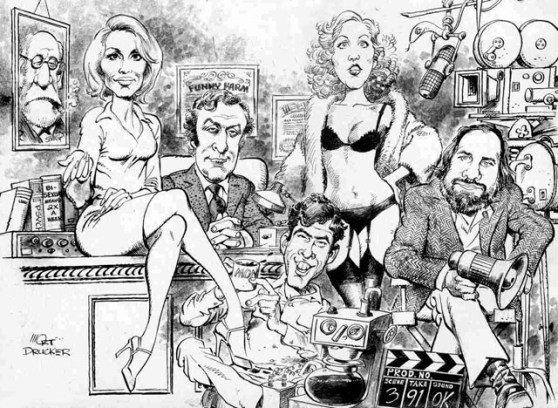
PS—I’ve often discussed—in person and on podcasts—that I experienced so many R-rated movies for the first time via Mad Magazine. I’m delighted I could find the Mort Drucker illustration for his skewering of Dressed to Kill.Dressed to Kill (1980)
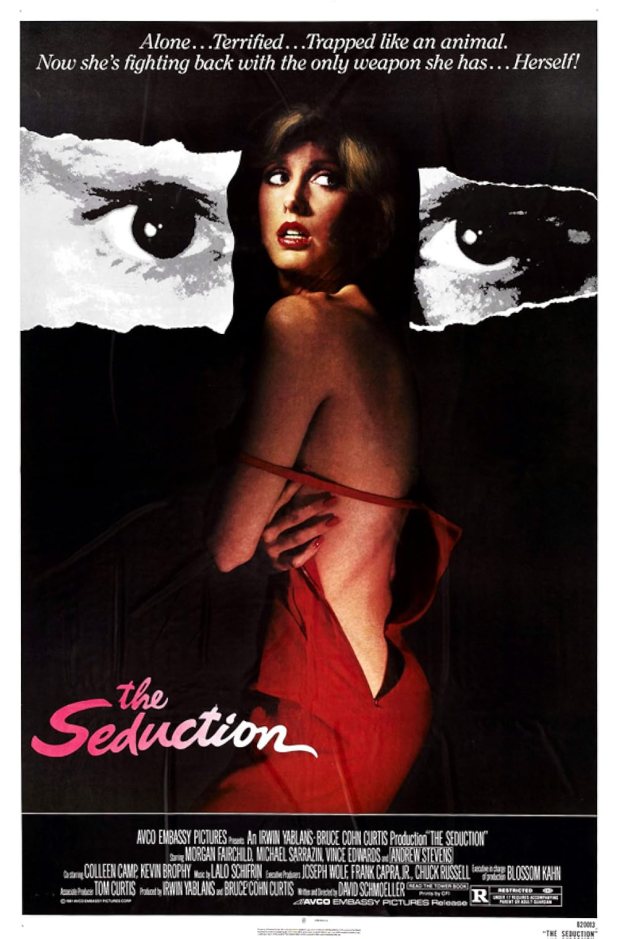
The Seduction (1980)

The Seduction is director and writer David Schmoeller’s follow-up to Tourist Trap. While that film exists in its own strange universe, where Chuck Connors just so happens to have psychic powers, this is based in the real—well, not always—world of Los Angeles. According to star Morgan Fairchild, Schmoeller was inspired by a story about a viewer stalking a TV reporter.

Jamie Douglas (Fairchild) has finally broken through and become an anchor on the local nightly news. Things are good — people like her — and she has a boyfriend named Brandon (Michael Sarrazin). The problems start when she begins to receive calls, letters and gifts from a man named Derek (Andrew Stevens, preparing to own the 1980s erotic thriller genre but not before he’d go from being a psychosexual deviant to chasing one with Bronson in 10 to Midnight). Soon, he also bothers her friend Robin (Colleen Camp) and drops by work to bring chocolates; Jamie, if anything, is too friendly and gently turns him down.

After he doesn’t stop calling her, Jamie learns that Brandon- a photographer- lives next door. He walks right in and starts taking photos of her. Her boyfriend beats him bloody, and when they talk to a cop named Maxwell (Vince Edwards), they learn that there’s not much they can do. As for Derek, he’s already bothering Robin, demanding that she talk to Jamie for him.

A doctor tells her that Derek is infatuated but to a degree that makes him psychotic. Would you say, mental enough to hide in the closet and go one-handed while she takes a bath? Oh Derek, can’t you see that a model named Julie (Wendy Smith Howard) is in love with you? Why did you tell her that you’re engaged?

Jamie starts to realize that Derek could be the Sweetheart Killer, a serial murderer that she’s been reporting on. He goes so far as to change her teleprompter while she’s on the air, leading to her having a breakdown in front of the entire city. Brandon tries to comfort her in the hot tub, but he’s soon killed by Derek mid-coitus; as our killer buries him in his front yard, the cops put Jamie on hold. On hold! Who is working there, Father Tom from Amityville II?

This is when Jamie goes full-final girl, blasting at Derek with a shotgun and starting to stalk him right back, repeatedly calling him and telling him how bad she wants him. As he comes back to the house to attack her, he runs into Julie, who tearfully announces that she knows that Jamie doesn’t really love him. He blows right past her — he has murder and sexual assault to do — before she turns the tables and becomes aggressive with him, begging him to have sex with her, revealing his impotence. Angered beyond all hope, he attacks her, just in time for Julie to announce that she’s seen Lipstick and wasn’t that part cool where the rapist got shotgunned?

This has a decent horror pedigree, as it’s the third film produced by Irwin Yablans (Halloween) and Bruce Cohn Curtis, who also made Roller Boogie and Hell Night.

The Seduction is a scuzzy film; I have no complaints. Yet it still has a theme song, “Love’s Hiding Place,” sung by Dionne Warwick! This song was written by the film’s composer, Lalo Schifrin. He may have written the Mission: Impossible theme but got no respect from the credit crew on this, as they spelled his last name incorrectly.

It left me wondering how so many early 80s American Giallo movies have the only nude appearances by major actresses. I’m looking at you, Blind Date, with Kirstie Alley going bare. I was shocked to see multiple nude scenes by Fairchild in this with nobody double being used. Bonus points for the script, which has Colleen Camp’s character declare, “Art, fart!”

Double word score for Lucan star Kevin Brophy appearing, Tom DeSimone’s brother Bob being in the cast as a shutterbug, and Fairchild’s sister Cathryn Hartt as a teleprompter person.

Triple overall score for this being the last Avco Embassy Film.

IMDB BS footnote for this one: “Apparently, veteran actress Bette Davis really liked this movie, and after viewing it on cable television, she allegedly sent the movie’s star, Morgan Fairchild, a congratulatory letter complimenting her work on the film.”

You can watch this on Tubi.

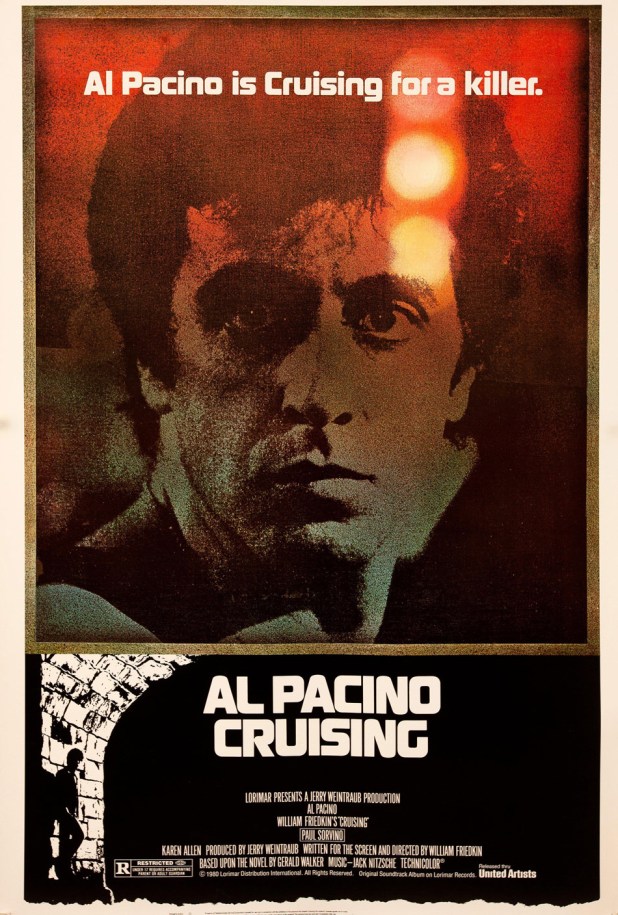
Cinematic Void January Giallo 2025: Cruising (1980)

EDITOR’S NOTE: Cinematic Void will be playing on Saturday, January 4, at midnight at the Little Theater in Rochester, NY (tickets here) and Friday, January 17, at 7:30 PM at the Little Theater in Rochester, NY (tickets here). For more information, visit Cinematic Void

Despite being approached several times with New York Times reporter Gerald Walker’s 1970 novel Cruising, William Friedkin (The Exorcist, Sorcerer and perhaps not as successfully, Jade) wasn’t interested. He changed his mind after an unsolved series of murders in New York’s leather bars.

Articles by Village Voice journalist Arthur Bell and NYPD officer Randy Jurgensen helped inform this film. The latter went into the same deep cover as this film’s protagonist, Steve Burns. Then, Friedkin learned that Paul Bateson, a doctor’s assistant who appeared in The Exorcist, had been implicated in the crimes while serving a sentence for another murder.

Friedkin did some of his research for the film by attending gay bars dressed in only a jockstrap, but by the time the movie began filming, he had been barred from two of the most oversized bars, the Mine Shaft and Eagle’s Nest, due to the controversy surrounding the movie.

Much like The New York Ripper and God Told Me To, this movie feels like one set at the end of the world — New York City near the close of the 20th century. Someone is picking up gay men, murdering them and leaving their body parts in the Hudson.

Officer Steve Burns (Al Pacino)—exactly the type of man the killer has been after—is on the case. Captain Edelson (Paul Sorvino) has assigned him to infiltrate the foreign world of S&M and leather bars. But as the case progresses, he begins to lose himself and his relationship with Nancy (Karen Allen).

Soon, he learns of just how brutal the NYPD is to gay men — even if they’re just suspects. And he finds himself growing closer to his neighbor Ted (Don Scardino, Squirm).

By the end, nothing is truly clear. While the killer may be Stuart Richards, a schizophrenic who attacks Burns with a knife in Morningside Park, it could also be Ted’s angry boyfriend Gregory (James Remar). After all, Ted’s mutilated body is discovered while Stuart is in custody. Or the real killer is still out there — perhaps he’s even a patrol cop (Joe Spinell). The truth is never told.

Spinell is incredible in this, which is no surprise. He used his real life for inspiration, as there’s a line about his wife, Jean Jennings, leaving him and moving to Florida with his daughter. His wife had just done exactly that before this movie was shot.

The actual version of this movie may never be released. Friedkin claims it took fifty rounds to get the MPAA to award the film an R rating. Over 40 minutes of footage was cut, which consisted of time spent in gay bars. The director claims that these scenes showed “the most graphic homosexuality with Pacino watching and with the intimation that he may have been participating.”

This footage also creates another suspect — Burns himself may have become a killer.

When Friedkin sought to restore the missing footage for the film’s DVD release, he discovered that United Artists no longer had it and may have even destroyed all the cut footage.

In 2013, James Franco and Travis Mathews released Interior. Leather Bar is a metafictionalized account of the two filmmakers’ attempts to recreate the lost 40 minutes of Cruising.

There’s a disclaimer at the start that says, “This film is not intended as an indictment of the homosexual world. It is set in one small segment of that world, which is not meant to be representative of the whole.” Years later, Friedkin would claim that MPAA and United Artists required this, hoping that it would absolve them of the controversy that had been all over this production.

That’s because protests had started at the urging of gay journalist Arthur Bell, the aforementioned Village Voice writer whose series of articles on the Doodler’s killing of gay men inspired this movie. There were numerous disruptions to the filming, as protesters blasted music and loud noises at all filming locations, leading to hours of ADR to fix the ruined dialogue.

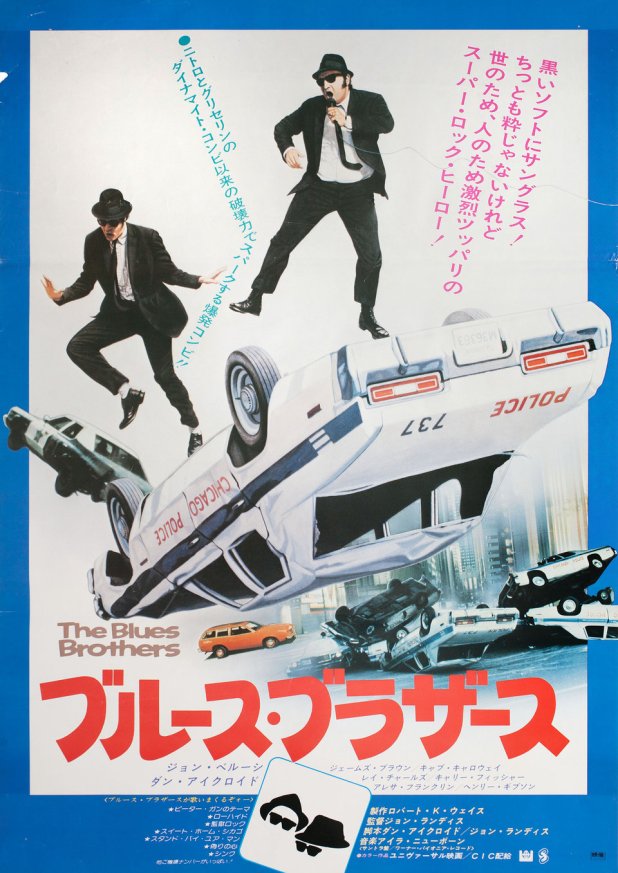
MOVIES THAT PLAYED SCALA: The Blues Brothers (1980)

Thanks to the British Film Institute, there’s a list of films that played Scala. To celebrate the release of Severin’s new documentary, I’ll share a few of these movies every day. You can see the whole list on Letterboxd.

Jake and Elwood Blues (John Belushi and Dan Aykroyd) went from a musical comedy sketch on Saturday Night Live to a $30 million budget mission from God as they careers of the Not Ready for Prime Players left New York City and set out for Hollywood.

There was a bidding war for this movie. After all, SNLAnimal House and The Blues Brothers album were all huge. Belushi was suddenly the star of the week’s top-grossing film, top-rated television show and singing on the number-one album all at the same time.

Universal won and what they got was a new writer in Aykroyd who wrote a long script that director John Landis was still writing and didn’t have a final budget until well after shooting started, at which point Belushi was already going wild in Chicago, drinking and drugging up a storm while cars were crashed everywhere and money was pretty much set ablaze.

It doesn’t matter. This movie is still remembered long after its star and all that money have gone away.

Raised in an orphanage and taught the blues by Curtis (Cab Calloway), the brothers became blood when they cut their middle fingers with a guitar string from Elmore James, the King of the Slide Guitar.

The past is important in this film, as Aykroyd demanded Calloway, James Brown, Ray Charles and Aretha Franklin to be cast and get musical numbers. Universal wanted younger acts and disco stars. They lost.

The story is simple. The brothers want to raise money to save their orphanage. That’s it. That’s the story. The rest is a road movie full of comedic scenes that you can basically come into any time that you want.

They could have filmed what happened during the making of the film and had just as great of a film. For example, there was an entire bar on set, The Blues Bar, staffed with drug dealers. And on one night shoot, Belushi disappeared. Aykroyd looked around and saw a single house with its lights on. He walked over and the owner of the house said, “You’re here for John Belushi, aren’t you?” He had walked into their home, asked if milk and a sandwich, and went to sleep. This is why he was nicknamed “America’s Guest.” Belushi was also called “The Black Hole” because he would lose his sunglasses after nearly every scene.

Beyond Paul Reubens, Steven Spielberg and Carrie Fisher, there’s a secret Colleen Camp cameo. Look for her Playboy poster in Ellwood’s cell.

I remember this movie running so many times on HBO in my youth and watching it nearly every time. I could watch it right now, even after watching it to write this.

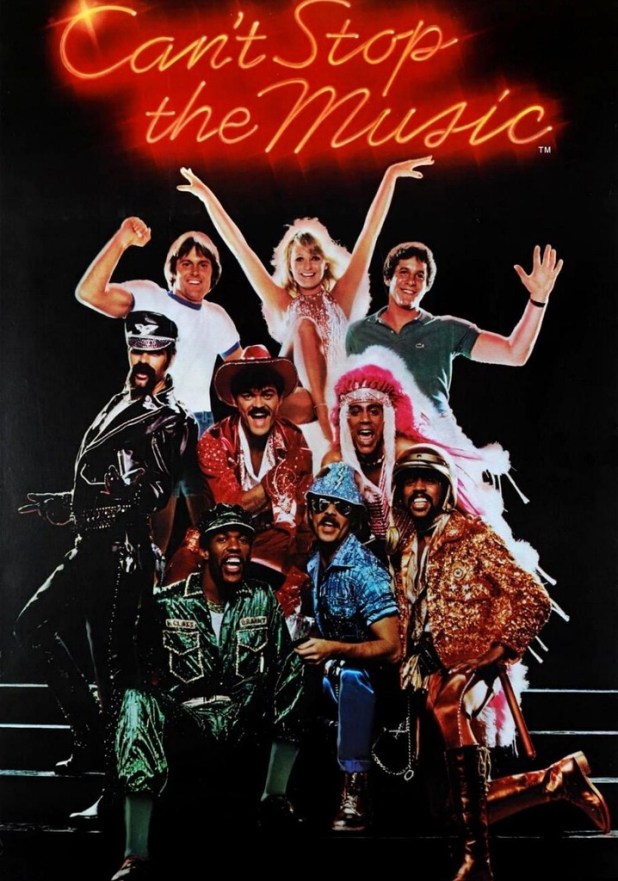
MOVIES THAT PLAYED SCALA: Can’t Stop the Music (1980)

Thanks to the British Film Institute, there’s a list of films that played Scala. To celebrate the release of Severin’s new documentary, I’ll share a few of these movies every day. You can see the whole list on Letterboxd

This movie — and Xanadu — are why the Razzies exist, awards that celebrate the worst in movies. But what do they know?

This is the only movie that Nancy Walker — Rhoda’s mom and the Bounty paper towel lady — ever directed. It’s Bruce Jenner’s film debut. And I don’t care what anyone says, I love it in spite of everything bad you can say about it.

You can see why the movie happened. Producer Allan Carr was riding high off the success of Grease. Disco had finally hit the mainstream with Saturday Night Fever. And there was probably so much coke going around that everyone had a constant nasal drip. The time was ripe for what people had been clamoring for: the origin story of the Village People.

Wait — what?

The Village People — you probably know the words to “YMCA” — were created by Jacques Morali and Henri Belolo. While in New York, Morali attended a costume ball at the Greenwich Village gay disco “Les Mouches.” There, he was taken by all of the macho male stereotypes that he saw in the room and thought — this could be a music act, with each member being a different gay fantasy. Soon, they were signed to Casablanca Records, where their songs “San Francisco (You Got Me),” “Macho Man” and “In the Navy” played in clubs all over the world.

The truth is that the Village People were all one person at first: Victor Willis. Once the album became a hit, Morali and Belolo quickly put out an ad that said: “Macho Types Wanted: Must Dance And Have A Moustache.” From that big success to the time this movie was ready to come out, disco was just about dead, a fact that Carr had foreseen, changing the title from the original Discoland–Where The Music Never Ends! 

So what’s it really all about? Jack Morell (Steve Guttenberg, Police Academy) — named for Jacques Morali, of course — wants to be a composer. But for now, he’s DJing at Saddle Tramps, a disco. His roommate, Samantha Simpson (Valerie Perrine, Superman) is a newly retired supermodel. He writes her a song and everyone loves it, so she uses all of her connections to get him a deal. Her ex-boyfriend Steve Waits of Marrakech Records — get it, Casablanca Records? — wants her back, so he agrees to listen to a demo.

However, Jack’s vocals pretty much suck. So she recruits all of her fabulous friends, like waiter Felipe Rose — the Indian! And model David “Scar” Hodo — the Construction Worker! Randy Jones needs dinner, so he joins up as the Cowboy! We almost have formed Voltron…I mean, the Village People!

We’re treated to a solo song by David the Construction Worker called “I Love You to Death” where he fantasizes about all of the women who will be chasing him once he’s popular. When this scene played in San Francisco, supposedly movie screens were decimated with eggs.

Meanwhile, Samantha’s former agent (Tammy Grimes, who is one of the commercial stars in The Stuff) wants her back in the modeling business and orders her secretary Lulu to make it happen. Somehow, Ron White (Jenner), a tax lawyer, gets mugged on his way to delivering a cake to Sam’s sister, but then Lulu gives Jack drugs, then Ray Simpson — the Cop! — shows up and the four sing the song “Magic Night.” It’s all too much for Ron, who runs away.

The next day, Ron and Sam get back together and hook up. Now that he has a reason to help, he offers his office for further auditions, where we meet Glenn Hughes — the Leatherman! — and Alex Briley — the G.I.! — who finally form the full version of the group. Blink and you’ll miss W.A.S.P. frontman Blackie Lawless trying out! Finally, Ron’s boss Richard says (Russell Nype, who is also in The Stuff) that their company shouldn’t have anything to do with the group, so Ron quits the firm.

The band then goes to the YMCA to rehearse, which leads to a musical number for the song of the same name. If you’re looking to see plenty of naked men in a PG movie, well, here you go! I won’t judge! Marrakech offers too little money for their contract, so the gang decides to throw a party to raise some funds.

Seriously: this is the most raw dong I have ever seen in a non-porno movie.

Samantha agrees to model again for a milk commercial, as long as the Village People can be there, too. The TV spot — with six small boys dressed as the band — starts with Samantha pouring them milk and turning into the song “Milkshake.” Of course, the milk company balks at this. I’ve been in advertising for some time. I can only imagine the meeting where they showed this video to them and the blank stares turning into faces filled with pure rage.

Norma White (Barbara Rush, It Came From Outer Space) decides to help and invites the guys to be part of her fundraiser. Sam lures Steve to the show by suggesting they can canoodle, so Ron dumps her. Meanwhile, on Steve’s jet, Jack and his mother Helen (June Havoc, sister of Gypsy Rose Lee!) win the record company owner over and the Village People are signed!

Everything works out just fine. Ron and Sam get back together. He gets his old job offered back. And following a song by Morali’s other band The Richie Family, the Village People finally unite for “Can’t Stop the Music.”

If only reality had been so kind. After all, the infamous Disco Demolition Night in Chicago, the evening most people claim was the death knell for disco in the United States, happened two weeks into filming.

Even with a TV special — Allan Carr’s Magic Night — featuring Hugh Hefner and Cher, along with a new Village People song “Ready for the 80’s!” that was cut from the film, it was to prime America for a movie that by the time it was filmed no one really wanted to see.

Oh man, the lyrics to that song:

I’m ready for the eighties things look positive
I’m ready and I’ve got a lot of love to give
There’s hope in every heart and love on ev’ey face
The eighties promise everything is just gonna be great

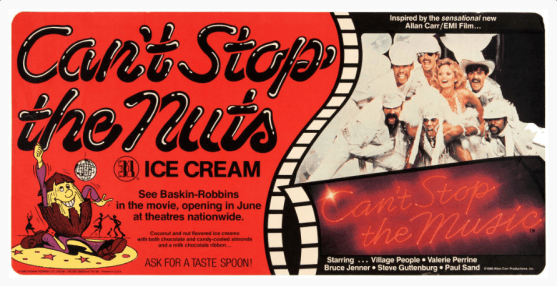
But hey — Baskin Robbins had a flavor made for the film. Can’t Stop the Nuts was offered for the whole summer of 1980. Think I made this up? Nope. I have evidence.

It’s also one of the first appearances of Ray Simpson as the Policeman. The previously mentioned Victor Willis, the original lead singer, quit the group during pre-production. Turns out he wanted to let everyone know he was the straight man of the group and had insisted that his wife, the soon to be divorced and renamed Phylicia Rashad, be written into the film as his girlfriend. Her role in the film ended up being played by Sammy Davis Jr.’s wife Altovise Davis.

Even crazier was that filming in New York was constantly delayed by protestors who were upset about the film Cruising. Many of them thought that this film was that film, so they protested against the wrong movie!

The film failed. Disco died. But why are we talking about this all thirty-some years later? Simple: disco never really went away. And neither did the Village People. Victor Willis is even back in the group, after years of fighting. Sure, there are two different Village People bands touring. But people love them. They’re a part of our culture, even if this movie is pretty much forgotten (outside of Australia, where it’s a New Year’s Eve tradition).

I also want to inform you for some reason this movie is 2 hours and 3 minutes long. I have no idea why it has to be so long. Plan your evening accordingly.

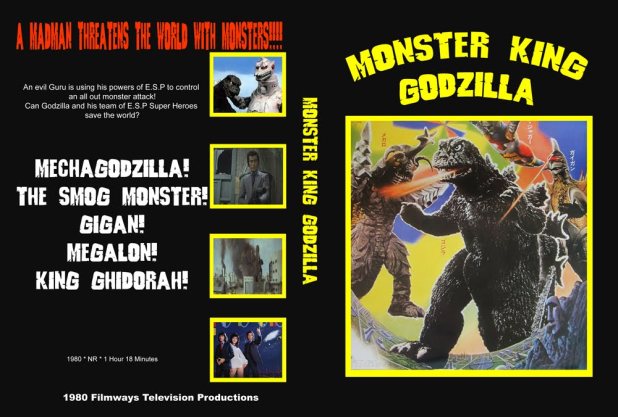
RETURN OF KAIJU DAY: Monster King Godzilla (1980)

“Very rare Godzilla film made for Hawaiian TV in 1980 by Filmways TV USA, 99% stock footage and a bizarre wrap around plot involving physic powers make this a very strange film.”

Yet another strange mash of footage that some believe came from Hawaiian TV and others think is a hoax, Monster King Godzilla puts together various Showa-era Godzilla moments with another Toho movie, 1974’s Jun Fukuda-directed ESPY.

That movie is all about the International Psychic Power Group, a team of psychic superheroes who are the X-Men if they were funded by the U.N. After four politicians from Eastern Europe are killed, the psychic team is called into action, but must deal with Ulrov and his mental powered killer Goro.

Now imagine that movie but someone would rather watch footage of Godzilla fighting Megalon, Hedorah, Mecha Godzilla, Titanosaurus, King Caesar, King Ghidorah and Gigan instead of letting you know most of the plot of ESPY.

The copy of this that I have has sound that cuts out from time to time, making this an even more disconcerting experience. It’s like this was dubbed into English, back into Japanese, dubbed into French, then Spanish, back to Japanese, a side trip to Switzerland and then back to English before, again, someone wanted every Godzilla fight in the 1970s dubbed in, just because.

Big love to the psychic girl in this with a white miniskirt, gigantic glasses and a white fur coat. Well done on the metallic orange lipstick, your outfit has choices and you made all of them.

You can download this from the Internet Archive.

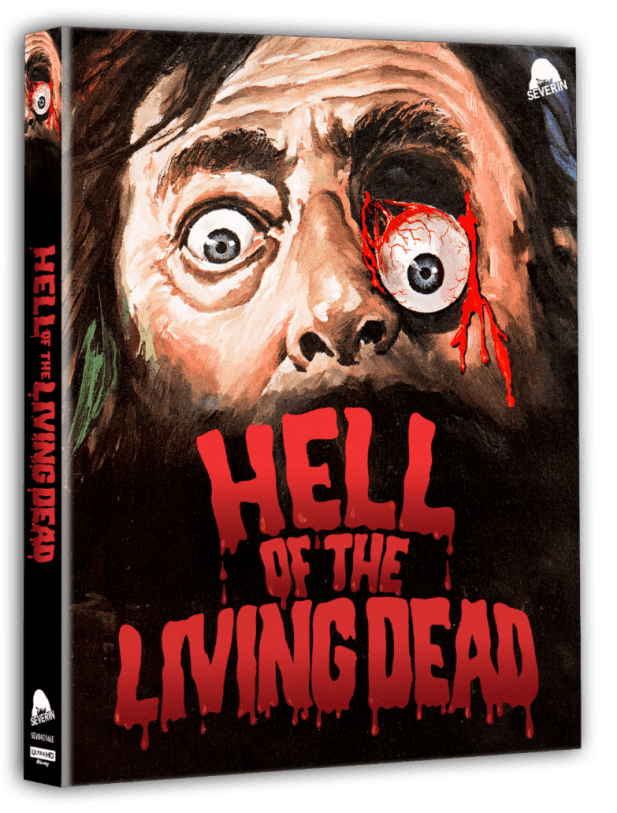
SEVERIN BLACK FRIDAY: Hell of the Living Dead (1980)

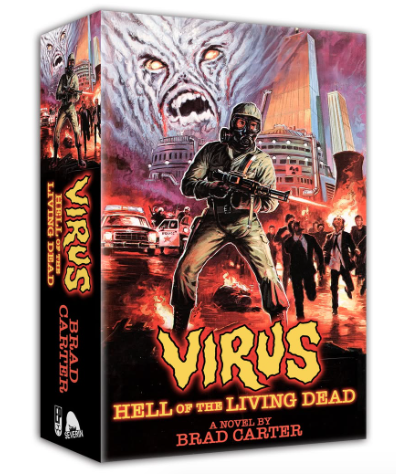
It’s no accident that Severin used our review for sales copy for this, reminding viewers that this movie is “absolutely insane.” What began as the epic global zombie apocalypse screenplay by Claudio Fragasso and Rossella Drudi became – via the inimitable vision of director Bruno Mattei and a fraction of the original budget – this wild effort, now on UHD and scanned in 4K from the original camera negative for the first time in America, complete with a CD of its soundtrack.

There’s also a brand new novelization by Brad Carter, who worked with original screenwriters Claudio Fragasso and Rossella Drudi!

The sale will take place from 12:01am EST on 11/29 to 11:59pm PST on 12/2 at Severin’s site.

Bruno Mattei got hired to make this, being asked by Spanish producers to make something like Dawn of the Dead but happier, if that was possible. He made this under the name Vincent Dawn, which the producers requested. Two scripts were written by Claudio Fragasso* and Rossella Drudi, with the one being picked not being the script Mattei preferred.

I wish I could have seen that script** because what got made is absolutely insane.

The movie starts in a top-secret chemical research facility called Hope Center #1. There, the male workers talk non-stop about sex like this:

Technician #1: She may not know much about chemistry, but in bed, her reactions are terrific.

Technician #2: I’m not surprised with that cute little ass.

Technician #1: I’m a tit man, myself.

In the middle of this locker room talk, a rat causes a chemical leak and comes back to life as a zombified rat*** that eats the face of a worker, turning every single person there — eventually — into the living dead.

Meanwhile, four commandos — Lt. Mike London (José Gras, billed as Robert O’Neal), Osborne (Josep Lluís Fonoll, Wheels on Meals), Zantoro (Franco Garafalo, The Other Hell, billed as Frank Garfield) and Vincent (Selan Karay) — wipe out some eco-terrorists who are demanding that the Hope Centers be revealed to the public.

Now that the Hope Center we’ve seen at the beginning of the movie has lost contact with the world, the commandos go to New Guinea to find out why. There, they encounter journalist Lia Rousseau (Margit Evelyn Newton, The Adventures of Hercules) and her cameraman Max (Gabriel Renom), along with a fighting husband and wife who are soon dispatched by a zombie doctor and their dead son.

Their fight dialogue really needs to be shared:

Josie’s husband: These bright ideas you get… bringing a 7-year-old child through this filth! Only YOU could have thought of it!

Josie: There was absolutely no way of knowing the trouble we’d run into.

Josie’s husband: Dumb broad! The living image of a modern mother! You couldn’t be so mean to leave our boy at a nice safe school for a couple weeks! Not her! “Oh, no! Not to bring our boy along with us would be cruel!” Doesn’t matter if he’s eaten by mosquitoes… or wounded by a native lunatic!

Lia Rousseau: Oh, please! You’re not gonna begin that again!

Josie’s husband: Oh, no! I’m sorry! Naturally, the great Lia Rousseau can’t possibly be disturbed listening to the complaints of a man who’s upset about his boy! No, she’s on a special mission. The idol of a TV audience who doesn’t get enough violence and BLOODSHED!

In case you’re wondering, “Is this a Bruno Mattei movie?” Let me satisfy you: when they go to a native village, footage from the documentary New Guinea, Island of Cannibals gets added into the movie and Rousseau having to strip down and get her body painted up. Of course, the mirth of the native village ends up with a zombie attack and the commandos — and journalists — make their way to the overrun hope center, where they learn that Operation: Sweet Death was made to destroy the world’s population so that overcrowding could be stopped, starting with the poor people, of course.

I love the ending of this, as politicians throw paper at one another while zombies have spread into the major cities.

In case you watch this and think, “This music sounds familiar,” I have the answer. It’s all Goblin, which was licensed instead of getting an original score made. It has songs from their album Roller, as well as their songs for Dawn of the DeadBeyond the Darkness and Contamination.

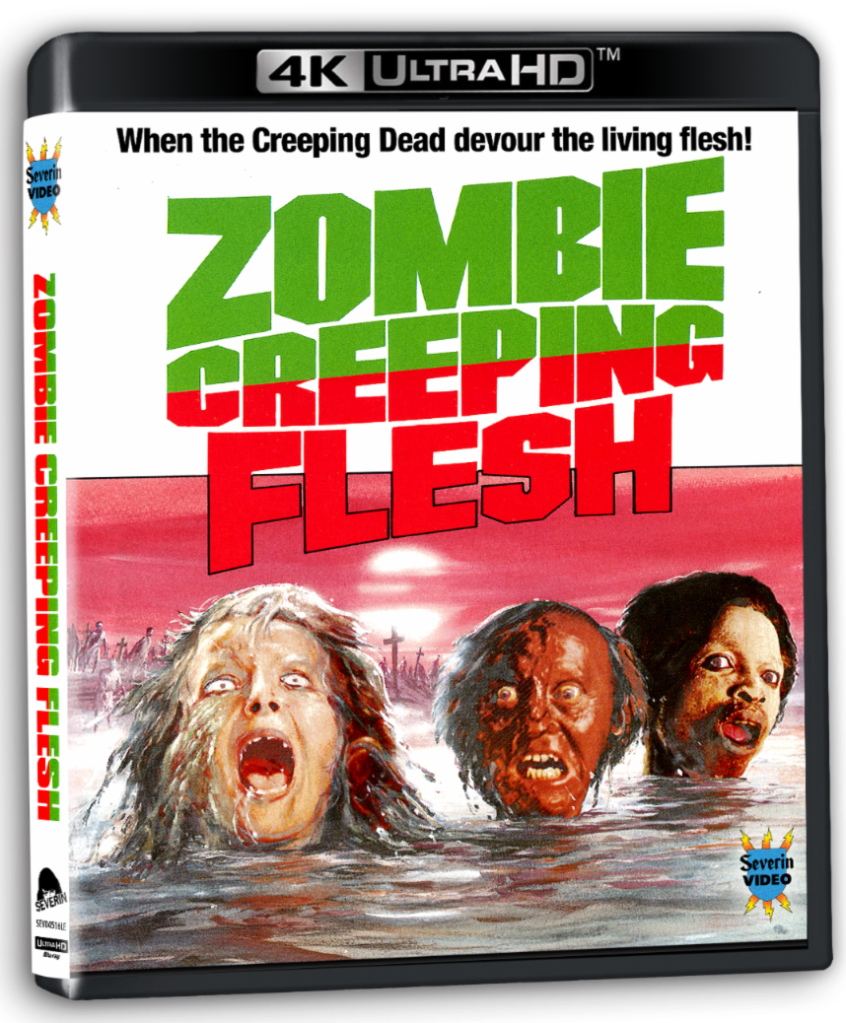
Alternate titles include Hell of the Living DeadZombie Creeping FleshNight of the ZombiesVirus CannibaleOs Predadores da Noite (The Night Predators) and Zombie Inferno.

I absolutely love the absurd dialogue in this! There’s so much, but this is my favorite back and forth:

Vincent: Patience is the chief virtue for those who have faith. Mahatma Gandhi, New Delhi, 1946.

Lt. Mike London: Up your ass. Lieutenant Mike London, Shit Creek, the year is now.

Also, it has the strange air that the terrorists are right, despite their actions being wrong. Pretty much humanity is doomed in the world of Mattei. Really, for all the bad I’ve heard about this movie, it’s a total success in my eyes.

I mean, it has a scene where a commando puts on a dress, sings a song from Singin’ in the Rain, causes a zombie kitten to leap out of a dead woman’s stomach and then dies while everyone yells, “Bastards! Filthy jackals! Look at them, look at THAT! They’re eatin’ him like PIGS! Goddamned rotten ghouls!”

You can watch this on Tubi.

*In an interview in GoreZone, Fragrasso said this movie was, “designed with lots of love, but in the end it came out a test tube baby, a kind of abortion. But I’m satisfied with the end results.”

**In that script, Fragasso wrote of “an entire Third World made up of an army of zombies, who the armed forces of the industrialized nations would have had to fight.”

**Spoiler warning! I wonder if this rat is the father of the rats we meet at the end of Rats: The Night of Terror?

You can listen to the podcast about this movie here:

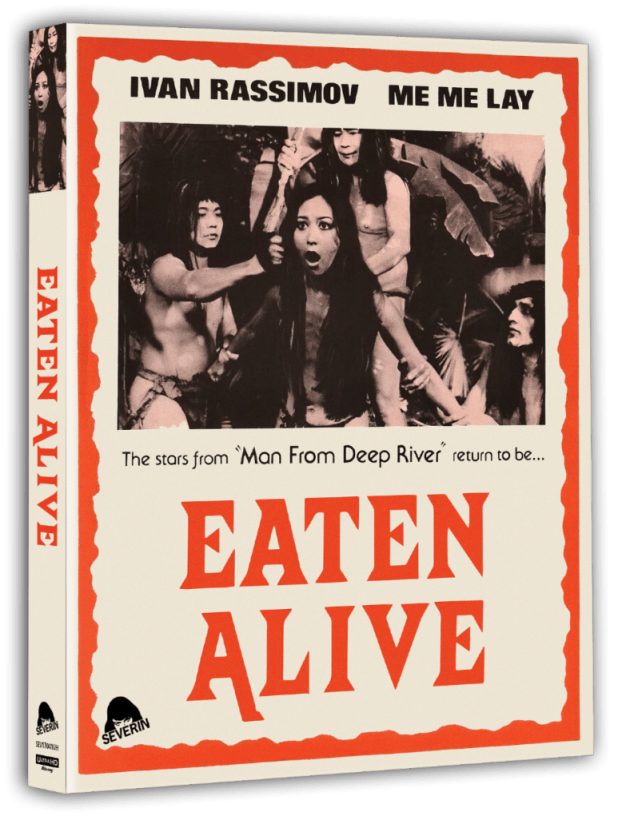
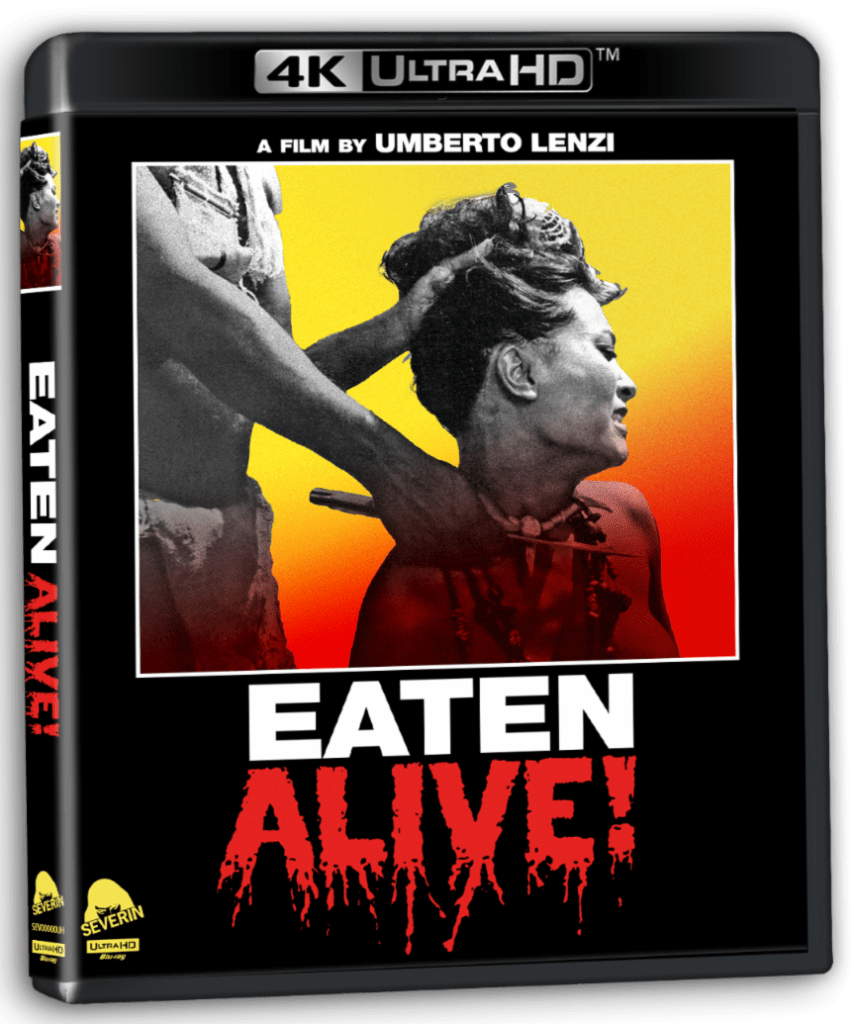
SEVERIN BLACK FRIDAY: Eaten Alive (1980)

Available during Severin’s Black Friday sale, this UHD of Umberto Lenzi’s film has so many extras, including commentary by Nathaniel Thompson and Troy Howarth; an interview with Lenzi; a Deodato Meats Lenzi featurette; the documentary Me Me Lai Bites Back; interviews; newly discovered alternate footage; a trailer and an exclusive booklet by Claire Donner Of The Miskatonic Institute Of Horror Studies.

The sale will take place from 12:01am EST on 11/29 to 11:59pm PST on 12/2 at Severin’s site.

What happens when you throw assassins in New York City, cannibals in the jungle and a Jim Jones-like cult leader into a big pot and set it to boil? You get Eaten Alive!

Sheila (Janet Agren, City of the Living Dead, Hands of Steel) is searching for her sister, Diana (Paola Senatore, Emanuelle in America)who has disappeared in the jungle. She hires Mark (Robert Kerman, Cannibal Holocaust) to help her find her way through the jungle. Oh yeah — and there are killers in the city using blow darts. That doesn’t matter so much once we’re in the jungle.

When they find Diana — after being chased by cannibals — they learn that she has joined the cult of Jonas (Ivan Rassimov, everyone cheer when he shows up to make this movie awesome), who abuses, murders, manipulates and mindfucks everyone and anyone he gets close to. Seriously, the minute Jonas shows up, this film goes off the rails. First, he burns a man on a funeral pyre and then orders his wife Mowara (Me Me Lai, who thanks to appearances in this film, Last Cannibal World and Man from Deep River is pretty much to this genre as Edwige Fenech, Barbara Bouchet or Nieves Navaro are to giallo) to be ritually raped. Then, he hypnotizes Sheila and takes her on an altar using a snake phallus covered in venom and blood (yep, really).

Jonas preaches the Book of Isaiah and pretty much owns everyone he can get his hands on, but Mowara, Sheila, Mark and Diana all attempt to escape. Diana and Mowara are overtaken by cannibals, with Diana graphically devoured while her sister and Mark watch helplessly. A helicopter arrives at the last minute to save them while the film goes into full exploitation mode, with the cult killing themselves ala Jonestown, leaving only one female survivor.

Oh man, I forgot! Mel Ferrer (The Visitor, Nightmare City) shows up as a professor!

Director Umberto Lenzi knows how to make a down and dirty film. He also knows how to keep it entertaining. Just witness other films he’s done like Ghosthouse! Plus, he’s the master of recycling, as this film re-uses the crocodile death and a woman being eaten from his 1972 film Sacrifice! (also starring Rassimov and Me Me Lai), Me Me Lai’s death from Ruggero Deodato’s Jungle Holocaust and a castration, a monkey being devoured and a man being eaten by a crocodile from Sergio Martino’s Slave of the Cannibal God. You could say he…cannibalized those movies! Sorry.

Again, keep in mind that these are rough films. They’re nearly indefensible, to be honest. I kind of wish the story of Jonas and his cult was more of the movie, with less of the cannibals. But you know, I can’t send notes back to Lenzi with a time machine or anything!

ARROW VIDEO SHAW SCOPE VOLUME 3 BOX SET: Killer Constable (1980)

In this movie, director Chih-Hung Kwei is remaking his frequent collaborator Chang Cheh’s The Invincible Fist and telling the tale of “Killer Constable” Leng Tian-Yin (Chen Kuan-tai). He’s been ordered by security chief of the Forbidden City Liu Jing Tian (Cho Tat-wah) — who has been commanded by Manchurian Empress Dowager Cixi — to bring back the five thieves that stole 2 million taels from the Royal Treasury dead or alive. When you’re called the Killer Constable, you never bring them back alive.

Trying to assemble his five best men, Leng learns that not even his brother, Cun Yi (Gam Sai-Yuk) wants to join him. He is tired of the brutal justice that his brother delivers. We witness this as Leng follows the thieves to a watermill and tortures one of them in front of his family. Yet you’re left to wonder if his rough style is warranted when one of his men, Peng Lai (Ai Fei), is rewarded for feeding the starving villagers by being staked and must be killed by Leng to ease his suffering. The thieves also hire Fan Jin-Peng (Jason Pai Piao), a killing master who murders elder constable Ma Zhong (Gam Biu) and injures Leng before being defeated.

Finally, after a battle with the leader of these thieves, Fang Feng-Jia (Ku Feng), and are helped by the intervention of Cun Yu. Leng is almost killed but is nursed back to health by Fang’s blind daughter Xiao Lan (Yau Chui-Ling). When Fang enters his home, instead of fighting, the Constable and he pretend to be friends in front of his daughter. In truth, it was Liu Jing Tian who stole the gold and sent Leng after him, as he knew that no one would survive. Another group of killers attack and Fang sacrifices himself to allow Leng to live, making him promise to care for his daughter. However, the Constable is driven with rage after his brother is killed, so he attacks Liu Jing Tian, killing many of his guards before wiping out the corrupt man. However, a trap also kills Leng, leaving Xiao Lan waiting for a father and protector who never arrives.

Kuei said that, “I simply wanted to depict how insignificant commoners are and how, under totalitarian rule, they turn out to be the victims.” While showing off the violence and combat that one expects from a Shaw Brothers movie, this also goes beyond to show the very real suffering that comes from that same brutality. As the only good person in the film is a blind woman — a scene repeated in The Killer as Ah Jong and Li Ying pretend to be old buddies for the benefit of the sightless Jennie — the moral is simple. The only pureness in this bloody universe can’t witness it.

Kuei was also inspired by another classic film: “I love Dr. Zhivago. In Killer Constable, I want to create a character like Zhivago. Despite his position in the high court, the protagonist is a righteous man. Yet in the corruption and poverty-stricken era at the end of the Qing dynasty, there is not much good he can do on his own. Hence he is deluded by society and lives his life foolishly.”

And yet in America, the most violent country in the world, all of this complexity struggles to be understood, as this played under the exploitation title Karate Exterminators.

Killer Constable was Chih-Hung Kwei’s only period wuxia film. He’d make his mark on many other genres, including women-in-prison (The Bamboo Dolls), modern crime (The Teahouse and its sequel Big Brother Cheng), women in trouble (The Bod Squad), comedy (Rat Catcher) and of course, his many horror films such as The Killer SnakesHex and Corpse Mania. In the 1990s, he moved to the United States where he opened a pizza shop. Yes, at one point in our reality, you could order a pizza made by the visionary director of The Boxer’s Omen.

His son, Ming Beaver Kwei, a producer of movies like My Lucky Star and The Meg, said of his father: “He’d bitch about his work every day, never quite satisfied how his work had turned out, or how it was being distributed. He was only ever happy when he knew for a day that a film had worked at the box office, then he’d start worrying again. He’d be so happy to know that his films were getting a second look today.”

The Arrow Video Shaw Scope Volume Three box set has a brand new 2K restoration of Killer Constable as well as three commentary tracks one by film critic and historian Tony Rayns, one by Frank Djeng and another by martial arts cinema expert Brian Bankston; alternate scenes from the South Korean version; an alternate English title sequence and a trailer.

You can get this set from MVD.

La Nuit de la Mort (1980)

I discovered this movie from Unsung Horrors, who said that it was “Somewhere in between Jean Rollin and Ogroff.”

How could I not want to see this?

Martine (Isabelle Goguey) has just left her boyfriend and taken on a live-in job as a nurse and housekeeper for a retirement home. Is it weird that it’s called the Deadlock House? Is it strange that Mademoiselle Hélène (Betty Beckers) keeps playing the same song incessantly on the piano? Why is everyone a vegetarian?

Trapped for her first two months and unable to take any calls, Martine soon learns the routines of the patients. Nicole (Charlotte De Turckheim) is on the same plan, waiting for the time she can see her boyfriend. But before that, they have to take care of the strange people here, including the always knitting, revolution spewing Jules (Michel Debrane), the unparalyzed wheelchair unbound Léon (Jean Ludow), the huggable and always hugging Pascal (Georges Lucas) and so many more, babbling about how life used to be so much better as they live out their dying days. There’s also the custodian, Flavien (Michel Flavius), who occasionally whips the old people when he isn’t bothering the girls.

Why two months? That’s how long the residents make a body last and they’re all hundreds of years old. As a nurse is due to go home, they take her from her bed, slice her throat and start to devour her body. Also: There’s a serial killer on the loose.

As good as this is, the ending is a let-down. The old people get sloppy after so many years of being ideal killers and eaters of people. Why? And just why — spoiler — get rid of Martine at the close like that? I’m all for a downer ending, but this is pointless after we’ve loved her for an entire movie. Otherwise, I really enjoyed it!

You can watch this on YouTube.