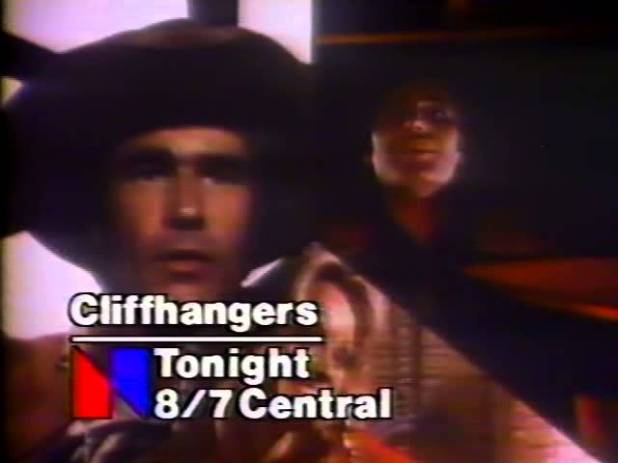
As part of the launch of Cliffhangers, NBC was really betting on Susan Anton. She’d started by singing commercial jingles for Muriel Cigarettes and the Serta Perfect Sleeper Mattress. She also had about thirty appearances on The Merv Griffin Show before getting one of the weirdest national TV show chances ever: a summer replacement variety series on ABC, Mel and Susan Together, produced by the Osmond Brothers.
He wasn’t a household name and no one knew who she was.
The show was off the air in four weeks, but she was picked as one of Time Magazine’s “Most Promising Faces of 1979.”
Fred Silverman remembered her when he moved to NBC and picked her for this show. The network even gave her NBC a special contract — just like the golden age of Hollywood — which had her make “an almost unprecedented number of appearances” to get known by the American TV audience.
She plays Susan Williams, who learns of the death of her reporter brother Alan, who was on the cusp of a major conspiracy story. An event was due to happen that would shock the world and someone had learned how to profit. His hit and run death didn’t sell with her. And seeing as how she’s also a reporter for The Dispatch, she picks up her brother’s work and tells her editor Bobby Richard (Ray Walston) that she has until May 15 — three weeks! — to learn the truth.
Starting with “Chapter 2: The Silent Enemy,” Susan would learn that a nuclear bomb had been built in America and was to be used to kill numerous world leaders during a peace summit at Camp David.
“Chapter 12: Crypt of Disaster” was part of the last episode of Cliffhangers that never aired in the U.S. Luckily, all of the episodes were edited into one movie, The Girl Who Saved The World. You can’t imagine my excitement when I watched this in syndication and learned how the story ended up.
1979 was Dracula’s year with the TV movie Vampire, Love at First Bite, the Frank Langella Dracula, Nosferatu the Vampyre, Salem’s Lot, Nocturna: Granddaughter of Dracula, Thirstand Nightwing all being released.
Let’s add one more.
The goal of The Curse of Dracula was to make the vampire a tragic hero devoid of camp. Michael Nouri was perfect for this. playing a bloodsucker who was also a professor of East European History at Southbay College in San Francisco.
His enemies were the grandson of his greatest challenge, Kurt von Helsing (Stephen Johns), and the daughter of one of his past loves, Mary Gibbons (Carol Baxter).
In this version of Dracula, the count has moved twety coffins packed with Transylvanian soil to America, but Kurt and Mary have used a computer to located and destroy twelve of them.To catch Dracula, Mary signs up for one of his night classes and at a party at his place afterward, she discovers that he knows who she is and just wants to be left alone.
The story started with “Chapter VI: Lifeblood” and would be the only Cliffhangers installment to reach its conclusion. It also gave birth to two movies, Dracula ’79* and World of Dracula. Ten chapters of The Curse of Dracula were produced, compared to eleven for Stop Susan Williams and twelve for The Secret Empire.
In the TV movie cut, Dracula removes the stake from his heart. That’s because there was a plan to create a Curse of Dracula TV show, but sadly, it was never to be.
It’s 1880 in Cheyenne, Wyoming. A group called the Phantom Riders are stealing gold, which gets U.S. Marshal Jim Donner (Geoffrey Scott) on the case. It turns out that these are no ordinary criminals. Instead, they’ve come from an Inner Earth alien city named Chimera.
The plot is lifted from the 1935 Gene Autry singing cowboy movie serial The Phantom Empire. There, Gene fights the Thunder Riders from a subterranean alien city named Murania.
With the series starting with “Chapter 3: Plunge Into Mystery” — Cliffhangers wanted to put people into the middle of the action — Donner is healing from being blasted with one of the Riders weapons. He later saves Maya (Pamela Brull), who is the daughter of Chimera’s overthrown ruler Demeter, with a whip just like Lash LaRue. Now, the city is commanded by her uncle orval (Mark Lenard, who was also Sarek, Spock’s father), a wheelchair riding maniac who wants to take over the world with the mind-controlling Compliatron, which is powered by gold.
There’s also another alien female named Tara (Diane Markoff) who is on the evil side yet has the hots for our hero. I remember being strangely attracted to her as a seven-year-old Sam and not knowing why.
The story expanded to have a greedy mine baron working with the evil side of Chimera, a giant spider, a mine collapse and even spaceships. But sadly, we’d never see these episodes in America. “Chapter 13: Partisans Unchained” and “Chapter 14: Escape to the Stars” would only play in Europe and we wouldn’t even get a compilation movie for The Secret Empire like the other two serials, Stop Susan Williams and The Curse of Dracula, had.
It’s funny because a lot of critics hated this segment, thinking that science fiction and cowboys had no business being in the same story. Maybe they didn’t know about the serial it was based on. Maybe no one was really ready for serials. But if they could have only released this two years later, when Raiders of the Lost Ark came out, this may have been a bigger success than it was.
As is the case with any actor who achieves a level of fame in the TV and film realms, Lee Majors, courtesy of his clout with The Six Million Dollar Man, was able to parlay his star into his own production company, Fawcett-Majors Productions, co-run with his then wife, Farrah Fawcett (the company dissolved upon their 1982 divorce). To help establish the company, during his 1977 contract negotiations for the series, Majors wanted his production shingle brought on as an independent producer in association with Universal Studios. While the negotiations soured between Majors, Universal, and ABC television, it didn’t matter: after five seasons, the show’s ratings, as well as those of its sister show, The Bionic Woman, declined, and both series were simultaneous cancelled in 1978.
Fawcett-Majors Productions made its feature film debut with the Vietnam war drama, Just a Little Inconvenience (1977) starring Majors, which aired on U.S. television. The company also produced the Farrah Fawcett-starring Somebody Killed Her Husband (1978) and Sunburn (1979) — both which flopped at the box office (and Saturn 3 sealed the deal on Farrah’s theatrical career). Meanwhile, Majors chose three films for himself, each which became popular, much-run HBO favorites: The Norseman (1978), Killer Fish(1979), and this action adventure — which, according to a 2015 interview with screenwriter Leigh Chapman, started out as Look Down and Die — about a rogue crew of The Magnificent Seven-styled steel workers against an evil corporation to complete a skyscraper project.
Now, if Leigh Chapman’s names rings a bell, that’s because she’s named dropped often around B&S About Movies with the blaxploitation classic Truck Turner, Dirty Mary, Crazy Larry, Chuck Norris’s The Octagon (1980), and The Fast and Furious precursor King of the Mountain.
For his director, Majors picked the Roger Corman-bred Steve Carver, who brought us the Pam Grier blaxploitationer The Arena, along with the mob epics Big Bad Mama and Capone. Remember when Hollywood tried to turn Heavyweight Boxing champ Ken Norton into a movie star? Steve Carver directed it: Drum. Then there’s Carver’s Chuck Norris two-fer with An Eye for An Eye and Lone Wolf McQuade. And we recently reviewed his own Fast and Furious precursor: Fast Charlie . . . the Moonbeam Rider.
Returning to his hometown of Lexington, Kentucky, and filmed in the surrounding Fayette County, Majors, acting as Executive Producer, pulled together all of the usual actors we care about here at B&S About Movies as his burly crew of steel workers: Jennifer O’Neill (The Psychic) as his construction damsel-in-distress, Art Carney (who co-starred with Farrah in Sunburn) as Pignose, George Kennedy (Top Line) as Big Lew, Terry Kiser (forever known as “Bernie” from Weekend at Bernie’s) as the ladies’ man, Valentino, character actor extraordinaire Albert Salmi (Escape from Planet of the Apes) as Tank, Robert Tessier (who got his start in the biker romp The Born Losers and co-starred with Burt Reynolds in The Longest Yard) as Cherokee, and the great Richard Lynch (Ground Rules) cast-against-type as a good guy (well, almost) with his character, Dancer.
It all starts with construction magnate Big Lew Cassidy — a guy who likes to get up the girders and get his hands dirty — who falls to his death (A.J Bacons, the stuntman who doubled for Kennedy, died when the airbag split on impact). So in steps Big Lew’s inexperienced, spunky daughter Cass Cassidy . . . and she’s determined to finish off the last nine floors and meet her father’s deadline before the bank forecloses.
But how?
By recruiting the best “ramrod” in the business. But according to Pignose: one’s dead, one’s on a project in Canada, and one’s in Saudi Arabia. So that only leaves the once great Harry Stamper(Bruce Willis) Mike Cattan (Lee Majors), but he washed-out of the steel biz to become a long-haul trucker. And, to be honest: Mike’s the only one crazy enough to fly to an asteroid to drill through a solid-iron rock attempt topping off an impossible nine floors in three weeks.
So, once Cass gets the reluctant ex-ramrod on board with the ol’ “I thought I was meeting a real man” speech, they’re off to recruit the “best of the best” (now this really is starting to sound a lot like Armageddon, sans the asteroid) to finish the job before Cassie’s slimy uncle Eddie (Harris Yulin!) and his partner Kellin (the always welcomed heavy, R.G Armstrong!) absorbs his estranged brother’s company.
While this Majors theatrical hopeful played in duplexes, triplexes and drive-ins, Steel — along with Agency starring Robert Mitchum and The Last Chase with Burgess Meredith — bombed at the box office. And the failure of the earlier The Norseman and Killer Fish didn’t help either. And, with that, Majors returned to a successful five-year run with ABC-TV’s The Fall Guy and a succession of successful TV movies throughout the ’80s and early ’90s, such as Starflight One, A Smoky Mountain Christmas, Fire: Trapped on the 37th Floor, and The Cover Girl Murders(which also starred Jennifer O’Neill).
Opinions vary on Steel. You can chalk it up to my youthful nostalgia for those HBO days of yore, but I love this movie and think it’s one Majors’s best. This is good ol’ fashioned, non-CGI filmmaking with real men on top of real steel girders, real prefabbed steel floors dangling from choppers, and real steel girders crushing real stretch Cadillac limos. And you can watch it all on You Tube.
As part of our May 2023 tribute to Roger Avery and Quentin Tarantino’s weekly podcast tribute to their days at Manhattan Beach’s Video Archives, here’s the link to their take on this Lee Majors favorite.
About the Author: You can learn more about the writings of R.D Francis on Facebook. He also writes for B&S About Movies.
Editor’s Note: This review originally ran on November 22, 2018. We are rerunning it as part of our “Lee Majors Week” of film reviews.
When I was a kid, there was an urban legend that Lee Majors moved to a small town outside Youngstown, Ohio, because the locals didn’t care what a big star he was. Everyone had an encounter with him, but many found his wife Farah Fawcett to be off-putting. I don’t know if these stories are true, but I want them to be. I do know that Lee and Farah did inspire the song “Midnight Train to Georgia,” though.
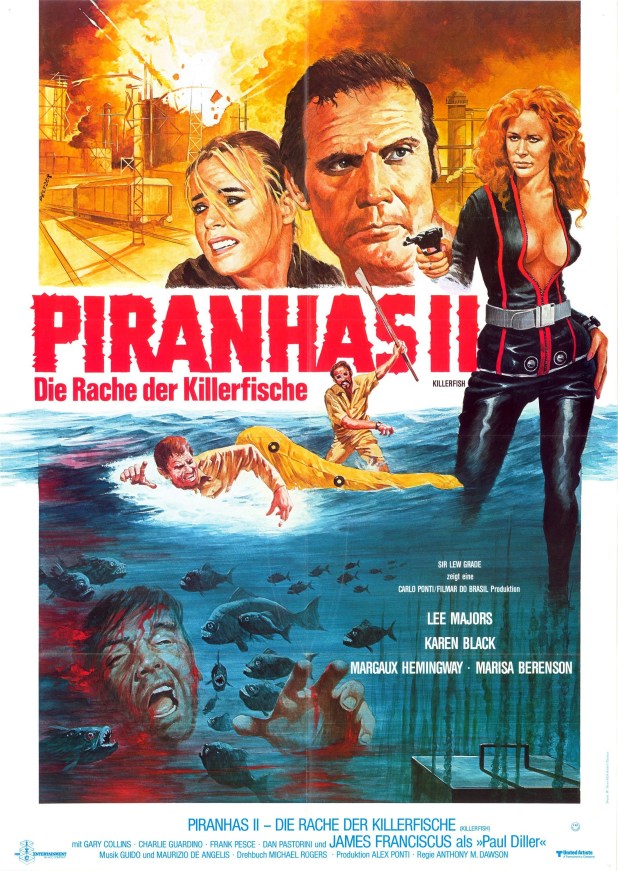
Let me sum this one up in short sentences: Priceless emeralds. Hidden jewels. Hungry piranha. Model shoot. Late 1970’s decor. Exotic Rio de Janeiro locations. Suspicion. Jealousy. More piranha.
Other than Lee Majors, this film is a cavalcade of my favorite stars. Well, maybe not favorite. But close. Karen Black is here! And there’s Margaux Hemingway, who is as good at being a supermodel as she is bad as an actress. And here’s James Franciscus (Beneath the Planet of the Apes) as the main guy you’re supposed to hate. And is that the doctor from Total Recall, Roy Brocksmith? Former NFL quarterback, NHRA drag racer and December 1980 Playgirl centerfold of the month Dan Pastorini come on down! Wow! It’s Anthony Steffen from The Night Evelyn Came Out of Her Grave! And finally, it’s the man whose The Sixth Sense ruined the syndicated episodes of Night Gallery, Hour Magazine host Gary Collins, the bane of my childhood!
This whole mess (but we love it here at B&S!) is directed by Antonio Margheriti, who we all know and love as the creator of perhaps the finest movie ever made, Yor, Hunter from the Future. The film was also one of three films that Fawcett-Majors Studios co-produced in 1979 — the others being Steel (also reviewed this week, look for it) starring Lee, and Farrah’s Sunburn . . . with Art Carney and Charles Grodin!
Killer Fish is more caper than Jaws rip-off. But hey, how many movies have Lee Majors sitting in a limo with a cane that has a crocodile’s shrunken head on it, much less him swimming through piranha? And that’s why Lee rocks our VHS world at B&S About Movies.
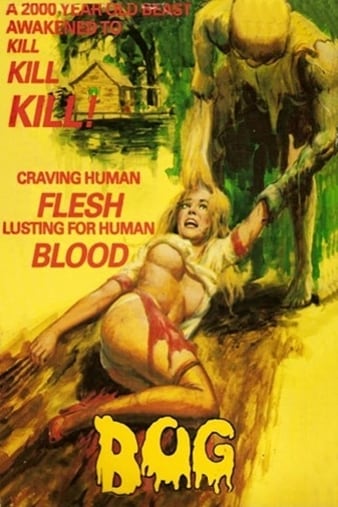
You know, dynamite fishing seems goofy enough and then it unleashes a prehistoric monster and that monster somehow only can live by drinking the blood of women.
Luckily, as they say, Gloria DeHaven is in this. Twice, really.
Bog tries to lure teenagers into the theaters and drive-ins with a hip, happening cast that included Aldo Ray, Leo Gordon and Marshall Thompson in support of DeHaven, a true star of the great old days of Hollywood now running through a swamp chasing and being chased by big eyed monsters.
Actually, I kind of love that this movie has so many older actors in it. And it also makes me wonder, why exactly do swamp creatures love human women so much? Do their own ladies get upset about it? And most importantly, what’s the point of fishing with dynamite?
This movie was originally called Friday the 13th until the makers of that franchise negotiated with this film’s producers to use that title. Well, the tales of Crystal Lake are better known than this film, but man, this is one weird slice of 1979 and that’s the way we like it.
It starts with our hero, David, being forced to kiss his father’s dead lips as he lies in a coffin while other kids snicker, “Now you’re an orphan.” If you think, “Well, that’s pretty dark,” you might want to stop watching right now.
It turns out that David watched his parents die in a murder-suicide and now suffers from horrific migraines while being raised by his puritanical aunt. It turns out that our hero’s father was obsessed with Africa and one of his father’s friends encourages the same thoughts in David, encouraging him to believe in ancient non-Christian deities.
This movie was started in 1968, is missing about thirty minutes and is still a dreamlike force that has stuck in my head since I watched it. It’s not perfect by any means but it’s weird in all the best of ways. It’s a movie obsessed with elephants, bread and kids making their own monkey gods to deal with death.
This movie moves as slow as it gets, like a doom metal band obsessively playing the same riff over and over with only slight deviations until suddenly you’ve been lured into a hazy daze and then they hit you over the head with an entirely new section of music before slowing down again and lurching right back into that same riff for another long, slow and grinding near-infinite length of time.
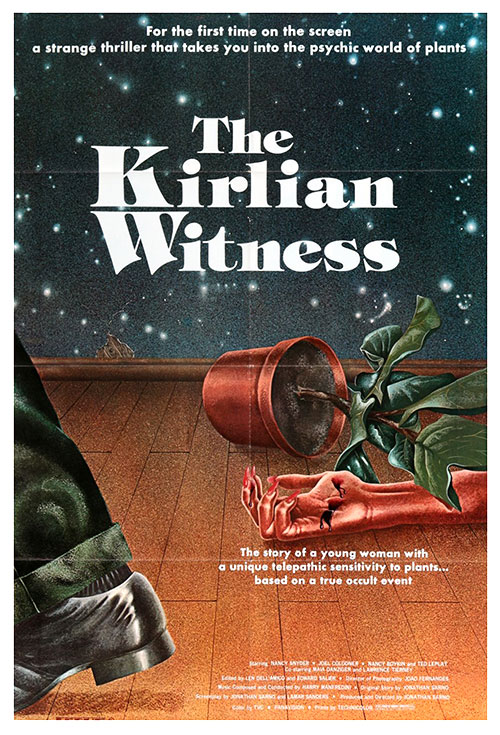
“For the first time on the screen a strange thriller that takes you into the psychic world of plants.”
Yes, in 1979, people were talking to their plants, using biofeedback devices to hear from them and even singing to them. For everyone obsessed with the 80s, let me tell you, the 70s were way better.
Director Jonathan Sarno did post-graduate work in playwriting and directing at the Yale School of Drama under directors Arthur Penn, George Roy Hill, Elia Kazan, Roberto Rosselini and novelist Jerzy Kozinski. He’s an artist and yet here he is, making a horror movie about psychic plants, but life is great that way. Sarno wrote this, along with Lamar Sanders, and also produced the movie and acts in it.
I don’t even know where to start with this movie. I mean, the phrase Kirlian is because the photographer detective at the heart of this movie, Rilla Hart, has a photo in this style that represents the energy field of the exotic plant that her sister Laurie owned before her death. And oh yeah, her sister could literally talk to that plant.
An occult low budget movie about talking plants and a psychic named Dusty who brags about how he has surpassed human existence and is one with the plants despite mainly working the night shift loaded trucks and also knows the exact moment that they will expire? What could make this better? How about a cameo by Lawrence Tierney as a police detective? Yeah, that’ll do it.
There’s another release of this called The Plants Are Watchingthat cuts a fair amount of footage, so go for this one. It’s so twisty and oddball that it could pretty much be classified as an American giallo, what with its dream logic and ending which reminded me of The Cat o’ Nine Tails. It’s a relatively sexless journey through the same end of the world New York City as Driller Killer, but you know, with plants.
Honestly, this movie is way better than it has any right to be. In a perfect world, it would have been the first film that Sarno turned into a cult film and we’d be celebrating everything he made afterward instead of him going into making travel videos. There’s honestly nothing else like it.
Oh yeah, one more thing.
In the credits, it thanks the owner of Day of the Triffidsfor the use of a scene from that movie. That man? Philip Yordan, whose strange movie Night Train to Terror is a nexus point in my strange film obsessions. Much like how the Church of Satan connects The Car, Tippi Hedren’s Roar and Jayne Mansfield, that movie is the crux of so many of the pathways that researching weird films has led me down.
Here’s a drink for this movie.
The Plants Are Drinking
1 oz. Midori
1 oz. vodka
1 oz. white rum
5 oz. lemonade
Stir the first three ingredients in a glass with ice.
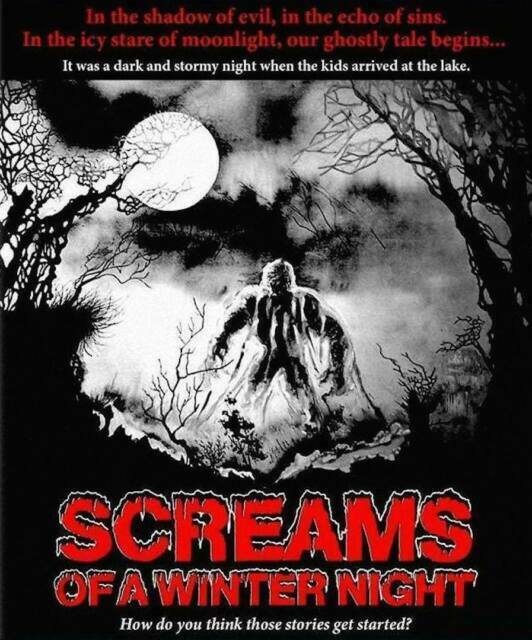
Screams of a Winter Night is a regional movie inspired by regional movies. Director James L. Wilson had played Santa Claus in the Disney movie Lefty, the Dingaling Lynx before getting inspired by the movies that Charles B. Pierce (The Town That Dreaded Sundown, The Legend of Boggy Creek) and Joy Houck (Creature from Black Lake) made. It has that hallmark of the regional film, a producer who was really a guy with some cash that never made a movie before, in this case, Mark Lovell, who was a real estate agent. And a local named William T. Cherry III made the special effects.
This movie does what Are You Afraid of the Dark? did for several seasons on Nickelodeon. A bunch of young people sit around a campfire telling stories, forming an effective anthology story that moves well and keeps you interested.
But man, what is really wrong with the characters in this movie? They go to John’s family’s cabin, which before that had belonged to the Durand family, who who weren’t just mysteriously killed at the cabin, they were found in pieces all over the place, possibly murdered by a demon called the Shataba. Why would you stay there after hearing this?
Made in Shreveport, Louisiana and premiering there, this movie feels like urban legends come to life, like the “Moss Point Man” that attacks a couple on lover’s lane, the “Green Light” that drives three college* fraternity kids mad and the story of a girl driven to insanity by a date rape.
The final story makes one of the girls frantic and before you know it, the wind has blows a window out and kills one of the girls before only four of the kids escape as the cabin crashes down. They run to the edge of a cliff and then they hear a howling behind them.
The Code Red release of Screams of a Winter Night includes the director’s cut of the film that runs two hours and has one more story of people being chased by a witch through a graveyard. Dimension Pictures — the people that put out Ruby, Return to Boggy Creek and Scum of the Earth — told the filmmakers that two hours was too long for the movie and that all the day-for-night footage wouldn’t show up well on drive-in screens.
This is a movie that sets up a really ominous mood from the very start. I appreciate that and love this movie because it feels like it was made by people who were excited at the prospect of creation instead of just commerce.
*This was shot at Caspari Hall, a dormitory on the campus of Northwestern State University in Natchitoches, Louisian. Its now abandoned and said to be haunted.
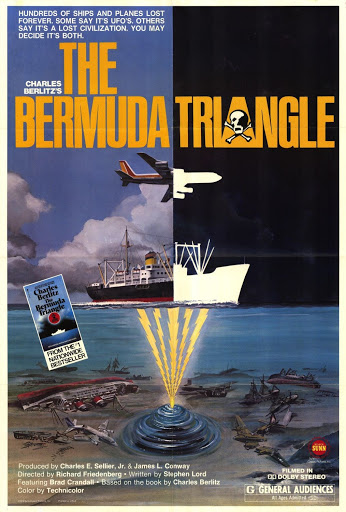
Charles Berlitz’s 1974 best-seller — 20 million copies! — The Bermuda Triangle codified the belief that this area in the North Atlantic used to be Atlantis and is now the cause of so many ship and airplane disappearances.
In 1978, Rene Cardonna Jr. used this book to inspire his ridiculous and amazing epic Bermuda Triangle. And somewhere in Utah, the folks at Sunn Classics were ready.
With good old Brad Crandall in his steady role as narrator, this film follows the blueprint of the best of the Sunn Classics docs. And by that, I mean that they throw a neverending torrent of increasingly ridiculous nontruths your way until you say, “Well, yeah, Atlantis is in the bottom of the Bermuda Triangle and oh look, there’s a spaceship flying through the streets.”
Seriously, the TV commercial for this movie — with said UFO floating down a major metropolitan street — caused me to run screaming in absolute fear, hiding in my grandparent’s house in utter years until The Car came on*.
There’s a line here that Crandall reads, “The lucky ones were the ones that died.” He’s talking about the Philadelphia Experiment, which won over low budget filmmakers enough that it shows up here and in The Final Countdown and, yes, The Philadelphia Experiment.
Somewhere in this house, we have a copy of the British Man, Myth and Magic that has smelly old pages but every single one of them is filled with increasingly weirder ideas. This movie is just like that, made by producers who used a computer to try and figure out what movies that low-income families wanted to see. Well, they get me every single time.
As for Berlitz, 1975 saw the publication of Larry Kusche’s The Bermuda Triangle Mystery — Solved, which takes Kusche to such task for errors in his reporting of missing ships that this phrase appears: “If Berlitz were to report that a boat were red, the chance of it being some other color is almost a certainty.”
*In 1979, I estimate that I watched that movie 400 times.







 B&S About Movies
You must be logged in to post a comment.