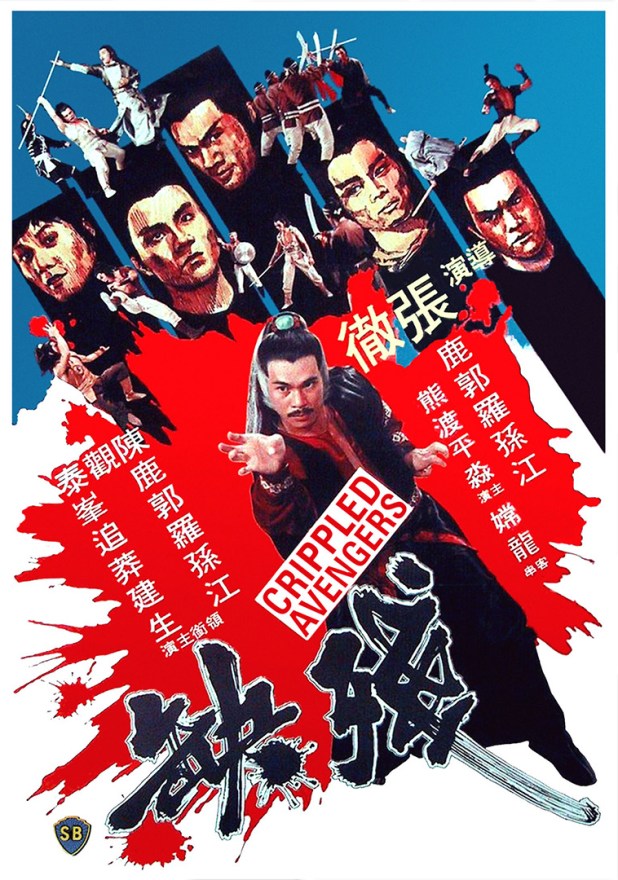
Released in the U.S. as Mortal Combat and The Return of the 5 Deadly Venoms, this is the story of how Chu Twin and his son Chu Cho Chang have started a reign of terror. It all begins when Chu Twin returns home to find his wife murdered and his son critcally injured, with his arms amputated from the elbows down. Making him iron arms and training him in kung fu, the two find that revenge is not enough and now they have become the villains, crippling four men who get in their way.
The town’s blacksmith is forced to drink a burning liquid that takes his voice whole a ear clap from Chu Twin makes him deaf as well. A travelling salesman is blinded by Chu Cho Chang and another has his legs torn off just for bumping into Chu Cho Chang. When kung fu Yuan Yi, he attempts to make the evil doers pay for this damage, but instead finds his head crushed inside a vice, reducing his intelligence to that of an idiot.
As they escape to the temple of Yuan Yi’s master, they each find ways to use their injuries to their advantage, with the blacksmith increasing his vision, the salesman being able to hear a leaf hit the ground and the legless man gains iron legs and feet. As for Yuan Yi, he now sees fighting as a child’s game, happily laughing even in the face of death.
The four men return on Chu Twin’s 45th birthday and exact their revenge, battling a series of kung fu experts before challenging the evil master and his iron fisted son.
Four of the Venoms — Kuo Chui, Lu Feng, Sun Chien and Lo Meng — show up in this film and it’s quite literally a living and breathing cartoon. Movies like this are why you seek out the films of Shaw Brothers and director Chang Cheh.
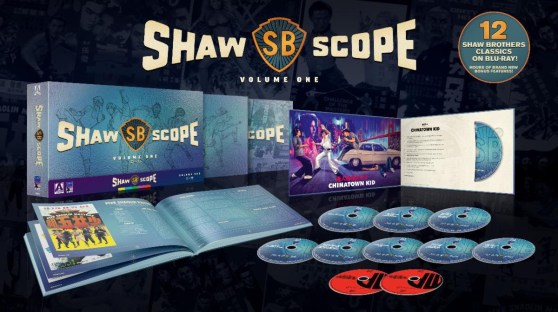
The Arrow Video Shaw Scope Volume One box set has a brand new 2K restoration of Crippled Avengers from the original negative by Arrow Films. There’s uncompressed Mandarin and English original mono audio, as well as newly translated English subtitles and English hard-of-hearing subtitles for the English dubs.
There’s also a Hong Kong trailer and image gallery.
You can also stream this movie on the Arrow player. Visit ARROW to start your 30-day free trial. Subscriptions are available for $4.99 monthly or $49.99 yearly. ARROW is available in the US, Canada, the UK and Ireland on the following Apps/devices: Roku (all Roku sticks, boxes, devices, etc), Apple TV & iOS devices, Android TV and mobile devices, Fire TV (all Amazon Fire TV Sticks, boxes, etc), and on all web browsers at https://www.arrow-player.com.
EDITOR’S NOTE: This Shaw Brothers film originally was on our site on May 8, 2021. Now that Arrow Video’s absolutely essential Shaw Scope set is out, we’re checking out the best possible version of this movie available. Check out how you can get this box below.
The Venom Mob had been in Shaw Brothers movies before, but this was the film where they showed the world that they were amongst the greatest theatrical martial artists of all time.
As the master of the Poison Clan dies, he sends his last student Yang Tieh (Chiang Sheng) to warn Yun (Ku Feng) that five of his students — Gao “Scorpion” Ji, Meng “Lizard” Tianxia, Liang “Toad” Shen, Qi “Snake” Dong and Zhang “Centipede” Yiaotian — plan on stealing the clan’s gold. Yang must fight them all or join with the ones still loyal to the clan to fulfill his dying teacher’s final request.
What follows is a series of double crosses — and triple crosses even — as the students of the Poison Clan battle to either keep the money for themselves or save it for the good of the clan. Because Yang Tieh knows a small bit of each of their five styles, he may have a chance to live. Yet who, if anyone, will be the ally he needs to win?
Chang Cheh made more than ninety films, among them the One-Armed Swordsman series, Crippled Avengers, Kid with the Golden Arm and many more. His style of heroic bloodshed films has influenced everyone from John Woo to Robert Rodriguez and Quentin Tarantino. Quite frankly, this is the kind of movie whose fingerprints you’ll see all over so many movies.
The Arrow Video Shaw Scope Volume One box set has a brand new 2K restoration of Five Deadly Venoms from the original negative by Arrow Films. There’s uncompressed Mandarin, Cantonese mono and English original mono audio, as well as newly translated English subtitles and English hard-of-hearing subtitles for the English dubs.
There’s also brand new commentaryby critic Simon Abrams, a feature on Chang Cheh, the Hong Kong and U.S. trailers and an image gallery.
You can also stream this movie on the Arrow player. Visit ARROW to start your 30-day free trial. Subscriptions are available for $4.99 monthly or $49.99 yearly. ARROW is available in the US, Canada, the UK and Ireland on the following Apps/devices: Roku (all Roku sticks, boxes, devices, etc), Apple TV & iOS devices, Android TV and mobile devices, Fire TV (all Amazon Fire TV Sticks, boxes, etc), and on all web browsers at https://www.arrow-player.com.
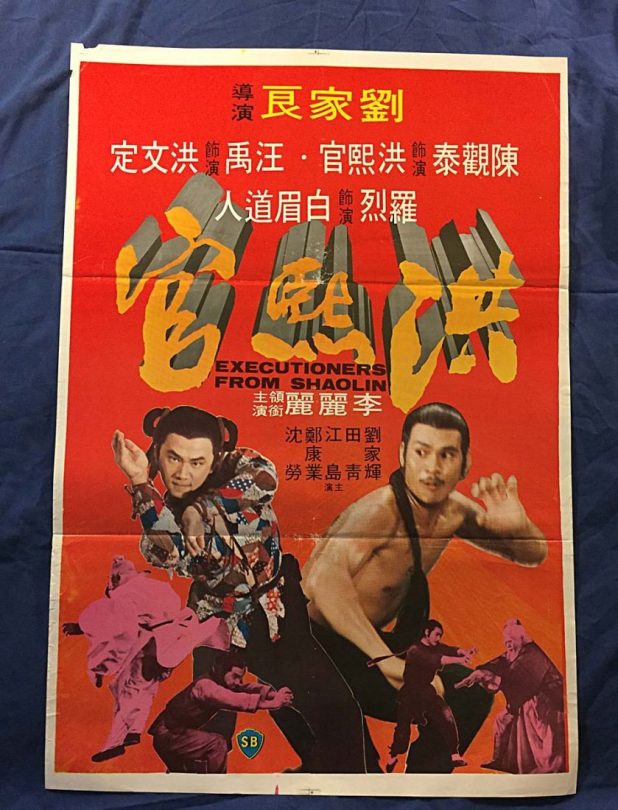
Having learned that the revolutionaries were using Shaolin Temple as an undercover, the Manchurian Count ordered Priest Pai Mei and his top disciple Kao Tsin Chung, Governor of Kwangtung and Kwangsi, to raid the Shaolin Temple. They surrounded the Temple and set fire to it. In an attempt to rescue his disciples, Priest Chi Shan enters into a crucial duel with Priest Pai Mei.”
Pai Mei blows your mind five minutes into this movie by pulling his privates into his groin, which enables him to not be hurt by low blows. Yes, he’s a formidable opponent and I’d be afraid to try that move. I mean, what if things didn’t drop when you were done?
Pai Mei’s student Kao Tsin-chung (Kong Do) and his army destroy the temple and chase away the students. One of them, Tung Chin-chin, (Gordon Liu), takes out as many as he can before arrows lay him low. Only Hung Hsi-Kuan (Kuan Tai Chen) survives to keep the rest of the students safe.
Over the next decade, he marries martial artist Wing Chun (Lily Li) and together they have a son that they raise as Hong masters the tiger style and works up the courage to battle Pai Mei. When he finally battles the man, he must face an entire army of his soldiers. Yet he knows Pai Mei is weak between one and three in the afternoon — this knowledge amazes me — and thinks that all of his acupuncture training can help him find the villain’s weak spot. However, he gets his foot caught in the evil one’s groin — just like his master in the opening — and is killed.
Can his son combine the tiger style of his father and the crane style of his mother to finally gain the revenge that has eluded the Shaolin? From the empty backdrop opening — a Chia-Liang Liu trademark to the samples that the Wu Tang Clan used on “Wu Tang Clan Ain’t Nuthin To Fuck With” this is an amazing and unforgettable movie.
The Arrow Video Shaw Scope Volume One box set has a gorgeous version of Executioners of Shaolin. There’s uncompressed Mandarin and English original mono audio, as well as newly translated English subtitles and English hard-of-hearing subtitles for the English dubs.
It also has alternate opening English credits, the Hong Kong and U.S. theatrical trailers, and an image gallery.
You can also stream this movie on the Arrow player. Visit ARROW to start your 30-day free trial. Subscriptions are available for $4.99 monthly or $49.99 yearly. ARROW is available in the US, Canada, the UK and Ireland on the following Apps/devices: Roku (all Roku sticks, boxes, devices, etc), Apple TV & iOS devices, Android TV and mobile devices, Fire TV (all Amazon Fire TV Sticks, boxes, etc), and on all web browsers at https://www.arrow-player.com.
Also known as Challenge of the Ninja, Shaolin vs. Ninja and Shaolin Challenges Ninja, this Lau Kar Leung-directed film has more Japanese martial arts on display than you usually see from a Hong Kong movie. The Japanese characters are also treated with respect, unlike many of these movies, and Lau insisted that none of the fights ended in death.
Ho Tao (Gordon Liu) has entered an arranged marriage with the daughter of one of his father’s Japanese business associates. When he watches her do martial arts, Yumiko Koda’s style is too rough and unladylike for Ho Tao, so he demands that she study the more feminine styles of Chinese kung fu. She’s too modern of a woman for him as well, as she immediately leaves him behind and starts training with her childhood friend Takeno.
To get her back, Ho Tao creates a challenge to determine which country has the better kung fu. Of course, he also has poor manners and infuriates the Japanese martial artists so much that their battles become real and not just exhibitions. Plus, now that Takeno has Yumiko Koda again, he doesn’t plan on giving her up and will use all of his ninjitsu skills to keep her in Japan.
There are a variety of styles on display here — samurai sword versus straight sword, Sino-Okinawan karate vs. Chinese Drunken Fist, Japanese crab-style vs. Chinese crane fist and many more — and those battles make this an incredibly interesting movie for those that love armed and unarmed combat.
It’s also rare in that it’s set in the 1930s and not the far-flung past. I had a blast with this film, a movie that mixes romance, comedy and battles into one overall great time.
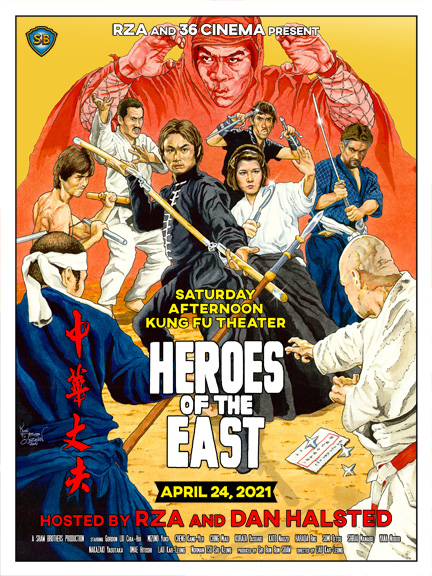
The Arrow Video Shaw Scope Volume One box set has a gorgeous version of Heroes from the East with uncompressed Mandarin, Cantonese and English original mono audio, as well as newly translated English subtitles and English hard-of-hearing subtitles for the English dubs.
It also has new commentary from A Brief History of the Martial Arts author Jonathan Clements, an interview with Yasuaki Kurata, alternate opening credits for Shaolin Challenges Ninjaand a trailer and U.S. TV commercial.
You can also stream this movie on the Arrow player. Visit ARROW to start your 30-day free trial. Subscriptions are available for $4.99 monthly or $49.99 yearly. ARROW is available in the US, Canada, the UK and Ireland on the following Apps/devices: Roku (all Roku sticks, boxes, devices, etc), Apple TV & iOS devices, Android TV and mobile devices, Fire TV (all Amazon Fire TV Sticks, boxes, etc), and on all web browsers at https://www.arrow-player.com.
Editor’s Note: Sam Panico previously reviewed this Christian post-apocalyptic film as part of our January 2019 “Tabloid Week” chronicling sensationalistic documentaries. As we fill out our ever-expanding database of reviews with some of the “Christian Cinema” films from the ’70s we’ve missed, we brought this prophetic classic back for another look. To say Sam and I are obsessed by this film is an understatement.And you should be, as well.And, one day: I’ll finally sell Sam onJonathan Livingston Seagull.
Who better than family nature film purveyor Pacific International (Challenge to be Free, Mountain Family Robinson, and The Adventures of the Wildness Family) to give us a good ol’ biblical prophecy gloom n’ doomer to scare the little ones into believing in Jesus? Hey, like the film tells us: 70 percent of The Holy Bible‘s predictions by the prophets of old have come true. So, if those predictions did, it follows the other 30 percent will happen in our lifetime.
Are you rejoicing in the light, yet?
Prior to the film breaking box office records, the 1970 book of the same title, penned by eschatologist (a theology concerned with the final events of history as told in The Bible) Hal Lindsay, competed for the title as one of the decade’s bestsellers (and with his first book!) against Erich von Däniken’s 1968 tome, Chariots of the Gods?, itself turned into a 1970 film. By the early ’90s, The Late Great Planet Earth sold 30 millions copies.
Initially, the book was produced as a prime-time documentary special in 1975. The ratings response was so favorable, a new, theatrical version narrated by Orson Welles was rushed into theaters. In addition to Welles’s voiceovers and occasional pop-ins on camera, Lindsey appears to weave his theories about the Earth’s future based on the prophets Jeremiah and Isaiah, Ezekiel and Amos in foretelling the arrival of Jesus as the Messiah.
While many of Lindsey’s projections — both in book and on film — are dated, and some proven wrong in our modern world, credit is due to Lindsey’s non-fire and brimstone approach (say, as opposed to Pastor Estus Pirkle’s approach in a series of Ron Ormond films, starting with If Footmen Tire You, What Will Horses Do?) in speaking calmly and reasonably correlating The Bible in a realistic, contemporary content — such as reasoning the weird creatures spoken of in biblical prophecies to modern-day war craft.
That is until those scenes . . . of a computer analysis calculating if Jimmy Carter, Ted Kennedy, or Ronald Reagan (the whole “666” thing), is the Antichrist . . . wow. That’s a hard swallow. Then there’s our “final judgement” by way of a 10-nation confederacy (i.e., Daniel’s 10-horned beast), which Lindsey sees as the European Common Market, going into battle with Russia (aka, The Bible‘s Magog), which will happen in 1988. But not before the gravitational pull of “The Jupiter Effect” in 1982 stirs up the sun and scores the Earth as warm up for the end times. And, if all else fails, another educated talking head tells us that man will never make it past the year 2000.
Believe it not, as goofy as it all may sound, before Lindsey brought a soupçon of common sense to the discussion, the pastors and preachers I dealt with in my youth actually believed in literal, “wild and mysterious creatures of multiple heads and multiple horns with tails of scorpions,” cooked up by Satan himself, would run loose on the Earth. Pure insanity. And we believed it. And it scared us stiff.
Whatever. As you can see, we’re still here.
Sure, we can scoff now, but this flick scared the shite out of us wee lads, leaving us a paranoid mess ripe for a “Friday Night Activity” evening at the local Baptist indoctrination center. I mean, come on, what little kid wants to not be called up in the Rapture and left to suffer on Earth, then go to Hell, afterwards? Seriously. Talk about child abuse. Youth pastors telling you Communist minions will force you to watch your mom and dad being executed. That you’ll be beheaded if you don’t allow yourself be “marked” by a red-hot “666” branding iron.
Anyway, Lindsey has since written 14 more books. When his fifth book, 1983’s The 1980s: Countdown to Armageddon became a runaway best-seller, luckily, it wasn’t made into a sequel film. Once again, he predicted the Rapture would happen at the end of the ’80s. And we are still waiting for Russia to attack Iran to gain control of the oil supply, with China not letting Russia get away with that nonsense — and all hell, literally, breaks loose — sans the multi-head and horned beasts (we hope).
Oddly enough: No predictions about a cyberattack on U.S. oil pipelines. Nothing about bat-born viruses cooked up in labs. Nada about social-media backed CHOP and CHAZ warriors overthrowing whole police precincts and running Walgreen’s out of business and out of San Francisco — none of that reality made it to either of Lindsay’s books or the film. And so it goes, as the prophetic wheels of fate, spin. . . .
You can watch The Late Great Planet Earth on the Internet Archive.org. You say you want your own copy? See, we told you an obsession for it would happen. The fine folks at Scorpion Releasing issued the film on Blu-ray available at Diabolik DVD.
You need more “Jupiter Effect” in your films, you say? Well, then, you need to check out our review for The Spirits of Jupiter. More predicted destruction of the Nostradamus variety? Then check out Japan’s inversion of an Irwin Allen flick with 1974’s Nosutoradamusu no daiyogen.
EDITOR’S NOTE: We wrote about this movie during our giallo week on September 16, 2021. Check it out and please share your thoughts on this film in the comments.
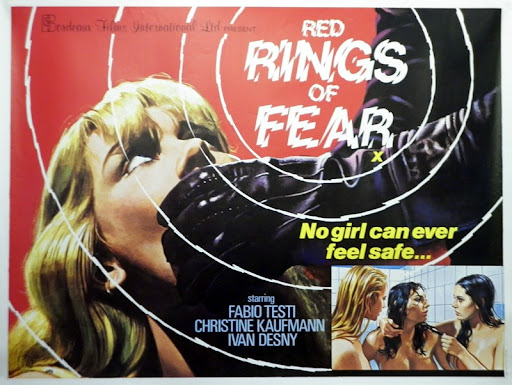
This is the third entry in a loosely linked series of films that are known by the pretty much pervy title of the Schoolgirls in Peril trilogy. All of these movies have young girls shockingly be interested in sex and being murdered for it.
The series starts with Massimo Dallamano’s What Have You Done to Solange?, one of the best films in the giallo form, which he followed with What Have They Done to Your Daughters? Sadly, Dallamano would die before this movie was made, but he is credited for writing the screenplay.
When the body of a teenage girl is discovered wrapped in plastic twelve years before Laura Palmer, Inspector Gianni DiSalvo (Fabio Testi) finds himself investigating a clique of young women called The Inseparables” who attend a prestigious all-girls school and were friends with the victim.
Most of this movie recycles the past two films, but man, the ending where the first killer casually kills himself and then there’s the reveal of the real person behind everything? That makes watching this all worthwhile.
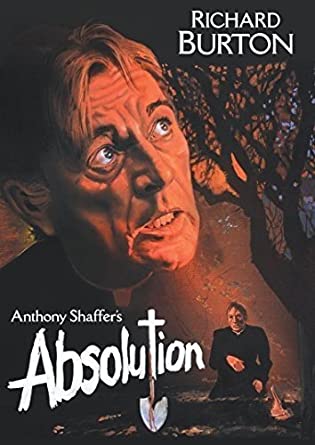
Between Anthony Page and playwright Anthony Shaffer, we can forgive this movie for feeling like more of a stage play in parts, but man, the end sure is tense and dark and I was kind of shocked by it because what’s this doing on a Mill Creek fifty pack. I realize that statement is ridiculous because just about anything can be on a Mill Creek fifty pack.
Father Goddard’s (Richrad Burton) favorite student at the all boys’ school is Benjamin Stanfield while he despises the boy’s friend Arthur Dyson and has even less use for the bum they’re friends with in the woods, Blakey, who is played by a very young Billy Connolly.
The biggest mistake the priest makes is to tell his students that he can’t tell the police anything that he is told under the seal of confession, which starts a series of pranks that Stanfield plays on his mentor. Or does he? The film plays fast and loose with how we see things — a Catholic giallo with no women? — and there was a lot of argument between the creatives of how much they wanted to tip their hand and how they wanted to handle the final reveal.
Producer Elliott Kastner was made aware of the script by Richard Burton, who had apparently waited several years to play the lead. He even turned down the opportunity to play King Lear on stage to be in this movie. Michael Caine and Christopher Lee had both been considered for the part.
EDITOR’S NOTE: We originally wrote about this movie on February 22, 2018. We’ve added to that original article in this revision for our Mill Creek month.
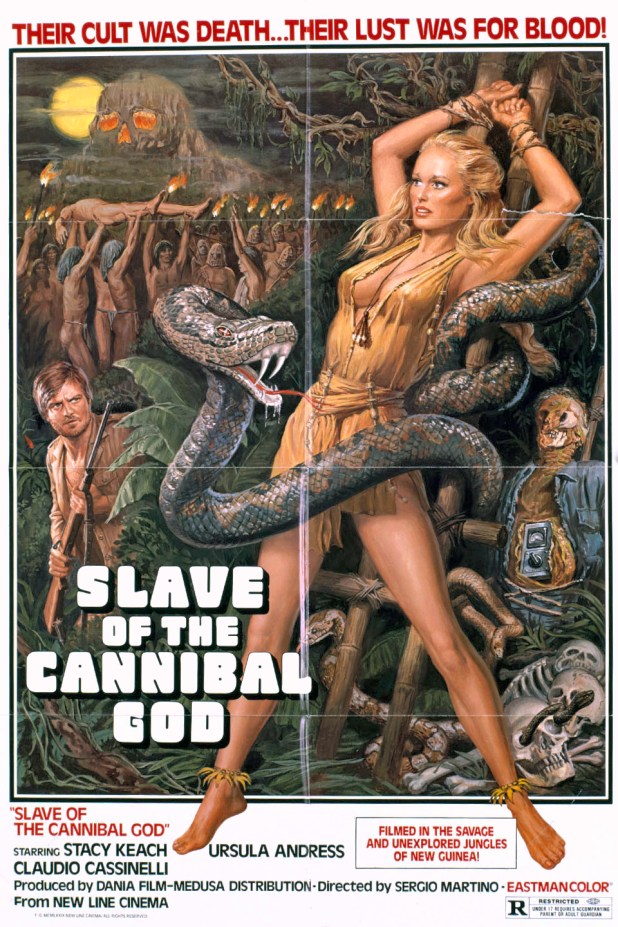
Also known as La Montagna del Dio Cannibale, Slave of the Cannibal Godand Prisoner of the Cannibal God, don’t be fooled by the pedigree of having big stars like Ursula Andress and Stacy Keach. This film may seem restrained at first, but it goes absolutely insane by the final ten minutes. I mean, when has Sergio Martino (All the Colors of the Dark, Your Vice is a Locked Room and Only I Have the Key) ever steered us wrong?
Susan Stevenson (Andress, the original Bond girl) is looking for her husband Henry, an anthropologist who has gone missing in the jungles of New Guinea. Along with her brother Arthur and Professor Edward Foster (Keach), they travel to the mountain Ra Ra Me, a cursed place where the authorities will not allow expeditions.
Of course, they go there. What did you expect? They’re stupid white people. The jungle thanks them with attacks from spiders, snakes and alligators. And then Manolo (Claudio Cassinelli, What Have They Done to Your Daughters?), a jungle guide, joins their party.
Bad idea. Arthur has sex with one of the native girls, who is already married, but a cannibal attacks and kills both the husband and wife. A missionary makes them leave, as they have brought nothing but sin, adultery and death to his village. Don’t fuck in the woods. And don’t bring your Western values to the jungle.
It turns out that none of their reasons for coming to the island are altruistic. Susan and Arthur have no interest in finding her husband, but are instead looking for uranium deposits. Foster is there just to find the tribe of cannibals who had taken him captive in the past so he can wipe them off the face of the earth.
On the way, a waterfall takes Foster after Arthur doesn’t save him. And they reach the mountain, which isn’t just a uranium mine. It’s made from uranium. And how do we know that? Well, Susan’s husband’s body is being worshipped as a god because the Geiger counter he had keeps ticking, like a heartbeat.
At this point, the film rewards you by going completely off the rails, descending into chaos. A native attacks Susan, but is stopped by the tribe and castrated, then his penis is cooked and eaten. Another villager has sex with a giant pig. Meanwhile, the drums build in a hypnotic rhythm as another female villager masturbates (this is from the “director’s special selection” version, there are several cuts of the film). As this happens, Susan is stripped and smeared with orange honey by two naked female cannibals before being fed her own brother. Manolo is tortured. It feels like a nightmare you can’t wake up from, one of the only moments where the Martino who delivered a quick succession of giallo a decade or so before rears his artistic head.
Then, it’s over, with Manolo and Susan escaping. I mean, one would think that there would be years of therapy after this. But I don’t know. Perhaps she can get over this easier than most.
This isn’t a great movie. It might not even be good. It is entertaining for the last section, but there’s also the problematic issue of animal torture in the film — a monkey is slowly eaten by a snake and lizard being cut apart. Martino claims he tacked on these scenes at the distributor’s insistence. I guess the cannibal audience — an outgrowth of the audience for mondo films — needed more than just Ursula’s breasts and a dummy of Keach getting killed for their kicks.
DAY24 — 2 CLOSE 4 COMFORT: A main character suffers from claustrophobia(and was Clint Eastwood “too close for comfort” in that editing suite with Jack Ging?).
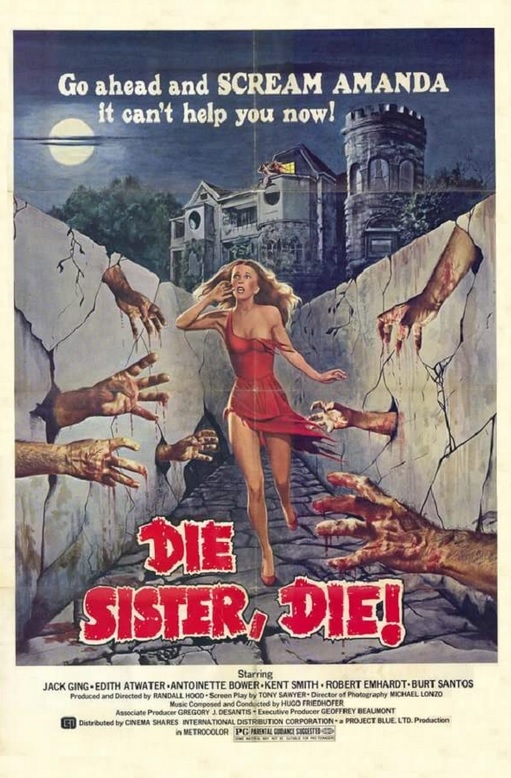
If only there was an olive-skinned Italian beauty adorned in a graveyard-appropriate mini dress and heels escaping a phalanx of zombie arms in an errant set piece from Paul Naschy’s Horror Rises from the Tomb and Panic Beats.
Well, actually . . . as the plot unfolds, our faux-Naschy Giallo babe, here, is British-American bombshell TV actress (from the late ’50s to the late ’80s) Antoinette Bower (Superbeast, Blood Song, Prom Night, Time Walker), so, it’s not a total loss. Well, yes it is: For as the beauty of Annie blinds us, instead, we get a “Hagsploitation” romp with a down-and-out Edith Atwater (our “Day 24” shut-in, here) — as our “screaming Amanda.” And, come to think of it, even though she was still stunning, the way Hollyweird objectifies women, even at youthful 39, our divine Ms. Bower — who never ends up in a red dress and heels nor is on the run — is on the cosine of appropriation of hagsploition.
So, goodbye pseudo Paul Naschy Giallo ripoff. Hello, psychobiddy riot.
Warning: This scene does not occur in the actual film.And where’s Clint’s credit?
Yes, the old hag in this exploiter, Edith Atwater, you know best from Boris Karloff and Bela Lugosi’s The Body Snatcher (1945), which was her third feature film; she also appeared in Strait-Jacket (1964) with Joan Crawford (herself a “hag” actress with the likes of Berserk! and Trog), then fell into a lot of TV work for the remainder of her career into the mid-’80s to pay the bills.
Atwater was just one of the many, ’40s startlets finding work in the hagploitation, aka psychobiddy, sub-genre where old, crusty women either terrorize “sinning” young women or simply are jealous of their youth, so they “gaslight” them into insanity (and sometimes string ’em up in cellars or dungeons or attics). In line behind Joan Crawford was Tallulah Bankhead with Die! Die! My Darling! (1965), studio starlet Veronica Lake, who took her final bow with Flesh Feast (1970), Wanda Hendrix (thumpy-whumpy goes my heart) closing out her career at the age of 44 with the Gothic, Civil War tale, the really fine The Oval Portrait (1972), and ex-20th Century Fox studio-starlet Jeanne Crain (skyrockets . . . rainbows . . . unicorns) attempted an early ’70s comeback with The Night God Screamed (1971). And let’s not forget Agnes Moorehead in Dear Dead Delilah (1972). Oh, toss Cult of the Damned, the aka’d “horror version” of Angel, Angel Down We Go (Let’s rock ‘n’ roll, Jen, baby!) that starred 1944 “Best Actress” Oscar Winner Jennifer Jones (The Song of Bernadette) on the hag stacks.
The Review
The plot of Die Sister, Die! concerns the greed of Edward (Jack Ging; our “Clint” connection): he tires of the “allowance” granted him by his sister Amanda (Edith Atwater) as he becomes impatient for her death and his inheritance. To hasten her demise, or at least stop her suicides (twice in one year) from being thwarted, Edward hires Esther Harper (Antoinette Bower), an employment-desperate, discredited ex-nurse to watch over her. The $25,000 deal: When Amanda tries for her third suicide attempt, let her succeed — if a heart attack isn’t induced, first. To Edward’s dismay, Esther and Amanda take a shine to one another; now Esther is less than enthusiastic about killing the old woman (e.g., induce a heart attack) — instead becoming more curious about the secrets held in the house, especially as to the whereabouts of a mysterious third sibling, Nell. (Two shut-ins! Where’s my “bonus points,” Scarecrow Video folks?) Nell, of course, either took the money and ran off to Europe, or Amanda killed her, or Nell killed pop, and so on, etc.
So, yeah, sorry. No zombies. Just a lot of Henry James-screw turning mixed with some Hitchcockian-hallucinations amid the twisted Edward and Esther romance.
Yes, this was, in fact, a Hitchcockian “passion project” by producer and director Randall Hood, who got his start working with the horror maestro on The Alfred Hitchcock Hour in the mid-’60s. His other two films: The children’s film The Two Little Bears (1961), which starred Eddie Albert, later of Green Acres TV fame . . . and vaudevillian slapsticker Soupy Sales, if that tells you anything. Then something called The Touching and the Not Touching (1965), which sounds like a soft-porn-cum-sexploitation flick . . . only it stars Robert Walker, Jr. (Charlie X from Star Trek: TOS) with Asian actors — never heard of it in all my UHF or VHS years.
As you can see by the dual years in our review’s title, Die Sister, Die! was a beleaguered production. While its pseudo-Gothic proceedings look like it was shot sometime in the Hammer-Edgar Allan Poe-inspired ’60s, it was actually shot in 1972. Randall Hood ran into production problems and the completed, but unedited film, languished on the shelf. Then, on August 16, 1976, at the age 48, Hood, died of cancer.
In steps the film’s star, Jack Ging.
Now, for your ’80s TV kiddies, you’ll remember Jack Ging in his most famous role as the recurring General Harlan “Bull” Fulbright on NBC-TV’s The A-Team. If you’re a B&S About Movies frequent visitor, you know he got his start in Ghost of Dragstrip Hollow (1959). Then there’s you spaghetti western fans who know Ging for his working alongside his longtime pal, Clint Eastwood, in Hang ‘Em High (1968) and High Plains Drifter (1973). Jing also starred in Eastwood’s Play Misty for Me (1971), as well as Sssssss (1973), and the TV air disaster romps Terror in the Sky (1971) and The Disappearance of Flight 412 (1974).
As you can see by the credits — of which we barely scratched the surface — Jack Ging was never the “star” or leading man, but he was always a solid, stock support player. Which is why completing Die, Sister Die! was so important to him: it was his lone, leading man role where his name led on the marquee.
So, back to Jack Ging’s longtime friendship with Clint Eastwood: Opinions vary, but it is believed that, as a favor to his friend, Clint ghost-edited the film. Randall Hood’s longtime friend, the 206-plus credited composer Hugo Friedhoffer (Sergeant York and Casablanca are two of them), who retired after working on Airport (1970), signed on to score the film as a favor to Hood. So distraught by the death, Friedhoffer never scored another film.
Also supporting in this Gothic take on Roman Polanski’s Repulsion (1965) — which made the UHF-TV ’80s rounds as The Companion — is Kent Smith, who goes all the way back to the classic, Cat People (1942), and Robert Emhardt, who I’ll always remember in my pop’s cherished 3:10 to Yuma (1957). Thanks to the cast — especially the effectively sinister Jack Ging — this somewhat dry, TV movie-paced mystery thriller is worth a watch. Freidhoffer’s all-original score is, of course, excellent.
Eastwood assist or not, the film is also expertly edited, but no editor is without a solid cinematographer providing the frames. To that end, Michael Lonzo, a respected camera man who has provided commentary tracks and supplements to DVD reissues of classic films, such as Love Is a Many-Splendored Thing (1955), Doctor Zhivago (1965), and Meet Me in St. Louis (1944), delivers a well-lit, well-shot film. So bravo to Jack Ging for seeing it through, six years after the fact. Die Sister, Die! is a well-made, solidly acted, good watch of a film filled with my own, drive-in undercard and UHF-TV memories.
The Remake?
Die Sister, Die! also has its fans, one of which is the prolific Dustin Ferguson (110-plus films strong since 2007, with eight films in various states of production) who completed a 2013 (cheesier, over the top) remake starring Brinke Stevens in the gaslighted, Edith Atwater role.
We supply links to watch for all of those films in the reviews — most on Tubi or You Tube. As for Die Sister, Die!, you can watch it as a free-with-ads stream on Tubi. Oh, and here’s the trailer.
About the Author: You can learn more about the writings of R.D Francis on Facebook. He also writes for B&S About Movies.
DAY 22 — BEASTS OF BURDEN: One where a horse/donkey/mule/ox, etc. (or a jungle cat?), is doing some serious work.
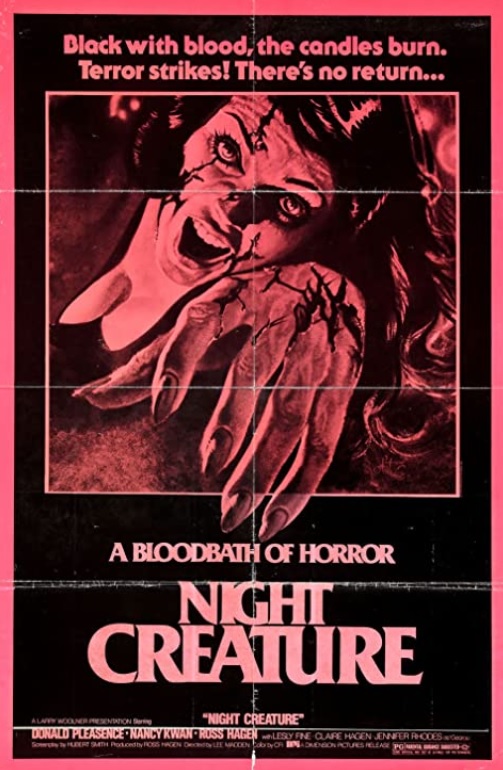
Sam, the head honcho at B&S About Movies, speaks a lot of celluloid truths: one of them is that Donald Pleasence really will take anything for a paycheck. Now, Ross Hagan, we know that he always takes everything offered. But wow . . . why is the stunning Nancy Kwan, here? Well, when times are tough and a buck is a buck, you sign on the dotted line for a ripoff of The Most Dangerous Game* — only set on a hunter’s private island. To that end: Donnie is our big-game hunter (and entrepreneur, race car driver, archeological temple restorer, etc.) who brings a killer leopard to his private island, turns it loose, and starts his hunt. Oops! Don’s daughter, played by Nancy Kwan, with her Texan squeeze, played by Ross Hagan, show up for an unexpected visit. Or something or other. . . .
Yeah, in the tradition of William Girdler’s Grizzly, we sort have a Jaws ripoff, here, or as we like to say, a “Bastard Pups of Jaws,” with a killer leopard on the loose, gnawing its way through its cast . . . like one of those killer dog flicks (which we explore in full, with our “Ten Horror Movie Dogs” feature) starring Joe Don Baker, David McCallum, and Richard Crenna. Yep. Just like a William Girdler flick — be it Grizzly . . . or Abby or Project: Kill or Day of the Animals or, hell, The Manitou, which, even though it’s based on a best-selling novel, is still a cash-in on The Omen — Night Creature, aka the poor leopard who was captured by ol’ Donnie and dumped here, doesn’t have an original spot on its hide.
But wait . . . it’s an all black leopard.
Eh, all I know is that Lee Madden, he of my beloved biker romps Hell’s Angels ’69 (1969) and Angel Unchained (1970), is knocking out his second horror film of the triple-threat that takes Charles Manson, washed-up studio contract players, aka “Hags,” and Jesus Christ to exploitation task with The Night God Screamed (1971).
Sadly, even with my fandom for those entries in Madden’s resume, I’ve never made the effort to seek out his sexploitation-action romp about three girls running their own brothel with The Manhanders (1974), which is an oversight that only a Mill Creek public domain box set can correct. I will not, however, ever . . . never, subject myself to Mr. Madden’s final film, Ghost Fever, for I have no desire to see a movie with TV’s George Jefferson as its star. (Besides, Madden knew a real dog when he scratches the fleas: he took the Alan Smithee credit.) Anyway, after Angel Unchained, this is Madden’s second and final writing credit, which, again, serves as his second and final horror film after — IMO — his best film, The Night God Screamed.
Speaking of movie wisdoms: Bill Van Ryn of Drive-In Asylum loves films — such as Prey — where nothing happens. But I don’t even think the Ryn can handle these maddening Madden reels of nothingness. Thankfully, someone took the time to cut this meandering, 83-minute snore fest into a 13-minute edit. Yeah, its like that: 70-plus minutes of this film isn’t necessary to get to the point of it all.
However, I’d be remiss if I didn’t tell you something about the film.
Well, it’s not — in spite of the “Donald Pleasence of Halloween” plug — a horror film: this is pure a thriller . . . with no thrills nor suspense. And the leopard is just a regular, run-of-the-mill leopard: it’s not possessed by Satan or injected with any manipulated DNA strands. The poor leopard is just sacred — after it’s capture from its jungle home in Thailand — and dumped into a foreign habitat. Wouldn’t you be pissed off after being drugged and caged and dumped in a foreign wood? Man encroaches on the animals’ environment, but the animal is the “monster.” So either kill it or capture it, for the tourism trade can’t suffer.
And suffer the animal does.
We are in the middle of Thailand and shooting on the sly, so PETA wasn’t on site, and it’s 1978 pre-CGI, so yes: We have ourselves a vile-as-fuck Ruggero Deodato joint of the who-gives-a-fuck-about-spider monkeys-and-river turtles variety, for we need the cat to do what we need it to do before we loose “the Golden Hour.”
Then there’s the not so “magical” cinematography.
Here we are, in the middle of one of the most exotic lands on the friggin’ planet, and yet, Lee Madden managed to make Thailand look like a shot-through-cheese cloth fucking mess. Even the Nancy Kwan, Jennifer Rhodes, and Russ Hagan (as our resident Texan-styled tour guide, natch) sub-plotted love triangle is an utter bore. Oh, but out-sucking the lover’s plot is the POV-cat stalking, which is out-sucked by the voice over narration required to thread the travel log footage into non-coherency.
Everything in this movie sucks. Shame on Lee Madden for snookering a film studio for a free Thailand vacation as a poor leopard suffered for it.
Don’t pay a time for this offense to cinema. Watch it for free on You Tube — if only to scratch another Donald Pleasence flick off that must-watch-everything-Donnie-ever-did watch list.
* We run down the “human death sport” genre in our review of Elio Petri’s sci-if pop art’er, The 10th Victim.
About the Author: You can learn more about the writings of R.D Francis on Facebook.He also writes forB&S About Movies.







 B&S About Movies
You must be logged in to post a comment.