Junesploitation: Napoli spara! (1977)

June 18: Junesploitation’s topic of the day — as suggested by F This Movie— is Gangsters! We’re excited to tackle a different genre every day, so check back and see what’s next.

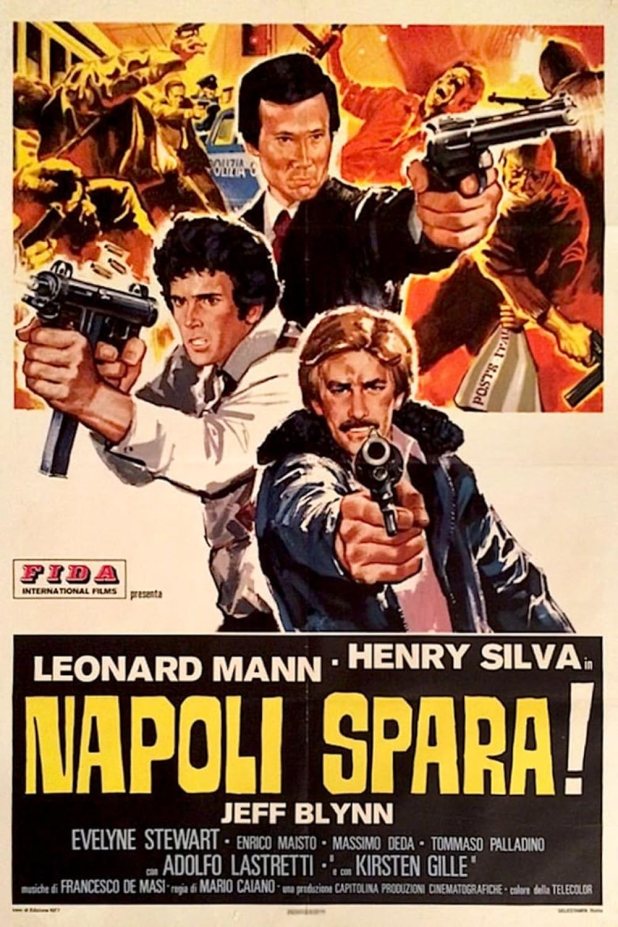
Weapons of Death comes from the Commissioner Betti (Violent Rome, Violent Naples and Special Cop in Action) cinematic universe as a spin off of the character Gennarino (Massimo Deda). Betti is also in this, except now he’s played by Leonard Mann instead of Maurizio Merli. And now, in the place of Umberto Lenzi, there’s Mario Caiano (Nightmare Castle) in charge of the show.

The villain is the main reason to watch this. Henry Silva is always absolutely perfect and here he’s as awesome as you’d hoped as a hit man named Santoro. He has the protection of crime boss Don Alfredo (Tino Bianchi). He’s able to train so many people to do robberies and murders that he puts not just Belli job in jeopardy, but his reputation. That’s because the one time that Santoro gets a gun on him, he lets the policeman live, telling him, “You go your way and I’ll go mine.” That’s how smart he is, as he gets more out of not killing Betti as he would have shooting him.

At the same time, the other crime families all begin to hate Santoro for how out of control he is — one of his major crimes has masked men running wild in the streets, shooting people and kicking women in the stomach — and they try to rub him out.

This movie lives up to the poliziotteschi madness that its fans want, as it has kids turned into young gangsters, a motorcycle rider getting beheaded and a man being castrated in prison. Also, Ida Galli. Or Evelyn Stewart. You know, whatever name you prefer. And it looks out of control because a lot of this was filmed without permits, closing streets or even informing the crowds of people in some of the scenes that they were filming. Instead, they had the camera inside a box on a truck. Italy, I will always love you.

You can watch this on YouTube.

Junesploitation: Felicity (1977)

June 13: Junesploitation’s topic of the day — as suggested by F This Movie— is Ozploitation We’re excited to tackle a different genre every day, so check back and see what’s next.

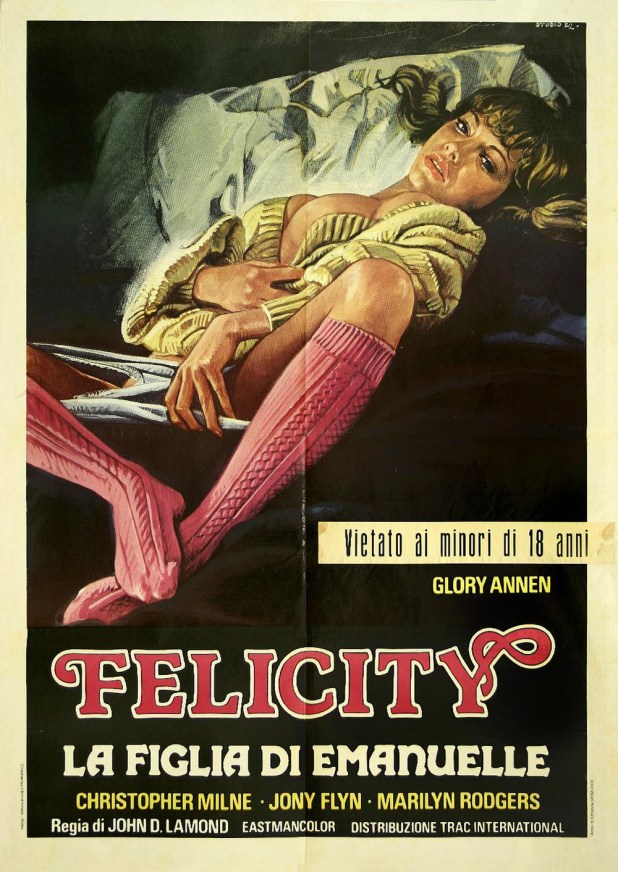
John D. Lamond worked in promotion before directing his first two movies, Australia After Dark and The ABC of Love and Sex. These mondo films were both successes which led to him making his first narrative film, which is Felicity. He also wrote Sky Pirates and directed the slasher Nightmares.

For this one, he was inspired by Just Jaeckin’s Emmanuelle to the point that the book gets references multiple times and there’s even a similar wicker chair. He said, “The French have always been able to make their films NOT be pornographic, they’d be erotic. They were classy – the most they could ever say was softcore. And the way they did it, they made pretty images that looked like a Singapore Airlines TV commercial, they had nice fashion, good photography and nice music. And that way it dresses it up and makes it all chocolate boxy… I thought okay, the way to do that on a film budget is to go somewhere exotic. Make sure the people are pretty and they don’t have pimples. Don’t be sordid in any way, have pretty music and exotic locations, nice lighting and nice fashion. So even though it was a tiny film, we came up to Hong Kong and we got all the clothes tailor made for them, so that they fitted properly.”

Felicity Robinson (Glory Annen, PreyThe Lonely Lady) has spent most of her life in boarding school, forever dreaming of the kind of true love — and plenty of lust — she has read about. Well, she mostly reads Emmanuelle and The Story of O (you can even see Udo Keir and Corinne Clery on the cover). She also occasionally has sapphic interludes with her Willows End Ladies College classmate Jenny (Jody Hanson) that mean more to Jenny than Felicity.

Then, her father arranges a trip to Hong Kong to visit his friends Christine (Marilyn Rodgers, Patrick) and Stephen (Gordon Charles). As soon as she gets there, Felicity spies on the two as they make love. Christine realizes this and decides to introduce Felicity to the ways of love, first having her be deflowered by the much older Andrew (David Bradshaw) and then the exotic Me Ling (Joni Flynn, Monty Python and the Holy GrailOctopussy), who takes her on a journey through the erotic world of the East. But ah, Felicity remains traditional and eventually falls in love with a nice young boy named Miles (Chris Milne, Thirst).

There’s even a scene where the characters go to see The ABC of Love and Sex, which Lamond said was a “total Roger Corman.” He also intended to make a sequel, Felicity in the Garden of Pleasures, that the government organization known as the South Australian Film Corporation would invest in. Controversy resulted and the movie was never made.

Felicity’s voice — and the reason this might feel so charming instead of lecherous — belong to Diane Lamond, the director’s wife. They pull another Emmanuelle move by claiming that the story was written by Felicity Robinson.

Sadly, Glory Annen’s went through some dark times in her life. She was the partner of racehorse owner Ivan Allan for more than a decade and when the relationship ended, both she and her mother were evicted from their home. This led to a major British court case which “established that parties to ancillary relief court proceedings may generally expect the information they have provided about their finances to remain confidential and protected from publication.”

After Annen died in 2017, several documents she wrote regarding her relationship have been released and are currently being used to create an expose of Allan, the British legal system and the criminal elements in the world of horse racing. Her last role was in Lamond’s True Flies.

I had so much fun watching this movie. I’m certain I watched it furtively on Cinemax After Dark along with stand outs such as Eleven Days, Eleven NightsEmanuelle in BangkokGwendolineThe Secrets of Love: Three Rakish Tales and Young Lady Chatterley II. These movies seemed so naughty then — well, Joe D’Amato’s work still is sleazetastic — and watching this today, I felt the same way that people that once got arrested for watching nudie cuties must have felt as hardcore started playing legally.

Junesploitation: Karate for Life (1977)

June 9: Junesploitation’s topic of the day — as suggested by F This Movie— is Kung Fu! We’re excited to tackle a different genre every day, so check back and see what’s next.

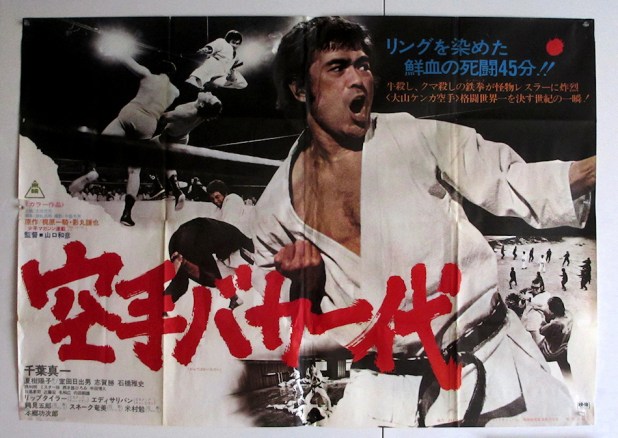
Karate for Life (Karate Baka Ichidai which means A Karate Crazy Life) is the third and final movie in Sonny Chiba and director Kazuhiko Yamaguchi’s series of movies about Kyokushin Karate master Mas Oyama. They’re based on the Karate Baka Ichidai manga that was drawn by Jirō Tsunoda and Jōya Kagemaru and written by Ikki Kajiwara. That comic book and the anime led to a karate boom in Japan and the artwork inspired the Street Fighter series and definitely is why you fight a bull in Karate Champ.

Chiba plays Oyama in all three movies and he has the belief that his martial arts is better than what he calls “dance” kung fu. There are some wild ways the movies prove this, as Chiba battles a bull in Kenka Karate Kyokushinken, which means Fighting Karate Kyokushin Fist. It was released in English speaking countries as Champion of Death and Karate Bullfighter. Not to be outdone, the sequel — Kenka Karate Kyokushin Burai Ken which means Fighting Karate-Brutal Ultimate Truth Fist — has Oyama literally battle a bear. Or a man in a bear costume, but what did you expect? That’s why it’s called Karate Bearfighter here.

Chiba actually studied for several years under Oyama — who has a cameo in the second movie — and achieved the rank of 4th Dan in the style. You can see his love for his master and the art in this movie, which mythologizes the abilities of Kyokushin Karate to somehow even more superhuman levels than the first two movies, minus the animal versus human battles.

This film is bookended by Oyama battling a karate school that he believes is inferior. He enters the school at the start of the film and battles nearly a hundred of their students, decimating them, before they cover the floor with oil to ruin his balance. It barely matters as he destroys even more of them and then plucks the eye out of the sensei, who follows him for the entire movie, waiting to attack, before Oyama fights him in a hall of mirrors as if this were a Japanese by way of Korean hero Enter the Dragon and climaxes with Oyama launching that man off a cliff.

In between, looking to make money to help street children, Oyama becomes involved with pro wrestling, which is used to entertain U.S. troops occupying post-war Japan. Despite giving up plenty of size, Oyama again obliterates everyone he faces and refuses to throw matches for the Yakuza organized crime figures that run it all. However, after he saves the life of a prostitute named Reiko (Yoko Natsuki) who is planning to kill herself after being assaulted by soldiers. Needing money to save a friend after they become sick, he finds himself coming back to wrestling but now he’s in death matches — ala the Tiger Mask manga and anime — that are real battles to one person being killed. Of course, as you expect, he absolutely crushes everyone.

There’s a lot to love here, from a hero that says, “Justice without power is nothing. Power without justice is just violence” which is kind of like Chiba renaming himself JJ Sonny Chiba and the JJ was for Japan Justice to pro wrestling scenes that have the names of each hold dynamically appearing on screen as if they were Shaw Brothers secret techniques, I was on the edge of my seat throughout.

Speaking of pro wrestling, this has Mr. Chin in the cast. According to a biography I found online, Mr. Chin was born Yuichi Deguchi and was a judo style martial artist who started his working life in the Hyogo prefecture’s riot police unit before becoming part of the “Pro Judo” International Judo Association that was founded by Tatsukuma Ushijima as a way for judo fighters to make money putting on bouts and touring before the rise of Rikidozan’s JWA.

After that, Deguchi joined the All Japan Pro Wrestling Association, an Osaka-based promotion that was the first to air pro wrestling on Japanese television. Mostly American soldiers were used as heels other than a man named P.Y. Chong, AKA Harold Watanabe, AKA Memphis legend Tojo Yamamoto (which makes sense to me finally as to how Phil Hickerson got his Asian name latter in his career, Py Chu Hi).

After being part of JWA’s interpromotional Japan Championship Series in October of 1956, Deguchi joined Osaka locals Michiaki “Fireball Kid” Yoshimura, future famous All Japan Pro Wrestling referee Kanji “Joe” Higuchi and Hideyuki Nagasawa in joining the JWA. He became Mr. Chin and dressed in Chinese clothes and became one of the first wrestlers to use the poison mist as well as being one of the first native heels.

Chin feuded with Giant Baba, who took him out of wrestling for two months with one of his big boot kicks. After time in the hospital and encouragement from the nurse who would become his wife, Mr. Chin returned and in one match bit Baba in the chest, giving him a scar that he would carry throughout his career.

After stomach issues, Deguchi did some acting and came back in 1970 for IWE. He traveled to the U.S. for several years on an excursion, reforming his team with Yamamoto and using the name Mr. Kamikaze. He returned in 1976 as a gaijin heel by the name of Mr. Yoto and would later become part of the Independent Gurentai Army with Goro Tsurumi and Katzuso Ooiyama as their managing, taking back his Mr. Chin name. Just before IWE went out of business, he would lose to Hiromichi “Samson” Fuyuki by DQ on the final show at a playground.

As for the IWA, when they went out of business, Masao Inoue, Ashura Hara, Tsurumi and Fuyuki would join AJPW and their biggest star Rusher Kimura would take Isamu Teranishi and Animal Hamaguchi with him to New Japan Pro Wrestling for the first invasion angle in Japanese wrestling history, one that would later inspire the battles with UWFI and the NWO. Meanwhile, IWE founder Isao Yoshihara would become one of NJPW’s bookers. As for Goro Tsurumi, he would run a local indy by the name of IWA Kakuto Shijuku, in which he was the only star and battle masked locals and other indy journeymen like Shoji Nakamaki and Yukihide Ueno.

But what about Mr. Chin? After IWE went out of business, he worked all over the world — even the Middle East — he would eventually debut for Frontier Martial Arts Pro Wrestling at the age of sixty in 1993. He was a comedy match character who would open shows, often wrestling young trainees like future ECW star Masato Tanaka. He also feuded with GOSAKU (who I once wrestled in WMF when he used the name Biomonster DNA) who was using the gimmick name of Undertaker Gosaku and Mr. Chin was Jinsei Chinzaki, taking off from Jinsei “Hakushi” Shinzaki. Sadly, Yuichi Deguchi died of chornic renal failure — after a life dealing with diabetes — in 1995.

Speaking of Japanese actors who would be famous and yet unknown to American audiences, Toshiyuki Tsuchiyama is in this. He’s better known for the mecha suit he wore as Johnny Sokko.

There was a two-part remake of this film, Shin Karate Baka Ichidai: Kakutōsha, directed by Takeshi Miyasaka and released in 2003 and 2004. The second film has pro wrestlers Keiji Mutoh, Masakatsu Funaki and kickboxer and former K-1 referee Nobuaki Kakuda in it.

You can watch this on Tubi.
Junesploitation: The Lincoln Conspiracy (1977)

June 4: Junesploitation’s topic of the day — as suggested by F This Movie— is Free Space! We’re excited to tackle a different genre every day, so check back and see what’s next.

I’m obsessed by the true fact movies that Sunn Classics and Schick Sunn Classics released in the 1970s. There’s Peter Graves telling the world about The Mysterious Monsters, Rod Serling narrating The Outer Space Connection, a movie about 70s hot topic The Bermuda Triangle, the religious strangeness of In Search of Noah’s Ark and In Search of Historic Jesus,  The Amazing World of Psychic Phenomena, near-death experiences in Beyond and Back and Beyond Death’s Door, the snuff disasters of Encounter With Disaster and two that I had never been able to find. One is pretty much lost, The President Must Die, and the other is today’s movie, The Lincoln Conspiracy.

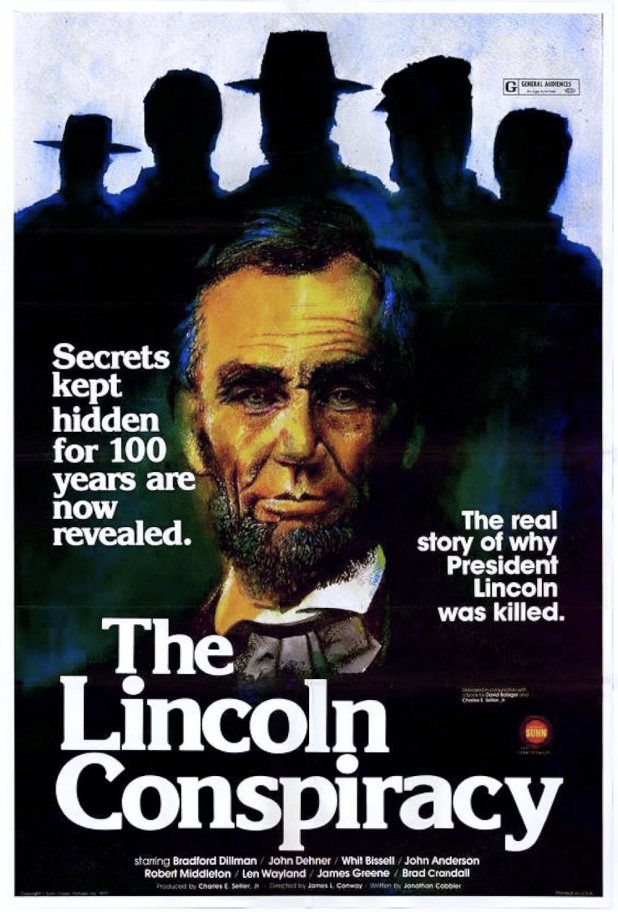
“Ladies and gentlemen, everyone sitting in this audience has been exposed to the traditional story of the assassination of President Lincoln. For over a century history books have taught us that the murder was committed by a crazed actor named John Wilkes Booth. The history books go on to say a few southern rebels helped him and no one else. The motion picture you are about to see will shock you. Because the true story of President Lincoln’s assassination can not be found in any history book. It is a story of corruption, treachery and cover-up. It is a story every American has a right to know.”

With that opening, we’re off and running with this movie, which was based on the book of the same name by David W. Balsiger and Charles E. Sellier Jr. If that last name sounds familiar, he’s the man behind so many of these movies. He has a wild life story, starting as a Cajun Catholic, converting to Mormonism and then to evangelical Christianity. He also wrote The Life and Times of Grizzly Adams and founded Sunn with Rayland Jenson and Patrick Frawley. They were the kings of market research and four-walling, a process in which they bought space at a theater and did all the ads, then collected all the ticket money. They realized that there was a Christian audience that wanted G rated movies on one hand and paranormal ones on the other. Sunn was ahead of its time when it comes to what is on basic cable today.

It made the movie look better to be based on a book. Schick Sunn Classic Books started to put this out, which is a genius movie that exploitation masters since Kroger Babb have used to make money. The main idea of the book and the movie is that historians and have been part of a big cover-up. This all started when President Abraham Lincoln’s Secretary of War Edwin M. Stanton, Union spy Lafayette C. Baker, Senator Benjamin F. Wade, Senator John Conness, other congressional Radical Republicansm and a cabal of Northern bankers and speculators all wanted to capture the President and keep him hidden until they cold impeach him. The reason? Lincoln wanted to unite the country after the Civil War and they were upset that they would lose money.

Baker found out that actor John Wilkes Booth wanted to kidnap Lincoln and was brought into the plan. After he failed several times, he was told to stop and instead, he decided on his own to kill Lincoln on April 14. He had a diary that incriminated several of the men who paid for him to do the plot and they were panicked. A Confederate double agent James William Boyd was killed and the trial that followed and the autopsy were altered to make it appear as if Booth was killed, while sympathetic people got him to England.

Maybe. You know how speculative history is.

The book and film’s theories and perhaps not all that well researched use of source material* made historians lose their minds. But weren’t they covering it up?

The movie casts Robert Middleton (Even Angels Eat Beans, amongst many other movies) as Secretary of War Edwin M. Stanton, John Dehner (who was an animator on Fantasia and was a radio actor before a long acting career in movies and TV) as Colonel Lafayette C. Baker, Bradford Dillman (BugPiranhaThe Swarm) as John Wilkes Booth, Ted Henning as Robert Campbell, Whit Bissell (a scientist in Creature from the Black Lagoon and I Was a Teenage Werewolf), Ken Kercheval (Dallas), as John Surratt, James Green (One Hour to Live) as Capt. James William Boyd, Len Wayland as Ward H. Lamon, Edmund Lupinski as Edwin Henson, Greg Oliver (the killer in Scalpel) as Rep. George Julian, Frank Schuller as Lt. Everton Conger, Patrick Wright (Track of the Moon Beast) as Major Thomas Eckert), Sonny Shroyer (Enos from The Dukes of Hazzard) as Lewis Paine, Wallace Wilkinson (who was in Cannibals ApocalypseInvasion U.S.A. and The Visitor) as Dr. Samuel Mudd, Mimi Honce (who was also in Scalpel and Asylum of Satan) as Mary Surratt, Ben Jones (yes, this movie has both Cooter and Enos in it) as Samuel Arnold, John Anderson (the car salesman in Psycho) as Lincoln and Sunn’s narrator in nearly every movie, Brad Crandall, who also was the voice of movies and shows like the “The Curse of Dracula” parts of Cliffhangers!, The Texas Chainsaw Massacre 2 and the Wizard on the early 80s Spider-Man cartoon.

Basically, it’s a Southern all-star low budget cast.

Director James L. Conway went from Sunn movies like their Classics Illustrated TV movies such as Last of the Mohicans to Beyond and BackHangar 18The Boogens and episodes of shows from Hardcastle and McCormickStar Trek: The Next Generation and Charmed to The Orville and The Magicians. He also produced Charmed and created the series Burke’s Law and University Hospital.

As always with Sunn, I loved every minute of this, no matter how fake the beards looked.

Want to watch it? It was just released by Kino Lorber.

*The movie ends with this: “The story you have just seen is true. It has been authenticated with the following documents: Lafayette Baker Papers; James William Boyd Papers; Chaffey Shipping Company Papers; Andrew Potter Papers; National Detective Papers; Rep. George Julian’s Diary; James V. Barnes Papers; Ray A. Nef Papers; Paine-Powell Papers; Michael O’Laughlin Testimony; Edwin M. Stanton Letters; John Wilkes Booth Letters; Richard D. Mudd Papers; Dr. Samuel Mudd Papers; Col. Julian Raymond Papers; Larry Mooney Papers; John Wilkes Booth Purported Missing Diary Papers; “Web of Conspiracy” by Theodore Roscoe; “Mask of Treason” by Vaughn Shelton; “Why Was Lincoln Murdered?” by Otto Eisenschiml; “In the Shadow of Lincoln’s Death” by Otto Eisenschiml.”

SUPPORTER WEEK: Black Market Baby (1977)

EDITOR’S NOTE: Today’s movie is brought to you by Jason, who made a one-time donation and told me to pick any 70’s TV I wanted. So how about an entire week?

Would you like to have me write about the movies of your choice? It’s simple!

  1. Go to our Ko-Fi site and donate. There’s no set amount and I won’t tell you what to do. In fact, if you just keep reading for free, we can still be friends.
  2. Join as a monthly member for just $1. That makes you a Little B&S’er.
  3. As a Medium B&S’er at just $3 a month, if you pick a movie or a director, I’ll write about them for you. In fact, I’ll do one for each month you subscribe and even dedicate the post to you.
  4. For $5 a month, you basically get some major power. As a Big B&S’er, I’ll write an entire week on any subject you’d like. How awesome would that be? In fact, I’ll do it for every month you’re a member. Do you think any of your other movie sites will do that for you?

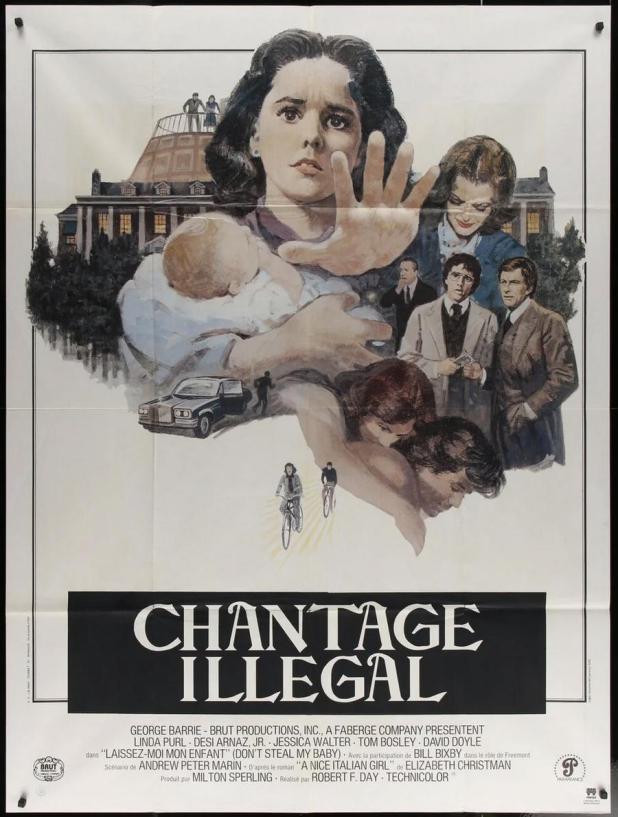
Brut Productions was a film production company that — if the name doesn’t clue you in — was part of Fabergé cosmetics. Run by George Barrie — who in addition to creating the Brut fragrance also was nominated for the 1973 Academy Award for Best Original Song with Sammy Cahn for “All That Love Went To Waste” and in 1975 for “Now That We’re In Love” — it had Cary Grant on the board of directors and Roger Moore was an ambassador at large.

Their films include Cry for Me, Billy; Night Watch; A Touch of ClassBook of NumbersWelcome to Arrow BeachMiracles Still Happen; Hangup; Mean Johnny Barrows; Whiffs; Sweet HostageHeddaHugo the Hippo; I Will, I Will… for Now; Nasty Habits; Thieves; Fingers; The Class of Miss MacMichael and The Dream Merchants along with this film. Fabergé sold their interest in 17 films in 1982 for an undisclosed amount to Ted Turner.

Directed by Robert Day (SheThe Man With Bogart’s FaceThe Initiation of Sarah) and written by Andrew Peter Marin from the book by Elizabeth Christman, this stars Linda Purl (Visiting Hours) as Anne Macarino, a young woman who falls for Steve Aletti (Desi Arnaz Jr.) and doesn’t realize that he’s part of a scheme by medical student Herbert Freemont (Bill Bixby) to get an Italian Catholic baby that has some intelligence to replace the child that was lost by Jessica Walter as Joseph and Louise Carmino (David Doyle and Jessica Walter). Everyone is in on this, even the kindly obstetrician Dr. Andrew Brantford (Tom Bosley) who is seemingly helping her. Now, knocked up, she can’t tell her good Catholic family that she’s with child (Allen Joseph, Mr. X from Eraserhead is her father), Steve is ignoring her and she’s trapped in a home for expectant single mothers.

Even a really young Annie Potts shows up, so it has that going for it. It’s her first movie. She plays one of the other mothers who reveals that she’s selling her child and that’s when Anne loses it. Then she stays with the Carminos without knowing that they want her child.

This movie is essential if you think that David Doyle and Tom Bosley are the same person.

Back to that house for mothers. It’s owned by Mrs. Krieg, who is played by Lucille Benson, who will forever be Mrs. Elrod from Halloween II.

You can watch this on YouTube.

SUPPORTER WEEK: Telethon (1977)

EDITOR’S NOTE: Today’s movie is brought to you by Jason, who made a one-time donation and told me to pick any 70’s TV I wanted. So how about an entire week?

Would you like to have me write about the movies of your choice? It’s simple!

  1. Go to our Ko-Fi site and donate. There’s no set amount and I won’t tell you what to do. In fact, if you just keep reading for free, we can still be friends.
  2. Join as a monthly member for just $1. That makes you a Little B&S’er.
  3. As a Medium B&S’er at just $3 a month, if you pick a movie or a director, I’ll write about them for you. In fact, I’ll do one for each month you subscribe and even dedicate the post to you.
  4. For $5 a month, you basically get some major power. As a Big B&S’er, I’ll write an entire week on any subject you’d like. How awesome would that be? In fact, I’ll do it for every month you’re a member. Do you think any of your other movie sites will do that for you?

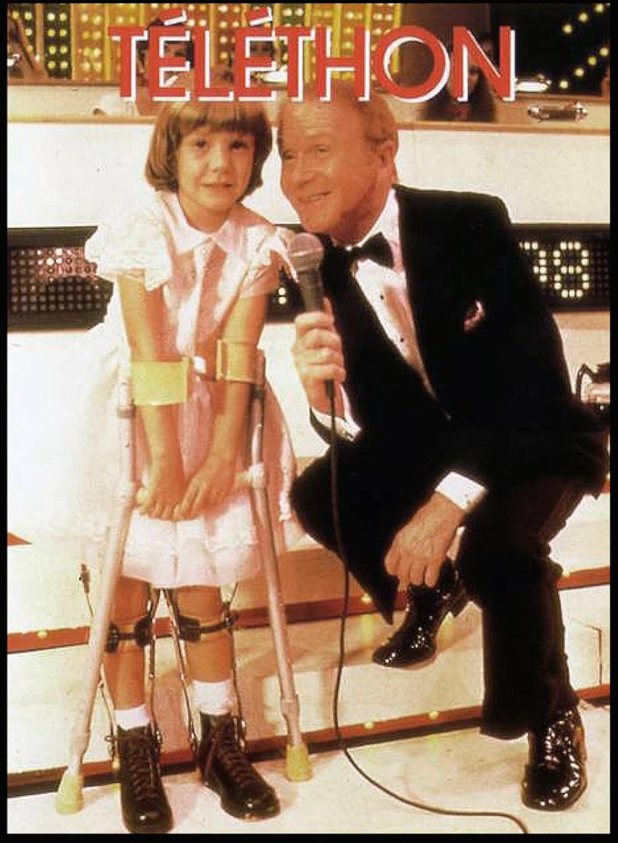
Telethons were a big deal in the 1970s. So much so that more than one movie got made about them — besides this, there’s Americathon from 1979 — and the Easter Seals and Jerry Lewis MDA telethons were marathon events that we all watched because, well, we didn’t have that many channels.

A Las Vegas hospital is running out of money and the chance to have their annual telethon unless they raise $8 million this year. Filmed in and around the Dunes Hotel — which closed January 26, 1993 after a time where it became a shadow of itself and also had a series of arsons — this is like a disaster movie, in that it has a huge cast whose stories are all interconnected, mostly with Marty Rand (Red Buttons), the entertainer who has hosted the event every year being considered too old. His illegitimate daughter is also coming to Vegas to tell him that she’s his daughter,  Matt Tallman (Lloyd Bridges) saves Elaine Cotton (Janet Leigh) in the midst of a brawl — Vegas seems beyond Sin City here and not the family destination that it became — and you get people like Jimmie Walker, Sugar Ray Robinson and David Burton all playing themselves.

Plus you get Jill St. John, David Selby, Randi Oakes, Polly Bergen, Dick Clark, Eve Plumb in an adult role, Kent McCord, Edd Byrnes and John Marley all in the cast. Yes, the mob is involved and when isn’t it in Vegas?

Director David Lowell Rich is one of the kings of the TV movie, as well as the disaster film. After all, he made SST: Death Flight, The Horror at 37,000 FeetThe Runaway TrainAdventures Of the Queen and the theatrical disaster that was The Concorde … Airport ’79. He also directed Satan’s School for GirlsThat Man Bolt, Scandal Sheet and episodes of Naked CityRoute 66The Twilight ZoneMannix and Cannon.

It was written by Roger Wilton, who is a one and done writer.

Originally airing on November 6, 1977 on ABC, Telethon is a caught in amber view of what Vegas was like in 1977, a dangerous and violent place where you could win big money or lose it all just as easily.

You can watch this on YouTube, complete with commercials from Las Vegas, which makes the experience so much better.

SUPPORTER WEEK: The Strange Possession of Mrs. Oliver (1977)

EDITOR’S NOTE: Today’s movie is brought to you by Jason, who made a one-time donation and told me to pick any 70’s TV I wanted. So how about an entire week?

Would you like to have me write about the movies of your choice? It’s simple!

  1. Go to our Ko-Fi site and donate. There’s no set amount and I won’t tell you what to do. In fact, if you just keep reading for free, we can still be friends.
  2. Join as a monthly member for just $1. That makes you a Little B&S’er.
  3. As a Medium B&S’er at just $3 a month, if you pick a movie or a director, I’ll write about them for you. In fact, I’ll do one for each month you subscribe and even dedicate the post to you.
  4. For $5 a month, you basically get some major power. As a Big B&S’er, I’ll write an entire week on any subject you’d like. How awesome would that be? In fact, I’ll do it for every month you’re a member. Do you think any of your other movie sites will do that for you?

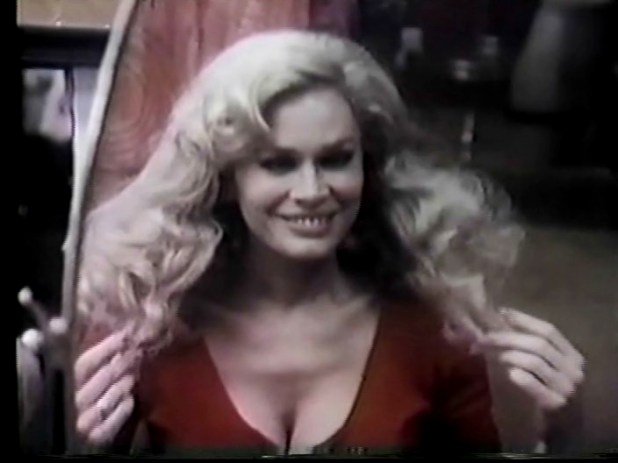
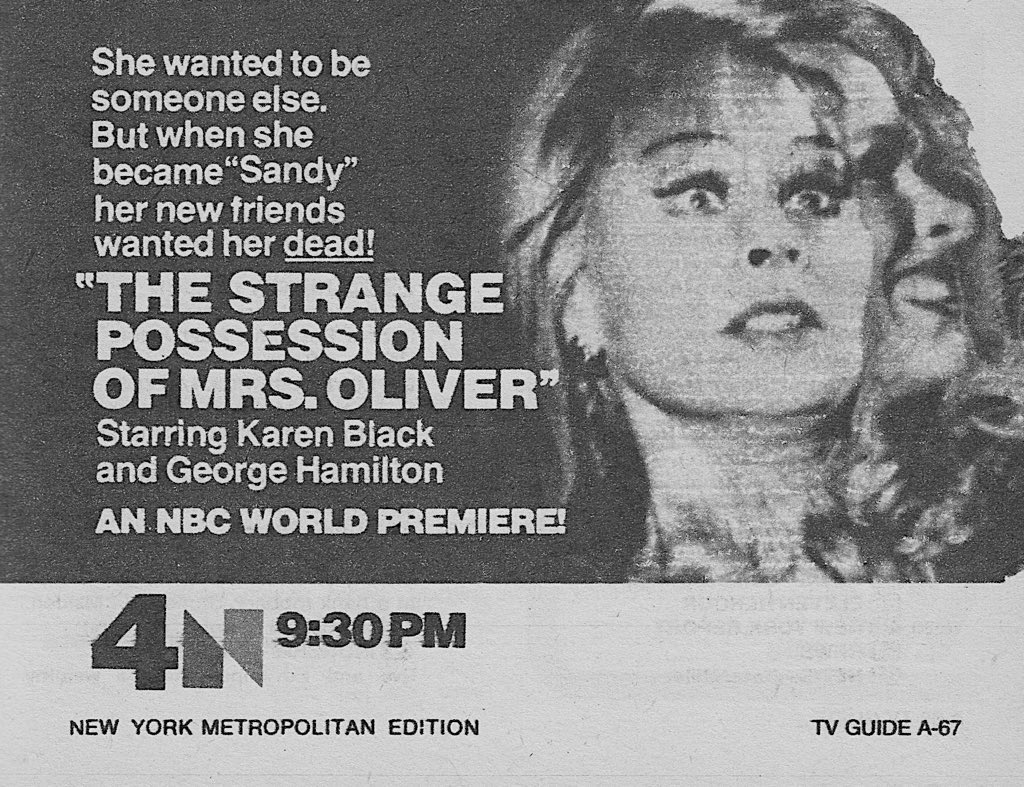
Look, I’m a very simple man and if you give me a movie where Karen Black decides to start exploring her wild side by wearing wigs and shopping for clothes, who am I to say no? I dare say that watching Karen Black freak out in a shopping mall is my very definition of a genre of movie that I want there to be more of.

Originally airing on NBC on February 28, 1977, this was directed by Gordon Hessler (Scream, Pretty Peggy) and written by Richard Matheson (more than I can say) and again, you’re in the best of hands. Black plays Miriam Oliver, stuck in a controlling marriage with Greg (George Hamilton) until she goes shopping, finds a blonde wig and red top from Gloria LeRoy (Mildred “Boom Boom” Turner on All In the Family) and decides that she will become Sandy. Except that Sandy was a real person that other people knew and start thinking that Miriam is her back from going away. Or, as we learn, died five years ago.

Also: She dreams of her own death constantly.

Greg can’t understand why she doesn’t want him controlling her and having his babies and why she’d ever want a little house at Crystal Beach. Yet something supernatural is compelling Miriam to be Sandy and we’re along for the ride. She doesn’t need her glasses any more and it seems like she doesn’t need Greg to hold her down, not when a low cut top can make men lose their minds over her instead of responding to her crying and saying, “I had a dream that I died” with “That’s a nice dream. honey.”

Except that by the end, we learn that Miriam and Sandy were friends that could be confused with one another and there’s no possession, like the end of a Scooby-Doo episode when I get let down again that there’s no magic. And then Miriam goes back to her jerk of a husband and becomes repressed again and I have no idea what we’re to learn from that.

Speaking of Scooby-Doo, Hessler would make Kiss Meets the Phantom of the Park the next year.

You can watch this on YouTube.

The Farmer (1977)

We watched The Farmer on the Drive-In Asylum Double Feature last year and I’ve been thinking about it ever since. I’d waited years to watch it and it more than was worth it.

This film was never released on home media — not on VHS, Beta, Laserdisc, DVD or any other release outside of theaters — until Scorpion Releasing put it out in 2022. Now, you can easily watch it on Tubi, a movie people waited for years to watch.

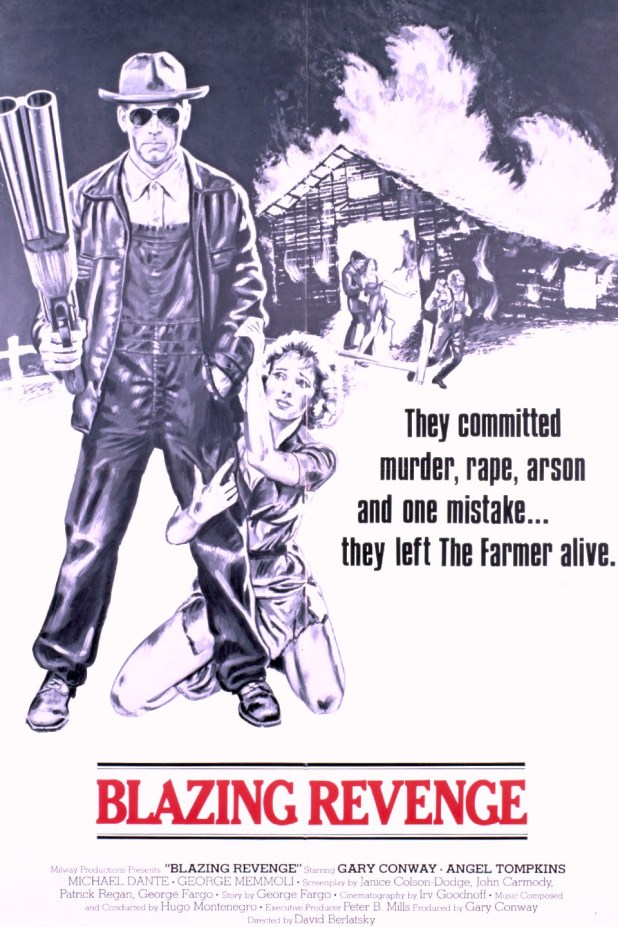
Originally written as a vehicle for Clint Eastwood — screenwriter George Fargo had acted with him in Dirty HarryPlay Misty for MePaint Your Wagon and Kelly’s Heroes — this was sold as a twenty-five page treatment to producer and star Gary Conway, who plays Kyle Martin. Martin is a hero of World War II, but his medals don’t help him run his one-man farm. He saves a gangster named Johnny (Michael Dante), who gives him $1,500, but it’s not enough. The bank barely pays him attention.

Johnny has no such money issues, especially after he screws over a mobster named Passini (George Memmoli) for $50,000. The boss finds him, kills Johnny’s bodyguard and then burns his eyes with acid. The gangster remembers the military man and has his girl Betty (Angel Tompkins) offer Kyle $50,000 to kill everyone. Kyle turns it down until Angel gets assaulted and his friend Gumshoe (Ken Renard) is killed.

And that’s when he basically becomes an unkillable slasher, taking out every single gangster one by one.

According to Tompkins, there was an alternate ending where — spoiler warning — the black soldier that Kyle stood up for at the beginning of the movie that has become a mob killer actually kills both of them. As she had never seen the movie, she had no idea that there is a happy ending.

Directed by David Berlatsky (the only movie he directed, but he edited The Deep) and written by Fargo, Janice Eymann, John Carmody and Patrick Regan, this is the kind of tough guy movie that has dialogue like “You made two mistakes: one was getting up and the other was making fun of Shirley Temple.” It also has a part for Sonny Shroyer, who would soon be Enos on The Dukes of Hazzard.

Memmoli got injured while making this and was in the hospital for most of the shooting. He only weighs 190 pounds in this, way less than his normal weight, but would get to nearly 500 pounds before his death. That accident also kept him from being in Taxi Driver.

The United States Conference of Catholic Bishops reviewed this movie and said, “Revenge story of a World War II veteran (Gary Conway) has arty pretensions but not a spark of intelligence. Mechanically directed by David Berlatsky, it is excessively brutal and sexually degrading.”

Sounds like a great review.

The Farmer has a song on its soundtrack by the name of “The American Dreamer” by singer-songwriter Gene Clark. How strange that it is from the Dennis Hopper documentary The American Dreamer, which is about the making of The Last Movie.

Conway is totally Rick Dalton. He went from his TV show Land of the Giants to appearing in low budget films and finally making this film, his own, to improve his career. He’d also bring a script he wanted to star in to Cannon and it totally got changed around. That script would end up being Over the Top and Conway would get to act in one Cannon film, playing The Lion in American Ninja 2.

There’s just something about this movie. Is it how inscrutable its hero is? How cathartic the violence is? The strange soundtrack by Hugo Montenegro? The fact that it took forever to be seen?

I don’t know. But I do know I think about it all the time.

You can watch this on Tubi.

Here’s a recipe to drink while you watch this movie.

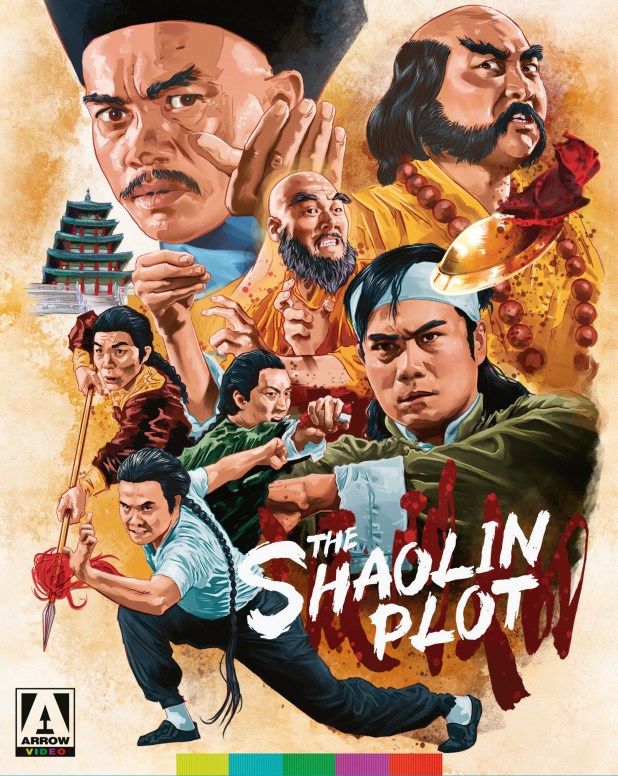
ARROW BLU RAY RELEASE: The Shaolin Plot (1977)

The last movie that fight choreographer Sammo Hung made with his mentor director Huang Feng (Lady Whirlwind, Hapkido) before directing The Iron-Fisted MonkThe Shaolin Plot is about Prince Daglen (Chan Sing) who is creating a library of Chinese martial arts manuals and learning each form so he becomes the greatest fighter in the world.

With only two manuals left, he sends a renegade monk (Hung) with two cymbals he uses to chop heads to take the Wu-Tang and Shaolin books. Yet for his plan to happen, Daglen will have to get inside the Shaolin temple, which will see him battle Little Tiger (James Tien) and a warrior monk team (Casanova Wong and Kwan Yung Moon).

I’m such a fool for movies like this, where people need to take all of the knowledge and moves and create their own ultimate style. Anything with the Wu-Tang or Shaolin makes me happy and as long as these movies keep getting re-released, I’m going to never stop watching them and throwing little kicks in the air as I cheer the fights.

As a fat guy who loves martial arts, I just have to say, “Thank you Sammo.” You have made all of us so proud.

The Arrow release of this movie has a 2K restoration from the original film elements by Fortune Star. It also has two commentary tracks, one by martial arts film experts Frank Djeng and Michael Worth and another by action cinema experts Mike Leeder and Arne Venema. Plus, there are trailers, a double-sided fold-out poster featuring original and newly commissioned artwork by Ilan Sheady, a reversible sleeve with both artwork and an illustrated collector’s booklet featuring new writing by Peter Glagowski.

You can get it from MVD.

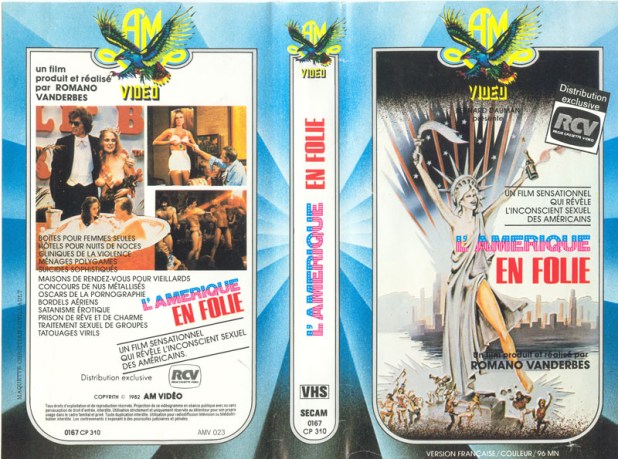
APRIL MOVIE THON 3: This Is America (1977)

April 2: Mondo Madness — Write about a mondo movie.

There was no internet in 1977 and the world was much larger, so the idea of what was in America could be seen as mysterious as countries like Africa that mondo filmmakers had already explored.

Directed and written by Romano Vanderbes (who also made This Is America Part 2The Sex O’Clock NewsAmerica Exposed and the compilation Sex Maniac’s Guide to the U.S.A.), this is also known as Jabberwalk and starts with “America the Beautiful” being played by The Dictators.

The America in this movie is the one that the right warns you about. It’s a place where demolition derbies, pro wrestling — there’s Ivan Putski! — and mud wrestling are our three biggest sports. Polygamy, nude beaches are packed, love boutiques are shopped by teenage girls, quick divorce and fast marriage is the order of the day, plus there are rentable BDSM dungeons, group sex encounter groups, dildo factories and legal brothels are everywhere. Even when people decide to actually get married, they go to the Poconos and have to undertake mandatory gun shooting classes to prepare them for the cities and suburbs of the United States where violence is a celebrated fact of life. Even church is just done inside your car now so you can keep moving to whatever is next, which is usually sex or death or being hooked up to electrodes that shock you when you eat too many french fries. Sorry. Freedom fries.

Also known as Crazy Ridiculous American People, this has everything from Don Imus hosting the 1975 Miss All Bare American pageant to a worship ceremony at the Church of Satan (incorrectly saying that people get so excited that they start hurting one another during rituals), a dildo salesman, the Eros Awards for pornography — look for Fanne Fox, Bree Anthony, female rock band Isis, Ron Jeremy, C.J. Laing, Marc Stevens, Helen Madigan, Darby Lloyd Rains and naked people painted silver — as well as Arnold casually walking out of a Gold’s Gym, the AccuJack masturbation machine, a man getting his penis tattooed, hot dogs being made, a clown church, suicide’s being fished out of the water around the Golden Gate Bridge (by the way, when my wife and I were first dating, she made me watch The Bridge doc about this while drunk and I was worried why I was allowing her in my house and now we’ve been married for nine years), cryogenics, drive-in funerals, brothels for senior men where older women are paid five and even ten dollars to sleep with them, a bank robbery, the many deaths in an Indianapolis 500 race, co-ed prisons, Mormon men with twelve wives and so much more.

At one point, before that internet I discussed at the open and the one you’re reading this on now, these movies were shocking. Then again, Vanderbes is Dutch and should know all about Amsterdam and that America is pretty puritanical, but maybe in 1977 we were all about sex before Reagan and the Religious Right and AIDS.

It’s all voiced over by Norman Rose, who narrated Harold and the Purple CrayonTennessee TuxedoMessage from Space, Pinocchio in Outer SpaceWar Between the Planets and Destroy All Monsters. He’s also Mr. Smith, the perverted dirty caller who gets Alice so excited in The Telephone Book.

What really gets me is that no matter how much sex is in this movie, there’s also the specter of Americanized violence leading everything. Our country was won by the gun and as movies like this and The Killing of America remind me, this kind of bloodshed that we gives hopes and prayers for every time and say that we can’t stop it and then it happens every single day. But it was like that in 1977 too as this movie continually reminds us. Worse, if it can get that way, kids today are upset about anything sexual while also fascinated, but not enough to make anything artistic or awesome. What I;m saying is that the 1970s of this movie are so far away that they only exist in this amber-grasp of VHS scuzz.

You can watch this on YouTube.