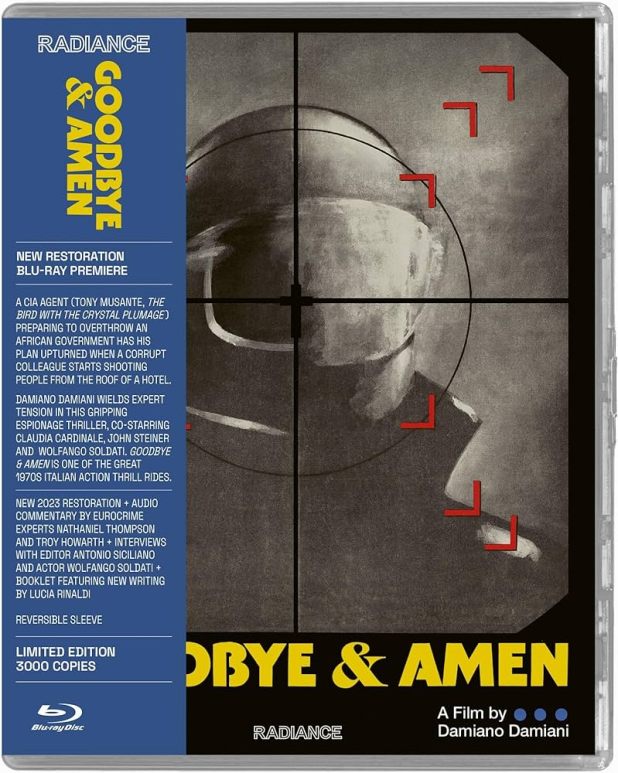
John Dhannay (Tony Musante) is trying to manage a coup in an African country for the CIA when one of his men, Douglas Grayson (John Steiner) kidnaps two actors — Jack (Gianrico Tondinelli) and Aliki De Mauro (Claudia Cardinale) — and puts John’s ability to lead in question.
Directed by Damiano Damiani, who co-wrote the script with Nicola Badalucco which was based on The Grosvenor Square Goodbye by Francis Clifford, this is a tense thriller that puts nearly everyone into the line of fire, including an ambassador played by John Forsythe.
While most of the movie takes place in a small hotel room, it stays packed with tension throughout. What helps is the score by Guido and Maurizio De Angelis or as I call them Oliver Onions. You may not end up liking John at all by the end, but you will realize that he gets the dirty work done.
A mix between political thriller and poliziotteschi, this kept me watching intently.
The Radiance Films release of this movie has a new 2023 restoration of the film from the original camera negative presented with Italian and, for the first time on home video, English audio options. It has audio commentary by Nathaniel Thompson and Troy Howarth, interviews with editor Antonio Siciliano and actor Wolfango Soldati, a reversible sleeve featuring designs based on original posters, a limited edition booklet featuring new writing by Italian crime cinema expert Lucia Rinaldi and the Radiance Films packaging that looks so great in your collection. You can get this from MVD.
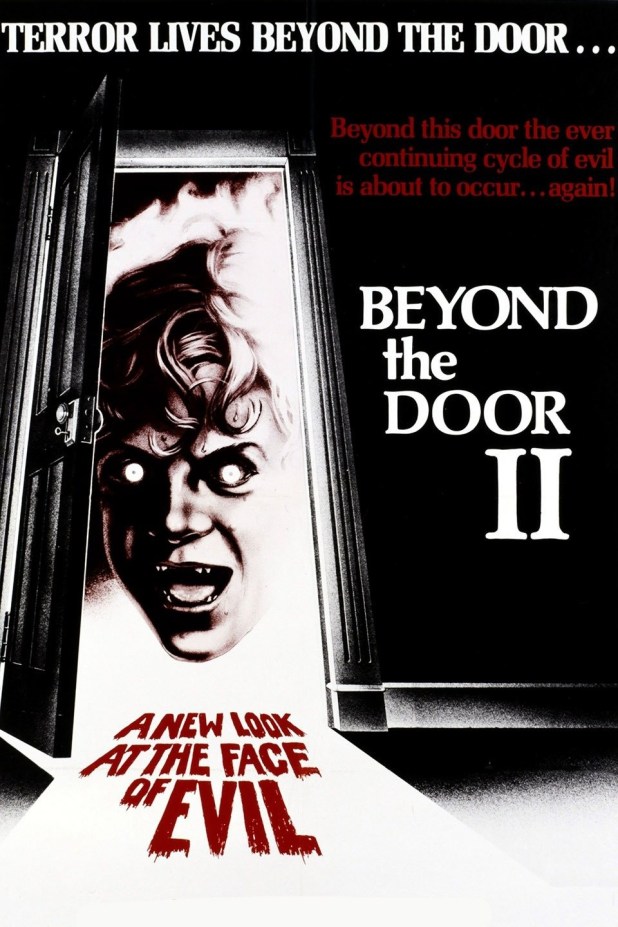
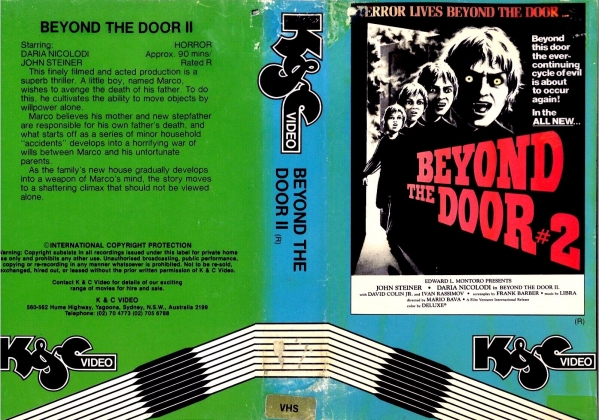
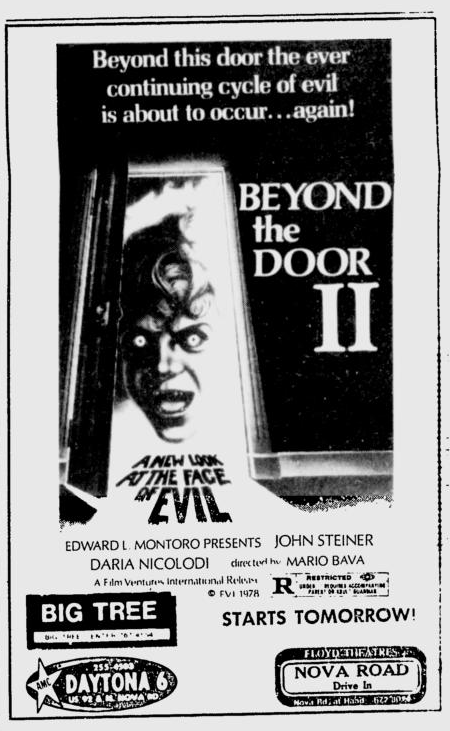
Beyond the Door II is, of course, Mario Bava’s Shock retitled by Film Ventures International.
Shock was Bava’s last film. Following a series of failures to reach theaters, including Rabid Dogs, Lamberto Bava continued to push his father to make a new movie. Originally written by Dardano Sacchetti and Francesco Barbieri after they wrote A Bay of Blood, this movie was loosely based on Hillary Waugh’s The Shadow Guest. Lamberto has also stated that he wanted this to be a modern film that was influenced by Stephen King.
Bava started pre-production as early as 1973, shooting screen tests with Mimsy Farmer for the lead role. Shot in five weeks, some of the film was directed by Lamberto based on his father’s storyboards, which is why he has the credit “collaboration to the direction.” He directed all of Ivan Rassimov’s scenes.
It’s a sparse film — there are only three characters (well, three living characters). Dora (Daria Nicolodi, who should be canonized for giving birth to both Suspiria and Asia Argento, as well as roles in Deep Red, Inferno, Opera and so much more) and Bruno (John Steiner, Yor Hunter from the Future‘s Overlord) are a newly married couple who have just moved back into her old home — the very same place where her drug-addicted husband killed himself — along with her son, Marco.
Dora’s had some real issues dealing with her husband’s death. And Bruno is never home to help, as he’s a pilot for a major airline. Either she’s losing her mind or her son is evil or he’s possessed or her new husband is gaslighting her or every single one of those things is happening all at once. You have not seen a kid this creepy perhaps ever — he watches his mother and stepfather make love, declaring them pigs before using his potential psychic powers to throw things at them. Then he tells his mom he wants to kill her, followed by nearly making his stepfather’s plane crash just by putting an image of the man’s face on a swing.
While Bava was sick throughout the filming (and his son Lamberto would fill in), you can definitely see his style shine through the simple story. There’s one scene of Dora’s face and her dead husband’s and then her face that repeats vertically that will blow your mind.
The secret of the film? Dora’s ex-husband forced her to take a mix of heroin and LSD, at which point she tripped out and killed him. Bruno dumped his body in the ocean and arranged for her to be placed in an insane asylum until she recovered. Now, the ex-husband’s ghost has returned and demands blood. And he gets it.
Perhaps the finest shot in here is when Dora is lying in the bed and you see her hair fall like she’s upside down, but then it goes back like it’s in the wind, all while it seems like she’s being ravaged. I have no idea how Bava did this shot, but it’s so visually arresting that it’s stuck in my mind for days. There’s also his famous Texas switch where Marco runs into his mother’s arms, only to be replaced by her ex-husband and that horrifying scene with the rake.
There’s also music from I Libra, a Goblin off-shoot. It seems kind of strange against Bava’s old school direction, but that doesn’t mean that I don’t love it. It’s a stylish and scary film that’s way better than any Exorcistclone, despite its U.S title.
William Girder died in a helicopter crash while scouting locations in 1978. If that hadn’t ended his life, who knows the heights of lunacy he would have achieved?
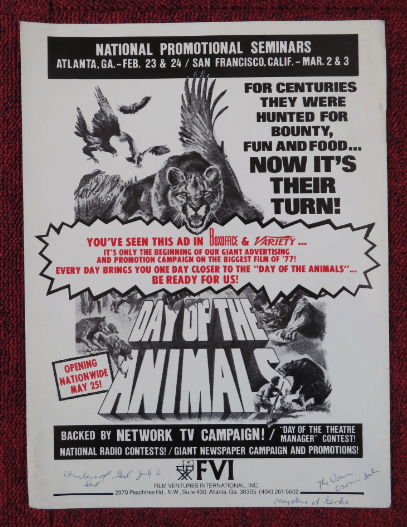
This had to have been the first movie about the loss of Earth’s ozone layer. Who knew that it would drive everyone nuts, including animals? Certainly not the hikers in this tale who turn against one another and try to survive all of the animal assaults.
Steve Buckner (Christopher George, who is fighting with Michael Pataki and George Eastman for most appearances on this site) has a dozen or so hikers who are about to go to Sugar Meadow for a nature hike, even though Ranger Chico Tucker (former NFL player Walt Barnes) tells him that the animals have been acting strangely.
Along for this nature trail to hell are anthropologist Professor MacGregor (Richard Jaeckel, Grizzly), a married couple named Frank and Mandy Young (Jon Cedar, who in addition to being a recurring Nazi on Hogan’s Heroes was also the co-star, co-screenwriter and associate producer of The Manitou and Susan Backlinie, the first victim in Jaws), rich Shirley Goodwyn (Ruth Roman from The Baby!), her son Johnny, teenage lovers Bob Dennins (Andrew Stevens, who was in the Night Eyes films) and Beth Hughes, a former pro football player dealing with cancer named Roy Moore, a magical Native American guide named Daniel Santee (Michael Ansara, Killer Kane from the 1980’s Buck Rogers series as well as the voice of Mr. Freeze), a television reporter named Terry Marsh (Lynda Day George, always ready to scream “BASTARDS!”) and finally, a frenzied Leslie Neilsen in the role of his career as Paul Jenson, an ad executive who acts like every account guy I’ve ever had to deal with in my 24-year-long ad career.
Before you know it, wolves are attacking people in sleeping bags, vultures circle overhead, hawks knock women off cliffs, Leslie Nielsen goes beyond bonkers and kills a dude with a walking stick and threatens to assault women before wrestling a bear and getting his neck torn out, rats attack the sheriff who decides to eat before trying to figure out how to deal with this emergency, dogs turn on the people they loved, rattlesnakes bite people and the military dons hazmats suits to deal with all of it.
If you haven’t figured it out yet, this movie is stupid. And awesome. It’s stupid awesome. And if you only know Nielsen from his later comedic roles, take a look at him in this movie. I love this movie. I don’t care what you think of me.
Here’s the drink to enjoy while you watch this movie.
Tentacle Painkiller
2 oz. Kraken spiced rum
4 oz. pineapple juice
1 oz. orange juice
1 oz. cream of coconut
Dash of nutmeg
Pinch of salt
Pour rum, pineapple juice, orange juice and cream of coconut into a cocktail shaker with ice. Mix it up.
Pour into a glass filled with ice. Drop in salt to give it the taste of the ocean and then top with nutmeg.
You can watch this on Tubi or get the blu ray from Severin.
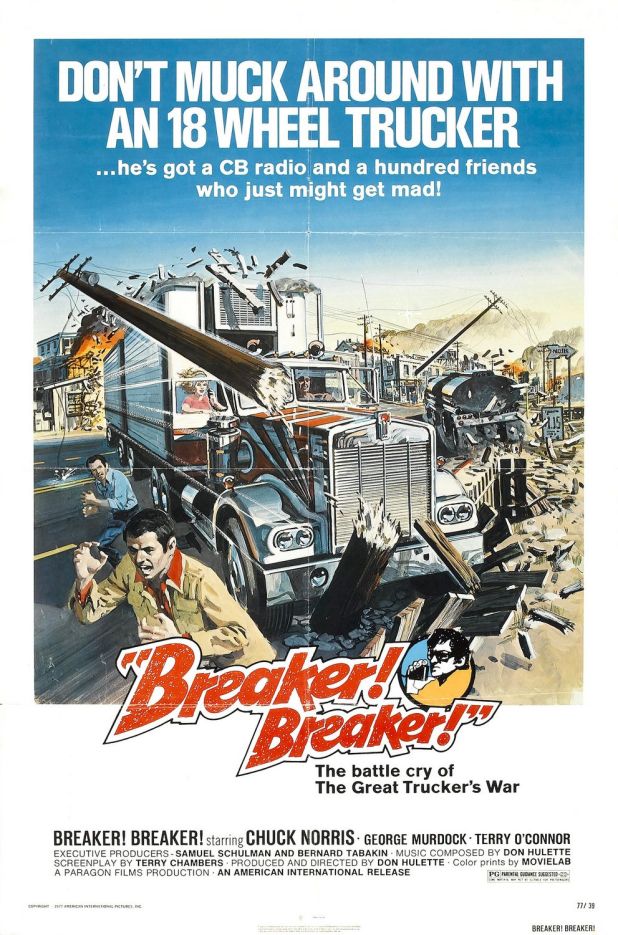
Don Hulette somehow went from the music to Starhops to directing this, which feels like a glitch in the matrix which is IMDB. Kind of the same feeling one gets realizing that they’re about to watch a trucking movie starring Chuck Norris, who said, “I didn’t know anything when I made that movie. We shot it in just 11 days. But it was amazing, people loved it anyway. It’s a down-home kind of movie. It’s still my dad’s favorite.”
J.D. (Chuck Norris) is a trucker from California who learns that his friend was paralyzed after being beaten by Texas City cops Sergeant Strode and Deputy Boles, who have a history of entrapping truckers and sending them to jail. J.D. warns his brother Billy to stay out of Texas City, the kid doesn’t listen and goes missing.
That brings J.D. to town, winning over single mom waitresses and accidentally killing mechanics, which gets him sentenced to death by Judge Trimmings. Luckily, J.D.’s new hash slinging old lady calls in a convoy of big rigs to save him. Jack Nance is in this, too. Yes, the same Jack Nance who was in Eraserhead. Life’s funny like that.
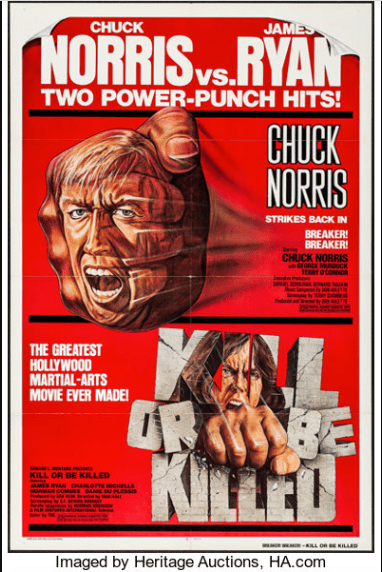
While not a Film Ventures production, it did play on a double feature they distributed along with Kill or Be Killed.
Of course, Beyond the Door II is really Mario Bava’s Shock.
We went to see Blood and Black Lace in the theater once and there was someone who talked about the movie before it began. Maybe he was bad at speaking in public, but in short, told everyone how the movie inspired Friday the 13th (I’d say A Bay of Blood versus that one) and how it had a different title. And that was it. I was incensed. I wanted to get up out of my seat and scream that Mario Bava is the reason why lighting is the way it is and his use of color and how I can cite hundreds of films that he influenced. But I sat in my seat and boiled while the movie unspooled, because I’m really passionate about Mario Bava and don’t need to make a scene and miss seeing one of his films on the big screen.
Shock is Bava’s last film. Following a series of failures to reach theaters, including Rabid Dogs, Lamberto Bava continued to push his father to make a new movie. Originally written by Dardano Sacchetti and Francesco Barbieri after they wrote A Bay of Blood, this movie was loosely based on Hillary Waugh’s The Shadow Guest. Lamberto has also stated that he wanted this to be a modern film — check out Stephen Thrower’s part of the Arrow Video release for more about that notion — that was influenced by Stephen King.
Bava started pre-production as early as 1973, shooting screen tests with MImsy Farmer for the lead role. Shot in five weeks, some of the film was directed by Lamberto based on his father’s storyboards, which is why he has the credit “collaboration to the direction.”
I kind of love that this was called Beyond the Door II here in the U.S., but I really like the original title better. It’s a sparse film — there are only three characters (well, three living characters).
Dora (Daria Nicolodi, who should be canonized for giving birth to both Suspiria and Asia Argento, as well as roles in Deep Red, Inferno, Opera and so much more) and Bruno (John Steiner, Yor Hunter from the Future‘s Overlord) are a newly married couple who have just moved back into her old home — the very same place where her drug-addicted husband killed himself — along with her son, Marco.
Dora’s had some real issues dealing with her husband’s death. And Bruno is never home to help, as he’s a pilot for a major airline. Either she’s losing her mind or her son is evil or he’s possessed or her new husband is gaslighting her or every single one of those things is happening all at once. You have not seen a kid this creepy perhaps ever — he watches his mother and stepfather make love, declaring them pigs before using his potential psychic powers to throw things at them. Then he tells his mom he wants to kill her, followed by nearly making his stepfather’s plane crash just by putting an image of the man’s face on a swing.
While Bava was sick throughout the filming (and his son Lamberto would fill in), you can definitely see his style shine through the simple story. There’s one scene of Dora’s face and her dead husband’s and then her face that repeats vertically that will blow your mind.
The secret of the film? Dora’s ex-husband forced her to take a mix of heroin and LSD, at which point she tripped out and killed him. Bruno dumped his body in the ocean and arranged for her to be placed in an insane asylum until she recovered. Now, the ex-husband’s ghost has returned and demands blood. And he gets it.
Perhaps the finest shot in here is when Dora is lying in the bed and you see her hair fall like she’s upside down, but then it goes back like it’s in the wind, all while it seems like she’s being ravaged. I have no idea how Bava did this shot, but it’s so visually arresting that it’s stuck in my mind for days. There’s also his famous Texas switch where Marco runs into his mother’s arms, only to be replaced by her ex-husband and that horrifying scene with the rake.
There’s also music from I Libra, a Goblin off-shoot. It seems kind of strange against Bava’s old school direction, but that doesn’t mean that I don’t love it. It’s a stylish and scary film that’s way better than any Exorcistclone, despite its U.S title.
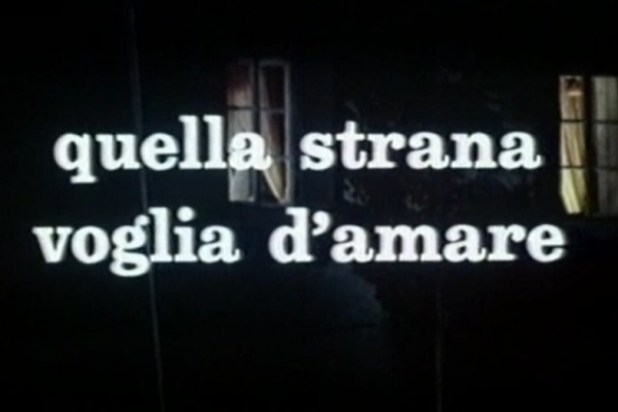
Angela (Marina Giordana, Beast with a Gun) and Marco (Christian Borromeo, Murder Rock) live in a huge house in the country — I will resist making Blur references — and because this movie’s title in English is That Strange Desire to Love, you can guess that they are a couple despite being related. Oh Italian exploitation movies…
The problems arise when a teacher named Claudia (Beba Loncar), a teacher is sent to instruct them under the orders of Father Don Giuseppe (Philippe Leroy). There’s also Rocco (Eastman), a handyman who has been made mute by a car accident who is also in love with Angela. The giallo element comes in when Angela uses Rocco to get revenge on Claudia for daring to make love to Marco. Upset by his guilt — and the sound of a car accident that Marco keeps replaying — Rocco kills himself and that means that Angela and Marco can embrace once again.
Also: George Eastman is so strong in this movie that he can lift a car.
Somehow, this is probably as tender and well-thought out of an Italian exploitation incest movie as you’re going to get. I realize that sentence makes no sense.
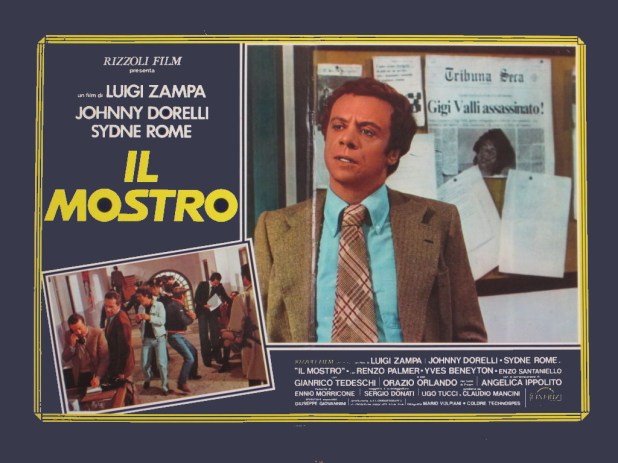
Valerio Barigozzi (Johnny Dorelli) is a giallo writer who also writes the Countess Esmerelda column in the newspaper. One day, he accidentally gets a letter from a serial killer that reveals the next victim. He starts to get even more letters and each killing moves him up into the editorial office, but it also makes him more of a suspect.
Unlike most gialli, the killings aren’t important or even shown as murder set pieces. We only see the end result. The real villains are those using these murders to advance their careers, like our protagonist. Like many a gialli, there is a score by Ennio Morricone.
Directed by Luigi Zampa and written by Sergio Donati, this even winks at the giallo genre by showing the posters for Spasmo and Death Walks On High Heels outside of a theater (as well as Carrie, Destruction Force and The Beast In Heat).
Don’t come to this expecting the black gloves and razor of the giallo. Instead, see how far someone will go to be somebody. It feels very much like Zodiac years before Robert Graysmith wrote his book and reminded the public that a very real killer was mailing confessions and clues to the San Francisco Chronicle.
Usually Franco Nero is the hero of a film, but in this, he’s nearly the villain from the beginning. He’s Walter Mancini, an alcoholic reporter on an RV vacation with his wife Eve (Corinne Cléry). Five minutes into the movie, he’s saying that he wishes that the wild game he shot and is barbecuing was his wife with a spit in her ass, drinking so much that he forgets his name and pretty much assaulting Eve while other campers can listen to his loud lovemaking moans.
The next morning, they get on the road and quickly pick up Adam Konitz (David Hess) and let me ask you, why would you ever pick up a hitchhiker that looks like David Hess? Within seconds, he’s asking Eve filthy questions and in the middle of a roadside fistfight with Walter. He pulls a gun on the couple and hijacks their vacation and makes them drive him to Mexico. Walter tries to outsmart him by writing SOS on his matchbook, but Adam gets the drop on both police officers, leaving their bodies bleeding on a desert highway.
On the way to the border, a truck attacks like something out of Duel. It’s Konitz’s partners, looking for the $2 million he stole from them. He ends up killing them, which exposes the fact that they only cared about the money and not sheer depravity, like Konitz, who then ties up Walter and makes him watch him assault Eve, who because this is an Italian movie ends up in bliss by the end of it. Walter and Konitz fight and a nude Eve emerges from their trailer with the killer’s rifle, blowing him away.
This is where any other movie would end, but for some reason, Walter keeps the killer’s body in the trailer and tells Eve they are keeping the money. After stopping for gas, four young motorcycle riders cover the road in oil and cause the Manicini car to crash. Is this where it ends? No, because after they steal $300 from Walter’s wallet, they have no idea how much money is in the backseat. Eve can barely move and can only watch while her husband pulls out Konitz’s body in the front seat and setting everything on fire.
He climbs up a hill and starts hitchhiking himself.
Based on The Violence and the Fury by Peter Kane, Franco Nero wanted to be in this movie because he had wanted to work with director Pasquale Festa Campanile. He was in Germany shooting 21 Hours at Munich with Hess when Companile asked him to be in the movie. Nero suggested that Hess come with him and be in this movie.
A few days before shooting, Nero hurt his hand punching an unruly horse on the set of Keoma. That’s why there’s a scene where he trips on the insurance man’s tent and breaks his arm.
This is set in California, but shooting there was too expensive. Instead, it was filmed in the mountains of the Gran Sasso in central Italy. To complete the film magic, American-like gas stations were built.
It’s also known as Death Drive and The Naked Prey, both of which are great titles. In the U.S., as you can already guess, it was released on video as Hitchhike: Last House on the Left.
Campanile was mostly known for his commedia sexy all’italiana, so I was shocked by how dark and hate-filled this movie is. Walter is an absolute loser, a man whose writing couldn’t pay the bills — ask a man about who he is and he will start with what he does for a living — and now he must work for Eve’s father. Feeling beat down, all he does is drink and abuse his wife. If anything, Eve has the least hope in this, as she keeps trying to believe in her husband even when he almost gets her killed.
What pushes it even further is the Ennio Morricone score, as well as the song “Sunshine,” which is first heard in a moment of fun as everyone drinks together at the camping area. By the end of the movie, each time that you hear it is filled with dread, like it keeps reminding you that things were bad at the start of this movie but they’ve somehow gotten even more bleak.
There are two alternate endings. There’s one in which the car explodes just as Walter and Eve reach for the money. The French ending has Walter and Eve laughing and leaving with the money after Konitz is shot.
I love this movie because it’s everything you expect when you see David Hess and the exact opposite of who Franco Nero usually is on film. It’s devoted to being a bad road trip the entire way with no hope and the only humor being as black as it can be.
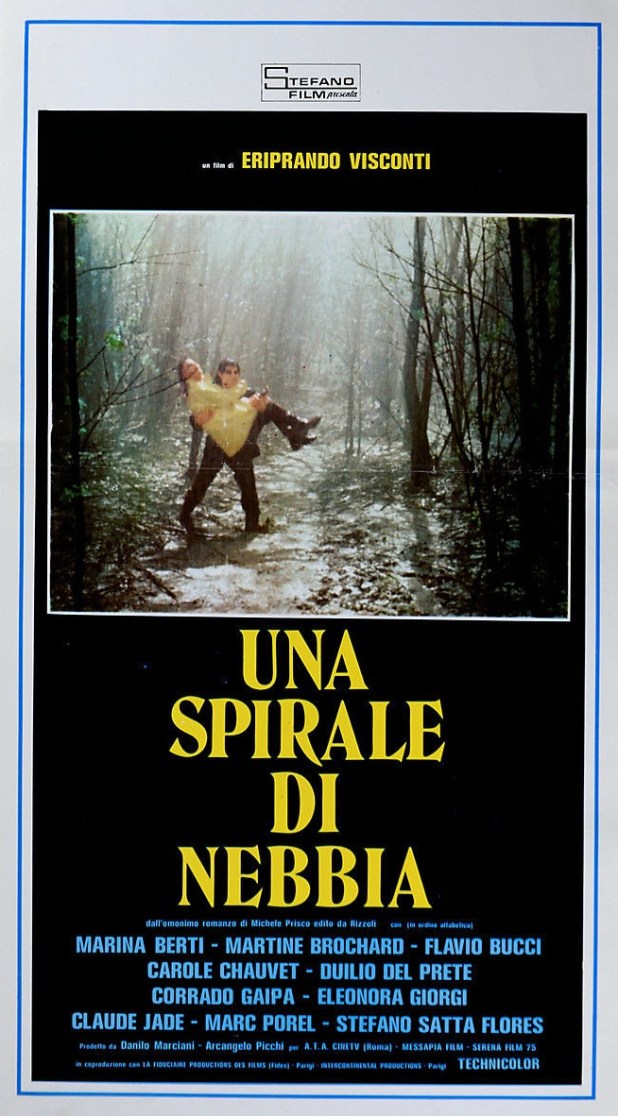
Directed by Eriprando Visconti (Oedipus orca) and written by Luciano Lucignani, Fabio Mauri, Roselyne Sesboue, Lisa Morpurgo and Visconti from the book by Michele Prisco, A Spiral of Mist starts with Fabrizio (Marc Porel) killing his wife Valeria (Carole Chauvet) with a shotgun.
Maria Teresa (Claude Jade), his cousin, believes there’s no way he could do it. She hopes that her lawyer husband Marcello (Duilio Del Prete) can convince Judge Renato Marinoni (Stefano Satta Flores) that Fabrizio is innocent.
In flashback, the movie shows us the unhappy marriages of both women and how Valeria tried to set up Maria Teresa with another lawyer, Cesare Molteni (Roberto Posse). Today, Maria has a child that really was the child of her driver (Flavio Andreini) and housekeeper Armida (Anna Bonaiuto), as her husband is impotent.
The oral sex scene between Chauvet and Porel is really hard to watch because it’s unerotic and as disturbing as a sex scene can get. Supposedly, Chauvet actually was doing it for real while Porel’s wife was watching, which caused a major uproar. Or that could be IMDB BS. This movie has just as much male frontal nudity as female, which is rare for a movie from any county.
A Spiral of Mist is more about the disintegration of relationships and expectations of love than it is a giallo, but it does have some elements of the form.
Directed by Ramón Fernández and written by Juan José Alonso Millán, Death Haunts Monica* might seem like a soap opera, but hold out. It’s also a giallo.
Frederico (Jean Sorel, Perversion Story) isn’t living the high life. His real estate firm Eurozone? A mess with business partners cutting him out. A friend from his smuggling days, Diego (Damián Velasco), is extorting him. And his wife Monica (Nadiuska, yes, just one name; she’s in Guyana: Cult of the Damned and played Conan‘s mom) has just learned that he’s having an affair with Eva (Bárbara Rey, The Night of the Sorcerers).
As if things couldn’t get worse for Frederico — and Monica — someone breaks into their house when she’s home all alone. She shoots whoever it is; they stand right back up and knock her out. Diego’s body is left, so the police assume he’s who broke in. This eliminates him from the blackmail scheme, except that’s when the phone calls start and Monica gets framed for murder. Then there’s Elena (Karin Schubert, Emanuelle Around the World), who is trying to play everyone against one another. That’s easy when the other partner, Arturo (Arturo Fernández), used to date Monica.
Man, was Jean Sorel typecast in giallo as a man who has no idea how cunning women can be?
Thanks to The Giallo Files for informing me that Il Buio Intorno a Monica translates as Darkness Surrounds Monica.


 B&S About Movies
You must be logged in to post a comment.