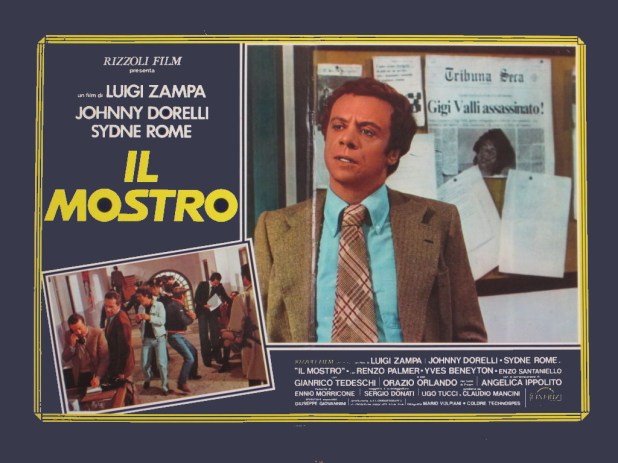
Valerio Barigozzi (Johnny Dorelli) is a giallo writer who also writes the Countess Esmerelda column in the newspaper. One day, he accidentally gets a letter from a serial killer that reveals the next victim. He starts to get even more letters and each killing moves him up into the editorial office, but it also makes him more of a suspect.
Unlike most gialli, the killings aren’t important or even shown as murder set pieces. We only see the end result. The real villains are those using these murders to advance their careers, like our protagonist. Like many a gialli, there is a score by Ennio Morricone.
Directed by Luigi Zampa and written by Sergio Donati, this even winks at the giallo genre by showing the posters for Spasmo and Death Walks On High Heels outside of a theater (as well as Carrie, Destruction Force and The Beast In Heat).
Don’t come to this expecting the black gloves and razor of the giallo. Instead, see how far someone will go to be somebody. It feels very much like Zodiac years before Robert Graysmith wrote his book and reminded the public that a very real killer was mailing confessions and clues to the San Francisco Chronicle.
Usually Franco Nero is the hero of a film, but in this, he’s nearly the villain from the beginning. He’s Walter Mancini, an alcoholic reporter on an RV vacation with his wife Eve (Corinne Cléry). Five minutes into the movie, he’s saying that he wishes that the wild game he shot and is barbecuing was his wife with a spit in her ass, drinking so much that he forgets his name and pretty much assaulting Eve while other campers can listen to his loud lovemaking moans.
The next morning, they get on the road and quickly pick up Adam Konitz (David Hess) and let me ask you, why would you ever pick up a hitchhiker that looks like David Hess? Within seconds, he’s asking Eve filthy questions and in the middle of a roadside fistfight with Walter. He pulls a gun on the couple and hijacks their vacation and makes them drive him to Mexico. Walter tries to outsmart him by writing SOS on his matchbook, but Adam gets the drop on both police officers, leaving their bodies bleeding on a desert highway.
On the way to the border, a truck attacks like something out of Duel. It’s Konitz’s partners, looking for the $2 million he stole from them. He ends up killing them, which exposes the fact that they only cared about the money and not sheer depravity, like Konitz, who then ties up Walter and makes him watch him assault Eve, who because this is an Italian movie ends up in bliss by the end of it. Walter and Konitz fight and a nude Eve emerges from their trailer with the killer’s rifle, blowing him away.
This is where any other movie would end, but for some reason, Walter keeps the killer’s body in the trailer and tells Eve they are keeping the money. After stopping for gas, four young motorcycle riders cover the road in oil and cause the Manicini car to crash. Is this where it ends? No, because after they steal $300 from Walter’s wallet, they have no idea how much money is in the backseat. Eve can barely move and can only watch while her husband pulls out Konitz’s body in the front seat and setting everything on fire.
He climbs up a hill and starts hitchhiking himself.
Based on The Violence and the Fury by Peter Kane, Franco Nero wanted to be in this movie because he had wanted to work with director Pasquale Festa Campanile. He was in Germany shooting 21 Hours at Munich with Hess when Companile asked him to be in the movie. Nero suggested that Hess come with him and be in this movie.
A few days before shooting, Nero hurt his hand punching an unruly horse on the set of Keoma. That’s why there’s a scene where he trips on the insurance man’s tent and breaks his arm.
This is set in California, but shooting there was too expensive. Instead, it was filmed in the mountains of the Gran Sasso in central Italy. To complete the film magic, American-like gas stations were built.
It’s also known as Death Drive and The Naked Prey, both of which are great titles. In the U.S., as you can already guess, it was released on video as Hitchhike: Last House on the Left.
Campanile was mostly known for his commedia sexy all’italiana, so I was shocked by how dark and hate-filled this movie is. Walter is an absolute loser, a man whose writing couldn’t pay the bills — ask a man about who he is and he will start with what he does for a living — and now he must work for Eve’s father. Feeling beat down, all he does is drink and abuse his wife. If anything, Eve has the least hope in this, as she keeps trying to believe in her husband even when he almost gets her killed.
What pushes it even further is the Ennio Morricone score, as well as the song “Sunshine,” which is first heard in a moment of fun as everyone drinks together at the camping area. By the end of the movie, each time that you hear it is filled with dread, like it keeps reminding you that things were bad at the start of this movie but they’ve somehow gotten even more bleak.
There are two alternate endings. There’s one in which the car explodes just as Walter and Eve reach for the money. The French ending has Walter and Eve laughing and leaving with the money after Konitz is shot.
I love this movie because it’s everything you expect when you see David Hess and the exact opposite of who Franco Nero usually is on film. It’s devoted to being a bad road trip the entire way with no hope and the only humor being as black as it can be.
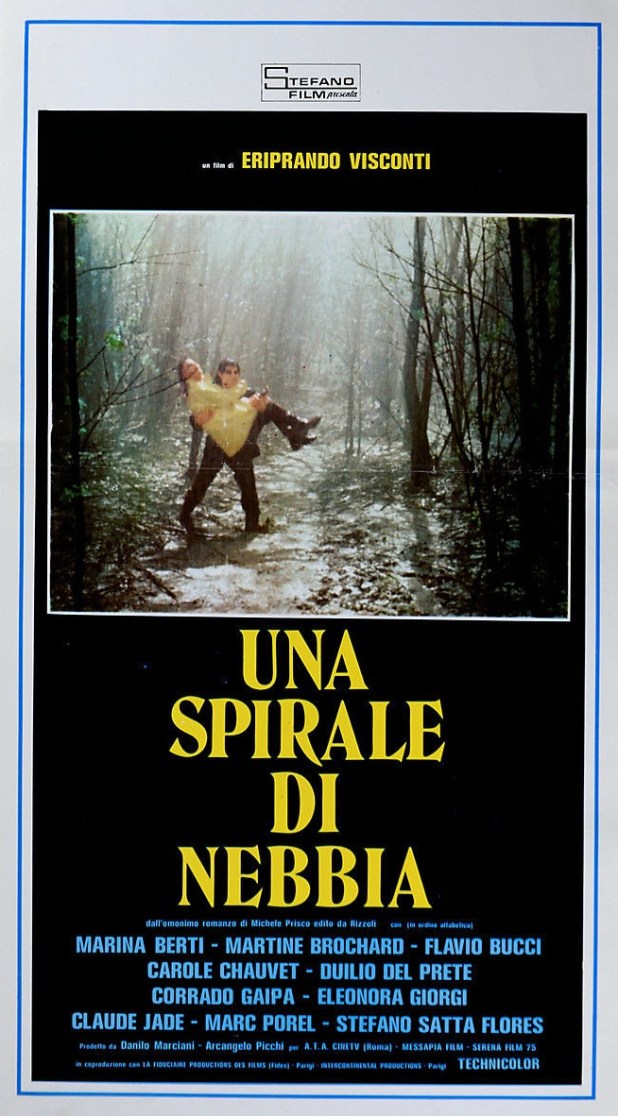
Directed by Eriprando Visconti (Oedipus orca) and written by Luciano Lucignani, Fabio Mauri, Roselyne Sesboue, Lisa Morpurgo and Visconti from the book by Michele Prisco, A Spiral of Mist starts with Fabrizio (Marc Porel) killing his wife Valeria (Carole Chauvet) with a shotgun.
Maria Teresa (Claude Jade), his cousin, believes there’s no way he could do it. She hopes that her lawyer husband Marcello (Duilio Del Prete) can convince Judge Renato Marinoni (Stefano Satta Flores) that Fabrizio is innocent.
In flashback, the movie shows us the unhappy marriages of both women and how Valeria tried to set up Maria Teresa with another lawyer, Cesare Molteni (Roberto Posse). Today, Maria has a child that really was the child of her driver (Flavio Andreini) and housekeeper Armida (Anna Bonaiuto), as her husband is impotent.
The oral sex scene between Chauvet and Porel is really hard to watch because it’s unerotic and as disturbing as a sex scene can get. Supposedly, Chauvet actually was doing it for real while Porel’s wife was watching, which caused a major uproar. Or that could be IMDB BS. This movie has just as much male frontal nudity as female, which is rare for a movie from any county.
A Spiral of Mist is more about the disintegration of relationships and expectations of love than it is a giallo, but it does have some elements of the form.
Directed by Ramón Fernández and written by Juan José Alonso Millán, Death Haunts Monica* might seem like a soap opera, but hold out. It’s also a giallo.
Frederico (Jean Sorel, Perversion Story) isn’t living the high life. His real estate firm Eurozone? A mess with business partners cutting him out. A friend from his smuggling days, Diego (Damián Velasco), is extorting him. And his wife Monica (Nadiuska, yes, just one name; she’s in Guyana: Cult of the Damned and played Conan‘s mom) has just learned that he’s having an affair with Eva (Bárbara Rey, The Night of the Sorcerers).
As if things couldn’t get worse for Frederico — and Monica — someone breaks into their house when she’s home all alone. She shoots whoever it is; they stand right back up and knock her out. Diego’s body is left, so the police assume he’s who broke in. This eliminates him from the blackmail scheme, except that’s when the phone calls start and Monica gets framed for murder. Then there’s Elena (Karin Schubert, Emanuelle Around the World), who is trying to play everyone against one another. That’s easy when the other partner, Arturo (Arturo Fernández), used to date Monica.
Man, was Jean Sorel typecast in giallo as a man who has no idea how cunning women can be?
Thanks to The Giallo Files for informing me that Il Buio Intorno a Monica translates as Darkness Surrounds Monica.
EDITOR’S NOTE: Cinematic Void will be playing this movie on January 8 at 10:00 PM PT at Los Feliz 3 in Los Angeles. For more information, visit Cinematic Void.
Before Fulci became known as the godfather of gore, he made movies in nearly every genre. This is the next to last film he’d make — Silver Saddle follows it in 1978 — before 1979’s Zombie announced to the world that he was here to tear eyeballs, unleash bats and provide dazzling if incomprehensible odes to mayhem.
Fulci is no stranger to the Giallo, with some of his most important films being A Lizard in a Woman’s Skinand Don’t Torture a Duckling and the unappreciated Perversion Story. The title refers to the film’s exploration of the duality of human nature, a theme that Fulci often revisits in his work. Here, he’d team up again with writer Roberto Gianviti and begin his long partnership with writer Dardano Sacchetti, who sought to lend a touch of Argento to the original script’s traditional mystery.
What emerged was a film shrouded in mystery and darkness—a rumination where death is inescapable and always close, a world where doom hangs over every moment, captivating the audience with its enigmatic atmosphere.
The film is set in Dover, England, in 1959, a time of social change and upheaval. A woman commits suicide by literally diving from the Cliffs of Dover. Forgive the harmful effects — Fulci tends to use wooden bodies in his films for some reason, much like the end of Duckling. The main point is that her daughter Virginia may be living in Italy, but she can clearly see her mother’s day.
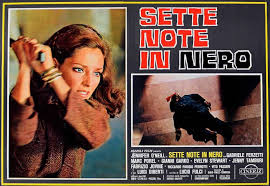
Today, Virginia (Jennifer O’Neill, Scanners) lives in Rome and is married to a wealthy businessman named Francesco (Gianni Garko, Sartana himself!). As she drives him to the airport for his next business trip, she begins to see visions. An older woman is being killed. A wall is torn down. And a letter is under a statue. How strange is it that the house she is beginning to renovate looks precisely like the one in her visions?
When she tears down the wall that looks like the one in her dreams, she finds the skeleton of her husband’s ex-lover and the police want to charge him with the murder. Virginia becomes the detective of the story, obsessed with saving her husband with the help of psychic researcher Luca Fattori. Soon, they believe that the real killer is Emilio Rospini (Gabriele Ferzetti, On Her Majesty’s Secret Service).
So who is the woman? Why was her body in that room, which was once her husband’s bedroom? Why is the woman’s face on the cover of the magazine that Virginia buys? That’s because Virginia’s visions aren’t the past but premonitions of the future.
Meanwhile, she’s given a wristwatch that plays a haunting theme every hour in the house. This eerie soundtrack, composed by Fabio Frizzi, adds a layer of suspense and tension to the film and was reused to incredible effect in Kill Bill. The growing knowledge that the victim isn’t dead yet—and that Virginia may be that victim—darkens every frame of Fulci’s epic.
Quentin Tarantino was so in love with this film that he intended to remake it with Bridget Fonda sometime in the 2000s, but this never happened.
Perhaps just as interesting as the film is the life of its star, Jennifer O’Neill. Possibly best known for her long career as a Cover Girl model, she has been married nine times to eight husbands (she married, divorced, and remarried her sixth husband, Richard Alan Brown). By the age of 17, she’d already attempted suicide so as not to be separated from her dog, had a horse break her neck in three places and married her first husband. She’s also had a horrible history with guns, having accidentally shot herself in 1982 and being on the set of the TV show Cover Up in 1984 when co-star Jon-Erik Hexum accidentally killed himself. While waiting for a delay, he had been playing Russian roulette with a prop gun and was unaware that the discharge could still cause damage. Placing the gun to his temple, he fired and caused so much damage to his brain that he died six days later.
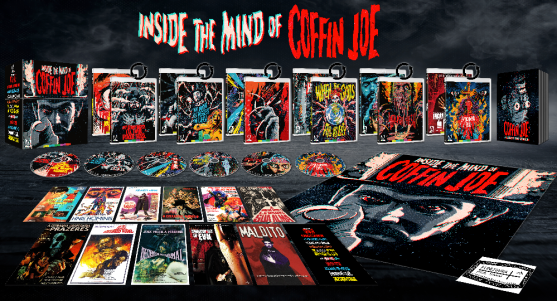
Directed and co-written (with Rubens Francisco Luchetti) by Jose Mojica Marins — the alter ego of Coffin Joe — Hellish Flesh is the tale of Dr. George Medeiros (Marins) and his wife Rachel (Luely Figueiró). He’s quite the scientist. But he’s neglecting his gorgeous bride over the need for science, so she hooks up with his best friend Oliver (Oswaldo De Souza). Together, they come up with a plan to kill him and take his money. Step one is throwing acid in his face. Step two is spending all his money. Yet he didn’t die during step one, so you better believe that he will come for revenge. Except that when he does come home, he doesn’t seem upset at all. As for Oliver, well, after spending most of his friend’s money, he got stabbed by another lover, leaving Rachel alone.
This is a movie filled with screaming and while strange, it doesn’t enter into the world of the Coffin Joe films. He doesn’t descend a staircase of naked women or go to Hell and learn that he is Satan. But still, it’s a movie where an acid-deformed scientist works on his revenge and even when making a morality story, Marins still can’t make a normal movie.
Arrow Video’s limited edition collection of the movies of Coffin Joe should be owned by every child. Hellish Flesh has extras including an interview with Andrew Leavold on Marins’ place in 60s and 70s Marginal Cinema and a new video essay by Kat Ellinger. You can get this set from MVD.
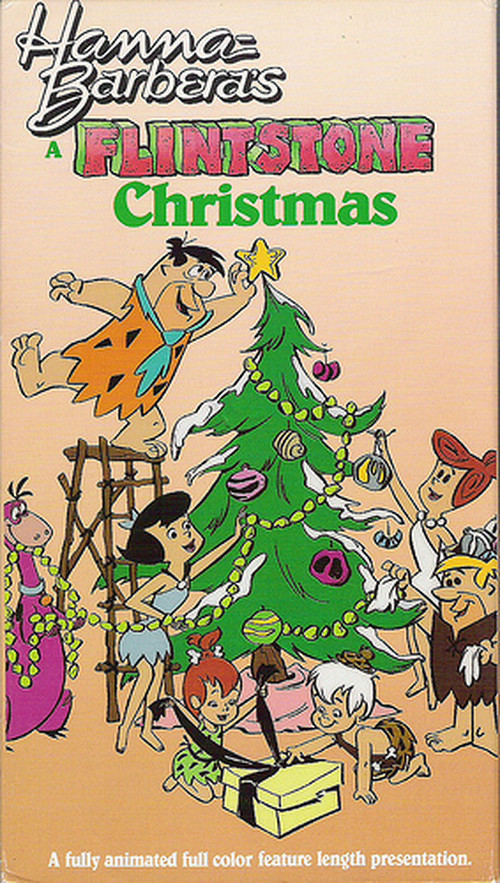
In 1964, there was an episode of The Flintstones, “Christmas Flintstone,” that was the first holiday story in the town of Bedrock. This aired on NBC on December 7, 1977 and is nearly the same story.
Fred and Wilma Flintstone, along with their daughter Pebbles, and Barney and Betty Rubble. with their son Bamm-Bamm, are all ready for the holidays, which makes me think that there is a Jesus Christ in the world of the Flintstones, AD before BC.
Wilma and Betty are getting ready for the Bedrock Orphanage benefit and Fred won’t be Santa. However, when Mr. Slate asks, he changes his mind. Santa, in a totally different style of animation than anyone else, wrecks his sleigh and Fred has to take over for Christmas. Will he get back in time to save the orphanage event?
Directed by Charles Nichols, who started his career as the animator for Coachman in Pinnochio before working at Hanna-Barbera and later back at Disney on their TV animation.
This film is the first cartoon appearance of Henry Corden as Fred Flintstone, as Alan Reed died earlier the year this was made.
A lot of the music in this is reused from A Christmas Story, another cartoon by the studio, while the song “Hope” is also in Yogi’s First Christmas.
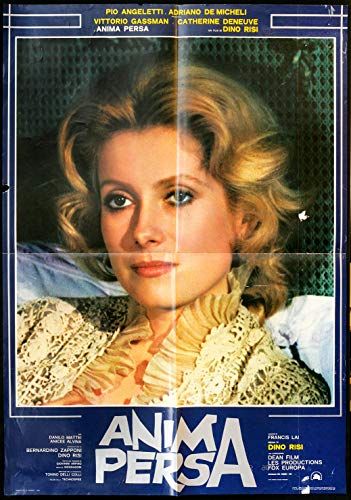
Based on Un’anima persa by Giovanni Arpino, The Forbidden Room has Tino (Danilo Mattei) come to Venice to study painting and stay with his Uncle Fabio (Vittorio Gassman) and Aunt Elisa Stolz (Catherine Deneuve). Yet the house just seems off; Fabio is abusive to Elisa. She just takes it.
He also starts to hear sounds from the attic in the section of the house he is never allowed to explore. It’s gigantic yet has fallen into ruin, cobwebs and cracks all over, even as it contains a full theater where Elisa once performed. The sounds come from a door behind the stage and soon, Tino learns that they belong to another uncle. Annetta (Ester Carloni), the housekeeper, allows him to enter that door and he learns that it is where Fabio’s brother (also Gassman) lives. He has gone mad after the death of Elisa’s ten-year-old daughter from her first marriage and screams, eats like a child and destroys baby dolls. But is the girl dead? And how did she die? The truth will ruin Tino, sending him away from painting and Venice, which always seems to attract the most gloomy of movies.
Director Dino Risi also made the original The Scent of aWoman. He wrote the script with Bernardino Zapponi, who wrote Deep Red. This has fantastic elements that show up before it’s over but is more drama than horror. However, it’s so well made that it will keep your interest for the whole film.
This movie doesn’t even take place in 2047, but I can only assume that Al Adamson and Sam Sherman saw Star Wars get hot and said, “Let’s put some tits on that.”
Overpopulation in the future is pretty bad, so the Controller (Erwin Fuller) makes sex illegal. Cindy (Catherine Erhardt) lives with her wicked stepmother — The Widow (Renee Harmon) — and two stepsisters — Bella (Bhurni Cowans) and Stella (Adina Ross) — you know the story. You understand that she has a fairy godfather (Jay B. Larson) and that she’ll hook up with her Prince Charming, here named Tom Prince (Vaughn Armstrong). And yes, she disappears and he looks for her.
You may not expect robots to enforce the law against sex and the fact that this is a musical.
I love that the Canadian VHS release of this movie was so cheap that it was a duplicate of the hotel version of this movie. At six minutes, a voice tells viewers that the preview is over and that they must select to watch the whole movie and charge their bill. I can’t imagine anyone buying this thinking they were going to see more sex and instead getting more musical numbers.
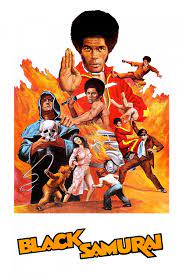
Robert Sand (Jim Kelly), agent of D.R.A.G.O.N. (Defense Reserve Agency Guardian Of Nations), is just trying to play tennis when he gets called in to save Toki Konuma (Essie Lin Chia, Doomsday Machine), an ambassador’s daughter. This brings him into conflict with another group called Warlock who want the freeze bomb, a new weapon, and use drugs and voodoo ritual murder to get what they want.
They’re led by Janicot (Bill Roy), who has a whole army of people willing to dress up in voodoo costumes, along with an evil woman named Synn (Marilyn Joi) and even a vulture named Voltron.
Based on the book by Marc Olden, this was directed by Al Adamson and written by B. Readick and Marco Joachim.
It’s got a great cast, including Felix Silla (who has a whip and that’s worth watching this for just that moment), Cowboy Lang, Little Tokyo, Regina Carroll and even Aldo Ray as the leader of D.R.A.G.O.N.
It also has Jim Kelly flying with a jetpack like he’s James Bond. That’s worth watching this movie for. Oh yeah — he also punches two dudes right in the cock. And not over the course of the movie. I’m saying he gives them both Roshambo at the same time.



 B&S About Movies
You must be logged in to post a comment.