EDITOR’S NOTE: Nightmare In Badham County was on the CBS Late Movie on February 18 and October 18, 1983 and February 8, 1985.
This was a made-for-TV movie but was released in theaters internationally with extended footage and nudity. It was so popular in China that actress Deborah Raffin became the first Western actress to make a promotional tour of the country and became an unofficial ambassador helping China make deals with Hollywood.
Raffin plays Cathy Phillips, who is driving across the country with her friend Diane Emery (Lynne Moody), ends up on the wrong end of the law after turning down the intentions of Sheriff Slim Danen (Chuck Connors), who puts them in jail and assaults Diane. This being a small Southern town, our heroines get sent to a work camp run by Superintendant Dancer (Robert Reed) and his guards, Dulcie, Smitty (Lana Wood) and Greer (Tina Louise).
Not everyone is going to make it out alive in this John Llewellyn Moxey — the man who made just about every great TV movie — film. Its writer, Jo Helms, also wrote the scripts for Play Misty for Meand The Girl in Lovers Lane.
This is another movie that reminds me I don’t go on vacation and talk to police officers too long. The saddest thing about this movie is that for all the attention it paid to having the women be in segregated jails, the actors all had to stay in segregated hotels while making this movie.
EDITOR’S NOTE: The Loneliest Runner was on the CBS Late Movie on August 12 and December 15, 1987.
This was written, produced and directed by Michael Landon, who really was the loneliest runner. That’s because he wet his bed until he was 14 and his mother hung his sheets out to dry so that all the neighborhood kids could see that he couldn’t sleep a night without pissing himself.
During his childhood, Landon had to deal with his mother threatening suicide. On a family beach vacation, she tried to drown herself, but he rescued her. Later, his mother acted as if nothing happened, and the stress of this led to him bedwetting even more.
Before he tore his shoulder, Landon wanted to be a javelin thrower. Instead, he became a teenage werewolf, a cowboy, a settler and an angel on the road.
John Curtis (Lance Kerwin) can’t sleep a night without getting the bed soaked and not from wet dreams. No, he urinates the sack nightly and runs to a local laundromat and washes the sheets when his parents are asleep. He also stays up all night during sleepovers. You would too if you had parents like Arnold (Brian Keith) and Alice (DeAnn Mears). She yells at both of them for being less than men and in response, Arnold slaps his son around. This makes him leak the sheets even more.
A young girl, Nancy Rizzi (Melissa Sue Anderson) shows interest, but all John can think about is running home to get those stained sheets down every day. However, his mother’s horrible parenting skills and his father’s inability to reveal that he also was a bedwetter means that he learns how to run fast. Really fast. He makes it to the Olympics, his father tells his mother to shut up and he gets the girl.
This movie inspired “Peanut Butter, Eggs, and Dice,” an episode of Mr. Show in which “The Bob Lamonta Story” is told.
Despite the earnestness of this film, it’s heart is in the right place. It was a staple of made for TV movies and it made me worry every night when I went to bed, sure that I’d be peeing everywhere. When I woke up and the bed was dry, I thanked Michael Landon.
EDITOR’S NOTE: Won Ton Ton: The Dog Who Saved Hollywood was on the CBS Late Movie on September 4, 1981.
We live in a magical reality, the kind of place where Michael Winner, the same man who made some of the roughest films ever — Death Wish, Death Wish 2, Death Wish 3, The Mechanic, The Sentinel — made this movie that’s a kind of, sort of biography of Hollywood star dog Rin Tin Tin.
It was originally called Won Ton Ton, the Dog Who Saved Warner Bros. before Paramount bought the film and, well, the movie had to change its name, right?
Estie Del Ruth (Madeline Kahn) has made her way to Hollywood, followed by a dog named Won Ton Ton. While she has dreams of being a star — and a director who continually and unsuccessfully pitches movies that will be made many years later named Grayson Potchuck (Bruce Dern) tries to help — the truth is that the dog has all the talent.
This is less a film than a collection of vignettes about the Golden Age of Hollywood, such as Ron Leibman’s effeminate take on Rudolph Valentino and Art Carney, Phil Silvers and Teri Garr as players in the tale of Estie and Won Ton Ton.
The draw for me — beyond how strange it is that Winner directed this comedy misfire — is the huge cast of Hollywood legends, many of whom made this movie their final role. Here are as many as I could remember:
Dorothy Lamour: One-time star of the Hope and Crosby Road movies, she shows up here as a visiting film star.
Joan Blondell: Often cast as a gold digger, Blondell’s career stretched back to vaudeville. She’d appear in two more movies after this: The Champ and Grease.
Virginia Mayo: Warner Brothers’ biggest box-office money-maker in the late 1940s, Mayo continued acting until 1997. She was one of the first actresses to be awarded a star on the Walk of Fame.
Henny Youngman: The rapid-fire standup who would always say, “Take my wife…please.”
Rory Calhoun: Readers of this site will definitely know Calhoun, as he reinvented himself in the 80’s, appearing in genre films like Motel Hell, Hell Comes to Frogtown and the first two Angel films.
Nancy Walker: This star of Rhoda would go on to direct an even bigger bomb than this: Can’t Stop the Music, the unreal story of the Village People.
Ethel Merman: Playing Hedda Parsons here, Merman was considered the First Lady of musical comedy.
Rhonda Fleming: Her name in this movie is Rhoda Flaming, which is…par for the course of this film. She was known as the Queen of Technicolor for how well she filmed.
Dean Stockwell: If you only know him from Quantum Leap, I’d recommend you check out his roles in To Live and Die in L.A. and Married to the Mob.
Tab Hunter: Known for his clean-cut, boy next door looks, his later years are marked by interesting turns, such as playing Mary Hartman’s dad on the spin-off Forever Fernwood and appearing with Divine in Polyester (1981) and Paul Bartel’s Lust in the Dust.
Dick Haymes: This big band vocalist sang in the session where Bing Crosby and The Andrews Sisters recorded both “There’s No Business Like Show Business” and “Anything You Can Do (I Can Do Better).”
Robert Alda: Yes, he’s Alan’s dad. But you knew that. And you also knew that he played Father Michael in Mario Bava’s House of Exorcism.
Victor Mature: This would be the actor’s last major role; he also shows up in a cameo at the end of Winner’s film Firepower.
Edgar Bergen: As Professor Quicksand, this is one of his few roles not holding one of his trademark partners like Charlie McCarthy or Mortimer Snerd. He’s also in The Phynx, which still blows my mind.
Henry Wilcoxon: You may not know that he was very involved with the films of Cecil B. DeMille, but you do know him as the priest caught in a rainstorm in Caddyshack.
Yvonne DeCarlo: In 1950, the Camera Club of America voted her “Sexnicolor Queen of the Screen.” You know those guys — the pre-Internet creeps that’d hire women to pose for them as they stood around en masse. DeCarlo is better known as Lily Munster, she also appears in the kind of movies that this creep enjoys, namely Satan’s Cheerleaders, Silent Scream, Play Dead, Guyana: Cult of the Damned, American Gothic and Mirror, Mirror.
There are literally dozens and dozens of stars here, so get ready…
Edward Le Veque (the last surviving member of The Keystone Kops); William Benedict (Whitey of The Bowery Boys); Huntz Hall of The Dead End Kids; silent stars Carmel Myers, Dorothy Gulliver, Maytag repairman Jesse White; comedians Jack Carter and Shecky Greene; Marilyn Monroe rival Barbara Nichols; Variety columnist Army Archerd; Fernando Lamas; Zsa Zsa Gabor; Cyd Charisse, whose legs were once insured for $5 million dollars; Doodles Weaver (who also shows up in plenty of insane movies like The Zodiac Killer); cowboy actor Pedro Gonzalez Gonzalez; Dick Van Dyke Show co-star Morey Amsterdam; Monroe/JFK scandal magnet Peter Lawford; Eddie Foy Jr.; Patricia Morison; The Adventures of Wild Bill Hickok star Guy Madison; John Carradine as a drunk (yes, I realize that this is an easy target; I also realize that I watch at least one movie with Carradine in it a day); Regis Toomey, who is also in another dog of a film C.H.O.M.P.S.; Ann Rutherford (Gone with the Wind); Milton Berle (once perhaps the most famous person in entertainment); Keye Luke (a founding member of the Screen Actors’ Guild as well as the original Brak on Space Ghost and Mr. Wing from Gremlins); Walter Pidgeon (he’d be in one more movie, the Mae West vehicle Sextette); character actors Phil Leeds and Cliff Norton as dogcatchers; Winnie the Pooh’s original voice Sterling Holloway; two of the Ritz brothers who were also in Blazing Stewardesses; Edward Ashley (Professor Sutherland from Waxwork); Fritz Feld (who is also in The Phynx); George Jessel; Ken Murray; Stepin Fetchit (considered to be the first African-American to have a successful acting career, now seen as an example of how Hollywood treated minorities); Tarzan actor Johnny Weissmuller; Louis Nye; Dennis Morgan; William Demarest (Uncle Charley from My Three Sons); Billy Barty who plays an assistant director; Ricardo Montalban; Jackie Coogan; Roy Rogers’ sidekick Andy Devine; Broderick Crawford (of his many movies, I’ll let on that Harlequin is one of my favorites); Richard Arlan; Jack La Rue; former pro wrestler “Iron” Mike Mazurki; as well as singers Dennis Day, Janet Blair, Jane Connell, Ann Miller, Rudy Vallee and Gloria DeHaven.
When Augustus von Schumacher attended the premiere — he was the dog who played the lead role — he walked in with Mae West. Now that’s how you become a star.
As for the movie — unless you’re someone like me that gets excited about cameos, you’re going to hate it.
Uschi Digard week (June 23 – 29) Digard is best known for her work with Russ Meyer but she became an SWV fan favorite for two gargantuan reasons, her charm and her prolific career. The Swiss actress fled to America in 1968 and began a long career filling the silver screen from corner to corner with her overflowing positive energy. Show the lady some respect and watch one of her movies.
This is not about the one with the silver balls, yet I remain obsessed about the idea that when people are fucking the Lady In Lavender in Phantasm, they’re fucking the Tall Man.
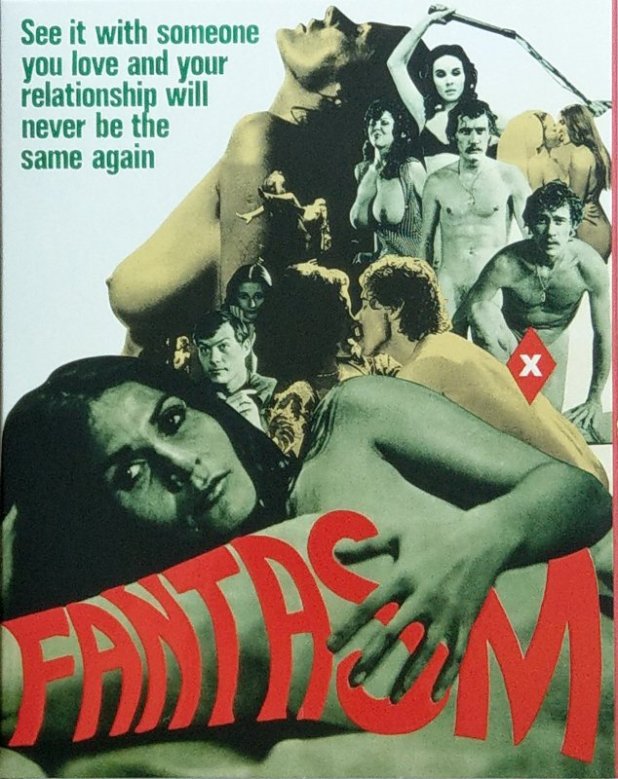
No, this is the adult movie from Down Under directed by the man that would one day make Psycho II, Richard Franklin. He used the name Richard Bruce, but it’s the same talented man who made Roadgames and Cloak and Dagger.
German sexologist Professor Jürgen Notafreud (John Bluthal) is here to explain to us how the female sexual mind works. To do so, we’re going to watch an anthology film of sexual hijinks, kind of like an Amicus movie but you know, with fucking.
There are many tales here, like the woman who is being pampered in a “Beauty Parlour,” a husband (William Margold) and wife (Maria Arnold, who is in the best titled of all Harry Novak’s movies, Wam Bam Thank You Spaceman) playing a “Card Game” where she takes on as many of his friends (Kirby Hall and Robert Savage) as she can (and then Wendy Cavanaugh and Helen O’Connell also come over), “Wearing The Pants” has a housewife (Gretchen Gayle, My Body Hungers) do some forced feminization and sodomy on a man (Con Covert) who steals her clothing and “Nightmare Alley,” which has Rene Bond being assaulted by Al Williams until she likes it.
Umm…it was 1976? No, I can’t defend it.
At least this recovers with “The Girls,” as Uschi Digard — listed as Super Girl, as if she was coming in from a Russ Meyer movie — and Mara Lutra engaging in some sapphic screentime. Then, the film’s most famous moment has John Holmes rise from the water nude — yes, it’s still intimidating — and eat “Fruit Salad” off of Maria Welton.
Fantasm seems to be about displaying taboos, like how Candy Samples lusts for her son (Gene Poe) in “Mother’s Darling” and a black exotic dancer (Shayne) performs for Richard Partlow, Paul Wyman and Sam Wyman. Or “After School,” where young Roxanne Brewer (Sexual Kung Fu in Hong Kong and Dr. Dildo’s Secret; spoiler warning; the doctor is a dildo) dances for her teacher (Al Ward) until he has a heart attack. Guess that test is cancelled tomorrow.
Finally, in the scene that you knew I’d like most, a “Blood Orgy” finds Serena get sacrificed by a Satanic cult, but not before making love to their priest (Clement von Franckenstein, whose father Sir George Franckenstein was the Austrian Ambassador to the Court of St. James).
Also: John Holmes’ name is Neptune and at one point, it seems like his underwater lover is using his massive membrum virile as a snorkel.
I would assume that Brockton O’Toole got his inspiration from this movie. And if you got that, you definitely walked through some video store curtains.
Uschi Digard week (June 23 – 29) Digard is best known for her work with Russ Meyer but she became an SWV fan favorite for two gargantuan reasons, her charm and her prolific career. The Swiss actress fled to America in 1968 and began a long career filling the silver screen from corner to corner with her overflowing positive energy. Show the lady some respect and watch one of her movies.
Stu Seagall created hyper-realistic training for military personnel and also directed Insatiable with Marilyn Chambers. How can you top that? He was the executive producer for Silk Stalkings, Renegade and the third Beastmaster movie. And more? He directed, wrote and produced Drive-In Massacre, which this was shot back-to-back with.
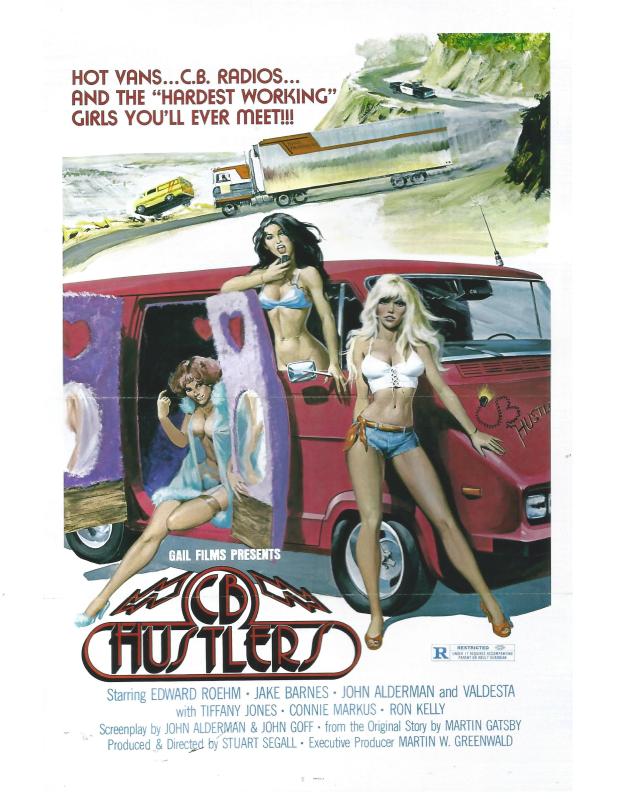
He also directed this movie, which was written by John Alderman, John F. Goff and Martin Gatsby. It’s about a couple named Dancer (John Alderman) and Scuzz (Jacqueline Giroux) who are the pimps for three women known as the C.B. Hustlers, who are played by Janus Blythe (Ruby from The Hills Have Eyes), Catherine Barkley and — most importantly — Uschi Digard, billed as Elke Vann. They always tell people in public that the girls are their daughters, but the truth is that they collect 40% of their $25 fee for each sex act, which they set up with C.B. radios.
In C.B. terms, they used to call the areas where sex workers would line up as pickle park, party row or the back row.
Sheriff Elrod P. Ramsey (Bruce Kimball) wants to bust the girls, so he brings on newspaper men Boots Clayborn (John F. Goff) and Mountain Dean (Richard Kennedy) to track them down. Of course, Boots falls for one of the girls and ends up helping them stay ahead of the fuzz. Or as C.B. users would say, bears driving bubble gum machines. Or a smokey. Or, if they’re women, Mama Bears.
It’s also a vansploitation movie! The Hot Box 1 and Hot Box 2 vans were made by Custom Touch of Van Nuys, California.
There’s one major reason — well, two — to watch this and that’s Uschi Digard, whose lovemaking scene is filmed as if you are under her. It’s worth sitting through all the bad country music, long walking scenes and the dumb plot, because I often wonder if God exists and upon rewatching this scene more than once, I can confirm that the answer is affirmative.
June 20: Junesploitation’s topic of the day — as suggested by F This Movie— is Blacksploitation! We’re excited to tackle a different genre every day, so check back and see what’s next.
Born Walter Gordon, Jamaa Fanaka was one of the leading directors of the L.A. Rebellion film movement, a new generation of young African and African-American filmmakers who studied at the UCLA Film School in the late-1960s to the late-1980s. They created a new form of black cinema that was an alternative to Hollywood. Fanaka was, however, “very much fascinated by Hollywood and averse to the contentious ideological and artistic discussions that were fundamental to the formation of the school.”
Independently produced, written, directed and edited by Fanaka as an undergraduate project at UCLA that took seventeen months of weekends, all of his savings and some of his parent’s as well, Fanaka’s advisors at the school told him to not even try a feature film as his class project. He ended up creating one that won a national theatrical distribution deal with Crown International Pictures. The director would complete his thesis film, Emma Mae, and Penitentiary while still in college.
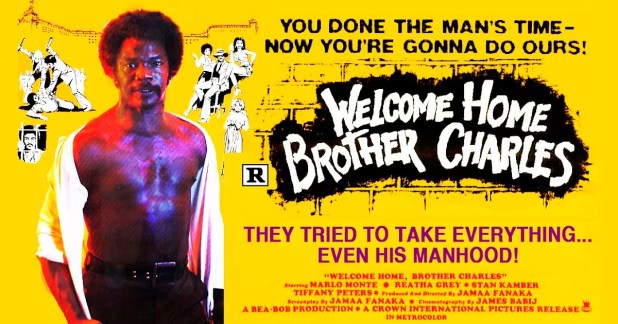
Sure, it was re-released on video as Soul Vengeance but this movie isn’t the typical blacksploitation movie, despite beginning with its hero Charles (Marlo Monte) being arrested by corrupt white police and nearly castrated. When he’s released, all Charles wants to do is forget the past. He wants to move past the life of crime he once led. He can’t even have Twyla (Jackie Ziegler), the girl he loves, who is now the woman of his former best friend, N.D. (Jake Carter).
Sounds like a typical blacksploitation movie and I promised you that it wasn’t.
That’s because while Charles was in prison, he was experimented on, like Luke Cage in Marvel Comics, but instead of getting skin knives and that bullets can’t touch, he gets a murderous and prehensile penis. Seriously, it’s feet, not just inches long. It’s the kind of penis that frightens the white male establishment way more than the typical African American member, because when he’s not using it to seduce the white wives of the cop who tried to slice off his prick, Officer Harry Freeman (Ben Bigelow), as well as the prosecutor and judge who set him up. He’s also strangling those men with it, which has to be the worst way for a straight white racist man to die.
Despite trying to find some form of comfort with Carmen (Reatha Grey), prison has destroyed Charles. And what he’s done to Freeman’s wife (Tiffany Peters) has ruined that cop, as if he needed any help, telling his wife that she’s contaminated. That’s because even before he gained his monstrous member, Charles was cucking the law. And that’s why Freeman tried to take a knife to our hero while he was in handcuffs. I have no idea why he’s stayed married, as one evening he wakes her up by choking her back into oblivion and she looks him in the eye and snarls, “You think you’re a man? You didn’t even have the guts to destroy the object of your humiliation. Me!”
Also, maybe I didn’t mention it, but his new penis — who would do this experiment, what was it for and why would they be authorized? — can hypnotize white women.
I love that this movie exists, that it has sloppy moments where we just watch people dancing in the streets in footage that had to be just the camera running and capturing what these small Los Angeles neighborhoods used to be like. As wild as this movie gets, it only hints at just how far Fanaka would push reality with the Penitentiary series.
June 16: Junesploitation’s topic of the day — as suggested by F This Movie— is Bruceploitation! We’re excited to tackle a different genre every day, so check back and see what’s next.
Originally a South Korean movie called Amelika bangmungaeg (also called Visitor of America), this was released in the U.S. by Aquarius Releasing with new dubbing, an incredibly insane poster of Bruce Lee emerging from a grave to defend a half nude woman and battle a flying bat baby as well as a new beginning filmed in the U.S. where lighting strikes the grave of Bruce Lee, who soon emerges, ready to fight. In an amazing display of absolute lunacy, that’s it. No more Bruce Lee.
No, instead, we follow Wong Han (Jun Chong, a judo master who used the name Bruce K. L. Lea; he’s the founder of the World United Martial Arts Organization (WUMAO); has trained Lorenzo Lamas, Sam J. Jones, Phillip and Simon Rhee, and Heather Graham; he also shows up in L.A. Street Fighters, Silent Assassins and Street Soldiers) as he makes his way to America to try and learn who killed his brother Han Ji-Hyeok.
Also: It appears that Wong’s brother died by jumping off his apartment building and is being incinerated in the furnace of the same building, which ends with Wong scooping up all the burned bones and placed them around his neck, along with a photo of the deceased and wandering the streets looking for answers. He’s then attacked by a man in black, who he defeats and kills, which leads to his arrest.
Wong is bailed out by a rich man named Scott Lee and asked to find a woman named Susan (Deborah Dutch, Deep Jaws, 976-EVIL II), who ends up being a waitress. Why Lee hired him is a mystery because he’s shown that he has no idea how to find the killers of his brother, so it’s not like they had a precedent for his detective skills. Anyways, he decides to help Susan and teaches her martial arts so quickly that she can fight nearly as well as him in mere days. She soon informs our hero that she learned from her job in Lee’s Turkish bathhouse that five men were involved in the death of his brother: the black man Wong has already battled, as well as a white man, a Japanese fighter, a Mexican and a cowboy. Seeing as how there are about 4 million people in Los Angeles, this won’t be easy to find them. Then again, he didn’t find the killers yet and did find Susan, so he’s batting .500 which would get you in the hall of fame.
Then, our hero goes to a Christmas parade. Why? So the people there can look directly at the camera and the filmmakers could shoot this without permits. Our hero is a strange guy, one who won’t sleep in Susan’s house for moral reasons, so she buys him an RV to sleep in outside her house.
Anyways, the cowboy is the last alive, killing the other killers before Wong and that means that our hero and he will have to battle one on one. He fights like a pro wrestler, which I can appreciate, and then we learn that maybe Wong’s brother is still alive as nearly everyone else dies. Yes, our hero can’t even protect the woman who helps him, choosing to do a fancy flying kick instead of just disarming the bad guy.
Directed by Lee Doo-yong and written by Hong Ji-Un, this movie is really something else. It’s not good and yet I loved every moment. I kept thinking about the trailer and the poster and how they had to have led people to say, “Bruce Lee versus the black angel of death? How can I not watch this?”
June 3: Junesploitation’s topic of the day — as suggested by F This Movie— is Revenge! We’re excited to tackle a different genre every day, so check back and see what’s next.
Inspired by a 1950s series of Malaysian movies*, this film is about Sheng Yun (Danny Lee, The Killer, Thunder of Gigantic Serpent/King of Snakes, Infra-Man), a man who has risen past the handicap that polio dealt him to become a lawyer. He tries to helps a man, Lin Yang Ba (Ku Feng), who has killed a criminal to protect his daughter Yue (Chen Ping) and his coconut oil business. Before he is hung, Lin Yang gives Sheng Yu a black magic spell that transforms him into an oily maniac.
The real problem is that Yue is really in love with Chen Fu Sin (Wa Lun) and wants nothing to do with him. That means he goes on a rampage, wiping out all manner of criminals, like a plastic surgeon, a woman who accuses men of rape and a blackmailer. Look, if someone asks you to look at the magic spell on their back, lie in a hole in your yard and cover yourself with oil, I guess you do it.
Some people think all the Shaw Brothers did was martial arts movies. Oh man. I hope you know that they made movies like The Boxer’s Omen, Human Lanterns and Corpse Mania. Somehow, director Meng-Hua Ho (The Cave of the Silken Web, Black Magic) and writer Lam Chua made a movie that feels like The Heap, Man-Thing and Swamp Thing with a bit of Toxic Avenger except, you know, in 1976.
You would also think that because this is a superhero movie that it would be for children. Well, no. Not with the near-constant nudity and threat of sexual violence in every scene. It’s so strange how the goofy costume of the creature is juxtaposed against the sheer depravity on display in this movie, including scenes where a woman reveals her burned breast and the Oily Maniac attacks an abortionist mid-baby killing.
*According to IMDB, this is based on the Malaysian legend of the orang minyak (oily man), a creature that comes to life out of crude oil and is fueled by the hope for revenge by those who have been done wrong. There are also three Malaysian films — Curse of the Oily Man, Orang Minyak and Serangan Orang Minyak — as well as two modern movies, Orang minyak and Pontianak vs. Orang Minyak, which has the oily man battle a vengeful ghost woman.
In the opening hours of June 11, 1979, I was listening to KDKA AM radio with my dad. In the middle of a show, the national news broke in to say that John Wayne had died.
I started crying because I always thought my grandfather was John Wayne. If the Duke could die, my grandfather could.
It was too much for a six year old child.
I’m glad the young version of me never saw The Shootist.
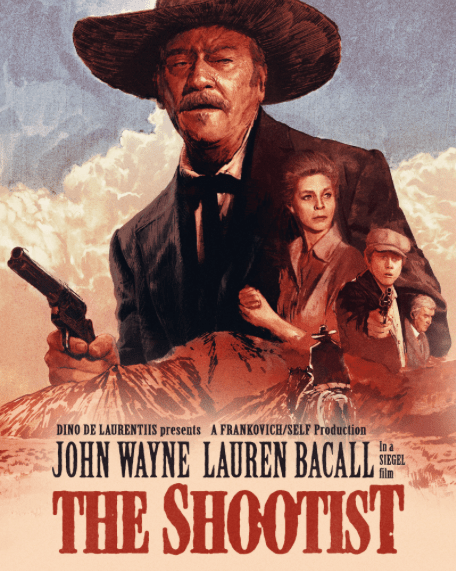
The last movie that Wayne would be in, this is the tale of sheriff-turned-gunfighter John Bernard “J.B.” Books, a man who has killed more than thirty men and become a legend. The kind of man that people run from rather than even look at, someone who Marshal Walter Thibido (Harry Morgan) hopes he doesn’t have to arrest.
He’s in Carson City to visit one of the only people he trusts, Dr. E.W. “Doc” Hostetler (Jimmy Stewart), the man who once saved his life after a gunfight gone wrong. He doesn’t have the energy he once did and he soon finds out that he has cancer. He has days, maybe weeks left. All he can do is take liquid painkillers and hope for the best.
Until he’s taken, he plans on just living a quiet unknown existence in the home of widow Bond Rogers (Lauren Bacall), a woman who instantly dislikes him and grows to feel differently. He also ends up being a father of sorts to her son Gillom (Ron Howard) who is close to being a criminal.
Once others learn he is in town, killers come to make their names off shooting him but even in the throes of death, Books is too tough to die. He also has no interest in telling his story to reporter Dan Dobkins (Rick Lenz), even if it makes money for one of the only women he ever loved, Serepta (Sheree North).
Realizing the end is near, Books tells Gillom to bring three men to the bar. They are dairy owner Jay Cobb (Bill McKinney), a man who insulted him when he first arrived; Jack Pulford (Hugh O’Brian), a Faro dealer who was once a killing machine who needs to destroy Books to get his name back and Mike Sweeney (Richard Boone), who wants to kill Books in revenge for the death of his brother. Despite being critically wounded, Books kills all three before being shot in the back by a bartender, someone he never even figured on. Gillom takes his gun and shoots the man before throwing the revolver down. As he dies, Books smiles and nods.
Gillom walks away without a sound.
Books lived by the words “I won’t be wronged, I won’t be insulted, and I won’t be laid a hand on. I don’t do these things to other people, and I require the same from them.”
Paul Newman, George C. Scott, Charles Bronson, Gene Hackman and Clint Eastwood all passed on this movie and it was thought that Wayne — who had his left lung and several ribs removed when he first had cancer — couldn’t handle the role. His breathing and mobility, as well as the altitude of Carson City were challenges he had to fight. When he made Rooster Cogburn a year before, he had pneumonia so bad that he damaged his heart from how much he coughed. A lot of people thought he couldn’t make this movie and his doctors almost stopped filming after he caught the flu.
He changed the ending of the book and the script. Books was supposed to kill his last opponent by shooting him in the back and would be put out of his misery by Gillom after he was shot in by the bartender. Wayne felt that he had never shot a man in the back and would not in this movie either. He also objected to his character being killed by Gillom and added the bartender shooting him in the back because “no one could ever take John Wayne in a fair fight.”
Director Don Siegel told Wayne. “That’s what Clint Eastwood would do.”
Wayne apocryphically replied, “Well I don’t like that, and I didn’t like High Plains Drifter!”
There are also some great moments with Scatman Crothers as a blacksmith and a short role for John Carradine (Wayne, figuring this was his last movie, got several of his friends to act in the film) as an undertaker. Even the horse, Dollar, is Wayne’s horse.
This is also one of only seven movies in which Wayne dies, along with Reap the Wild Wind, The Fighting Seabees,Wake of the Red Witch, Sands of Iwo Jima, The Alamo and The Cowboys.
The father and son relationship between Books and Gillom reminds me of the way that Tin Star takes a man ruined by a hard life and shows how he can be redeemed by how he treats a younger one.
The Arrow blu ray of The Shootist has a new 2K remaster by Arrow Films from the original 35mm camera negative and extras such as a new audio commentary by filmmaker and critic Howard S. Berger, a visual essay by film critic David Cairns, an interview with Western author C. Courtney Joyner, an appreciation of Elmer Bernstein’s score by film historian and composer Neil Brand, a visual essay on Wayne by filmmaker and critic Scout Tafoya and The Shootist: The Legend Lives On, an archival featurette, There is also a trailer and image gallery.
It all comes inside a reversible sleeve featuring original and newly commissioned artwork by Juan Esteban Rodríguez, as well as even more like a double-sided fold-out poster, six postcard-sized lobby card reproductions and an illustrated collector’s booklet featuring new writing by film critic Philip Kemp.
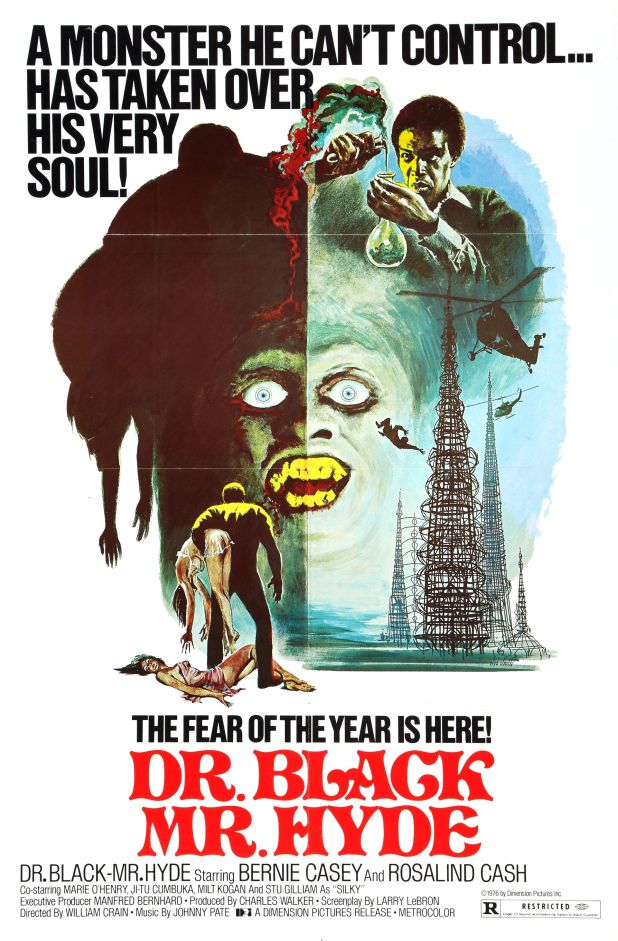
American-International Pictures’ Blacula was a big success. Its director, William Crain, and AIP wanted to make more black films that were classic stories retold for a new audience. What’s interesting here that while adapting Strange Case of Dr. Jekyll and Mr. Hyde by Robert Louis Stevenson, the evil side of Dr. Henry Pride (Bernie Casey) appears to be a mix of King Kong, Frankenstein’s Monster and an evil white man.
Pride may be a celebrated and wealthy African American medical doctor, but as he fails to discover a cure for cirrhosis of the liver — along with his colleague Dr. Billie Worth (Rosalind Cash) — he begins to experiment on himself and others. Coming just a few years after the way our government treated the Tuskegee airmen with their syphilis experiments, this feels like not only a crime against nature, but a black man attacking his very race.
By the end, he’s killing sex workers and their pimps, leading the police to Watts Towers, where he climbs upward — again, like King Kong — before being shot and falling to his death.
This also had the working titles The Watts Monster, Hyde, Serum and Decision for Doom. Along with the aforementioned Blacula, Scream Blacula Scream, Sugar Hill, Blackenstein, JD’s Revenge, Abby, Ganja and Hess and Petey Wheatstraw, there are some other black-themed horror films from this era but not enough. Later films in the genre that I would recommend are Bones, Def by Temptation and Tales from the Hood.
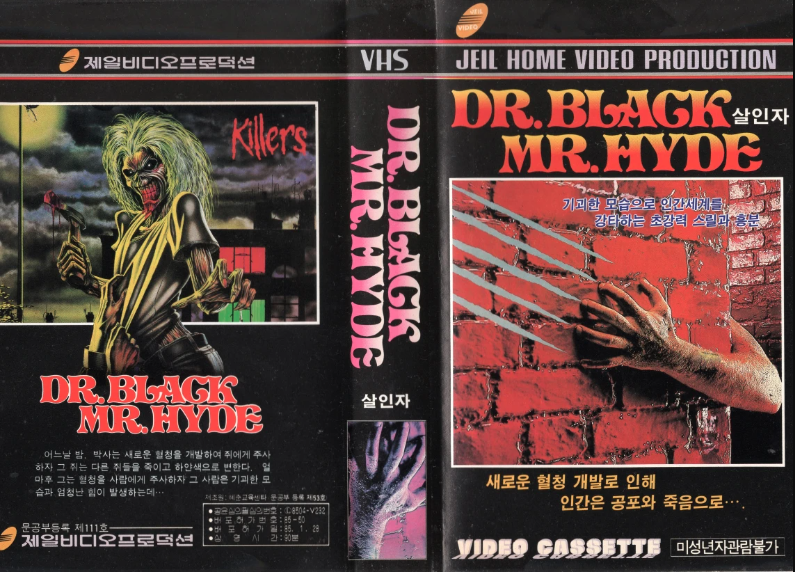
How incredible is it that the South Korean VHS release of this had the Iron Maiden artwork from Killers on its back cover?





 B&S About Movies
You must be logged in to post a comment.