Poor Pretty Eddie (1975)

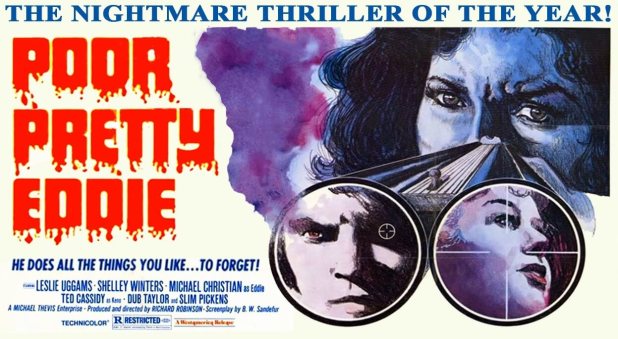
It’s rare that I watch a movie that gets on the very verge of upsetting me. Poor Pretty Eddie is that rare film that pushed me pretty far and made me feel somewhat upset for watching it, which ended up making me keep going and enjoying the end results. It’s not an easy watch, but it’s amazing that this movie even exists.

Most of the makers of this film were employed in the world of adult films, with Poor Pretty Eddie representing their chance to go straight. Backing came from Michael Thevis, the notorious Atlanta-based “King of Pornography,” who owned a record company named GRC, a chain of sex shops and a company that manufactured peep show booths. In fact, the rock band Flood recorded the soundtrack for the martial arts movie Blood of the Dragon in his Sound Pit Studio on Atlanta’s Simpson Street, which also saw country singer Moe Bandy, dance sensation Loleatta Holloway and country songwriter and the author of the three million record selling “Chevy Van” Sammy Johns — as well as R&B acts like Ripple, the Rhodes Kids, King Hannibal and Sam Dees — all record there. He also published a series of pornographic novels that were written by Ed Wood under the name Donna D. Dildo.

Producing a legit movie allowed Thevis to launder money that he had made through shadier dealings, which brought the FBI in. Shortly after the film was released, he was jailed on a variety of charges and then escaped prison in 1978, ending up on the FBI’s most-wanted list. He had already put a contract out on the life of the man who had given the police all the info they needed to put him away. While on the lam, he tracked down that man — Roger Dean Underhill — and killed him and another associate. He bragged about it in prison and fellow prisoners ratted him out.

In 1980, Michael Thevis, the so-called “Scarface of Porn,” who once owned nearly half of the industry and made $100 million a year ($311 million today when adjusted for inflation) was sentenced to spend 28 years to life in the Oak Park Heights Correctional Facility, an underground penitentiary outside of Minneapolis and eventually United States Penitentiary in Atlanta. His palatial home was sold eventually to Whitney Houston. In 2013, he died of heart and respiratory failure. This Daily Beast article on his life is required reading.

Poor Pretty Eddie was written B. W. Sandefur, who is mostly known for his TV writing and producing. In fact, he was behind one of the oddest series of the early 1980’s, NBC’s Cliffhangers, which featured three different stories that all began in the middle of their stories. Stop Susan WilliamsThe Phantom Empire and The Curse of Dracula were all eventually turned into theatrical releases — along with extra material added — in Europe.

Loosely based on the Jean Genet play The Balcony and directed by David Worth (Kickboxer) and Richard Robinson (who has films like Is There Sex After Marriage and Adultery for Fun & Profit on his resume), this film is shocking even today.

The Turner Classic Movies article on the film hits it right on the head. They describe Eddie as such: “A sleazy exploitation thriller with artistic pretensions, the film manages to be offensive, crude and inept in equal measure while still succeeding as a compulsive viewing experience for connoisseurs of fringe cinema who think they’ve seen everything.”

We start at the University of Georgia as Liz Wetherly (Leslie Uggams, who older readers will know from Roots and younger ones will know from the Deadpool movies), a famous singer, is performing the national anthem. There’s a cut to her car driving down a country road and we hear her say, “Look, I have two weeks before my next concert. Now I’m going to get in my car and drive until I find a nice, quiet hole to crawl into.”

Be careful what you wish for.

After he car breaks down, Liz rents a cabin for the night — so she thinks — while the gigantic handyman Keno (Ted Cassidy, who was Lurch on The Addams Family, as well as the second actor to play Bigfoot on The Six-Million Dollar Man after Andre the Giant. He was also the narrator for The Incredible Hulk and provided the voices for Godzilla, Frankenstein Jr., The Thing, Moltar, Metallus, Black Manta and Brainiac for various Hanna-Barbera cartoons.)

Somehow, she ends up stuck for days thanks to the machinations of Eddie (Michael Christian, TV’s Peyton Place), a lothario who has already ensnared motel owner Bertha (Shelley Winters, who was in so many movies where she ran a house of ill repute, at least in my imagination, as well as the killer mother of an alien child in a role that doesn’t add up in another astonishingly bonkers Atlanta-based movie, The Visitor). Strangely enough, in the filmed version of the aforementioned Genet play, WInters played nearly the same role. Yet here, she plays it as a once gorgeous showgirl stuck remembering the past through the haze of alcohol, trying in vain to hold on to her man. Of note, Winters was paid in cash for her role and nearly died when her private plane almost crashed upon landing in Atlanta.

Not only does Eddie want Liz for carnal reasons, he also thinks she can help him in his career as a country singer. He spends much of the film dressed in Elvis jumpsuits and warbling his way through ballads. And oh yeah — he eventually assaults our heroine and then subjects her to further torture like forcing her to please a traveling salesman and eating Keno’s dog.

Liz finally gets the courage to turn in Eddie, which leads to Sheriff Orville (Slim Pickens!)  asking her “Did he bite ya on the tittie?” and making her submit to a public trial in a crowded VFW/bar as locals gasp that a black woman is in their midst. Drunken proprietor Floyd (Dub Taylor, a cowboy star and former Clemson Tide football player, who is in all manner of redneck films like Thunderbolt and Lightfoot…tick…tick…tick…, Evel KnievelGatorCreature from Black LakeThe Great Smokey Roadblock and Moonshine County Express) then conducts a trial in front of an assembled crowd of drunken locals, many of whom appear disturbingly disturbed, that ends with Liz stripped nude and crying.

The film’s montage sequences are some of the most disturbing I’ve sat through, including Eddie assaulting Liz to the sounds of a country love song intercut with two dogs humping, as well as a scene where she takes photos of him near a waterfall, imagining her camera is a shotgun and that he is covered in blood and gore.

It all climaxes with a wedding where Eddie and Liz are to be wed, which ends up in a slow motion Sam Peckinpah gun battle, as Keno blasts his way in wanting revenge for his dog and everyone gets caught in the crossfire. The film ends with Liz, her life ruined and not enhanced by this escape from her busy life, raising a shotgun to murder Bertha.
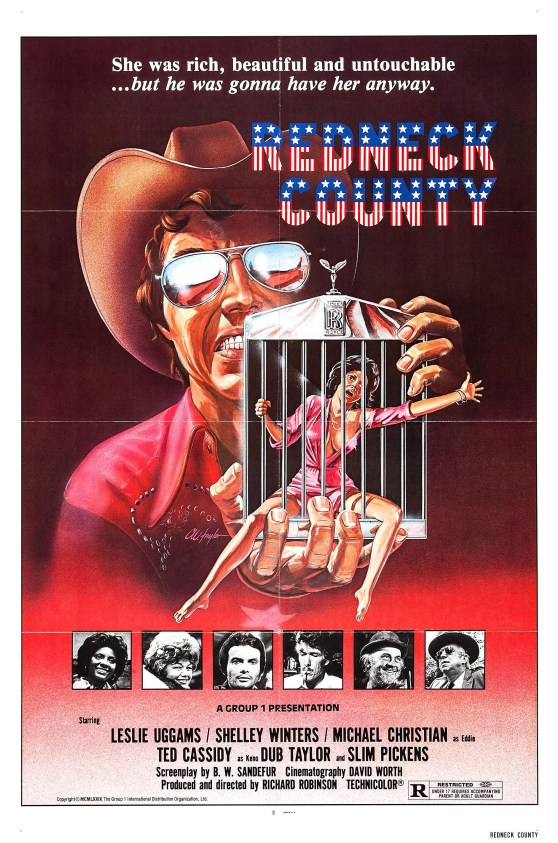
Also known as Black Vengeance, The Victim, Heartbreak Motel and Redneck County Rape, the film played drive-ins and grindhouses for nearly a decade. The Heartbreak Motel version features plenty of differences, as Eddie narrates the movie and action scenes have been cut out and replaced with length soliloquies that don’t appear in any other version of the film. Instead of ending with the gun battle, Heartbreak Motel closes with Eddie leaving Georgia for Nashville and a recording contract. There are less scenes of Eddie attacking Liz, but strangely enough, there is a scene where Eddie and Bertha make, umm, third input love to the haunting strains of a bluegrass ballad.

To say that critics — especially in Atlanta — disliked this film is an understatement.

The 1970s were packed with films that you are kind of, sort of horror movies, yet feature no supernatural elements. They just made you feel like you needed to take an entire day’s worth of showers to clean off the scum after watching them. This is one hell of an addition to those movies. It’s not for everyone, but for those who want to see how low exploitation can go, it’s ready to attack your sensibilities.

You can watch this on Tubi and Amazon Prime.
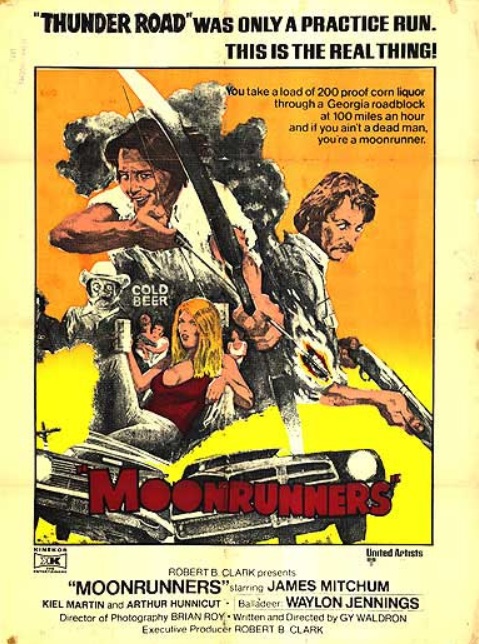
Moonrunners (1975)

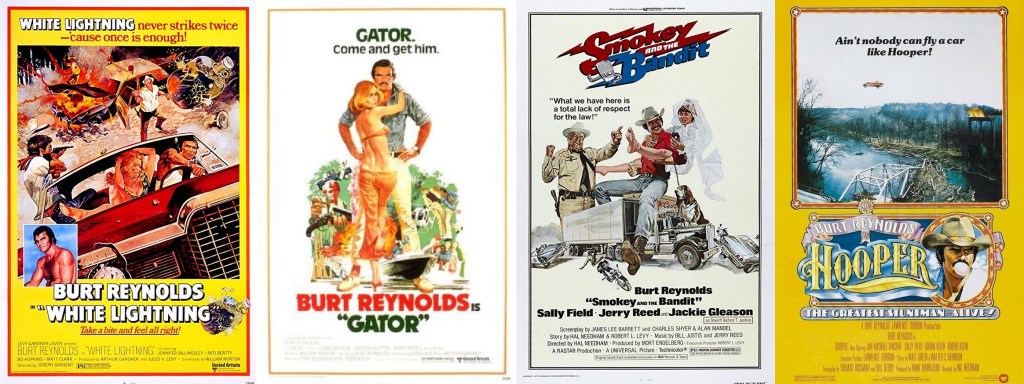
Moonrunners is one of the earliest celluloid responses to the massive box office generated by Burt Reynolds’s White Lightning (1973)—and was filmed in 1973 in the wake of that film. Over the years, Reynolds applauded White Lightning as being one of the best of his career and reasoned White Lightning’s success was the result of it being the first film that celebrated Southerners and didn’t degrade their culture and lifestyle: it was a film made about and for those folks living south of the Mason-Dixie. Burt Reynolds’s Deliverance (1972) and White Lightning—and obviously Gator (1976) and Smokey and the Bandit (1977)—set those stills o’ bubblin’ for every Southern tale thereafter.

Watch the trailer.

So, if you never heard of Moonrunners, but you enjoyed White Lightning or Burt Reynolds’ post-Smokey and the Bandit, “good ol’ boy” films of Stoker Ace and Hooper, then you’re up-to-speed to enjoy the down-home, pre-Dukes of Hazzard action that is Moonshiners—as well as Roger Corman’s copies, Moving Violations (1976) and Thunder and Lightning (1977), both made to catch that Burt Reynolds-lightning in a bottle.

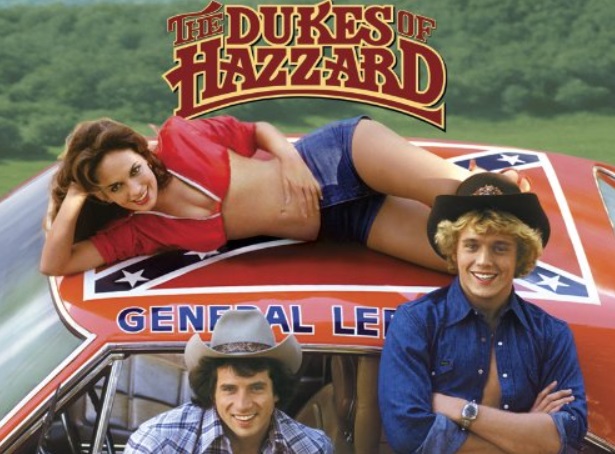
And you’ll recognize the plot and characters of Moonrunners right away: you’ve seen it before—on the successful TV series, The Dukes of Hazzard (1979-1985). While M.A.S.H receives an acknowledgment as the most successful film-to-TV adaptation, with the transition of Alice Doesn’t Live Here Anymore as Alice as a close second, critics have forgotten Moonrunners successfully transitioned to television. More critics “remember” The Super Cops (1974) transitioning to the small screen as Starsky and Hutch and FM (1978) “became” WKRP in Cincinnati; while both drew from analogous source materials, they’re not movie-to-TV projects.

The action-comedy Moonrunners was the feature-film writing and directing debut for ‘60s television scribe Gy Waldron; he convinced the CBS Network to green light The Dukes of Hazzard as result of his writing success on the CBS sitcom, One Day at a Time. The movie and subsequent series is based on real-life bootlegger Jerry Rushing, known for tearin’ up southern roads with his souped-up, 1958 Chrysler 300 D that he affectionately referred to as “The Traveller,” nicknamed after General Robert E. Lee’s favorite horse; the car served as the model for the Duke’s “General Lee”; Rushing was the blueprint for “Bo Duke,” and “Uncle Jesse” was modeled after Rushing’s Uncle Worley.

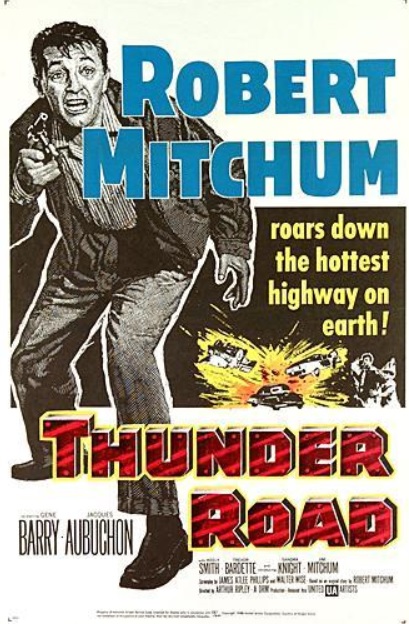
Backed by a requisite Outlaw Country-soundtrack adopted by other films in its wake, Moonrunners stars James Mitchum as a bootlegger behind the wheel of “Traveller”—blazoned with the #54 (in lieu of a #01)—outrunning federal agents on the southern backroads; he co-starred with his father, Robert Mitchum, in the similarly-themed Thunder Road (1958).

As with its TV clone, Waylon Jennings narrates as The Balladeer to move along the story of Grady and Bobby Lee Hagg (read: Bo and Luke Duke) who run moonshine for their Uncle Jesse in the mythical Georgia county of Shiloh (the real city of Shiloh is in Harris (read: Hazzard) County, Georgia). Between running ‘shine, the two hang out at The Boar’s Nest (also featured in the TV namesake) and race stock cars with their buddy, Cooter (another Dukes’ character). Uncle Jesse is at odds with his ol’ bootleggin’ partner, Jake Rainey (read: Boss Hogg) who’s in cahoots with Sheriff Roscoe P. Coltrane to “git them Duke Boys” and put Uncle Jesse’s ‘shine stills out of business. Along the way the Hagg brothers help a daisy-duke wearin’ damsel, Beth Ann Eubanks (read: Daisy Duke).

Of course, as with the adaptational softening of M.A.S.H and Alice Doesn’t Live Here Anymore, the moonshining action was softened to a more family-friend storyline. The “good ol’ boy” style of the series was so successful that Waldron spun off the character of Deputy Enos Strate into a short-lived series, Enos. Waldron also completed a film-to-TV adaptation of Kenny Rogers’s kid-friendly, stock car racing comedy, Six Pack (1983), starring Don Johnson, which failed to be picked up as a series. Jerry Reed of Smokey and the Bandit also tried to get some of that Duke Boys-flavor—as a character named “Traveller”—co-starring with fellow musician-actor Lane Caudell in a failed TV movie pilot, The Good Ol’ Boys (1978). Exploitation guru Roger Corman also attempted to git ‘em some of that Duke Boys-action with his failed TV movie pilot, The Georgia Peaches (1980), starring Dirk “Starbuck” Benedict (of the hicksploitation film Ruckus).

You need more redneck cinema? Then surf on over to our “Hicksploitation: The Top 70 Good Ol’ Boys Film List: 1972 to 1986” feature.

About the Author: You can read the music and film reviews of R.D Francis on Medium and learn more about his work on Facebook. He also writes for B&S Movies.

Sixpack Annie (1975)

American International Pictures — AIP — was formed in 1954 by Samuel Z. Arkoff and James H. Nicholson with the goal of releasing double features that appealed to young males, 19-years-old to be exact, as they found that was the optimum audience for their films. That was based on the Peter Pan syndrome, which their PR department believed went like this:

A. A younger child will watch anything an older child will watch;
B. An older child will not watch anything a younger child will watch;
C. A girl will watch anything a boy will watch
D. But the boy will not watch anything a girl will watch;

Therefore: to catch your greatest audience you zero in on the 19-year-old male.

Arkoff even believed that the perfect drive-in movie followed the ARKOFF Formula:

  • Action (exciting, entertaining drama)
  • Revolution (novel or controversial themes and ideas)
  • Killing (a modicum of violence)
  • Oratory (notable dialogue and speeches)
  • Fantasy (acted-out fantasies common to the audience)
  • Fornication (sex appeal for young adults)

For decades, AIP would find the exact double features that its audience was looking for. They had a stable of winning directors in their employee, like Roger Corman, Alex Gordon, Lou Rusoff, Herman Cohen, Bert I. Gordon and imported films from the UK, the Phillipines, Italy, Germany and more.

AIP would move on from science fiction to Poe adaptions to beach party movies to biker films to horror and anything else that would sell. They employed everyone from Jack Nicholson to Peter Fonda, Dennis Hopper, Fabian and so many more.

In 1972, James H. Nicholson resigned from AIP to work on the 20th Century Fox lot, setting up Academy Pictures Corporation. They only had two released before he died of a brain tumor, sadly, which were The Legend of Hell House and Dirty Mary Crazy Larry.

As the 1970s went on, AIP would move into even more genres, like kung fu, gangster and blaxploitation films. They also started moving into the mainstream with movies like Cooley High, The Amityville Horror, Love at First Bite, Meteor, Force 10 from Navarone, The Island of Dr. Moreau and C.H.O.M.P.S., as well as the final film they imported, Mad Max. However, AIP started to price themselves out of business with higher budgets and finally combined with Filmways in 1980. Arkoff bought himself out and started a new production company soon afterward. Meanwhile, Filmways/AIP became Orion Pictures.

The films of AIP read like a laundry list of the greatest films in exploitation history. I could create an entire website just to chronicle their greatest. This is but one of them.

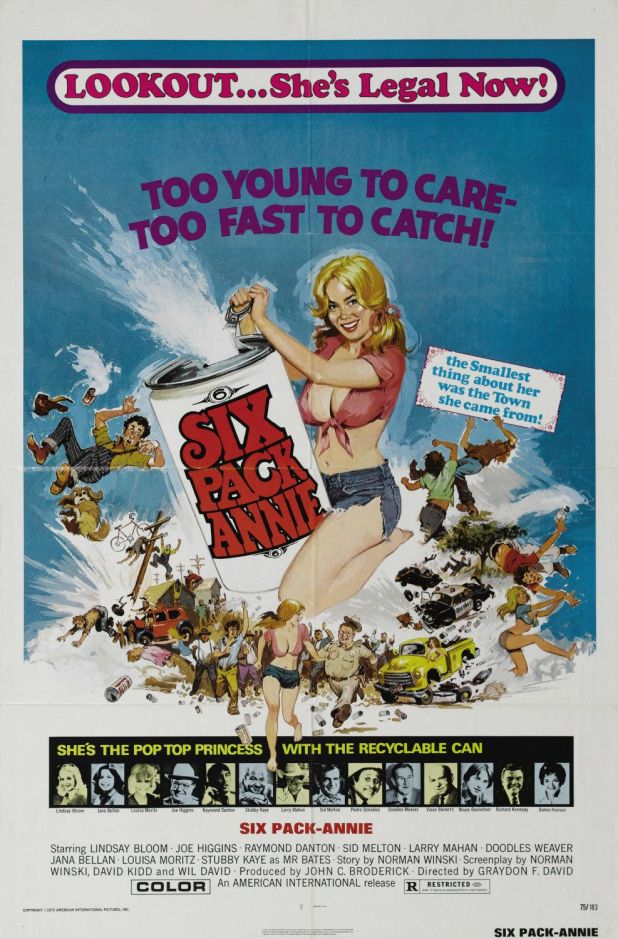
The best part of this movie is the poster, created by the venerable AIP PR team, screaming headlines at you like “Lookout… She’s Legal Now! She’s Out to Tear the Town Apart!”, “She’s got the boys glad and the sheriff mad!” and “She’s the pop top princess with the recyclable can.”

Somewhere in the south lies Titwillow, where our heroine Sixpack Annie Bodine (Lindsay Bloom, who was somehow both Miss Omaha and Miss Utah in her beauty pageant career before appearing in movies like this and eventually becoming switchboard operator Maybelle on The Dukes of Hazzard) is taking her friend Mary Lou to work at the diner.

You don’t get a name like Sixpack Annie drinking soda pop out of the bottle. She chugs a can of brew as she drives her pickup truck, earning the ire of Sheriff Waters (Joe Higgins, who resume keeps on saying Sheriff in everything from Green Acres to Sigmund and the Sea Monster, the TV show Annie and The Man from Clover Grove). He chases her into the diner and literally slips on a banana peels while all the old timers laugh their asses off. Among their number is Doodles Weaver, who was the uncle to Sigourney as well as being a comedian and character actor. His scene in 1971’s The Zodiac Killer is one I always point to as his strangest. He’s also in plenty of redneck movie fare like BigfootMacon County LineTrucker’s WomanRoad to Nashville and Li’l Abner. He’s also in The 30 Foot Bride of Candy Rock, the only movie Lou Costello made without his usual partner Bud Abbott, and Won Ton Ton, the Dog Who Saved Hollywood, Michael Winner’s cameo laden film about, well, a dog saving Hollywood.

But I digress. Aunt Tess, the owner of the diner, is $5,641.87 behind on the mortgage to Mr. Piker the banker. This is important to the plot, as when the sheriff arrests Annie and her man Bobby Joe (a pre-Tron and Scarecrow and Mrs. KIng Bruce Boxleitner) for swimming naked — which does not seem like such a punishable crime — he offers to pay the Aunt Tess’ debt if she marries him. She agrees, but it turns out he doesn’t have anywhere near that much dough.

Annie and Mary Lou decide to go to Miami next, where Annie’s sister Flora (Louisa Moritz, Myra from Death Race 2000 and one of the first women to come out against Bill Cosby) lives in splendor thanks to her escort business. She suggests that if the girls want to save the diner, they should get a sugar daddy of their own. That said, all of the potential GFE benefactors are losers, like a sneezing married man (Sid Melton, who would go on to play Alf Monroe on Green Acres and Sophia’s dead husband on The Golden Girls), a man dressed as Napoleon, a swindler named Oscar Meyer who steals all their money (Ray Danton, who was married to the lovely Julie Adams and would go on to direct plenty of episodes of Magnum P.I.) and a Texan (Richard Kennedy, Dr. Kaiser from Ilsa, Harem Keeper of the Oil Sheiks as well as appearances in The Witch Who Came From the Sea and Invasion of the Blood Farmers) with a jealous wife who nearly kills Annie.

The girls make it back to the diner with no money to help, just in time for a jewelry salesman named Mr. Bates (Stubby Kaye, Marvin Acme from Who Framed Roger Rabbit?) who buys her necklace for $7,000. Just like Dorothy in The Wizard of Oz, Six Pack Annie had the power to go home all along.

Six Pack Annie was the only movie that Fred G. Thorne ever directed, but one of the three screenwriters, David Kidd, would go on to write The Swinging Cheerleaders and Carter’s Army.

You can watch this movie on Amazon Prime.

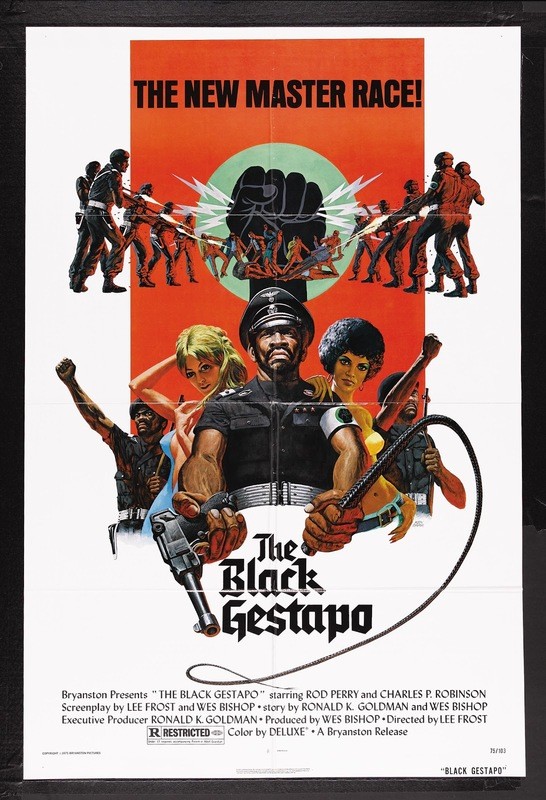
The Black Gestapo (1975)

Lee Frost was behind some strange films like Race With the Devil, Love Camp 7, Chain Gang Women and The Thing with Two Heads. None of those films will prepare you for this one. After all, how does one prepare for a movie where an army of black men get inspired by the wrong side of World War II and become the new master race?

General Ahmed (Rod Perry of TV’s S.W.A.T.) starts a People’s Army to protect the black people of Watts, but after chasing the drug dealers out of town, his second-in-command Colonel Kojah (Charles Robinson, who played Fabulous from Sugar Hill and would go on to be Mac on TV’s Night Court) takes over, turning the group into a fascist paramilitary outfit that controls every racket in town.

With a concept like that, you’d hope that the film itself would be more out of control. Sadly, it isn’t. That said, Uschi Digard shows up and really, that’s worth seeing the film in the first place. Comparing the Black Panthers to the Third Reich and castration are things that you don’t see in movies any longer. I’d argue that this is the lone movie that combines both.

You can get The Black Gestapo on Mill Creek’s new Soul Team Six DVD collection, along with five other films.

DISCLAIMER: Mill Creek sent us this set, but we were planning on buying it anyway. It has no bearing on this review.

Update: Kino Lorber is re-issuing The Black Gestapo to Blu-ray on January 5, 2021. The new 2K master from the original camera negative also features interviews with stars Charlie Robinson, Rod Perry, and Charles Howerton, while Robinson and Perry offer a commentary track. You can learn more about Kino Lorber’s complete roster of films at their official website and Facebook, and watch the related film trailers on You Tube.

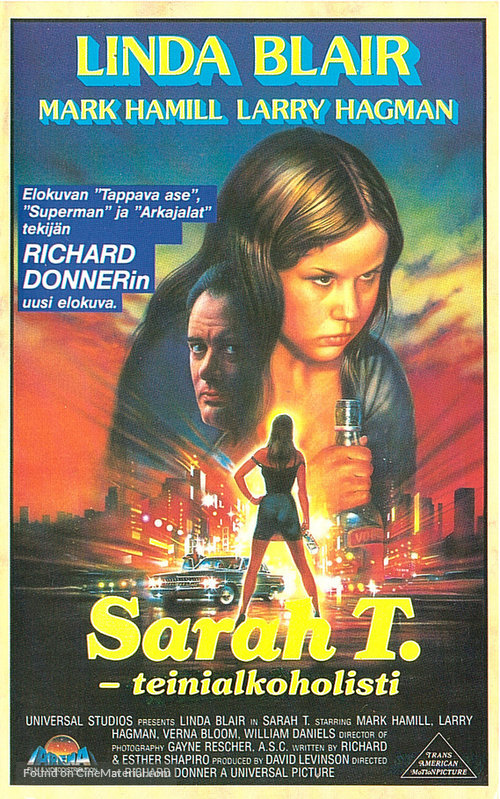
Sarah T. – Portrait of a Teenage Alcoholic (1975)

The last film Richard Donner would make before The OmenSarah T. – Portrait of a Teenage Alcoholic is a hard-hitting made for TV movie all about how easily teens in the 1970’s could become full-fledged alcoholics before they even graduated high school. It’s written by Richard and Esther Shapiro, who would go on to create Dynasty.

Sarah Travis (Linda Blair!) is fifteen and feels all alone. Her parents are divorced, with her drunk father (Larry Hagman!) being pretty much absent and her mother (Vera Bloom, Animal House) concentrating on her new marriage (William Daniels — the voice of KITT from Knight Rider — plays the stepfather).

Sarah feels overshadowed by her older sister Nancy (Laurette Spang-McCook, Cassiopeia from the original Battlestar Galactica) and tries to live with her father, but he can barely take care of himself.

As the movie starts, she’s already drinking at her mother’s parties and is dealing with major feelings of anxiety and feeling out of place. And when her mother sets up a blind date with Ken (Mark Hamill!), she really shows off how much she can handle at a series of parties. While her parents disapprove of the boy, they bond over his horse Daisy and become friends.

But Sarah’s alcoholism starts to impact others. She gets a maid fired who her mother blames for watering down their booze. And she already started to drink to get through school.

Things get much worse when Sarah tells Ken that she’s in love with him. He gently tells her that he’s not interested — honestly he looks and feels ten years older than her — and when her father rebuffs her again, Sarah goes off the deep end. From getting hammered while babysitting to riding Ken’s horse into traffic, our heroine is trapped in a downward spiral.

This is a great reminder of how made for TV movies once looked as good or better than theatrical films, particularly if they had a message like this one. Blair is quite good at conveying the tailspin that her character endures, another of her “girl in danger” roles like another great made for TV movie she made, Born Innocent.

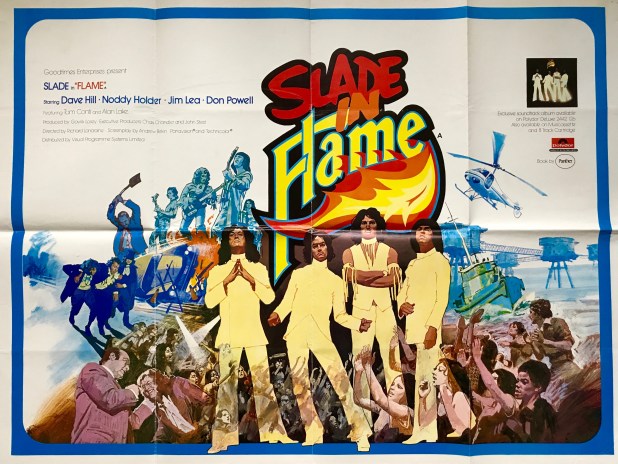
Slade In Flame (1975)

Slade is a band near unfamiliar to American ears. This Wolverhampton band had 17 consecutive top 20 hits — three of those singles entered the charts at number one — and six number ones on the UK Singles Chart, making them the most successful British band of the 1970’s. They may have sold over 50 million records worldwide, but despite living in the United States in the 1970’s, they never really broke here.

That changed in 1983 when Quiet Riot released “Cum on Feel the Noize,” a Slade cover (they also would release a version of “Mama Weer All Crazee Now”), which broke the band in the US and led to their song “Run Runaway” charting in the top twenty. Despite numerous breakups, the band still plays today and has influenced artists as diverse as KISS, Nirvana, The Clash, The Ramones and Oasis.

But back in 1975, Slade was big enough to make a movie. Despite all their success, the band just found that they were doing more of the same and wanted something different. Manager Chas Chandler suggested a movie, but the band didn’t want to do a Beatles comedy film, despite the band’s happy-go-lucky image.

They almost made Quite a Mess, a comedy cover version of The Quatermass Experiment before deciding to make a gritty look at the underside of the music business.  Writer Andrew Birkin created the story of a fictional band named Flame, but the band felt it was missing something. They invited Birkin and the film’s director, Richard Loncraine, on tour. After seeing band life first-hand and hearing numerous anecdotes of things that had happened to them and other bands, the script was closer to the band’s vision. 

Lead vocalist Noddy Holder and bassist Jim Lea also pushed for the movie’s soundtrack to expand on the band’s formula and try new ideas. If the film wasn’t a success, the soundtrack was, hitting number 6 on the UK charts with two singles, “Far Far Away” (Hodder’s favorite Slade song) and “How Does It Feel,” a song that Oasis frontman Noel Gallagher says is “one of the best songs written, in the history of pop, ever.”

Slade in Flame, much like many of the movies we’ve covered this week, wasn’t met with initial success. The band’s fans didn’t expect such a downer of a movie and the band, out of the public eye working on the film for so long, were met with a decline in popularity.

As the film begins, the members of Flame are in two rival bands. Despite numerous pranks and fisticuffs, they form a new band and become an overnight sensation. However, tensions within the band develop just as immediately and the ghosts of their past — an old manager with thugs ready to cut the toes off of band members and threaten their children — doom our heroes before they even get started.

There’s a great sequence in this movie where the band appears on the pirate radio station Radio City that’s soon attacked during the Ricky Storm Show. I love how far the band has to climb to find their way to the studio and how this part contributes a bit of the surreal to what is otherwise a very earthbound affair.


Infra-Man (1975)

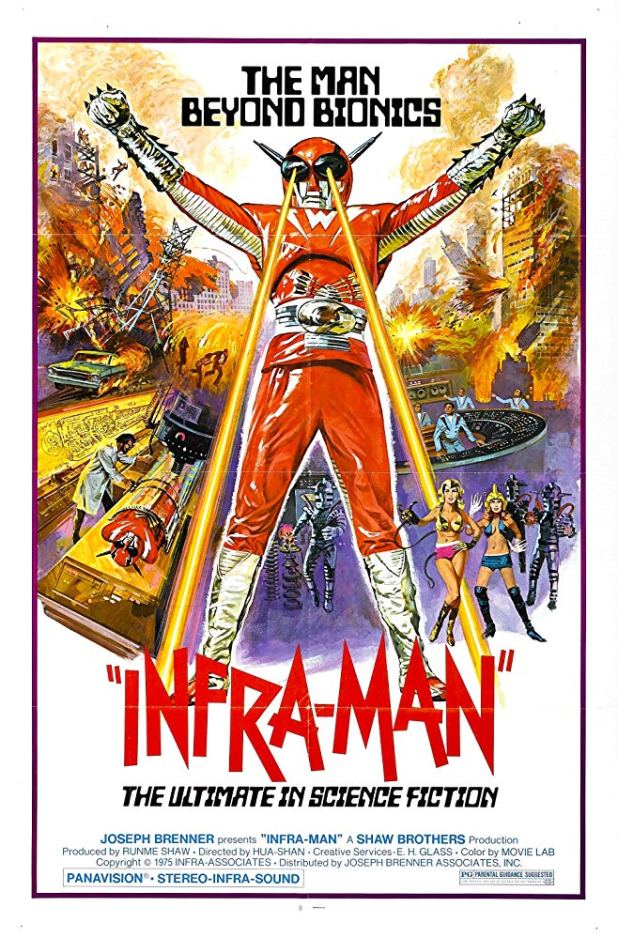
Inspired by the huge success of the Japanese superhero versus monster fare such as Ultraman and Kamen Rider in Hong Kong, the Shaw Brothers produced the first Chinese superhero in 1975, which they called Infra-Man. However, they pushed the envelope created by the Japanese even further, inventing a world where a school bus can crash, Hong Kong can be destroyed, an earthquake can happen and monsters appear all within the first minute of the film.

Let me see if I can summarize the blast of pure odd that I just watched at 5 AM: Princess Dragon Mom (known in the original version of this film as Demon Princess Elzebub) is a ten million-year-old mother of monsters who wants to destroy the Earth. She carries around a whip and has a dragon head on her hand, but can also turn into a monster herself. She also has an entire legion of beasts ready to do whatever she asks, like her assistant She-Demon (Witch-Eye in the original), who is an Asian girl with a hand that has an eyeball in the middle of it. Also: both of these ladies wear metallic bikinis with skulls all over them and have several costume changes. They also have an army of cannon fodder dressed in skeletal costumes, which was obviously the influence for the Skeleton Crew in the new episodes of Mystery Science Theater 3000.

They’re battling with Science Headquarters, led by Professor Liu Ying-de. He’s used the BDX Project to transform Lei Ma (Danny Lee, The Killer) into the bionic kung-fu kicking motorcycle riding Infra-Man, who has whatever powers he needs for any situation. He’s also really good at getting tall and stepping on monsters until their green blood pours out. Bruce Lee tribute actor Bruce Le also appears as Lu Xiao-long, another member of the team.

You get all manner of monsters in this one — the Emperor of Doom, the Giant Beetle Monster, an Octopus Mutant, the Driller Beast, a Laser Horn Monster and the Iron Fist Robots. All of them are given to dramatic pronouncements, overacting and blowing up real good.

Believe it or not, Roger Ebert said, “When they stop making movies like Infra-Man, a little light will go out of the world.” Twenty-two years later, he went even further: “I find to my astonishment that I gave Infra-Man only two and a half stars when I reviewed it. That was 22 years ago, but a fellow will remember a lot of things you wouldn’t think he’d remember. I’ll bet a month hasn’t gone by since that I haven’t thought of that film. So, in answer to those correspondents who ask if I have ever changed a rating on a movie: Yes, Infra-Man moves up to three stars.”

He’s right — this movie is completely unhinged, with dragon witch women who threaten to throw little girls down volcanos, blotting out the sun and rocket fists. They should have made five thousand sequels to this.

You can watch this on Amazon Prime.

The Killer Must Kill Again (1975)

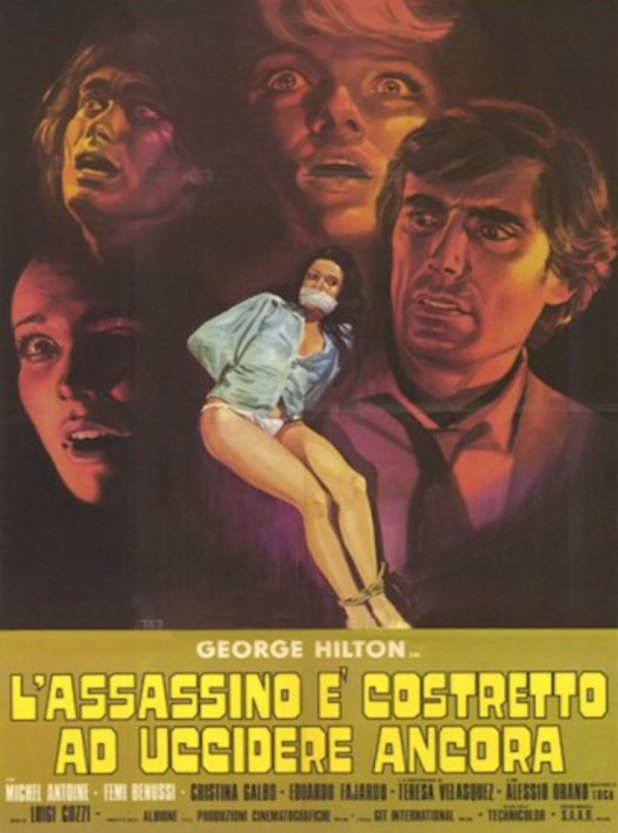
Luigi Cozzi is well thought of around these parts for his less down to the planet Earth fare like Hercules, Star Crash and Alien Contamination. However, his giallo experience exists, as he was the writer of Argento’s Four Flies on Grey Velvet. He contributed to other Argento projects throughout his career, like the special effects for Phenomena and second unit direction for The Stendhal Syndrome. He even co-owned and managed Argento’s memorabilia store, Profondo Rosso (Deep Red). Here, he brings us the tale of an adulterous man who uses a murderer to solve all of his life’s problems.

https://www.dailymotion.com/video/x56pj41

George Hilton (Sartana’s Here… Trade Your Pistol for a Coffin, The Strange Vice of Mrs. Wardh) plays a man who wants to take care of his wealthy wife. He ends up meeting an unnamed killer who is disposing of his latest murder (he’s played by Antoine Saint-John, who played Schweick, the artist who starts the events of The Beyond). They strike a deal where the killer will erase the wife and make it look like a kidnapped. That said — nothing is ever that easy.

As he’s loading Nora’s body in the trunk, Luca and Laura (Christina Galbo, The Living Dead at Manchester MorgueWhat Have You Done to Solange?) steal the car and head to the beach. The killer gives chase as they take up at an abandoned seaside house, as Luca plans on taking her virginity. She keeps putting him off, sending him out to get food while the killer sneaks in.

As the killer makes his way closer to Laura, Luca is making time with a stranded and sexed up motorist played by Femi Benussi from Strip Nude for Your Killer and Hatchet for the Honeymoon. This is an absolutely bonkers segment, as the killer attacks our heroine to somber music while a happy ditty plays as her boyfriend cheats on her, unaware what horrors are going on inside that beach house.

Every man in this movie is either a moron or a complete villain. The same can be said for most of the women, except they’re victims, too. Luckily, Laura finds it within herself to stop this cycle of madness.

This film doesn’t really follow all of the giallo conventions, but that’s just fine. It keeps moving and by the end, I was gripped as the many webs of the store all drew together. Indeed, it has an alternate title of The Spider (I saw it as The Dark is Death’s Friend). Cozzi does a nice job of building the suspense and presenting Laura as less of a faceless victim and more of a proto final girl that you want to see survive.

TABLOID WEEK: Mysteries from Beyond Planet Earth (1975)

George Gale has mostly worked as a post-production guy, but he also produced and directed two strange 1970’s Fortean documentaries, Mysteries from Beyond Planet Earth and Are We Alone in the Universe? Narrated by character actor Lawrence Dobkin, this movie pretty much hits every single theory in its 94-minute whirlwind of info.

Your host stays calm through it all as we rush past every single theory anyone has ever had about anything, basically.

UFOs, Atlantis and Cayce talking about Atlantis? We’ve got that.

Planes getting lost in the Bermuda Triangle? Sure.

Telepathy, ESP, firestarters, Kirlian photography that captures auras and plants being able to communicate? Sure, we can talk about that.

But wait! Do you have time to talk about witchcraft and Satanism, including a Black Mass? Of course. And then we’ll have to speak about the Hollow Earth, Bigfoot, black holes, genetic engineering, clones, freezing people and maybe we’ll even get to aliens again. How much time do we have left?

This is a movie that from its very tagline asked, “What is the message from beyond the stars, which has been kept secret from our world until now?” Indeed. What is that message? Or messages?

This one is bought to you by American National Enterprises, who also blessed us by distributing SheIronmasterEndgameEncounter with the Unknown and more. These guys had taste. None of it good. All of it amazing.

You can get this piece of 70’s strange from Cult Action.

Autopsy (1975)

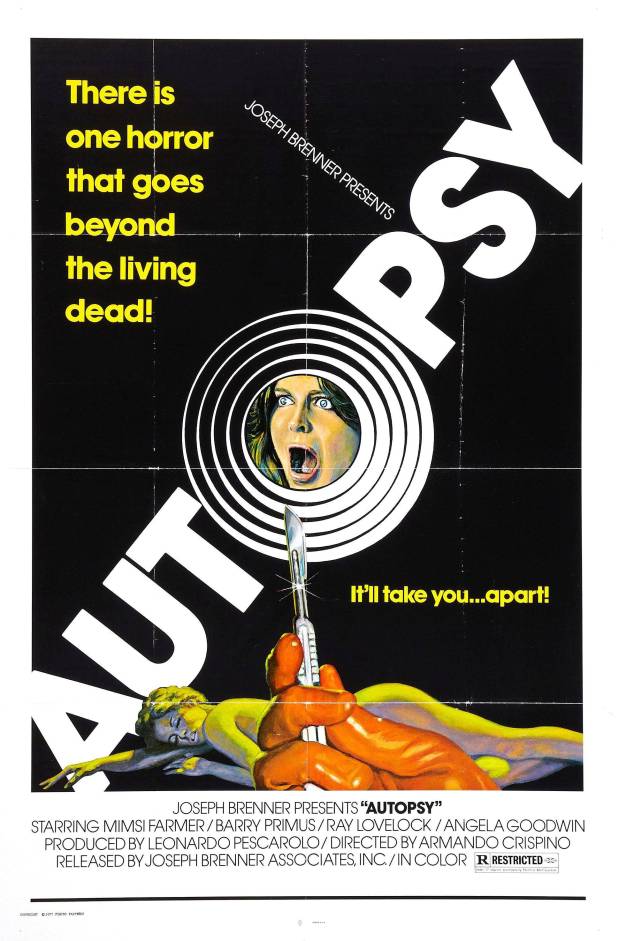
Armando Crispino really only did two horror films, 1972’s The Dead Are Alive and this 1975 giallo, which is a shame, as this is a pretty decent entry in the genre. Known in Italy as Macchie Solari (Sunspots), it does indeed feature sunspot footage from space before we see any major murders. And if you’re looking for a movie packed with autopsy footage, good news. It totally lives up to its title.

Simona Sana (Mimsy Farmer, who is also in Argento’s Four Flies on Grey Velvet and The Perfume of the Lady in Black) is a pathology student who is trying to work on a theory about suicides, one that’s disputed by a young priest, Father Paul, whose sister — Simona’s dad’s latest fling — has recently killed herself. It turns out there’s been a whole series of self-killings which are being blamed on, you guessed it, sunspots.

I mean, what can you say about a movie that starts with several of said suicides, like sliced wrists, a self-induced car explosion and a man machine gunning his kids before turning the gun on himself? Obviously, this is a rather grisly affair, with real corpse photos spread — quite literally — throughout the film.

In between all of the gore, corpse penises, two bodies falling to their deaths and crime museums, there’s also Ray Lovelock (The Living Dead at Manchester Morgue) as Simona’s boyfriend, an out there Morricone score and a heroine who hallucinates that the dead are coming back to life.

The plot gets pretty convoluted, but if you’re on this site, you obviously appreciate films like this and will get past it. This is an Italian 70’s murder movie, though, so if you get easily upset about the way men behave, well, be forewarned.

You can watch this on Amazon Prime.