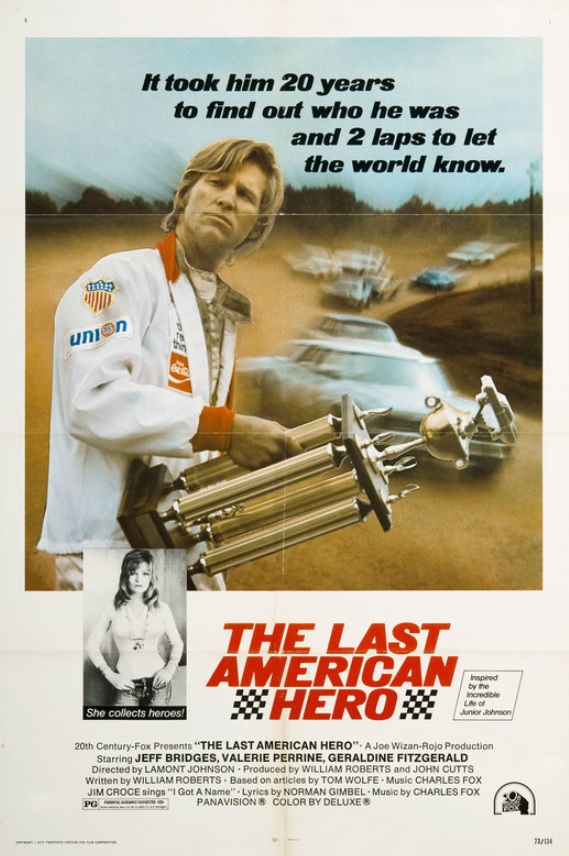
Prohibition bootlegging of the 1930s gave birth to NASCAR: that’s a fact. And one of those bootleggers — and the sport’s biggest success stories — was Junior Jackson, who got his start behind the wheel hauling illegal liquor through the North Carolina foothills.
The script by Williams Roberts (The Magnificent Seven, The Devil’s Brigade, one of Charles Bronson’s better post-Death Wish movies, 10 to Midnight) was based on Tom Wolfe’s (Bonfire of the Vanities) award-winning article, “The Last American Hero,” published in a 1965 issue of Esquire (which is how William Harrison’s “Roller Ball Murder,” aka Rollerball, got its start). It’s all directed by Lamont Johnson, who gave us the war drama (The McKenzie Break, the military-paranoia drama The GroundstarConspiracy, and, wait for it . . . one of the better Star Wars clones: Spacehunter: Adventures in the Forbidden Zone).
Jeff Bridges (on his way to an Academy Award “Best Supporting Actor” nod for next year’s Thunderbolt and Lightfoot with Clint Eastwood) stars as Junior Jackson, a moonshiner and amateur stock-car driver that stays one step ahead of the law — until he experiences an epiphany when his father is sent to prison for moonshining.
His new commitment to racing faces obstacles from Ned Beatty as a cheapskate promoter and Ed Lauter as a race-team owner who refuses to let Junior field his own pit crew led by his brother, played by Gary Busey. Romantic entanglements come in the form of Valarie Perrine who plays her affections against Junior and his main competitor on the track, played by William Smith (who jumps behind the wheel again in David Cronenberg’s Fast Company). In case you haven’t noticed: that’s all of the actors we care about at B&S About Movies.
This movie has it all: a great cast backed by a great script courtesy of Tom Wolfe and Williams Roberts, along with solid direction by Lamont Johnson. And . . . while the film didn’t exactly light up the box office for 20th Century Fox, it helped catapult Jim Croce’s “I Got a Name,” which served as the film’s theme song, up the charts (a process that was repeated when it was used in that same capacity in the Mark Walhberg’s 2006 football drama, Invincible).
Not everyone remembers this early entry in Jeff Bridges’s career, but it slides into the DVD racks nicely, right alongside fellow A-List race epics Red Line 7000 with James Caan, Grand Prix with James Garner, Le Mans with Steve McQueen, and Winning with Paul Newman. For me, it’s as good, even better, than Days of Thunder with Tom Cruise (no offense, Tom; it’s due to drive-in nostalgia with pops).
You can learn more about Junior Johnson with this eulogy published upon his December 2019 death at NASCAR.com. You can read a digitized version of Tom Wolfe’s article as part of the University of Virginia’s archives.
Rarely airing on ’70s UHF-TV and ’80s pay-cable, and poorly distributed as a hard-to-find Fox Home Video VHS, The Last American Hero finally made it into the digital marketplace as high-quality DVD in 2006 and is readily streamable on all the usual platforms — but we found a copy on You Tube. Watch the trailer, HERE.
About the Author: You can learn more about the writings of R.D Francis on Facebook. He also writes for B&S About Movies.
Who is missing from this list: Robert Blake. And, for additional credibility: he brought along pro-drivers Bobbie and Donnie Allison, Buddy Baker, Richard Petty, and Cale Yarbourgh. Way to go MGM Studios! Ticket sold! Uh-oh. The producer wants his name removed?
The man behind the lens is TV director Leonard J. Horn: name a ’60s or ’70s TV series and chances are Horn directed at least one episode. And outside of a couple of TV Movies (1970’s Lost Flight with Lloyd Bridges is the one I remember), this was Horn’s lone theatrical film — that was regulated to the drive-in circuit. Screenwriter Eugene Price also primarily worked in television, but occasionally ventured into theatricals (I remember him for the 1975 TV “disaster movie” Smash-Up on Interstate 5). The producer behind this — his first foray into film — was Bruce Geller, who you remember as the creator behind Mission: Impossible. In the TV movie realm, he gave us the 1978 “when animals attack” classic, The Savage Bees.
Unlike the biographical The Last American Hero starring Jeff Bridges, this race epic is a faux-epic: a celluloid fugazi, so much so that Geller and MGM butt heads to the point Geller wanted his name removed, which was refused.
Blake is Corky Curtiss, a Texas race-car mechanic and sometimes dirt track racer (how Tom Cruise’s Cole Trickle in Days of Thunder got started) from a small Texas town who shares his dreams with Billy (Christopher Connelly of Atlantis Interceptors) of getting out of the grease pits and into the cockpit of Patrick O’Neal’s (Silent Night, Bloody Night) race team.
Oh, and Corky’s a skosh of a sociopath with a soupçon of a drinking and gambling problem. To win: he runs his competitors off the track. When he wins: he drinks and pisses away the winnings on the green felt, much to the chagrin of his wife (a miscast Shakespearean-proper Charlotte Rampling of Zardoz goin’ “suthern”) and two kids. Corky eventually makes it to the bigs in Atlanta, but his self-destructive ways finally catch up to him.
If you thought Blake’s anti-hero in the biking epic Elektra Glide in Blue was dark, well, Kolwaski from Vanishing Point and “Driver” and “Mechanic” from Two Lane Blacktop have nothing on Corky: this is one of the darkest race flicks, no, the darkest, race flicks we’ve reviewed across our two “Fast & Furious” tribute weeks. Regardless of Geller’s displeasure with the finished product, which MGM wrestled from him, and the fact that it bombed during its brief run, Blake is excellent — as is the rest of the cast — throughout. And a plus: in addition to the NASCAR stars in the film, the cars, including Blake’s Plymouth Barracuda SXB Formula S Fastback, were built by George Barris Customs, the shop behind many of the iconic cars in ’60s and ’70s TV and film.
In addition to Warner’s official upload-reissue clip/trailer, we also found these two behind-the-scenes clips to enjoy, HERE and HERE.
Corky is truly forgotten and lost — as it never made it to UHF-TV syndication or pay-cable replays or VHS. Luckily, I watched it twice in the late ’70s as part of a drive-in double feature. DVDs were once available via the Warners Video Archives in the online marketplace — if you search for them. If there’s ever a film that needs to be made available as a VOD, it’s this entry in the Robert Blake canons.
About the Author: You can learn more about the writings of R.D Francis on Facebook. He also writes for B&S About Movies.
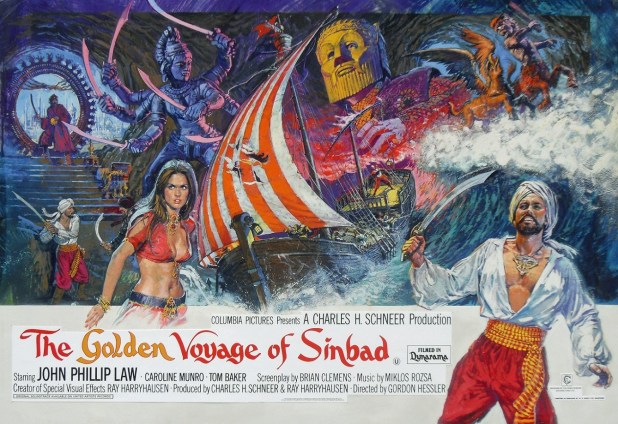
Gordon Hessler is one of those directors that no one talks about, but he made a lot of movies worth watching. The Oblong Box; Scream and Scream Again; Scream, Pretty Peggy and Prey for Death are all pretty great. He also made the George Hamilton kind of, sort of giallo Medusa and Kiss Meets the Phantom of the Park, but not every movie can be a winner, right?
That said, here he has a script by Brian Clemens (Captain Kronos, And Soon the Darkness and Highlander II: The Quickening, proving that yes, not every movie can be a winner all over again), effects by Ray Harryhausen and a cast that inclues a pre-Dr. Who Tom Baker, John Phillip Law and Caroline Munro, somehow making a G-rated film sexy.
Seconds into this movie, I was already writing a review to tell all of you how much I loved it. Get this opening scene: Sinbad (Law) Sinbad finds a golden tablet that was lot by a mysterious flying creature before he falls asleep and dreams of Margiana, as she reveals an eye tattooed on her hand before a man dressed all in black calls his name and makes her disappear between the folds of his cape.
That man is Prince Koura, who battles Sinbad throughout the film for the three pieces of a medallion which will point the way to the Fountain of Destiny of the lost continent of Lemuria. Whoever gets there first will discover youth, a shield of darkness and a crown of untold riches.
With each use of his magic, Koura ages more and more. Yet he still sends all manner of beasts after our hero, who has assembled a crew to discover this uncharted island which includes a deposed Vizier (Douglas Wilmer, who played Sherlock Holmes on British TV) who hides his scarred features behind a mask.
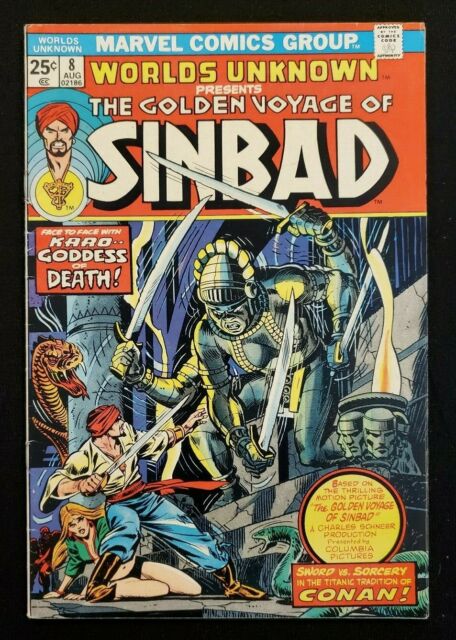
A homunculus, an animated statued of Kali*, a one-eyed centaur, a griffith, an invisible shield — this movie really does have it all in full Technicolor. This even had a tie-in Marvel comic (Worlds Unknown #7–8)!
Even cooler, the Oracle of All Knowledge was Robert Shaw! He was a friend of producer Charles H. Schneer, who got him to play the part — which took 20 minutes — covered in make-up and with his voice altered. He’s uncredited, but yes, that’s really him. Orson Welles was originally supposed to do this part, but he had asked for too much money. Shaw was on vacation in Spain and ended up taking the role as a favor to Schneer.
This is the kind of movie that helps you escape from the world into the better than real life world of monsters, magic and, well, Caroline Munro. This is a movie I foresee returning back to over and over again.
*This entire section of the movie is based on one of Harryhausen’s favorite movies, 1940’s The Thief of Bagdad.
Editor’s Note: This review previously ran on May 8, 2018.
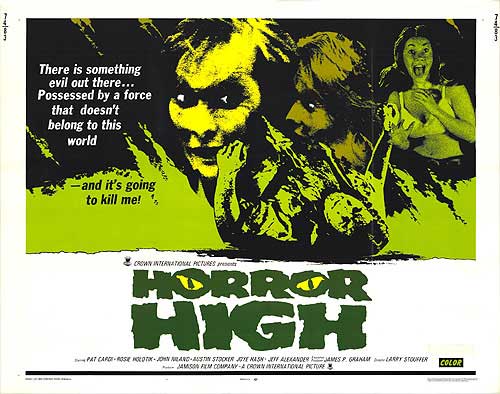
When horror movies have socially maladjusted kids getting abused by popular football players while showing how attractive girls can still fall for them, they’re playing directly to their demographic. How many fright fans felt the same way or endured the same stings and arrows as the hero of this film?
Everybody beats the shit of Vernon. His fellow students hate him. His teachers despise him. Even the janitor. His only friend is Robin (Rosie Holotik, Nurse Charlotte from Don’t Look in the Basement), who is dating the main football player who abuses him. And his other friend, the mouse known as Mr. Mumps? Well, he’s taking a mind-altering potion that Vernon’s developed that makes the little fella super violent. In fact, it makes him so brutal that it kills the janitor’s cat, who flips out and smashes the little fellow and forces Vernon to drink his own potion.
Pat Cardi, the actor who played Vernon, was a busy child star, playing in over 100 TV shows and appearing as a young chimp in Battle for the Planet of the Apes. He grew up to create and found MovieFone, which in the pre-internet days was how people discovered what films were playing in theaters.
Austin Stoker (Assault on Precinct 13, Abby) plays the detective who comes into the school once Vernon starts killing. The murder scenes form a proto-slasher vibe while the music is crazy, with primal power chords accentuating big moments (think the guitar sound from the Torso trailer). It also features Pittsburgh Steelers star “Mean” Joe Greene in a small role. If you live here in the Steel City, you need no introduction to Mean Joe. If you live elsewhere, he’s the player who threw a jersey to the kid in the Coca-Cola commercial. He’s also in The Black Six, one of the first all-black biker films, along with other NFL names like Gene Washington, Mercury Morris, Lem Barney, Willie Lanier and Carl Eller. Of course, we’ll be getting to this movie very soon. But until then, savor Joe in that Coke commercial:
At heart, this is a Jekyll & Hyde story (it’s Carrie before Carrie, too) but told as if it were a 1950’s teen monster movie refilmed through a 1970’s doom-laden lens. Its script comes from Jack Fowler, who is really J.D. Feigelson, writer of Wes Craven’s Chiller and Dark Night of the Scarecrow.
The film — also known as The Twisted Brain — was shot in Texas and released by Crown International in March of 1974 to the drive-in circuit. It really picked up its cult cache thanks to frequent TV airings. Code Red put out an uncut version on blu-ray in 2009, following a Rhino release of the TV version of the film. They’re both rather hard to get now, but worth seeking out. I found myself really liking this film, despite its budget and relative silliness at times.
Want to learn more? The new issue of Drive-In Asylum has an interview with director Larry Stouffer and some artwork from me that you can see here!
DAY. 20: HINDSIGHT IS 20/20: This one’s gotta have flashbacks in it (since looking ahead doesn’t seem to be working amirite?).
Don’t Look Now is the kind of movie that people should talk about in the same hushed tone that they reserve for The Exorcist and The Bird With the Crystal Plumage and they don’t. That makes no sense to me, so perhaps these words will do something to change that.
Compared to Performance, director Nicolas Roeg’s directorial debut (he co-directed with Donald Cammell), this is a simple film. Compare it to anything else and it’s as complex as it gets. Roeg had already contributed to the horror genre with his director of photography work on The Masque of the Red Death, but this rumination on loss stands apart, using the genre itself to try and make sense out of the senseless.
In the same way that the giallo plays with themes of misinterpretation and mistaken identity often when it comes to sexual identity, this movie does the same when it comes to trying to get through the grief of losing a child and perhaps a marriage.
It’s also a deconstruction of how we perceive time through the lens of film. Instead of just flashbacks, this movie is filled with a fluid sense of time, in that we experience the past, present and the future almost simultaneously, as if we were Jon Osterman becoming the ubermensch Dr. Manhattan.
Real-life couple Natalie Wood and Robert Wagner (ironic, as this movie concerns a drowning death) were suggested for the leads of Laura and John Baxter, but Roeg only saw Julie Christie and Donald Sutherland in his film. Sutherland was worried that the film gave a bad name to ESP, but Roeg told him this was the story they were telling.
John and Laura have come to Venice after the death of their daughter Christine in a drowning accident. While working to restore an ancient church, he meets two sisters. One of them, Heather (Hilary Mason, I Don’t Want to Be Born), is a psychic and she reveals that a great danger is coming for John. This danger — in all ways that we see time in the film — hangs as heavy as the death of his daughter, who the psychic reveals that she can see around the couple.
That night, before dinner, John and Laura finally make love after a long period of coolness, as she is relieved that her daughter seems to be at peace. This moment — the love scene is intercut with them getting ready for dinner afterward — plays with our notions of time, making this entire scene feel like a dream. It could also very well be an actual sex scene, as it was rumored for years that the acting couple was really having sex, to the consternation of Christie’s boyfriend Warren Beatty, who was usually the one doing the cucking.
At dinner, the couple is briefly separated and John sees what he believes to be his daughter. This image of her in the red coat she died in dominates the movie, luring him into more foreign places and deeper dangers. As their son is injured at boarding school, Laura must return home. Despite this, John sees her as part of a canal funeral procession. And oh yes — there’s also a serial killer on the loose.
I know that I often discuss the spoilers of films that are half a century old here, but in the hopes that you haven’t seen this film, I want you to enjoy the mystery that it presents for yourself. Roeg emerges as a consummate filmmaker here and this English giallo shot in Venice deserves so many more words than it has received.
If you don’t already own this — and you should — it’s on Amazon Prime.
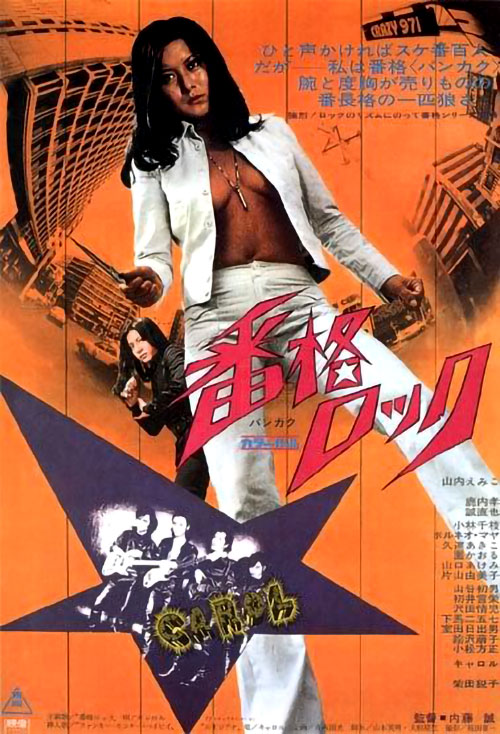
If there’s one thing I love — this site is really about the many things I love, but indulge me — it’s movies with girl gangs up against horrible odds. The Japanese sukeban genre — delinquent girl — isn’t just up my alley. It’s the entire city block.
The Akabane 100 Club and the Ikebukuro Cavalry are at war. Yukiko (Emiko Yamauchi, School of the Holy Beast) is fresh out of reform school and decides to live up to her role as the chief bodyguard of the Akabane, deciding it’s time to finish her war with the entire Calvary gang. Yukiko is so far gone that her father urges the police to put her to death.
Imagine, if you will, a female gang movie with music by Japanese Group Sounds band Carol (their lead vocalist and bassist Eikichi Yazawa went solo and recorded the albums Yazawa, It’s Just Rock ‘n Roll and Flash In Japan with members of the Doobie Brothers and Little Feat) and slow motion violence that looks like it was influenced by Peckinpah.
While many use the title Farewell to Rock’n Roll, the actual translation is Ranking Bos Rock.
“If I ventured in the slipstream Between the viaducts of your dreams.” — Van Morrison, “Astral Weeks” (1968)
My attendance of the recent Saturday Night Drive-In Asylum Double Feature Watch Party on September 5 — which featured The Redeemer (1978) — brings us to this review. And I have to admit that, until this most recent viewing of The Redeemer and digging deeper into the film’s history, I had no idea of that occult-slasher’s connection to this Canadian radio drama by way of actor Michael Hollingsworth. If we are to believe the digital content managers at the IMDb, Hollingsworth, in the role of the hippy Billy, made his acting debut in Slipstream—and vanished from the business after his portrayal of the gay actor, Roger, who met his fate at the hands of The Redeemer.
The writer of Slipstream, William Fruet, aka the “Roger Corman of Canada,” is a name oft mentioned around these ‘ere parts of Steel Town, U.S.A., if not in a direct review, such as for his works Funeral Home, Baker County, U.S.A., Killer Party, and Blue Monkey, we’ve mentioned his work in passing within the context of other canuxploitation flicks.
One day, we’ll get to three of my personal favorites of Fruet’s oft-run, ’80s HBO and Showtime oeuvre with the Perry King and Don Stroud Vietnam-slanted serial killer drama, Search and Destroy (1979), the Peter Fonda and Oliver Reed-starring giant serpent romp, Spasms (1983), and, what I consider Fruet’s crowned jewel: the home-invasion classic, House by the Lake, aka Death Weekend (1976), which also stars Don Stroud, along with Brenda Vaccaro as the damsel-in-distress. Of Fruet’s seven writing credits, among his thirty-nine directing credits, he directed House by the Lake and Spasms. He already proved his skills as a director on his first feature film: Wedding in White (1972), a film starring Donald Pleasence and Carol Kane which he also wrote. Why the reins of Slipstream were turned over to first-time director David Acomba, who never expanded his recognition beyond the Great White North’s borders, sans his work on The Star Wars Holiday Special (1978), is a reason lost to the ages.
Now, looking at the theatrical one-sheet, we’re sure your eyes perked up at the sight of Macon, Georgia-born actor Luke Askew, who first came to widespread acclaim with his role as Boss Paul in his third feature film, Cool Hand Luke (1967) starring Paul Newman, and the Charlton Heston western follow-up, Will Penny (1967). In addition to appearing in the war flicks The Devil’s Brigade (1968) alongside William Holden and The Green Berets (1968) with John Wayne (Hey, Pops!), Askew delved into Italian spaghetti westerns as a first-time leading man with Night of the Serpent (1969), and the annals of bikerdom with the likes of Easy Rider (1969), and Angel Unchained (1970) with Don Stroud. By the time of his role as troubled DJ Mike Mallard in Slipstream, Askew began his long-fruitful transition as a well-respected U.S. television actor, appearing in both series and TV movies. But Askew took the time to work with David Carradine in The Warrior and the Sorcerer (1984) and Ciro H. Santiago’s Mad Max rip, Dune Warriors (1991). Oh, and there’s Paul Schrader’s Rolling Thunder (1977) with William Devane.
Yeah, we could go on and on with all of the great movies we’ve watched with the late Luke Askew. . . . Oh, almost forget: he was a recording artist that Bob Dylan likened to blues great Bobby Blue Bland.
And that brings us to this Canadian film that’s mismarketed as “featuring” the music of Van Morrison and Eric Clapton”; in reality, it features only a snippet of one Morrison song — the title cut from his breakthrough album Astral Weeks (1968) that bookends the film — and one Clapton song in its entirety — “Layla” from Derek & the Dominos.
Askew is Mike Millard, a popular but brooding-reclusive Albertan DJ who runs his popular pirate radio station from a remote wilderness farmhouse. As with Clint Eastwood’s Dave Garver on KRML in Play Misty for Me (1971), Millard is all about mood; he spins off-beat tunes interjected by poetic passages that connect with the youth counterculture. Millard’s soul rolls with the independent spirit of Wyatt Williams from Easy Rider; in lieu of a motorcycle, Mike uses the airwaves; his on-air style is one where he sticks the studio’s microphone outside the window to capture the sounds of a thunderstorm as he begins the refrains of “Layla” by the then “hot” Derek & and the Dominos.
The mysticism and mystery of his secluded broadcasts — a gimmick devised by his producer to develop an audience — has led his listeners painstakingly searching the wilds of Alberta to find him — one listener, Kathy, does, which Mallard begins to romance. Adding to Millard’s aggravation: as the show’s popularity grows, his producer wants him to play “more commercial music,” so as to expand the audience even more — even if it alienates the listeners who made his career.
Unlike the genre’s most popular film, the Michael Brandon-starring FM (1978), William Fruet dispatches with that radio chronicle’s slapstick moments for an introspective examination on the psychology; the need of a DJ being on the air and the responsibility of connecting with one’s audience through integrity and not gimmicks; about the creative, audio war where the commercial needs of the bean counters clashes with the artistic needs of a radio station’s airstaff. Fruet’s anti-hero soon comes to realize the allure of the “glass booth” that once gave him freedom is now a psychological prison.
The walls of that prison become more evident as the now emotionally-crumbling Mallard shatters the illusions of his beloved on-air persona with a half-baked interview that crushes the fandom of a young journalist-fan who successfully tracked down his broadcast.
As with most Canadian-made films, the recently reviewed Terminal City Ricochet in particular, Slipstream had a virtually non-existent VHS release south of the border and no (possibly limited; I never seen it) UHF-TV or ’80s HBO or Showtime replays. This is one of those films that — being a radio DJ and big Luke Askew fan, with a desire to see this lost Canada radio drama — I had no choice but to purchase it as a grey market taped-from TV VHS. And as with most of those back-of-magazine grey market distributors utilizing low-grade VHS tapes in multi-packed, shrink-wrapped bricks and churning out copies via high-speed dubbing machines, I lost that cherished copy of Slipstream to the blue screen of death. Chatting with one of my Detroit-based radio contemporaries who’s lived in Canada for a number of years, tells me Slipstream has never been issued on DVD and rarely airs on Canadian TV; not only has it been years since he’s seen it on TV, he hasn’t seen a VHS for as long.
My hats off to Bill Van Ryn of Groovy Doom and Sam Panico of you-know-who for their joint Drive-In Asylum Double Feature Watch Party nights and screening The Redeemer, affording me the opportunity to revisit a radio film — and one of my favorite films overall — that is truly lost for the ages.
About the Author: You can learn more about the writings of R.D Francis on Facebook.He also writes for B&S About Movies.
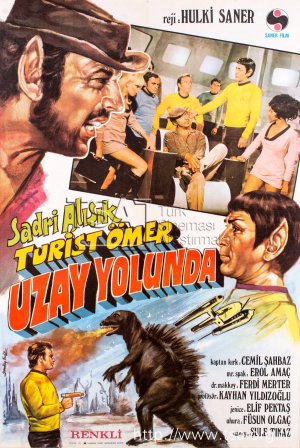
Tourist Ömer first appeared as a supporting character in a 1963’s Helal Olsun Ali Abi as a friend of that film’s hero. He was so beloved that he ended up being the lead in eight films, with Ömer the Tourist in Star Trek being the final in the series. He’s played by Ayhan Işık in all these films.
Somehow, this became the first Star Trek theatrical release, beating 1979’s monotonous Star Trek: The Motion Picture by six years. It’s a retelling — let’s be fair, outright rip-off — of “The Man Trap” episode. Everything is copied, from the look of the bridge, the characters, the music, sound effects and miniature footage of the Enterprise. Yet the things that are different — Spock wears yellow and Yeoman Rand is a lieutenant — are so off-brand that they are striking.
Oh yeah — the other big difference is that Ömer is beamed onto the ship from modern Turkey and proceeds to drive Spock beyond bonkers. If that isn’t enough, this turns into a greatest hits episode, bringing in elements of “Arena,” “What Are Little Girls Made Of,” “I, Mudd” and Kirk and Spock brawling from “Amok Time.” I was waiting for a Tribble or two just to see what a Turkish Tribble would look like!
Seeing as how the outside footage was shot in ruins of Ephesus — one of the Seven Wonders — instead of Bronson Canyon, this version of Star Trek somehow has better production values than the show that inspired it.
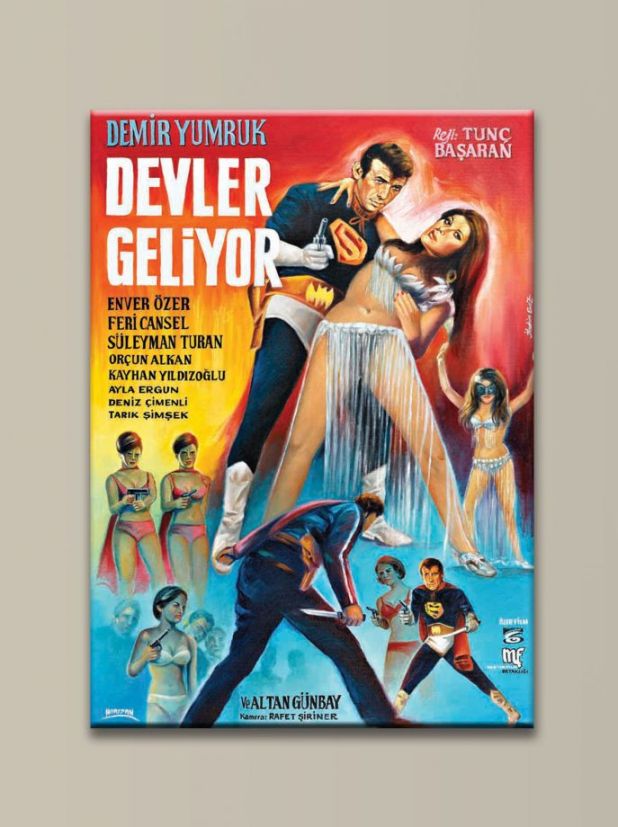
This is a superhero movie — I guess, the jury is really out — that is also a Fu Manchu movie because, well, look when you’re watching Turkish cinema, your best weapon in the face of insanity is to just shut off your brain and go for the ride. So if Fu Manchu ends up being a transvestite in a wheelchair, you just slowly say the words, “Of course he is.”
Enver is a supercop who can outfight — and let’s come clean, outaardvark — anyone else in Turkey. His regular girl Meral (Feri Cansel, the Emmanuelle of Kasımpaşa who appeared in more than 120 seks filmleri before being murdered by her fiancee in 1983) just deals with all his sleeping around because she’s too busy infiltrating the evil gangs by posing as a masked bellydancer.
There’s also another gang — Russians! — led by Zangof, a man with a facial scar and a metal hand that can shoot bullets. He looks like a member of Big Jim’s P.A.C.K. (Professional Agents – Crime Killers) in real life. He has a henchman named Çengel, who has a double hook for a hand.
Fu Manchu raises the odds by having an entire army of machine gun-toting women, because that’s how Eurospy movies roll on their way into Turkey.
As for Iron Fist — remember him? — he’s not even a superhero, but an identity for one of our heroes who cheats death. And then there’s another Iron Fist at the end! Let me tell you what’s so great about Iron Fist. He has a mask, which seems enough for most superheroes. He tops that off with Superman’s symbol on his chest, which again, would be way more than adequate. But no. No, this is a Turkish hero, sho he finishes his look with Batman’s belt, but it also has an S on it.
There’s a whole big deal about uranium and everyone wants to get it and then Fu Manchu gets out of his wheelchair and goes mano y claw with Iron Fist and pays for his bad behavior with death.
What a circuitous route this movie takes, but along the way, it does take place in a magical world of movie serials, copyright infringement and evil Russians tying up Feri Cansel into bondage. In short — our highest recommendation.
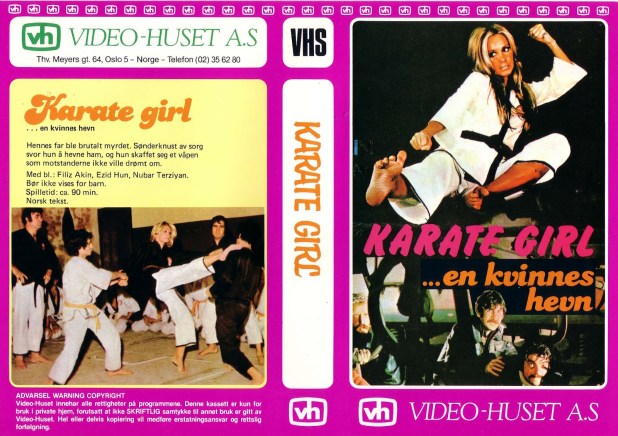
Zeynep (Filiz Akın, who starred in 116 movies in just over thirteen years and even survived being stabbed in the leg by an obsessed fan — she even went on stage to perform that same night!) is a mute girl content to be a florist with her father. They’ve been saving money for an operation that will allow her to speak, but one night five men break in, steal the money and kill her father. She refuses to testify against them because she wants them to all get away with it so she can hunt them down herself.
What really makes her story kind of Ben Parker tragic is that she falls for a man named Murat who teaches her how to shoot a gun and to defend herself with karate. He never tells her that he’s a policeman, despite being set up by his superiors to get her to testify. In what is either committing way too much to being undercover or just really taking advantage of his job, they get married. The five men? They show up and kill him.
Oh man, Turkish cinema, I love you so.
The bad guys in this film are so evil that one of them steals a baby and threatens to break its neck if anyone gets in his way. You will not feel badly at all, even if you’re the most liberal of left-leaning people, when they all get their karate chopped and bullet blazed comeuppance.
The really strange thing is that after the five men attacked Karate Girl, she could speak again, which really seems like a backward way of retelling They Call Her One-Eye. This one also doesn’t have the heroine getting assaulted or porn inserts, but it does have the kind of extended fight scenes that you come to these movies for.




 B&S About Movies
You must be logged in to post a comment.