EDITOR’S NOTE: The Longest Night was on the CBS Late Movie on November 14, 1974; April 19, 1977 and January 2, 1978.
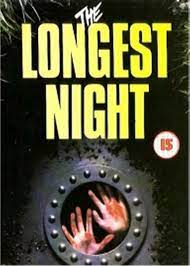
Based on the 1968 Barbara Mackle kidnapping by Gary Steven Krist, this was the ABC Movie of the Week, airing on September 12, 1972.
Karen Chambers has been kidnapped and placed in an underground coffin with an air supply and water while the criminals try and get the money. Karen is played by Sallie Shockley, which is kind of interesting because The Candy Snatchers is pretty much the same movie — well, this is made for TV and doesn’t get quite so rough — and the female protagonist of that movie was played by another alliteratively named actress, Susan Sennett.
The cast is great. There’s David Janssen as the father, Phyllis Thaxter (Ma Kent from the Superman movies) as the mother, James Farentino as the lead kidnapper, Skye Aubrey as his partner and Mike Farrell as an FBI agent.
Beyond being referenced in the aforementioned The Candy Snatchers, this was also filmed in 1990 as 83 Hours ‘Til Dawn. There’s also an episode of Quincy M.E., “Tissue of Truth,” that is ripped from these headlines. This movie only aired once, as there were issues with who owned the rights to the story.
Bleeding Skull’s Top 50 (July 7 – 13) The middle-brow champions of low-brow horror, Bleeding Skull has picked out some of their favorites from the SWV catalog. They neglected to put I Drink Your Blood or EEGAH!on the list, but I think I can forgive them since they included Ship of Monsters.
J.G. Patterson Jr. — full name Jr Junius Gustavious Patterson — was only on our planet for 45 years, but in that time, the North Carolina native worked on She-Devils On Wheels, The Gruesome Twosome and Axe, as well as providing effects for Three On a Meathook and The Electric Chair. He was also an actor in movies such as Preacherman, Moonshine Mountainand Whiskey Mountain.
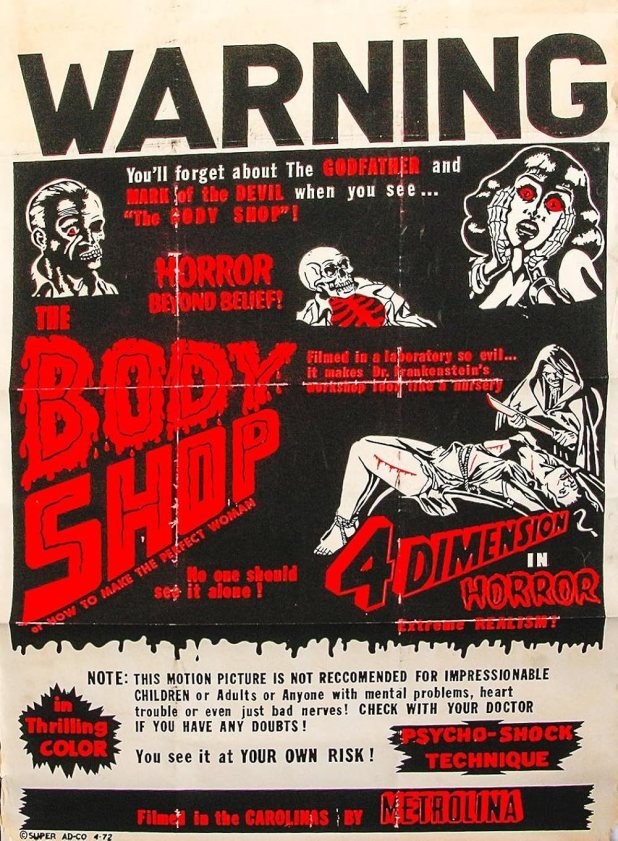
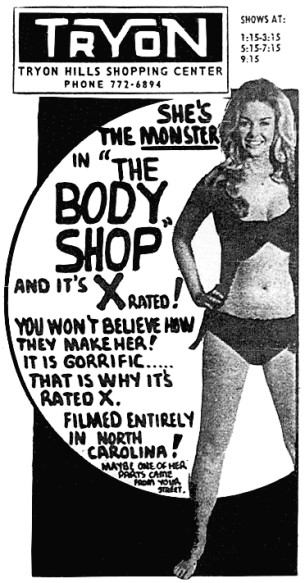
Yet it’s his vanity production — in the best sense of the word — The Body Shop that we’ll be talking about today. In addition to directing, writing and producing this movie, Patterson was also its lead, playing Dr. Brandon. He’s lost his wife in a car crash — shades of The Brain That Wouldn’t Die— so after setting her head ablaze, he decides to just remake her in a perfect body by killing women — again, The Brain That Wouldn’t Die — along with his hunchbacked assistant Greg (Roy Mehaffey).
Patterson got the most important part of being a horror star right. Just like Paul Naschy, he gets to make out with every pretty girl in this movie before killing them and getting to show off his skills at making over the top gore. He also repeatedly cuts to a country star — I use this word in the lowest wattage and I am also not about to refer to the stand up comedian — Bill Hicks, who keeps coming back to tell us that “A Heart Dies Every Minute.”
Hicks may be William T. Hicks, who was also in the Earl Ownsby-produced North Carolina-filmed classics A Day of Judgement, Death Screams and Order of the Black Eagle.
Now that the doctor has Anitra (Jenny Driggers), he wants to keep her away from every other man. He can also control her mind. But you know that women are always smarter than men, even if they are sewn together from the corpses of a model, a secretary and a few other pretty girls.
When this came out on VHS, it had Herschell Gordon Lewis introduce it and the name changed to Dr. Gore. In the credits, it also says that Patterson was America’s #1 magician, which seems like the kind of claim that can be verified. Also known as Shrieks in the Night, this movie is also evidence as to why Patterson died of metastatic malignant melanoma — his death certificate is linked on his IMDB page — because he’s lighting up in every scene, even when he’s in his lab. He also picks his nails with a scalpel, so there’s that.
A few of the ladies in the cast — Jenny Driggers and Jeannine Aber — are also in another North Carolina regional film, The Night of the Cat.
This was also called Anitra while it was being shot. I can tell you that because the clapboard is on screen for a good five seconds. But I loved this. It has 15 gallons of blood in it, which is enough for ten people.
Let me ask you: Does Poor Things have a soundtrack by William Girdler? Does it have the line, “Greg! Put on this lab coat, so they don’t know you’re a hunchback!” Does a cop give up the investigation because the doctor says, “I’m a doctor?” No, it doesn’t. This movie cost a fraction that can’t even be calculated of that Film Twitter darling’s budget and it doesn’t have Bill Hicks and The Reignbeaux singing in a steak house.
EDITOR’S NOTE: Necromancy was on the CBS Late Movie on January 6 and June 23, 1977.
If you go to a town named Lilith to live, you should not be surprised that the town is run by devil worshippers. If Orson Welles comes to you in a robe and his name is Mr. Cato, you should not be shocked to learn that he wants to use you to raise his son from the grave. What is surprising is that for a movie promising rituals and raising the dead, Necromancy isn’t all that exciting.
Directed by Bert I. Gordon (War of the Colossal Beast, Picture Mommy Dead), the master of rear projection, this film is all about Lori Brandon (Pamela Franklin, The Legend of Hell House, And Soon the Darkness), a woman who has recently lost a child. She moves with her husband, Richard (Michael Ontkean, Sheriff Harry S. Truman from Twin Peaks) to the aforementioned town of Lilith to start over again.
On the way there, they get in an accident and kill a woman, but it’s totally glossed over because this is 1972. Life was cheap. At least Lori gets a baby doll out of this accident.
There used to be a sign in my hometown that said, “What Ellwood City makes, makes Ellwood City.” The town of Lilith makes one thing: the world’s finest occult paraphernalia. There’s one great scene here with Lori sees her image inside a tarot card, a really evocative scene thrown away in a film that is otherwise less than memorable.
If you’ve seen Rosemary’s Baby, you know exactly how this is all gonna turn out. If you are the star of a 1970’s horror movie — especially if you are Donald Sutherland — expect to die. Horribly.
Much like the devil, Necromancy goes by many names, such as The Witching, A Life for a Life, Horror-Attack, Rosemary’s Disciples and The Toy Factory. When Paragon Video re-released it on VHS in 1982, they chopped out tons of story and dialogue to insert scenes of nude witches like Brinke Stevens and even more Satanic rituals.
As much as I love Orson Welles — we’ll have a whole month of his films at some point, I’m certain — this is not his finest hour. He has some fine speeches, but the material is Mrs. Paul’s level. Beneath him.
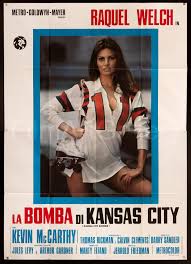
EDITOR’S NOTE: Kansas City Bomber was on the CBS Late Movie on September 11, 1975; December 6, 1976 and February 10, 1978.
Barry Sandler wrote Making Love, the first mainstream American film to deal with homosexuality and Crimes of Passion. His film script — written as his Master’s Degree thesis at UCLA — was for this movie. He always had Raquel Welch in the lead and said, “”Raquel was a huge star at the time — kind of like the pop culture goddess. I just thought it would be great to see her as a roller derby queen; it seemed like a perfect meshing of pop culture with that role.”
Sandler personally delivered the script to her house and her husband Patrick Curtis bought the script for their production company, Curtwel Productions.
The original idea changed somewhat, as Sandler told Stone Cold Jeff, “It was a dark, gritty, character piece, more in the vein of Requiem for a Heavyweight. It’s about this young woman from Kansas City who goes out to Hollywood dreaming of fame and fortune, making it in the movies, and she’s really not good enough to do so, but she’s desperate to make her name and to get attention. She struggles and struggles, and never makes it, and then one day, she meets this kind of beat up, bruised up, burnt-out ex roller derby queen who kind of takes her under her wing and coaches her, and tries to get her involved in the roller derby. It sort of shows her becoming a roller derby star, and the irony is that she makes it in the roller derby, but as a black-trophy … as a bad girl who gets hissed at, beat up, and spit on every week. The irony is that she is able to find the stardom she desperately yearned for, but not as a movie star–as a star on the roller derby track getting booed at and spit at every week. And so it’s kind of dark, and much grittier and different, kind of almost along the lines of Midnight Cowboy.”
It was originally to be made at Warner Brothers and he believed that they would have stayed true to what he wrote: “Warner Brothers was a much more adventurous studio at the time. They were making The Devils and A Clockwork Orange, Performance. They stuck with those kinds of movies. MGM wanted to sell Raquel Welch in a tight roller derby jersey, running around the track. Listen, they weren’t stupid, they were smart to do that. It certainly made them a lot of money, and it would have been a much riskier project to go the other way. They weren’t sure whether Raquel could pull it off. I think she could have, but they wanted to play it much safer and go with a much more straight-on roller derby story.”
Roller derby used to be a totally different sport than it is today. Imagine if pro wrestling won over women and they decided to do it for real. That’s exactly what happened with roller derby.
The sport has its origins in the banked-track roller-skating marathons of the 1930s. It became a competitive sport thanks to Leo Seltzer and Damon Runyon. Yes. The short story writer.
In 1940, more than 5 million spectators watched in about 50 American cities. Eight years later, Roller Derby debuted on New York television and by the 1960s, it aired on several national networks. Of the competitors to Seltzer — who owned the name roller derby — Roller Games was started by Herb Roberts and bought by Bill Griffiths Sr. and Jerry Hill.
By the mid 1960s, Roller Games had teams in Baltimore, Chicago, Cleveland, Detroit, Philadelphia, Florida and Hawaii, with leagues in Canada, Mexico, Australia and Japan. The biggest team — and where the TV was taped — was in Los Angeles with the L.A. Thunderbirds. It was such a big deal that in 1972, an interleague match between the Thunderbirds of Roller Games and the Midwest Pioneers set a roller derby attendance record of 50,118 at Chicago’s Comiskey Park.
Yet by 1975, Roller Games disbanded and many of the skaters started local circuits, kind of like how pro wrestling has survived the ups and downs of popularity. In the late 80’s, RollerJam and RollerGames both aired on television, but the revival didn’t take except with people that remembered watching the original games on UHF TV.
Welch understood what the sport was all about, telling the New York Times, “The game is almost show business, it’s a carnival atmosphere, but I can understand its popularity. Most of the spectators are basic people and there’s something cathartic about watching people get dumped. The yelling creates a certain kind of intensity. The type of violence draws you in, makes you involved. The skaters are tough but I think all women are tough. The skaters aren’t any tougher than most of the women in the world, underneath. Skating is a batchy, sweaty, funky life. I don’t want to do another film about it. I’ve done my number. But I enjoyed it.”
Welch played K.C. Carr, who has just left her team in Kansas City to start life all over again in Portland to skate for the Loggers. It’s all because their owner, Burt Henry (Kevin McCarthy), wants her. She dates him without knowing how he manipulates the team, like sending her best friend and roommate Lovey (Mary Kay Pass, Nurse Sherri) to another team and gets the crowd to drive “Horrible” Hank Hopkins (Norman Alden) crazy after he realizes that the older player has a crush on K.C. He has a plan to get out of Portland and go to Chicago, bringing her along. He sets up a match between her and Jackie Burdette (Helena Kallianiotes), which will lead to her leaving, just as she lost a match at the start of the movie with “Big Bertha” Bogliani (Philadelphia Warriors skater Patti “Moo Moo” Cavin) but by this point, she knows he’s a liar and instead of throwing the fight, she wins. The actual fight got out of hand between Welch and Kallianiotes, with the sex symbol getting punched in the face. She also suffered bruised knees, a spasm in her trapezius, hematomas on her head, several headaches and a broken wrist that delayed filming for two months.
The most harrowing scenes are when K.C. stops in Fresno to visit her two children who live with her bitter mother (Martine Bartlett). Her son Walt (Stephen Manley) refuses to speak with her, as he worries about her getting hurt. Her daughter Rita is a young Jodie Foster. And when Hank confides that he hates riling up the crowd and confesses how beat up he is, it made me think of the many aging heels I’ve met through wrestling.
The battles between K.C. and Jackie make up most of the film, including one battle where they tumble down a hill and are nearly hit by a train before being saved by team coach Vivien (Jeanne Cooper, Katherine Chancellor from The Young and the Restless). Kallianiotes earned her Golden Globe nomination for this movie.
Real roller derby venues in Kansas City, Fresno, and Portland were also used for key scenes and stars Judy Arnold (the captain of the Philadelphia Warriors and the skating double for Welch), Ralph Valladares (the holder of every important scoring, speed and endurance record in the history; “The Living Legend” was a member of the T-Birds as a player, coach and manager for 38 years), Danny “Carrot Top” Reilly, T-Bird Ronnie “Psycho” Rains, T-Bird and later New York Bomber Captain Judy Sowinski, one of the best jammers in the game “King” Richard Brown, “The Body Beautiful” Tonette Kadrmas, announcer Dick Lane and John Hall, a former skater who became the in-field manager for the Detroit Devils.
Director Jerrold Freedman mainly worked in television, directing TV movies like A Cold Night’s Death, Unholy Matrimony, The Boy Who Drank Too Much, The Comeback and The O.J. Simpson Story(as Alan Smithee). He also helmed episodes of The X-Files and Night Gallery. Oh yeah — he also wrote and directed the Charles Bronson movie Borderline. The script was written by Thomas Rickman (Coal Miner’s Daughter) and Calvin Clements Sr. (who wrote 66 episodes of Gunsmoke) from Sandler’s story.
Perhaps most odd, Phil Ochs was originally approached to write a theme song for this movie. His song was rejected but A&M Records released it. He hoped to publicly debut the song at the Olympic Auditorium during a Roller Games television taping at Los Angeles’ Olympic Auditorium. Thunderbirds owner Bill Griffiths Sr. said no thanks.
Welch claimed that this was the first of her movies that she liked. She isn’t always the heroine in this and despite her looks, she comes off as tough. I wish she’d made more films like this.
Roger Corman found out this was getting made and created his own roller derby film, Unholy Rollers. It’s very similar to this movie but has the benefit of Claudia Jennings as its star. She’s even wilder than Welch and ends the film attacking the entire audience and flipping off the cops. It’s great.
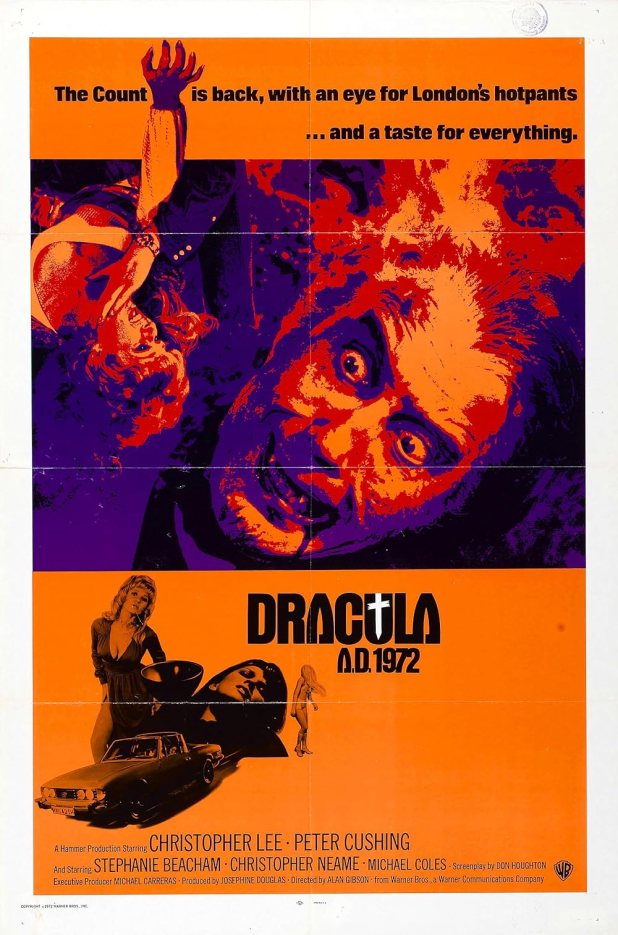
EDITOR’S NOTE: Dracula A.D. 1972 was on the CBS Late Movie on March 18, 1981. You can download the full episode with commercials at the Internet Archive.
Warner Brothers and Hammer saw how well Count Yorga, Vampire did with young moviegoers and decided that it was time to make a modern Dracula.
While today, many associate Christopher Lee and Peter Cushing with their roles as Dracula and Van Helsing, this was the first time that Cushing played the role since Brides of Dracula. And while this was the sixth time Lee played the Count, the two had not battled since the original Hammer Dracula. It would be the next to last time they faced off in the roles and the next Hammer Dracula, The Satanic Rites of Dracula, would be the last for them to both play these characters.
It opens with Count Dracula and his nemesis Lawrence Van Helsing battling atop a carriage that crashes, impaling Dracula. With his mortal wounds about to end his life, Van Helsing finally destroys his archenemy. This is a thrilling opening — kind of like a Bond movie — but to Hammer continuity lovers, this invalidates the last few movies and starts a new timeline.
In 1972, Jessica Van Helsing (Stephanie Beacham, And Now the Screaming Starts!) and her hippie friends are convinced to come and watch Johnny Alucard (Christopher Neame, The Love Factor) perform a Black Mass — set to White Noise’s “Black Mass: An Electric Storm in Hell” — at the deconsecrated St Bartolph’s, the same church where her descendent Van Helsing and Dracula were both buried.
He soon draws the blood of Laura Bellows (Caroline Munro!) and brings Dracula back from the dead, as the Count quickly drains the lifeblood of the young girl. Then, they start to turn all of Jessica’s friends like Bob (Philip Miller) and Gaynor Keating (Marsha Hart) into vampires, all to draw her back to the Lord of the Vampires so that he can keep getting revenge on Van Helsing, who has a descendent, Lorrimer (also Cushing), the grandfather of Jessica.
This movie features controversial Page Three girl Flanagan — who was the Kray Twin’s mother’s hairdresser and campaigned for their release — and Concord, CA ten-piece band Stoneground. Three members of that group — Cory Lerios, Steve Price and David Jenkins — would later form Pablo Cruise. They were in the movie to replace The Faces, which would have been wild.
In the U.S., a brief clip was played before this movie in which Barry Atwater (Janos Skorzeny from The Night Stalker) rises from a coffin and swears the entire audience in as members of the Count Dracula Society as part of a HorroRitual.
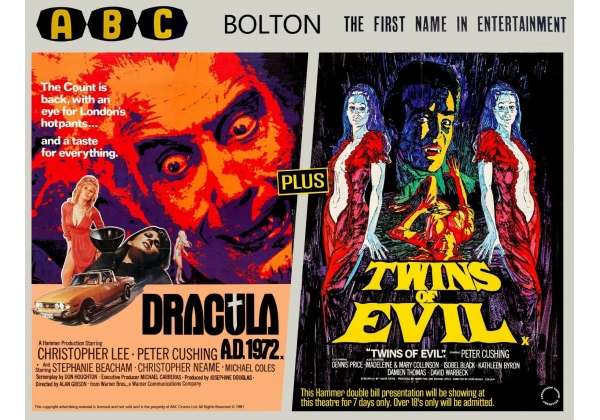
This played as part of some great double features with Trog, Twins of Evil and Crescendo.
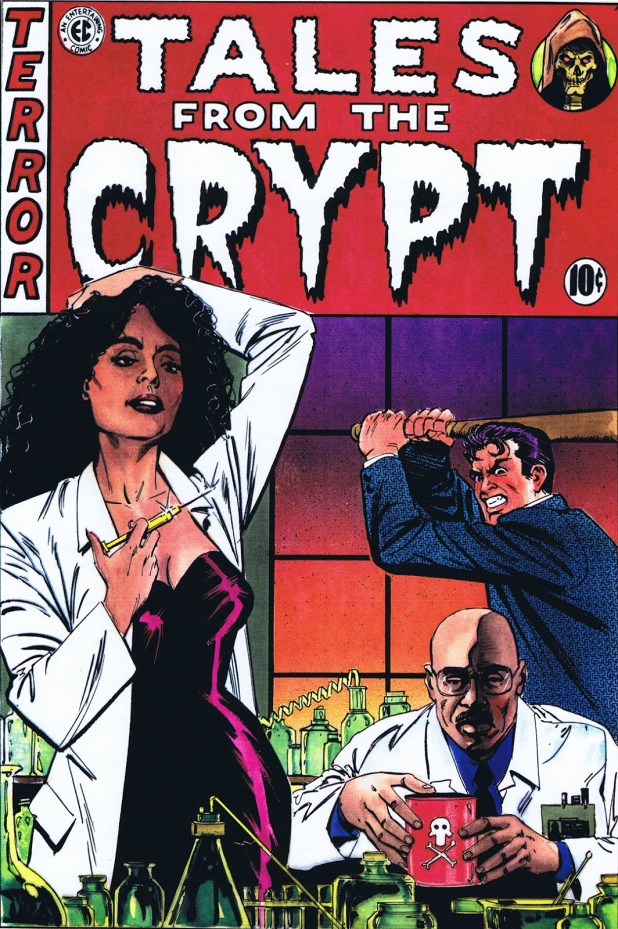
Directed by Robert Longo (who directed “Bizarre Love Triangle” for New Order, “Peace Sells” by Megadeth, “The One I Love” for R.E.M. and Johnny Mnemonic) and written by Gilbert Adler (who produced 69 episodes of this show, wrote and directed Bordello of Blood and wrote Children of the Corn II: The Final Sacrifice) and AL Katz (who worked with Adler on many of those projects), “This’ll Kill Ya” concerns George Gatlin (Dylan McDermott), Pack Brightman (Cleavon Little) and Sophie Wagner (Sônia Braga) and their attempts to study H-Cell 24, an experimental hybrid cell that may cure any disease.
“Damn! I love when that happens! You didn’t know your old friend the Crypt Keeper was the boo-it-yourself type, did you? I’m actually pretty handy with my little ghoul box. Here’s a bookshelf I just finished for my die-brary. Over there’s a stand I made for my new big scream TV! (the camera pans to the stand, where the TV shows the Crypt Keeper waving at the viewers; cut back to his original view) And here’s something else I’ve been working on. It’s a nasty nugget about an unpleasant young man in the medicine biz who’s about to get a dose of his own. I call tonight’s tale: “This’ll Kill Ya.””
Sophie used to be with George and when she accidentally injects H-Cell 24 into his body — covering him with tumors — he learns that she’s with Pack and they just may be setting him up. So he does what anyone would. He beats his romantic rival with a baseball bat and then injects his heart with insulin so that it explodes. He takes the man’s body to the police in the hopes of a suicide by cop, only to learn it was all a prank and that his co-workers have figured out the issues he couldn’t with H-Cell 24, showing how ineffective he really was despite being a workaholic.
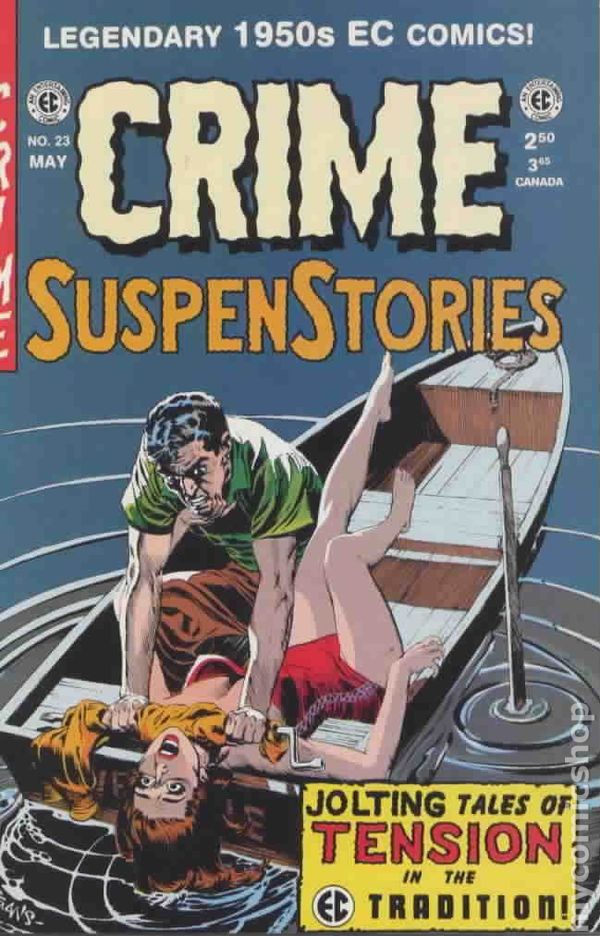
This episode comes from Crime SuspenStories #23. It was drawn by Reed Crandall and written by Otto Binder.
EDITOR’S NOTE: Frogs was on the CBS Late Movie on October 26, 1973; September 20, 1974 and June 11, 1976.
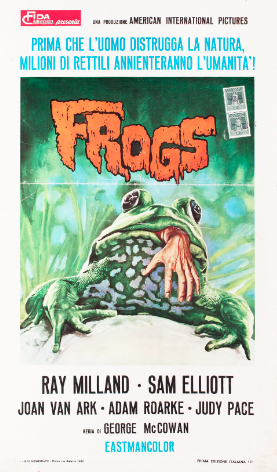
The Crockett family, led by Jason (Ray Milland), may have great power and influence, but nature in no way cares about those things. Snakes, birds, geckos, alligators, turtles, butterflies and, yes, frogs, are prepared to end their lives for daring to abuse the ecosystem with pesticides.
Wildlife shutterbug Pickett Smith (Sam Elliot) picked the wrong holiday weekend to be in their Florida mansion.
Directed by George McCowan, whose career often found himself working in episodic television, and written by Robert Hutchison and Robert Blees (Whoever Slew Auntie Roo?, Dr. Phibes Rises Again).
I am sad that I will never live the life of drive-in aficionados of 1972 who got to see this with Godzilla vs. the Smog Monster.
I have no idea if the animals are turning on all of humanity — I mean, Jason’s dog remains loyal — or if it’s just this family, but I love the swampy world that this movie makes, one that makes nearly every creature in the world outside the Crockett home into a killer ready to work together and wipe out rich folks.
This also has tons of stock footage of animals which is how you make a low budget movie about a whole bunch of animals. As it was, the hotel everyone was staying in was adamant that no animals were allowed to stay in the actor’s rooms, as if that would be a thing.
EDITOR’S NOTE: Something Evil was on the CBS Late Movie on February 8 and August 17, 1973.
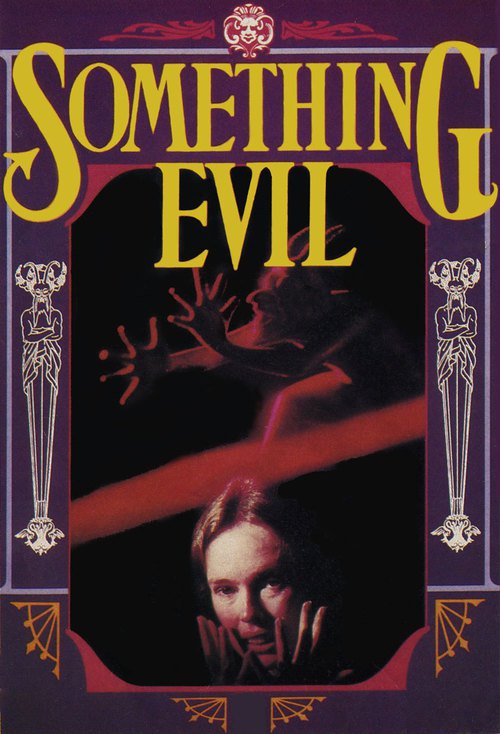
Steven Spielberg directed this Robert Clouse (the director of Enter the Dragon) written TV movie that originally aired on January 21, 1972. In fact, Spielberg even appears briefly in the film speaking to Carl Gottlieb (who would go on to co-write Jaws) at a party.
Marjorie (Sandy Dennis, God Told Me To) and Paul Worden (Darren McGavin, Carl Kolchak forever) have just moved to a Pennsylvania farmhouse with their children, Stevie (Johnny Whitaker, Jody from Family Affair) and Laurie. There are symbols all over the house, which no one seems to have any issues with.
Is there weirdness at the farm? You know there is. Their neighbor, Gehrmann, (Jeff Corey, Battle Beyond the Stars) kills chickens right in front of the kids. Marjorie keeps hearing the sound of crying children. Then there’s Harry (Ralph Bellamy, Coming to America, Pretty Woman), a local who believes in demons and says that the house is protected from them because of all the symbols.
Marjorie is convinced that the devil wants her and even slaps her son, which leads to her leaving the family, as she can’t even trust herself. But what if the devil was after her kids and not her? Hmm?
Spielberg would escape TV movies after this. It’s a low budget affair, but his style as a director transforms the material. It’s unsettling, filled with doom and gloom and dread. The 70s really seem like a dismal time to be alive if we only go by TV movies, huh?
June 30: Junesploitation’s topic of the day — as suggested by F This Movie— is Slasher! This month, I tackled a different genre every day. This is the end.
Directed by Robert Hartford-Davis (The Black Torment, Gonks Go Beat, Black Gun, my beloved Corruption) and written by Brian Comport (Girly, The Asphyx), this starts with a baptism being juxtaposed with a pretty young girl being stripped, strangled and thrown in a river. Ah, British pre-slashers, you are never subtle.
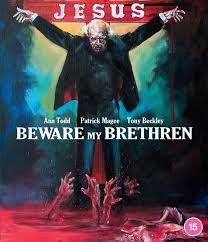
Birdy Wemys (Ann Todd) has given most of her money and home to the Brethren, a fire and brimstone church that believes that the world is going to hell. All of the religion in the home and sermons of the minister (Patrick Magee) have made her withdrawn son Kenny (Tony Beckley) into a lunatic cleaning the streets of fallen women.
Kenny uses his job as at a public swimming pool to basically yell at girls who dress in skimpy bathing suits and then at night, he’s a security guard. Meanwhile, his mother’s health is failing and the minister won’t let any of his followers take medicine. Yet she still gets insulin for her diabetes and a state provider nurse, Brigitte (Madeleine Hinde), who tells her investigative reporter sister Paddy (Suzanna Leigh) about the ministry. As she’s been writing about cults, Paddy tries to sneak in, pretending that she’s an expectant mother.
Kenny starts killing women everywhere, from a nubile teen who goes topless at the pool to ladies of the evening, leaving them for people to find stripped of their clothing and dangling from meat hooks or hanging out of cement trucks. His mother grows closer to Paddy and the minister accuses them of being a lesbians and takes her medication. As Birdy starts to die, Paddy tries to save her but is locked in the basement by Kenny who finds out too late that the minister was wrong. As his mother dies, he confesses to the religious man that he’s the Nude Killer that’s been in the newspapers. Then he crucifies the minister in his own church.
Also known as The Fiend, this has some incredible music and a great theme. I have a weakness for early 70s sexploitation horrors from England. Richard Kerr and Tony Osborne created a great soundtrack and this church, while certifiable, knows how to rock it out with their music. Maxine Barrie sings “Wash Me In His Blood” as people start to come alive with the spirit and you know, I would never survive the 70s because I’d totally love to be in one of these movie cults.
John Talbot (Barry Newman, Vanishing Point) shows up in a small Louisiana town and nearly immediately starts a fight with some cops, goes to jail and it’s soon discovered that he is wanted for killing a policeman and robbing a bank. He then escapes, abducting Sarah Ruthven (Suzy Kendall), who just so happens to be the daughter of a millionaire. But nothing in this movie is as it seems.
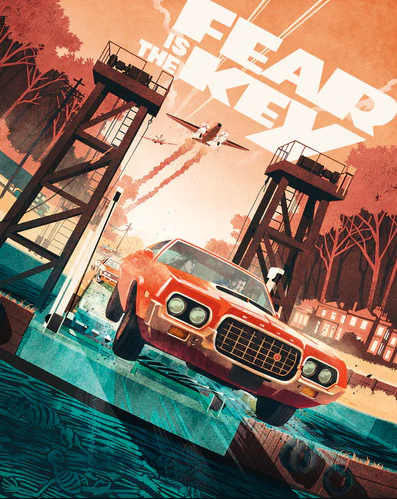
Directed by Michael Tuchner with stunt sequences coordinated by Carey Loftin (Bullit, The French Connection), Fear Is the Key is really about Talbot faking his way into becoming a criminal in order to find out who killed his wife and son, going the whole way to the depths of the ocean to get the answers and retribution that he craves.
It’s also Ben Kingsley’s first movie, although he would only work on the stage on on TV for a decade until he was in his next movie, Ghandi.
As exciting as the book that this was based on, written by Alistair MacLean, there’s nothing like getting a twenty-minute car chase that features Newman driving a 1972 Ford Gran Torino. Loftin was the king of scenes like this, as well as being the driver of famous car scenes in Duel and Christine. That chase happens at the beginning of the movie, which may seem like a strange way to structure a movie, but sometimes, you give it your best shot right from the starting flag.
The Arrow release of Fear Is the Key has tons of extras, including new audio commentary by filmmaker and critic Howard S. Berger, a visual essay by film critic and author Scout Tafoya, an appreciation of the movie’s composer Roy Budd by film and music historian Neil Brand, a making of, an interview with associate producer Gavrik Losey and a trailer. It’s all inside a reversible sleeve featuring original and newly commissioned artwork by Nathanael Marsh, along with a double-sided foldout poster and a booklet with new writing by filmmaker and critic Sean Hogan.



 B&S About Movies
You must be logged in to post a comment.