ARROW BLU RAY RELEASE: Fear Is the Key (1972)

John Talbot (Barry Newman, Vanishing Point) shows up in a small Louisiana town and nearly immediately starts a fight with some cops, goes to jail and it’s soon discovered that he is wanted for killing a policeman and robbing a bank. He then escapes, abducting Sarah Ruthven (Suzy Kendall), who just so happens to be the daughter of a millionaire. But nothing in this movie is as it seems.

Directed by Michael Tuchner with stunt sequences coordinated by Carey Loftin (Bullit, The French Connection), Fear Is the Key is really about Talbot faking his way into becoming a criminal in order to find out who killed his wife and son, going the whole way to the depths of the ocean to get the answers and retribution that he craves.

It’s also Ben Kingsley’s first movie, although he would only work on the stage on on TV for a decade until he was in his next movie, Ghandi.

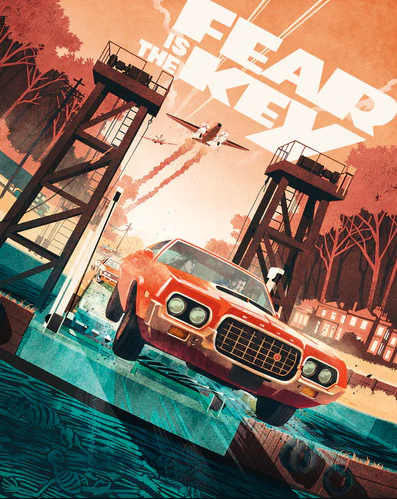
As exciting as the book that this was based on, written by Alistair MacLean, there’s nothing like getting a twenty-minute car chase that features Newman driving a 1972 Ford Gran Torino. Loftin was the king of scenes like this, as well as being the driver of famous car scenes in Duel and Christine. That chase happens at the beginning of the movie, which may seem like a strange way to structure a movie, but sometimes, you give it your best shot right from the starting flag.

The Arrow release of Fear Is the Key has tons of extras, including new audio commentary by filmmaker and critic Howard S. Berger, a visual essay by film critic and author Scout Tafoya, an appreciation of the movie’s composer Roy Budd by film and music historian Neil Brand, a making of, an interview with associate producer Gavrik Losey and a trailer. It’s all inside a reversible sleeve featuring original and newly commissioned artwork by Nathanael Marsh, along with a double-sided foldout poster and a booklet with new writing by filmmaker and critic Sean Hogan.

You can get it from MVD.

RE/SEARCH Incredibly Strange Films: Private Parts (1972)

Paul Bartel is a bonafide hero here at B & S About Movies. From his cameos in movies like Gremlins 2: The New Batch and Chopping Mall to the films he directed like Death Race 2000 and Eating Raoul, every time he turns out on the screen it makes us happy.

Cheryl and her roommate get in a fight, so instead of going back home, she decides to move into her aunt’s run down hotel in downtown Los Angeles. Suffice to say that shenanigans ensue.

Aunt Martha is a strange lady, played by Lucille Benson, who was on TV’s Bosom Buddies and played Mrs. Elrod in Halloween 2, as well as time on Broadway. She’s obsessed with funerals and given to moralizing. Her hotel is packed with maniacs and there are also a series of murders going on, with Cheryl as the best chance to be the next victim.

Get this — the role of Aunt Martha was originally written for Mary Astor (The Maltese FalconHush…Hush, Sweet Charlotte)!

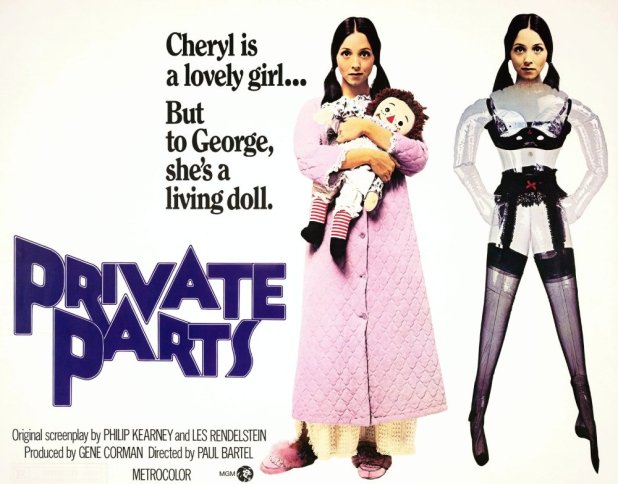
Cheryl wants to be a woman and experience her sexuality, which leads her into George’s orbit. He’s a photographer who longs for love, but also sleeps with a water inflated doll that he often injects with human blood and covers with a photo of Cheryl’s face. He’s somehow not the strangest person in the hotel. And oh yeah, to add to the whiff of perversion in the air, he’s her cousin.

Stanley Livingston, Chip Douglas from TV’s My Three Sons, also is in this movie, playing Jeff, another tenant. He would be a better mate for Cheryl, but she’s already too deep. And it’s pretty crazy to see Laurie Main, who hosted and narrated Disney’s Welcome to Pooh Corner, as a gay priest. That said, he also shows up in some other strange places, like Larry Cohen’s Wicked Stepmother and as the narrator of Cheech & Chong’s The Corsican Brothers.

There was also a model named Alice that once lived in Cheryl’s room that nobody wants to talk about. And a whole bunch of keys that open other rooms so that our voyeuristic heroine can spy on all of them.

Private Parts began with the working title Blood Relations, but its new title was rough on the film, as some newspapers wouldn’t promote it with that name, some even calling it Private Arts. Some ads even said that the title was too shocking to print and asked people to call the theater to learn the name of the film!

It really was shot in a skid row hotel, the King Edwards Hotel in downtown L.A and all of the people in it were based on people that writers Philip Kearney and Les Rendelstein met in LA in the 1960s. It’s still around, having been purchased in 2018 with plans to convert it into low-cost single-occupancy transitional housing.

This is a movie that fits in well with other blasts of 70’s odd like The Baby. Like that movie, Private Parts may not explicitly have sex and violence, but it just feels off and as if it came from another universe that might appear to be ours, but has scum and strangeness in every corner.

Leonard Maltin said this about Private Parts: “If Andy Warhol’s Chelsea Girls had co-directed by Alfred Hitchcock and John Waters, it would come close to this directorial debut by Paul Bartel.” That sums this up quite well.

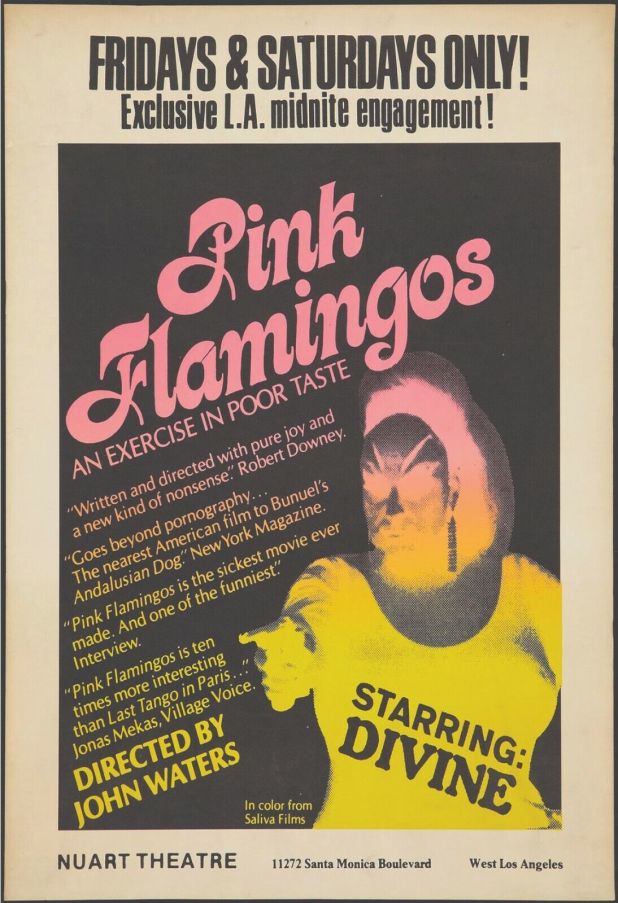
RE/SEARCH Incredibly Strange Films: Pink Flamingos (1972)

As late as 1997, when it was re-rated NC-17 “for a wide range of perversions in explicit detail,” Pink Flamingos keeps on offending people in the best of ways.

A movie that has the dedication “For Sadie, Katie, and Les- February 1972” — Manson Family members Susan Atkins, Patricia Krenwinkel and Leslie Van Houten discovered in February 1972 that the death penalty was abolished in California, reducing their sentences — director and writer John Waters and star Divine announced themselves to the world here, despite already making the movies Hag in a Black Leather JacketRoman CandlesEat Your Makeup, Dorothy, the Kansas City Pot HeadMondo Trasho, The Diane Linkletter Story and Multiple Maniacs, films that didn’t escape Baltimore and small screenings.

The filthiest person alive Babs Johnson (Divine) lives with her mother Edie (Edith Massey), son Crackers (Danny Mills) and traveling companion Cotton (Mary Vivian Pearce) in a trailer with pink flamingos in the front yard. Her title is challenged by Connie (Mink Stole) and Raymond Marble (David Lochary) who come to regret ever invoking her wrath, costing them their baby stealing empire and eventually their lives.

Banned in Switzerland and Australia, as well as in some provinces in Canada and Norway as well as Hicksville in Long Island, this movie is less about the plot and more about the urge to shock you. It’s Waters using filth in the same way that his hero William Castle used gimmicks to bring you into the theater. If Joan Crawford was the ultimate gimmick for Castle, Divine served the same role for Waters. She even ate dog feces for the movie (followed by her calling a hospital emergency hotline pretending to be a mother whose son ate the same thing to make sure she would survive). And yet somehow, it’s all rather heartwarming, even if it’s a movie punctuated by Divine’s rants that include incendiary words like “Kill everyone now! Condone first degree murder! Advocate cannibalism! Eat shit! Filth is my politics! Filth is my life!”

Pink Flamingos is as old as me but retains its wild edge when everything else feels dulled down. I often think of it when I am down and am amazed that it exists, a movie that is endlessly watchable and quotable. I’ve resisted writing about it for so long because what else can I add to it? But I feel that I must celebrate it and why it keeps on meaning so much, a movie that I watched people walk out on 25 years after it was made, angry that the movie was just so wrong.

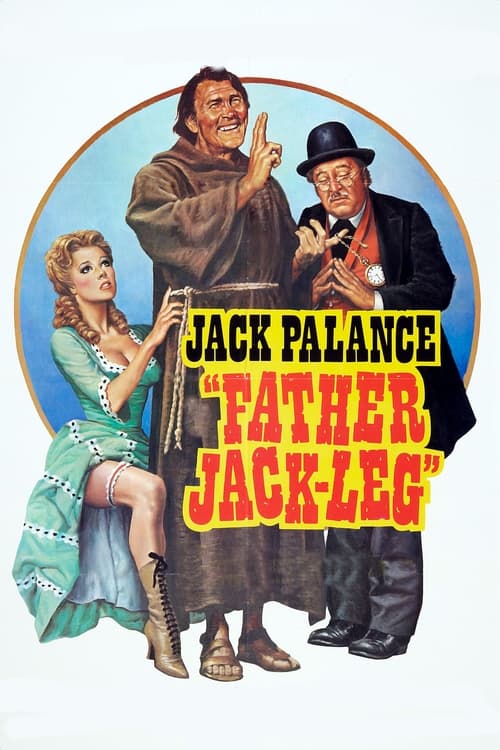
FVI WEEK: Father Jack-Leg (1972)

Also known as Tedeum, Sting of the West and Con Men, this was directed by Enzo G. Castellari, who also wrote the script along with  Tito Carpi, Giovanni Simonelli and José Gutiérrez Maesso.

Stinky Manure (Lionel Stander) and his family of criminals have inherited a gold mine but they don’t trust anyone, so they send their son Tedeum (Giancarlo Prete) to sell the mine to someone else. Being a moron, he sells it to a lawman before getting help from a holy man named Santini (Jack Palance) and Betty and Wendy Brown (Francesca Romana Coluzzi and Mabel Karin) who also have a mine to sell.

The truth is that the Manure family mine is actually pretty valuable. That’s why an actual criminal with some brains and guile, Grant (Eduardo Fajardo), wants it. is after. I say that he’s a pretty good bad guy except he keeps losing his pants.

At the end of the Italian Western cycle, most movies were comedies like this. As to whether or not you find them amusing, well, that’s up to you.

If you don’t like it, well, you can at least keep an eye open for Jack’s brother Ivan as a man on a train. He also used the stage name John Gramack and is in A Bullet for the GeneralKill a Dragon and A Bullet for Rommel. Castellari’s daughter Stefania is also on hand as is the mysterious Carla Mancini, who often is in credits just so a movie could receive Centro Sperimentale di Cinematografia tax credits.

Oh yeah — it has music by Oliver Onions!

Do you think when Lionel Stander stood up and was blacklisted he knew he’d be playing someone named Stinky Manure?

FVI WEEK: When Women Lost Their Tails (1972)

Director Pasquale Festa Campanile is back, along with writers Marcello Coscia and Ottavio Jemma with a story by Lina Wertmüller, to tell the story of the cavemen from When Women Had Tails and the cavegirl, Filli (Santa Berger) who has joined them.

Ulli (Giuliano Gemma) and Kao (Lando Buzzanca) don’t return, but there’s a new cave person named Ham (Lando Buzzanca) to pal around with Grr (Frank Wolff), Maluc (Renzo Montagnani), Put (Lino Toffolo), Uto (Francesco Mulé) and Zog (Aldo Giuffrè) along with other new people like Pap (Mario Adorf) and Katorcia (Fiammetta Baralla).

All of the cave people live inside the skeleton of a dinosaur and life is good until someone figures out what money is and then, as you would figure, things get rough.

Filli has obviously watched The Flintstones as she uses a bird as a kitchen tool. And in the middle of what should be a funny Italian sex comedy, there’s a gay caveman who is so upset that he doesn’t have a mate that he tries to pay someone to kill him.

At least they used the Ennio Morricone from the first movie, right?

I due gattoni a nove code… e mezza ad Amsterdam (1972)

The title of this movie translates as The two cats o’ nine tails… and a half in Amsterdam. As you can see, this references the names of two Argento movies, Four Flies On Grey Velvet and The Cat O’Nine Tails.

Investigative reporter Ciccio (Ciccio Ingrassia) and photographer Franco (Franco Franchi) are working in advertising when they get sent to Amsterdam to look into the murder of a diamond seller. They meet an organized crime player named Big Bon (Luigi Bonos) who is arrested as soon as their plane lands. However, he told them to find Thea (Elisabeth Sennfors), a model that he knows, who can help.

None of this has anything to do with Argento or giallo once you get past the murder mystery that sets up all of the unconnected comedy scenes and the title. Well, Luciano Pigozzi is in it as a killer, but otherwise unless you have a Letterboxd list of giallo films to add to, you can probably skip this.

Director and writer Osvaldo Civirani also made The Devil Has Seven Faces among many other films throughout his long career. The comedy duo of Franco and Ciccio also show up in another of his works, Two Sons of Trinity. Speaking of those guys, they were in several films directed by Lucio Fulci (including 002 Operazione Luna, Oh! Those Most Secret Agents!The Two ParachutistsThe Long, The Short, The Cat, How We Got into Trouble with the Army, How We Robbed the Bank of Italy and How We Stole the Atomic Bomb) and Mario Bava’s Dr. Goldfoot and the Girl Bombs.

ARROW VIDEO BOX SET RELEASE: Inside The Mind Of Coffin Joe: When the Gods Fall Asleep (1972)

The sequel to Finis Hominis (The End of Man) finds the good side of José Mojica Marins, Finis Hominis, leaving the mental ward yet again to set the world right. The last time he got out, he almost became a world leader. This time, he wants to do something easier: fix all of the social, religious and political unrest in the world.

How would he do this? Well, start small. He walks throughout the streets of Brazil and stops the war between two criminals, Skull and Chico, by stealing Skull’s son and making them work together. The people in another community go wild and decide to bring Satan back in a cemetery, even eating live chickens — yes, do not doubt the animal deaths in the movies of Italy or Brazil — and drinking their blood right out of their necks until Finnis Hommis stops it all, as well as a wedding, then the doctors realize that he’s loose. The footage also goes from black and white to color seemingly at will and probably based on what film stock and cameras Marin could get that day.

It’s sad that Coffin Joe and Finnis Hommis didn’t ever battle — maybe inside Marins’ brain? — because they would have just yelled at one another about morality and the ways of mankind.

Directed and written by Marins, the man who is also Zé do Caixão,

Arrow Video’s limited edition collection of Coffin Joe may never escape my blu ray player. When the Gods Fall Asleep has new interviews with Virginie Sélavy on surrealism in Marins’ work and Jack Sargeant. You can get this set from MVD.

Terza ipotesi su un caso di perfetta strategia criminale (1972)

Third Hypothesis on a Case of Perfect Criminal Strategy is better known by the name Who Killed the Prosecutor and Why? It was directed by Giuseppe Vari (Rome Against Rome) and written by Thomas Lang. Carlo (Lou Castel) and girlfriend Olga (Beba Lončar) started with a fashion shoot on a remote beach but have already dropped the camera — and most of their clothes — when two cars show up. Men throw the body of a dead man — who turns out to be a prosecutor — into the other car, cover it with gasoline and light it up. state prosecutor. Instead of going to the police, Carlo decides to find out who did this and blackmail them with the photos he’s taken.

After talking to his pornographer Uncle Fifi (Massimo Serato), Carlo speaks to Don Salvatore (Fortunato Arena) about buying the photos. When he refuses, the photographer goes to the media, but his buyer Roversi (Carlo Landa) is soon killed, which means that both Carlo and the newspaper’s editor Mauri (Antonio La Raina) decide to figure out who is killing people who want these photos. Maybe they should have just gone to the police and Inspector Vezzi (Adolfo Celi). If they did, we wouldn’t have a movie, so that’s how it goes, I guess.

So how is this a giallo? Whoever wants the photos has gained some of the negatives and is killing anyone else who has seen them, as mentioned before, but they have black gloves, we never see them and their murders are in the style of the genre.

If that isn’t enough for you, some cuts of this movie have hardcore inserts, which is the definition of gratuitous.

Testa in giù, gambe in aria (1972)

Head Down, Feet Up is about a killer who has picked teachers as his target. An artist named Andrea (Corrado Pani) gets involved when he tries to save one of them and catches a look at the killer’s face. Like the typical giallo hero, he decides to become the investigator of the case. And seeing as how the police won’t listen to him and he’s become the primary suspect, he has even more reason to solve the crimes.

Director and writer Ugo Novello only directed this one film, but was a second unit director on La muerte incierta and a production manager on several movies. This is a rare comedy giallo — the title refers to the protagonist’s affinity for yoga — that also has a subplot where Andrea gets his girlfriend (Marina Malfatti, All the Colors of the Dark) pregnant and she has an abortion without telling him. It also has a scene has a dream where the professors are all being murdered. When he tries to warn one, the gay teacher believes that Andre wants a date.

This also has an ending where nothing is solved other than Andrea finally being able to nail one of the yoga poses that has been too difficult for him. What an odd movie.

What the Peeper Saw (1972)

Elise (Britt Ekland) is the much younger second wife of Paul (Hardy Krüger), who married her soon after the loss of Sarah from drowning in a tub. Three months into their honeymoon of a marriage, she’s surprised by his 12-year-old son Marcus (Mark Lester, the star of Oliver), who claims that he’s left school early due to a chickenpox epidemic. The film wastes no time letting us know that not only is Marcus weird, he may also be a criminal sociopath.

After their first meeting, in which Marcus confesses to stealing money from his father, Elise looks through the child’s room and soon learns from the headmaster (Harry Andrews) that he was kicked out of school for stalking, creating sexual drawings and killing numerous small animals. She’s obviously worried and Paul just says that his son needs to get over the death of his mother.

That’s when this movie gets weird, as you wonder if Paul just doesn’t care that his son is a lunatic or if he’s just as much of a mentally ill person. Why wouldn’t he tell his new wife that the house they’re attending a party at used to be his and the place where Sarah died? Elise isn’t all that mentally set either, as she’s convinced to strip nude for Marcus if he’ll reveal the truth about killing his mother after she finds a hole above her bed and figures out that he’s been watching her.

That’s when Dr. Viorne (Lilli Palmer), who owns that house where Sarah died, listens to Elise’s concerns. She turns it around on her and accuses her of trying to seduce Marcus, as well as killing the family dog, a crime that was definitely committed by the young man. Elise loses her mind and tries to kill the boy before she’s put in a mental hospital where she dreams of being torn to pieces by the dog, as well as her killing Marcus and making love to him — not the same dream, this isn’t a Joe D’Amato movie — while Paul watches.

Marcus has, of course, been planning this all along. He asks Elise, when they are finally alone, if she wants to have an affair as his father is now too old to satisfy her. She kisses him passionately before…well, that would give up the ending, right? You really need to see this for yourself. The last ten minutes go for it and just unleash everything that could upset people about this movie.

This was directed by James Kelley, who also directed and wrote The Beast In the Cellar, and Andrea Bianchi, the maniac who made Cry of a ProstituteStrip Nude for Your KillerMalabimba and Burial Ground. It was written by Bautista Lacasa Nebot, Erich Kröhnke, Trevor Preston and Bianchi, so was supposedly brought in by another lunatic, producer Harry Alan Towers,  to add more exploitative scenes to the film.