A combination giallo and spaghetti western? Sure. We can do that.
Mario Bianchi directed Satan’s Baby Doll and the mondo Africa Sexy before using the pen named Nicholas Moore, Tony Yanker and Martin White to make adult films.
Known in Italy as Hai Sbagliato… Dovevi Uccidermi Subito! (You Were Wrong…You Had to Kill Me Immediately!), this is all about federal agent Alan Fields, who is working undercover as Jonathan Pinkerton, acting as an employee of Lloyds of London to get to the bottom of a bank heist gone wrong, as two of the criminals are dead and the third has taken the money and their lives.
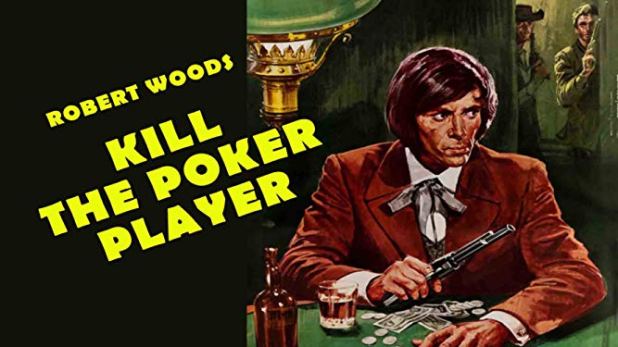
He’s played by Robert Woods, who was in all manner of Italian films like The Sinister Eyes of Dr. Orloff, Lucifera Demon Lover and His Name Was Sam Walbash, But They Call Him Amen.
A strange mix of genres, of course, but one that stands out in neither of them. Then again, I prefer my giallo to have jazzy music and mid-century modern furniture. But your mileage may vary.
You can watch this on Amazon Prime or on YouTube below.
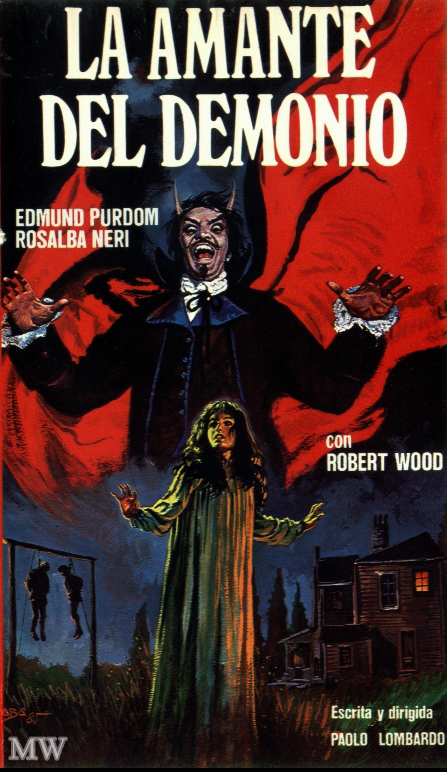
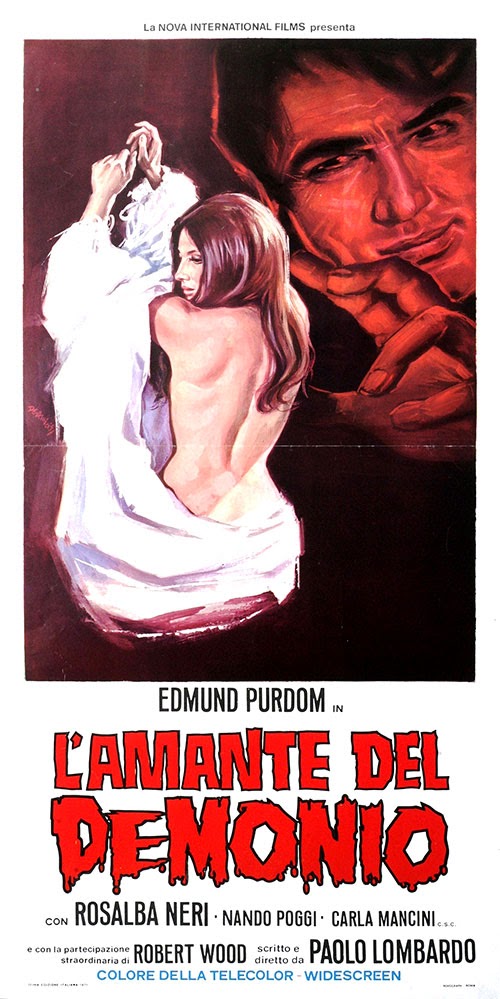
With a title like that, you might be forgiven if you expect The Devil Within Her or The Devil In Ms. Jones style antics here. Instead, this is a slightly erotic gothic romance.
In his book Italian Gothic Horror Films, 1970-1979, Roger Curti spoke to the cast and they really can’t get any of their facts straight. Rosalba Neri (Lady Frankenstein herself!) claimed that director Paolo Lombardo “couldn’t stay awake for more than two hours” and “looked as if he was near his end, from the way he walked and moved around. I think he must have been very ill…” That said, Lombardo was only 31 at the time that he made this movie.
To top that, Robert Woods (Kill the Poker Player) — who plays Helmuth in this film — claims that he was hired to finish the film and received no credit. While assistant director Marco Masi was adamant that Woods didn’t direct any of the film, he can’t remember anything about making it.
Edmund Purdom (Pieces) is also in here — as Satan — so if you’re trying to fill out your Edmund Purdom Letterboxd list like I am, you’re in luck.
Rosalba Neri’s is Helga, who takes her two girlfriends to visit a remote European castle that is supposedly owned by Satan himself. After she sees a painting that resembles her, she starts having visions of maniacs living in caves, vampires, the inquisition and a hooded swordsman who can vanish at will.
You’d think an Italian erotic horror film with Satan, zombies and Ms. Neri wouldn’t induce slumber. But man, how wrong you would be.
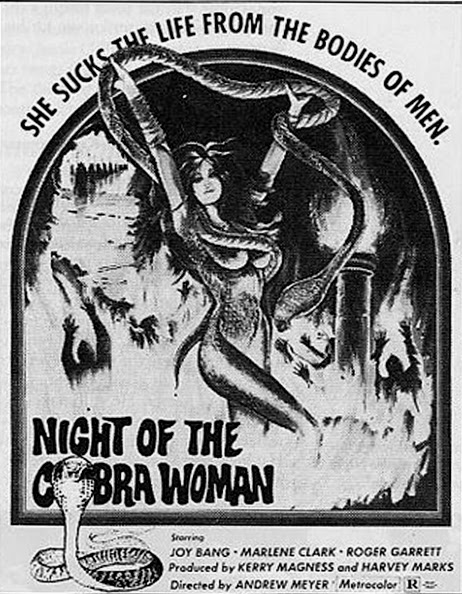
Roger Corman wasn’t happy with the end results of this film, which was shot in the Philippines, but man, he has no idea. This is my kind of insane movie, where a movie leaves his woman for, well, a cobra woman who keeps him alive by pimping out his native lover who draws venom from the men that she kills.
Andrew Meyer only wrote and directed one other film, The Sky Pirate, which is a shame because this movie is pretty much insane. It has snake murders, an air of filth and women ruining lives. Is there anything else you can put in a movie?
How about Joy Bang? You know and love her from Messiah of Evil and she’s here, looking gorgeous. She’s the former girlfriend of Stan Duff (Roger Garrett, who got a poultry infection while making this movie!), who has now found love in the arms of Lena (Marlene Clark from Ganja & Hess, Beware the Blob and Switchblade Sisters), the cobra woman herself.
Vic Diaz, who was Satan in Beast of the Yellow Night, also shows up. Quentin Tarantino would refer to Vic as the Peter Lorre of the Philippines, a title he earned in appearances in movies like Beyond Atlantis, Black Mama White Mama, Superbeast, Daughters of Satan and Raw Force.
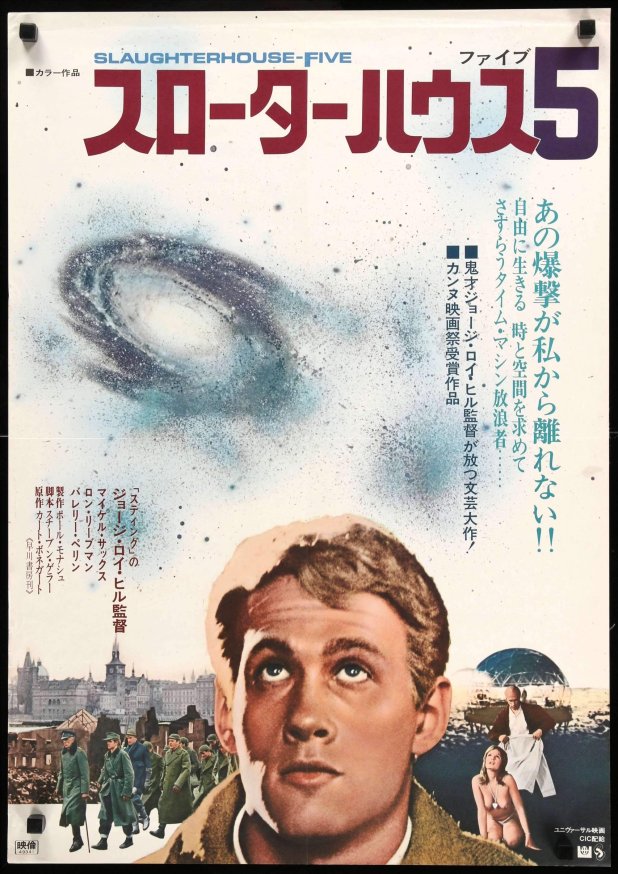
Based on Kurt Vonnegut’s classic 1969 novel, this tale of time travel and alien abduction finds Billy Pilgrim (Michael Sacks, The Sugarland Express, The Amityville Horror) finds himself unstuck in time. Traveling back and forth to random points within his existence, Pilgrim experiences his life in scattered fashion, such as what it was like to grow up, the firebombing of Dresden and a surreal adventure on a distant planet named Tralfamadore at some point in the future.
Praised by Vonnegut himself, Slaughterhouse-Five was directed by George Roy Hill (Butch Cassidy and the Sundance Kid, The Sting, Thoroughly Modern Millie). The author would say, “I love George Roy Hill and Universal Pictures, who made a flawless translation of my novel Slaughterhouse-Five to the silver screen. I drool and cackle every time I watch that film, because it is so harmonious with what I felt when I wrote the book.”
For horror fans, keep your eyes open for Gilmer McCormick as Lily Rumfoord (she played Sister Margaret in Silent Night, Deadly Night), Roberts Blossom as Wild Bob Cody (he was Ezra Cobb in Deranged and Old Man Marley in Home Alone), Sorrell Booke as Lionel Merble (he was in Devil Times Five as well as more famously playing Boss Hogg on The Dukes of Hazzard) and Kevin Conway as Roland Weary (he’s Conrad Straker the Funhouse Barker in The Funhouse).
Plus, Valerie Perrine plays the Hollywood starlet Montana Wildhack, along with Perry King (like I need an excuse to mention TV’s Riptide) and Holly Near (The Magic Garden of Stanley Sweetheart) as Pilgrim’s children.
Although Vonnegut’s renown refrain, “So it goes”, appears over a hundred times in the novel, it does not occur, even once, in the movie version. However, he did base the story on his own experiences as a prisoner of war during the Battle of the Bulge while a battalion scout with the 106 Infantry Division on December 22, 1944. Vonnegut also lived through the bombing of Dresden, an experience that informs the entire first part of this movie.
The character of Howard W. Campbell Jr. in this movie is also the subject of another Vonnegut novel which was turned into a movie, Mother Night. Nick Nolte played Campbell in that movie. Also, the character Elliot Rosewater, who Billy’s mom talks to in the hospital, is the title character in Vonnegut’s 1965 novel, God Bless You Mr. Rosewater, and would be played by Ken Hudson Campbell in 1999’s Breakfast of Champions.
This is a film that I’ve always wanted to see, so I really appreciated the opportunity that the new Arrow Video release afforded me.
Their new blu ray release features a brand new 4K restoration from the original camera negative, produced by Arrow Video exclusively for this release. Plus, you get audio commentary by author and critic Troy Howarth, an appreciation from author and critic Kim Newman and interviews from Perry King, Rocky Lang, Robert Crawford, Jr. and film music historian Daniel Schweiger. Obviously, Arrow puts astounding care into everything they release and this is no different. You can order it right here.
DISCLAIMER: This movie was sent to us by Arrow Video.
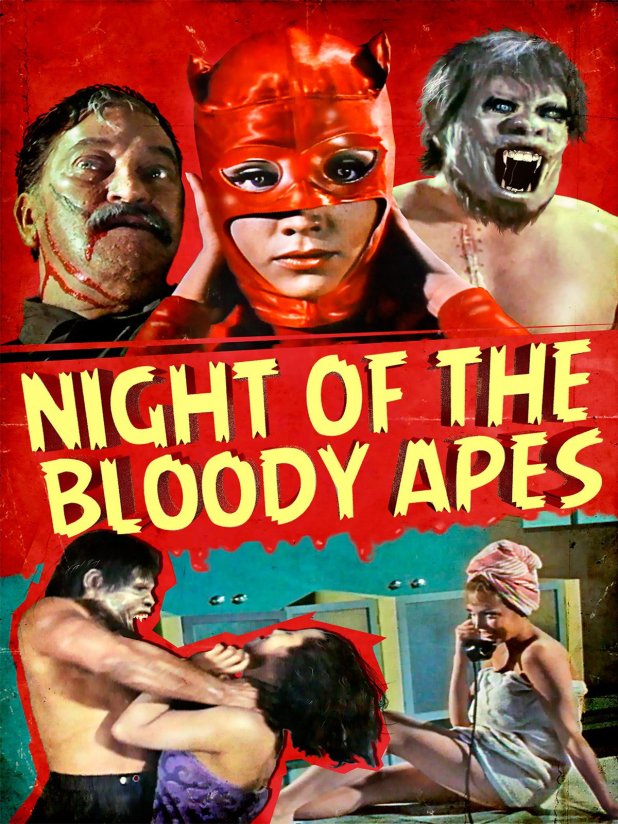
Oh René Cardona. Here you are remaking the lucha libre movie you did back in 1962, Las Luchadoras Contra el Medico Asesino, or The Wrestling Women vs. the Killer Doctor or Doctor of Doom, as it was called in the U.S.
While this was made in 1969 as La Horripilante Bestia Humana, or The Horrible Man-Beast, this one didn’t play in the U.S. until 1972. With alternate titles like Horror y Sexo and Gomar – The Human Gorilla, this is a fine blend of ladies wrestling with apes and, well, human heart surgery footage.
Rene is also known for his films Wrestling Women vs. the Aztec Mummy, the incredibly baffling Santa Clausand Survive!, a movie all about plane crashes and cannibalism.
Female masked wrestler Lucy dresses like the devil and wrestles at the arena — dare we say Arena Mexico? — every Friday, where she often knocks out other girls who dress like cat girls. She wants to retire for a life of leisure — and less stress — with her cop boyfriend.
However, Dr. Krellman (Jose Elias Moreno, who was Santa Claus in the aforementioned film where he battles Patch the demon) wants to cure his son from leukemia. So he does what doctors have always said would work — he puts him a gorilla heart inside his boy. As we all know from health class, this turns his son into a deformed and murderous man-ape with the craziness of the organ donor to boot.
You won’t be bored, what with the nudity, real open heart surgery and rampant murders. A monkey man that rips off dudes’ faces and the clothes of girls? Si, muchacho.
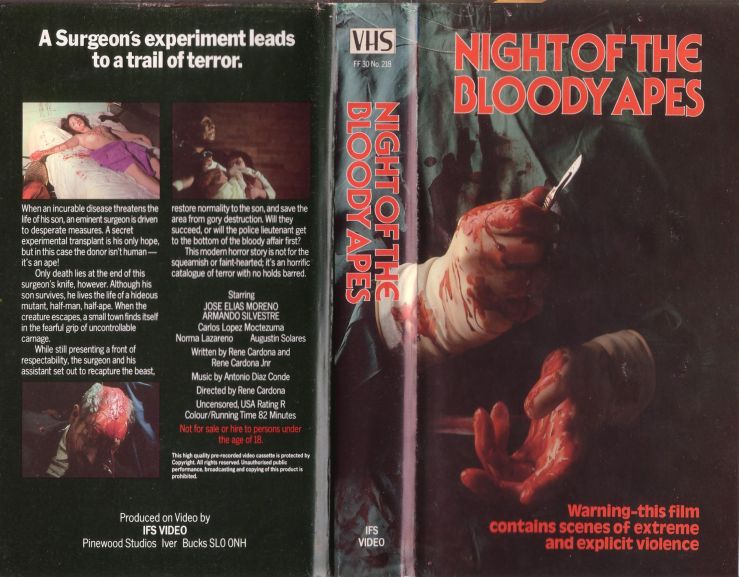
This made the Section 1 video nasties list, probably because its VHS cover art was had a bloody surgeon’s hands holding a scalpel with the words “Warning: this film contains scenes of extreme and explicit violence.”
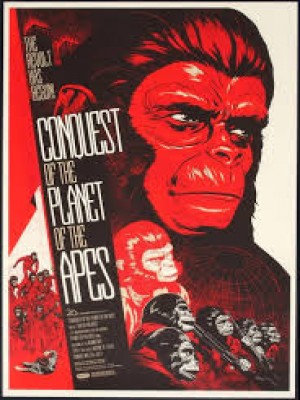
J. Lee Thompson had wanted to be involved with Planet of the Apes since the original film, but scheduling conflicts had kept that from happening. For this, the fourth film in the series, he shot much of the film like a news broadcast, influenced by the many civil rights changes over the past few years.
Screenwriter Paul Dehn thought that this would be the last movie in the series and saw this as the closing of the circle that began with the first movie. For inspiration, he also went back to the original novel, where apes took over as pets.
After a 1983 pandemic that wiped out all dogs and cats, humanity has taken on apes as slave labor. In fact, if it feels like slavery, that’s kind of the intention of the film. By 1991, the world has almost become a police state, which was foretold in 1973 when Cornelius and Zira came back in time.
However, their son Milo — now Caesar and played by Roddy McDowall — has evaded capture by being raised by Armando (Ricardo Montalban, returning from the last film) as a horseback riding performer. Almost a father to the young ape, Armando warns Caesar not to be upset at what he’s sees and definitely not to speak. However, the young ape can’t contain his anger.
While his “father” goes to jail, Caesar is sold into slavery and bought by Governor Breck (Don Murray, Bus Stop), where he is put to work by the African-American chief aide MacDonald (Hari Rhodes, Detroit 9000), who is against the slavery of the apes.
Armando is interrogated by Inspector Kolp (Severn Darden, who would help form Second City and was also in Saturday the 14thand comes back for the next Apes film), whose machine The Authenticator can get out any truth. Rather than cause the death of his son, Armando leaps out a window to his death.
Caesar loses faith in humanity and begins to teach the apes how to fight. He’s even captured and nearly killed — MacDonald saves his life — before escaping and inciting his revolution. He sets fire to most of the city and his apes murder nearly every cop that tries to fight them. He marches into Breck’s command post, kills nearly everyone and marches the leader out to be killed.
MacDonald begs Caesar not to become as bad as humanity and asks hm to spare his former master. Caesar howls back: “Where there is fire, there is smoke. And in that smoke, from this day forward, my people will crouch, and conspire, and plot, and plan for the inevitable day of Man’s downfall. The day when he finally and self-destructively turns his weapons against his own kind. The day of the writing in the sky, when your cities lie buried under radioactive rubble! When the sea is a dead sea, and the land is a wasteland out of which I will lead my people from their captivity! And we shall build our own cities, in which there will be no place for humans except to serve our ends! And we shall found our own armies, our own religion, our own dynasty! And that day is upon you NOW!”
This is where the movie splits, depending on what version you watch.
In the theatrical version, as the apes raise their rifles to kill Breck, Caesar’s girlfriend Lisa becomes the first ape other than our hero to speak, yelling “No!” The apes lower their weapons as Caesar says, “But now… now we will put away our hatred. Now we will put down our weapons. We have passed through the night of the fires, and those who were our masters are now our servants. And we, who are not human, can afford to be humane. Destiny is the will of God, and if it is Man’s destiny to be dominated, it is God’s will that he be dominated with compassion, and understanding. So, cast out your vengeance. Tonight, we have seen the birth of the Planet of the Apes!”
After a negatively recieved preview screening, the producers reworked the film, even though they did not have the budget to do so. After all, this film had the smallest budget of any of the Apes films.
Seriously, this was made on the cheap. The jumpsuits worn by the apes saved on the cost of fake fur and were leftover costumes from Voyage to the Bottom of the Sea. Other props and sets came from The Time Tunnel, City Beneath the Sea and Land of the Giants. Finally, Breck’s throne at the ape auction came from Taylor’s spaceship in the original film.
After all, the Apes were keeping 20th Century Fox in business after flops like Cleopatra, Star! and Hello, Dolly! They kept doing so even with lower and lower budgets.
So how did they accomplish this new ending? Roddy McDowall looped in a new speech, which was done through editing tricks — notie that you only see Caesar’s eyes — and the guns are raised back up by playing the footage backward. The blu ray release of this has both endings. Obviously, I prefer the one where the humans get what they deserve.
This is the only film from the original Planet of the Apes series without a pre-title sequence. That’s because that scene — where a night patrol kills an ape and learns that his body showed signs of abuse — was too much for the MPAA. All of the other movies had been rated G, after all. So this scene — and several others that were quite bloody — were all axed.
As we wrote about back when we covered Dream No Evil, John Hayes began his career producing and directing short subjects and even appeared an actor in movies like The Shaggy D.A. and his own End of the World.
The movies he directed included The Grass Eater, Five Minutes to Love, the incredibly named Jailbait Babysitter, the adult movies Pleasure Zone and Hot Lunch, and even more crazily titled movies like All the Lovin’ Kinfolk and Up Yours – A Rockin’ Comedy.
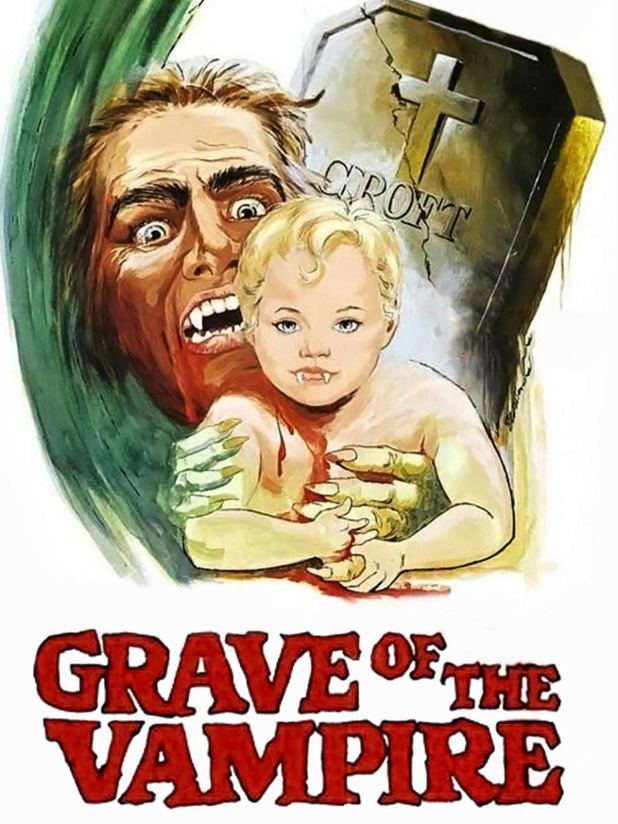
This is probably his best known film. It starts with a warning if you’re worried about watching baby vampires drink blood. With that, you know that you’re in for something completely bonkers.
Years after his death by electrocution in the late 1930s, Caleb Croft (Michael Pataki!) rises from his grave as a vampire, where he’s a brutal and completely unromantic bloodsucker. After assaulting Leslie Hollander, she becomes pregnant with his son, who grows up to be James Eastman (William Smith, who played Conan’s father in the original Arnold version).
His goal in life is find and kill his diabolical father while repressing the vampiric bloodlust that is his birthright. Now, daddy is known as Professor Lockwood, a much more refined version of the murderous beast we saw before. He teaches an occult class and one night, after he hosts a seance, James and his dad finally throw down.
This movie presents a very modern take on the vampire. Well, as of 1972 modern, that is. It’s definitely not the suave and sophisticated vampires that the world had come to know thanks to Lugosi and Lee.
If you don’t have the Pure Terror set, you can watch this one for free on Amazon Prime. Or you can go for the bloody gusto with the Scream Factory blu ray.
ABOUT THE AUTHOR: Bill Van Ryn is the man behind the website Groovy Doom and the zine Drive-In Asylum. You should grab an issue after reading this.
Independent regional production Enter the Devil was shot in Texas by producer/director Frank Q. Dobbs, who made four regional theatrical releases (one of them a hardcore porn flick titled The California Connection) before moving to a more prolific career in TV production.Don’t confuse it with 1974 Italian Exorcist cash-in L’Osessa, which was also known as Enter the Devil in various territories. This movie belongs squarely alongside low budget devil cult opuses like Race with the Devil and The Devil’s Rain instead of possession flicks.
A motorist traveling through the desert is victimized when his tire is shot out by an unseen person. Finding his spare tire flat, the guy hitches a ride with a guy in a pickup truck, only to end up flat on his back on a Satanic altar, surrounded by a large group of hooded figures carrying torches, who sacrifice him with a large cruciform knife. It’s safe to say the locals are pretty weird there.
The sheriff sends his deputy, Jase (David S. Cass Sr.), to investigate the man’s disappearance, and not too long afterwards, a couple of hunters find the missing guy’s car all burned out, his charred remains behind the wheel. Jase is a textbook example of an arrogant prick, behaving rudely to a gas station attendant and just about everyone else in the film, too. He stays at a lodge run by acquaintance Glen (Josh Bryant), currently hosting a group of obnoxious deer hunters who make unwanted sexual advances to Glen’s Mexican employee, Maria (Linda Rascoe). One guy in particular gets a little too eager and tries to rape Maria after cornering her in an isolated part of the lodge. Maria is rescued by her cousin, a scary Mexican dude (Norris Domingue) with a badass mustache, and we’re not too surprised when the would-be rapist ends up kidnapped by the hooded cult and thrown into a pit full of rattlesnakes.
Maria isn’t our damsel in distress, however — she clearly knows something about the shady shenanigans going on in the area — and from nowhere comes Leslie (Irene Kelly), an anthropologist who wants to study the existence of a Christian cult rumored to be in the area. Glen moves in on her and easily invites himself into her cabin for a night of lovemaking, but we the viewers know she’s on a collision course with the Disciples of Death.
At 75 minutes, Enter the Devil doesn’t ask too much of your time, and it’s a fairly economical thriller, if a little routine. When it comes time for the hooded cultists to reveal their identities, we’re not surprised to find out that they’re the silent Mexicans who work for Glen and also in the local mine, but there’s at least one face among them that may come as a surprise to those of you who haven’t been paying close attention. There are a few well directed chase scenes, and the action inside the caves is very atmospheric. This is a PG-rated thing, so there’s no significant flesh on display or gory money shots. Can we talk about the sets, though? This movie looks more like a Western than anything else, with vast desert expanses, a dusty ghost town vibe, and spooky mines. There’s even a scene where someone is threatened by a runaway mine cart. There are a few scenes set inside the lodge cabins, which have a total late 60s shag carpet look, and I was ready to book a reservation.
Seekers of sex and violence may be a little disappointed by how tame the film is. Cass appears in nothing but his tightie whities all of a sudden, but nobody’s naked in this one, and the Satanists aren’t intent on sacrificing any nude virgins. There is a rather horrible moment when a female victim is burned alive after being bound with barbed wire, and her body darkens horribly in the flames. That charred corpse in the beginning of the movie is pretty gruesome as well, reminding me of what happened to poor Ben Tramer in Halloween II.It’s interesting to note that Byron Quisenberry, director of the ultra low budget Scream from 1981, did the stunts in this film and also appears as a character.
Leading lady Wanda Hendrix, a contract player in the ‘40s and ‘50s with Warner Bros. and Paramount, is best known to film historians for her marriage to WWII war hero-turned-actor Audie Murphy. The storybook marriage—on which the ‘50s gossip sheets thrived—was over in seven months; the controversy surrounding the marriage—Audie’s wartime PDST issues caused outbreaks of marital violence—instigated irreparable harm to Hendrix’s career from which she never recovered.
As did ‘40s starlet Veronica Lake, Hendrix made guest appearance on television series during the ‘60s, and then moved into horror films. While Lake made her final bow with Flesh Feast (1970) and Joan Crawford appeared in Trog (1970), Hendrix closed out her career at the age of 44 with this Gothic, Civil War tale originally released as The Oval Portrait.
Based on the Edgar Allen Poe short-story, this minor “old dark house” flick concerns a woman, Lisa Buckingham (Hendrix), who attends the reading of a will at her uncle’s home. She soon becomes “possessed” by the soul her cousin Rebecca, depicted—and trapped—inside an oil portrait.
While this meanders with a slowly unfolding plot awash in muddy cinematography (Are the prints bad or was the director attempting to achieve an “atmosphere”?), this Mexican shot and directed tale by Rogelio A. Gonzàlez has a José Mojica Marins-influence crossed with Mario Bava-styled horrors (Bava’s Lisa and the Devil comes to mind with its aristocrats dealing with the supernatural and necrophilia) as Lisa’s newfound behaviors—such as finding and wearing Rebecca’s old clothes—cause her cousin, Rebecca’s widow, Joseph, to go off the deep end and dig up Rebecca’s crumbly corpse for a little ballroom dance n’ romance.
Is Rebecca back from the dead for revenge? Is Lisa caught in a Let’s Scare Jessica to Death-inspired drive-her-crazy-for-the-money plot? Is the creepy, Paul Naschy-esque red-herring housekeeper giving Joseph the ol’ Henry James screw turn?
Released in the wake George Romero’s Night of the Living Dead—when horror was “hot” again—Wanda Hendrix was hoping for a big horror hit to revitalize her career. It wasn’t meant to be: three times divorced and childless, she died of double pneumonia at the age of 52 in 1981.
About the Author: You can read the music and film criticisms of R.D Francis on Medium and learn more about his rock ‘n’ roll biographies, along with horror and sci-fi novellas, on Facebook. He also writes for B&S About Movies.
Vampires, cannibalism, graveyards, nudity, and gore. Oh, my! Vampires, cannibalism, graveyards, nudity, and gore. Oh, my! I’m confused. What’s going on? Who is that? Oh, my! Why is there no apostrophe before the “s” my dear, Dorothy? Because there’s more than one vampire, can’t you see? So, doesn’t the “Night Orgy” belong to the vampires many; There should be an apostrophe after the “s” I do believe. You’re over analyzing the film, R.D; Just turn your neck so I can feed, as Punctuation lessons are not part of my blood cult’s creed. I know, Helga, my dear; You’re sick and tired of my pseudo Dr. Seuss poetry. Yes, R.D, you are a dumbass film dweeb. I’ll shut my mouth; Click your heels, dear Helga; Let’s slop across this bloody brick road. We’re off to see the Blood Countess . . . The wonderful Blood Countess of the Night Orgy Oz!
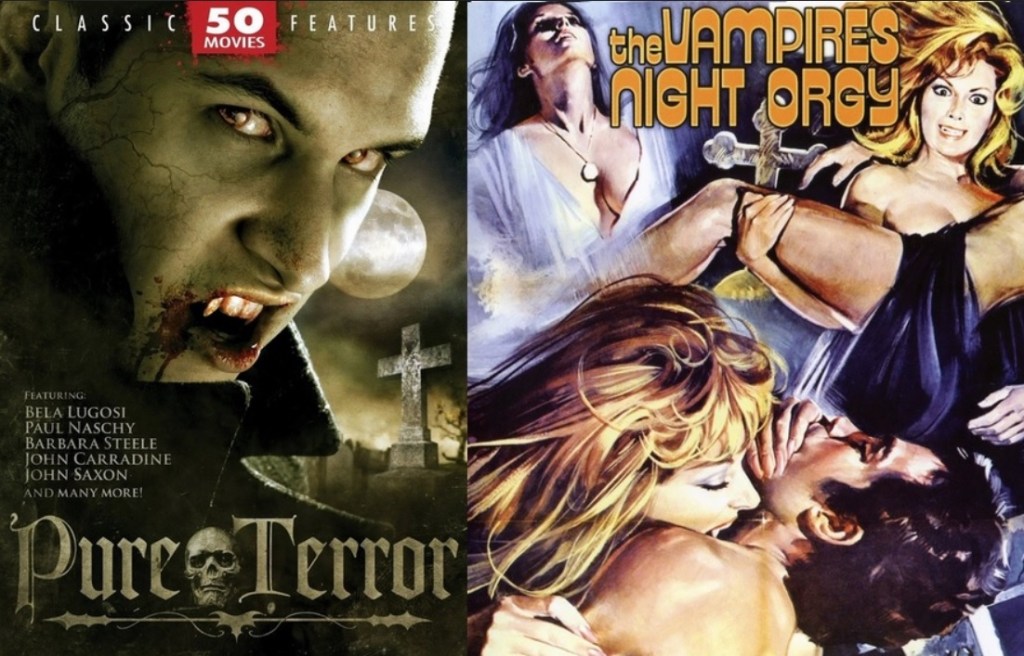
Now we’re talking. A film with the words “Vampires” and “Orgy” and a Paul Naschy connection! Look at that DVD cover. You got two semi-breast shots. You got one hot vamp-babe carrying a woman and another vamp-babe goin’ down on a guy’s neck!
Is this one of those rare occasions when the cheesy art work lives up to the film? Eh, sort of. It depends on which cut of the film you’re seeing. You know how it goes with American TV and video distributors: they never want us Euro-horror lovin’ horndogs have any fun!
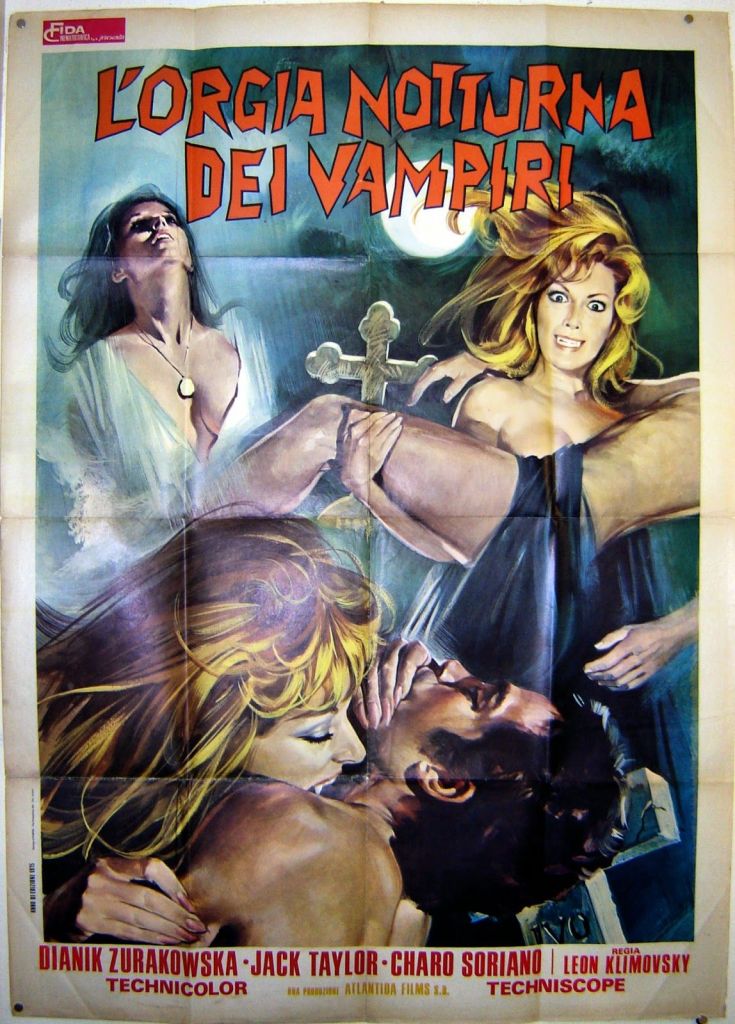
The Naschy connection comes in two forms: First, we have heart-melting Belgian actress Dyanik Zurakowska from his Mark of the Wolfman (1968) and The Hanging Woman (1973) as a vamp-victim (she’s starred in 40 films, so you better get to a-rentin’!). Then we have Naschy’s long-time collaborator, León Klimovsky, who directs this dripping-with-atmosphere tale.
We’ve got two Juan Logar alumni: American expatriate actor Jack Taylor of Autopsia (1973) and Jose Guardiola of Transplant of a Brain (1970).
Then we’ve got Maria Jose Cantudo of Paul Naschy’s Horror Rises from the Tomb (1973), Amando de Ossorio’s “Blind Dead” sequel, The Ghost Galleon (1974), Jess Franco’s Count Dracula (1970; with Christopher Lee, Klaus Kinksi and Herbert Lom), and Klimovsky and Naschy’s Universal tribute, Dr. Jekyll vs. The Wolfman (1972). Maria also went full frontal in Franco’s hardcore-porn vamp-romp, Bare Breasted Countess (1975).
And there’s Luis Ciges of Naschy and Carlos Aured’s Blue Eyes of the Broken Doll(1974) and Horror Rises from the Tomb, along with Klimovsky and Naschy’s Vengeance of the Zombies (1973). Along with Helga Liné, Ciges was also in Klimovsky’s The Dracula Saga (1973).
Rounding out the cast is Manual de Blas of The Ghost Galleon and Paul Naschy’s Hunchback of the Morgue (1973), along with Charo Soriano from The Garden of Delights (1970), and Fernando Bilbao from de Ossorio’s Fangs of the Living Dead (1968) and Franco’s Dracula, Prisoner of Frankenstein (1972).
And . . . sigh! Dear Lord, be still my heart and hold steady my tender loins as the star of this Spanish vamp festival is Helga Liné (Eugenio Martin’s Horror Express; 1972) as the rich bitch blood countess-vampire queen of the hive. (I’m bending my head to expose my neck now, Helga!)
And with this cast—led by Helga—who needs continuity or logic?
As is the case with most Spanish horror films of the period: Two versions of La orgía nocturna de los vampires were shot: one with actors clothed and one with nudity. The clothed version was mostly for Spanish distribution while the nude version played in the rest of Europe—and the clothed ones (with more edit-killing continuity) ended up on U.S TV in the ‘70s and VHS video in the ‘80s—and appears in this Mill Creek cut (and most of the econo-friendly box sets).
Regardless of the “orgy” and the implied “gore,” there isn’t much gore and the nudity is only in three scenes—and the “orgies” are so-so. When the gore comes, it’s effective; but what The Vampires Night Orgy does have, as do all of the what-the-fuck-is-going-on shenanigans of Spanish horror films: lots of atmosphere.
And not a lot of sense: The “churchless” town is deserted, but there plenty of clean beds and the booze flows plentiful at the local tavern. But it’s the “afterworld” and the devil or a connected blood countess can make “things appear,” right? And while there’s booze, there no meat to serve the tourists to keep ‘em fat and happy. So the vamps hospitality-string along any stranded tourists that happen by, suck them dry, serve the leftovers to the survivors, then suck another one, etc., and so one. And Helga gets first choice: always. In one scene: she plugs a horn dog, sucks ‘em, then tosses the meat out the second floor window to the fanged hoards below. (Bitch be crazy! Helga I’m ready for my window toss!)
To place this film into a contemporary context with a film you’ve more likely heard of or seen: 30 Days of Night, only with its vampire town in the Carpathian Mountains run by Helga as a bus load of six tourists take the obligatory “wrong turn” and end up in the uninhabited town of Tonia, Transylvania—where the vamps are more cannibals than vamps and attack in Lucio Fulci-style, zombie wolf packs. And that pack is in full force when Jack Taylor (Luis) and Dyanik Zurakowska (Alma) barley make it out with their blood intact in an escape-by-chased car scenario. When they arrive safely in Bojoni, the town of their original destination before their detour, the superstitious townspeople pull the ‘ol Hershell Gordon LewisTwo Thousand Maniacs dues ex machina on them: there is no such town. Huh? So the vamps weren’t “vamps,” they were the ghost of vamps? Denied! What the fuck is going on here!
Eh, screw continuity. Screw logic. Screw the perpetual stupidity of the tourists. People are vanishing and dying, yet the little daughter of one is allowed to prance in the mountains and run in a graveyard with a ghost boy? Screw it. Screw the dubbing that rivals the worst in Asian cinema. Screw it. Follow the Red Brick Road to Madrid . . . Helga Liné is at the end of the line.
She’s the Wicked Witch of My West and so help me god, trust me, you’ll enjoy every bite. It’s a wonderful Spanish Oz.
About the Author: You can learn more about the work of R.D Francis on Facebook.He also writers for B&S About Movies.



 B&S About Movies
You must be logged in to post a comment.