Two for the Money (1972)

Thanks for joining us as we wrap up our second day of our three-day tribute to all things Bernard L. Kowalski!

He had to go through Roger Corman with Hot Car Girl, Attack of the Giant Leeches, and Night of the Blood Beast, then do TV series for the rest of the ’60s to get his shot at the major studio brass ring with Krakatoa: East of Java and Stiletto. But both of those films — as well as the David Janssen-starring western Macho Callahan — flopped at the box office, so it was back to TV for Bernard L. Kowalski. However, instead of the TV series of the ’60s, he now was in the TV movie business, in which he gave us Terror in the Sky, Black Noon, and Women in Chains. For his fourth TV movie, Kowalksi directed this script by TV series and TV movie scribe Howard Rodman (best known for the series Route 66 and the later Harry O, also the TV sci-fi flicks Exo-Man and the first Six Million Dollar Man TV movie). Was this a TV movie pilot film? Yep, you bet.
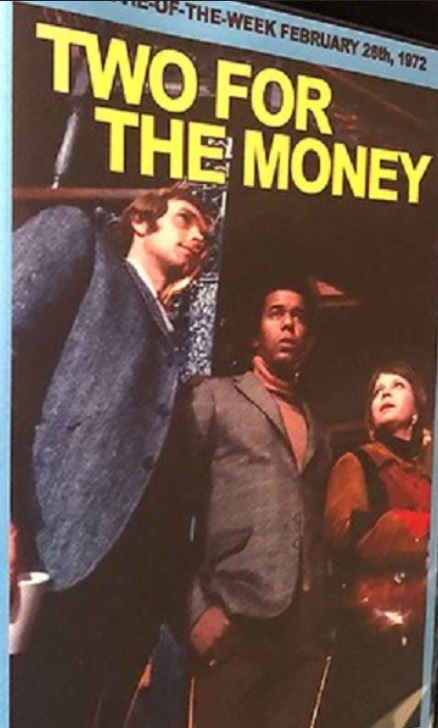
If you spent any time in front of the TV watching reruns of series from the ’60s and ’70s, and even into the ’90s, you’ll notice character actors Robert Hooks and Steven Brooks as our two cops who quit the police department to become private detectives — and come to hunt down a serial killer who has eluded the law for years. And they’re against the clock because notable western character actor Walter Brennan (John Wayne’s Rio Bravo) is out for vigilante justice to avenge the murder of a family member by the killer. And the always welcomed character actor-ness of Neville Brand as a racist, small town sheriff isn’t helping matters.

Yep, that is Richard Dreyfuss (Two Bernard L. Kolwaski flicks with future Jaws stars? Roy Scheider was in Stiletto, remember?) starting out his career. And that is the voice of the devil, Mercedes “Pazuzu” McCambridge, from The Exorcist. (Plot spoiler: she’s the killer and she’s off-the-hinges-great here; not that you don’t see that plot twist coming.) Also be on the lookout for Oscar actors Anne Revere (Supporting Actress winner for National Velvet) and her “sister” Catherine Burns (Supporting Actress nominee for Last Summer). Shelley Fabares, who did her share of car racing and Elvis flicks*, is the town’s pretty librarian girlfriend of Brooks that’s caught the creepy eye of Brand.

You can watch Two for the Money on You Tube. Grey market DVDs are easily available. It’s not that bad of TV movie thriller. Definitely not engaging TV series material in the manner of say, Starsky and Hutch (gotta go watch The Supercops from 1974 with my youth-buddy, Ron Leibman), but a serviceable TV flick, none the less.

* Of course we did all off the King’s — well, all three — racing flicks. What ensuing, trope-laden cliched movie site did you think your were surfing, here? Check out our “Drive-In Friday: Elvis Racing Nite” feature.

About the Author: You can learn more about the writings of R.D Francis on Facebook. He also writes for B&S About Movies.
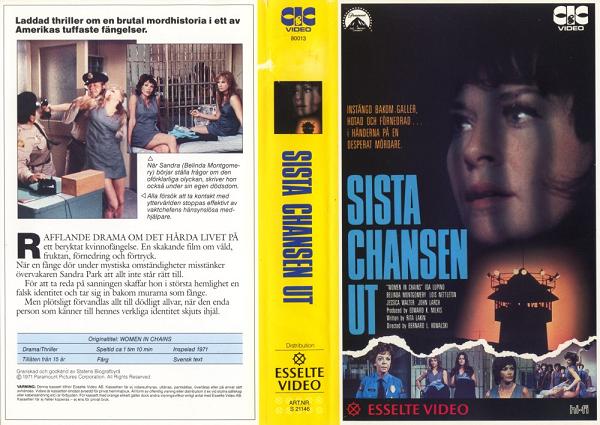
Women In Chains (1972)

The ABC Movie of the Week for January 25, 1972, Women In Chains brings Ida Lupino to TV for her first made-for-TV movie, as well as bringing her back to the WIP genre that she made such a mark on with 1955’s Women’s Prison.

She plays prison guard Claire Tyson (Ida Lupino), a woman who can get away with anything that she wants to, as long as its within the prison walls. Parole officer Sandra Parker (Lois Nettleton, who was on the TV series form of In the Heat of the Night) gets the idea to make herself over as junkie Sally Porter to the protests of Assistant District Attorney Helen Anderson (Penny Fuller).

Helen is the only one who knows about this undercover work, but when she’s shot and killed by the boyfriend of one of her cases our heroine is stuck in the big house. Her goal is to save an innocent girl named Lemina (Belinda Montgomery, Dooger Hauser’s mom) but she runs into Tyson’s henchwoman Leila (BarBara Luna, who was in the “Mirror, Mirror” episode of the original Star Trek). After asking so many questions, the word comes down. Helen/Sally is going to get killed, so she makes a daring escape that brings her directly into physical combat with Tyson.

Written by Rita Lakin (who wrote 464 episodes, eight movies of the week and two miniseries in her career, as well as the  Gladdy Gold Mystery book series) and directed by Bernard L. Kowalski (Night of the Blood BeastSssssss), don’t go into this movie expecting the normal WIP hallmarks. After all, this aired on broadcast TV. That doesn’t make this a bad film, however.

You can watch this on YouTube.

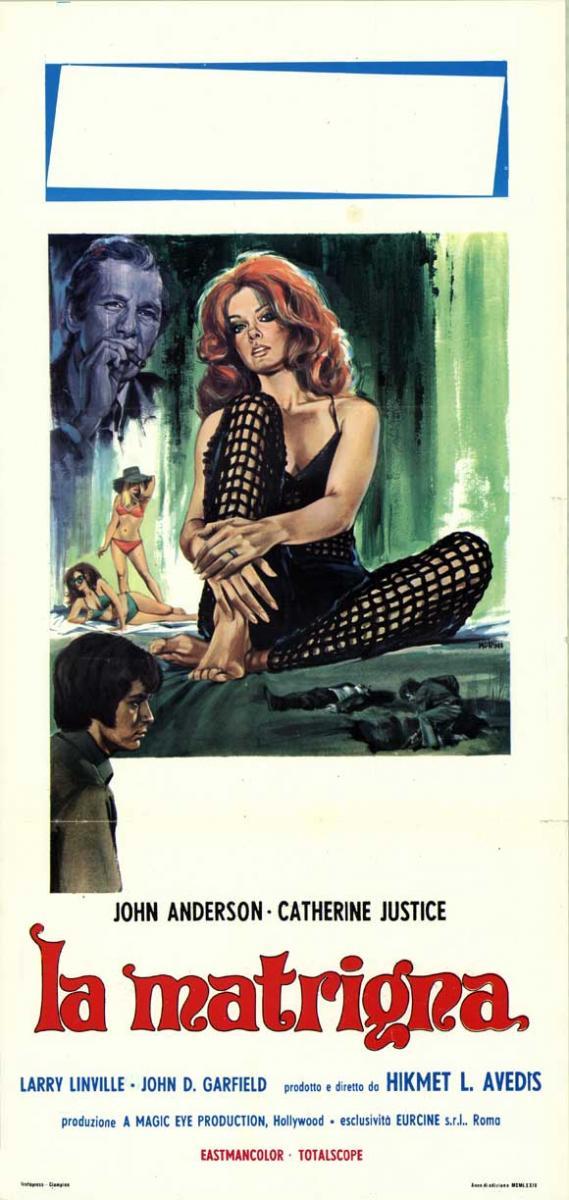
The Stepmother (1972)

Hikmet Labib Avedis may not be considered one of the best directors of all time, but he should be known as one of the most entertaining. Throughout his films, I’m never anything but into the story and wondering what happens next.

Take The Stepmother, a film which prefigures the adult world of today by presenting the story of, well, exactly what you think a stepmother is going to do. Just take a look at the tagline: “She forced her husband’s son to commit the ultimate sin!”

Architect Frank Delgado (Alejandro Rey, TerrorVision) returns home to find the car of his client Alan Richmond (Mike Kulcsar, Raise the Titanic!) in the driveway. Thinking that his wife Margo (Katherine Justice) is having an affair, he follows the man home and strangles him, then buries him at the beach.

But now, he’s taken a whole group of people — his business partner Dick (Larry Linville!) and his wife Sonya (Marlene Schmidt, Miss Universe 1961, who was also Avedis’ wife), as well as porn director Goof (David Garfield) and his wife Rita (Claudia Jennings! — to the home of the man he just killed.

Of course, all manner of shenanigans ensue, but the movie never goes as far as you’d expect a 70s exploitation movie to go. Trust me, Avedis would eventually find his way to better work, but hey, we should all be so lucky to watch Claudia Jennings in a movie.

Despite this being a drive-in film, composer Sammy Fain and lyricist Paul Francis Webster were nominated for the Academy Award for Best Original Song for “Strange Are the Ways of Love.”

Drag Racing Week: Wheels of Fire (1972)

Image Courtesy of Vectezzy.

Not to be confused (and it is) with the Wheels on Fire drag-doc made in Australia, this U.S. documentary focuses on the lives of five major drag racers of the era: Don Garlits, Don Prudhomme (Snake & Mongoose), Shirley Muldowney (Heart Like a Wheel), Richard Tharp and Billy Meyer, as they are each followed through a complete drag racing season. Yep. This is reality TV before Robert Kardashian had his first kid (I think; too lazy to check K-Dash B-Days), the very same kids who unleashed the ubiquitously-hated broadcasting format.

Don “The Snake” Prudhomme and Tom “The Mongoose” McEwen were gods to us kids in the ’70s. When the ABC Wild World of Sports held one of Prudhomme and McEwen’s drag or funny car races on a Saturday afternoon, the neighborhood streets cleared and everyone sat in front of the TV. The Snake and Mongoose were matched pnly by Richard Petty and Evel Knievel. They were the “Muhammad Ali” of racing. Everyone loved them.

As with the oft-confused Wheels on Fire, there’s no online streams of this lost, classic drag racing film. It was on You Tube in several parts, but was removed. Only this 10:00 minute clip is available, which we’re posting in lieu of an official trailer (. . . and don’t be surprised if this clip also vanishes to grey screen; yep, it’s gone). The now out-of-print DVDs are available in the online marketplace from time to time (and, as you can see, it’s impossible to find a decent theatrical one-sheet). The NHRA web platform and their upper-tier cable channel rerun it from time to time.

We featured this film as part of our “Drive-In Friday” tribute to drag racing documentaries.

About the Author: You can learn more about the writings of R.D Francis on Facebook. He also writes for B&S About Movies.
Drag Racing Week: Drag Racer (1972)

Editor’s Note: This review ran on December 12, 2020. We’re bringing it back for our tribute week to the funny cars and rails of drag racing of the ’60s and ’70s

Image Courtesy of Vecteezy.

“(A) versatile and underrated B-movie Renaissance man.”
— IMDb, about actor-director John “Bud” Carlos.

That’s the understatement of the century, ye IMDb database scribe. Look at that short — but hit-packed director’s resume: Kingdom of the Spiders (we need to review that one!), The Dark! The Day Time Ended! Mutant! Gor II: Outlaw of Gor! (well, they’re hits for the B&S About Movies crowd). Then there’s Bud’s cable and VHS potboilers that star friggin’ Ernest Borginine, Robert Vaughn, Oliver Reed, and Herbert Lom in the same friggin’ movie: Skeleton Coast (1988), and Act of Piracy (1988) with Gary Busey and Ray Sharkey kicking ass. Then there’s Bud’s acting resume with Al Adamson and the films Hells Angels on Wheels (1967), Psych-Out (1968), The Road Hustlers (1968), The Savage Seven (1968), Killers Three (1968; starring Merle Haggard and a very young Lane Caudell of 2020’s Getaway), Blood of Dracula’s Castle (1969), Satan’s Sadists (1969), Five Bloody Graves (1969), and Hell’s Bloody Devils (1970).

After entering the annals of Bikerdom with his third acting gig in Hells Angels on Wheels (he had support roles in 1965’s Deadwood ’76 and Run Home, Slow), and paying attention on all of those Al Adamson sets and Roger Corman AIP productions, Bud Carlos transistion behind the lens for the blaxploitation-spaghetti western (Uh, oh. Here we go again with the genre mixin’: Hey! Harry Hope and Harry Tampa of Smokey and the Judge and Nocturna fame, hiya!) with The Red, White, and the Blue, aka Soul Soldier (1970).

And the burgeoning, becoming “hot” and “trendy” drag racing genre was next on Bud’s resume with the youth-oriented (as were all of the ’60s racin’ flicks that simply substituted asphalt for sand) action-drama starring John Davis Chandler?

“Who?”

Seriously? The dude is iconic in a Richard Lynch-amazing kind of way.

John Davis Chandler January 28, 1935 – February 16, 2010

Now do you know him?

Let’s not even get into his extensive ’60s and ’70s television resume . . . just look at the movies: John Frankeheimer’s The Young Savages (1961; a more violent The Blackboard Jungle, if you will) with Burt Lancaster. Sam Peckinpah’s Pat Garrett & Billy the Kid (1973) with Kris Kristofferson, James Coburn, and Richard Jaeckel. Clint Eastwood’s The Outlaw Josie Wales (1976). Across 100-plus credits, JDC was everywhere, and he was nowhere. No truer “dark man” actor was he.

Courtesy of NHRA.com

Here, John Davis Chandler stars alongside Jeremy Slate (Do we really need to get into is resume?) and beach-snow flick bunny mainstay Deborah Walley in this not-a-Frankie-Avalon-Fabian racing flick that stars Mark Slade alongside (as you can see by the drive-in flyer, above) the nation’s top drag racers. (Mark has too many ’60s and ’70s TV series to mention, but by 1967, starred for three years on The High Chaparral; before that, the McHale’s Navy rip, The Wackiest Ship in the Army; he got his start as co-star on Gomer Pyle: USMC.)

Drag Racer is simple tale: Mark Slade is a young man who dreams of tearin’ down the quarter mile with the big dogs that, while it has (it must have) romance, there very little of that dramatic yakity-yak that bogged down the likes of Red Line 7000, Thunder Alley, and The Wild Racers. As with David Cronenberg’s lone non-horror film, Fast Company, Drag Racer is about gritty realism that puts the actors into the pits to mix it up with the real racers (Bill Schultz, John Lombardo, Norm Wilcox, and Larry Dixon) at famed West Coast racetracks Irwindale Raceway, Lions Drag Strip, and Orange County Int’l Raceway.

Is the acting a bit rough in spots? Is the editing and cinematography amateurish? Sure. (It adds to the film’s realistic, documentary quality.) This is one of those films that was once embraced by UHF-TV in the early ’70s (watched it twice), temporarily embraced on VHS (watched it once), then jettisoned. Considering Bud Carlos’s pedigree, this one — is in desperate need — of a full restoration (and not just a rip n’ burn) to DVD. Hint! Kino Lorber, Arrow Video?

This is a classic must-watch for racing fans — even with a muddy, washed-out blurred print. It really is one of the best drag flicks out there. And whadda ya’ know: You Tube comes through again — and with a VHS and not a TV rip! Sweet!

About the Author: You can learn more about the writings of R.D Francis on Facebook. He also writes for B&S About Movies.

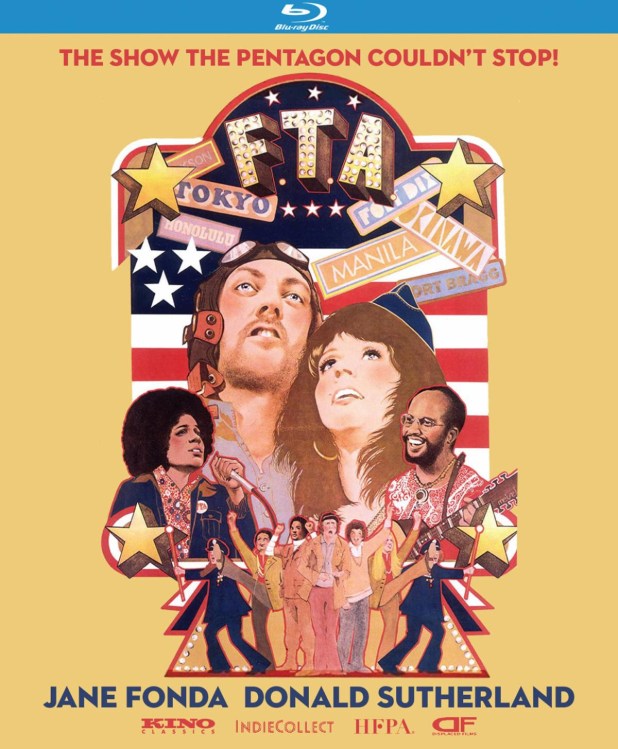
F.T.A. (1972)

In 1971, at the height of the Vietnam War, Jane Fonda and Donald Sutherland did more than just become part of an anti-war comedy tour across Southeast Asia. They also reached out directly to enlisted soldiers who were critical of the war.

The documentary of this tour, F.T.A., shows the tour as it goes to Hawaii, The Philippines, Okinawa and Japan. It was directed by Francine Parker, who was only the eleventh woman to join the Director’s Guild.

In addition to Fonda and Sutherland, Paul Mooney, Peter Boyle, Steve Jaffe, Holly Near (The Magical Garden of Stanley Sweetheart), Pamela Donegan, Len Chandler, Michael Alaimo (Mr. Mom), Rita Martinson and Yale Zimmerson all appear.

While the tour was a success, the film was incredibly controversial and opened the same week that Fonda made her trip to Hanoi. Within a week of release, American-International Pictures withdrew it from circulation, with Parker saying that this was the result of “calls were made from high up in Washington, possibly from the Nixon White House, and the film just disappeared.” David Ziegler, whose documentary Sir! No Sir! appears on the blu ray of this movie and was part of the team that helped restore F.T.A. said, “There’s no proof, but I can’t think of another reasonable explanation for Sam Arkoff, a man who knew how to wring every penny out of a film, yanking one starring Jane Fonda and Donald Sutherland from theaters at a big loss (and, apparently, destroying all of the prints, since none were ever found).”

Now, the film has now been fully restored by IndieCollect in 4K and is available from Kino Lorber, along with a new introduction by Fonda, a 2005 interview with the actress, the documentary Sir! No Sir! and a booklet with essays by historians David Cortight and Mark Shiel.

Regardless of your politics, this is a piece of history that I feel that everyone should watch.

You can get this directly from Kino Lorber.

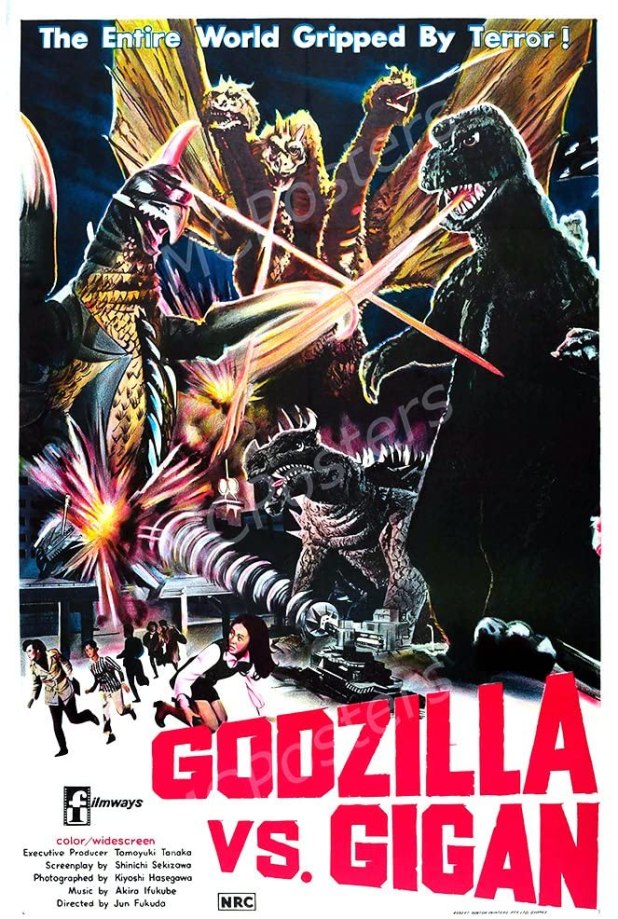
SON OF KAIJU DAY MARATHON: Godzilla vs. Gigan (1972)

M Space Hunter Nebula is a dying planet whose inhabitants are giant cockroaches who have decided that Earth is the next planet that they will use up and move on to afterward. They take the shape of dead people to create a theme park called World Children’s Land and call upon the monsters King Ghidorah and Gigan to destroy the planet.

Godzilla movies will continually mess your mind up with their outlandish plots and I would not have it any other way.

A manga artist learns about the plan and somehow is able to contact Godzilla, who brings along his former enemy Anguirus to help. The army thinks that the monster just want. to destroy Tokyo, but with the aliens trying to take over, a change of heart has occurred.

The aliens may have a Godzilla Tower with a blue laser in it, but they don’t have atomic breath. The King of Monsters has completed his face turn and despite how boring they can be, humans can finally feel safe.

Toho did their own dub of this movie with one major change. There’s a scene where Godzilla and Anguirus speak to one another and use comic book word balloons. In the U.S. version, they actually speak, with Ted Thomas actually voicing Godzilla, who speaks perfect English. Cinema Shares International Distribution releasing it as Godzilla On Monster Island.

SON OF KAIJU DAY MARATHON: Daigoro vs Goliath (1972)

This collaboration between Tsuburaya Productions — the makers of Ultraman, whose close ties to Toho provided them with directors and costumes — and Toho was released to Japanese theaters on December 17, 1972. It was originally going to be a Godzilla film entitled Godzilla vs. Redmoon, which would have celebrated Tsuburaya Productions’ tenth anniversary and the character that started it all — Godzilla.

The film would have Redmoon — who arrived from the moon — and Erabus — arriving from Habu Island — being guided together by the Japanese Self Defense Forces to attack and eliminate one another, but instead hooking up and giving birth to a new kaiju named Hafun. However, a carny entrepreneur would exploit and ultimately kill the child, leading both creatures to go wild until stopped by Godzilla.

Instead, we got this.

Daigoro became an orphan after the military destroyed his mother and the one soldier who stood up to the order has adopted the kaiju as his own child. In order to pay for his huge food bills, he’s had to start a business all around the monster, so you can see some hints of the canceled film in the final product.

Meanwhile, another kaiju named Goliath has come to Earth and Daigoro decides to prove himself by battling the monster. Since many of the folks in his hometown didn’t trust Daigoro, they had been feeding him an anti-growth drug that makes him too weak to defeat Goliath.

He nearly dies but recovers and trains hard every single day, coming back to save humanity, who strap Goliath on a rocket and send him into space.

Daigoro is made up of parts from Red King, one of Ultraman’s best-known foes and he has a roar that would later be used for Godzilla Jr. in Godzilla vs. Space Godzilla. As for Goliath, he was made from the canceled Redmoon costume. He has Astromons’ roar.

While a more child-friendly kaiju movie, it’s still a blast.

You can watch this on YouTube.

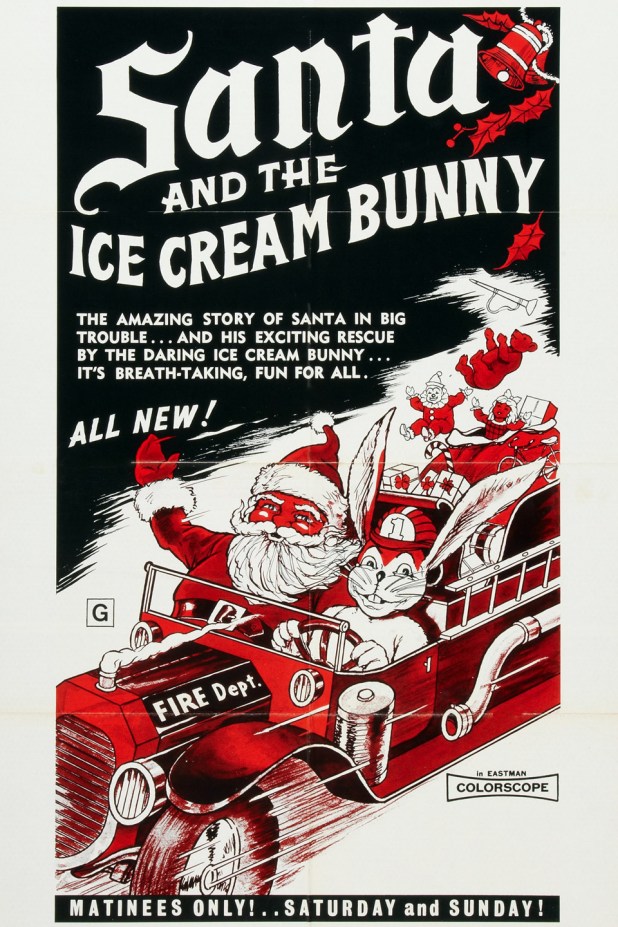
REPOST: Santa and the Ice Cream Bunny (1972)

EDITOR’S NOTE: While not fully a Barry Mahon movie, this film — originally watched on December 24, 2017 — has one of two different Barry Mahon films inside it. Read on — this is probably the most insane movie I’ve ever watched and I still think about it all of the time.

This movie was made for children. Let’s keep this in mind as we discuss it.

Sure, it was created by R. Winer to use existing Barry Mahon films — either Thumbelina or Jack and the Beanstalk — and create a framing device of Santa so that it could be released over Christmas. But what emerged was a piece of cinematic horror that can try even the bravest of souls.

In the North Pole, the elves are worried about Santa not being there. Where is he? Oh, stuck in the sand on a beach in Florida, with the reindeer flying away because of the heat. Santa sings a song about his problems, then he falls asleep.

Santa uses telepathy to reach out to children, several of whom are fistfighting. They race to help him, asking him logical questions like, “Why don’t you just get on a plane?” He says he cannot abandon his sleigh, so a pig, a sheep, a donkey, a horse and a gorilla come to help while Tom Sawyer and Huckleberry Finn watch.

This movie is drugs.

Santa tells the kids to not give up, then tells them a story, which would be one of the two stories discussed earlier. Santa then tells the kids to always believe and a girl reveals that her dog, Rebel, can do anything.

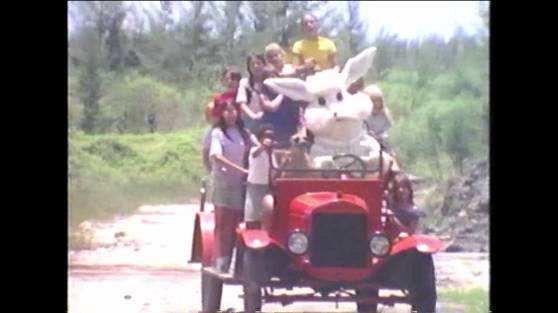
Santa gives up — even after the advice he gave the kids — and goes to sleep. But then the kids come back in a fire truck driven by the Ice Cream Bunny, a scene which ruined my already tenuous grip of sanity, leaving me lying on the couch holding my sides while my eyes cried deep tears of laughter.

Yes, Rebel the dog knows the Ice Cream Bunny, who drives Santa to the North Pole, leaving behind the sled, ruining the main conceit that Santa had brought up before, that he would never leave his sled behind. The children wonder what to do and then the sled disappears.

The conflict that has driven this movie was all a lie.

Why did we sit through all of the animals trying to pull the sled?

Why did we have to watch the movie within a movie?

Why were Tom Sawyer and Huck Finn in this film?

What the fuck did I just watch?

This movie was probably created as part of the Pirates World amusement park in Dania, Florida, which had already produced the two films within the film. But with Disney World opening in 1973, this little enterprise was doomed. Was the Ice Cream Bunny one of their characters? Because we’re led to believe that he’s well-known, but I’ve never heard of him.

This is a movie that will break you.

You think I’ve covered some insane holiday movies?

I really think this one tops it all.

Did I mention that when the Ice Cream Bunny comes to rescue Santa that he almost runs over Rebel the dog? I mean, this genius dog that was able to summon a magic bunny runs in front of a moving vehicle to drink out of a muddy pool of water, nearly being run down by a fire truck driven by a man in a rabbit suit that surely can’t see him! Look for the jump cut where Rebel is back and moved to safety!

And Pirates World is even crazier when you learn that Led Zeppelin, Black Sabbath, Alice Cooper and David Bowie all played the theme park! You can see footage of Iron Butterfly playing the park in the movie Musical Mutiny.

The director Barry Mahon, who created the films for the park, lived an insane life that inspired the film The Great Escape. During World War II, Mahon Mahon escaped Stalag Luft III only to be captured on the Czechoslovakian border. He escaped again, was recaptured again, and was finally saved by Patton’s 3rd Army in 1945.

So what did he do when he got back to the USA? He became Errol Flynn’s personal pilot and manager. His directorial credits alternate between children’s fare, like Santa’s Christmas Elf Named Calvin and The Wonderful Land of Oz, and nudie cuties like Fanny Hill Meets Dr. EroticoThe Diary of Knockers McCalla and The Beast That Killed Women. He also directed 1961’s Red Scare shocker Rocket Attack U.S.A.

No one is really sure who R. Winer is, but some think he was Richard Winer, a cinematographer and director whose entire IMDB page is devoted to films he either created or appeared in that were all about the Bermuda Triangle and UFOs. Of course.

This is the kind of film David Lynch dreams that he could make. Alejandro Jodorowsky lives in abject terror of its unholy power. You should have to wear some kind of protective brain plate when you watch this.

I can’t keep this to myself. If you want to subject yourself to the assault that is this film, here it is. Don’t say I didn’t warn you.

You can also watch this on Amazon Prime.

Blood Freak (1972)

ABOUT THE AUTHOR: Jennifer Upton is an American (non-werewolf) writer/editor in London. She currently works as a ghostwriter of personal memoirs for Story Terrace London and writes for several blogs on topics as diverse as film history, punk rock, women’s issues, and international politics. For links to her work, please visit https://www.jennuptonwriter.com or send her a Tweet @Jennxldn

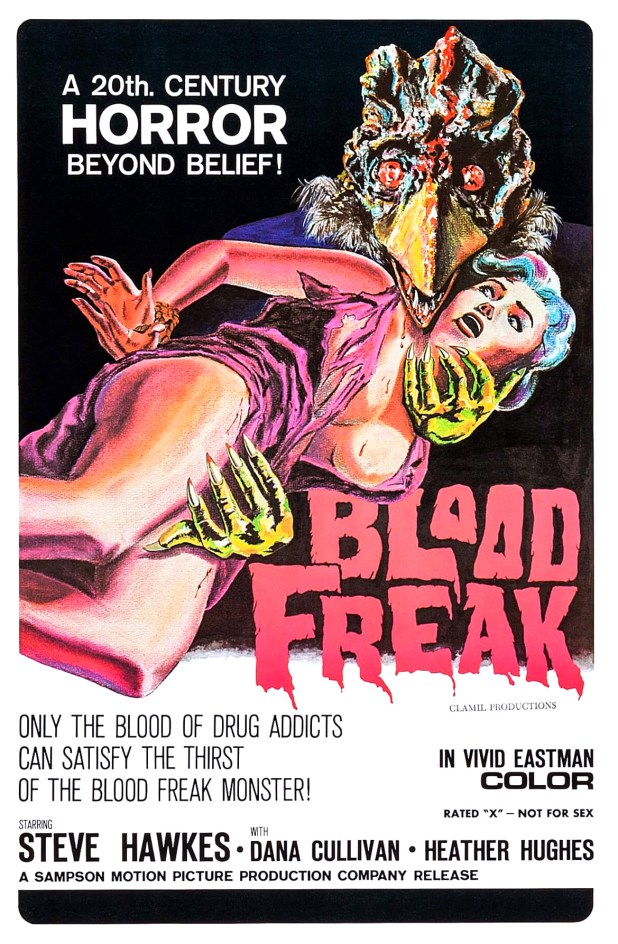
In 2004, I stumbled across a copy of Blood Freak released as a special edition on the Something Weird Video label. I knew nothing about the film before I watched it. 90 minutes later, as the credits rolled, I held up the packaging to the heavens and proclaimed, “Every film I ever watch from this moment forward will be compared to Blood Freak.” Is it good? That depends on your point of view. Do I love it? Absolutely. It is, in this writer’s humble opinion, the best “worst” movie ever made. Not because it’s slow or boring. But because it’s a film that defies all logic. Made equal parts enthusiasm and technical ineptitude in Florida by nudist director Brad F. Grinter on a $25,000 budget, and star Steve Hawkes, it’s positively dripping with WTF moments. Blood Freak exists in a genre all its own somewhere in the center of a “Cult Movie” Venn Diagram featuring Sting of Death, Blood Feast, Reefer Madness, and the collective Christian works of Kirk Cameron.

The plot involves a biker named Herschell (in a nod to fellow Florida filmmaker H.G. Lewis) played by the box-bodied, pompadoured Hawkes himself. Herschell has just finished his service in Vietnam and needs to figure out the rest of his life. After assisting a girl on the Florida turnpike named Angel with her car trouble, she invites him home. There, we find Angel’s polar-opposite younger sister Ann toking up and sniffing poppers with her friends. Ann likes Herschell, who rejects her for an evening at Bible study with Angel and her elderly friend who just happens to need “a husky guy” to help out on his poultry farm. To mellow him out, Ann gives Herschell a laced joint by the pool, causing him to become addicted after one dose. The two quickly fall in stoner love.

Herschell gets a job at the old man’s turkey farm (where the sounds of real turkeys are augmented by human voices gobbling and whistling on the soundtrack) and agrees to eat some experimental samples injected with chemicals. The combination of the spiked weed and the spiked turkey causes him to pass out. He awakens a while later to discover he has transformed into a giant turkey monster. Well, more like a guy with a papier-mâché turkey head and feather scarf, but you get the idea. He’s a mutant game bird dependent on the blood of drug addicts. When he’s not out killing junkies and drinking their blood with his toothy beak, he goes home to Ann and gobbles softly to her about his plight. In response she ponders, “Gosh, Herschell, you sure are ugly. I love you. But if we stay together, what will the children look like?” Then they make sweet, sweet turkey love.

If it sounds insane, it is. It is the only film I’ve ever seen where the director periodically interrupts the proceedings to explain what the hell is going on. It doesn’t help but it sure is entertaining to watch Grinter glance down at his script every few seconds.

Fortunately, Herschell wakes up to discover the entire episode was all a hallucination. It turns out our hero was already addicted to pain killers from injuries sustained in Vietnam. Angel, Ann and the poultry farmer get him the help he needs and he and Ann walk off happily ever after.

Just prior to the conclusion, director Brad Grinter pays his audience one last visit to warn us of the dangers of chemicals in our food. All while chain-smoking and coughing. The message couldn’t be clearer. Grinter knows he’s a hypocrite. It’s an apt description given that he taught filmmaking at the same time he made a literal turkey of a movie comprising underlit, out-of-focus shots. Me? I love turkey. I searched for many years to find a gem worthy of the “Best of the Worst” title. Blood Freak is the reigning Gobbler.

Trivia: Blood Freak is filled with a lot of big cat imagery. Actor Steve Hawkes was rescued by a lion from a fire while shooting a Tarzan film in Europe. He spent the rest of his life rescuing big cats. Steve was the original Tiger King. 

To find out more about his life, which is worthy of a film on its own, click here: https://en.wikipedia.org/wiki/Steve_Sipek