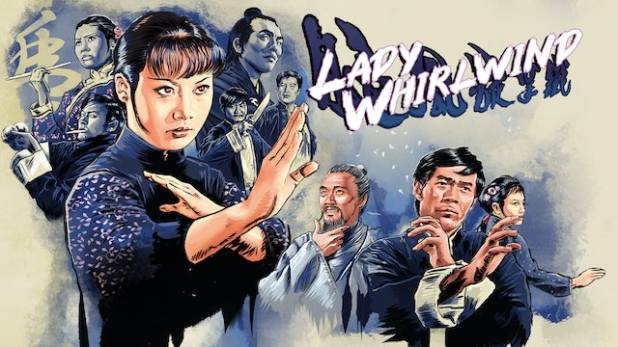
Angela Mao worked with director Huang Feng to create a series of martial arts films that are well-considered like Deadly China Doll, When Taekwondo Strikes, Hapkido and this movie. She’s best known for her appearance in Enter the Dragon as Bruce Lee’s doomed sister. After a career as a hard-fighting star, she moved to New York City in 1993 where her family runs several restaurants.
When Ling Shih-hua (Chang Yi) is left for dead by Yakuza attackers, he vows revenge as he is nursed back to health. His problems aren’t anywhere near over because Tien Li-Chun (Mao) is here, demanding that he take his own life for leaving his sister and causing her suicide. He begs her for a favor. He must have his revenge before he dies. Of course, he gets beaten down again and she has to save him after he gets buried in the sand up to his neck. That means that she has to save him and help him to defeat his enemies, all so that she can be the person who gets the pleasure of killing him.
In our country, this was given a sexy ad campaign and called Deep Thrust — wink wink nudge nudge — and the tagline “the deadly stroke of bare-handed combat.” It has no sexual content, so don’t be fooled. It’s about kicking some ass.
Besides that title, you know what else gets stolen? John Barry’s score from Diamonds Are Forever. Georges Garvarentz’s song “The Bulldozer Leads the Dance” is also in this, which doesn’t seem like music for martial arts mayhem, yet there it is, right?
This movie inspired me. I must find more movies where Mao, who looks so prim, proper and ladylike, unleashes hell and decimates ten or more human beings at once. This also has a wise old man who teaches the male protagonist the Tai Chi Palm and the bad guys have a villainess who uses a whip, which is all I ask for in a movie.
Lady Whirlwind has been released by Arrow Video in a set with Hapkido. Both movies have brand new 2K restorations by Fortune Star, an illustrated collectors’ booklet featuring new writing on the films by critic James Oliver and a reversible sleeve featuring original and newly commissioned artwork by Ilan Sheady.
There are three commentary tracks: one by Frank Djeng and Robert “Bobby” Samuels, another with Frank Djeng and Michael Worth, and another with Samm Deighan. There are also newly filmed interviews with Angela Mao and her son Thomas King, as well as alternate English credits, a Hong Kong theatrical trailer, U.S. theatrical trailer, radio ad and an image gallery.
You can also stream this movie on the Arrow player. Visit ARROW to start your 30-day free trial. Subscriptions are available for $4.99 monthly or $49.99 yearly. ARROW is available in the US, Canada, the UK and Ireland on the following Apps/devices: Roku (all Roku sticks, boxes, devices, etc), Apple TV & iOS devices, Android TV and mobile devices, Fire TV (all Amazon Fire TV Sticks, boxes, etc), and on all web browsers at https://www.arrow-player.com.
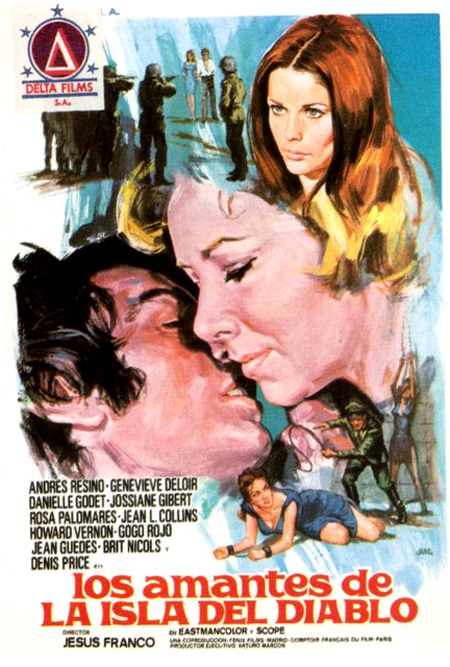
When you hear Jess Franco Women In Prison movie, your mind may go to his more salacious efforts like Isla the Wicked Warden, Justine, Barbed Wire Dolls, Women Behind Bars, Love Camp, Sadomania or 99 Women, nearly all movies that push the very boundaries of taste and morality to their limits.
This movie isn’t that.
Beatriz Coblan (Geneviève Robert, who was also in Franco’s Dracula, Prisoner of Frankensteinand the mother of Jason Reitman and why doesn’t everyone ask him about that in every interview?) and Raymond Franval (Andrés Resino, The Murder Mansion) have both been framed for murder by Colonel Mendoza (Jean Guedes) and his mistress Emilia (Danielle Godet) for murder — by drugging them and putting a bloody corpse in their room — and sent to Devil’s Island.
I guess it’s convenient to have both male and female prisons on the same island, but that also helps the two escape with the help of fellow prisoner Rosa (Josyane Gibert, who wrote the dialogue for Nightmares Come at Night and Female Vampire) and a lawyer named Lindsay (Dennis Price, Horror Hospital; this is his last feature film and he looks exhausted).
Howard Vernon shows up, which seems like a prerequisite for Franco movies, as well as Britt Nichols (Daughter of Dracula), Anne Libert (A Virgin Among the Living Dead) and even Franco composer Daniel White as an uncredited judge. Lina Romay is around there too, but doesn’t make herself known, unlike her near-psychotic work in Isla the Wicked Warden.
There are a lot of flashbacks and — as you can imagine — a lot of zooms. Unlike many other Franco movies, no one is nude and the camera isn’t trying to teach you how to be a gynecologist. This is a serious film and there’s no time for that. I mean, there are more than a few other films Jess did to scratch that itch.
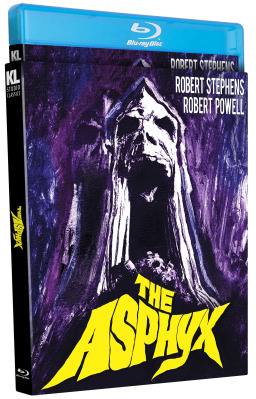
Man, if you’re looking for a British seance movie — and really who isn’t — there’s not a better film for you than this 1972 bit of craziness. Sir Hugo Cunningham’s (Robert Stephens) idea of fun is to film the last moments of peoples’ lives and seeing if a smudge in the images are the soul of the body trying to escape. Man, Victorian England was daffy.
Things get crazier, because when he uses a camera at the party for his engagement, his new fiancée and son are killed in a boating accident. When he watches the movie he made of the tragedy — because why not, right? — he sees that not only has he captured the blur, but that it is moving towards his son. That’s when he starts to believe that these smudges and blurs are something he calls the asphyx, the grim reaper from Greek myth that individually comes for each of us.
Now here’s where things get even more interesting. Because our hero figures that the asphyx must deal with the rules of the physical world. So he invents a special light that uses phosphorus stones beneath a drip irrigation valve that can briefly capture that smudgy black angel, making anyone who keeps asphyx remained imprisoned into an immortal.
Cunningham tasks his ward — how rich and British and Batman do you have to be to get a ward — Giles (Robert Powell) with capturing his asphyx and burying it deep in a family tomb. Because after all, Cunningham’s contributions to science are just too important for him to ever die. They need to bring in another person, Giles’ stepsister (and fiancee, because this is high society England) Christina for help. If they help him become an immortal, he will consent to them getting married.
Nothing works out well for anyone, save perhaps the guinea pig that can’t die. He’s doomed to wander the Earth with an immortal Cunningham, all the way to modern London as seen at the end of this movie.
The Asphyx is a movie that feels like a hard sell to an American crowd. It’s kind of staid and nuanced, but the effects are pretty wild and the idea is definitely high concept.
This is the only movie directed by Peter Newbrook, who also wrote Gonks Go Beat, produced Corruption (which no woman will dare go home alone after watching) and worked on the second unit on Lawrence of Arabia and Bridge on the River Kwai.
The Kino Lorber blu ray release of this film has an extended 99-minute cut — its made from HD footage of a 35mm negative with SD footage from the U.S. master print, so quality jumps around a bit — as well as a trailer and commentary by Kim Newman and Stephen Jones. You can get it from Kino Lorber.
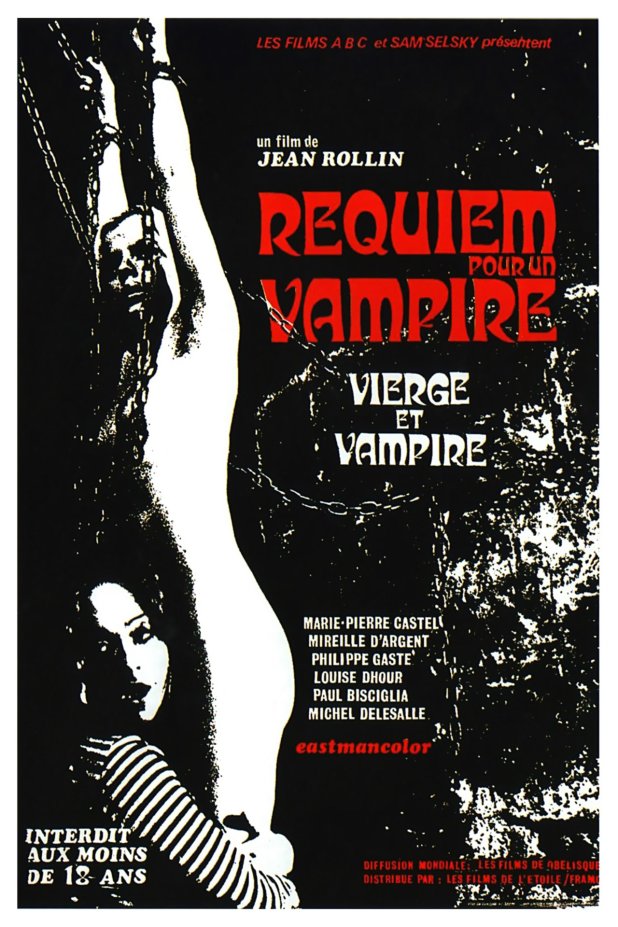
Shot in a historical castle in the small village of Crêvecoeur, Requiem for a Vampire finds director Jean Rollin’s fourth female vampire movie. The castle was nice — it was filled with expensive antiques — but Rollin was more interested in the dungeons that overlooked the entire region.
Marie-Pierre Castel, who starred in Rollin’s The Nude Vampire and Shiver of the Vampires along with her twin sister Catherine, stars and is joined by Mireille Dargent, whose agent was stealing her wages for the movie and Rollin figured that out and got her paid.
They play Marie (Castel) and Michelle (Dargent), who first appear as clowns on the run from unseen pursuers. Their driver is killed and they race into the woods where they are nearly buried alive in a cemetery and then an ancient castle filled with bats and a cozy bed to make love in. The castle is filled with skeletons and a male and female vampire. Of course, the male has designs on them, wanting them for his virginal eternal vampire brides, but Michelle ends up sleeping with another man which ruins those plans and almost destroys her relationship with her true love Marie.
Rollin wrote this in one sitting, piling story beats on top of one another with little care for plausibility or any connection. Then again, when was he any different? Amazingly, this played American grindhouses as Caged Virgins, a title that I guess makes as much sense as anything. One wonders what people thought when confronted by a near-wordless journey of two clown girls trying to shoot everything in their way and setting a man on fire before both finding their way to a vampiric master who finally decides that his bloodline must end.
He was learning however and got past censors by shooting a version where the girls stayed clothed, even when being whipped and while they engaged in a sapphic embrace. Most countries can handle horrific violence; the form of a nude woman is where the problems begin.
This is the only movie I’ve ever seen where a vampire bat goes down on a woman, so for that alone, Jean Rollin has my respect if not obsession.
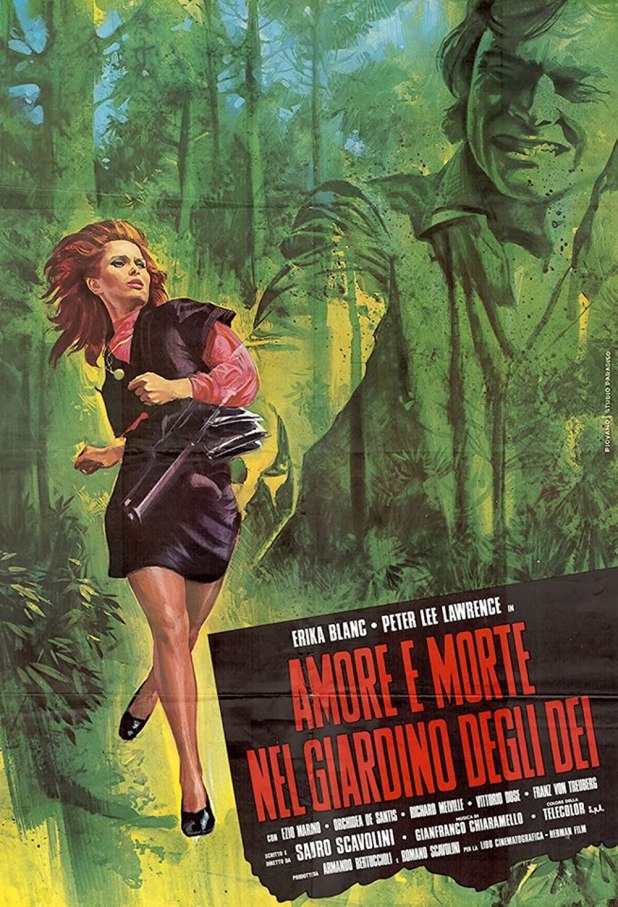
There’s a scene in this movie where Erika Blanc walks down some steps wearing a white coat and I swear that if I hadn’t already been through puberty, I had my second one. I try to be above such things when I write of giallo (and gothic horror and women in prison and nunsploitation and Jess Franco and man, maybe I am scum) but I think I now believe in some form in Divine Spark and I will argue it with you at will.
When a professor moves into a new home, he finds a mess of tape in the woods. When he cleans it, he finds himself drawn into the life — and death — of Azzurra (Blanc), just married to Timothy (Rosario Borelli) but in love with her brother Manfredi (Peter Lee Lawrence) and on a one-way ticket to suicide.
It may seem like the only nod to giallo is that the old man teaches ornithology and is only at the house to try to study a rare bird. It’s more a journey backward through the tape, as we see the many tragedies that led to greater tragedy. After she slices her wrists — nude in the bathtub so you don’t forget that this is a giallo — she’s saved by her brother’s supernaturally gorgeous new lover Viola (Orchidea de Santis, Seven Murders for Scotland Yard) and then falls for her and vice versa.
It also looks gorgeous, with cinematography by Romano Scavolini, Sauro’s brother and the man that would one day make Nightmare In a Damaged Brain. Somehow, a garden fried chicken party becomes a psychedelic freakout and even Blanc simply walking takes on a dreamlike tone.
Some people find this one too strange and too talky and not much happens but look, there are plenty of giallo that have actual killers and stalking and you can go watch those. If you want to be challenged, this one is ready.
EDITOR’S NOTE: Cinematic Void will be playing this classic on Saturday, Jan. 21 at midnight at the Coolidge Corner, Theatre in Brookline, MA. For more information, visit Cinematic Void.
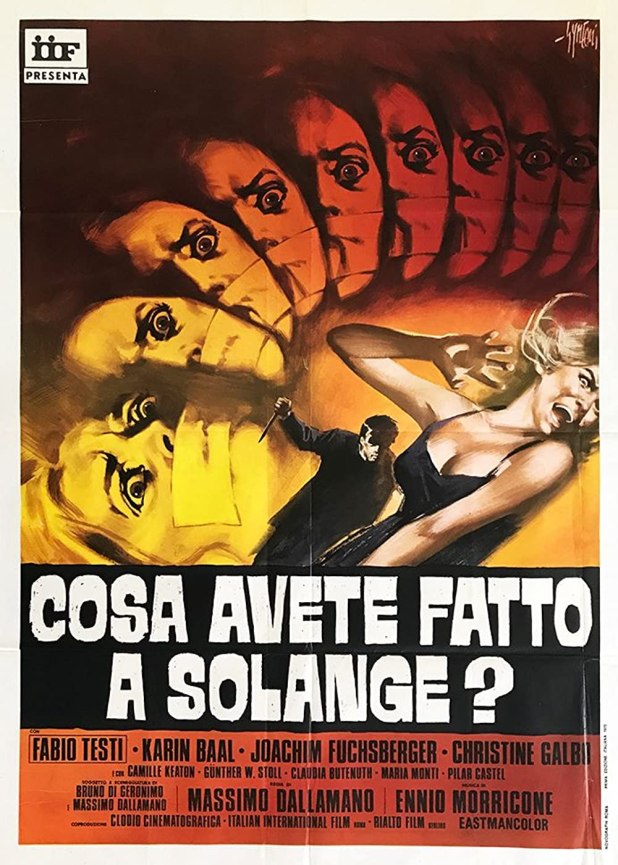
London. The 70’s. Professor of Italian Enrico Rosseni (Fabio Testi, The Four of the Apocalypse) is on his boat, making out with Elizabeth (Cristina Galbó, The Living Dead at Manchester Morgue, The House that Screamed) and trying to get her to go further than she has before. Right when it seems like he’s going to finally conquer her, she looks up to see a woman being stabbed on the shore.
After angrily rowing to the shore, Rosseni and Elizabeth find no evidence of a crime. He accuses her of being too religious, like all the girls at the school her uncle sent her to. The next morning, while he dresses and argues with his wife Helga, he hears about a horrid murder on the banks of the Thames river. He drives to where he and Elizabeth were and finds tons of cops. And there are even more at the school where he works!
The victim was one of Elizabeth’s friends, so she wants to tell the police what they know. However, he doesn’t want the affair exposed. However, his pen has been found near the body and he shows up in the crime scene photographs in the newspaper.
More murders. More clues in Elizabeth’s mind. More priests doing evil things. More anger from Helga. More of Rosseni trying to solve the crime. And all he has is one clue: Who is Solange and what was done to her?
The movie takes a turn when Elizabeth is killed inside the apartment that Rosseni has rented for the two of them to continue their affair. And at that point, Helga starts being much nicer to our hero. As their relationship improves, her makeup grows softer, her clothing gets more fashionable and her hair comes down. How strange to find a giallo about a relationship coming back together as the result of murder!
What happened to Solange (Camille Keaton, I Spit on Your Grave)? She was given an abortion that all of the murdered girls were there for. In a kitchen, no less. And all of those girls were involved in doing drugs and dating older men.
So what do the cops do? Oh, just set up a sting operation with all of the surviving girls. And of course, Solange just happens to show up, walking through the park. Here’s the second of course — the cops bungle everything and the killer takes Brenda, asking her the story of Solange, as he did every other victim.
This is one well-put-together film, thanks to Massimo Dallamano, who was the cameraman for Sergio Leone’s A Fistful of Dollars and For a Few Dollars More. Joe D’Amoto was the cinematographer and added plenty to the film. And you can’t deny the power of having an Ennio Morricone score!
This film is an interesting combination of the German krimi film and the Italian giallo and gave way to Dallamono’s Schoolgirls in Peril trilogy, which includes What Have They Done to Your Daughters?and Rings of Fear.
I always love seeing what titles films get released and re-released under. What Have You Done to Solange? has so many, including an attempt to sell it as a teen comedy entitled The Rah-Rah Girls! You can learn more at the amazing Temple of Schlock site. And for an awesome police report of the events of the film, head to The Giallo Files.
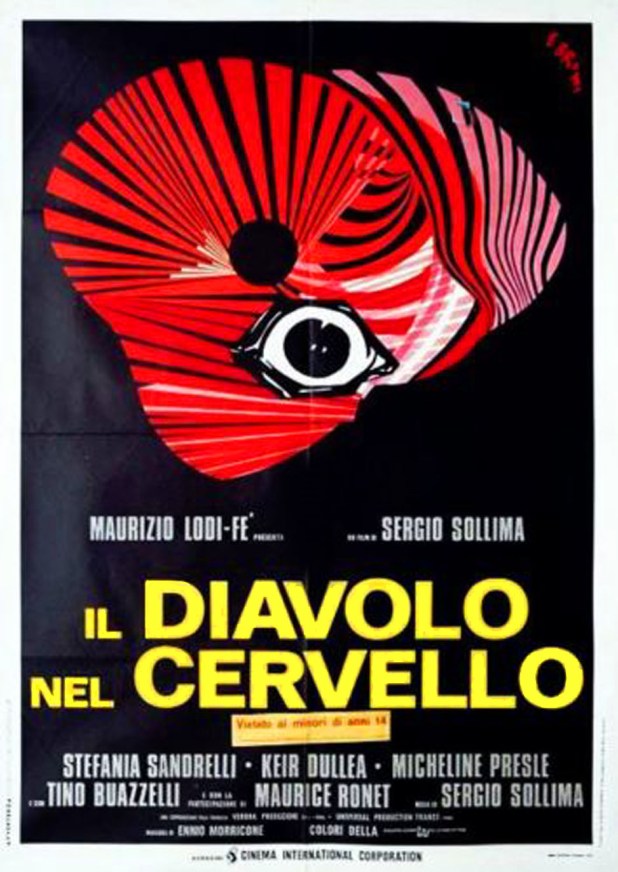
Oscar Minno (Keir Dullea, who in addition to 2001 has a career filled with odd films like Welcome to Blood City, Full Circle, Bunny Lake Is Missing, De Sade and Black Christmasto name a few) has come back from overseas and seeks out an old love, Sandra (Stefania Sandrelli, Divorce Italian Style) who is now a widow confined to her family estate, her husband potentially killed by her son Fabrizio (Maurice Ronet, Bloodline) and now in the care of the domineering Countess de Blanc (Micheline Presle). Meanwhile, Doctor Emilio Bontempi (Tino Buazzelli, who played Nero Wolfe on TV) believes that Ricky, now confined to the care of nuns, may be innocent of the murder.
Directed by Sergio Sollima (Violent City), who co-wrote the script with Suso Cecchi d’Amico (Bicycle Thieves, Brother Wolf Sister Moon) with a soundtrack by Ennio Morricone, this has a higher pedigree than most giallo. It has no black gloved killer, little nudity and hardly any blood. Instead, this deals with class conflict, as Oscar was never considered a viable husband for Sandra and yet he still wants to save her — and maybe her son — from the stigma of mental illness. But when the working class proletariat interferes in the world of the bourgeois, nothing but pain can arrive.
I have no idea why more people aren’t watching and discussing this one. It’s probably not sleazy enough and has no interest in ripping off Argento. Instead, it emerges from a slow start to become a wonderful detective tale.
EDITOR’S NOTE: Cinematic Void will be playing this Giallo classic Monday, January 3 at 7:00 PM at the Music Box Theater in Chicago. You can get tickets here. For more information, visit Cinematic Void.
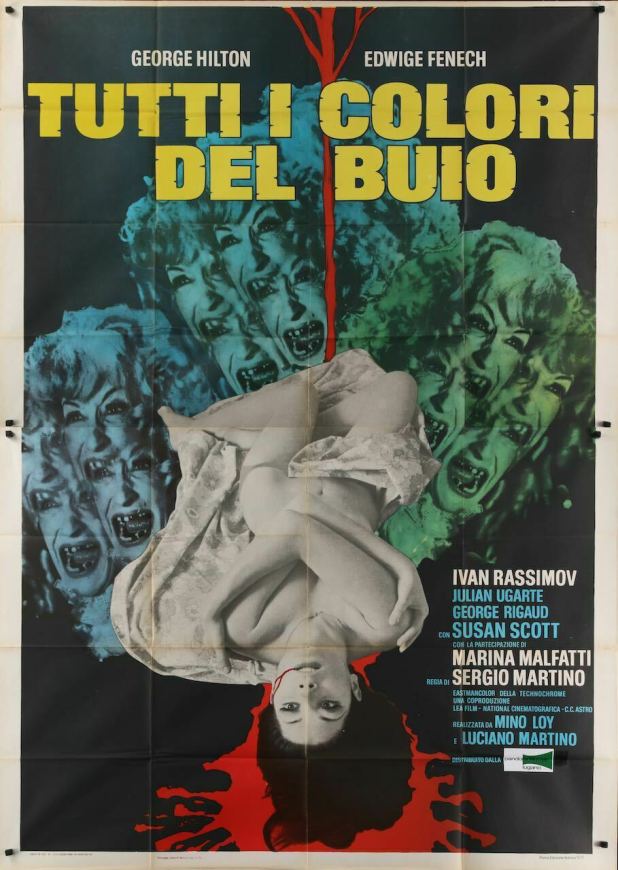
The first five and a half minutes of 1972’s All the Colors of the Dark (also known as Day of the Maniac and They’re Coming to Get You!) subvert what I call Giallo’s “graphic beauty” in intriguing ways.
An outdoor scene of a stream slowly darkens, replaced by an old crone with blackened teeth, dressed as a child and a dead pregnant woman are both made up to be anything but the gorgeous creatures we’ve come to expect from these films; even star Edwige Fenech (The Strange Vice of Mrs. Wardh, Five Dolls for an August Moon and so many more that I could go on and on about) isn’t presented in her usual role of a sex symbol. She’s covered in gore, eyes open and lifeless. As the camera zooms around the room and begins to spin, we see a road superimposed and hear a car crash. Even when Edwige’s character in this film, Jane Harrison, wakes up to shower, we’re not presented with the voyeuristic spoils that one expects from Giallo’s potent stew of the fantastique and the deadly. She stands fully clothed, the water more a caustic break with the dream world than an attempt at seducing the viewer or cleaning herself.
Again — in a genre where words possess little to no meaning — we are forced to wait five and a half minutes until the first dialogue. Richard (George Hilton, Blade of the Ripper), her husband, bemoans that he must leave but feels that he can’t. His therapy is a glass of blue pills and lovemaking that we watch from above; his penetration of her intercut with violent imagery of a knife entering flesh. Instead of the thrill we expect from this coupling, we only sense her distance from the proceedings.
As Richard leaves her behind, we get the idea of the madness within their apartment: a woman makes out on the sidewalk with a young hippy man who asks when he’ll ever see her again. Mary (Marina Malfatti, The Night Evelyn Came Out of Her Grave, The Red Queen Kills Seven Times), a mysterious blonde, glares down at him, somewhat knowingly. His wife looks lost and trapped. Without dialogue, we’ve already sensed that some Satanic conspiracy is afoot. Echoes of Rosemary’s Baby? Sure, but you could say that about every occult-themed 1970s film — the influence is too potent, a tannis root that has infected all of its progeny.
Last year, a car crash took the life of Jane’s unborn child. Her sister Barbara (Nieves Navarro, Death Walks at Midnight, Emanuelle and the Last Cannibals) has advised therapy, which Richard laughs at. As Jane waits to see the doctor, she sees a man with the bluest eyes (Ivan Rassimov from Planet of the Vampires and Django in Don’t Wait, Django…Shoot!) — eyes we’ve seen before, eyes that hint at blood and murder and madness.
Even when surrounded by people, such as on the subway, Jane is lost in her thoughts and in another world, one of inky blackness and isolation punctuated only by the cool blue eyes of the sinister man who tracks her everywhere she goes. Even the teeming masses of the city make her feel more lost; only the light of the above-ground world erases the nightmare of her stalker. That is — until he finds her in the park, where she screams for him to stop following her. The camera is detached, following her from high above, watching her run away, needing the refuge of her home. Even then, the man is still there, banging on the door, demanding to be part of her reality.
The thing is — Richard has no faith in his wife’s sanity. And even when he’s telling her sister, Barbara, how he doesn’t trust psychiatry, he’s also watching her undress in a mirror. This scene really hints that they’ve had sex in the past (perhaps the past was just five minutes ago).
Jane finally finds a kindred soul—her neighbor, Mary, whom we saw earlier in the windows. Mary tells Jane of the Sabbath, the black mass and how it helped her. She sees Jane as a lost soul who needs to be saved and agrees to take her to her church.
The blue-eyed man returns, chasing Jane past a spiraling staircase, ax in hand. The camera spins, making us dizzy as it cuts from the building to the man to Jane’s car to the man. Jane demands to be allowed to go to the Sabbath as she fears the madness that seems ready to overtake her.
As we approach the old mansion where the rite will occur, we feel more of a sense of belonging, a warmer color palette instead of the washed-out nature of the urban sprawl we’ve experienced until now. Everything is lit by a candle. Mary appears to have achieved a glow, and Jane stands in stark contrast to the beatific zombies of the assembled congregation. A taloned priest murders a dog in front of Jane’s eyes as Mary caresses her (trust me, this isn’t a Fulci realistic dog murder, although I hid my mutt Angelo’s eyes for this scene). The priest tells her that if she drinks the blood, she will be free. Hands and lips and bodies overtake her as an orgy breaks out, a bacchanal that she seems to want none of. This sex is presented as horror, as anything but pleasure, yet Jane seems ill-equipped to resist.
Immediately, we see her enjoying her husband, no longer frigid and everything back to normal, as he says. However, Jane tells her that she doesn’t feel real any longer. She walks to the bathroom, seeing multiple reflections of herself that harken back to the kaleidoscope effect we saw as the priest took her to the altar.
No matter what peace, love, and sex happen, Jane can’t escape the blue-eyed man. Even on a romantic lunch date with her husband, he’s there, outside, waiting for her. A taxi drives her back to her home, the only sanctuary against the invasion that the man presents. As she goes through her husband’s effects, she finds a book of the supernatural emblazoned with a pentagram. He claims it’s just a second-hand book and accuses her of hiding things from him.
Jane returns to the Satanic church, this time willing to give herself over and actually seeming to enjoy lovemaking for the first time in this film. Mary intones, “Now you’ll be free.” Again, the long-fingernail priest takes her while the blue-eyed man watches her, his hands covered in blood. The members of the church dance around her as Mary calls to her. The priest tells her that Mary no longer exists. She is free to go, as she brought Jane to the church. The final act is for Jane to murder her, to send her away. Jane screams that she can’t do it, but Mary tells her that they must part, that this act will free her, as she lowers herself onto the dagger that Jane clutches.
Jane awakens, fully clothed, in a field. The blue-eyed man is there, telling her, “Now you are one of us, Jane. It’s impossible to renounce us.” He offers his hand, telling her to follow him. She’s expected. He takes her to an altar that is the same design as the pendant we just saw her wear during the orgy. She demands to know where Mary is, but the only answer she gets is that she belongs to the cult and will now be protected. Mary is gone, and Jane’s sacrifice allows her to be free. They show her Mary’s body, covered in black lace, as she runs screaming.
Perhaps in retaliation for the ritual, dogs chase her through the woods, tearing at her, stopped only by the blue-eyed man who knocks her out. She awakens, clad in virginal white, surrounded by white sheets. Her husband leaves a note in lipstick on her mirror. She looks, and the symbol is on her arm, which is covered in blood. When she goes to Mary’s apartment, an old woman lives there instead.
Jane is totally lost — the ritual has brought her nothing but more madness and the blue-eyed man even closer. Her husband is away on business, her sister is on vacation, and her therapist is dismissive. Even her apartment walls, which offer security, have become a maze of fear. The colors shift to Bava-esque hues of blackness and reds as we see the blue-eyed man attack her over and over again, with constant repetition of the frame as she screams — and then there’s no one there, just the room filled with red and a broken piece of pottery embedded in her hand.
After examining Jane, the doctor leaves her with an elderly couple. Her husband can’t find her and asks Barbara to help.
Jane awakens in a white room — of course, the blue-eyed man is waiting outside the house in the gauzy early morning hours. Yet there is an ominousness about the proceedings — no one is there. A tea kettle is boiling on the stove while the old man and woman sit there, in still repose, dead at the breakfast table. She’s trapped in the room with them as she frantically calls for help. She tells her doctor that the man is there and has killed everyone. He calmly tells Richard and Barbara that he has another patient to deal with, as he doesn’t trust Richard and wants to keep him in the dark. However, he does reveal the truth to Barbara. That lack of trust goes both ways as Richard follows the doctor.
Meanwhile, the blue-eyed man finds Jane, telling her she cannot renounce them. He tells her that the knife that he holds killed her mother when she tried to deny them. And it’s the same knife that killed married. He tells her she is beyond reality and will never find it again.
Following the sound of a hound, she finds the doctor’s car in the driveway — and, of course, he’s dead, too. The blue-eyed man gives chase and finally tries to kill her, but he’s stopped at the last minute by Richard, who stabs him with a rake. He stomps on the man’s hand repeatedly, revealing the tattoo symbol he stares at.
Meanwhile, Mary arrives home to a green-hued apartment, where Richard is smoking and accusing her of being part of black magic. He sees the symbol when he watches her undress, and she tells him that she wants him, that she can make him forget her sister. She promises him untold power and that he can become anyone he wants. As she leans in for a kiss, he shoots her, tossing the envelope of a letter that he received that explains it all.
Cut to a hazy white room where Jane has been given a sedative. An inspector — the priest from the cult! — demands to see her. Richard arrives and embraces her, telling her he will take her out the main door. They speed away in a car and return to their apartment. But all is not well — Richard is killed by an unseen person, and Jane is left holding the dagger. The police that arrest her all have the symbol on their wrists and are led by the leader. The camerawork becomes tighter and claustrophobic as we see the cult descending on her.
Wait — it’s all a Wizard of Oz dream, with the police and her husband at her bedside, explaining the film’s entire plot, which ends up even more ridiculous than everything that we’ve seen up until now (which is really saying something). Turns out there was no real magic. The cult was just a drug ring. Mary was real and just a heroin addict. Her sister was behind it all because she wanted all of the money from the will of their mother’s murderer, who wanted to give 600,000 pounds to both of them.
Jane rejects this reality, saying that this cannot be true after all that she’s seen. The cop replies that he kept trying to call her, and she never answered, so he wrote it all in a letter — the letter that Richard showed Barbara after he shot her. It’s worth noting that the American version of the film ends with Jane being killed by the cult and all of the ending — nearly six minutes worth of important story and denouement — exorcised.
We return to where we were, with Richard going upstairs — just like we’ve seen before. Jane screams that she knows what will happen. The cult leader attacks him, blaming her for Barbara’s death. Richard follows him to the roof, where they fight, and the priest is thrown from the roof. Jane tells Richard that she knew the man was there; she knew that her husband had killed her sister, that it wasn’t a suicide, and that some strange force was guiding her. She asks for help, and the credits roll.
With this film, director Sergio Martino (Torso, 2019: After the Fall of New York) crafted an intriguing blend of the supernatural and the Giallo. Even the procedural elements come only after the film has descended into surrealism as if a cold glass of water splashed in the face of a viewer who needs an explanation. Magic is madness, and we can’t even trust our heroine at the end when she begs to escape the power inside her.
This film is terrific, with Edwige Fenech turning in a strong performance. You really feel the isolation and madness that surround her and empathize with her. The strong visuals and the break from the genre conventions of masked killers, gloved hands and inept police make watching this film an absolute joy. From beginning to end, it makes you question not only the reality that it presents but also the objective trustworthiness of our heroine. And while it betrays an obvious inspiration to the aforementioned Rosemary’s Baby, it is not slavish in its devotion, making a powerful statement on its own merit.
Here’s a cocktail recipe.
They’re Coming to Get You
1.5 oz. J&B
.5 oz. lemon juice
.5 oz. simple syrup
1 egg white
3 dashes Angostura bitters
Shake all ingredients in a cocktail shaker filled with ice.
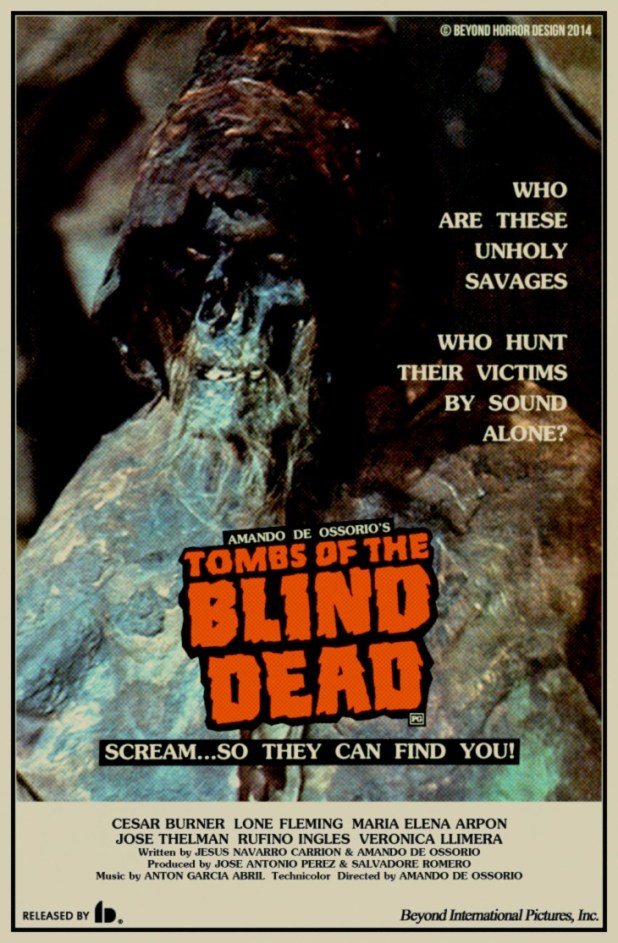
The original Spanish title of this movie is La noche del terror ciego (The Night of the Blind Terror) but it is better known as Tombs of the Blind Dead). Director and writer Amando de Ossorio was inspired by El monte de las ánimas by Spanish romantic writer Gustavo Adolfo Bécquer and Night of the Living Dead to make this. Instead of zombies, these knights from the Easts would come to be known as the Templars, based on the Knights Templar, a Catholic military order who were the most skilled fighting units during the Crusades. The Knights Templar innovated banking and had a form of basic credit which King Philip IV of France took advantage of. Once he was deeply in debt, he began to spread rumors that the Templars spat on the cross, denied Jesus, worshipped either Baphomet or the head of John the Baptist and engaged in homosexual relationships. There was no evidence of this yet the Templars were still tortured, gave enforced confessions and were burnt at the stake.
Their Grand Master Jacques de Molay recanted his confession and when he was burned at the stake, he asked to be turned so he could face the Notre Dame Cathedral and hold his hands together in prayer. As he perished, he said, “Dieu sait qui a tort et a péché. Il va bientôt arriver malheur à ceux qui nous ont condamnés à mort.” which means “God knows who is wrong and has sinned. Soon a calamity will occur to those who have condemned us to death.” His accusers King Philip and Pope Clement would be dead within the year.
In the abandoned medieval town of Berzano, at the border between Spain and Portugal, the Templars were hung and birds pecked their eyes out. Now, they emerge from their graves seeking blood to remain alive now and forever.
Why would you come to such a place, Betty Turner (Lone Fleming)? Why would you bring your new lover Roger Whelan (César Burner), a fact that upsets your college girlfriend Virginia (María Elena Arpón) so much that she leaps from a train and ends up dead at the dusty hands of the Templars? What will it take you to realize that nothing stops the slow moving Templars and that they will destroy everyone that you love and leave you ruined by what you have witnessed?
As much as I adore this movie, I love even more that it was released in the U.S. as Revenge from Planet Ape, removing the Templar flashback and changing the movie to be about a post-apocalyptic future in which the undead are deceased intelligent apes.
EDITOR’S NOTE: This holiday giallo was first on the site many years ago, all the way back on December 16, 2017.
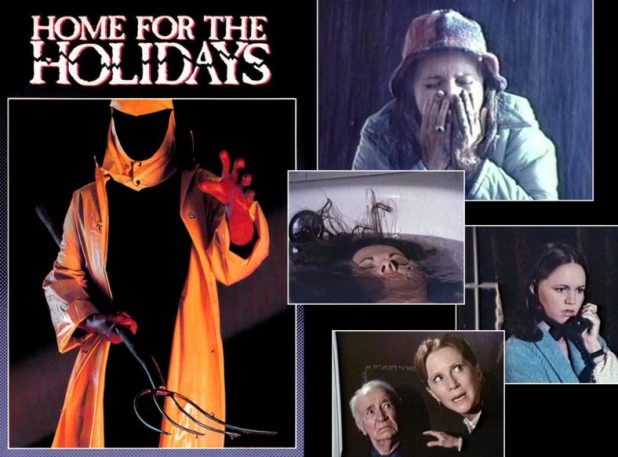
Originally airing on November 28, 1972, this ABC-TV movie was produced by Aaron Spelling and debuted on VHS in 1986. It’s packed with future talent and is at the center of what we love most here: TV movies, Christmas movies and horror.
Benjamin Morgan (Walter Brennan, Rio Bravo) is rich and dying and suspects his wife, Elizabeth (Julie Harris, one of America’s most famous stage actresses), of poisoning him. He sends his oldest daughter, Alex (Eleanor Parker, Eye of the Cat) to find her three sisters and bring them home — the first time they’ve been back since their mother’s suicide.
The three sisters are Freddie (Jessica Walter, Arrested Development), Joanna (Jill Haworth, The Brides of Dracula) and Christine (Sally Field, Steel Magnolias). Their father tells them that they must kill their stepmother before she kills them. At dinner that night, Joanna harangues her stepmother with questions about how her first husband died, while Freddie screams in her room about how their father’s affairs led to their mother killing herself.
This is obviously the holiday get-together everyone hoped for.
Soon after, Joanna tries to leave but is killed by a pitchfork-wielding person in a yellow raincoat. That same killer also drowns Freddie in the bathtub while Elizabeth keeps offering everyone warmed milk and honey. Soon, the phone line gets cut and everyone is trapped with a killer. But who is it?
There are plenty of twists and turns here, as the love between a father and daughter and the love between husband and wife is contested. It’s bloodless, as it’s a TV movie, but it’s also pretty dark, because the 1970’s were the end of the world and the movies made then reflected it. You also get a cast packed with Oscar winners and nominees, all acting within basically one or two rooms, so there’s plenty of emotion and suspense.


 B&S About Movies
You must be logged in to post a comment.