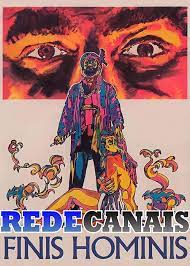
Embracing the socially conscious — yet still exploitative — black humor and tongue in cheek style of the Brazilian Mouth of Garbage Cinema (Boca do Lixo), the man known as Coffin Joe — José Mojica Marins — directed co-wrote (with Rubens Francisco Luchetti) and stars in this story of a man named Finis Hominis who rises naked from the ocean and walks through the streets of the city, changing the world.
After helping a woman in a wheelchair to walk, protecting a woman and her child from a gang and then being given the finest in clothing, he walks to a church where he drinks Holy Water and is proclaimed Finis Hominis, the end of man. He brings the dead back to life, gathers followers and upsets the leaders of the world until he announces that he must return home. And that is an insane asylum. And this has happened before.
A messiah and an insane person may be the same. That seems like what Marins is saying in a film that avoids his traditional horror look, feel and main character and instead, trips out.
EDITOR’S NOTE: The Mephisto Waltz was on the CBS Late Movie on July 29, 1977.
Paul Wendkos may have directed most of the Gidget movies, but he has quite the horror pedigree. There’s the TV movie Good Against Evil, Haunts of the Very Rich, the 1985 remake of The Bad Seed and the legendary 1975 TV movie The Legend of Lizzie Borden.
Because this is a Quinn Martin Production and CBS aired it extensively on TV, many people believe that it was a made-for-TV movie. However, it was actually released in theaters—the only movie that Twentieth Century Fox released for the entire calendar year of 1970, due to several of 1969’s movies failing at the box office.
Myles Clarkson (Alan Alda) once wanted to be a pianist but is now a music journalist. He gets to interview the world’s greatest piano player, Duncan Ely (Curd Jurgens, The Vault of Horror). It doesn’t start well, but then Ely discovers that Myles has hands perfect for the piano.
At that point, Duncan and his daughter Roxanne (Barbara Perkins) become friends with Myles and his wife Paula (Jacqueline Bisset), who doesn’t trust either of them. She was right to suspect them, as they’re Satanists who have transferred Duncan’s mind to Myles’ body. However, as Myles becomes a major star, she starts to like the man she’s married to more and more. She becomes seduced by the power, even if Duncan comes to her in dreams and tells her that their daughter must die.
After that dream, the daughter dies, which pushes Paula to investigate the Ely family. She then finds herself falling into the arms of Roxanne’s ex-husband, Bill (Bradford Dillman).
This is the 1970s, so of course, incest figures in. It turns out that Duncan and Roxanne have bartered with Satan to enable them to pursue their incestuous relationship by placing Duncan’s consciousness into Myles’ body. When Bill is killed with the same blue forehead murder style as Paula’s daughter, she starts to worry for her life. But simultaneously, she decides that no matter who is in her husband’s body, that’s the man she wants to be with.
So she does what any of us would do. She turns to Satan and kills herself, moving her mind into Paula’s body. Then, she returns to her husband, Paula’s father, in her husband’s body. Whatever issues there were with the marriage have been solved, thanks to the left-hand path and outright murder.
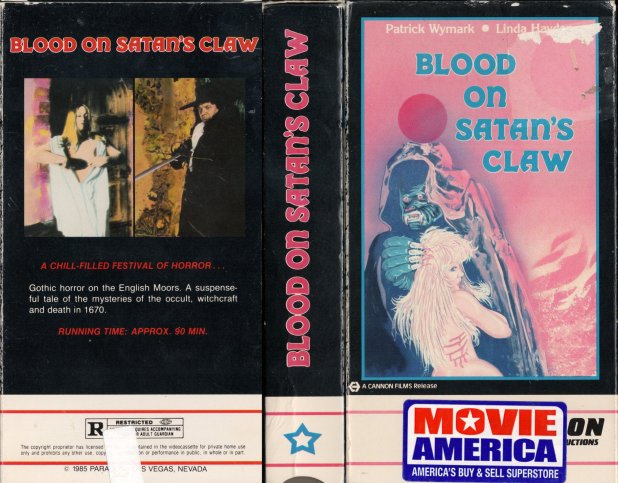
In his BBC documentary series A History of Horror, Mark Gatiss referred to this film, along with Witchfinder Generaland The Wicker Man, as the prime example of a short-lived subgenre he called folk horror.
It’s directed by Piers Haggard, who also was behind The Quatermass Conclusion, The Fiendish Plot of Dr. Fu Manchu and Venom. He’s also the great-great-nephew of H. Rider Haggard, the creator of Allan Quartermain.
Robert Wynne-Simmons was hired to write the story, which was inspired by the modern-day Manson Family and Mary Bell child murders.
In the early 18th century, Ralph Gower (Barry Andrews, Dracula Has Risen from His Grave) uncovers a one-eyed skill covered with fur while plowing his fields. He asks the judge (Patrick Wymark, Dr. Syn, Alias the Scarecrow) to look at it, but it’s gone missing, and his fears are ridiculous.
Peter Edmonton brings his fiancee, Rosalind Barton (Tamara Ustinov, Blood from the Mummy’s Tomb), to meet his aunt, Mistress Banham. Banham disapproves of the coupling and demands that Rosalind sleep in an attic room. After screaming throughout the night, she soon gets ill, and the judge commits her. As she’s led away, Peter discovers she has a claw instead of a hand.
Claws show up all over this — hidden in fields to be found by children and attacking Peter inside the cursed room, causing him to sever his hand. The judge leaves behind the town for London but promises to return. He places Squire Middleton (James Hayter, The 39 Steps) in charge.
One of the children who found the claw, Mark, is lured out by his classmates and killed in a ritual game by the leader of a new cult, Angel Blake (Linda Hayden, Madhouse, Queen Kong). She even tries to seduce Fallowfield (Anthony Ainley, the Master from Dr. Who) and tells him that Mark had the devil inside him, which needed to be cut out. Her group also has a Black Mass inside a ruined church where they attack Mark’s sister Cathy (Wendy Padbury, companion Zoe on Dr. Who). They ritualistically assault and murder her before tearing the fur from her skin.
Of course, it’s not long before all hell quite literally breaks loose, with insane children raising Satan himself from the Great Beyond and Ralph growing fur on his leg, marking him for death. This movie is…well, there’s nothing else quite like it. I can see why it had a limited audience for years; it’s so dark and unforgiving.
“It never made much money,” said Haggard. “It wasn’t a hit. From the very beginning, it had a minority appeal. A few people absolutely loved it, but the audiences didn’t turn out for it.”
While Satan’s Skin was the original title, you must give it to American International Pictures’ Samuel Z. Arkoff, who created the film’s title.
EDITOR’S NOTE: When I first wrote about this movie, I said “If this played on the CBS Late Movie, it would have probably taken two hours and forty minutes with all the commercials. Actually, it did, on August 29, 1972 and March 6, 1975.”
Bernard L. Kowalski has a decent horror pedigree, directing Night of the Blood Beast; Attack of the Giant Leeches;Krakatoa: East of Java; Terror in the Sky and Sssssss. Here, he puts the terror on a slow boil and puts Reverend John Keyes (Roy Thinnes, always battling the occult) and his wife Lorna (Lynn Loring, The Horror at 37,000 Feet) against an unseen force bedeviling a small Western town named San Melas. There’s voodoo, devil worship and a mute young girl and a gunslinger possessed by the Left Hand Path.
Ray Milland shows up, proving that Old Hollywood is never to be trusted. Plus there’s Gloria Grahame (Blood and Lace), Henry Silva (Almost Human, Megaforce, the epic Escape from the Bronx), stuntman Stan Barrett, Joshua Bryant (Salem’s Lot), a young Leif Garrett (Thunder Alley) and Jodie Foster’s brother, Buddy.
70s made for TV horror neglects the Old West, so this is a strange film to start with. Then again, it also plays the Troll 2 trick of a town with a backward name and a connection to witches, but it doesn’t telegraph that. The ending — which moves to 1971 — more than makes up for the slow moving last 68 minutes.
Actually, I love dreamy TV movies that seem to take forever to get anywhere.
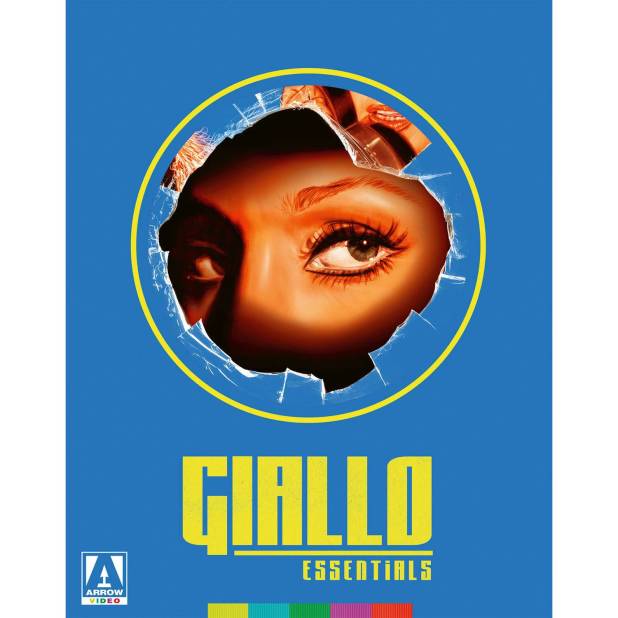
Arrow Video continues its exploration of giallo with its fourth box set after the Black, Red, Yellow and White editions of Giallo Essentials.
In the early 1970s, when the giallo boom was at its peak, producer-turned-director Luciano Ercoli made three standalone — but thematically linked — giallo films all starring his wife Nieves Navarro under the name Susan Scott. This set shares those movies in one convenient and well-priced edition.
The Forbidden Photos of a Lady Above Suspicion (1970): Minou (Dagmar Lassander, The House by the Cemetery) loves her husband, Peter. But Peter is cold and only really seems to care about work. All she does all day is pine for her husband and take care of a turtle. Yep. You just read that correctly.
One night, a mysterious stranger attacks her, cuts open her clothes and then warns her: her husband is a killer.
The mysterious man is proven correct when a man who owed Peter money shows up dead. He demands that she come to his home, where he blackmails her into sleeping with him. Seeing as how he has recorded their tryst, he now has more material on her.
Even her friend Dominique (Nieves Navarro, All the Colors of the Dark, who was married to the director, Luciano Ercoli) can’t be trusted, as Minou finds photos of the blackmailer in provocative poses in her possession. When she finally gets the police to investigate, the man’s home is empty and Dominique tells the police he never even existed. Oh yeah. Dominique was once Peter’s woman before Minou. So there’s that.
Minou has a nervous breakdown and overdoses on tranquilizers before sobering up and learning that it’s all been a plot against her from the beginning. But come on — if you’ve watched any giallo, you knew that going in.
Despite its lurid title, Forbidden Photos of a Woman Above Suspicion isn’t filled with sex or even all that much violence. It’s more about alcoholism and how women were taught that they had to have the skills to land a man, but not what to do with their lives to make them fulfilled beyond just a relationship.
Director Luciano Ercoli has some gorgeous shots in here that really take advantage of the space age 1960’s aesthetic. And a bossa nova score by Ennio Morricone keeps this film bouncing. It wouldn’t be the first giallo I’d recommend, but it’s not the last, either.
Extras include commentary by Kat Ellinger; Private Pictures, a documentary featuring interviews with Navarro, Ercoli and Gastaldi; an appreciation of the music of 70s Italian cult cinema by musician and soundtrack collector Lovely Jon; a Q&A with Lassander; the Italian and English trailers and an image gallery.
Death Walks On High Heels (1970):
A man is stabbed on a train, leading the police to question Nicole (giallo queen Nieves Navarro) about diamonds that are missing. Her life turns upside down, as she begins to receive disguised phone calls asking about the diamonds and a blue-eyed masked man attacks her in her boudoir. She then remembers that her jealous lover Michel owns contact lenses in that color, so she runs away with an older eye surgeon to the coast of England. But Michel isn’t far behind…
The first of three giallo directed by Navarro’s husband, Luciano Ercoli, this is what the genre should be: shocking, lurid, bloody and oh so fashionable. It also makes a deft turn from what we expect from the form into an actual mystery film.
There’s a plot twist here that honestly shocked me, so I won’t spoil it. While the other two films in the Ercoli giallo trilogy are much better, this is still a quality film worthy of your time. Some critics decry them as Ercoli making movies just to feature his wife, but if you had a quality woman like Navarro in your life, I bet you’d do the same.
This comes with audio commentary by film critic Tim Lucas, an introduction to the film by screenwriter Ernesto Gastaldi, an interview with Ercoli and actress Navarro, Gastaldi explaining how to write a successful giallo, an interview with composer Stelvio Cipriani and Italian and English trailers. These extras are a sheer joy for giallo lovers and what an opportunity to hear from Ercoli, Navarro and Gastaldi.
In this one, she plays a fashion model named Valentina who agrees to help her journalist beau study LSD. But while she’s dosed and in the middle of a photo shoot, she watches a man brutally murder a woman with a spiked gauntlet. He thinks she’s just hallucinating and publishes her account, but she believes it’s real. And when the killer starts stalking her, she really starts to worry.
The entire opening of the film is one big acid freakout and everything that follows is the bad trip, the comedown and reality brutally intruding into drugged out bliss. This is a film packed with brutal violence and plenty of gore, but it makes sense. The movie demands it.
The end, when everything is wrapped up by the killer (killers?) is pretty great, as the many red herrings are discussed and the entire plot is finally explained to us. If everything before felt like a nightmare, this is bracingly cold water directly to the face.
Even better, Navarro portrays a heroine who doesn’t faint at the first sign of danger. She deals with the ineffectual police and indifference of her boyfriend with aplomb.
And yes — this film is packed with bonkers crazy fashion — a metal/glass silver wig and a strange sculpted wall feature prominently — so if that’s why you love giallo, you’ll be quite happy here. Me? I loved every minute.
This release comes with audio commentary by film critic Tim Lucas, an introduction by screenwriter Ernesto Gastaldi, an extended TV version, a reflection by Gastaldi reflects on his career in the crime film-writing business and Desperately Seeking Susan, a visual essay by Michael Mackenzie exploring the distinctive giallo collaborations between director Luciano Ercoli and star Nieves Navarro. If you love giallo — or are just getting into it — all of these extras will open deepen your love for the form; Lucas is one of the best commentary track experts there is.
This limited edition Arrow Video box set comes in rigid packaging with the original poster artwork in a windowed Giallo Essentials Collection slipcover. You’ll enjoy 2K restorations for all three films as well as reversible sleeves for each film featuring original and newly commissioned artwork by The Twins of Evil and Gilles Vranckx.
VIDEO ARCHIVES NOTES: This movie was discussed on the April 25, 2023 episode of the Video Archives podcast and can be found on their site here.
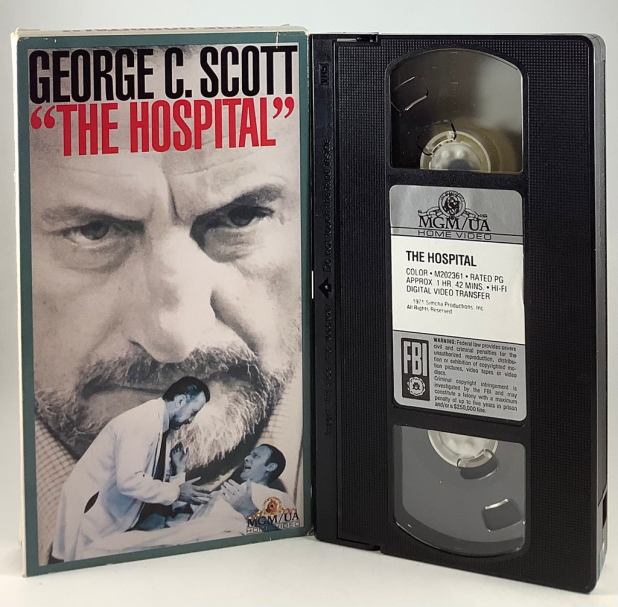
Directed by Arthur Hiller and written by Paddy Chayefsky — the winner of the 1972 Academy Award for Best Original Screenplay, as well as the narrator and the man who had control over the casting and content of this movie — The Hospital concerns a New York City medical center — Metropolitan Hospital Center, which is called Manhattan Medical Center — that is just as damaged as one of its lead medical experts, Dr. Herbert Bock (George C. Scott). His marriage is over, his children hate him and he’s been impotent for several years. And oh yeah, several doctors and a nurse have been murdered on his watch while the hospital takes over an apartment building so that it can expand, pushing citizens into the streets. Nobody comes here to be healed, just patched up and shoved back out. It’s enough to make Bock want to commit suicide, which is just what he was doing when Barbara Drummond (Diana Rigg) barges into his office, engaging him in a spirited discussion that ends up with him roughly taking her.
This changes his life — one can argue, as Quentin Tarantino did on the Video Archives episode, whether she actually exists — but he can’t leave behind the hospital or stop solving problems, like how his new lover’s father (Barnard Hughes) is either on his death bed, the killer or both. I mean, it’s a spoiler but if you watch this, it’s so obvious that in no way is it hard to see coming.
The film makes a wild swing in the middle from a black comedy about the American medical system into a murder mystery mixed with a romance that starts with pretty much an assault. Luckily, it has strong acting from Scott — as always — and Rigg answers the challenge of playing against him in her first American movie.
It’s also the first movie of Tracey Walter, who may be one of the few people in this movie to have an action figure, as he was Bob the Goon, a short-lived but long-beloved character in Tim Burton’s Batman.
VIDEO ARCHIVES NOTES: This movie was discussed on the February 13, 2023 episode of the Video Archives podcast and can be found on their site here.
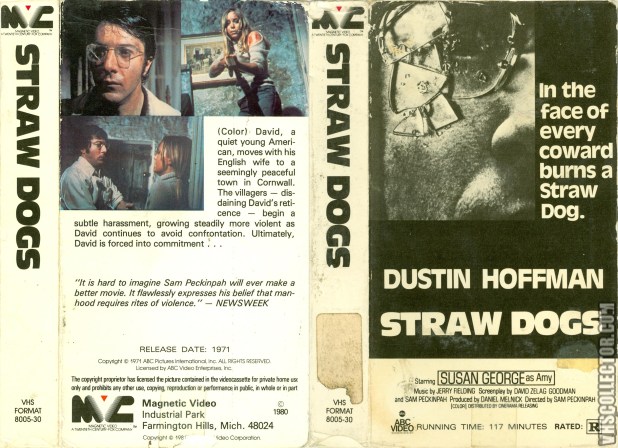
I know they made a remake of Straw Dogs in 2011, but there’s no way I can imagine people not being beyond upset with this movie. The violence probably wouldn’t upset all that many people, but the two graphic assaults of Susan George — much less the quick flash that she may not have been all that upset by the first — would be greeted by a procession of anger the likes of which no movie made today would be able to create. I mean, would director Sam Peckinpah have been able to make movies in today’s world? One could argue that he struggled to do it in the 70s.
Based on The Siege of Trencher’s Farm by Gordon M. Williams and written by David Zelag Goodman and Peckinpah, the story begins with David Sumner (Dustin Hoffman) moving his wife Amy (George) back to her hometown of Wakely. Her ex, Charlie Venner (Del Henney), has a gang of horrible townsfolk like Norman Scutt (Ken Hutchison), Chris Cawsey (Jim Norton) and Phil Riddawa (Donald Webster) and each of them resents the meek academic American making love to one of their own.
David and Amy have moved into her father’s house, Trenchers Farm, and hired the four men to fix it up. As the house improves, their marriage falls apart, as she claims he left America because he was a coward afraid of conflict and that he treats her in a condescending manner. He withdraws into his study of stellar structures while she teases the workmen with her body.
Despite the men killing their cat, David still goes hunting with them. They pull the snipe hunting trick and abandon him, heading back to his home so that Venner can attack his wife. That coupling seems a bit too much like lovemaking by the end and as she holds her ex-lover, Scutt comes in with a gun and forces Venner to hold her down. By the time David returns, Amy says nothing.
The next day, David fires the men and Amy has a breakdown in church when she sees them. Things get worse — a local boy named Henry Niles (David Warner) ends up being seduced by a relative of Venner named Janice Hedden (Sally Thomsett). When the men chase them down, he accidentally kills her and goes on the run. After David accidentally hits him with his car, he takes the boy home, which brings the foursome back to begin invading the home.
Then David says, “I will not allow violence against this house.”
What follows is a Hoffman descending into the kind of barbaric behavior one expects in a Stanley Peckinpah movie.
Straw Dogs is older than I am and still packs such infernal power. We see ourselves cheering for David to finally rise up, but is too much well, too much? I guess not from the same man who made The Wild Bunch. I’ve been thinking this film over and over in my head and trying to figure out how I feel about it. It’s not ambivalence. I’m just seeking an answer.
VIDEO ARCHIVES NOTES: This movie was discussed on the March 14, 2023 episode of the Video Archives podcast and can be found on their site here. You can read another take here.
Harry Garmes (George C. Scott) has left the world behind. His wife has left him after the death of their son. And after a life in organized crime, he’s content to be a nobody in a little fishing village somewhere in Portugal.
Then Harry gets a job.
It’s been nine years, but he still gets a job. Bring escaped killer Paul Rickard (Tony Musante) and his girlfriend Claudie Scherrer (Trish Van Devere) to France. Rickard is to kill French President DeGaulle under orders of the OAS.
Harry knows this will end bad.
He takes the job anyway.
Even the prostitute he sleeps with and gives all his money to, Monique (Colleen Dewhurst) turns on him.
Because Harry’s been dead a long time.
He just doesn’t know it.
Directed by Richard Fleischer (20,000 Leagues Under the Sea, Fantastic Voyage, See No Evil, Mr. Majestyk, Mandingo, Conan the Destroyer and like, ten or more other movies I could mention) and written by Alan Sharp (The Osterman Weekend, Ulzana’s Raid, Damnation Alley), this was originally directed by John Huston, who went to war with a drunken Scott on set. Then again, Huston and his son Tony were rewriting the script over and over — Sharp also rewrote it six times — but after all that messing with the script, it wasn’t a movie anyone wanted to make. Huston left, Tina Aumont went with him and Fleischer was called in. He hated the script. That’s because it wasn’t the movie Sharp and Scott wanted to make.
The Last Run finished with a cost of a little over $2 million, only one week and $30,000 over the original schedule. Flesicher said, with no small pride, “I think it’s a miracle it got made. I’m the miracle.”
As for Scott, once his wife Dewhurst flew out with his kids, he fell in love with Van Devere, who he would later marry. So yeah. Scott is in this movie with two of his wives from three of his marriages (he was married to Dewhurst twice). In all, he was married five times, but he was with Van Devere from 1972 until his death in 1999.
Scott had just finished Patton, so he had some power on this film, and wanted to make a movie that reminded him of the ones he loved when he was young. I always liked that it seemed like he made every film personal.
VIDEO ARCHIVES NOTES: This movie was discussed on the December 6, 2022 episode of the Video Archives podcast and can be found on their site here.
Kevin Billington was the son of a factory worker who ended up marrying Lady Rachel Billington. He was also a director of plenty of TV movies, like a well-considered BBC version of Henry VIII. He ended up directing this international collaboration of French, Spanish and Italian producers. They paid Kirk Douglas an estimated $1 million dollars to star, which is about $7.2 million in today’s money.
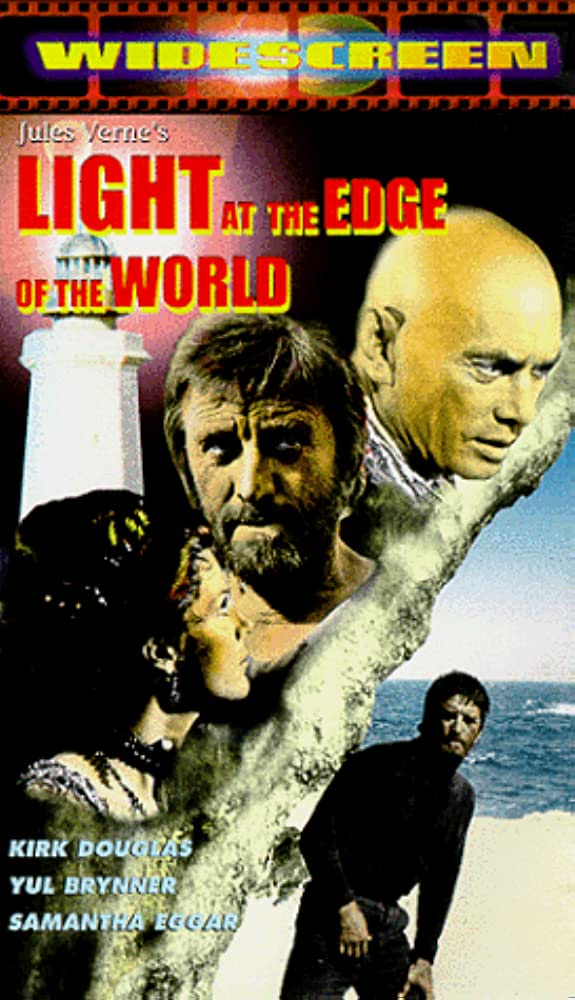
Will Denton (Kirk Douglas) runs an isolated lighthouse to hide from a failed romance and the fact that he killed a man in self-defense. The only people he ever speaks to are the crew, Captain Moriz (Fernando Rey) and assistant Felipe (Massimo Ranieri). They watch over a very strategic trade route near the Tierra del Fuego archipelago at the southern tip of South America.
Yet in one horrible moment, it all changes, as Captain Jonathan Kongre (Yul Brynner) and his pirates — they include actors from Sergio Leone’s films, such as Luis Barboo, Víctor Israel and Aldo Sambrell — kill Moriz and Felipe, smash the lighthouse signal and start to loot everything they can. Surviving their attack along with an Italian sailor named Montefiore (Renato Salvatori), they begin to fight back.
Kongre has also made a change in his life. He always kills everyone on the ships that he takes over, but he’s fallen for one of the women on board, Arabella (Samantha Eggar). Denton tries to save her, but when Montefiore is caught and slowly killed, he puts his friend out of his misery, just as Kongre angrily gives the woman to his crew. Denton sinks the ship and it ends up with just the two men, battling each other to the death inside the lighthouse.
If you’re expecting a light hearted Jules Verne adventure, well, this is as rough as it gets. It’s about a broken man trying to just live out his days coming up against a sophisticated villain who loves murder and carnage. I mean, they kill Douglas’ monkey. That’s how horrible the bad guys are. They deserve everything they get.
EDITOR’S NOTE: This movie was watched as part of Salem Horror Fest. You can still get a weekend pass for weekend two. Single tickets are also available. Here’s the program of what’s playing.
In his BBC documentary series A History of Horror, Mark Gatiss referred to this film, along with Witchfinder Generaland The Wicker Man, as the prime example of a short-lived subgenre he called folk horror.
It’s directed by Piers Haggard, who also was behind The Quatermass Conclusion, The Fiendish Plot of Dr. Fu Manchu and Venom. He’s also the great-great-nephew of H. Rider Haggard, the creator of Allan Quartermain.
Robert Wynne-Simmons was hired to write the story, which was inspired by the modern-day Manson Family and Mary Bell child murders.
In the early 18th century, Ralph Gower (Barry Andrews, Dracula Has Risen from His Grave) uncovers a one-eyed skill covered with fur while plowing his fields. He asks the judge (Patrick Wymark, Dr. Syn, Alias the Scarecrow) to look at it, but it’s gone missing, and his fears are ridiculous.
Peter Edmonton brings his fiancee, Rosalind Barton (Tamara Ustinov, Blood from the Mummy’s Tomb), to meet his aunt, Mistress Banham. Banham disapproves of the coupling and demands that Rosalind sleep in an attic room. After screaming throughout the night, she soon gets ill, and the judge commits her. As she’s led away, Peter discovers she has a claw instead of a hand.
Claws show up all over this — hidden in fields to be found by children and attacking Peter inside the cursed room, causing him to sever his hand. The judge leaves behind the town for London but promises to return. He places Squire Middleton (James Hayter, The 39 Steps) in charge.
One of the children who found the claw, Mark, is lured out by his classmates and killed in a ritual game by the leader of a new cult, Angel Blake (Linda Hayden, Madhouse, Queen Kong). She even tries to seduce Fallowfield (Anthony Ainley, the Master from Dr. Who) and tells him that Mark had the devil inside him, which needed to be cut out. Her group also has a Black Mass inside a ruined church where they attack Mark’s sister Cathy (Wendy Padbury, companion Zoe on Dr. Who). They ritualistically assault and murder her before tearing the fur from her skin.
Of course, it’s not long before all hell quite literally breaks loose, with insane children raising Satan himself from the Great Beyond and Ralph growing fur on his leg, marking him for death. This movie is…well, there’s nothing else quite like it. I can see why it had a limited audience for years; it’s so dark and unforgiving.
“It never made much money,” said Haggard. “It wasn’t a hit. From the very beginning, it had a minority appeal. A few people absolutely loved it, but the audiences didn’t turn out for it.”
While Satan’s Skin was the original title, you must give it to American International Pictures’ Samuel Z. Arkoff, who created the film’s title.







 B&S About Movies
You must be logged in to post a comment.