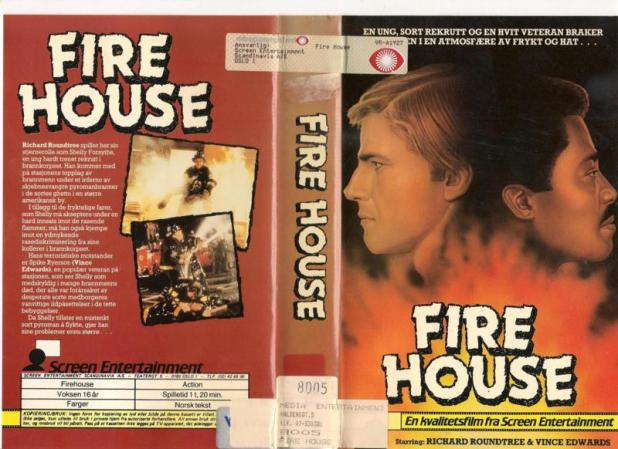
MILL CREEK THE SWINGIN’ SEVENTIES: Firehouse (1971)

Richard Roundtree — a star from Shaft making a TV movie a year later, was that a step back? — is Shelly Forsythe, a black firefighter bringing racial tensions to a firehouse. This is even worse when Spike Ryerson (Vince Edwards), the oldest firefighter, claims that an arsonist has to be black. The men include Val Avery as cook Sonny Caputo, Richard Jaeckel as Hank Myers, Michael Lerner as Ernie Bush and Andrew Duggan as Captain Jim Barr.

This was based on Report From Engine Company 82 by retired FDNYC firefighter Dennis Smith. Another thing you may catch — the firehouse for this movie would one day be the Ghostbusters’ building.

What’s strange is that this became a TV series with Richard Jaeckel the only cast member to appear in both the TV movie and the series. They dropped the black firefighter angle for the show when that’s the main reason we’re watching this.

To save money, most of the firefighting is newsreel footage. That said, the idea that Shelly has to fit in with racist co-workers, have the black community not think he’s an Uncle Tom and still not die in a fire are all great plot elements.

Firehouse was directed by Alex March (Serpico, Shane and Paper Moon — the TV shows) and written by Frank Cucci (The Andros Targets)

You can watch this on Tubi.

MILL CREEK THE SWINGIN’ SEVENTIES: Evel Knievel (1971)

Robert Craig Knievel was the hero of my childhood. After all, who else was brave, insane or dumb enough to attempt more than 75 ramp-to-ramp motorcycle jumps in his life, a life that should have ended way shorter than the 69 hellacious years that he lived on this planet with?

How does one become a daredevil? For Evel — who was given that name by a jail guard — it all started with rodeos, ski jumping and pole vaulting. Upon returning from the army, he started a semi-pro hockey team, the Butte Bombers. In one of their games, where they played against the Czechoslovakian Olympic ice hockey team, Evel was ejected from the game minutes into the third period and left the stadium. When the Czechoslovakian officials went to collect the money for playing, they learned that it had been stolen.

After the birth of his son, Evel started the Sur-Kill Guide Service, which was really just a front for poaching in Yellowstone National Park. He was arrested for this and then hitchhiked with a 54-inch rack of antlers the whole way to Washington to plead his case.

It was around this time that Evel decided to stop committing crimes — don’t worry, he kept up with them — and get into motorcycle riding. A broken collarbone and reading Success Through a Positive Mental Attitude led to Evel working for the Combined Insurance Company of America, a job he held for a few months until they wouldn’t promote him to vice president after a few months. Whew Evel! And then a failed Honda dealership led him to work for Don Pomeroy at his motorcycle shop, where the owner’s son Jim taught him how to do a wheelie.

This led Evel to do his first stunt show that he promoted entirely on his own, even serving as his own MC. He did a few wheelies and then jumped a box filled with rattlesnakes and mountain lions. This is where you either say, “This is stupid” or become fascinated. Me? How awesome is it to have a box filled with dangerous wildlife and decide to jump a motorcycle over it? Yep, this is why I was obsessed with Evel as a child.

This led to an obsession with jumping more things — like cars — and the unfortunate side effect of getting hurt nearly every time. He crashed around twenty times — huge, incredibly violent crashes — and his Guinness Book of World Records entry states he suffered 433 bone fractures by the end of 1975.

In Evel’s 1999 autobiography, he published this photo, which showed his many, many broken bones and injuries. You can learn more at http://www.stevemandich.com/evelincarnate/knievelinjuries.htm

Evel crashed at Caesar’s Palace. He crashed jumping Pepsi trucks. He crashed outside the Cow Palace. And then he started dreaming big — he wanted to jump teh Grand Canyon. Why? Take it from the man himself: “I don’t care if they say, “Look, kid, you’re going to drive that thing off the edge of the Canyon and die,” I’m going to do it. I want to be the first. If they’d let me go to the moon, I’d crawl all the way to Cape Kennedy just to do it. I’d like to go to the moon, but I don’t want to be the second man to go there.”

The government would never allow Evel to do this. It’s even a big part of this movie — just look at the posters. Finally, he’d jump Snake River Canyon, an event whose close circuit telecast bombed, almost bankrupting a young Vince McMahon Jr. before he even bought his father’s WWF. He used the Skycycle and nearly drowned when again he failed to make the jump.

A year later, Evel would crash again jumping thirteen buses in front of Wembley Stadium. After the crash, despite breaking his pelvis, Knievel made it to his feet and talked to the crowd, announcing his retirement: “Ladies and gentlemen of this wonderful country, I’ve got to tell you that you are the last people in the world who will ever see me jump. Because I will never, ever, ever jump again. I’m through.” Frank Gifford begged him to go out on a stretcher, but Evel said “I came in walking, I went out walking!”

Of course, Evel was a carnie and kept on pulling off stunts until 1977, when a Jaws-inspired leap broke both his arms and nearly blinded a cameraman.

The life of Evel is a complicated story to tell. On one hand, he was an entertainer, out there in a jumpsuit covered with stars and a cape. On the other, he was a man who believed in keeping his word and battling the evils of drugs (a Hell’s Angel threw a tire iron on stage during one of his jumps as he had often battled against the group for being drug dealers and he ended up putting three of them in the hospital). And on another hand, he lost his Ideal Toy and Harley Davidson endorsements when he went wild on Shelly Saltsman, a sports promoter, Hollywood producer and author of the book Evel Knievel on Tour, which alleged that Evel used drugs and abused his family. To get back at him, despite having two broken arms, Evel cornered him on the 20th Century Fox backlot and beat him unmerciful with a baseball bat.

When the news of Knievel’s attack came up on the news, Saltman’s elderly mother had a heart attack and died three months later. Evel got a six month work furlough and was ordered to pay $12.75 million in damages, money he never paid. After the stunt icon’s 2007 death, Saltman decided to sue his estate for $100 million US dollars with interest, but he never got a dime before he died in 2019.

As for Evel, even his death was an event. His packed funeral was presided over by Pastor Dr. Robert H. Schuller — who baptized Evel in 2007 at his Crystal Cathedral, which led to an influx of new parishioners — with Matthew McConaughey giving the eulogy. But first — there were fireworks. Before he died, Evel said that he “beat the hell out of death.”

I told you all that to tell you about this movie.

The film begins with Evel — played by George Hamilton — giving a speech directly to us, the viewer: “Ladies and gentlemen, you have no idea how good it makes me feel to be here today. It is truly an honor to risk my life for you. An honor. Before I jump this motorcycle over these 19 cars — and I want you to know there’s not a Volkswagen or a Datsun in the row — before I sail cleanly over that last truck, I want to tell you that last night a kid came up to me and he said, “Mr Knievel, are you crazy? That jump you’re going to make is impossible, but I already have my tickets because I want to see you splatter.” That’s right, that’s what he said. And I told that boy last night that nothing is impossible. Now they told Columbus to sail across the ocean was impossible. They told the settlers to live in a wild land was impossible. They told the Wright Brothers to fly was impossible. And they probably told Neil Armstrong a walk on the moon was impossible. They tell Evel Knievel to jump a motorcycle across the Grand Canyon is impossible, and they say that every day. A Roman General in the time of Caesar had the motto: “If it is possible, it is done. If it is impossible, it will be done.” And that, ladies and gentlemen, is what I live by.”

Then we get a movie version of Evel’s life. It was originally written by Alan Caillou, who played King Sancho in The Sword and the Sorcerer. Hamilton wanted John Milius to rewrite it. Upon reading the original script, he launched it into Hamilton’s pool and beat it with an oar. That meant that he was the new writer.

Milius would go on to say that he preferred the final product to many of the other films shot from his scripts. “They didn’t restrain it or tone it down, they shot the script. The guy is just as obnoxious and full of hot air as he was in the script. Just as full of life and vitality too. He’s Evel Knievel! He wouldn’t take a dime off of anybody.”

Hamilton would later tell Pop Entertainment, when asked about the film, “The thing about it is at that time Evel was not famous. When we made that movie he took a jump over the fountains and splattered. He had not become a Mattel toy at that time. I put a writer on it named John Milius – who [later] wrote Apocalypse Now. He was the best of the writers of that era. I got him to write the script for me. Then Milius made me read the script to Evel. I realized he was kind of a sociopath and was totally messed. Then all of sudden Evel started to adopt lines out of the movie for himself. So his persona in the movie became more of his persona in real life. He would have been every kid’s hero on one hand, but then he went and took that baseball bat and broke that guy’s legs and that finished his career in the toy business. Evel was very, very difficult and he was jealous of anybody that was gonna play him. He wanted to portray himself and he did go and make his own movie later on. He had a great perception of this warrior that he thought he was and that was good. Then he had this other side of himself where he’d turn on you in a minute. Success is something that you have earn. You have to have a humility for it, because it can leave you in a second. It may remember you but it can sure leave you. I think if you don’t get that and you don’t have gratitude for what you are and where you are it doesn’t come back and it goes away forever.”

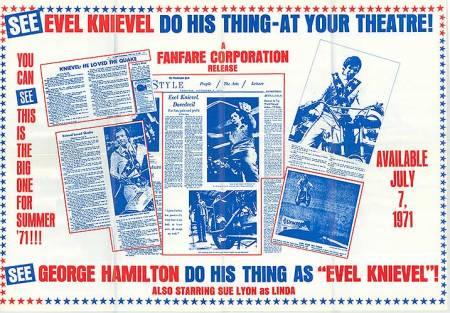
Evel Knievel ends with our hero successfully making a jump at the Ontario Motor Speedway and driving to a dirt road that leads to the Grand Canyon — which is about 456 miles if you take I-40. Again, he looks right at the camera and says, “Important people in this country, celebrities like myself — Elvis, Frank Sinatra, John Wayne — we have a responsibility. There are millions of people that look at our lives and it gives theirs some meaning. People come out from their jobs, most of which are meaningless to them, and they watch me jump 20 cars, maybe get splattered. It means something to them. They jump right alongside of me — they take the bars in their hands, and for one split second, they’re all daredevils. I am the last gladiator in the new Rome. I go into the arena and I compete against destruction and I win. And next week, I go out there and I do it again. And this time — civilization being what it is and all — we have very little choice about our life. The only thing really left to us is a choice about our death. And mine will be — glorious.”

Sue Lyon, who debuted as Lolita in the film of the same name, plays Evel’s woman. She’d go on to be in all manner of movies that I could go on for hours about like End of the World and Alligator.

George Hamilton seems as far from the real Evel as you can get. But he was a carnie too, as Milius related that Hamilton was “A great con-man, that’s what he really is. He always said, “I’ll be remembered as a third-rate actor when in fact, I’m a first-rate con man.””

Evel made one more movie. You should watch it: Viva Knievel!

Don’t have the box set? You can watch this on Tubi. or download it on the Internet Archive.
MILL CREEK THE SWINGIN’ SEVENTIES: The Deadly Trap (1971)

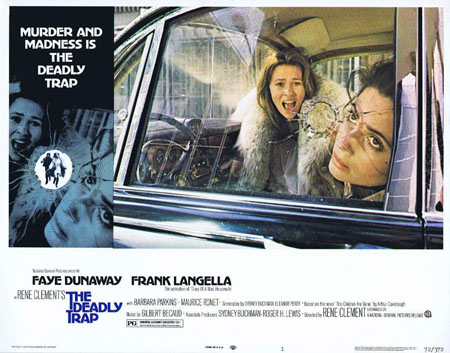
Directed by René Clément, who wrote this with Daniel Boulanger, Sidney Buchman and Ring Lardner, Jr., The Deadly Trap is based on The Children are Gone by Arthur Cavanaugh.

Jill (Faye Dunaway) and her husband Philipe (Frank Langella) are Americans in Paris. Phillipe may just work in an office now, but he used to be in a spy group that wants one more mission. The lovely couple also is having issues, because Jill is losing her mind and thinks that Phillip is cheating on her. This isn’t helped when their neighbor Cynthia (Barbara Parkins) knows way too much. And oh yeah, she keeps blacking out, which nearly kills the kids in a car accident and then the little fellers suddenly go missing. The cops think the mom did it. Phillipe can’t reveal his past. And Jill keeps going bonkers.

Rex Reed said ”Rene Clement, the French Alfred Hitchcock, has sculptured a masterwork of suspense and human emotions that put sweat on my palms and kept it there.”

What movie did he see?

I kid, I kid. There are some effective moments here, particularly the car crash that sends kids and mother sailing into the street. But you have to wonder about a criminal or spy group that is dumb enough to just leave a gun out around some kids. Surely they know better. No, they don’t.

You can watch this on YouTube.

MILL CREEK THE SWINGIN’ SEVENTIES: Congratulations, It’s a Boy! (1971)

Directed by William A. Graham (Return to the Blue Lagoon, Change of Habit) and written by Stanley Z. Cherry, this movie finds Johnny Gaines (Bill Bixby) learning that he has a son named B.J. (Darrell Larson) whom he’s never known, all while he’s still sleeping with 16-year-olds. Or nearly sleeping with them, as his kid shows up right before his initials happen to his dad.

Johnny is still a boy, protected by his father Al (Jack Albertson) and mother Ethel (Ann Sothern) who are starting to wonder why their son doesn’t want to settle down with Edye (Diane Baker). Can Johnny settle down and become a father to the son he never knew while maybe not being someone who double books dates and tries to get his son drunk to go out with someone as his replacement?

Plus: Tom Bosley as Edye’s dad and Judy Strangis in the cast (she was Dyna Girl!).

Don’t have the box set? You can watch this on Tubi.

Spagvemberfest 2023: Trinity Is Still My Name (1971)

…continuavano a chiamarlo Trinità (They Still Called Him Trinity) is a sequel to, you knew it, They Call Me Trinity and was, for some time, the biggest Italian movie of all time.

It starts by reminding us that Bambino (Bud Spencer) and Trinity (Terence Hill) are as much the same as they are different. Bambino and Trinity both come across the same four men, they both steal their beans and eat them, but they do it in different ways. Bambino with his brawn and Trinity with his brains.

Those same four men follow the two of them back to their family home, where their mother Farrah (Jessica Dublin) robs them at gunpoint. Then, their father (Harry Carey, Jr.) acts as if he’s on his deathbed. He asks the brothers to get along, for once, and help each other be the best outlaws that they can be. The problem is that for as much of a scoundrel as Trinity is, he can’t not be a good person. And that keeps rubbing off on Bambino, even if it makes him angry that he has to go along with his little brother.

For example, they keep finding the same family in a stagecoach and have to help them and give them any money they’ve stolen. Even when challenged to a duel by Wild Card Hendricks (Antonio Monselesan), Trinity just keeps showing him how fast he is without killing him. This is after he’s surprised an entire saloon with his insane card sharp skills, showing off multiple shuffles and cuts of the deck.

An episodic movie to say the very least, this ends with the brothers helping some monks who have been taken over by criminals. My favorite part is in this scene, as Bambino spends an inordinate amount of time confessing his sins as a monk is shocked with every transgression.

Directed by Enzo Barboni, who wrote this with Gene Luotto, this would be the last official sequel until 1995’s Sons of Trinity. There are tons of retitled movies and ones that have Trinity in the name to watch until you get to that or you can watch Spencer and Hill in other films like Who Finds a Friend Finds a TreasureOdds and EvensCrime BustersDouble TroubleMiami Supercopsall the Way BoysTurn the Other CheekI’m for the Hippopotamus and Go for It.

You can watch this on Tubi.

Spagvemberfest 2023: Duck, You Sucker! (1971)

According to Peter Bogdanovich, the original title for this movie — Duck, You Sucker! — was meant by Leone as a close translation of the Italian title Giù la testa, coglione! which means Duck your head, balls!

For some reason, Leone thought that this was a common phrase in America.

That’s why this is also called A Fistful of Dynamite and Once Upon a Time … the Revolution.

In America, a lot of the movie was cut, as it was too violent, profane or politically sensitive. The movie starts with a quote from Mao Zedong that says, “The revolution is not a social dinner, a literary event, a drawing, or an embroidery; it cannot be done with elegance and courtesy. The revolution is an act of violence…” Moments later, a man’s bare ass is on screen.

This was sold in America as a light-hearted follow-up to Leone’s Dollars movies.

It is not.

Juan Miranda (Rod Steiger) leads a gang that is mostly made up of his children, robbing rich people in a train and not part of any revolution at all. John H. Mallory (James Coburn) is an Irish man in Mexico to be a silver prospector. Juan wants him to be part of his crew that robs a bank. John refuses and gets set up as a murderer, so he has to come along.

John is working for Dr. Villega (Romolo Valli) as an explosives expert, something he did as an Irish Republican. They blow up the bank that Juan wanted to rob. It has no cash, instead being used to hold prisoners. This makes Juan a hero of the revolution.

Colonel Günther Reza (Antoine Saint-John) kills nearly everyone, including so many of Juan’s family members, including his dad. He runs into their headquarters and is nearly killed before being captured and sent to a firing squad. John learns that Dr. Villega was tortured and gave them up. This reminds him of how he and his friend Nolan (David Warbeck) had a similar thing happen, as he gave up John to British soldiers. John killed them all and left Ireland. He saves Juan by racing in on his motorcycle, yelling for him to duck and blowing every soldier to chunks.

This is a film of how people see heroes. Juan isn’t someone for the revolution and becomes one. John is someone who believed in a cause and love and now just blows things up. Dr. Villega is destroyed by realizing that he saved himself instead of those he rallied to the cause.

Oh yeah — I know it goes without saying that Morricone’s music is always making these movies epic, but here it is somehow even more glorious.

The end of this destroys me, as John is shot in the back and Juan destroys Reza with bursts from a gigantic gun. It’s not a heroic action like Django but a man in pain just obliterating someone when that’s all he has left. As John lies near death, he remembers when times were different, when he and Nolan were close, when they both loved Coleen (Vivienne Chandler, who is in Hammer’s Lust for a Vampire and Twins of Evil; she was also in Asia’s video for The Smile Has Left Your Eyes” and was rebel pilot Dorovio Bold in Return of the Jedi; she was in a relationship and had a son and daughter with Kate Bush’s brother John Carder Bush and influenced the photos that he did on her album covers. She styled Kate on her artwork for Hounds of Love).

Then everything explodes.

You can watch this on Tubi.

Spagvemberfest 2023: Red Sun (1971)

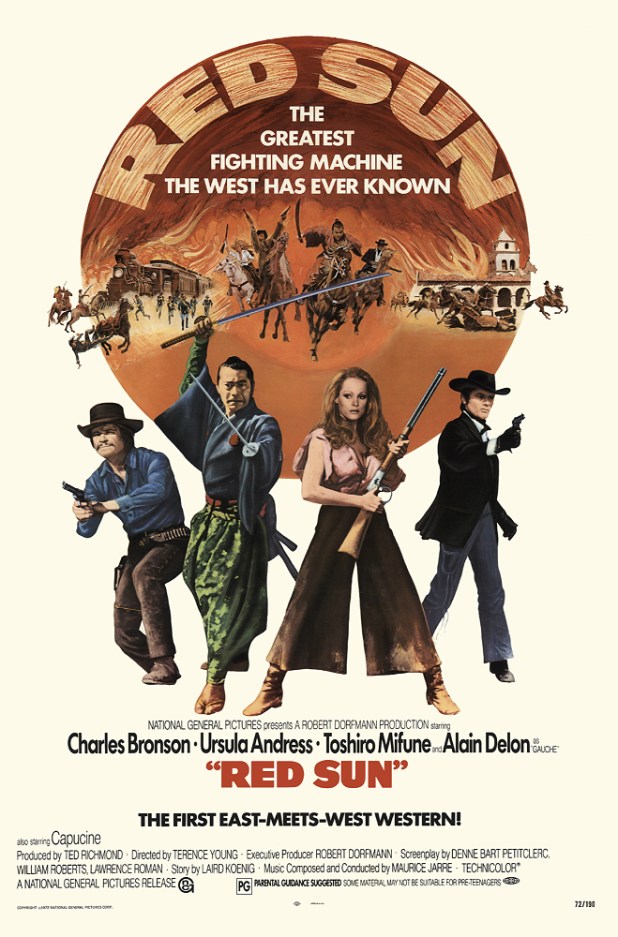
Look, I know this is directed by the British Terence Young and has a cast that is multinational, but this movie is so great I’m inclined to overlook such things.

It stars one of the Magnificent Seven, Charles Bronson, and one of the Seven Samurai, Toshiro Mifune. At the time, Bronson was a huge deal everywhere but the U.S. In fact, in Japan, he was known as the face of the Mandom cologne (and still is, I have friends who only know him as that) in commercials directed by the man who made Hausu, Nobuhiko Obayashi.

Link Stuart (Bronson) and Gauche (Alain Delon, can this movie have any more suave dudes in it?) have robbed a train of about $400,000. That should be enough to set them up for life, but then they discover that a Japanese ambassador is on his way to Washington to give the President a gold sword. Gauche kills one of the bodyguards and blows up the train car, injuring Link. He’s left for dead but nursed back to help by the Japanese. The surviving bodyguard, Kuroda Jubei (Mifune), takes a blood oath to get the sword back and kill Gauche. Otherwise, both Japanese will have to commit ritual seppuku and kill themselves for their loss of honor. Link is asked to lead Kuroda to Gauche but keeps trying to lose him.

Gauche has killed all of the men and buried the money. So if he dies, Link won’t learn where his rightful stolen money is. Over time, he comes to respect the honor that Kuroda has, a man who feels that he is the last of his time as such things as duty and having a moral code are dying. The plan to get the sword and the money isn’t honorable at all. They kidnap Gauche’s lover Cristina (Ursula Andress) and offer to switch her for what they want. An attack by Commanches delays things, but Cristian soon learns that Gauche isn’t the honorable criminal she thought he was.

By the end, only Gauche, Link, Kuroda and Cristina are left alive. Kuroda realizes that he needs to kill Gauche to get his honor, but Link also needs what is his. That hesitation costs him his life, a fact that places his friend’s need above money, as Link blasts Gauche and promises — and fulfills that promise, even if being caught will see him lynched — to return the sword.

I love this IMDB fact: Mifune entertained the cast and crew throughout the entire production with his refined culinary skills, bringing over a supply of Japanese meats, watercress, seaweed and other ingredients. He would also exchange recipes for French and Italian dishes, including spaghetti.

How amazing is it that this is written by Laird Koenig, the same person who wrote The Little Girl Who Lives Down the Lane?

This movie is pretty much everything I love. The swagger of Bronson, the detached cool of Mifune, the cockiness of Delon and Andress looking incredible even when fighting inside a burning field. Even Cappucine is in it!

You can watch this on Tubi.

UNSUNG HORRORS HORROR GIVES BACK 2023: Web of the Spider (1971)

Each October, the Unsung Horrors podcast does a month of themed movies. This year they will once again be setting up a fundraiser to benefit Best Friends, which is working to save the lives of cats and dogs all across America, giving pets second chances and happy homes.

Today’s theme: Haunted house

After Castle of Blood‘s disappointing box office, Antonio Margheriti felt he could remake the film in color and have it be more successful.

Edgar Allan Poe (Klaus Kinski) is our narrator and Kinski shows up for the beginning and the ending of the movie. He’s interviewed by Alan Foster (Anthony Franciosa), who challenges him as to the truth of his stories. This leads to a bed with Lord Blackwood (Enrico Osterman) about spending a night in his castle, a place where he soon meets Elisabeth (Michèle Mercier, Black Sabbath) and quickly falls into love — and bed — with her before she announces that she’s no longer alive.

There’s also Julia (Karin Field), William Perkins (Silvano Tranquilli) and Elisabeth’s husband,Dr. Carmus (Peter Carsten). The ghosts need his blood to come back to life, but Elisabeth helps him to escape, only for him to impale himself on the gate, dying just as Poe gets there.

I adore that the tagline of this is “Based on Edgar Allan Poe’s Night of the Living Dead.” He did write a poem “Spirits of the Dead” and the 1932 movie The Living Dead was based on Poe’s “The Black Cat” and “The System of Doctor Tarr and Professor Fether” as well as Robert Louis Stevenson’s The Suicide Club. But no, he has nothing to do with Romero’s movie.

I really like the soundtrack by Riz Ortolani but this can’t compare to the black and white — and yes, Barbara Steele appearance — in the original. That said, Kinski is awesome in every second he’s on screen, looking like a complete madman.

CHILLER THEATER MONTH: Lust for a Vampire (1971)

EDITOR’S NOTE: Lust for a Vampire was on Chiller Theater on Saturday, February 5 1977 at 1 a.m. It also was on the show on December 30, 1978. It aired as To Love a Vampire.

After the success of The Vampire Lovers. Tudor Gates was hired to write the sequel, starting with a story he hadn’t finished for Mario Bava all about a girl school serial killer. Jimmy Sangster directed and didn’t like the fact that Hammer wanted a pop song “Strange Love” by Tracy. Also, British censors saw how many lesbian moments were in the first film and made sure even less would show up here.

In the deserted chapel at Castle Karnstein, Count (occultist, conjurer, DJ, sculptor, sheep farmer, writer, ballet dancer, flamenco guitarist and photographer Mike Raven) and Countess Karnstein being their daughter Carmilla (Yutte Stensgaard) back.

Richard LeStrange (Michael Johnson) has come to the area to write a book on vampires and this seems like the right place for it. He’s immediately seduced by Mircalla Herritzen, who is…Carmilla, subverting the lesbian mood of the first movie.

Lots of women lose their lives to the vampire and it all ends in fire, as all Hammer movies must. I like this movie, but I love the first and third movies in the trilogy. This would have been better, I feel, if Peter Cushing was able to be in it, as he was caring for his sick wife, and if Ingrid Pitt was the lead.

You can watch this on Tubi.

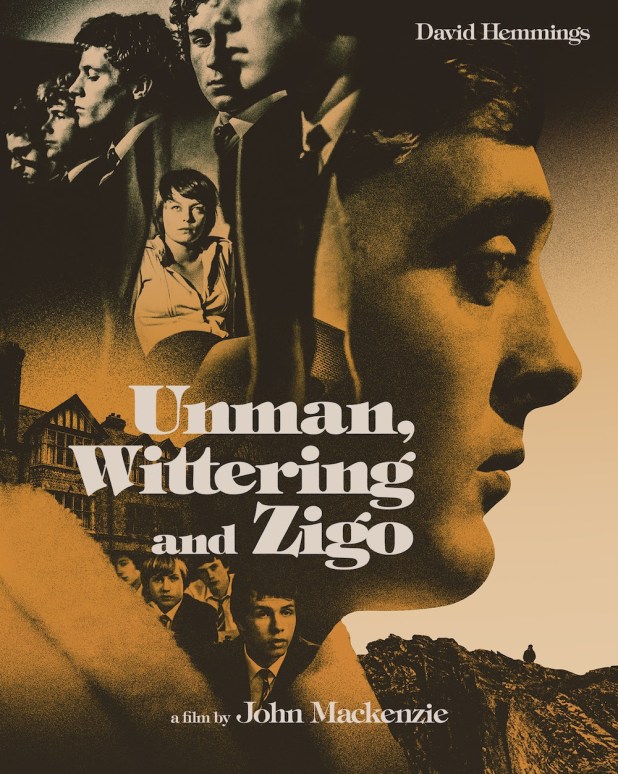
UNSUNG HORRORS HORROR GIVES BACK 2023: Unman, Wittering and Zigo (1971)

Each October, the Unsung Horrors podcast does a month of themed movies. This year they will once again be setting up a fundraiser to benefit Best Friends, which is working to save the lives of cats and dogs all across America, giving pets second chances and happy homes.

Today’s theme: Physical media

John Ebony (David Hemmings, who also produced this) is an idealistic young teacher who arrives at Chantrey School for Boys to fill the shoes of the recently fallen-off a-cliff Pellham. Yet this somewhat of a dream job is anything but, as he lives on the school’s grounds with his wife Sylvia (Carolyn Seymour), who feels trapped. She struggles to fit in with the older wives who have been there for decades, just as John is challenged by the juvenile delinquents he must somehow teach.

Directed by John Mackenzie and written by Simon Raven and based on a radio play by Giles Cooper, this movie gets dark when the boys in his class tell John that they killed the last teacher and they’ll do the same if he doesn’t do exactly what they say. No one believes him, not even his wife.

She makes the mistake of thinking that she can connect with the boys much more than she can with the much older teachers and their wives, even sharing a cigarette with her. Yet she’s defiant in the face of them threatening her with gang rape, which luckily is stopped at the last moment.

I’d never seen this movie, but it really gets across the way that British schools can lead to a legacy of brutal men who do the same thing in real life that they did in class. Seymour is also incredible in this. I’d never seen her in a movie before and now I’m seeking out other roles that she performed in.

The Arrow blu ray release of Unman, Wittering and Zigo contains a new audio commentary by Sean Hogan and Kim Newman; an appreciation by Matthew Sweet; a featurette with several of the cast members looking back at the movie; an original 1958 recording of Giles Cooper’s radio play; a trailer; an image gallery; a double sided fold-out poster featuring original and newly commissioned artwork by Eric Adrian Lee, which also appears as a reversible sleeve and book with writing by Kevin Lyons and Oliver Wake. You can get it from MVD.