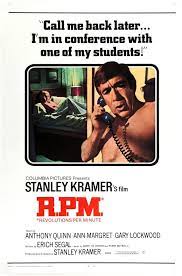
SUPPORTER DAY: RPM (1970)

EDITOR’S NOTE: Today’s movie is brought to you by AC Nicholas, who has graciously become a Big B&S’er, a monthly supporter of the site and got to pick an entire week of movies. Would you like to have me write about the movies of your choice? It’s simple!

  1. Go to our Ko-Fi site and donate. There’s no set amount and I won’t tell you what to do. In fact, if you just keep reading for free, we can still be friends.
  2. Join as a monthly member for just $1. That makes you a Little B&S’er.
  3. As a Medium B&S’er at just $3 a month, if you pick a movie or a director, I’ll write about them for you. In fact, I’ll do one for each month you subscribe and even dedicate the post to you.
  4. For $5 a month, you basically get some major power. As a Big B&S’er, I’ll write an entire week on any subject you’d like. How awesome would that be? In fact, I’ll do it for every month you’re a member. Do you think any of your other movie sites will do that for you?

Stanley Kramer called his movies heavy dramas but they’re what are often called message films. A liberal, he brought issues to the public eye through his movies like the dangers of nuclear war (On the Beach), fascism (Judgement at Nuremberg, Ship of Fools), creationism against evolutionism (Inherit the Wind), greed (It’s a Mad, Mad, Mad, Mad World) and racism (The Defiant OnesGuess Who’s Coming to Dinner).

While Pauline Kael saw his movies as “melodramas,” and “irritatingly self-righteous,” she also had to realize that they had “redeeming social importance.”

But in 1970, maybe he was past his expiration date.

Did he feel like Professor F.W.J. “Paco” Perez (Anthony Quinn) does in this movie? For years, Paco has been the radical, the one that stood outside the mainstream. He says at one point that he fought Franco and McCarthy and has learned so much, but the young people don’t want to learn anything. Did Kramer feel that way, an old man in the New Hollywood that was so much more in touch with the youth?

Is Paco just a fifty-year-old fanny chaser, as out of touch with the time as the administration he’s been asked to be a part of?

Radical student activists — Paco is impressed that the blacks and whites have worked together — occupy the administration building with a list of 12 demands. President Tyler (John Zaremba, who spent the 70s and 80s wandering the Earth searching for the best beans for Hills Brothers Cofee) resigns and the Board of Trustees looks at the list that the students have written up of the presidents they would be happy with.

Top on the list? Paco.

It’s after midnight and he’s asleep with his grad student girlfriend Rhoda (Ann-Margret). Yet he’s urged to rush out and fix things. The next day, he starts his new job, showing up on a motorcycle.

Paco reads their demands and many of them, like inner-city scholarships, a college reinvestment program, no military research on campus and adding an African American to the all-white Board of Trustees make sense. But the idea that students can hire and fire faculty doesn’t work for him. He’s already reached the first time where his theory and reality begin to not work together.

With Rossiter (Gary Lockwood) and Steve Dempsey (Paul Dempsey) leading the students, Paco tries to be the person between them and the Board of Trustees. But when Rossiter says that he will destroy all of the campus’ computers, Paco has to make the tough decision to call in the police. They come charging in with tear gas, turning their hero professor into just one of the old people never to be trusted. When the cops round up the students, Rhoda is one of them.

What they don’t know is that Paco has signed off on their bail. Yet he still walks past the crowd and is screamed and booed at. He has learned the hard way that the lessons of books and classrooms often mean little in the real world.

I really liked the songs by Melaine, “We Don’t Know Where We’re Goin’” and “Stop! I Don’t Wanna Hear It Any More,” that were in this. It’s quite preachy, but it also feels like this movie was Kramer attempting to determine where he fit in any longer. Then again, Kramer would say that this was his least favorite film that made the lowest amount of money. The dialogue may get silly sometimes, but that’s because it’s written by Erich Segal, who also did Love Story.

After this movie, however, I understand why my dad and other older male relatives would say Ann-Margaret’s name with the reverence they otherwise reserved for the saints.

You can watch this on Tubi.
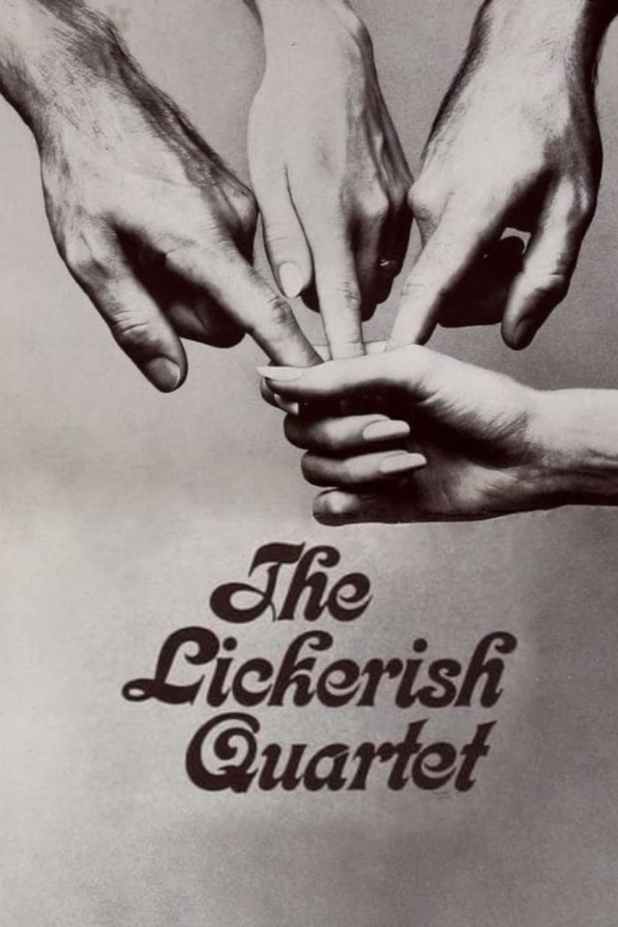
SUPPORTER DAY: The Lickerish Quartet (1970)

EDITOR’S NOTE: Today’s movie is brought to you by AC Nicholas, who has graciously become a Big B&S’er, a monthly supporter of the site and got to pick an entire week of movies. Would you like to have me write about the movies of your choice? It’s simple!

  1. Go to our Ko-Fi site and donate. There’s no set amount and I won’t tell you what to do. In fact, if you just keep reading for free, we can still be friends.
  2. Join as a monthly member for just $1. That makes you a Little B&S’er.
  3. As a Medium B&S’er at just $3 a month, if you pick a movie or a director, I’ll write about them for you. In fact, I’ll do one for each month you subscribe and even dedicate the post to you.
  4. For $5 a month, you basically get some major power. As a Big B&S’er, I’ll write an entire week on any subject you’d like. How awesome would that be? In fact, I’ll do it for every month you’re a member. Do you think any of your other movie sites will do that for you?

When this movie was first released, at the dawn of what would be porn chic, Andy Warhol and Vincent Canby both spoke highly of it. Today, it wouldn’t seem so incendiary. In 1970, it was mind blowing.

An adult movie is watched by a wealthy couple played by Frank Wolff (The Great Silence) and Erika Remberg (Cave of the Living Dead) and their son (Paolo Turco, What Have They Done With Your Daughters?). That night, at a carnival, they meet a woman who they think is the actress — it’s actually Annie Carol Edel (Crazy Desires of a Murderer) — they’ve just watched. She’s played by Silvana Venturelli and she soon seduces the entire family, forcing them to admit their desires and secrets.

Shot Italian style — a plan to use live sound didn’t work out — and with a score by Stelvio Cipriani, this all becomes an exercise in style, like the scene in a library where words are zoomed into and books are thrown. I also am amazed that the girl who may or may not be the actress is willing to spend any time with the son, who seems devoted to magic tricks and telling people his strange myth-based dreams, much less making love to him in a field outside the castle he lives in.

Director Radley Metzger, who wrote the script with Michael DeForrest, this movie just hints at how far things would be taken in the future. As it is, in Pittsburgh, it played at The Guild, a theater in Squirrel Hill that became Gullifty’s, another place that is gone.

Spagvemberfest 2023: Giunse Ringo e… fu tempo di massacro (1970)

Ringo, It’s Massacre Time (AKA Wanted RingoRevenge of Ringo and Reward for Ringo) is at once an Italian Western and a mystery. A series of deaths at a ranch — the victims are all foaming at the mouth — brings Mike Wood (Mickey Hargitay) to solve things. Yet he soon mysteriously disappears (he was actually the star of the movie, but had to fly home to California when he learned that his son Zoltan was mauled by a tiger at Jungleland during a publicity shoot for his wife Jayne Mansfield) and his brother Ringo (Jean Louis) comes on board.

Director and writer Mario Pinzauti starts with those basics and then goes wild, bringing in elements of the giallo and even voodoo dolls, something you may not see in a single other Italian Western. Pinzauti made several movies that cashed in on other films, like Let’s Go and Kill SartanaMandingaPassion PlantationDue Magnum .38 per una città di carogne and Clouzot & C. contro Borsalino & C., which looks like Borsalino quite a lot from the poster.

There is a femme fatale named Pilar (Lucia Bomez) and a witch — yes! — that lives in a cave that has caused all of this. The film feels like it was being written as it was shot, as people literally stop speaking in scenes and some characters walk on and never get seen for the rest of the movie. It’s just a blast of complete wildness and while I appreciate just how strange it all is, if you’re looking for a complete film, this is in no way it.

You can watch this on YouTube.

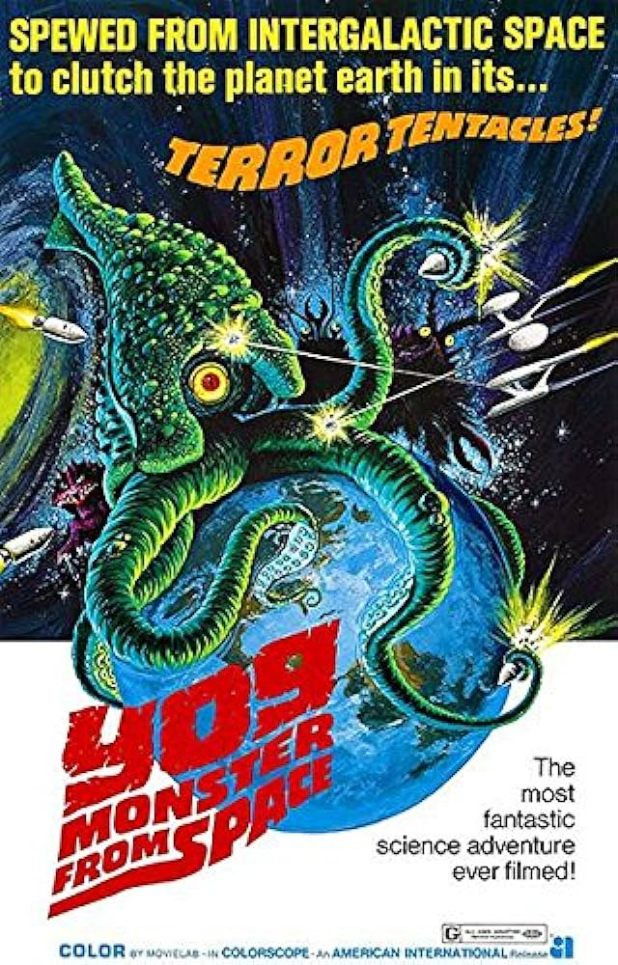
THAN-KAIJU-GIVING: Yog: Monster From Space (1970)

Also known as Space Amoeba and Gezora, Ganime, Kamēba: Kessen! Nankai no Daikaijū (Gezora, Ganimes, and Kamoebas: Decisive Battle! Giant Monsters of the South Seas), this Toho movie is all about aliens that come to Earth and create gigantic monsters from a kisslip cuttlefish, stone crab and mata mata. It’s like the best sushi menu ever except it wants to eat you.

The Helios 7 space probe has an incident near Jupiter — alert Pittsburgh news stations, Hell is full — and comes crashing back down here, bringing the space amoeba with it. It first creates a creature called Gezora, which is the cuttlefish. The humans have a bunch of weapons left over from World War II and set it on fire, killing it.

The stone crab, which is called Ganimes, is next and the humans defeat it as if it were the Tall Man or the Car. They lure it into a pit and blow it up.

The amoeba gets smart and makes two monsters at once, another Ganimes and a mata mata named Kamoebas. Humans grab some bats — a lot of bats — and the space amoeba loses control over the monsters, who start to fight one another. Then a volcano is made live and everything alien dies, all at once.

Never doubt the humans capacity for killing, whether you are a kaiju, space amoeba or some other monstrous being.

Directed by Ishiro Honda, this was written by Ei Ogawa who intended for it to be called Great Monster Assault and have entire continents be destroyed by alien monsters.

This was also the last science fiction film made under Toho’s studio system, which established a subsidiary called Toho Eizo to specialize in tokusatsu films. Most of the actors were released from their contracts, Eiji Tsuburaya’s — who died days before filming started — special effects department was closed and even Honda’s contract ended.

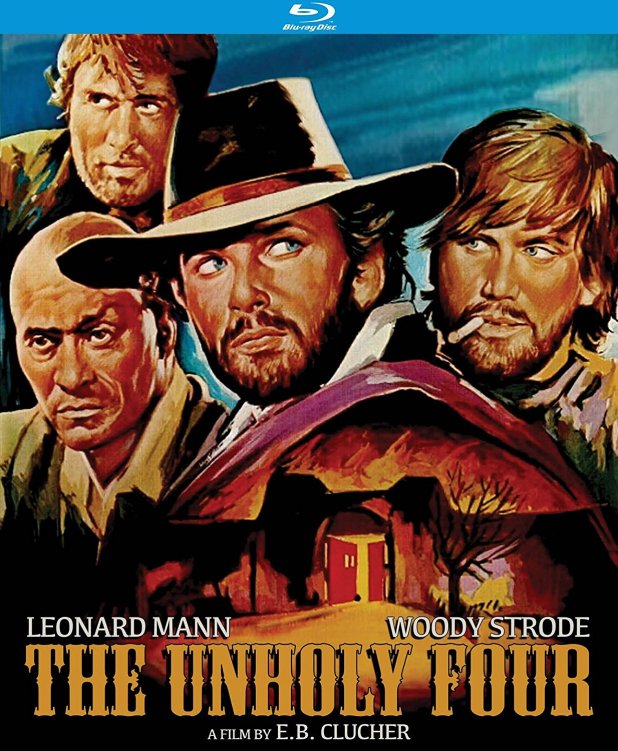
Spagvemberfest 2023: The Unholy Four (1970)

Ciakmull L’uomo della vendetta (Ciakmull the Vengeful Man) was directed by Enzo Barboni, the director of They Call Me TrinityTrinity Is Still My Name and Even Angels Eat Beans. He replaced Ferdinando Baldi, who was fired by the producer Manolo Bolognini because they fought over Baldi wanting Annabella Incontrera to play Sheila, the role that went to Ida Galli, who is also known as Evelyn Stewart.

Chuck Mool (Leonard Mann, Night SchoolFlowers In the Attic) escapes the institution he’s been in thanks to three men, Woody (Woody Strode), Silver (Pietro Martellanza) and Hondo (George Eastman). Chuck has no idea who he is and the men decide to ride with him in the hopes that he can get his memory back. He makes it to a town where he was supposedly the best gunfighter and is being counted on to choose sides in a war between the Caldwells, whose leader John (Helmuth Schneider) might be Chuck’s father and the Udos, whose leader tries to convince Chuck that he’s really his father. Turns out that Chuck’s half-brother Tom Udo (Lucio Rosato) has always hated him for being illegitimate and he was supposed to stay out of the way.

Pietro Martellanza and George Eastman were Barberi’s original picks to play Trinity and Bambino. There are hints of that movie here as some of the fights are comical and in the way that Hondo can shuffle cards, not to mention a bean eating sequence.

By the end, this movie finally remembers to have some action, but it’s helped along by the cast and a sparkling Riz Orlotani jazz score. It’s great!

The AKA for this is The Bastard of Dodge City which spoils one of the movie’s reveals.

You can watch this on Tubi.
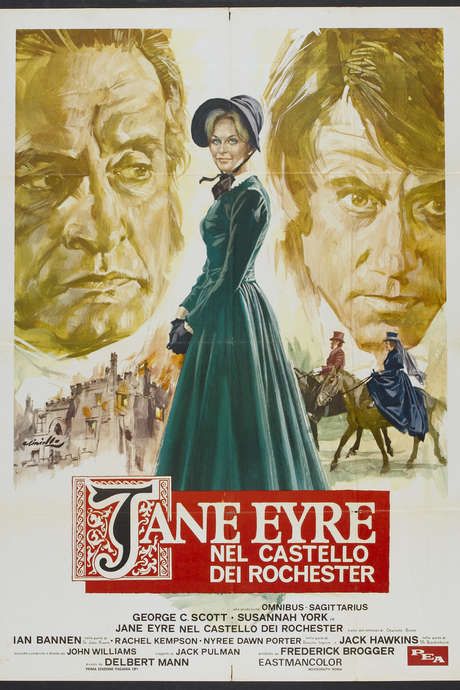
MILL CREEK THE SWINGIN’ SEVENTIES: Jane Eyre (1970)

This movie had its theatrical debut in the United Kingdom in 1970 and was released on television in the United States in 1971 where it won John Williams an Emmy for Outstanding Achievement in Music Composition.

Jane Eyre (Susannah York) is the kind of classic heroine you read about in high school whose best friend had a cough and was forced to sleep in the rain and died the next day and you wonder, “Why are they making us read this book?” Well, she’s also in love with her boss Edward Rochester (George C. Scott), who is much older than her and he’s the father of Adele, the girl she’s raising. But oh the foggy secrets of Thornfield Hall.

Based on the Charlotte Bronte book, this was directed by Delbert Mann, who had directed MartyShe Waits and David Copperfield. The script was from Jack Pulman, who had worked with Mann on the aforementioned David Copperfield and also wrote Kiss the Girls and Make Them Die and The Executioner.

Don’t have the box set? You can watch this on Tubi.

Spagvemberfest 2023: Shango (1970)

Anthony Steffen, born Antonio Luiz de Teffé von Hoonholtz and also known as Antonio Luigi de Teff, was born at the Brazilian embassy in Rome in what is known as the Pamphilj Palace. His noble family came from Prussia, with his great-grandfather being the Great Baron of Teffé and his father Manoel being a Formula One racer and a Brazilian ambassador. His grandaunt, Nair de Teffé von Hoonholtz, was the first female caricaturist of Brazil and wife of Brazilian President Hermes Fonseca. And yet his teen years were filled with war, as he and his family worked with Italian resistance fighters against the Nazis.

From 1965 to 1972, Steffen became the Italian Clint Eastwood, showing up in 27 Italian Westerns like Django the BastardArizona Colt ReturnsA Few Dollars for Django and Viva! Django as well as giallo movies such as Crimes of the Black CatThe Killers Are Our Guests and Play Motel. He retired to a jet set life based out of Brazil.

He also wrote this movie along with director Edoard Mulargia, who also made Don’t Wait, Django… Shoot!Tropic of Cancer and Escape from Hell, which is part of the two movies that make up Savage Island.

Shango (Anthony Steffen) has been framed for the death of a telegraph operator. That man just happens to be the only person that can inform a small Mexican town that the American Civil War is over, which allows Major Droster (Eduardo Fajardo) to keep the war going and lording over the people. Shango hangs from a wooden cage until Fernandez (Attilio Dottesio), his daughter Consuelo (Barbara Nelli) and son Pedrito (Giusva Fioravanti) help him to escape. Droster allows his henchman Martinez (Maurice Poli) to attack the people of this small Mexican barrio and this won’t stand. Shango must get his revenge and somehow goes from PTSD POV to avenging killing machine in moments. And it all ends in fire and self-sacrifice.

Giusva Fioravanti went from being a child star to — along with Francesca Mambro — becoming a leading figure in a far-right terrorist group, Nuclei Armati Rivoluzionari. His brother Cristiano had joined a far right youth section at the age of 13 and Giusva joined as well to protect him. But even a year in the U.S. didn’t make him any less violent or devoted to the cause. Along with his girlfriend Francesca Mambro, they had no real ideology but still caused plenty of mayhem, including potentially being behind the Bologna Massacre in 1980 that killed 85 people. Today, Fioravanti is a writer for Il Riformista focusing on human rights and the criminal justice system in Iran and the U.S.

You can watch this on Tubi.

MILL CREEK THE SWINGIN’ SEVENTIES: How Awful About Allan (1970)

Along with What’s the Matter With Helen?, this movie is one of the two collaborations between writer Henry Farrell and director Curtis Harrington.  It was the ABC Movie of the Week on September 22, 1970 and has stood the test of time as one of the better TV movies. And there’s some stiff competition for that.

Shot in just 12 days, it stars Anthony Perkins as Allan Colleigh, who has psychosomatic blindness after an accident — he left paint cans too close to a fire — that killed his abusive father and scarred his sister Katharine (Julie Harris from the 1963 version of The Haunting).

After Allan returns to their home after time in a mental hospital, he’s convinced that everyone is out to get him, including a new boarder with speaks in a hoarse whisper and one of his sister’s ex-boyfriends on the phone.

Joan Hackett — who was in two great TV movies, Dead of Night and The Possessed — appears as Allan’s former girlfriend. She gets caught up in his mania as rooms of the house explode into flames and he’s kidnapped by that mysterious ex.

How Awful About Allan has plenty of actors as comfortable on the stage as they were on the big or small screen. Perkins agreed to wear special contacts that completely made him blind so that his performance would be more realistic.

This didn’t get great reviews when it came out, but do the movie we love ever do?

Don’t have the box set? You can download this on the Internet Archive.

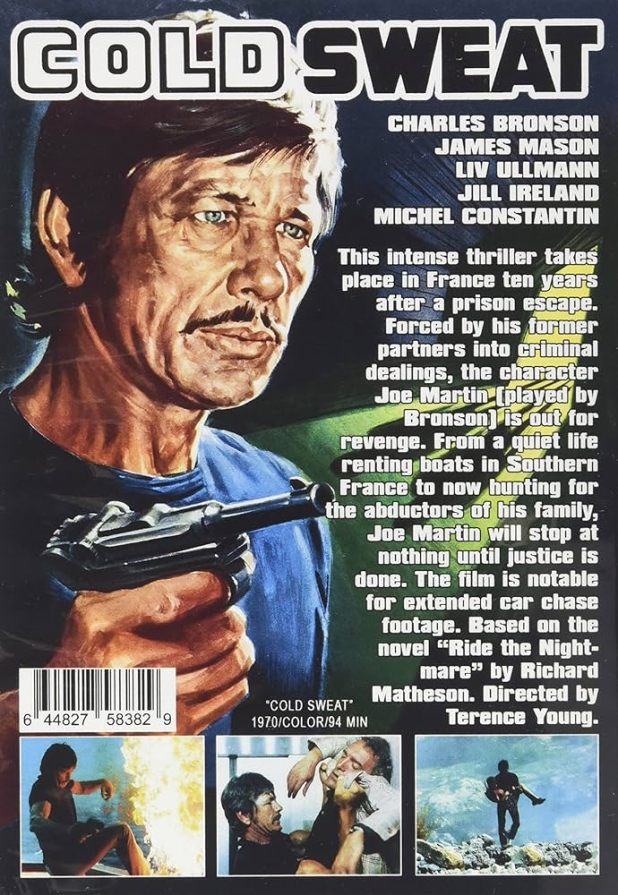
MILL CREEK THE SWINGIN’ SEVENTIES: Cold Sweat (1970)

Based on the Richard Matheson novel Ride the NightmareCold Sweat has Joe Moran — an American in France played by Charles Bronson — dealing with his wife and kids being taken by former associates that he once double-crossed.

Directed by James Bond director Terence Young from a script by Dorothea Bennett, Shimon Wincelberg and noir master Jo Eisinger, it shows just how quiet of a life Martin is living along with his wife Fabienne (Liv Ullmann) and daughter Michèle. But ten years ago, he’d been part of a gang with Katanga (Jean Topart), Ross (James Mason), his girl Moria (Jill Ireland), Whitey (Michel Constantin dubbed by David Hess) and Fausto (Luigi Pistilli) show back up and ruin his life.

Yeah, like Bronson is going to take that.

Liv Ullmann later complained that Bronson was rude to her and her daughter during the filming. When her daughter wandered over to his lunch table, Bronson brought her back and said, “Please keep your child to yourself.”

I grew up not far from Bronson and my dad always told me when we went to dinner, when and if we did, that the men in the bars had just come out of the mills and mines and just wanted some quiet. “They aren’t here to listen to you be stupid,” he said, and I get it. Bronson got it. And now Liv Ullmann’s kid got it.

Don’t have the box set? You can watch this on Tubi.

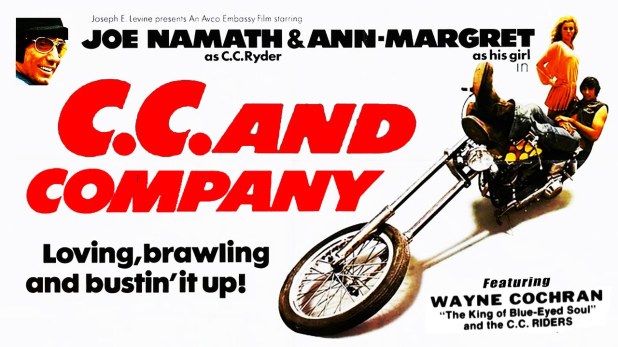
MILL CREEK THE SWINGIN’ SEVENTIES: C.C. and Company (1970)

C.C. Ryder (Joe Namath, who is from a town over from me and we shared the same dentist; perhaps he is better known as the New York Jets quarterback who was such a big deal that he had his own fashion doll) is a biker who hooks up with a gang called The Heads who are led by Moon (William Smith, who as we all know improves every movie).

There’s a race between the whole gang and C.C. decides to win it to get a fashion model named Ann McCalley (Ann-Margret, whose husband Roger Smith wrote this) to notice him. She’s kidnapped by The Heads and C.C. has to save her.

This was directed by Seymour Robbie, who mostly worked in television, and was savaged by critics. Gene Siskel gave it no stars and said, “Ann-Margret has a brief nude scene in which she proves that in addition to having a foul mouth she is fat.” Let me say something. Gene Siskel’s wife Marlene Iglitzen was quite attractive, but Ann-Margaret is, well, Ann-Margaret. He’d never get away with a comment like that today.

Well, because he’s dead.

But you know what I mean.

The Heads also have members like Crow (Sid Haig), Captain Midnight (Bruce Glover), Pig (Teda Bracci, who was Bull Jones in The Big Bird Cage and Rita in The Centerfold Girls), Pom Pom (Jennifer Billingsley, The Thirsty Dead), Zit-Zit (Jacquie Rohr, The Mini-Skirt MobDevil’s Angels), Tandalaya (Kiva Kelly), Lizard (Greg Mullavey, My Friends Need Killing) and Rabbit (Mike Battle, who also played for the Jets).

Glover was supposed to play the lead, but when Joe Namath saw him, he got Willaim Smith. Glover said, “”He took one look at me and said I was too short to beat him up. I had no power at the time, so I couldn’t quit. But I made my character and improvised every line I had in that movie.”

Don’t have the box set? You can watch this on Tubi.