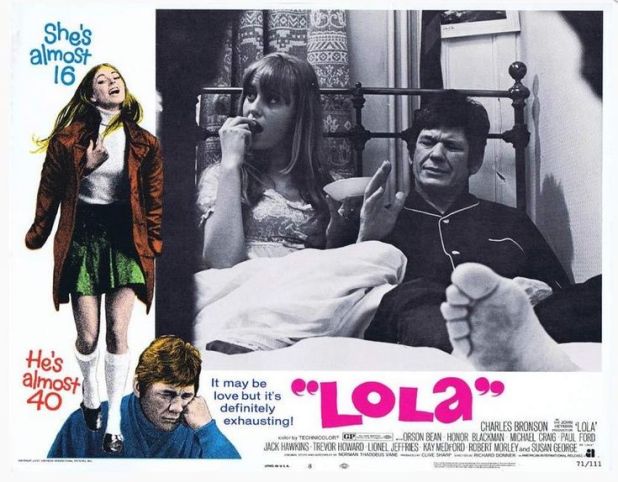
Junesploitation: Lola (1970)

June 21: Junesploitation’s topic of the day — as suggested by F This Movie— is AIP! We’re excited to tackle a different genre every day, so check back and see what’s next.

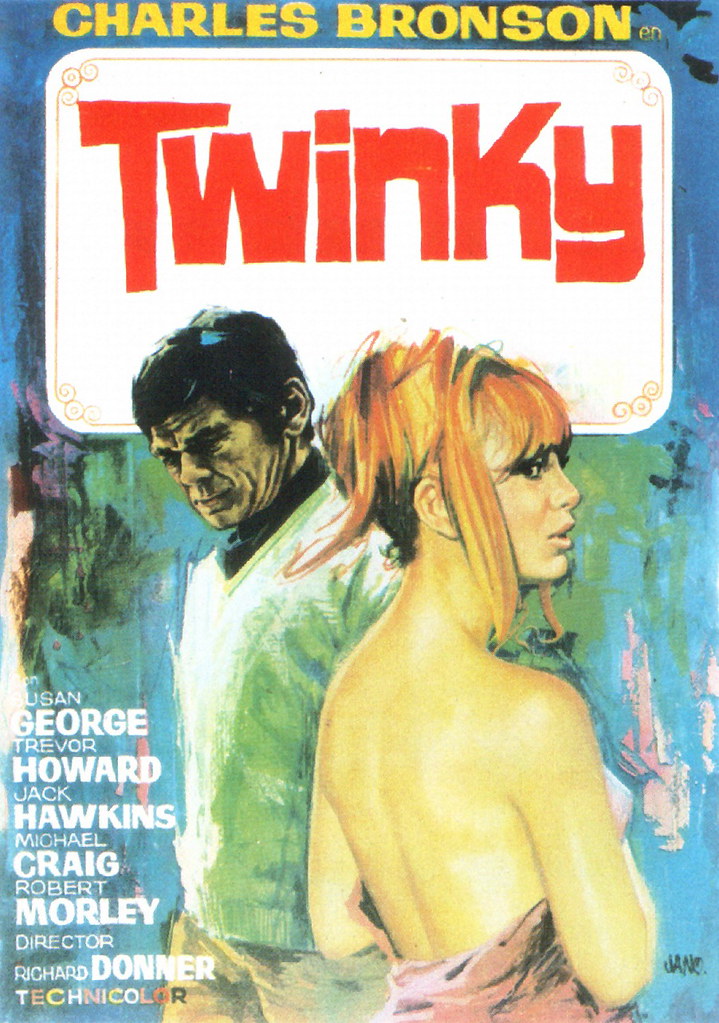
Also released as Twinky and London AffairLola has the kind of story that only a movie made in 1970 could have.

Scott Wardman (Charles Bronson) falls in love — or something — with Sybil Londonderry (Susan George), who also goes by Twinky and Lola. The problem is that he’s 38 and she’s 16. He seemingly knows the age of consent and any guy that can instantly tell you that is a creep.

Then Scott gets busted for being married to a child and forced to leave England. He says, “I make one uncool move with a nutty 16-year-old kid, and suddenly my whole world is turned upside down.” Now this pornographic author has to go back to the United States.

If you think this couldn’t happen, well…

Norman Thaddeus Vane wrote this and its based on his own married to 16 year-old model Sarah Caldwell, who he married when he was also 38. In an interview with the astounding Hidden Films, the writer — and later director — would claim, “There was a reason I wound up marrying Sarah Caldwell (who was 16 at the time and later cast in Mrs. Brown, You’ve Got a Lovely Daughter which Vane scripted; Vane later based the script for Lola on this scandalous marriage). I was a good-looking kid on King’s Road in Chelsea, I had a sports car, I had money, I had a beautiful flat.”

Vane also pretty much explains the plot of this film in that interview: “I met her at a party. She was stunningly beautiful. I had a small flat on King’s Road in Chelsea, and she used to come over secretly on the way back from school, and we used to fuck. And she told her parents that she was seeing me — I was probably about 38 or something—and they were angry. Her father was head of the East India Trading Company. The only way we could see each other was if we got married, and in Scotland, you could get married at 16. So we eloped there. I had been sleeping with a Scottish girl from Glasgow. You had to spend three days in residence in Scotland before you got married, so I asked her if we could use her family’s address and she said yes. Sarah called her parents and said “I’m very sorry to tell you this, but I got married today!” The newspapers wrote columns about her, it was like a front page story, for months afterwards. They called me “The Cad of the Year.””

This entire interview is wild and I urge you to read it, as he claims that director Richard Donner immediately slept with Susan George, that the movie was financed by an Italian baron and Bronson superfan who later committed suicide over Britt Ekland, that Bronson’s wife Jill Ireland wanted to play the teenage girl and that Bronson couldn’t be controlled by Donner and he ruined the movie.

Lola is fascinating because why would Scott and Lola ever get together — well, sex — or stay together? There’s nothing that suggests that they have a single thing in common other than her schoolgirl crush on him and well, yeah, she’s Susan George in 1970, I get that. Yet Bronson comes off as, well, Charles Bronson, a man who speaks little and is quick to violence. Maybe that’s how I see him as I’ve watched so many of his action movies, but when you see the posters and VHS covers for this, you’ll see that I wasn’t the only one who saw Bronson just as a force of violent nature.
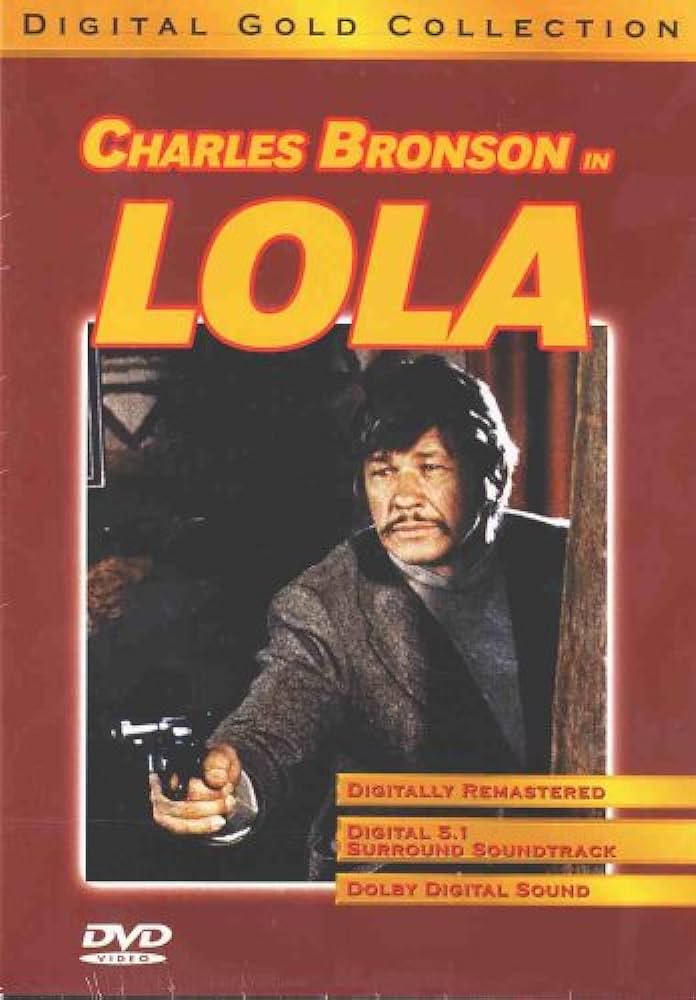
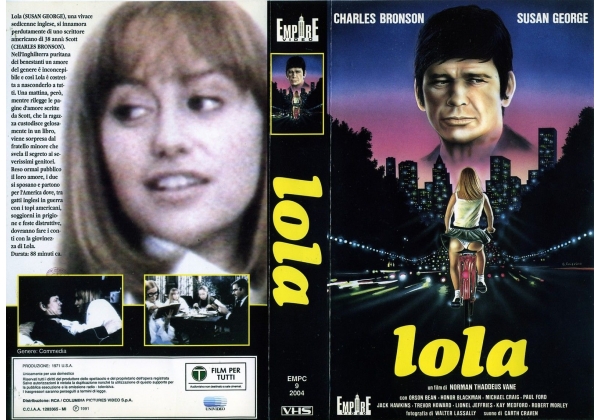
Lola ends up getting an apartment for the couple while Scott is in jail over a misunderstanding, then she doesn’t realize that he has a job as a writer and needs to be left alone while he’s working. As a jerk of a writer myself, I get it. She also acts like a kid because she is one. Finally, after running away and coming back, she goes back to England for good.

This is not the last movie that Vane would make that references his life. The Black Room is about how he cheated on his wife in his own black room with Penthouse centerfolds that he met while working at that publication. It remains to be discovered if any of those women were vampires. Vane also made the absolutely baffling Club Life, a movie that I want everyone to watch.

I wonder if Susan George met with her agent and said, “Can I do something not so scuzzy for my next movie, like sleep with a guy twice my age?” And the agent said, “Susan baby, have I got a movie for you. It’s classy. It’s called Straw Dogs.”

You can watch this on Tubi.

SUPPORTER WEEK: Brotherhood of the Bell (1970)

EDITOR’S NOTE: Today’s movie is brought to you by Jason, who made a one-time donation and told me to pick any 70’s TV I wanted. So how about an entire week?

Would you like to have me write about the movies of your choice? It’s simple!

  1. Go to our Ko-Fi site and donate. There’s no set amount and I won’t tell you what to do. In fact, if you just keep reading for free, we can still be friends.
  2. Join as a monthly member for just $1. That makes you a Little B&S’er.
  3. As a Medium B&S’er at just $3 a month, if you pick a movie or a director, I’ll write about them for you. In fact, I’ll do one for each month you subscribe and even dedicate the post to you.
  4. For $5 a month, you basically get some major power. As a Big B&S’er, I’ll write an entire week on any subject you’d like. How awesome would that be? In fact, I’ll do it for every month you’re a member. Do you think any of your other movie sites will do that for you?

Director Paul Wendkos (The Mephisto Waltz) was nominated by the Directors Guild of America for “outstanding directorial achievement in television” because of this film. It was written by David Karp, who also wrote the original novel. It had been made once before as an episode of Studio One in 1958.

A world premiere CBS Thursday Night Movie on September 17, 1970, this arrived just as the seventies began, a decade packed with conspiracy. Professor Andrew Patterson (Glenn Ford) is back at the College of St. George in San Francisco to watch a young man be initiated into the secret society that he joined there, the Brotherhood of the Bell.

After the ritual, one of the leaders — Chad Harmon (Dean Jagger) — gives Patterson an assignment. Stop Dr. Konstantin Horvathy (Eduard Franz) from accepting a deanship at a college of linguistics so that a brother can take that position. Harmon is to blackmail Horvathy with the names of the people who helped him defect. Patterson wonders if this is legal. He’s told that he should be happy this is all they’re asking of him.

The professor does what he is supposed to do and it caused Horvathy to kill himself. Patterson then does exactly what no brother should do and reveals the truth to his wife Vivian (Rosemary Forsyth) and his father-in-law Harry Masters (Maurice Evans). This causes the Federal Security Services (as conspiracy-filled as this movie is, it doesn’t named the FBI; the agent is played by Dabney Coleman) to get involves and his father-in-law to turn him into the Brotherhood and Patterson’s father Mike (Will Geer) gets ruined in the process, then has a stroke and dies. Patterson also loses his job, gets humiliated on a talk show by Bart Harris (William Conrad) and is at rock bottom when his former boss Dr. Jerry Fielder (William Smithers) and the man he saw initiated Philip Dunning (Robert Pine) both stand up for him.

Obviously, the makers of The Skulls watched this movie.

You can watch this on YouTube.

The Magic Garden of Stanley Sweetheart (1970)

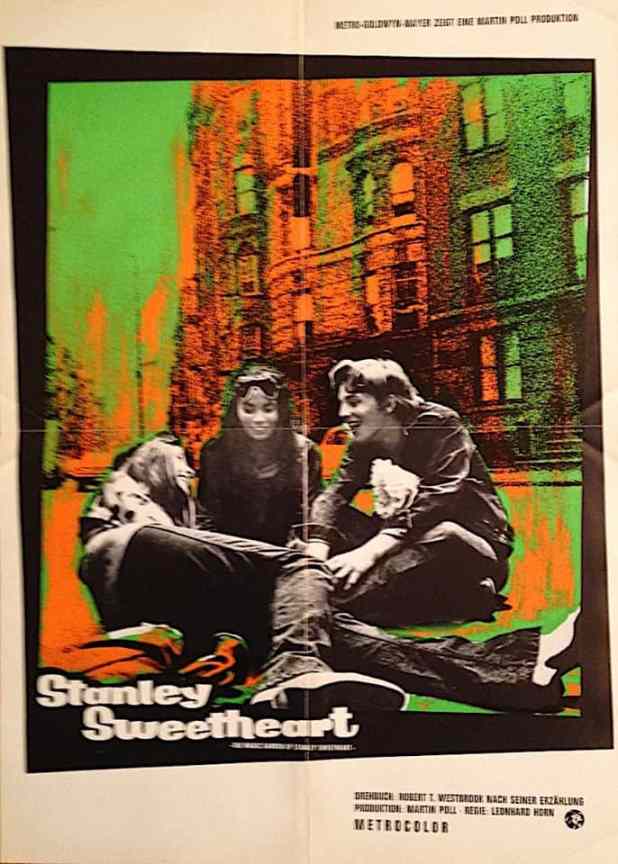
In The Andy Warhol Diaries, Warhol wrote that the producer of this movie, Martin Poll, approached him about doing making his life story into a movie.Warhol responded that “a wonderful movie had already been made on the sixties, and he should just remake it — The Magic Garden of Stanley Sweetheart.” He also said that it was “the quintessential, most truthful studio-made film about the ’60s counterculture.”

Directed by Leonard Horn (who sadly died young while shooting the pilot for Wonder Woman) and written by Robert T. Westbrook (he also wrote the book this was based on; his novels The Mexican, Insomnia and The Final Cut were also adapted into movies), this is the story of Stanley Sweetheart (Don Johnson), an aspiring filmmaker and college student at Columbia University. After the death of his father, he’s moved from Beverly Hills to New York City and is going from being a rich kid to one from a family slowly losing its money. He has no real friends, he’s bored with life and he lives in a dump.

The film goes into his many romances, like a hippie friend Barbara (Linda Gillen) who changes her name to Shayne. He has a one night stand with her, but really wants her roommate Andrea (Victoria Racimo). This is a major issue with Stanley, as whatever he has never seems good enough. Even when he scores with the virginal girl of his dreams, Cathy (Dianne Hull), he can’t help but either seduce or be seduced by her roommate Fran (Holly Near).

He also meets Danny (Michael Greer), an underground musician who once went to Julliard and who seems to have a worldly bit of advice to give. Or at least lead Stanley to the best parties. And taking his girl, who didn’t really want in the first place until she’s gone.

Stanley finds happiness with Andrea and Shayne as a triad family of sorts, but even that eventually can’t make him happy. Cathy sees him at a happening but he’s so high that he barely makes sense. The film ends with him leaving and Andrea telling him she needs him. The film leaves it up to you where he ends up, but it does show you that Danny shot himself behind his mother’s house right in front of her.

Speaking of Warhol, The New York Times reported that this movie would have Ultra Violet, Candy Darling (who actually does appear in a wordless cameo), Gerard Malanga, and Warhol as a “freaked-out psychiatrist” in its cast. One Warhol superstar did make it — almost — as Joe Dallesandro was originally cast as Danny. However, he was fired when for being late and causing trouble with the cast and crew.

This film is an interesting document of another time and not just because you can see the World Trade Center get built. It’s made at a time when Hollywood was trying to figure out how to get movies made for the counterculture and maybe not always understanding. The era of films avoiding sex and drugs was, obviously, over. It was a brief moment before blockbusters took over and films like this are vital moments out of a past that didn’t last long enough.

You can watch this on YouTube.

RE/SEARCH Incredibly Strange Films: Blood Mania (1970)

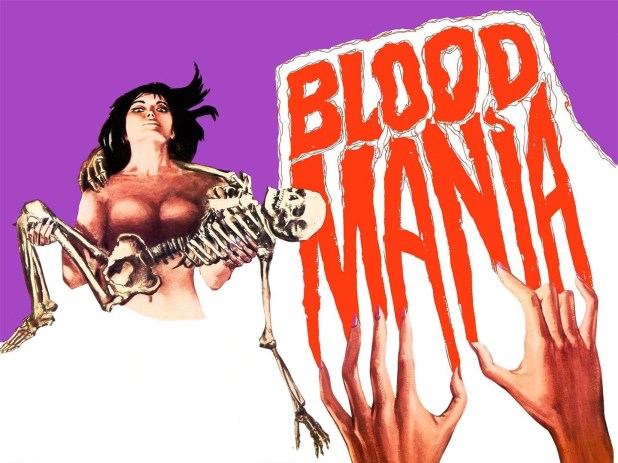
Dr. Craig Cooper (Peter Carpenter) is overseeing the care of the dying Ridgeley Waterman (Eric Allison), who is tended to by his daughter Victoria (Maria De Aragon) and round the clock nurse Miss Turner (Leslie Simms).

Victoria has repeatedly tried to seduce the doctor, who has problems of his own. He used to perform abortions when that was illegal and he’s being blackmailed. He finally gives in to her and looks the other way when she poisons her father. Her sister Gail (Vickie Peterson) comes to contest the will, only to learn that she gets everything. She also has a would-be lover — maybe, it’s never outright said but come on — named Kate (Jacqueline Dalya), but once Gail hooks up with the doctor, she leaves. And this all puts Victoria from being bedridden over the will to absolutely a murderer when her sister reveals that she’s taken her doctor from her.

Then she paints in blood.

Shot in a home once owned by Bela Lugosi by Robert Vincent O’Neill, Gary Kent said of this, “Robert was a prop man to begin with. I had no idea he was a director. The next thing I knew he was doing it, and he called me in as a production manager. It was fun. He took it seriously, so you never got the feeling he was just in it for the bucks. I thought it just took him forever to get a shot. He was always fussing over it. It was murder. His movies were long and arduous, but nonetheless I had some affection for Robert.”

According to Leslie Simms, a year after production had commenced, she was called back to complete re-shoots for an alternate cut of the film intended for television broadcast. In order for the film to be shown on TV, the nudity and violence had to be cut. That left a lot of time. They added a subplot that has her nurse working with the blackmailer. Instead of the murders, we see Miss Turner report the killings to the blackmailer.

This movie also has Regan Wilson in the cast. She was Playboy‘s Playmate of the Month for October 1967. Those photos were taken to the moon inside the schedule of Apollo 12’s mission commander, Pete Conrad. Her co-star, Vicki Peters, was also the April 1972 Playmate of the Month.

You can also read Eric Wrazen and Bill Van Ryn‘s feelings on this movie.

FVI WEEK: The Dark (1979)

Bill Van Ryn from Groovy Doom/Drive-In Asylum explained this movie short and sweet: “It’s like an episode of Kolchak: the Night Stalker without Kolchak.” It’s also about the press freaking out about an eight-foot-tall alien who is killing people who eyebeam lasers in the dirty and dingy streets of Los Angeles. It was originally about an autistic child who never met people before. It was also originally to be directed by Tobe Hooper. Things kind of didn’t happen that way.

John “Bud” Cardos (Kingdom of the SpidersGor II) stepped in to direct. And realizing that his movie now had an alien instead of a child, he hastily put together an opening narration that talks about electric eels and Venus fly traps. If our planet has those, what about other worlds? What that has to do with the rest of the film, well, your guess is as good as mine.

What we end up with is a monster that beheads people while someone chants, “The dark! The dark!”  William Devane (Greg Sumner from TV’s Knot’s Landing) and a TV anchorwoman (original Wonder Woman and That’s Incredible host Cathy Lee Crosby) finally figure out how to catch the monster. Oh yeah — there’s also an ancient psychic who believes that a young actor will be the next to be killed, so we get some 70’s Hollywood parties along the way. Casey Kasem shows up. Keenan Wynn and Richard Jaeckel, too.

Roger Ebert referred to this movie as, “the dumbest, most inept, most maddeningly unsatisfactory thriller of the last five years. It’s really bad: so bad, indeed, that it provides some sort of measuring tool against which to measure other bad thrillers. Years from now, I’ll be thinking to myself: Well, at least it’s not as bad as The Dark.”

I really didn’t think it was that bad. It’s not the best movie ever, but I was certainly entertained. Not riveted. But entertained. But how can you hate a movie where a giant alien shoots laser beams out of his eyes and rips peoples’ heads off so that the coroner can put them in body bags (along with mini head bags)?

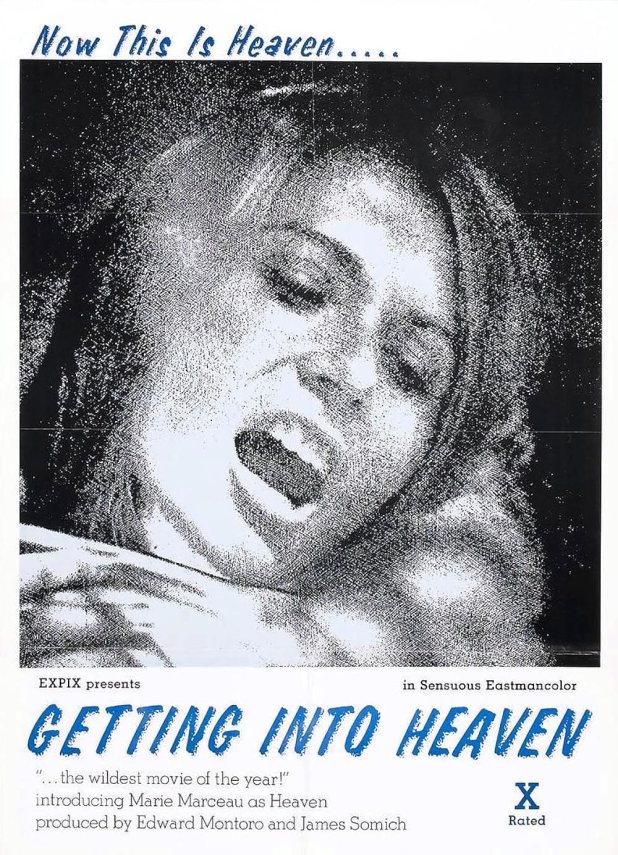
FVI WEEK: Getting Into Heaven (1970)

Edward L. Montoro, the man who was the heart and soul of the main era of Film Ventures International, only directed one other movie — Platinum Pussycat — and wrote two others — again, Platinum Pussycat and Day of the Animals — other than this movie.

Heaven (Marie Marceau, which is hilarious, because who else would mistake Uschi Digard with that body and accent?), Sin (Jennie Lynn, who played four roles on My Three Sons before this) and Karen (Phyllis Stengel, who was in tons of early adult, like Ed Wood’s Take It Out In Trade) are out to become movie stars, even leaving behind Heaven’s cop man Bernie (Scott Cameron).

This leads him to Mr. Salacity (Miles White), a Hollywood producer who gets them on the casting couch. It’s pretty much what you expect, except for the fact that the men never show anything while the women show it all. There’s also a scene where Uschi gets a cold and to heal herself, she has one of her friends cover her breasts with Vicks VapoRub. I love Vicks so much, so this scene meant a lot to me, particularly when you realize that it takes two gigantic tubs of the stuff to even get close to covering the pride of Saltsjö-Duvnäs, Sweden’s 48 F bosom.

I mean, you kind of have to see that, you know?

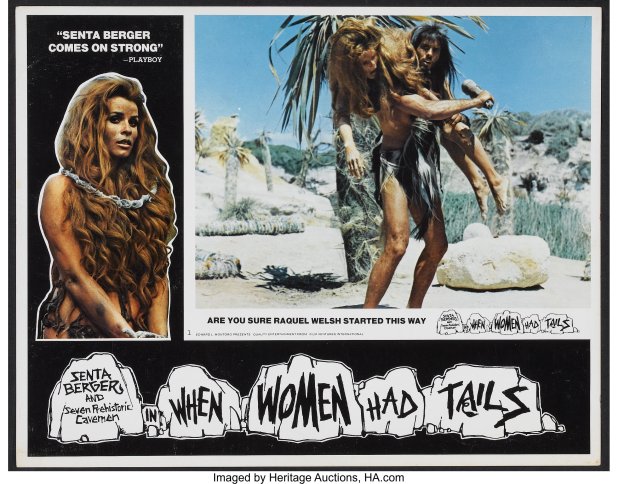
FVI WEEK: Quando le Donne Avevano la Coda (1970)

When Women Had Tails was directed by Pasquale Festa Campanile (Autostop rosso sangue), who wrote it with Marcello Coscia and Lina Wertmüller. Yes, 1970s art house film director Lina Wertmüller. The first woman to ever be nominated for a Best Director Oscar.

It’s the story of seven cavemen who were sent on a boat — Ulli (Giuliano Gemma), Kao (Lando Buzzanca), Grr (Frank Wolff), Maluc (Renzo Montagnani), Put (Lino Toffolo), Uto (Francesco Mulé) and Zog (Aldo Giuffrè) — and now they live alone on a small island. One day, they find what they think is an animal in their trap but its really a woman named Filli (Senta Berger). As you can guess, she upsets their natural order even more than the beat that attacks them. Ulli, being the alpha, must have her and for his lust makes him fight his own brothers.

Somehow, this caveman sex comedy also has a soundtrack written by Ennio Morricone and directed by Bruno Nicolai.

This movie was so popular that it had two sequels, When Men Carried Clubs and Women Played Ding-Dong and When Women Lost Their Tails. As hard as this was to watch, you know that I will also be watching both of those movies.

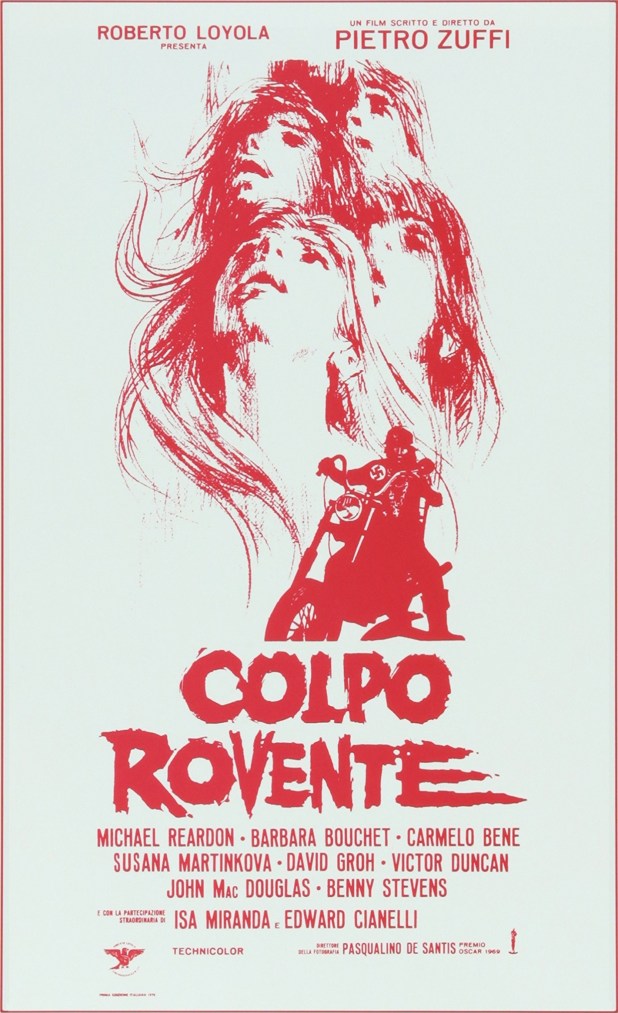
Colpo rovente (1970)

Piero Zuffi was an Italian set designer and painter who worked for a decade at Milan’s historic opera house Teatro alla Scala. He also worked as a production designer on several movies, directed and wrote this movie — with Ennio Flaiano — and wrote one other, General Della Rovere.

So yeah, this is a poliziotteschi with giallo leanings, but when you’ve watched more than four hundred gialli, you start hunting for things you haven’t seen. Also released as Red Hot Shot and The Syndicate: A Death In The Family, this is the story of NYPD detective Frank Berin (Michael Reardon) who is trying to learn who killed a pharmaceutical company owner named Mac Brown (Vittorio Duse), gunning him down right in the middle of Wall Street. There are no leads or suspects, so Brown’s daughter Monica (Barbara Bouchet) goes on TV and offers a reward of $250,000 for any information.

Berin is no fan of the Brown family, as he’s always felt that they ran the heroin trade in the Big Apple, but his case ended when his main witness Fanny (Susanna Martinková) was blinded. And Monica is worried that whoever killed her father is coming after her. That killer could be her fiancee, Don Carbo (David Groh).

What’s kind of strange is that Michael Reardon was in two acting roles. This movie and a bit part on the Burt Reynolds’ TV show Hawk. And that’s it. This movie is near impossible to find and Reardon died in 2006. This was given an X rating for some reason, so it never really played, but it’s astounding thanks to Berin going wild with its look, filling it with a great Piero Picceroni score, parties in mirrored rooms, numerous flashing light shows, old rich people gorging themselves on a nonstop menu of food while near a swimming pool and a scene where drug addicts nearly take on the look and feel of Romero’s zombies. And perhaps strangest of all, Bouchet is a brunette!

There are giallo elements in this and yes, there are tons of plot holes and the story isn’t all that great, but there are so many weird elements in it that I think you really have to see it. Speaking of the soundtrack, it’s been released several times, but this hasn’t come out on DVD or blu ray. In a world where every movie has been rereleased so many times, let’s get this out and into peoples’ hands!

You can watch this on YouTube.

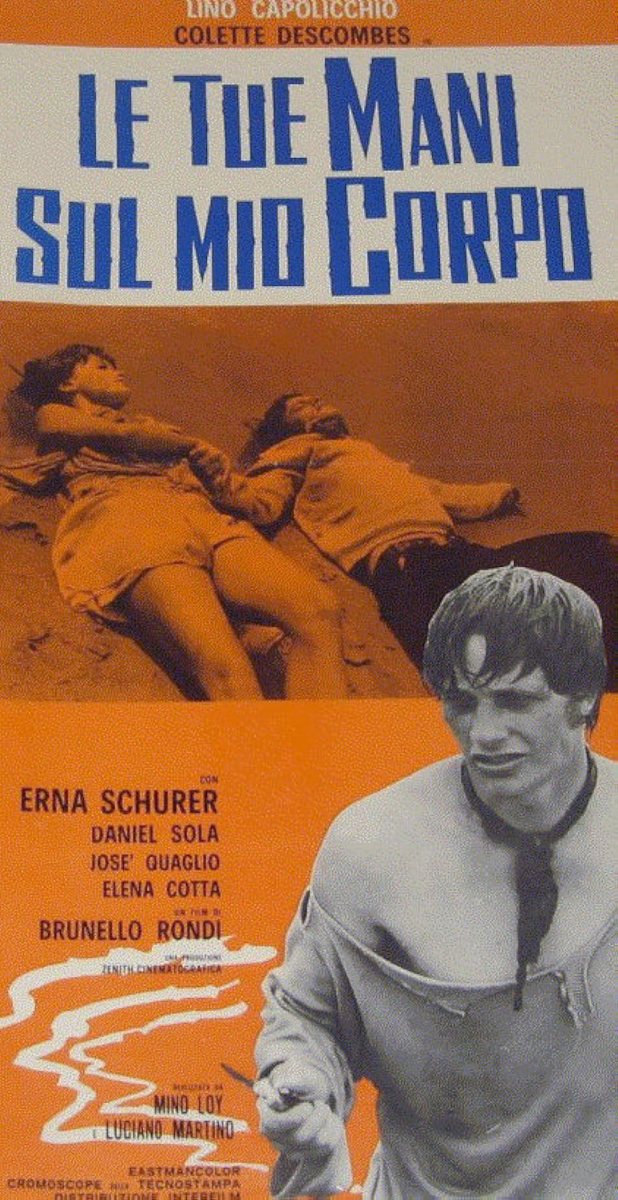
Le tue mani sul mio corpo (1970)

Directed by Brunello Rondi (Run. Psycho, Run), who wrote the story with Luciano Martino and Francesco Scardamaglia, this is about Andrea (Lino Capolicchio), the son of a rich publisher. He rebels by living a life of excess as a way of dealing with the death of his mother when he was a very young man. Beyond sleeping with anyone and everyone, he really wants to cuck his father and to have sex with his stepmother Mireille (Erna Schürer, Strip Nude for Your Killer) and her gal pal Carole (Colette Descombes, Orgasmo).

A giallo with no murder, this is about one man trying to ruin everyone through his desires — and need to film all of his fantasies — as well as him learning what happened to his mother, who he only sees in glimpses wearing white.

Also known as Schocking, there’s a scene where Andrea dresses a black girl in a Klan hood to, well, shock you. Aren’t you scandalized? There’s no real hero or heroine here, unless you like the spoiled rich man who loves to use his camera to film women make love to other men, then burn the film while they watch.

It looks nice, though, and the Giorgio Gaslini score is solid. He also did the music for So Sweet, So DeadFive Women for the Killer and was the original composer for Deep Red. When Argento didn’t like the music, he contacted Goblin, although some of the original music is in the movie.

You can watch this on YouTube.

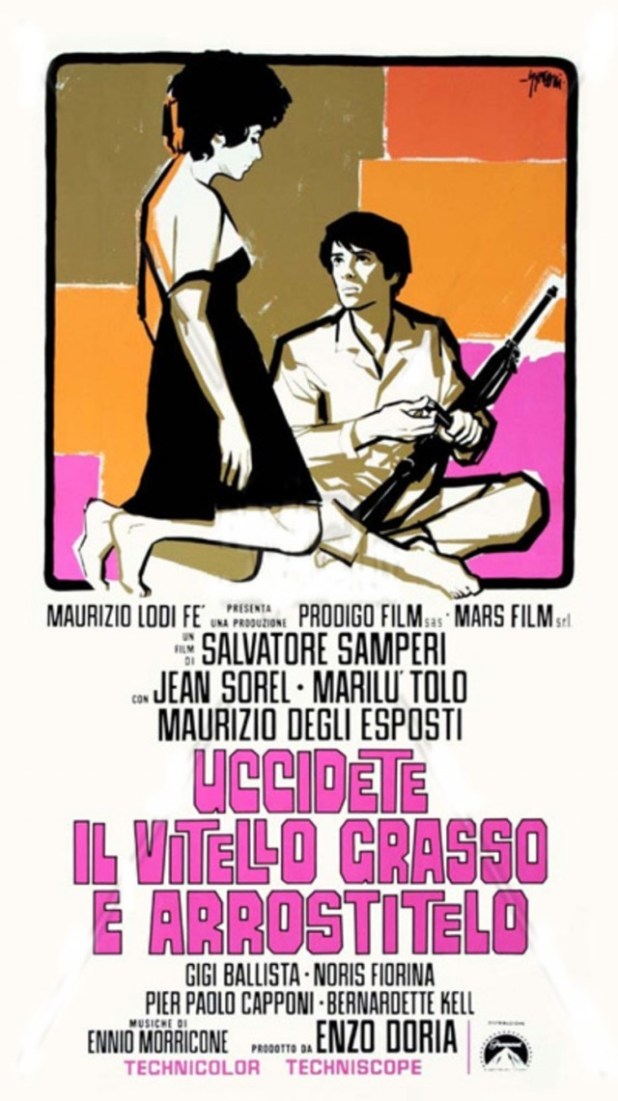
Uccidete il Vitello Grasso e Arrostitelo (1970)

Directed by Salvatore Samperi, who wrote the story with Dacia Maraini, Kill the Fatted Calf and Roast It is about a cursed family. Maurizio Degli Esposti plays Enrico, who has left his Swiss boarding school to come home for his father’s funeral. That’s when he remembers just how strange his family is and starts to wonder if his dad’s death really was an accident or if his older brother Cesare (Jean Sorel) did it — he did watch him and his cousin Verde (Marilù Tolo) inject it — and if his family really is doomed.

All of the family’s servants had been let go before the father’s demise and the most faithful of them, Talia (Aleka Paizi) has been put into a mental home. This is the same place where Enrico’s mother was committed in the past and where she presumably killed herself. Even though that happened in his childhood, Enrico feels a closeness to her and constantly listens to tapes of her voice. This is all the evidence that Cesare needs to try and put Enrico into that same clinic. Our protagonist’s mistake is being in love with Verde, who could be just as bad as his brother, and who he feels a love beyond family — yes, the incestual love that Italian horror seems to flirt so much with — and it’s even odder because she reminds him of his mother, so it’s like double family obsession. When he gets pneumonia, she should be taking care of him, but she may also have her own sinister plan.

After Arcana, this is the second movie I’ve watched where Maurizio Degli Esposti is in love — really in love — with his mother. To give you another reason to watch this strange giallo, the Ennio Morricone soundtrack is great.

You can watch this on YouTube.