Cinematic Void January Giallo 2024: The Strangler (1970)

EDITOR’S NOTE: Cinematic Void will be playing this movie on January 15 at 7:00 PM CT at Music Box Theatre in Chicago, IL. You can get tickets here. For more information, visit Cinematic Void.

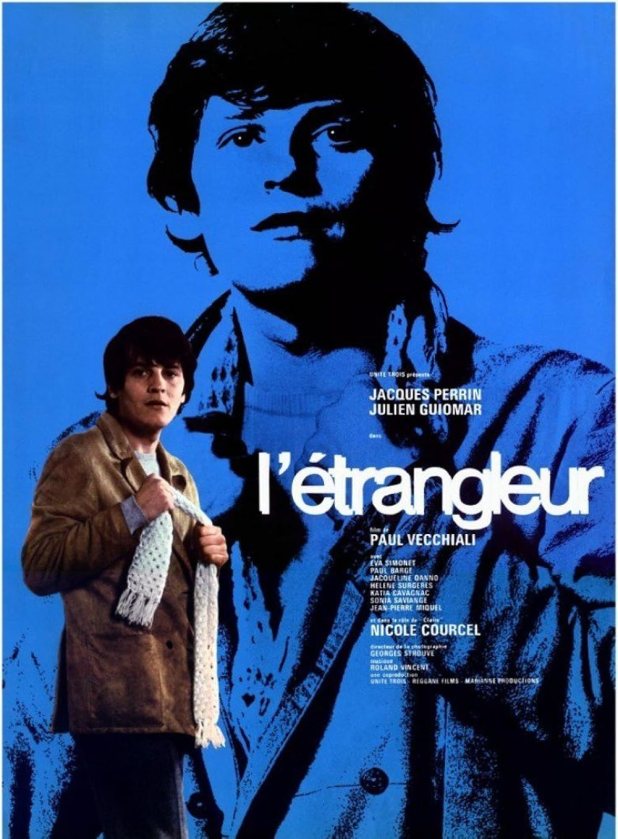
Émile (Jacques Perrin) has an interesting reason for being a killer. He sees what he does as a public service, taking unhappy women away from this world with his white scarf.  Inspector Simon Dangret (Julien Guiomar) is on the case but the ways that he goes after the killer are just as morally suspect. There’s also Anna (Eva Simonet), a gorgeous woman who feels that she’s the next victim. Maybe she even wants to be that person. And then there’s the thief (Paul Barge) who lurks at each scene and takes what cash and trinkets are left from each dead woman.

Directed and written by Paul Vecchiali, this giallo comes from the same year as Argento’s The Bird With the Crystal Plumage. It may not have the same visual madness as that film but it does have a villain who looks like a hero, a child of a man damaged by seeing a murder when he was young using the same knit white scarf that he uses to snuff out lives today. The women that he murders would have just killed themselves regardless, he reasons on the phone to Dangret, so he was saving them. The breakup that Anne has just emerged from has left her feeling that life is worthless; she volunteers to Dangret to be the lure.

Unlike most giallo, we know who the killer is from the start. Yet each kill is so planned, so precise, such a murder set piece as the women give themselves to Émile. He isn’t getting any sexual thrill from killing these women, unlike so many black gloved killers. These are mercy killings. It seems like the person he really wants is the cop.

You can also get this from Altered Innocence, a partner of Vinegar Syndrome.

ARROW VIDEO BOX SET RELEASE: Inside The Mind Of Coffin Joe: The Awakening of the Beast (1970)

José Mojica Marins directed movies for six years before making At Midnight I’ll Take Your Soul, the first appearance of Brazil’s national boogeyman, Zé do Caixão, or Coffin Joe.

Joe is a man with no morals but a devotion to Nietzschian philosophies and absolute hatred for religion with the goal of achieving immortality through the birth of a perfect son. And while he does not believe in the supernatural, he often finds himself walking through visions of the otherworld.

Coffin Joe came to Marins — the man who would often be referred to as the character interchangeably — in a very magic way. “In a dream saw a figure dragging me to a cemetery. Soon he left me in front of a headstone, there were two dates of my birth and my death. People at home were very frightened, called a priest because they thought I was possessed. I woke up screaming, and at that time decided to do a movie unlike anything I had done. He was born at that moment the character would become a legend: Coffin Joe. The character began to take shape in my mind and in my life. The cemetery gave me the name, completed the costume of Joe the cover of voodoo and black hat, which was the symbol of a classic brand of cigarettes. He would be a mortician.”

Awakening of the Beast begins in black and white, as a series of vignettes of the ways that drug users debase themselves are shown in lurid, sweaty detail. A TV panel debates the idea that sexual perversion is caused by the use of illegal drugs, with more stories that illustrate this point. The TV show needs an expert on depravity, so they ask Marins to appear on the show.

Afterward, the doctor who conducted the experiment doses four volunteers and asks for them to stare at a poster of The Strange World of Coffin Joe. Supposedly Marins didn’t know much about using drugs, but he intended this movie to speak against the fact that the uses of drugs are treated worse than the suppliers and that the Brazilian film industry saw him as no better than a long-nailed drug dealer.

The acid trip that follows is highlighted by Coffin Joe, ranting against anyone and everyone. Of course, this film was banned by the very establishment it rails against. So basically, Coffin Joe is a self-fulfilling prophecy; the maniac attacking belief structures created by an artist who only believes in the power of film.

“My world is strange, but it’s worthy to all those who want to accept it, and never corrupt as some want to portray it. Because it’s made up, my friend, of strange people, though none are stranger than you!”

Arrow Video’s limited edition collection of the movies of Coffin Joe will own your soul. Awakening of the Beast has commentary with Marins, Paulo Duarte and Carlos Primati in Portuguese with English subtitles. There’s also a new interview with Guy Adams on Marins’ esoteric aspects, a new video essay by Alexandra Heller-Nicholas on the gender politics of Marins’ films and alternate opening titles. You can get this set from MVD.

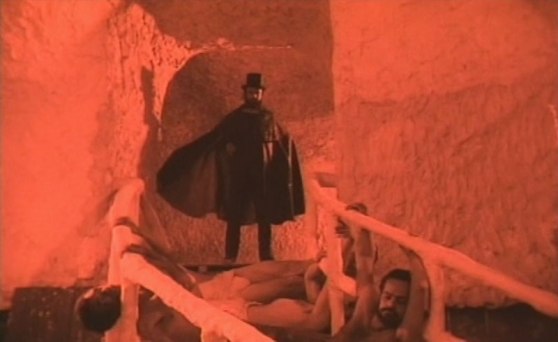
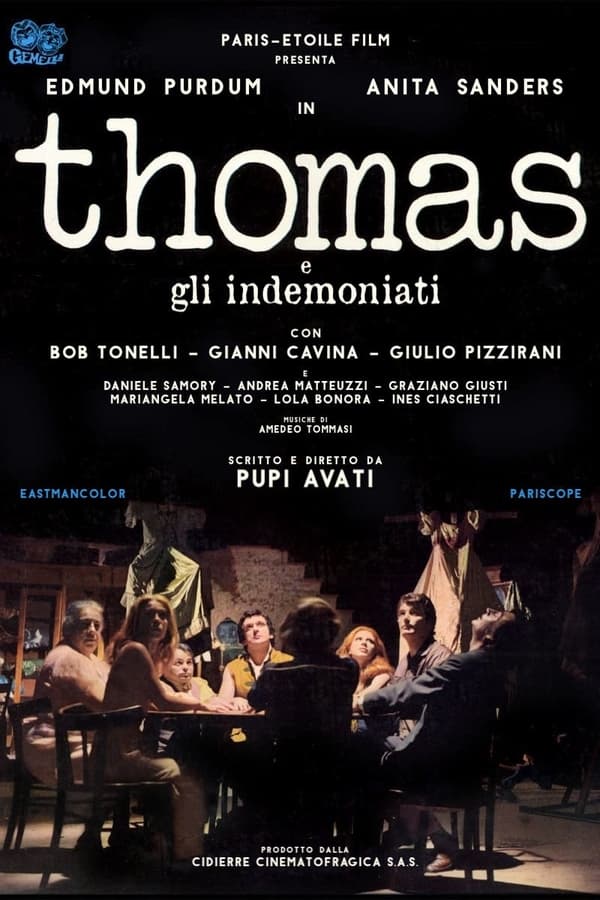
Thomas… …gli indemoniati (1970)

Thomas the Possessed (or Thomas and the Bewitched, I have seen both translations) is from director Pupi Averti, who wrote it with his brother Antonio and Giorgio Celli. It was his second film, one he said that was cursed by family issues and money issues.

A new theater company — Edmund Purdom is one of the actors — is about to put on its first performance, the story of a child named Thomas who a woman believes that she has given birth to but who does not exist. They’re met by a man who offers to read the fortune of the play. At that seance, they are introduced to Thomas, who has become a real person.

On the way to the town where they will perform, they meet an actor hanging from a tree who claims to be the only survivor of a performance gone wrong, one that ended with the audience murdering all of the actors except for him. This must have happened, as the audience is already attacking the stage before the first scene. This is after they rode a ghost train to the town, so at this point, anything could happen.

From a cemetery with bottles instead of graves, the sexual revolution and a hospice home where the elderly die rapidly, Thomas the Possessed is one strange movie, yet we should accept no less from its director. If it all ends where it begins, we must accept this.

After this failed to find an audience, it would take Averti five years to make his next film, La mazurka del barone, della santa e del fico fiorone. A year later, he would make Bordella and the movie he may be best known for, The House With the Laughing Windows. He’s still directing movies today.

For some time, the only way to see this was to rent the copy in the Bologna library, which Averti himself donated. Its production company went out of business and the movie had only played the 1970 film festival in Locarno.

You can watch this film on YouTube.

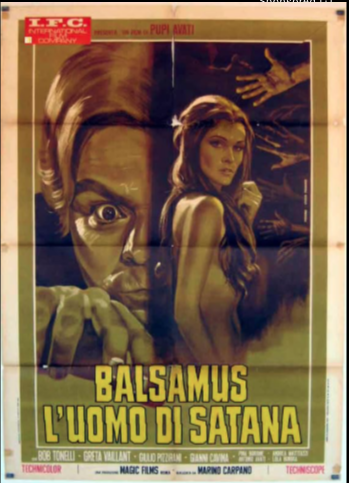
Balsamus, l’umomo di Satana (1970)

Balsamus the Man of Satan was directed by Pupi Avati and nearly the entire cast and crew were close friends of his, including writers Enzo Leonardo and Giorgio Celli. It stars Ariano Nanetti (Bob Tonelli) is the dwarf of the title. He was an entrepreneur who had a man named Mister X — businessman Carmine Domenico Rizzo — who paid for most of the movie. It’s the director’s first movie and if you want to watch some of the better films that he would do, I would say The House With the Laughing Windows and Zeder are two solid ones.

Balsamus is a magician who says that he can solve human and animal sterility and who has been gathering several rich women around himself. Meanwhile, his wife Lorenza is sleeping with his assistant Alliata and his servant Ottavio does all of the work. He kills his mother-in-law and resurrects her, but when he tries to add to his magical powers, he fails. Depressed, he calls out all of his wife’s affairs and kills himself. The court mocks him other than the faithful Ottavio.

Based on Giuseppe Balsamo, Count of Cagliostro, a famous alchemist and necromancer. Avati said, “I was fascinated by readings on paranormal and alchemical themes, furthermore in the film there was a rural matrix, my rural life in Sasso Marconi. I wanted to write Cagliostro’s life, in grotesque terms, setting it in the present day.” 

Yet much like its protagonist, this all ended up as a movie that others didn’t understand. “I had a lot of hope in Balsamus, I hoped to be appreciated by who knows what critics, but in reality it was a resounding defeat,” concluded Avati. He also claimed that the movie would have been a bigger disaster if not for the assistance of director of photography Franco Delli Colli, who was on camera for Leone’s Duck, You Sucker! and lit Django Kill… If You Live, Shoot! as well as being the cinematographer for plenty of great movies like GhosthouseRats: Night of TerrorStrip Nude for Your Killer and Avati’s Zeder

This was released in other countries as Blood Relations and The Man of Satan.

You can watch this on YouTube.

THE MOVIES OF AL ADAMSON: Hell’s Bloody Devils (1970)

It just makes sense that the Third Reich would regroup in Las Vegas, I guess. FBI agent Mark Adams (John Gabriel) poses as a member of a Sin City organized crime gang to get into the world of war criminal Count von Delberg (Kent Taylor) and stop him from his plan to counterfeit U.S. dollars. He’s helped by Israeli agent Carol Bechtal (Vicki Volante) whose parents were killed by von Delberg during the war. But the Count hasn’t slowed down or not gotten with the times. He’s working with the Bloody Devils, a motorcycle gang, to make his plans work.

This started as a spy movie called Operation M before it was The Fakers and then a few years later, bikers — real bikers, the kind that get busted for weapons charges during filming — joined the cast.

You know who else is in there? Colonel Sanders. He’s in one of his KFC restaurants. The Colonel had sold the restaurants in 1964 but retained ownership of the Canadian stores and was a brand ambassador, even if he started to despise the way the new owners made his chicken cheaper and not to his taste. In 1975, he said, “My God, that gravy is horrible. They buy tap water for 15 to 20 cents a thousand gallons and then they mix it with flour and starch and end up with pure wallpaper paste. And I know wallpaper paste, by God, because I’ve seen my mother make it. There’s no nutrition in it and they ought not to be allowed to sell it. Their fried chicken recipe is nothing in the world but a damn fried doughball stuck on some chicken.” KFC has paid for product placement in this movie, which may seem strange, but the Colonel also shows up — as does his chicken — in some Herschell Gordon Lewis movies. The Godfather of Gore used to serve up the original recipe as his craft service. The Colonel is also in Blast-Off GirlsThe Big Mouth and The Phynx.

John Carradine plays a pet shop owner. That’s enough to make me watch.

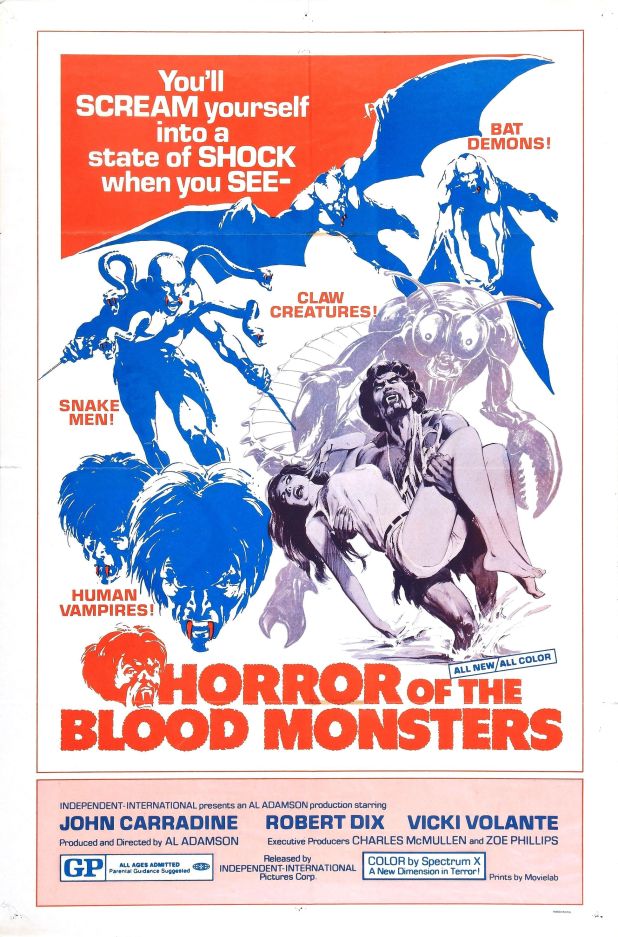
THE MOVIES OF AL ADAMSON: Horror of the Blood Monsters (1970)

Al Adamson was remixing movies back in 1970. Invasion of the Blood Monsters has footage from Robot MonsterUnknown IslandOne Million B.C., the Filipino movie Tagani and The Wizard of Mars. By the time it was ready for drive-ins and theaters, that black and white footage looked old. Adamson used a process called Spectrum X that made everything a single color. It’s really strange when mixed with full color footage yet I kind of enjoy it.

Exploitation heroes like Gary Graver and Adamson play vampires in the beginning as we listen to Brother Theodore tell us what has happened to our home world and why a rocket must go into space and John Carradine will lead humans in their quest to save Earth.

Jennifer Bishop is the beautiful girl who will help them fight snake men, lobster people and more vampires — hey, Bud Cardos — and oh yeah, bat people! Sam Sherman produced this and it was originally started in 1966 with reshoots in 1970. It was getting renamed all the way up until it was a Star Wars clone — well, in title only — under the AKA Space Mission of the Lost Planet.

I just read a bad review of this movie and it made me dislike the person who dare say anything mean about this film. From the moment the Independent International logo shows up, I was happy. Like, deliriously joyous. How can you not love a movie like this? What’s next, people don’t like Brain of Blood?

SUPPORTER DAY: RPM (1970)

EDITOR’S NOTE: Today’s movie is brought to you by AC Nicholas, who has graciously become a Big B&S’er, a monthly supporter of the site and got to pick an entire week of movies. Would you like to have me write about the movies of your choice? It’s simple!

  1. Go to our Ko-Fi site and donate. There’s no set amount and I won’t tell you what to do. In fact, if you just keep reading for free, we can still be friends.
  2. Join as a monthly member for just $1. That makes you a Little B&S’er.
  3. As a Medium B&S’er at just $3 a month, if you pick a movie or a director, I’ll write about them for you. In fact, I’ll do one for each month you subscribe and even dedicate the post to you.
  4. For $5 a month, you basically get some major power. As a Big B&S’er, I’ll write an entire week on any subject you’d like. How awesome would that be? In fact, I’ll do it for every month you’re a member. Do you think any of your other movie sites will do that for you?

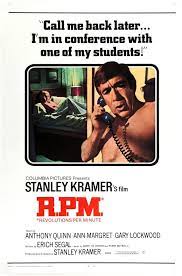
Stanley Kramer called his movies heavy dramas but they’re what are often called message films. A liberal, he brought issues to the public eye through his movies like the dangers of nuclear war (On the Beach), fascism (Judgement at Nuremberg, Ship of Fools), creationism against evolutionism (Inherit the Wind), greed (It’s a Mad, Mad, Mad, Mad World) and racism (The Defiant OnesGuess Who’s Coming to Dinner).

While Pauline Kael saw his movies as “melodramas,” and “irritatingly self-righteous,” she also had to realize that they had “redeeming social importance.”

But in 1970, maybe he was past his expiration date.

Did he feel like Professor F.W.J. “Paco” Perez (Anthony Quinn) does in this movie? For years, Paco has been the radical, the one that stood outside the mainstream. He says at one point that he fought Franco and McCarthy and has learned so much, but the young people don’t want to learn anything. Did Kramer feel that way, an old man in the New Hollywood that was so much more in touch with the youth?

Is Paco just a fifty-year-old fanny chaser, as out of touch with the time as the administration he’s been asked to be a part of?

Radical student activists — Paco is impressed that the blacks and whites have worked together — occupy the administration building with a list of 12 demands. President Tyler (John Zaremba, who spent the 70s and 80s wandering the Earth searching for the best beans for Hills Brothers Cofee) resigns and the Board of Trustees looks at the list that the students have written up of the presidents they would be happy with.

Top on the list? Paco.

It’s after midnight and he’s asleep with his grad student girlfriend Rhoda (Ann-Margret). Yet he’s urged to rush out and fix things. The next day, he starts his new job, showing up on a motorcycle.

Paco reads their demands and many of them, like inner-city scholarships, a college reinvestment program, no military research on campus and adding an African American to the all-white Board of Trustees make sense. But the idea that students can hire and fire faculty doesn’t work for him. He’s already reached the first time where his theory and reality begin to not work together.

With Rossiter (Gary Lockwood) and Steve Dempsey (Paul Dempsey) leading the students, Paco tries to be the person between them and the Board of Trustees. But when Rossiter says that he will destroy all of the campus’ computers, Paco has to make the tough decision to call in the police. They come charging in with tear gas, turning their hero professor into just one of the old people never to be trusted. When the cops round up the students, Rhoda is one of them.

What they don’t know is that Paco has signed off on their bail. Yet he still walks past the crowd and is screamed and booed at. He has learned the hard way that the lessons of books and classrooms often mean little in the real world.

I really liked the songs by Melaine, “We Don’t Know Where We’re Goin’” and “Stop! I Don’t Wanna Hear It Any More,” that were in this. It’s quite preachy, but it also feels like this movie was Kramer attempting to determine where he fit in any longer. Then again, Kramer would say that this was his least favorite film that made the lowest amount of money. The dialogue may get silly sometimes, but that’s because it’s written by Erich Segal, who also did Love Story.

After this movie, however, I understand why my dad and other older male relatives would say Ann-Margaret’s name with the reverence they otherwise reserved for the saints.

You can watch this on Tubi.
SUPPORTER DAY: The Lickerish Quartet (1970)

EDITOR’S NOTE: Today’s movie is brought to you by AC Nicholas, who has graciously become a Big B&S’er, a monthly supporter of the site and got to pick an entire week of movies. Would you like to have me write about the movies of your choice? It’s simple!

  1. Go to our Ko-Fi site and donate. There’s no set amount and I won’t tell you what to do. In fact, if you just keep reading for free, we can still be friends.
  2. Join as a monthly member for just $1. That makes you a Little B&S’er.
  3. As a Medium B&S’er at just $3 a month, if you pick a movie or a director, I’ll write about them for you. In fact, I’ll do one for each month you subscribe and even dedicate the post to you.
  4. For $5 a month, you basically get some major power. As a Big B&S’er, I’ll write an entire week on any subject you’d like. How awesome would that be? In fact, I’ll do it for every month you’re a member. Do you think any of your other movie sites will do that for you?

When this movie was first released, at the dawn of what would be porn chic, Andy Warhol and Vincent Canby both spoke highly of it. Today, it wouldn’t seem so incendiary. In 1970, it was mind blowing.

An adult movie is watched by a wealthy couple played by Frank Wolff (The Great Silence) and Erika Remberg (Cave of the Living Dead) and their son (Paolo Turco, What Have They Done With Your Daughters?). That night, at a carnival, they meet a woman who they think is the actress — it’s actually Annie Carol Edel (Crazy Desires of a Murderer) — they’ve just watched. She’s played by Silvana Venturelli and she soon seduces the entire family, forcing them to admit their desires and secrets.

Shot Italian style — a plan to use live sound didn’t work out — and with a score by Stelvio Cipriani, this all becomes an exercise in style, like the scene in a library where words are zoomed into and books are thrown. I also am amazed that the girl who may or may not be the actress is willing to spend any time with the son, who seems devoted to magic tricks and telling people his strange myth-based dreams, much less making love to him in a field outside the castle he lives in.

Director Radley Metzger, who wrote the script with Michael DeForrest, this movie just hints at how far things would be taken in the future. As it is, in Pittsburgh, it played at The Guild, a theater in Squirrel Hill that became Gullifty’s, another place that is gone.

Spagvemberfest 2023: Giunse Ringo e… fu tempo di massacro (1970)

Ringo, It’s Massacre Time (AKA Wanted RingoRevenge of Ringo and Reward for Ringo) is at once an Italian Western and a mystery. A series of deaths at a ranch — the victims are all foaming at the mouth — brings Mike Wood (Mickey Hargitay) to solve things. Yet he soon mysteriously disappears (he was actually the star of the movie, but had to fly home to California when he learned that his son Zoltan was mauled by a tiger at Jungleland during a publicity shoot for his wife Jayne Mansfield) and his brother Ringo (Jean Louis) comes on board.

Director and writer Mario Pinzauti starts with those basics and then goes wild, bringing in elements of the giallo and even voodoo dolls, something you may not see in a single other Italian Western. Pinzauti made several movies that cashed in on other films, like Let’s Go and Kill SartanaMandingaPassion PlantationDue Magnum .38 per una città di carogne and Clouzot & C. contro Borsalino & C., which looks like Borsalino quite a lot from the poster.

There is a femme fatale named Pilar (Lucia Bomez) and a witch — yes! — that lives in a cave that has caused all of this. The film feels like it was being written as it was shot, as people literally stop speaking in scenes and some characters walk on and never get seen for the rest of the movie. It’s just a blast of complete wildness and while I appreciate just how strange it all is, if you’re looking for a complete film, this is in no way it.

You can watch this on YouTube.

THAN-KAIJU-GIVING: Yog: Monster From Space (1970)

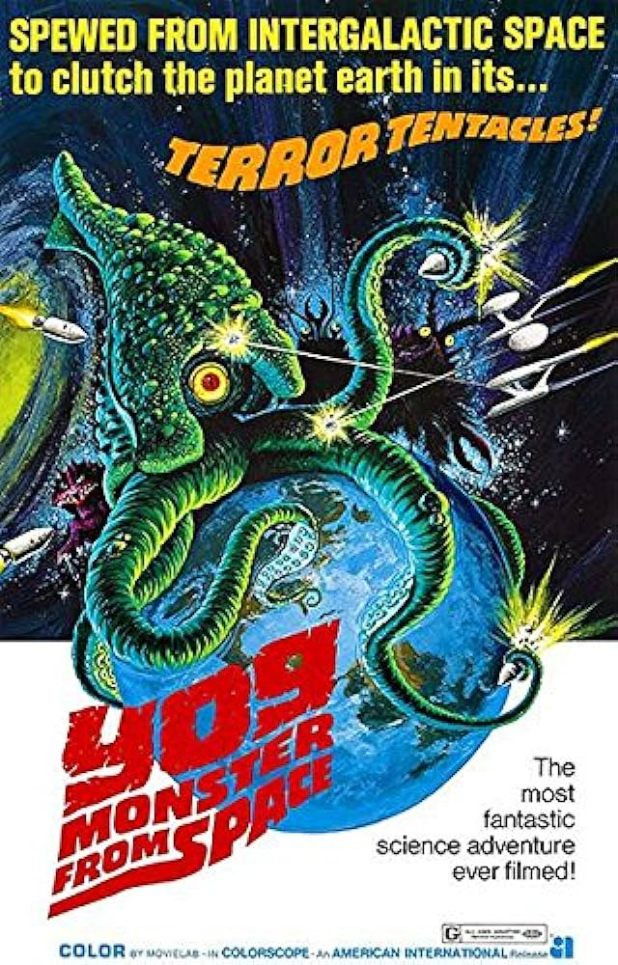
Also known as Space Amoeba and Gezora, Ganime, Kamēba: Kessen! Nankai no Daikaijū (Gezora, Ganimes, and Kamoebas: Decisive Battle! Giant Monsters of the South Seas), this Toho movie is all about aliens that come to Earth and create gigantic monsters from a kisslip cuttlefish, stone crab and mata mata. It’s like the best sushi menu ever except it wants to eat you.

The Helios 7 space probe has an incident near Jupiter — alert Pittsburgh news stations, Hell is full — and comes crashing back down here, bringing the space amoeba with it. It first creates a creature called Gezora, which is the cuttlefish. The humans have a bunch of weapons left over from World War II and set it on fire, killing it.

The stone crab, which is called Ganimes, is next and the humans defeat it as if it were the Tall Man or the Car. They lure it into a pit and blow it up.

The amoeba gets smart and makes two monsters at once, another Ganimes and a mata mata named Kamoebas. Humans grab some bats — a lot of bats — and the space amoeba loses control over the monsters, who start to fight one another. Then a volcano is made live and everything alien dies, all at once.

Never doubt the humans capacity for killing, whether you are a kaiju, space amoeba or some other monstrous being.

Directed by Ishiro Honda, this was written by Ei Ogawa who intended for it to be called Great Monster Assault and have entire continents be destroyed by alien monsters.

This was also the last science fiction film made under Toho’s studio system, which established a subsidiary called Toho Eizo to specialize in tokusatsu films. Most of the actors were released from their contracts, Eiji Tsuburaya’s — who died days before filming started — special effects department was closed and even Honda’s contract ended.