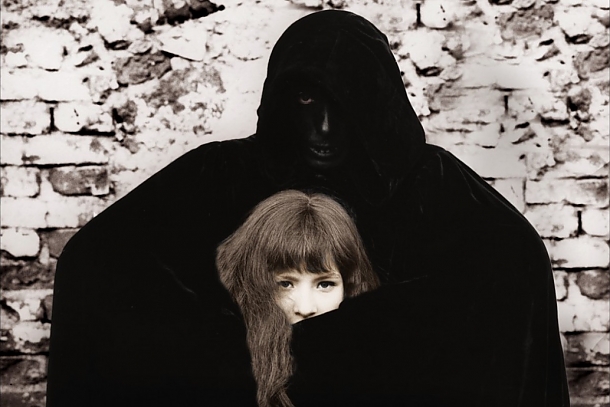
Chattanooga Film Festival: End Zone 2 (1970)

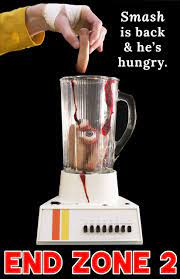
Whatever side you’re on when it comes to the controversy between whether Mikey Smash or William Mouth played Smash Mouth in the sequel to Warren Q. Harolds’ 1965 slasher End Zone, you can say quite simply that they’re both better than Snead Crump when it comes to menacing Angela Smazmoth (Julie Kane). Now that there’s a restored version of this never-released to the public slasher, well, now we can all fight that same fight all over again.

And hey — whatever happened to that final half hour of this movie? Have you seen it? Did you check it out when it played with The Curse of the Mummy’s Tomb and The Evil Eye?

Put together from six partial prints and a partial Italian internegative — that explains why the language changes — this is the film that didn’t just give birth to the American slasher, it also influenced movies like Let’s Scare Jessica to Death.

Shh…I like keeping up the premise that this is a lost movie, so don’t tell anyone that it works because it’s just as rough and ramshackle as those pre-78 slashers that we love so much like My Brother Has Bad Dreams and Scream Bloody Murder (which ironically nearly shared a title). I also think it’s kind of wild that in the same year we’ve had two double features based around slasher movies of the past based around football (this pairs with The Once and Future Smash; the other entry is The Third Saturday In October and The Third Saturday In October V).

The Chattanooga Film Festival is happening now through June 29. To get your in-person or virtual badge to see any of these movies, click here. For more information, visit chattfilmfest.org and follow us on Facebook, Twitter and Instagram.

RADIANCE BLU RAY RELEASE: Red Sun (1970)

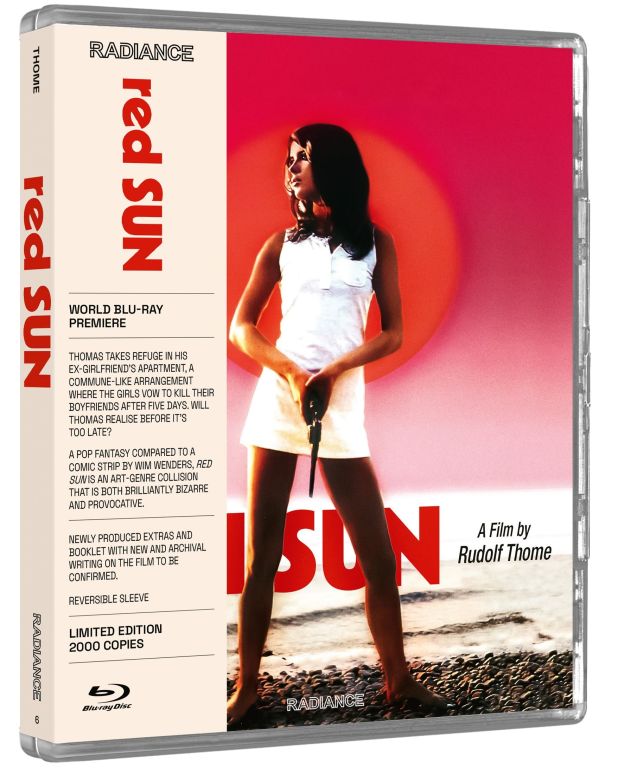
Thomas (Marquard Bohm) gets a ride to Munich where he finds his ex-girlfriend Peggy (counterculture icon and model Uschi Obermaier) who takes him in. In her flat he finds Peggy and her roommates have a commune-like lifestyle where they take a male lover and murder them within five days so that they never fall in love. Does Thomas realize that in time?

Directed by Rudolf Thome and written by Max Zihlmann, the girls all seem rather nice, you know, other than the fact that they murder men. They all seem to genuinely like Thomas, but when you have a manifesto, you have to follow it or it’s not a manifesto.

This is definitely more style than substance but that’s not a complaint. Plus. the soundtrack has the Small Faces and The Nice on it, as well as “Adagio in G Minor” by Remo Giazotto, which also shows up in Rollerball and Space: 1999.

Obermaier is a dream and has a presence that you wish showed up in more than just that handful of movies that she was in. Her flatmates are played by Diana Körner, who was memorable in a small role in Barry Lyndon, Sylvia Kekulé and Gaby Go.

I really have no idea what category this is, but whatever it is, I want more.

This limited edition Radiance Films blu ray includes a high definition digital transfer overseen by director Rudolf Thome; select scene commentary with Thome and Rainer Langhans, Obermaier’s boyfriend and Kommune 1 member who served as inspiration for the film and was on set for the shoot; Rote Sonne between Pop Sensibility and Social Critique, a newly produced visual essay by scholar Johannes von Moltke on Red Sun which looks at the social and cultural influences on the film and provides context for the era in which it was made; From Oberhausen to the Fall of the Wall, a visual essay by academic and programmer Margaret Deriaz tracing the development of the New German Cinema from the Oberhausen Manifesto to the fall of the Berlin wall; a reversible sleeve featuring designs based on original posters; a limited edition 52-page booklet featuring new writing on the film by Samm Deighan; newly translated archival letters by Wim Wenders, critic Enno Patalas and the German Film Evaluation Office on the film’s official submission; a newly translated archival interview with Rudolf Thome and full-height Scanavo packaging with removable OBI strip leaving packaging free of certificates and markings. You can get it from MVD.

THE FILMS OF BRIAN DE PALMA: Dionysus in ‘69 (1970)

ABOUT THE AUTHOR: A.C. Nicholas, who has a sketchy background and hails from parts unknown in Western Pennsylvania, was once a drive-in theater projectionist and disk jockey, Currently, in addition to being a writer, editor, podcaster, and voice-over artist, he contributes to Drive-In Asylum. His first article, “Grindhouse Memories Across the U.S.A.,” was published in issue #23. He’s also written “I Was a Teenage Drive-in Projectionist” and “Emanuelle in Disney World and Other Weird Tales of a Trash Film Lover” for upcoming issues.

Director Brian DePalma has had an amazing career in diverse genres. He’s best known for his horror films, like Carrie and The Fury, and giallo-esque suspense thrillers, the greatest being Blow Out and Dressed to Kill, but he’s also done a fantastic musical, Phantom of the Paradise, a moving war film, Casualties of War, and a trio of classic gangster films, Scarface, The Untouchables and Carlito’s Way. Early in his career, he dabbled in comedy with mixed results, and he’s stumbled with science fiction, Mission to Mars, and adapting a couple of beloved best-sellers for the screen, A Bonfire of the Vanities and The Black Dahlia. I’m pleased that B & S About Movies is devoting a week to one of my favorite directors of all time, even though he hasn’t had a success in decades, and I’ve come to realize that he’s probably lost his touch. For my contribution to this special retrospective, we’ll look at DePalma’s least-seen film, Dioynsus in ’69 from 1970.

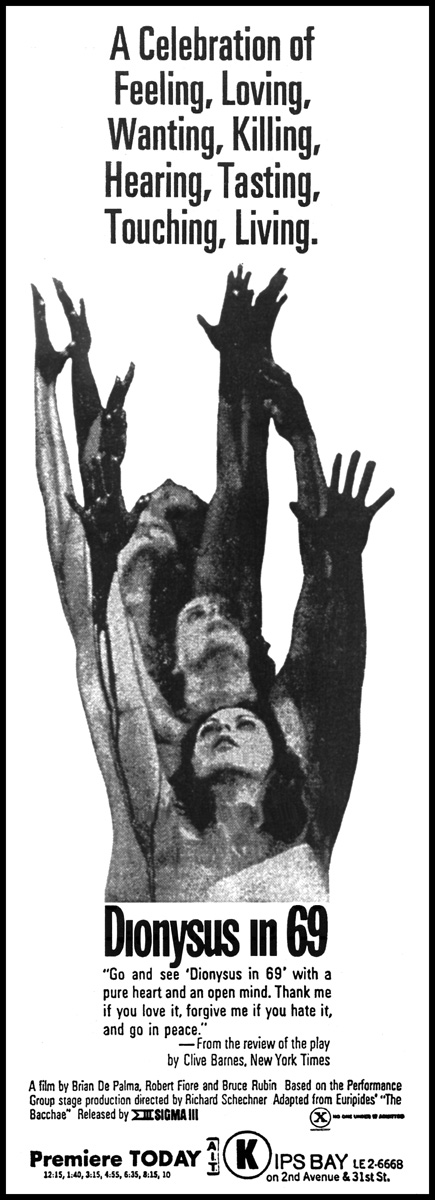
Even for early-career DePalma, this was a weird project, a film of an avant-garde stage production of The Bacchae by Euripedes, performed in a garage, by a New York City experimental theater group called The Performance Group. The film’s direction is credited to DePalma, Robert Fiore and Bruce Rubin, but you can tell by looking at any five minutes of the film that it was mostly DePalma calling the shots behind the camera. Indeed, the immersive nature of the staging—making the audience part of the performance—calls to mind the famous “Be Black, Baby” sequence in DePalma’s other 1970 release, Hi, Mom! But apart from that, the biggest tell is the use of split screen throughout, a DePalma trademark if ever there was one. 

Today, while the film remains little more than a curio for DePalma completists and those who like ancient Greek tragedies and avant-garde theatre, it did foreshadow that DePalma would, by the end of the 70s, become a world-class director. The black-and-white camera work is crisp, and the split screen allows you to take in different perspectives simultaneously, becoming a voyeur as in so many DePalma films to come. Best of all, the play stars DePalma regular William Finley as Dionysus. Finley’s terrific—as you’d imagine—and the performance ends with the wonderfully insane segment “William Finley for President.” Roger Greenspun, in his New York Times review, wrote: “DePalma, a witty, elegant, understated young director (for example, Greetings) seems to have found new ease and vigor and a taste for risks in meeting the challenge of this film.” I wholeheartedly agree.

Dionysus in ’69 has been a challenge to view over the years. Its distributor, Sigma III, had released a classic 60’s Euro-horror double feature, The Horrible Dr. Hichcock and The Awful Dr. Orloff, as well as DePalma’s Greetings and Hi, Mom!, but didn’t seem to have much enthusiasm for the film, which snagged an unfortunate X-rating for its pervasive nudity. As far as my research uncovered, it played one New York City theater in March 1970, but had few, if any, other bookings. It has languished, surfacing only for a long out-of-print North American DVD and an appearance in a French DVD box set of DePalma’s earliest films. A few years ago, I was delighted to discover that it was available for free streaming on a New York University website. For me, that was like a gift from the Greek gods: the ability to check off the last film in DePalma’s filmography.

Even the least of Brian DePalma’s films has things of interest for true film buffs. I, for one, am glad that I found Dionysus in ’69. My life is now complete. Well, okay, not quite. There’s still Jerry Lewis’s The Day the Clown Cried

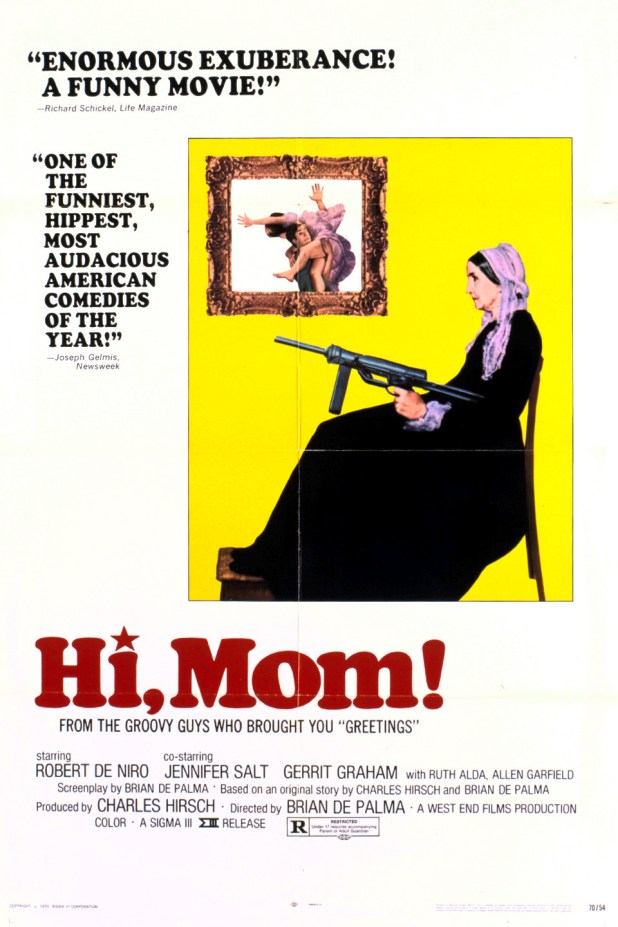
THE FILMS OF BRIAN DE PALMA: Hi Mom (1970)

Playing the same role from Greetings, Robert De Niro is Vietnam veteran and aspiring filmmaker Jon Rubin, who has been hired by producer Joe Banner (Allen Garfield) to make an adult film. Rubin uses this to take advantage of his crush on neighbor Joey (Jennifer Salt), wooing her and having sex with her on hidden camera. The problem is that the camera misses most of the action and Banner decides not to hire him.

Rubin follows that by being part of a confrontational theater group led by Gerrit Wood (Gerrit Graham) whose latest play, Be Black Baby! has the audience forced to wear blackface and be abused by the African-American actors who all are wearing white paint on their faces. Rubin’s part is to play a cop who arrests members of the white audience because they are black. Of course, the audience loves the show and decrees it an artistic success. Rubin gets back together with Judy, marrying her and then blowing up their apartment building.

Plenty of actors who would work again with director and writer Brian De Palma appear in this, including Charles Durning, Salt (they’re both in Sisters) and Graham. It also has roles for Paul Bartel and Lara Parker, who was Angelique on Dark Shadows. De Niro and De Palma would, of course, work together again on The Untouchables.

De Palma was still finding his way here and often, he struggles with comedy. There are still some wild moments as the audience is attacked, however.

ARROW BOX SET RELEASE: Giallo Essentials: Blue Edition

Arrow Video continues its exploration of giallo with its fourth box set after the Black, RedYellow and White editions of Giallo Essentials.

In the early 1970s, when the giallo boom was at its peak, producer-turned-director Luciano Ercoli made  three standalone — but thematically linked — giallo films all starring his wife Nieves Navarro under the name Susan Scott. This set shares those movies in one convenient and well-priced edition.

The Forbidden Photos of a Lady Above Suspicion (1970): Minou (Dagmar Lassander, The House by the Cemetery) loves her husband, Peter. But Peter is cold and only really seems to care about work. All she does all day is pine for her husband and take care of a turtle. Yep. You just read that correctly.

One night, a mysterious stranger attacks her, cuts open her clothes and then warns her: her husband is a killer.

The mysterious man is proven correct when a man who owed Peter money shows up dead. He demands that she come to his home, where he blackmails her into sleeping with him. Seeing as how he has recorded their tryst, he now has more material on her.

Even her friend Dominique (Nieves Navarro, All the Colors of the Dark, who was married to the director, Luciano Ercoli) can’t be trusted, as Minou finds photos of the blackmailer in provocative poses in her possession. When she finally gets the police to investigate, the man’s home is empty and Dominique tells the police he never even existed. Oh yeah. Dominique was once Peter’s woman before Minou. So there’s that.

Minou has a nervous breakdown and overdoses on tranquilizers before sobering up and learning that it’s all been a plot against her from the beginning. But come on — if you’ve watched any giallo, you knew that going in.

Despite its lurid title, Forbidden Photos of a Woman Above Suspicion isn’t filled with sex or even all that much violence. It’s more about alcoholism and how women were taught that they had to have the skills to land a man, but not what to do with their lives to make them fulfilled beyond just a relationship.

Director Luciano Ercoli has some gorgeous shots in here that really take advantage of the space age 1960’s aesthetic. And a bossa nova score by Ennio Morricone keeps this film bouncing. It wouldn’t be the first giallo I’d recommend, but it’s not the last, either.

Extras include commentary by Kat Ellinger; Private Pictures, a documentary featuring interviews with Navarro, Ercoli and Gastaldi; an appreciation of the music of  70s Italian cult cinema by musician and soundtrack collector Lovely Jon; a Q&A with Lassander; the Italian and English trailers and an image gallery.

Death Walks On High Heels (1970): 

A man is stabbed on a train, leading the police to question Nicole (giallo queen Nieves Navarro) about diamonds that are missing. Her life turns upside down, as she begins to receive disguised phone calls asking about the diamonds and a blue-eyed masked man attacks her in her boudoir. She then remembers that her jealous lover Michel owns contact lenses in that color, so she runs away with an older eye surgeon to the coast of England. But Michel isn’t far behind…

The first of three giallo directed by Navarro’s husband, Luciano Ercoli, this is what the genre should be: shocking, lurid, bloody and oh so fashionable. It also makes a deft turn from what we expect from the form into an actual mystery film.

There’s a plot twist here that honestly shocked me, so I won’t spoil it. While the other two films in the Ercoli giallo trilogy are much better, this is still a quality film worthy of your time. Some critics decry them as Ercoli making movies just to feature his wife, but if you had a quality woman like Navarro in your life, I bet you’d do the same.

This comes with audio commentary by film critic Tim Lucas, an introduction to the film by screenwriter Ernesto Gastaldi, an interview with Ercoli and actress Navarro, Gastaldi explaining how to write a successful giallo, an interview with composer Stelvio Cipriani and Italian and English trailers. These extras are a sheer joy for giallo lovers and what an opportunity to hear from Ercoli, Navarro and Gastaldi.

Death Walks At Midnight (1972): Nieves Navarro is a true queen of giallo, appearing in All the Colors of the Dark, Forbidden Photos of a Lady Above Suspicion, So Sweet, So Dead and Death Walks on High Heels. Here, she makes her third film with her husband, Luciano Ercoli.

In this one, she plays a fashion model named Valentina who agrees to help her journalist beau study LSD. But while she’s dosed and in the middle of a photo shoot, she watches a man brutally murder a woman with a spiked gauntlet. He thinks she’s just hallucinating and publishes her account, but she believes it’s real. And when the killer starts stalking her, she really starts to worry.

The entire opening of the film is one big acid freakout and everything that follows is the bad trip, the comedown and reality brutally intruding into drugged out bliss. This is a film packed with brutal violence and plenty of gore, but it makes sense. The movie demands it.

The end, when everything is wrapped up by the killer (killers?) is pretty great, as the many red herrings are discussed and the entire plot is finally explained to us. If everything before felt like a nightmare, this is bracingly cold water directly to the face.

Even better, Navarro portrays a heroine who doesn’t faint at the first sign of danger. She deals with the ineffectual police and indifference of her boyfriend with aplomb.

And yes — this film is packed with bonkers crazy fashion — a metal/glass silver wig and a strange sculpted wall feature prominently — so if that’s why you love giallo, you’ll be quite happy here. Me? I loved every minute.

This release comes with audio commentary by film critic Tim Lucas, an introduction by screenwriter Ernesto Gastaldi, an extended TV version, a reflection by Gastaldi reflects on his career in the crime film-writing business and Desperately Seeking Susan, a visual essay by Michael Mackenzie exploring the distinctive giallo collaborations between director Luciano Ercoli and star Nieves Navarro. If you love giallo — or are just getting into it — all of these extras will open deepen your love for the form; Lucas is one of the best commentary track experts there is.

This limited edition Arrow Video box set comes in rigid packaging with the original poster artwork in a windowed Giallo Essentials Collection slipcover. You’ll enjoy 2K restorations for all three films as well as reversible sleeves for each film featuring original and newly commissioned artwork by The Twins of Evil and Gilles Vranckx.

You can get this from MVD.

VIDEO ARCHIVES WEEK: The Private Life of Sherlock Holmes (1970)

VIDEO ARCHIVES NOTES: This movie was discussed on the December 6, 2022 episode of the Video Archives podcast and can be found on their site here.

Steven Moffat and Mark Gatiss, the creators and writers of Sherlock, credited this movie as a source of inspiration for their project. It attempts to tell the real story of Sherlock Holmes (Robert Stephens) and Dr. John Watson (Colin Blakely).

It is made up of two stories. In the first, a man named Rogozhin (Clive Revill) wants Holmes to have a child with ballerina Madame Petrova (Tamara Toumanova), but he tells her that he is in love with Watson. Whether or not that is true is left up to the viewer. In the second, Holmes rescues the drowning Gabrielle Valladon (Geneviève Page) and she asks him to save her husband, which leads him to Loch Ness, a place where he sees the legendary sea serpent and learns that his brother Mycroft (Christopher Lee) is creating a submarine for World War One. Queen Elizabeth says that the ship is unsporting, so Mycroft allows the Germans — posing as monks — to steal it and arrests Valladon, who is actually a German spy named lse von Hoffmanstal.

Director Billy Wilder said of the film, “I should have been more daring. I have this theory. I wanted to have Holmes homosexual and not admitting it to anyone, including maybe even himself. The burden of keeping it secret was the reason he took dope.” That said, Holmes does fall for the spy and is so moved by the revelation of her death that he disappears into his room to do cocaine.

When this came out on laserdisc, several deleted scenes — some not even filmed — were included. The first is a framing device that would have Dr. Watson’s grandson picking up a box full of his grandfather’s writing; a scene on a train that would take Holmes and Watson to 221B Baker Street; “The Curious Case of the Upside Down Room” in which Watson creates a case to get Holmes out of his drug haze; “The Adventure of the Dumbfounded Detective” of which only the script survives and Holmes discussing winning a race and a night with a sex worker. He had fallen for another girl and wanted to keep his purity, only to learn that the girl and prostitute were the same person, which is why he is emotionally uninvolved; “The Dreadful Business of the Naked Honeymooners,” a story where Holmes asked Watson to solve a case and two epilogue scenes where Holmes avoids being involved in the Jack the Ripper investigation and another that was similar to the end of Wilder’s Some Like It Hot.

The Loch Ness Monster in the film actually sank into the water and was lost for fifty years. The model was built by Wally Veevers with a neck and two humps. Wilder wanted no humps, which made the model too heavy. It sank and needed to be made all over again. In 2016, after sightings of Nessie in one section of the Loch, the lost model from the movie was brought back above the surface.

Ghetto Freaks (1970)

ABOUT THE AUTHOR: Jennifer Upton is an American (non-werewolf) writer/editor in London. She currently works as a freelance ghostwriter of personal memoirs and writes for several blogs on topics as diverse as film history, punk rock, women’s issues, and international politics. For links to her work, please visit https://www.jennuptonwriter.com or send her a Tweet @Jennxldn

Regional independent film made in Cleveland, Ohio and released originally under the titles Love Commune, The Aquarians, The Wages of Sin, and Sign of Aquarius, this pseudo-musical was one of many from that era that attempted to capitalize on the hippie trend and the popularity of Hair. Then it was released again more than a year later under this version, with a new marketing campaign to capitalize on the popularity of Blaxploitation films. 

How might these two genres cross over? Well, they don’t. Ghetto Freaks is the same movie as the earlier versions, with two minutes of footage added. Thie new scene features an African American guy in a robe performing some sort of blood ritual and has nothing to do with anything else in the film. With a cast of mostly white kids, plus one black guy and no literal ghetto freaks, it must have been a disappointing experience for anyone who went into this version expecting the next Shaft.  

In 2023, it serves as a wonderful time capsule. The clothes, hairstyles, lingo, and furniture are far out, man. It’s a slice-of-life film where the cast randomly breaks into song and dance. The narrative follows the daily (sometimes mundane) activities of a group of hippies. They pretty much do what you’d expect them to. They panhandle and bitch about “the man” to anyone on the street that walks past them. They protest the war in Vietnam go to a club (owned by co-director John Pappas) to listen to groovy music. One evening, the main man Sonny (Cincinnati’s Paul Elliot) meets a naïve runaway teen girl named Donna (Gabe Lewis) who joins their commune.  

Back in their squat, Donna is inducted into the hippie life. They sit around, smoke pot, philosophize endlessly, dance around nude, paint each other and have group sex. There’s one scene of a pregnant girl going on a really bad acid trip, allowing the directors to get creative with lenses and lighting.  

There’s also something resembling a plotline where a dangerous drug dealer threatens Sonny and Donna’s newfound happiness by pressuring Sonny to sell drugs for the neighborhood gangs. Donna dies tragically because of Sonny’s refusal. 

Released on a double bill with the far superior anti-drug message film Way Out (1967) by Something Weird in 2009, it’s unclear where Ghetto Freaks stand on the issue. The filmmakers include some scenes that make it look fun and other scary ones. While their efforts to grab as wide an audience as possible are noteworthy, it didn’t work. Hence the alternate titles, re-releases, and re-vamped marketing campaigns. 

Older people from the Cleveland area will likely get a thrill from seeing all their favorite places preserved on film as they existed in the late 1960s. For the rest of us, it’s slow going. 

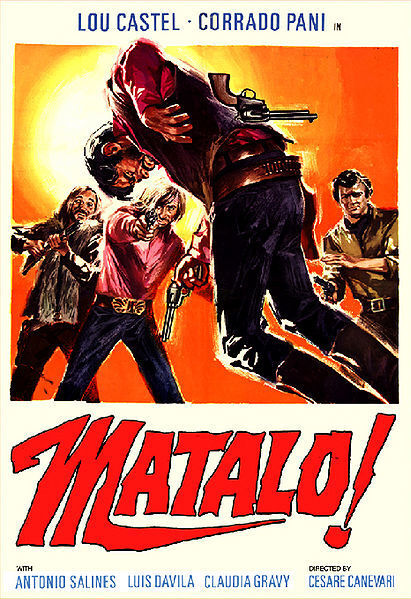
APRIL MOVIE THON 2: Matalo! (1970)

April 30: How the (Not) West Was Won — A Western not made in America.

It would take other film industries decades to equal the sheer volume that the Italian exploitation machine could accomplish. In the four years since Django and five since A Fistful of Dollars and West and Soda, a traditionally animated movie whos escreation predates Leone’s film, hundreds of cowboys thundered out of the European West and several genres emerged, from comedies and zapata westerns to films centered on the tragic hero, horror westerns and this film, which is uncatagorizable but could maybe be an acid horror art deconstruction.

Cesare Canevari only directed nine movies, but wow if he didn’t hit nearly every genre: an early Western (Per un dollaro a Tucson si muore), giallo (A Hyena In the Safe), an early Italian Emmanuelle (A Man for Emmanuelle), Eurospy (Un tango dalla Russia), Ajita Wilson’s first movie (The Nude Princess), late era giallo with plenty of sleaze (Killing of the Flesh) and Naziploitation (the go all the way madness that is  The Gestapo’s Last Orgy).

It starts with a desperado named Bart (Corrado Pani) walking through the town as cocky as possible, despite the fact that he’s headed to the gallows. He even puts his own neck in the noose, knowing that some Mexican bandits are about to save his neck. His walk back out of town is even more audacious, as he’s just stood on the precipice of death and watched the chaos that he has ordered come true. He somehow tops that by killing off the men who saved him before meeting up with his friends Ted (Antonio Salines) and Phil (Luis Dávila) in a ghost town where the movie decides to slow down as they explore an abandoned hotel as electric guitars scream and wind blows through every frame of this film.

They’re joined by Mary (Claudia Gravy, Yellow Hair and the Fortress of Gold, Tuareg: The Desert Warrior), a snarling force of female nature that finds herself strong enough to be on the side of stagecoach robbing evil. That robbery seems to cost Bart his life and the film switches gears as the gang hides out in the ghost town, abusing an old woman until Ray (Lou Castel) and a younger widow (Mirella Pamphili) arrive and they too are abused by the gang. Luckily, Ray has a horse who seems smarter than him and he’s quite good with a boomerang, which this movie uses for wild POV shots as he whips them at the gunmen.

What’s wild is that a year earlier, Dio non paga il sabato (Kill the Wickeds) was directed by Tanio Boccia and it’s nearly the same movie but shot as if it were a normal film, not the sometimes wandering, other times hyperfocused Matalo!

10TH ANNUAL OLD SCHOOL KUNG FU FEST: The Grand Passion (1970)

Lu Xiao-Ling (Polly Shan-kuan) and her brother Lu Liu (Pai Ying) are young rebels and part of the Southern Song Dynasty. Tasked with moving a document that will allow two allied armies to finally come together to defeat the despised Jin army that has occupied China, this film is about the clandestine meetings and secret paths that the two will undertake to save their homeland. Also, Lu Xiao-Ling has the wildest martial arts weapon ever: she can throw coins with deadly efficiency.

This week, I’ve touched on how it took King Hu years and years to make A Touch of Zen. In fact, it took so much time that assistant director Tu Chung-hsun made A City Called Dragon while the cast and crew was waiting. But it also took so long that Yang Shih-Ching also took the cast and crew to make this movie.  And when you have fights between Polly aand Pai Ying against Lung Fei, Shan Mao, Chang Yi kwai and Chen Shi Wei, well, the results won’t be boring.

Want to see it for yourself?

You can watch The Grand Passion Friday, April 28 at 7:15 PM

in Theater 1 at Metrograph and Subway Cinema in New York City. It’s part of the 10th Old School Kung Fu Fest: Sword Fighting Heroes Edition from April 21-30, 2023!

Tickets are on sale right here!

10TH ANNUAL OLD SCHOOL KUNG FU FEST: A City Called Dragon (1970)

King Hu’s A Touch of Zen took so long to make that his assistant director Tu Chung-Hsun and the cast made a whole different movie, the one you’re about to read about.

Shang Yen-Chih the Jade Dragonfly (Feng Hsu) is in trouble. She was supposed to get plans to defeat the invading Manchu army from her contact in Dragon City and when she gets there, he and his entire family — nearly eighty of them — are dead. Now, she has to find the plans, get revenge on Commander Bu Lung (Shih Chun) and get out alive.

Sure, it’s wuxia, but it’s closer to a spy movie than an out and out fight film. That’s what makes this stand out and it’s still wild that everyone went back to working on A Touch of Zen and King Hu was probably waiting for a particular plant to be in bloom or a roof to have the perfect aged look that had to come from nature and not paint.

Want to see it for yourself?

You can watch A City Called Dragon on Sunday, April 23 at 7:15 PM in Theater 1 at Metrograph and Subway Cinema in New York City. It’s part of the 10th Old School Kung Fu Fest: Sword Fighting Heroes Edition from April 21-30, 2023!

Tickets are on sale right here!