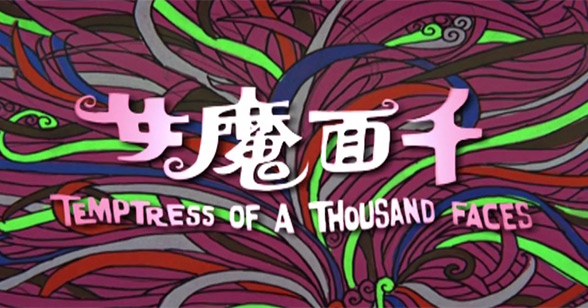
SHAWGUST: Temptress of a Thousand Faces (1969)

At once a Shaw Brothers film, a Eurospy action movie and kind of like the Hong Kong Danger DiabolikTemptress of a Thousand Faces is why I watch movies.

Officer Chi-ying (Tina Chin-Fei) is trying to hunt down the Temptress, who she publically dares to come after her. The Temptress agrees to this by stealing her identity, flirting with an entire club full of men and cleaning out a jewelry store while wearing Chi-ying’s face. Our heroine’s name gets cleared by her photographer boyfriend Inspector Yu (Liang Chen), who ends up being the one in peril when dealing with the titular villainess and her army of henchwomen.

Yes, the Temptress really does have a thousand masks, maybe even more, as well as an unlimited supplies of knockout gas and scantily clad women ready to answer her every command. This is a movie that at once has a strong female heroine and antagonist, but also one that has fan service aplenty, like the Temptress appearing being bathed by her handmaidens and Chi-ying fighting barefoot in a near see-through gown, but the men around them are such morons that they can’t help but shine, no matter how much of the male gaze gets thrown their way.

There’s a bomb that gets deactivated with seven seconds left — just like Goldfinger — as well as a volcano base — just like You Only Live Twice — and even the Bond theme playing just because, well, this movie is a riot and unafraid where it’s taking stuff from. That’s how good it is.

It all ends with Chi-ying battling the Temptress after she wears the face of our heroine and makes love to her man while she’s forced to watch. A twin adversary kung fu spectacle, topped only with our heroine and her reclaimed man shooting near thousands of bullets and wiping out an entire base full of dedicated domina female supertroopers.

I may not have any power over Arrow, but I know another Shawscope box set has to be coming. I dream that this and Infra-Man end up on it, movies that show that the Shaw Brothers made more than just their typically amazing kung fu movies.

You can watch this on YouTube.

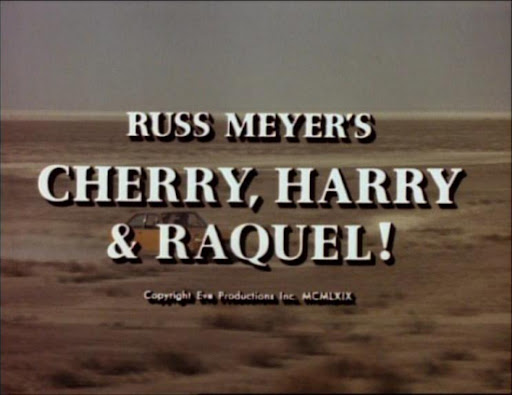
The Sizzlin’ Something Weird Summer Challenge 2024: Cherry, Harry and Raquel (1969)

Uschi Digard week (June 23 – 29) Digard is best known for her work with Russ Meyer but she became an SWV fan favorite for two gargantuan reasons, her charm and her prolific career. The Swiss actress fled to America in 1968 and began a long career filling the silver screen from corner to corner with her overflowing positive energy. Show the lady some respect and watch one of her movies.

This is the first appearance in a Russ Meyer movie of Charles Napier. He plays Harry Thompson, a California border sheriff and marijuana smuggler who also somehow — spoiler warning — comes back from the dead to die again in Supervixens.

But as for this movie, it starts with a narration that blames marijuana for so many evils in society. Harry has ignored all that as he Harry works his sheriff job in between illegal activity. He lives at the site of a close silver mine with his English nurse girlfriend Cherry (Linda Ashton). As for Raquel (Larissa Ely), she’s a writer who has an interest in sexually pleasuring men. The two women learn of one another but Harry doesn’t want them to make love for some reason. When we first see Raquel, she’s in bed with Harry’s partner Enrique (Bert Santos). The two men work for Mr. Franklin (Frank Bolger), the town’s main politician, to move drugs. One of their other associates, the Apache (John Milo) is screwing everyone over. Franklin asks for him to be killed, but he gets away and steals Harry’s Jeep.

Now, Enrique knows too much and he must be killed. But the Apache gets to him — and Mr. Franklin — first. Raquel finds his body and is so upset, she must be hospitalized. Good news. Her nurse is Cherry and they finally get together to make love, all while Harry and the Apache do the exact opposite and kill one another.

But ah — it was all a story that Raquel was writing. This strange ending may be because a lot of the film’s footage was accidentally ruined by the color lab. Roger Ebert said, “The result is that audiences don’t even realize anything is missing; a close analysis might reveal some cavernous gaps in the plot, and it is a little hard to figure out exactly how (or if) all the characters know each other, but Meyer’s subjective scenes are so inventive and his editing so confident that he simply sweeps the audience right along with him. Cherry, Harry and Raquel! is possibly the only narrative film ever made without a narrative.” Uschi Digard, the lover of the Apache, was also added Linda Ashton quit and you have to admit that she adds a lot to the film. Meyer claims the other actress quit over her pomeranians ruining the carpets of the motel they were staying in and the owner getting upset.

He also said, “The picture is the most successful film I have on cable television-or hotel-vision-because you never have to come in at the beginning. It doesn’t matter. It could be a loop.”

It also has one of the first instances of mainstream full frontal male nudity, which made it a controversial movie all the way back in 1969.

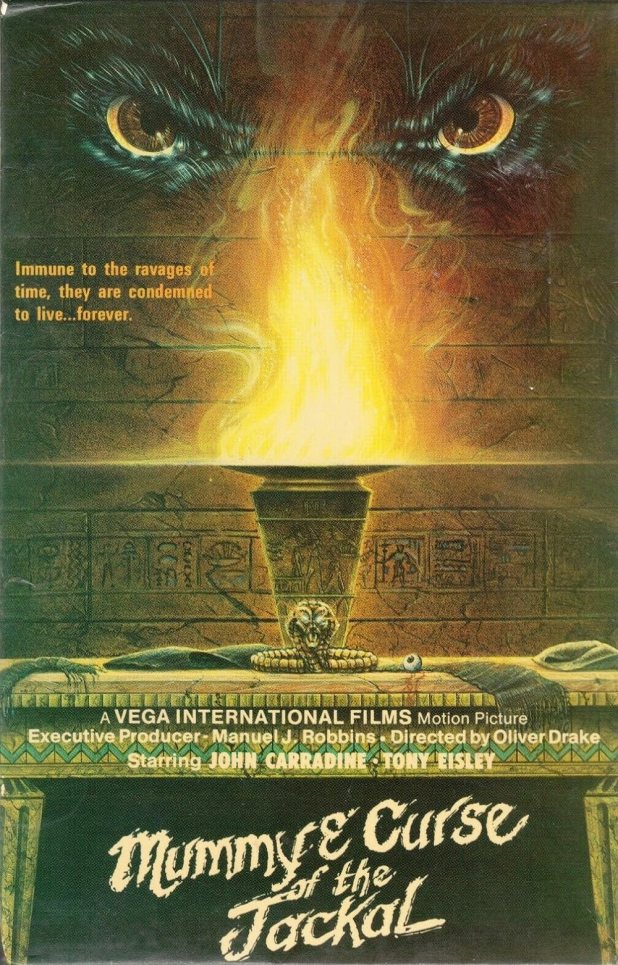
Junesploitation: The Mummy and the Curse of the Jackals (1969)

June 23: Junesploitation’s topic of the day — as suggested by F This Movie— is Free Space! We’re excited to tackle a different genre every day, so check back and see what’s next.

Oliver Drake may have started as an actor, but he’s probably best-known as a prolific screenwriter (151 movies!) and director (41 films, including two adult movies — Angelica: The Young Vixen and Ride A Wild Stud as Revilo Ekard and he was not fooling anyone with that Alucard scam) of low-budget Western films.

A former cattle rancher, he brought his own trained horse with him to Hollywood. 1917, appearing with his trained horse. After acting in silent films, he directed, wrote and produced films for Gene Autry, Tex Ritter and others for RKO, Monogram and Republic. He was so invested in the Western film genre that he used his Pearblossom, California ranch for location shooting.

But by 1969, he was pretty much done in Hollywood. He’d moved to Las Vegas and decided to make a horror movie. Many claim that he didn’t ever work in horror before, but he wrote the 1968 proto slasher No Tears for the Damned AKA Las Vegas Strangler as well as The Mummy’s CurseRiders of the Whistling Skull, the giallo-esque Sinister Hands and Weird Woman.

In Tom Weaver’s Interviews With B Science Fiction and Horror Movie Makers, this movie’s star Anthony Eisley (Dracula vs. Frankenstein) said, “The director was quite senile at the time — the absolute epitome of total confusion.”

That claim is denied by the director’s daughter, who said on IMDB, “Oliver Drake would have agreed with these reviews. I should know because he was my father. He was his harshest critic & did not enjoy watching this after it resurfaced on VHS. It is also incorrect that this was the only monster movie he ever made, The Mummy’s Curse comes to mind. But I completely disagree with comments by Anthony Eisley that my father was senile during the making of this film! Its true that this film was never finished and sat on the shelf for years. My father went on to write two books, both of which were very well received by critics. He attended many Western Film Festivals as the guest of honor and gave very informative and entertaining speeches about the early days of film-making.”

The Mummy and the Curse of the Jackals was written and co-produced by William C. Edwards. He only has three movies on his IMDB page with one being the aforementioned Ride A Wild Stud (“When men were men — and women didn’t forget it!”) and Dracula (The Dirty Old Man), another movie that has a jackal-man, as Dracula — using the Alucard name, see it never gets old — enslaves Dr. Irving Jekyll, making him a werejackal and forcing him to bring women to his cabin. It’s the kind of movie where you can see the stick that’s holding up a vampire bat.

Man, Edwards loved the Alucard trick. After all, this has a mummy named Sirakh instead of Kharis and the Ananka character — yes, he also adored Universal horror movies — is Akanna. Well, guess what? This movie is kind of, sort of a sequel to that movie, as it brings back the werejackal under the name Irving Jackalman.

So how did this get made? Well, Drake ended up in Vegas and Edwards was working with Vega International Pictures. According to an article in The Las Vegas Sun, this was just the first of many films the studio had in the works: “The Mummy and the Curse of the Jackal is designed as a breakaway from the high camp and pseudo-intellectual spook picture. Said one Vega executive, “There’s no social comment and no hidden meaning. The horror characters were designed to scare the hell out of the audience and that’s that.””

Supposedly, the production ran out of financing before it was completed and all of the footage was confiscated by an unpaid contractor, which is how it ended up on VHS when Academy released a decimated looking copy in 1985, complete with sitar music — I guess that’s Egyptian, said someone — and surf rock instrumentals instead of whatever music the filmmakers intended. Or maybe Drake himself was looking to sell it at one point. There are also vague reports of it playing in 1969 at an L.A. theater for investors and on a horror UHF show. Somehow, Drake sold They Ran for Their Lives to the CBS Late Movie, so anything is possible.
Maybe I should tell you the story of this movie now.

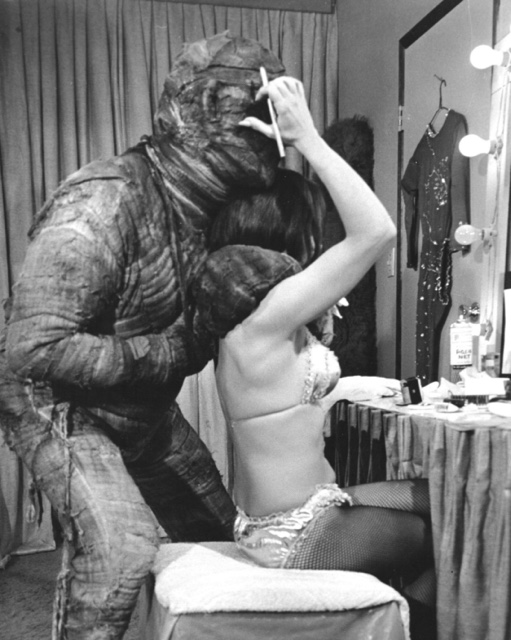
The sarcophagus of Princess Akana (Marliza Pons, who was a famous belly dancer in Las Vegas and supposedly had an uncredited part in Cleopatra and is also in Did Baby Shoot Her Sugardaddy? along with Rene Bond) is being displayed by controversial archeologist Dave Barrie (Anthony Eisley), along with another mummy. She’s remarkably well-preserved and he falls in love with her, falling for the curse of the jackal, which transforms him into a jackal by the light of the full moon. And by jackal, I mean he looks a lot like my chihuahua.

Let me tell you, the place that he stores these mummies is in no way hermetically sealed or scientific minded. It’s a shack probably in Hendersonville and it looks like a total mess.

The princess wakes up and Dave falls in love with her, taking her on dates and teaching her how to put on a bra, which is a modern invention that she doesn’t understand. I have to tell you, I’ve seen a lot in movies but nothing prepared me for a movie where a werejackal by night explains to an undead Egyptian how a Maidenform works. They also go see a Vegas show, at which point the other mummy awakens and attacks an exotic dancer before blasting his way through a wall.

I was wondering, how could this get better? And then John Carradine shows up for all of a minute to say scientific things like, “I can tell from the mold accumulation that this casket is 4,000 years old.”

Is this heaven? Yes, if heaven has a werejackal and a mummy battling on Fremont Street back when Vegas was seedier and cooler and filled with tourists who just look and keep gambling, because yeah, sure, you see monsters fighting every day but you only get the chance to do Vegas once every few years.

Can it get better? Well, the mummy is played by a man named Saul Goldsmith, which is the least frightening mummy name ever.

This is eighty minutes of film with two sentences of plot, which is just how I like it. You come here wanting to see monsters and man, you get monsters. It also completely rips off the Universal version of The Mummy but adds in a Herschell Gordon Lewis-style tongue ripping out effect. It also has a scene where Dave takes Akana — who also has a magic ring that can hypnotize people — on a double date where he claims that “She’s not from here. She comes from … back east.”

The cinematographer of this was William G. Troiano, who also worked on the Vegas productions Ride a Wild StudThey Ran for Their Lives and No Tears for the Damned. He’d follow this by going to work on Horror of the Blood Monsters. He also shot She FreakThe Devil’s Messenger and The Wild World of Batwoman. What a career!

The makeup effects — such as they are — are by Byrd Holland, whose credits stretch across the gamut of my cinematic obsessions, working on everything from Rabid and The Baby to LemoraThe Undertaker and His Pals and Terror Circus. Supposedly, he spent days doing a transformation scene that was cut from the film. He was assisted by Jack Shafton (the creature developer for The Intruder Within and effects on Jennifer) and Tony Tierney (effects for Dracula vs. Frankenstein and The Astro-Zombies). Its effects come from Harry Woolman, who was also on EvilspeakHangar 18In Search of Historic JesusThe Incredible Melting Man, RattlersSupervanLove Camp 7, Dolemite, Don’t Go Near the Park and so many more movies. Again, what a career!

This movie really is a nexus point for my fascinations.

It has no fewer than four assistant directors. Wyott Ordung shot second unit for The Navy vs. the Night Monsters and wrote Robot Monster. Willard Kirkham was on second unit for The Dark and Plan 9 from Outer Space. Russell Hayden only worked on this film, but Robert Farfan was an assistant director on Rebel Without a Cause, which is classy, and more movies I’d be proud to say I worked on, like Bride of the Monster and Moonfire.

This is a movie filled with werejackal murders of winos and cops. I’ve oversold it beyond belief so when you watch it, you may wonder why I love it so. I love the idea of it, I adore the fact that it exists and this to me is why movies are made in the first place. It has Carradine solemnly intone, “We can’t just stand by and let a 4,000-year-old mummy and  a jackal man take over the city!” It was made by people who had astounding careers both before and after. And here we are, in a world where we can say, “I know I could watch a movie that critics worldwide agree is true cinema that makes the blind see and the lame walk, but I’m going to watch The Mummy and the Curse of the Jackals and disappoint everyone.”

Severin is releasing this as a totally cleaned up version that I can’t wait to watch. They found a print at Ewing “Lucky: Brown’s Los Angeles estate sale and added two hours of special features, including another Vega International Pictures film, the once lost movie Angelica, The Young Vixen.
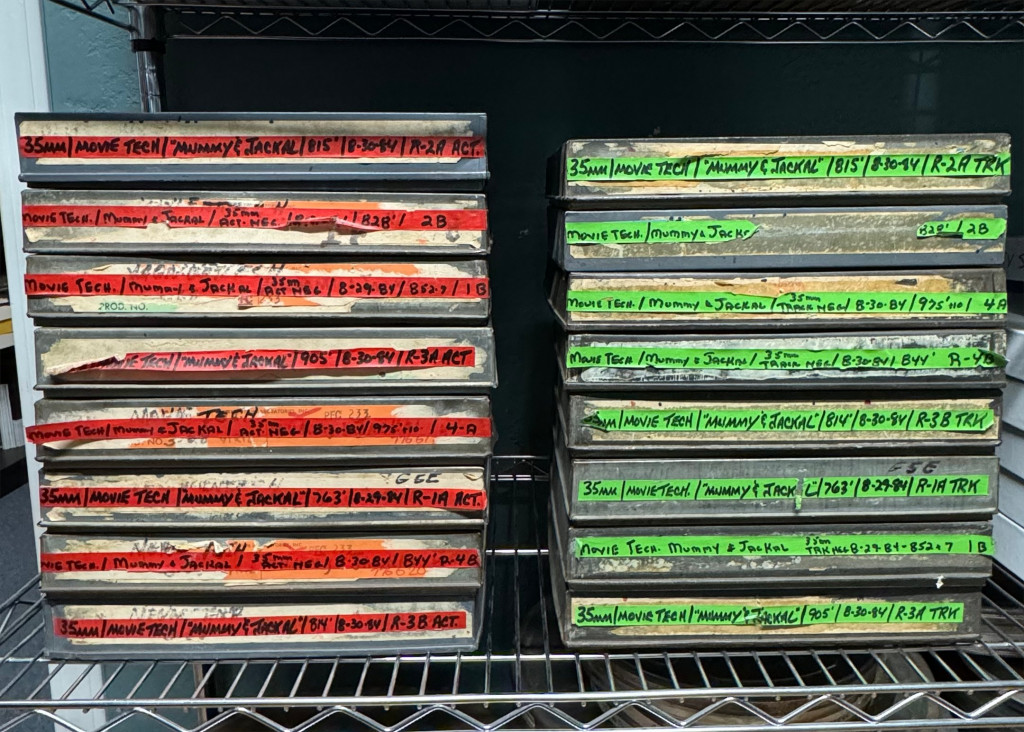
Until then, you can watch the battered original VHS version on YouTube and Tubi.

A lot of the info for this post came from the amazing Monster Kid Classic Horror Forum.
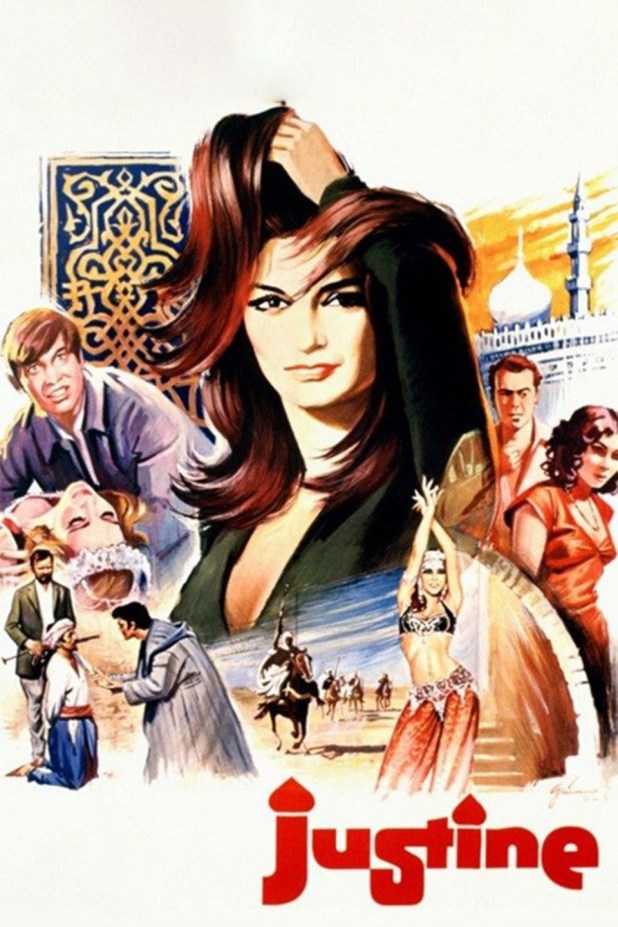
APRIL MOVIE THON 3: Justine (1969)

April 1: Drop A Bomb — Please share your favorite critical and financial flop with us!

No, not Jess Franco’s Justine which came out the same year.

This is a bigger movie.

Maybe not better.

Directed by George Cukor and Joseph Strick and written by Lawrence B. Marcus from the novel by Lawrence Durrell, Justine takes what is seemingly an impenetrable source and turns out, well, something.

Why two directors? The pre-production was done by Strick, who intended to shoot the movie in Morocco. He did some location filming there, but battled Fox execs and star Anouk Aimée. When he did not hire along with the studio’s wishes — and fell asleep on the set while working — Cukor was brought in. Instead of shooting on location, the rest was shot in Hollywood.

It ended up losing $6,602,000, which in today’s money is $55,824,857.00.

Let’s go back a bit. The book that this was based on is part of The Alexandria Quartet, a tetralogy of novels by British writer Lawrence Durrell. The first three books are a Rashomon-like telling of three perspectives on a single set of events and characters in Egypt, before and during the Second World War. The fourth book is set six years later. Justine is the best-known of these books. The author saw the four novels as an exploration of relativity and the notions of continuum and subject–object relation all within the theme of modern love.

Seems like a blockbuster, right?

In the book, the narrator — unnamed but revealed as a man named Darley in later novels — tells of his time in Alexandria and his tragic romance with Justine, a mysterious Jewish woman who was once poor and now married to the rich Egyptian Nessim. Darley is quite similar in background and life to the actual writer of this book.

I love the way that Justine herself is described: “alluring, seductive, mournful and prone to dark, cryptic pronouncements.” Feels like my dating history. There’s also another book within the book written by another lover of Justine, as well as her diary, all of which tell of her many lovers and teh dark hurricane that she brings into the lives of men.

There are also bits about the study of the Kabbalah and secret political games.

As for Durrell, he was born in India to British colonial parents and spent much of his life traveling the world. He worked as a senior press officer to the British embassies in Athens and Cairo, press attaché in Alexandria and Belgrade and director of the British Institutes in Kalamata, Greece and Córdoba, Argentina. He was also director of Public Relations for the Dodecanese Islands and Cyprus. Yet he resisted only being listed as British and didn’t even have citizenship, needing to apply for a visa every time he came to the country, which was embarrassing to diplomats. Also, he may have had a relationship with his daughter Sappho Jane, who was named for the Greek poet whose name is associated with lesbianism.

It’s hard to sum up an artist’s complex life in one paragraph but there you go.

Anyways, this movie feels cursed. Even people who left it worked on bombs. For example, Joseph L. Mankiewicz was working on the screenplay when he was approached to take over Cleopatra. Speaking of that movie, it’s failure led to original producer Walter Wanger being fired and original star — and the person often blamed for Cleopatra — Elizabeth Taylor being replaced.

The actress who was picked to play Justine, Anouk Aimée, was so upset at being separated from her lover Albert Finney that she wanted to leave. The actor had to visit her and tell her to complete the movie. In the book Conversations with My Elders, Cukor was asked who the worst actor he had ever worked with. He answered Aimée, saying “That picture could have been much more than it was allowed to be.” He said that the problem was “Attitude. Intractible. Like Marilyn Monroe, but without the results. Let me tell you, that girl knew she’d probably never work in Hollywood again, or she’d never have defied me like that.”

I love this review from Roger Ebert: “What Cukor has salvaged from this morass is rather remarkable. “Justine” is a movie that doesn’t work and is usually confusing, but all the same it’s a movie with a texture, an atmosphere, that’s almost hypnotic. People who go to movies to enjoy the story will be enraged, and people who go to Justine with any familiarity with Lawrence Durrell’s Alexandria Quartet will be appalled. But people who go to movies to watch the way scenes work, and to relish the rhythm of an actor’s performance, will like Justine more than they expected to.”

There’s a great cast at least. Nessim is played by John Vernon, Darley by Michael York, Narouz is Robert Forster, Pursewarden is Dirk Bogarde, plus there are roles from Jack Albertson, Michael Constantine, Michael Dunn, Barry Morse and Severn Darden. They’re great actors seeking a script to work with and sometimes it works, but there’s so much to get through and the first hour seemingly is formless. I don’t know if this film came out today if anyone would even feel like wading through it; attention spans have changed greatly in its lifetime.

In the 60s, 20th Century Fox seemed like they were unable to get anything going. Cleopatra was such a failure that they had to release all of their contract actors just to save money and sold their studios to Alcoa. They were saved by the box office of The Longest Day, The Sound of MusicFantastic Voyage and Planet of the Apes but would make other flops from 1969 to 1971, including Hello, Dolly! and Myra Breckinridge.

You can watch this on YouTube.

RE/SEARCH Incredibly Strange Films: Body Fever (1969)

What if Ray Dennis Steckler made a gumshoe movie?

What if he starred in it — using his real name and not Cash Flagg — as private eye Charlie Smith?

And what if he were hired by Big Mack, who is played by Bernard Fein who created Hogan’s Heroes, to find a heroin-stealing cat burglar named Carrie Erskine who is, of course, played by Carolyn Brandt, Steckler’s wife?

Also known as Deadlocked and Super Cool, this has all of the Steckler players in it, like Gary Kent, Joseph Brado, Herb Robins and Ron Haydock. But I loved seeing Steckler acting like a tough guy and getting all sorts of women when he’s not fighting various bad guys. It was almost called The Last Original “B” Movie which is a funny name but Body Fever seemed to stick.

Oh yes, that is Coleman Francis, the director of The Beast of Yucca Flats, The Skydivers and Red Zone Cuba. Steckler had just completed filming the last scene and when walking to his car, he saw Francis drunk and lying in the gutter. Steckler felt so bad about Francis’s condition that, even though he had finished work on the movie, he offered Francis a role. Steckler added some scenes just to give Francis some work and money, which he gave to him in advance. Steckler and his crew were astonished when Francis showed up for work the next day sober, clean-shaven and nicely attired. Steckler had wanted him to play the part of a disheveled bum, but Francis had used the advance pay to buy a decent second-hand suit, a shave and a haircut.

Kevin Murphy of Mystery Science Theater 3000 said of his movie, “Coleman Francis uses edits like blunt instruments. He uses blunt instruments like blunt instruments. His major themes are death, hatefulness, death, pain, and death. He looks like Curly Howard possessed by demons from Hell. He tried to pass off Lake Mead as the Caribbean Sea. His films have the moral compass of David Berkowitz.”

He plays the only person Charlie trusts, a laundromat owner who went out of business when his customers kept using wooden change to get free washes. If you think that’s weird, well, Steckler wears a Gilligan hat through most of this movie.

A sequel called Bloody Jack was filmed in 1972 starring Steckler, Brandt and Robbins with Charlie discovering that all of the girls he’s dated are being killed, It was shot but never edited or scored.

You can watch this on YouTube.

RE/SEARCH Incredibly Strange Films: Cherry, Harry and Raquel(1969)

This is the first appearance in a Russ Meyer movie of Charles Napier. He plays Harry Thompson, a California border sheriff and marijuana smuggler who also somehow — spoiler warning — comes back from the dead to die again in Supervixens.

But as for this movie, it starts with a narration that blames marijuana for so many evils in society. Harry has ignored all that as he Harry works his sheriff job in between illegal activity. He lives at the site of a close silver mine with his English nurse girlfriend Cherry (Linda Ashton). As for Raquel (Larissa Ely), she’s a writer who has an interest in sexually pleasuring men. The two women learn of one another but Harry doesn’t want them to make love for some reason. When we first see Raquel, she’s in bed with Harry’s partner Enrique (Bert Santos). The two men work for Mr. Franklin (Frank Bolger), the town’s main politician, to move drugs. One of their other associates, the Apache (John Milo) is screwing everyone over. Franklin asks for him to be killed, but he gets away and steals Harry’s Jeep.

Now, Enrique knows too much and he must be killed. But the Apache gets to him — and Mr. Franklin — first. Raquel finds his body and is so upset, she must be hospitalized. Good news. Her nurse is Cherry and they finally get together to make love, all while Harry and the Apache do the exact opposite and kill one another.

But ah — it was all a story that Raquel was writing. This strange ending may be because a lot of the film’s footage was accidentally ruined by the color lab. Roger Ebert said, “The result is that audiences don’t even realize anything is missing; a close analysis might reveal some cavernous gaps in the plot, and it is a little hard to figure out exactly how (or if) all the characters know each other, but Meyer’s subjective scenes are so inventive and his editing so confident that he simply sweeps the audience right along with him. Cherry, Harry and Raquel! is possibly the only narrative film ever made without a narrative.” Uschi Digard, the lover of the Apache, was also added Linda Ashton quit and you have to admit that she adds a lot to the film. Meyer claims the other actress quit over her pomeranians ruining the carpets of the motel they were staying in and the owner getting upset.

He also said, “The picture is the most successful film I have on cable television-or hotel-vision-because you never have to come in at the beginning. It doesn’t matter. It could be a loop.”

It also has one of the first instances of mainstream full frontal male nudity, which made it a controversial movie all the way back in 1969.

RE/SEARCH Incredibly Strange Films: The Honeymoon Killers (1969)

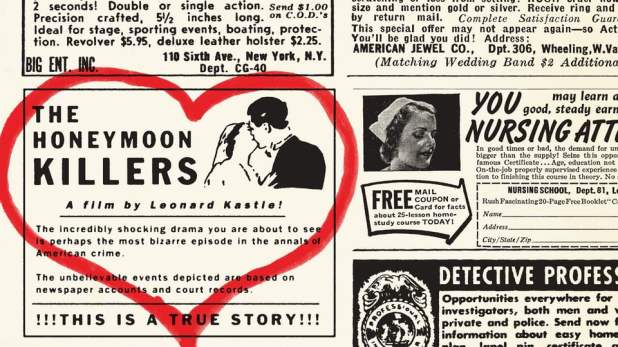
Inspired by the true story of Raymond Fernandez and Martha Beck, the notorious “lonely hearts killers” of the 1940s, The Honeymoon Killers tells the tale with Tony Lo Bianco and Shirley Stoler, in her film debut, as the leads.

Ray starts the film by seducing Martha and stealing money from her, but it turns out that she may be every but his equal, using her wits to help him con and even kill numerous women from lonely hearts ads.

From relationship to relationship, Ray promises to never cheat on Martha, but there’s no way that he can keep up the con. Along the way, every one that crosses their path dies, often horribly.

Originally to be directed by Martin Scorsese, who was fired from the film, it was taken over by writer Leonard Kastle, who only created this one film. Named by François Truffaut as his “favorite American film,” it looks more like a grim documentary than an exploitation film.

American-International Pictures was going to distribute this, even making ad materials, but dropped it due to the film’s “extremely gruesome and misanthropic” tone. Their loss — it’s a work of art.

I’m enthused by the fact that an ad appeared in Variety at some point in the late 70’s announcing a sequel. Although never made, the story would have involved an imagined death row conjugal visit between Ray and Martha , resulting in the prison birth of brother/sister twins who were separated at birth. Years later, the pair meets and becomes adult murderers/lovers, never suspecting that they are siblings. This movie needs to be made.

FVI WEEK: Boot Hill (1969)

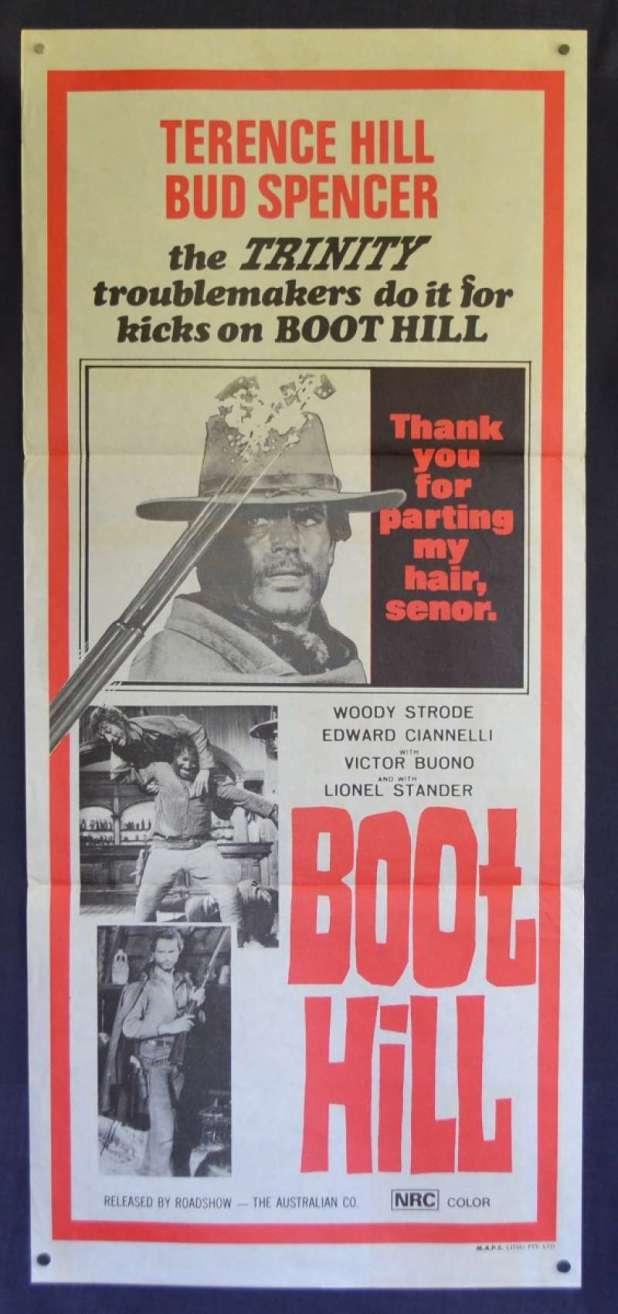
Boot Hill (the Italian title means The Hill Made of Boots) is the last movie in a trilogy that began with God Forgives…I Don’t and was followed by Ace High. Taking advantage of star Terence Hill’s fame, it was re-released as Trinity Rides Again.

It was directed and written by Giuseppe Colizzi, who also made the other films in this trilogy, as well as All the Way Boys with Hill and Bud Spencer; Run, Joe, Run and Switch.

Hill plays Cat Stevens and Spencer is Hutch Bessy, who along with George Eastman as the mute Baby Doll are all somewhat friends and partners by the end. But to get there, Cat is shot and left for dead by a gang and nursed back to health by the circus of Thomas (Woody Strode), which includes can can dancers, dwarves and Mami (Lionel Stander), the dress-wearing manager of all of them, which ain’t easy, because when they met, it was murder.

Beyond the bad guy having the name Honey Fisher, he’s played by Victor Buono, which is quite a treat. There’s a strange dual look to this film, with the circus sections filled with color and near surrealism — they were shot by the movie’s original director Romolo Guerrieri (Johnny YumaThe Sweet Body of Deborah, L’ Ultimo Guerriero) — while most of the film’s look is quite dark and moody.

You can watch this on Tubi.

FVI WEEK: Alive or Preferably Dead (1969)

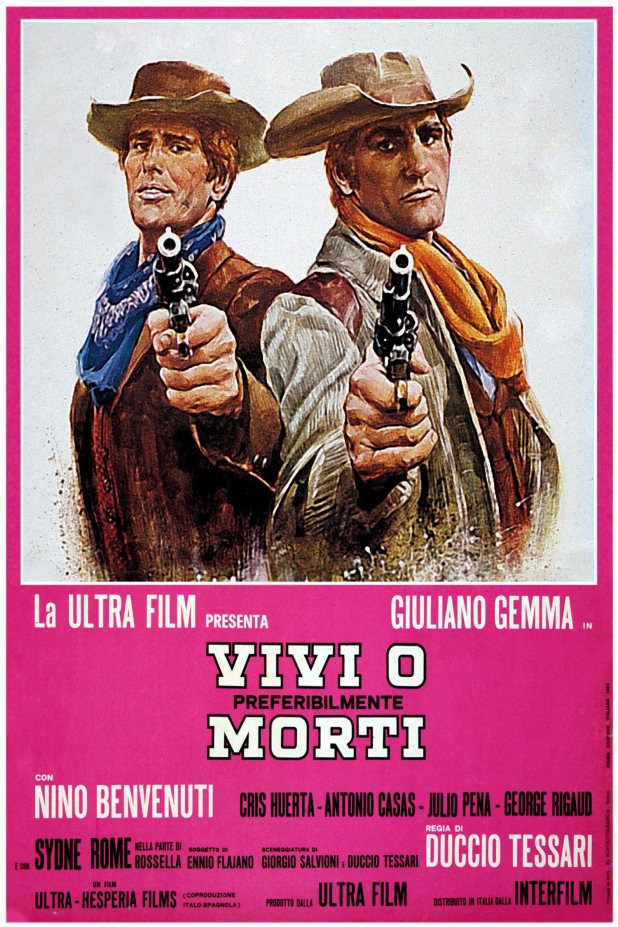
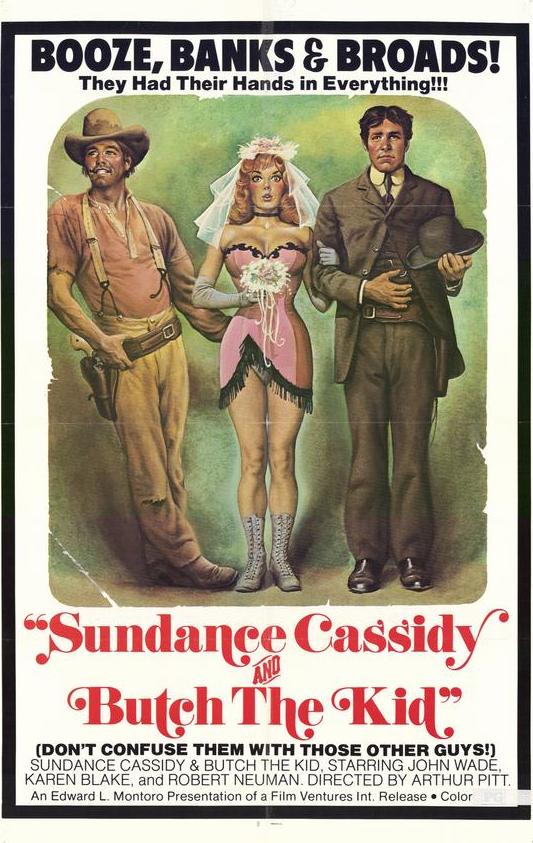
Also known as Sundance and the Kid and Sundance Cassidy and Butch the Kid, an attempt to win the audience of Butch Cassidy and the Sundance Kid, this movie was directed by Duccio Tessari, who wrote A Fistful of Dollars and would go on to direct A Pistol for Ringo. Its story comes from Ennio Flaiano, who wrote ten movies with Fellini, and has a screenplay by Tessari and Giorgio Salvioni (The Tenth Victim).

In the U.S. version, everyone gets an American name: Giuliano Gemma is John Wade; Nino Benvenuti becomes Robert Neuman; Sydne Rome is Karen Blake and director Tessari is called Arthur Pitt.

Country mouse Ted Mulligan (Nino Benvenuti, a former boxer) and city mouse Monty (Giuliano Gemma) inherit $300,000 if they can live together for six months.As soon as Ted arrives, he insults local tough “Bad Jim” Williams (Robert Huerta) who responds by burning down his brother’s house. Soon, the two of them are doing odd jobs, including robbing banks and kidnapping Rossella (Sydne Rome, What?Some Girls Do) who they both fall for.

It’s all rather goofy and really a predecessor of the sillier Italian westerns that were soon to come riding into town.

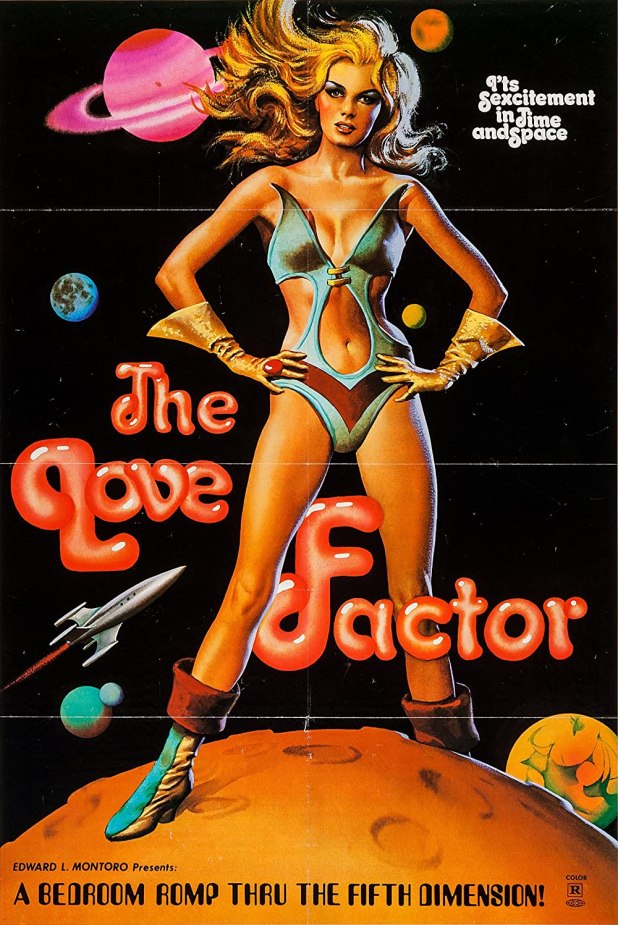
FVI WEEK: The Love Factor (1969)

Directed by Michael Cort, who wrote it with Alistair McKenzie and Christopher Neame, The Love Factor is also known as Zeta One. It’s about secret agent James Word (Robin Hawdon) telling his boss W’s Ann (Yutte Stensgaard, Some Girls Do) about his latest adventure just as we also meet Zeta (Dawn Addams, The Vault of Horror) and her cadre of alien women from the planet Angvia — get it, it’s an anagram for vagina — who are trying to find new girls for their planet while also fighting off Major Bourden (James Robertson Justice) and his henchman Swyne (Charles Hawtrey).

Zeta has a formidable force of extraordinary magnitude, including Brigitte Skay (Isabella Duchess of the Devils), Anna Gael (Nana), Wendy Lingham, Valerie Leon (Queen Kong), Kirsten Betts (Twins of Evil) and Carol Hawkins (The Body Stealers).

Released in America by Film Ventures International four years after it played England as Zeta One, it was first shown as The Love Slaves and the next year was renamed The Love Factor. It was produced by Tigon and Vernon Sewell directed some of the scenes.

This is like Bond, Barbarella and pop art mixed with pasties, go go boots and the kind of humor that has the secret agent show up late and just want to make love to the many, many aliens he’s battling. It doesn’t make much sense, but who cares? It starts with a thirty-minute strip poker scene that really goes nowhere as well, but when you’re having fun, who is looking at the run time?