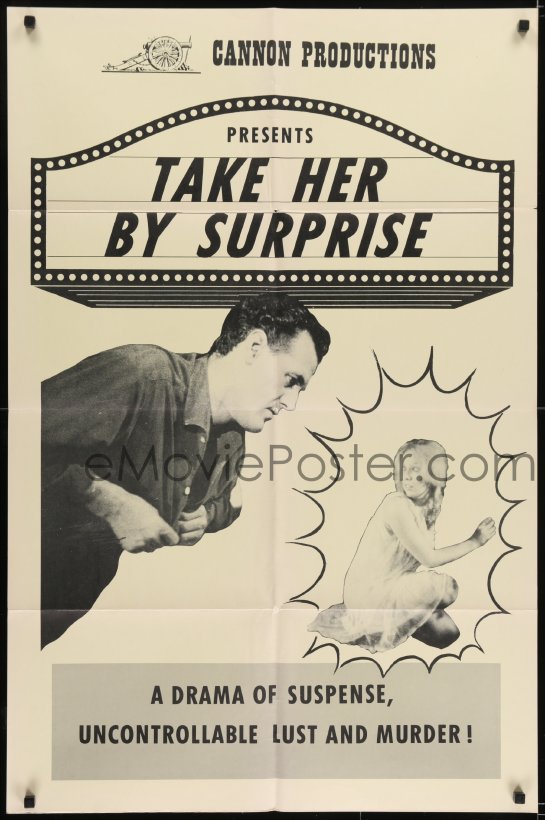
Also known as Violent Love, this is the first movie ever produced by Cannon.
Directed by Rudi Dorn and an uncredited John Gaisford, this movie finds drug dealer Walter Dorland (Paul Negri) fighting with his wife Margaret (Joan Armstrong) over her threatening to turn him itnto the police, so he visits a hypnotist named Korba (Peter Adamson), who hypnotizes Miklos (Noel Beckett) to assault and kill his wife while she stays at the couple’s cabin for the weekend.
I list this here for its historical importance, seeing as how this is an example of how Cannon took European exploitation, released it in the U.S. and made money. At this time in our history, a roughie like this was the absolute height of decadence. One imagines it could play on TV today.
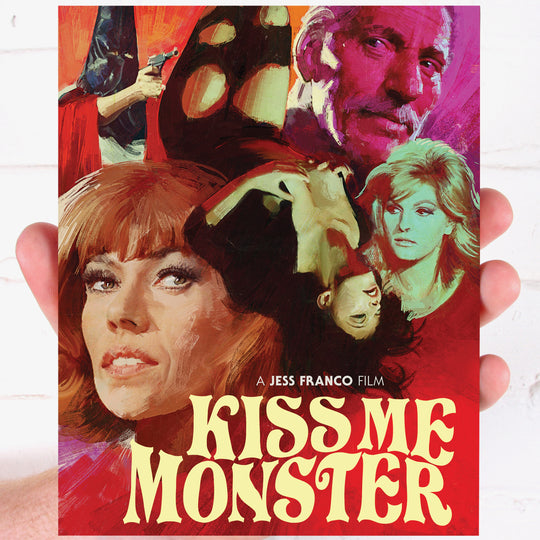
EDITOR’S NOTE: As part of Jess Franco Month, these movies were on the site on February 15of this year. Now, Vinegar Syndrome is releasing them as only they can, newly scanned and restored in 4K from their 35mm original camera negatives. Beyond English and German langauge tracks, there;s also an alternate feature-length extended Spanish versions for both films (sourced from tape with newly translated English subtitles). Plus, Franco expert Stephen Thrower is interviewed about both movies, there are two archival Franco interviews and trailers and still galleries for both movies.
Also known as Sadist Erotica, The Case of the Two Beauties, Two Avenging Angelsand Red Lips Sadisterotica, this mindblast from Jess Franco is kinda sorta a Eurospy movie, but you get the feeling that Mr. Franco just wants to get to the choking and nudity and whipping and forget whatever minor plot there is.
Basically: two lesbian detectives are trying to find criminals, so they themselves pose as a supercriminal named Red Lips (this goes back to Franco’s 1960 movie, Red Lips, which was before Bondmania). The police have no idea and the tone of the films go from swinging fun and humor to outright brutality with no warning whatsoever.
I have no idea if I can explain what happens in this movie, which starts with an attractive brunette — Franco loved his brunettes, so get ready — being ripped to shreds by a werewolf man while a rich guy named Klaus Thiller watches and paints it all.
Then Red Lips steals a painting and we learn that the two lesbians, the blonde Regina (Rosanna Yanni, Count Dracula’s Great Love) and redhead Diana (Janine Reynaud, The Case of the Scorpion’s Tail) wear the mask and outfit when it suits them.
So yeah. The girls get hired to find someone that Thiller probably killed, they sleep with every man around them and yet still wind up with one another. Also: every few minutes, just when things threaten to get boring, there’s a go go dancing scene filled with nudity and blaring music.
This movie made no sense and I loved it for that reason.
If the last film — Two Undercover Angels — made no sense, guess what? This one doubles down, almost a stream of consciousness film made up of murders, jazz clubs, stripteases, our girls play saxophones and near-escapes.
The sell copy for this claims, “Stiffs, Satanists and Sapphic sadists all after a secret formula for human clones!”
Maybe it’s the fact that I watched Jess Franco movies one after another and pounded what’s left of my brain into putty, but I loved every single minute of this movie.
Also known as Castle of the Doomed, it feels like Franco ran out of ideas here and just decided to have more things happen to the point that continuity and plot became the contrivances that lesser people try to bring up as necessary elements for a movie.
Nope. Not to Jess Franco.
Knife throwing clones? Evil lesbians? Good lesbians? Satanic murderers? Yeah. It’s got all that and an ending that doesn’t solve anything.
The failure of this movie would bring an end to the girls’ adventures until 1999’s Red Silk, although you can perhaps consider Two Female Spies with Flowered Panties a spiritual side quest.
But I think you should only watch a few Jess Franco movies in a row if you want to survive. And my head is already throbbing.
Also note: Two Undercover Angels had a monster in it. Kiss Me Monster has no monster.
Somewhere in there is a koan that will change your life.
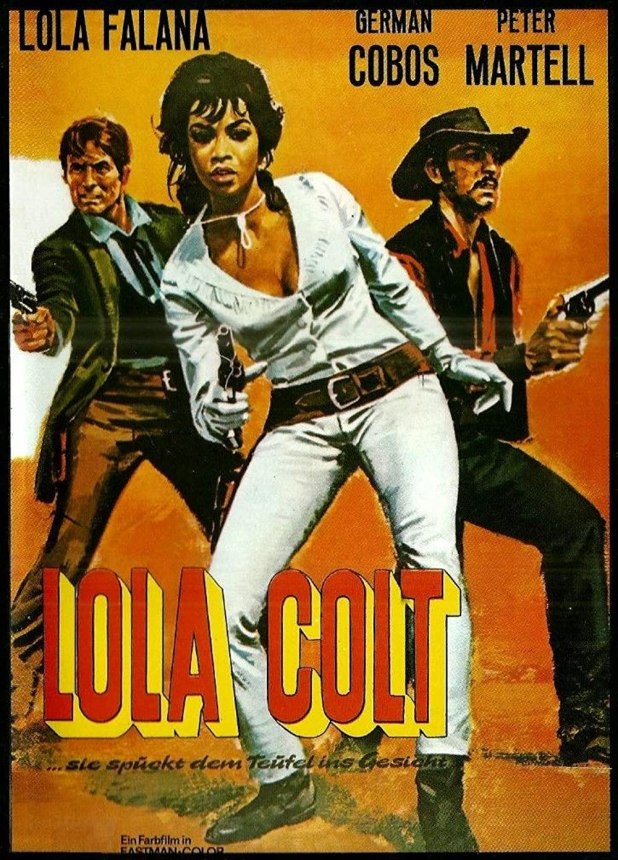
AKA Lola Colt, Lola Baby and Mean and Black, this Italian western — directed by Siro Marcellini, who also wrote the script with Luigi Angelo (The Pumaman) and Lamberto Antonelli (who directed the mondo Vietnam, guerra e pace) — has Lola Falana as Lola, a saloon dancer who came to Santa Ana to dance and ends up saving it from the outlaw El Diablo.
In addition to being one of the few — actually only — movies in which a black woman is a hero in the west, Lola gets to sing “Why Did You Go?,” “You’re the One I Love” and “Swing Low, Sweet Chariot” in musical numbers that seem to be from 1967 and the time when the movie is supposed to be taking place. It also has a white medical student named Rod (Peter Martell, The French Sex Murders) fall in love with Lola and not a single mention is made of her blackness. In 1967. Yes, I’m as surprised as you.
It’s more a curiosity than a movie you need to seek out, but yes. Lola Falana in an Italian western.
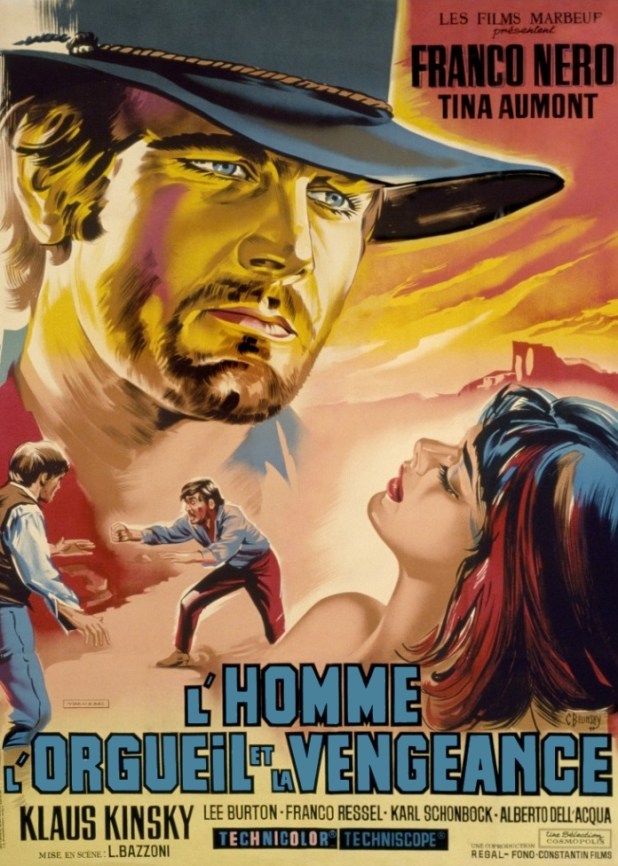
An Italian western based on an actual work of classic literature, Carmen, Man, Pride and Vengeance (which was sold as Mit Django kam der Tod (With Django Came Death) in Germany due to Franco Nero being the star) is actually set in Europe instead of the American west.
Don José (Nero) is bewitched by Carmen (Tina Aumont, Arcana), even allowing her to escape an arrest which finds him demoted. He soon learns that she’s also slept with Lt. Pepe (Franco Ressel, Blood and Black Lace) which makes him insane, so he kills the man and runs from the city. He’s injured and barely makes it before being rescued by Carmen’s family, which surprisingly has her husband Garcia (Klaus Kinski!) amongst them.
He wants to run to America with her. She says they need gold, gold that can only come from robbing a stagecoach with Garcia’s gang. Of course, everyone — including the woman that got him to this ebb — is out to destroy Don José. But if you know Carmen, you already knew that.
One should expect such a strange western to come from a creative force like Luigi Bazzoni, who also made two of the best giallo — The Possessed and The Fifth Cord — as well as one of the strangest, Footprints on the Moon.
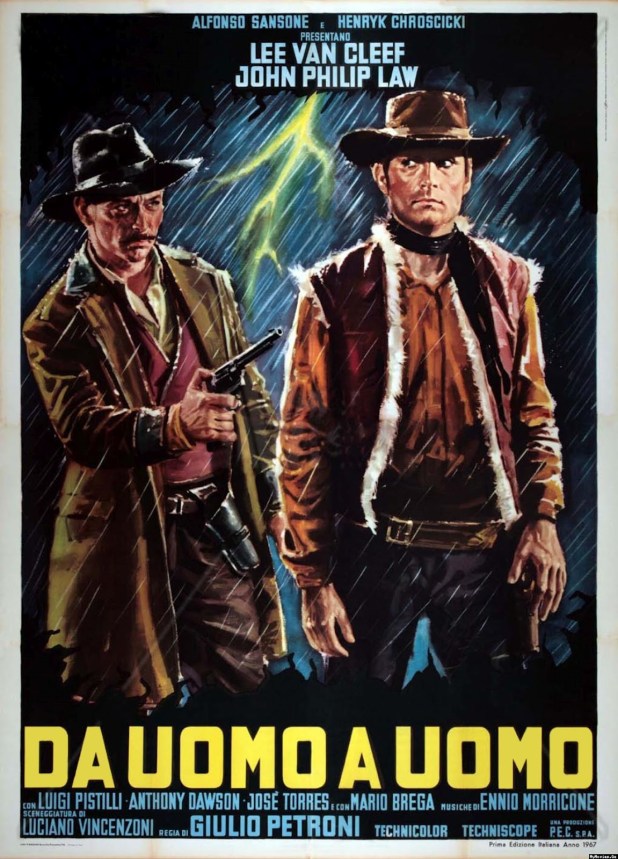
The Italian title of this movie may mean As Man to Man, but in the U.S. it got the great title of Death Rides a Horse. The original title of the film was Duel in the Wind, but star Lee Van Cleef came up with the Italian title while he was discussing the movie with John Phillip Law, as he saw the movie as having a “man to man” story. Van Cleef remarked, “Why don’t they call it From Man to Man?” The Italian producers liked how it sounded in Italian and used it.
Directed by Giulio Petroni, who made Tepepa, an Italian western with Orson Welles and written by Luciano Vincenzoni (For a Few Dollars More, Orca, Raw Deal), it’s the story of Bill (John Phillip Law), a man who once watched his entire family defiled and murdered before his eyes and their home set on fire.
Now, 15 years later, he’s finally gunning for vengeance. He remembers one thing about each of the five men: a tattoo of four aces, a scar, an earring, a skull necklace and only one face. As he tracks them down, he runs into Ryan (Van Cleef), a man out of jail and hunting the same men after they framed him for armed robbery. While Bill manages to kill the first, played by Anthony Dawson, Ryan wants the rest all to himself.
Bill tries, but it doesn’t go well. He’s captured by the outlaws and buried alive with just his head emerging into the hot sun. He’s rescued by Ryan, who ends up being the man with the skull necklace. While he was present during the murders, but he claims that he arrived late and did not participate. He’s also the one who rescued Bill from the fire.
Ryan gives a pledge to the younger man. Once the gang has been dealt with, he will face whatever justice Bill wants to dish out.
An excellent film with a great Morricone soundtrack, this film saw writer Vincenzoni break away from Sergio Leone just as the director was starting The Good, the Bad and the Ugly.
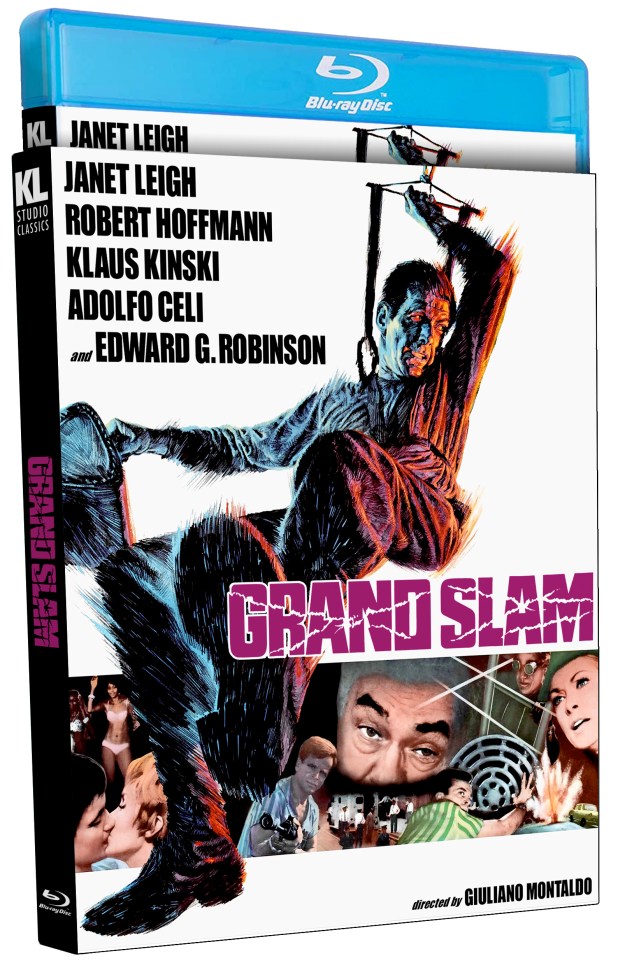
Professor James Anders (Edward G. Robinson) is an American teacher in Rio de Janeiro who grows tired of working every day, so he retires and puts together a team to pull off a diamond heist during the Rio Carnival: Gregg (George Rigaud) the safecracker, Jean Paul (Robert Hoffman) the playboy, Agostino (Riccardo Cucciolla) the electronics expert and Erich (Klaus Kinski) the military man.
Standing in their way is the Grand Slam 70 security system, an alarm that uses microphones to detect any sound. Can they successfully seduce the girl (Janet Leigh), get the key, rob the safe and get out alive? And what if one of them isn’t willing to share the loot? How does Adolfo Celi fit in?
The only other film by director Giuliano Montaldo I’d seen before was the Closed Circuit. This caper film moves quickly and has a great closing scene. It was written by Mino Roli, Augusto Caminito and Paolo Bianchini along with Marcello Fondato, José Antonio de la Loma and Marcello Coscia. It took more writers to do the script for a caper movie than crooks to pull the caper!
The Kino Lorber blu ray release of Grand Slam has commentary by Howard S. Berger, Steve Mitchell and Nathaniel Thompson and a trailer.
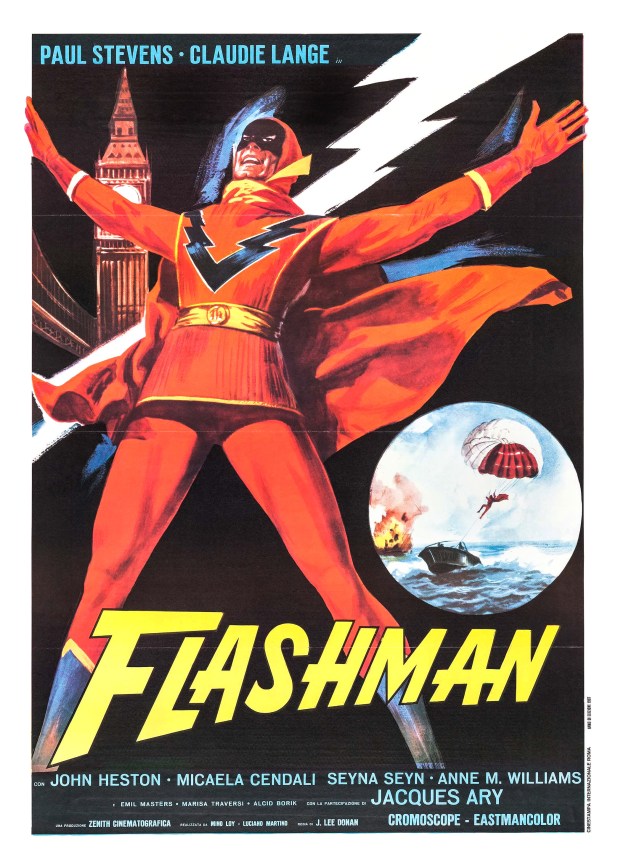
Mino Loy directed Fury in Marrakesh and lots of mondo like Sexy Magico, Supersexy ’64 and Mondo Sexuality before this movie, which is between Adam West Batman and Eurospy, with a funky costumed hero and lots of guitar on the soundtrack.
Will his flashing power be enough to battle a group of models led by Claudie Lange and the thugs with invisibility abilities and lvano Staccioli as the boss? Sure. I mean, you have to love a movie where Italians make Batman and decide that he should be a dandy Englishman named Lord Alex Burman.
That said, in no way is this a good movie. I want it to be, the poster tells me that it will be, but it isn’t.
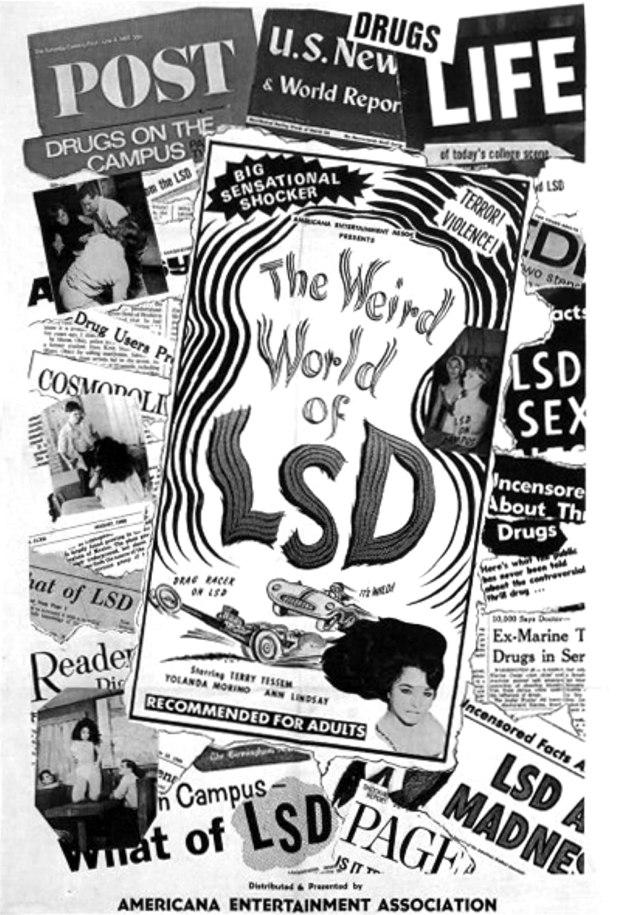
I thought LSD was going to make me see the gods that live beyond the wall of sleep and wait for us to notice us and then drive man mad, but instead this movie taught me that I’ll just think I’m a chicken, play with cats or eat a ham sandwich, which are all things I do just about every day without needing to take any drugs.
Fog, so much fog. Chocolate blood. So many stripteases. Are acid trips really in black and white? Rubber masks. Mannequins. How is this made in Tampa — I think — and no one from a Herschell Gordon Lewis movie shows up?
This is under an hour and feels like four and I think that should tell you what LSD is all about.
“No two trips are alike. Even if you can’t fly now and pay later, you don’t need to book a round-trip fare because you never come back the same way. It’s the leaving and going that counts.”
I hope the next trip I am on does not have people body painting each other while a man drones on, but you have to take the journey where the journey takes you. I mean, you meet a guy with a pan flute, you know what you’re getting into.
I’ve never been to a drug party cool enough to have Cara Peters from Suburban Pagans, Space Things (during which she used the name Legs Benedict) and Massacre Mafia Style (a movie that she appeared in using the very Italian name Cara Salerno). She’s the best part of that last movie, by the way.
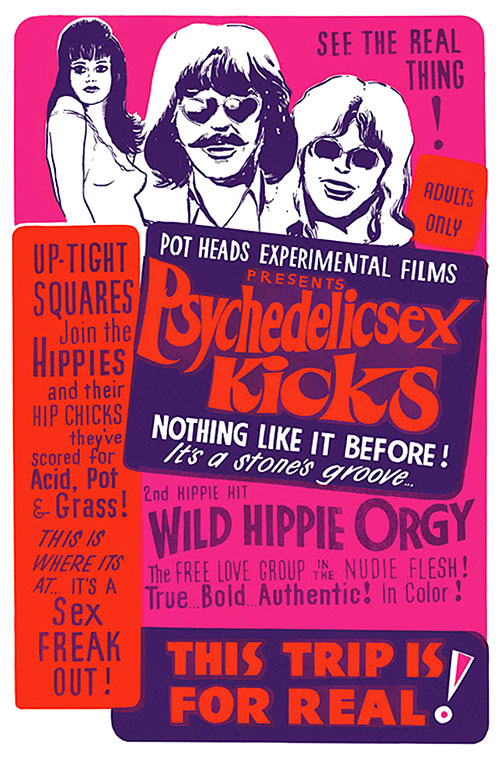
Something Weird has made out lives so much richer, saving the strange, the smutty, the scary and everything in between. Working with the American Genre Film Archives, they created this mixtape of sheer lunacy which adds up the scare films of the past. You’ll never do drugs again until the next time to do drugs.
This blu ray has the following movies, all uncut and in 2K:
Beyond LSD (1967): This movie astounded me because instead of telling parents that their kids are maniacs, it tells them to listen to them because they’re going through some things. How is this even real?
Director Paul Burnford mainly made shorts and documentary films, like 1944’s Nostradamus IV and the 1943 blood transfusion ten-minute epic Brothers in Blood. He also directed the first movie in the Rusty series and an entry in the A Crime Does Not Pay series, Dark Shadows, which is about a psychiatrist matching wits with a killer.
In short — it’s less about drugs and more about how to treat your kids. It’s still relevant today.
The Bottle and the Throttle (1961, 1968): Narrated by Timothy Farrell, who was one of the two narrators and the psychiatrist in Glen or Glenda, as well Girl Gang,Pin-Down Girl, Dance Hall Racket, Test Tube Babies, The Violent Years, Jail Bait and many more. He was also a bailiff for the Los Angeles Marshal’s Department when he was acting in movies like Paris AfterMidnight, which was raided by the Los Angeles Vice Squad during filming.
A bunch of kids a drinking beach beers — Budweiser, Schlitz and Hamm’s — and Bill has had one too many. He ends up driving home and killing a child and breaking the back of her mother. Was it worth it?
Do you remember that wheel of how many drinks you had and how long until you sober up back in driver’s ed or health class? Man, I used to think of that all the time and here I am, now trying to gauge edibles which are magical and unpredictable lunacy when compared to whiskey.
The major difference between the 1961 and 1968 films is that the former is made with the help of the Culver City Police Department and the Culver City Unified School District while the latter is made with the West Covina Police Department. I’d like to think these organizations were scammed and paid twice for one movie.
“The little girl died on the way to the hospital and the mother will probably never walk again. No matter how your trial comes out, you’ll always have to live with those facts, won’t you Bill. A child dead. A mother crippled. Not a pleasant future to face at the age of 18.”
Pure nihilism.
Sidney Davis Productions also made The Dropout, Boys Beware (an anti-homosexual scare movie), the Ib Melchior-directed — yes, the guy who wrote Death Race 2000 and directed The Angry Red Planet — Keep Off the Grass, Skateboard Sense and LSD: Trip or Trap!
Curious Alice (1971): Dave Dixon, the Culture Czar, was the lead DJ of the legendary “Air Aces” on Detroit’s rock station WABX and the first person to play Sabbath, The Doors, Led Zeppelin and The Doors in the Motor City. Beyond co-writing Peter, Paul and Mary’s “I Dig Rock & Roll Music,” he co-wrote this animated film that explains drugs through Alice In Wonderland which is totally right on with the kids and four years after Jefferson Airplane did the same thing in “White Rabbit.”
The art in this movie is mind-boggling, however, and you’ll be entranced as Alice learns about LSD from the Mad Hatter, speed from the March Hare, heroin from the King of Hearts and barbituates from the Dormouse.
Made by the National Institute of Mental Health in 1971 and meant for use with ten-year-old students, if I had seen this before my teen years I would have done all the drugs in high school. The National Coordinating Council on Drug Education agreed, writing that viewers “may be intrigued by the fantasy world of drugs” after watching it.
The Distant Drummer (1970): A short-lived series of four 22-minute American documentary films that warned the kids about drugs, these were all directed by William Templeton (The Fallen Idol) and written by Don Peterson.
The first two movies in this series, A Movable Scene and A Movable Feast, were narrated by Robert Mitchum, who served 43 days at a California prison farm for possession of marijuana in 1948, a conviction that was overturned in 1951.
Here’s just a sample of Mitchum’s speech: “Thousands of snapshots on police station walls remain the only link between many of America’s most affluent families and the children who embodied their great expectations. Nearly everyone in the hippie community smokes marijuana — whether they call it pot, grass, hemp, gage, joint or mary jane — the marijuana is the basic background for the shared drug experience. The experience is shared to such an extent that roach pipes are always in demand — a roach is a marijuana butt and it requires some form of holder for those last few drags. The new generation, whether they are runaways or rebels-in-residence, use marijuana as a symbol of discontent with the basic values of the establishment. For some, there exists a social imperative beyond flaunting society’s rules — for these adventurers the mind-expanding drugs open a window on a whole new frontier…”
The other two parts, Bridge from No Place and Flowers ofDarkness, were narrated by Rod Steiger and Paul Newman.
Drugs, Drinking and Driving (1971): Herbert Moskowitz is now here to explain why you should never mix the three things in the title. I love that this movie has no issues with using the Mission: Impossible theme over and over and over, flaunting copyright law with each successive refrain.
This also seems pre-Jackass with a stunt where two drivers are each given drugs, one amphetamine and one barbituates, and then told to drive for 36 hours straight until they either pass out or wreck their cars.
LSD: Insight or Insanity (1967): “Now, everybody who takes it admits that there’s always the risk of a bad trip, a bummer, a freak-out, even a flip-out. But, why be lame, baby? Give yourself a real kick. Yes, a kick in the head!”
That’s Sal Mineo talking in this Max Miller-directed (the same dude who made the Sonny Bono anti-drug movie Marijuana) film which explains what LSD is, how it’s made and when people take it they jump in front of cars and take leaps off cliffs like Diane Linkletter out of the windows of the Shoreham Towers, blamed on LSD even if the last person who saw her alive — Edward Dunston — may have also was the last person to see actress Carol Wayne alive. Then again, both Dunstons could be different people and for some other reason, people seem to confuse them with David E. Durston, the man who taught us that Satan was an acidhead in I Drink Your Blood.
See, I may make some detours, but I always get you back on the road.
This ends with a Russian Roulette freakout and Mineo singing over the closing credits, which inform us that everyone in this movie was not an actor. You won’t be surprised.
LSD 25 (1967): Directed by David Parker and written by Hank Harrison — the father of Courtney Love — this movie is narrated by an LSD tab which proves that the creators of this may very well be getting high on their own supply.
“Today, you’re high. Tomorrow, you’re dead.”
Yes, LSD starts all happy explaining all the good things it does and by the end, your fingerprints can’t get out of any police database.
So go ahead and take that sugar cube. You’ll learn all the secrets of the infinite and then, you know, you won’t be able to tell anyone.
Because you’ll be dead.
Narcotics the Decision: Goofballs and Tea (1958): Written by Pittsburgh native Roger Emerson Garris, who was the story editor for the Sherlock Holmes TV series, this police training film is all about barbituates and marijuana. Yes, people once called drugs these words.
Narrated by Art Gilmore, who was on Dragnet and voiced the radio announcer on The Waltons, this movie lets kids know that it starts with sneaking their parent’s booze and ends up with you in jail, dead or worse. Avoid weed, avoid malt shops, avoid everything.
None for the Road (1957): Margaret Travis wrote 83 shorts that we know of, movies like The Other Fellow’s Feelings, Health: Your Clothing and Rowan and Martin on the Driveway One Fine Day, an industrial film for Phillips 66 Petroleum where the future Laugh-In stars run a gas station. This movie, too.
But the director? That’s Herk Harvey, who made around four hundred or more industrial films like Shake Hands with Danger. And one very important movie, Carnival of Souls.
Three men all use alcohol in different ways: not at all, a little and too much. They’re like the lab rats that we later see injected with alcohol, which sounds like a good way to spend a weekend. But wow, we’ve been warning people about drunk driving for 65 years and not everyone listens.
The Trip Back (1970): It’s no accident that an episode of Strangers With Candy was titled “The Trip Back.” Jerri Blank on that show is literally the star of this movie, Florrie Fisher, played for comic effect.
Fisher was married four times by the time she filmed this speech, first an arranged marriage, then to a pimp, then another drug addict and finally to a man she met via the mail. She credited her recovery to Synanon, which was originally established as a drug rehabilitation program and became one of the most dangerous and violent cults America had ever seen.
Wait, what?
Founded by Charles E. “Chuck” Dederich Sr., Synanon — a mix of togetherness (“syn”) with the unknown (“anon”) — was an alternative community centered on group truth-telling sessions called the “Synanon Game”, a form of attack therapy during which participants humiliated one another and exposed each other’s innermost weaknesses. There are theories that Dedereich was given LSD by Dr. Keith S. Dittman and Dr. Sidney Cohen, as well as encouraged to start Synanon as part of the CIA MK Ultra program.
Headquarted in a former beachfront hotel in Santa Monica called the Club Casa del Mar, women who joined Synanon had to shave their heads. Men were given forced vasectomies. Pregnant women were forced to abort their babies. Married couples were broken up and had to take new partners as the group became the Church of Synanon.
After Synanon’s transition into an alternate society in 1968, the game became a 72-hour ordeal for most members. The program of rehabilitation went from two years to a lifetime rehabilitation program, as they now preached that addicts would never truly be well enough to return to society.
Throughout this period, San Francisco area media covered the adult and child abuse caused by the church, but were often sued for libel by Synanon’s lawyers. If all of this sounds like Scientology, well…there was a group within the group called the Imperial Marines authorized to beat members into oblivion.
When NBC started reporting on the church in the late 70s, executives received hundreds of threats and Paul Morantz, a lawyer who had helped members escape, had a de-rattled rattlesnake placed in his mailbox. It bit him and put him in the hospital. A police search found a tape of Dederich speaking about Morantz, saying: “We’re not going to mess with the old-time, turn-the-other-cheek religious postures. Our religious posture is: Don’t mess with us. You can get killed dead, literally dead/ These are real threats. They are draining life’s blood from us, and expecting us to play by their silly rules. We will make the rules. I see nothing frightening about it. I am quite willing to break some lawyer’s legs, and next break his wife’s legs, and threaten to cut their child’s arm off. That is the end of that lawyer. That is a very satisfactory, humane way of transmitting information. I really do want an ear in a glass of alcohol on my desk.”
The teachings of Synanon influenced groups like CEDU, Daytop Village (the very place Nancy Reagan visited and became aware of the drug problem, which led to Just Say No), Phoenix House and those boot camps that always show up on daytime talk shows.
Back to Florrie Fisher.
An interview with David Susskind led to her appearing on The Mike Douglas Show, speaking at schools and an autobiography, The Lonely Trip Back. This film captures her speaking at a New York City high school, barraging the audience with a rambling dissertation on turning tricks, six of her marijuana friends all dying in the chair, jailhouse sapphic antics and shouting things like “I now know that I can’t smoke one stick of pot! I can’t take one snort of horse! I can’t take one needle of cocaine because I am an addictive personality! And that’s all I need is one of anything. Ya know I need one dress. If I happen to like this dress in tan, I buy the same dress in green and black and pink. This is the type of personality I am!”
Despite how horrible Synanon was for some, it worked for Florrie. Sadly, she died during the lecture tour she’s on in this movie due to liver cancer and kidney failure.
This movie is totally worth the price of this entire blu ray.
Users Are Losers (1971): Think drugs are for teens? This kid is saving up his milk money to pay for his habit, doing odd jobs and being incredibly thrifty just to get some marijuana. It made me think, parents are always on kids for throwing their money away, but this kid knows what he wants, works hard for it and then is selfless and shares what he gets with his friends.
Some kids also find one of their friends dead on a mattress and some young narc says, “If you blow pot, you’re blowing your future.” Get off my TV, kid.
Plus, you also get DRUG STORIES! NARCOTIC NIGHTMARES AND HALLUCINOGENIC HELLRIDES, a full-length mixtape from the AGFA team.
Now if you’ll excuse me, I must go blow some pot. Get toasty toast. Go clambaking. Fly Mexican Airlines. Run within an endless field. Walk the green ducks. Roll into the Backwoods. Be a ninja. Do some chiefing at the Rooney statue.



 B&S About Movies
You must be logged in to post a comment.