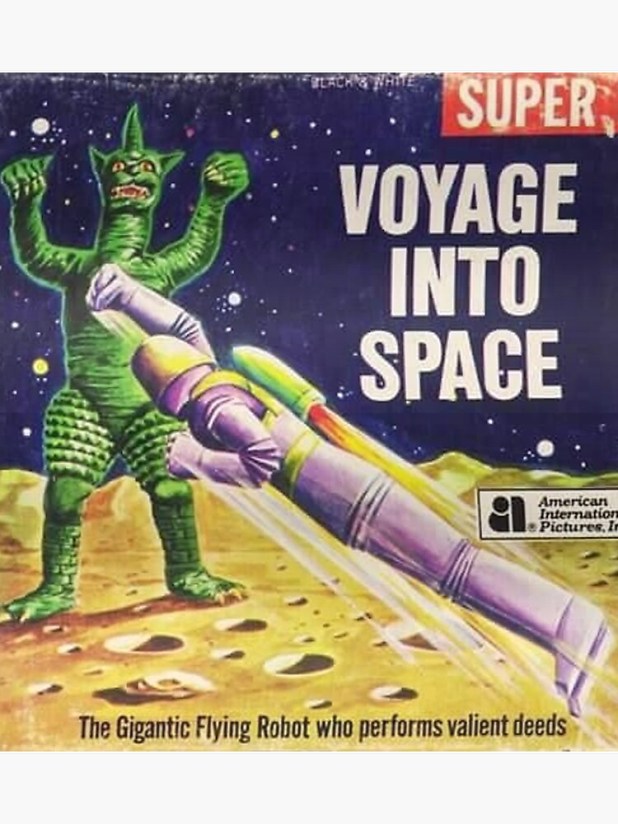
Voyage Into Space (1967)

Voyage Into Space is my Vietnam.

It takes 4 episodes of the 26 episode series Giant Robo, or Johnny Sokko and his Flying Robot, and crams them into one movie. So why does it distress me so?

I saw it when I was probably 5 years old. I was obsessed with robots, like my Mazinger Z Shogun Warrior. I had never seen a movie where the robot dies at the end. Spoiler warning — the robot blows up real good at the end.

I cried for years. I might still be crying.

Earth has been invaded by an interstellar terrorist group known as the Gargoyle Gang, which is led by Emperor Guillotine, who spends all of his time hidden on the ocean floor in a UFO. Yes, that’s just how awesome this is.

They’ve been capturing scientists to create an army of extraordinary magnitude, err monsters, to conquer the Earth.

A boy named Daisaku Kusama, or Johnny Sokko in America, where he was voiced by a woman named Bobbie Byers who also shows up in Savages from Hell and The Wild Rebels, and Juro Minami — nee Jerry Mano in the gaijin world — from the spy team Unicorn are all that stands between aliens owning this big blue rock. It gets better for them when they meet scientist Lucius Guardian, who gives a small child the power to control a robot — great logic — before he gets killed and drops a nuke on the aliens.

Man, this Gargoyle Gang — they dress like the United Nations of bad guys, donning German, Soviet and Central American military gear all at once, topping it off with designer sunglasses — are bad guys. They have all manner of horrific beasts ready to destroy Earth. In this cut down movie, which is basically episodes 1, 2, 10, 17 and 26 of the show, you get 100 minutes of pure madness.

There’s Draculon the Sea Monster, who was known as Dakolar in Japan. Nucleon the Magic Globe — also known as Globar in Tokyo. Lygon, who swallows a train. The Gargoyle Vine, which has the much cooler name in Japan of the Satan Rose. And all manner of evil henchmen like Spider and Doctor Over. The full series even has an alien mummy and a peg-legged snakeman.

Unlike most anime and Japanese movies that were sent to the U.S. at this time, nobody thought that they should edit the violence out of this. So in one episode, a kid almost gets killed by a firing squad. And yeah — the ending — where the pharaoh robot dies saving the Earth? I remember going outside and staring into the sky, punching my fist into the ground, screaming at God. No, really. I did. For days. It was so bad that my mother had to write an entirely new ending for me so that I could get on with grade school.

You can watch this on the Internet Archive. Prepare yourself to be depressed.

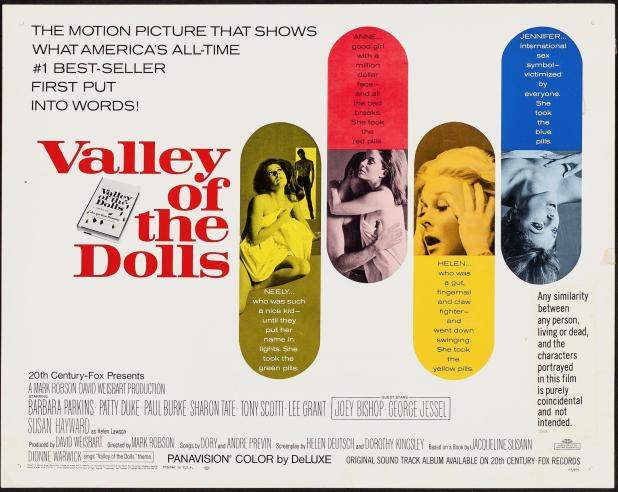
Valley of the Dolls (1967)

I love this movie. I can’t deny it. I won’t say that it’s a guilty pleasure. I have no beliefs that this is a great movie or that it’s a classic. I just love it. I quote from it all the time. I wish that I could live in the world of the film.

Jacqueline Susann. It’s thanks to you that I know just how bad dolls are.

Three young women are out to make it in the big bad world.

Neely O’Hara (Patty Duke) has talent, if she can just stay off the pills. She’s in the big bad world of Broadway, where she runs up against arrogant legend Helen Lawson (Susan Hayward).

Jennifer North (Sharon Tate) is gorgeous but doesn’t have the talent. She’s stuck in the chorus.

Anne Welles (Barbara Parkins) is an ingenue who has arrived in New York City to work in the theatrical agency that represents them.

Of course, the dolls — which are the barbiturates Seconal and Nembutal and various stimulants — are all too much for everyone. Neely becomes a diva and cheats on her husband with fashion designer Ted Casablanca, but when she puts her career before him, he leaves her. Eventually, her career goes into the skids because of all the drugs she’s on and she gets committed to a sanitarium.

Jennifer also heads to Hollywood, where she falls for nightclub singer Tony Polar, who has Huntington’s Chorea and ends up in the same asylum as Neely. She also has an abortion and to pay for her man’s care ends up doing French art films, which really means nudie cuties.

Anne falls for a guy named Lyon and she starts a new career as a model, but he gets stolen from her by Neely, fresh out of the sanitarium and ready to get on the make. Of course, she falls right back into the loving embrace of all them dolls. She also gets into a catfight with Helen Lawson and flushes her wig down the toilet, which is a moment that I always pause and get on my hands and knees and thank God that this movie was made.

She then hits rock bottom, has sex with a stranger and watches him rob her. That’s nothing — Jennifer’s mother can’t deal with her softcore films and won’t support her when cancer strikes. She commits suicide with all them dolls.

Anne gets on them too, but she decides to kick the habit and move back to New England. Lyon comes to try and win her back, but she walks away, out of his life for good.

No one leaves Valley of the Dolls unchanged.

Judy Garland was originally cast as Helen Lawson, but was fired when she reportedly came to work all messed up. She would have brought some real know-how of this world to that role. After all, Neely was based on her, as well as a little bit of Betty Hutton and Frances Farmer. She still got paid and loved the sequined pantsuit she was to wear in the movie so much she didn’t just keep it; she had costume designer Travilla make her duplicates.

Patty Duke brought plenty of know-how when it came to drugs, too. She had become addicted to drugs because her guardians gave them to her to make her a better actress.

Of course, this all led to probably my favorite movie of all time, Beyond the Valley of the Dolls, which was filmed while the studio was being sued by Jacqueline Susann. Obviously, this Roger Ebert written and Russ Meyer directed film is a completely different and much crazier movie, if that’s possible. Her estate won $2 million in damages years after her death. That’s good, because she believed that even this movie was “a piece of shit.”

A lot of the more risque parts of her book never made it into the film, like Jennifer’s attempting to become a lesbian, Ted Casablanca’s homosexuality and Tony’s love of anal sex. Of course, there are plenty of mentions of the hard g “f word” throughout the film.

There were also two TV series made from this movie. 1981’s Jacqueline Susann’s Valley of the Dolls, had James Coburn, Catherine Hicks, Lisa Hartman, Gary Collins, Bert Convy, one-time wife of Robert Evans Camilla Sparv, Tricia O’Neill from Are You In the House Alone? and Britt Ekland. There was also another 1994 version called Valley of the Dolls which had Carol Lawrence as Bernice Stein (she was also Miriam on the 1981 series), Sally Kirkland, Melissa De Sousa and Sharon Case.

Director Mark Robson, who also was behind the movies Peyton Place and Earthquake — as well as an assistant editor on Citizen Kane and The Magnificent Ambersons and an editor on Cat People and I Walked With a Zombie — was rough as hell on the actresses in this movie. Sharon Tate was the one he directed most of his rage at, but even years after his death, Patty Duke would refer to him as “a mean son of a bitch.”

Famous science fiction writer, noted crank and one of my heroes, Harlan Ellison was the original screenwriter of this film. He was upset at the softened ending of the film and demanded that his name be taken off of it. Hollywood never really treated Harlan all that fairly, between stealing two of his Outer Limits episodes for Terminator and him getting fired from Disney within a few hours thanks to an impression of Mickey, Minnie and Donald having barnyard coitus.

50 Flix: Cool Hand Luke (1967)

ABOUT THE AUTHOR: This is the first movie that Raven Mack is covering in his series of 50 Flix. You can learn more about this work of art here or support the work of the artist at his Patreon.

Cool Hand Luke got released in November of 1967. America was almost four years past Lyndon B. Johnson declaring a War on Poverty, which became such a thing it got capitalized like that. That initial movement tended to focus on poor mountain whites, but rural white people have always tended to have higher poverty rates than urban (and definitely suburban) whites, most likely because the economy doesn’t really tendril out to rural areas the same way it does more populated places. This has always been why poor folks are expected to uproot themselves and go elsewhere.

Early November of 1967, when this movie was released, my father would have been a few weeks away from his 12th birthday. I know for a big chunk of his teen years, my grandmother and that family lived in Cumberland, VA, right behind the Cumberland Restaurant. My grandmother had remarried by then, though my blood grandfather had passed yet. I don’t know the story there, other than it didn’t work out, and my grandfather was a PTSD mess after the Korean War, before PTSD was really something they said about people. At the time, I think he was just seen as more of an abusive drunk than anything else, but also a war hero. By age, my father would’ve been possibly a 7th grader, but on my birth certificate, his education level only says 7th grade, and I know he used to brag that he and two of his friends were in 5th grade three years in a row together, so I don’t know what actual grade he would’ve been at age 12. But he was a rough one, likely due in no large part to the father he had coming back from multiple wars messed up in the ways he was.
Patriarchal norms in our culture tend to have boys identifying and/or latching onto fathers. My dad always fetishized military shit, but in a weird guerrilla anti-government way. He was too young for the Vietnam War, which was the biggest shit in the news at this time, by far, with multiple giant protests happening the month before Cool Hand Luke’s release, including the one where Allen Ginsberg and Abbie Hoffman and them folks said they were gonna levitate the Pentagon.

My mom would’ve been 11 at the time, and I’m not sure where they lived. She was born outside Chicago, but her parents, and two older step-brothers had moved east to Maryland and Virginia, multiple places, early in her life. Again, I don’t know all the details, because at one point my maternal grandmother was either a widower or abandoned or something, living with two young boys in a car. My grandfather also had fallen in love with some women in New Orleans, and had been a natural born wanderlust, but somehow moved back to Chicago, married my grandmother, adopted her sons, and decided to just straight up settle down and take care of family business, no more fucking around, which he did until his death. In fact, with a certain amount of instability and addiction and inherited traumas on both sides of my family tree, I can say without a doubt the combination of my maternal grandfather and paternal grandmother were the two forces that made it as stable as it could be, and were the unseen forces that got me typing words into a computer screen right now instead of either being dead or lost in an opiate and/or alcoholic fog.

Luke, of Cool Hand Luke, is a veteran, and the very opening scene which establishes the context of our story is a perfectly appropriate illogical moment for anyone from fucked up environments full of traumas, addictions, chaos, that gives that accumulated version of PTSD, rather than the single event one, because the entirety of the universe’s work in just piling shit up on you reduces your coping window to nothing, and something happens which causes that Fuck It Moment to happen. The Fuck It Moment (such a thing among my people that it is capitalized like the War on Poverty) is when you might know better, you might not, but life is just such a constant shit storm you figure one big final momentary “fuck it”, and do whatever the fuck you’re tired of the motherfuckin’ bullshit mind decides to do. This could be murderous, it could be getting a Greyhound ticket to somewhere you ain’t told nobody, it could be that infamous metaphor of the dad going to the store for a pack of cigarettes and never coming back. But the Fuck It Moment happens every day for a lot of people. Sometimes, you disappear and never come back. Sometimes, there are no immediate consequences, and better sense returns, and you try to fix shit real quick. (In fact, the worst is being emotionally tied too closely to somebody with a lot of minor Fuck It Moments who knows they need to do better but can’t, and always has the heart that says “I’m gonna try to be better” but ain’t built mentally to make those changes. That’s some painful shit to be in, especially when addictions get tied up into that type of person, and they compound actual health problems they can’t control on top of all this other already existent shit.)

And then sometimes we have those stupid criminal Fuck It Moments that do get caught, punished, and change everything forever. That’s the opening scene in Cool Hand Luke, with Luke just cutting up parking meters for the fuck of it, while drunk, and the cops showing up, and he don’t give a fuck, because he’s still in the metaphysical euphoria of the Fuck It Moment. And that’s how Luke ends up in the state prison farm in Florida.

Immediately upon entry, the Captain goes through the line of newbs, explaining the situation to them. “You learn the rules. It’s all up to you.” No Fuck It Moments allowed. And this is the essence of the penal system, that you won’t be given any rehabilitation aid really, it’s up to you to figure it out, but you gotta stop having Fuck It Moments, or we’re gonna fuck you up more. Like when you type it out, it obviously makes no sense at all as a way of changing behavior patterns, but hey, we’re America, and prisons have become a booming industry in the decades since Cool Hand Luke.

One obvious culturally interesting note from this is the segregated society. This prison is all-white – no non-whites appear in this movie in any major roles, except people Luke interacts with while on the run. It’s a completely segregated world where racial relations plays no part at all, so it’s strictly a class system really, with the Captain at the top, the boss (as well as other prison guards, including this one creepy one with a rifle always wearing the standard mirrored sunglasses of a freedombeard type), or a prisoner. America, on top of the racial imbalances, has also always had economic inequality within white folks as well. There’s always been far more white people on welfare than non-white people on it. And I mean, I’m perfect example that even as a poor white originally, you can put on a button-up shirt and some khakis and go sit in a job interview and convince the systems of power that you’re one of them, so you can weasel your way out of it as a white person, so long as Fuck It Moments don’t consume your life in friendly fire from burning bridges. But there’s no shortage of white prisoners in America even today, even though it is disproportionately applied racially. I think sometimes folks forget that even in European history, it wasn’t like it was some great unified homeland of whiteness that then spread out across the planet. A lot of various indigenous European clans and groups got decimated and conquered over the course of what we now know as “Western Culture”.

The cast on Cool Hand Luke is pretty great, obviously with Paul Newman in there at the top, and Harry Dean Stanton as a prisoner, as well as the dad from The Waltons. And of course George Kennedy as the infamous bully turned Mice and Men self-snitching sidekick Dragline.

Early on when the crew is working, clearing the side of a road, there’s the scene of the hot woman washing the car, pushing her tits all over the glass, just generally tormenting these men. I had a job at one point renovating a giant warehouse for a guy named Tillie in Farmville, VA. It’s part of the Green Front complex now, but was just a fucked up warehouse when we fixed it up, which included jacking up the basement a quarter inch every Monday morning to fix a major support beam down there, but that’s all we could lift it without fucking the whole building up or something. Everybody else on Tillie’s crew was on work release from the private jail, all white guys, one of which I went to high school with. One guy on the crew, named Flip, got released during our time renovating it, and I remember him openly talking about the torment of lack of desired sex, how his ol’ lady was coming to pick him up in a borrowed van, and they were probably gonna have to pull over two or three times before he got back to Petersburg from Farmville. “I ain’t had pussy in five years, at least not no woman pussy,” he said at one point.

I mostly painted, with this other dude who went by Soupbone. We had a big ass cherry picker we operated, painting the big industrial windows of the warehouse. In fact, a dude died the previous time the building got painted, having fallen off a ladder, so Tillie made us wear safety harnesses on the cherry picker, “so don’t nobody else die.” Most days were just me and Soupbone, painting away, talking shit, him on the right side, me on the left, working our way through these giant windows with two 16 pane by 16 pane panels, side by side. When we were doing the front side on Main Street, we could see a nearby little grassy park area, and we weren’t far from Longwood University (then only a college), and I remember one day where I saw two young women walking by, beautiful sunny day, and Soupbone, being locked up, spent plenty of time looking down into cars trying to get glimpses of women’s legs and maybe more. I saw these women walking through, as did Soupbone, who was ogling them stealthily. “You know they’re probably going down there to lay in the sun, Soup?”

“Noooo.” He couldn’t believe it even possible. Sure enough, they went to the grassy park, spread out big towels, stripped down to bikinis, and stretched out. 16 x 16 panes, one over the other, side by side, meant we both had to paint 32 panes on the window before we moved. Needless to say, I couldn’t get Soupbone to stop gawking that day, and I remember I painted my 32, and half of his, and even when we finished that one, instead of moving down to the next one like we normally would’ve, Soup made us move further left on the top row to get an even better viewing spot.

Eventually in Cool Hand Luke, with Dragline being the main dude in the prisoner’s ranks, it was only a matter of time before Luke and him had their inevitable fight, which they did. This is the purity of the antihero, so against everything he’s even against the established order of the lowest class. And of course Luke couldn’t beat Dragline, not through physical fighting, so had to go to that metaphysical level of eternal stubborn goat-spirit- refusing to stay down even when whooped, to where onlookers, hoping for the satisfaction of a clear victory, were denied even that, and became uncomfortable, begging Luke to stay down. He never did, the purest form of loser, who loses so bad he can’t even lose right, thus nobody wins. Dragline eventually just walks off.

Luke repeats this losing harder than everybody else motif playing poker, where he bluffs a shitty hand into winning a big pot, saying “Sometimes nothing can be a real cool hand.” If that’s not tattooed in cursive letters on somebody’s chest or upper back, then I’m highly disappointed in humanity. Shit, I might put it on my leg myself now that I think about it.

In another road work scene, Luke and Dragline get into a competition about who can work the fastest, preparing the road for paving. At first, Dragline’s bitching at Luke to slow it down, but then gets caught up in the competition of it. And at the end, they all realize it’s gonna take the paving crew a couple hours to catch up now, so they get to have two hours of nothing. That’s very much a metaphor for the working life promises of American society, where if you work yourself half to death, you’ll get to retire a little early. Not sure that one’s still there for most of us.

The classic scene from the movie is the egg eating contest, where Luke grossly consumes 50 eggs, gorging himself on fertility? I don’t know. It’s a somewhat disgusting scene to be honest, and whenever I watch it, I can’t eat eggs for like two weeks.

The Man with No Eyes though, is the true danger in this movie. Sure, the Captain wields the power, though he’s mostly unseen. And Dragline rules the pen, but lacks any real power outside of that microcosm. The Man with No Eyes is the enforcer, and oddly reminiscent of today’s actual cultural warriors, always present in the comments online, in their mirrored sunglasses profile pics, which I’ve come to call freedombeards. These are the enforcers of the police state, so the institutional Man with No Eyes from Cool Hand Luke has now become a cultural trend, rocking Punisher stickers on a shiny pick-up truck as a gateway marker before graduating to blue lives mattering and 3 percenter stickers and shittier paramilitary freedombeard police state co-signs. The mirrored sunglasses, both in the movie and with freedombeards, refuse to show the wearer’s own eyes, thus denying a read on their true intentions. It also then just reflects the world it is scanning back at itself, straight up refusing to take part in everything on an equal level. I firmly believe in seeing a person’s true intentions in their eyes, because even the best lying ass conmen got shaky sketchy gazes as they talk their shit. And yet, in the period where Luke is playing the good prisoner, to build up to an escape attempt, there’s a scene where he grabs a rattlesnake, holds it up, and the Man with No Eyes shoots it immediately. This signifies his great aim and ability in enforcing the police state, but also that Luke has no problem with handling snakes. And a dude who won’t ever show you his eyes is most definitely a fuckin’ snake.

After an early escape attempt, the Captain admonishes Luke with “you gonna get used to wearing those chains” right before the famous failure to communicate quote used by Guns-n-Roses in “Civil War”. That’s a pretty perfect white underclass swirl of cultural ephemera right there – Cool Hand Luke, GNR, the concept of the civil war. Axl Rose and Izzy Stradlin were both southern Indiana boys, and there’s no stronger Fuck It Moment creating fucked up white underclass homeland than southern Indiana, because it’s not the South, and not Appalachia, and yet has all the metaphysical signs of hopelessness as if it was both. “Civil War” is off Use Your Illusion, which was GNR’s huge leap into releasing something after already being huge. In between Appetite for Destruction’s unexpected explosion, and Use Your Illusion, they released GNR Lies, which has the now abandoned song “One in a Million”. I still find that song intriguing at a cultural level, even as it has been scrubbed from new releases for the overtly racist and homophobic parts, which are of course inexcusable. But there’s also nuance within that, because the song’s not at all a mirrored sunglasses freedombeard mentality, as the voice of the song also hates the police, and that last verse feels more relevant than ever to a lot of white underclass folks who haven’t yet been co-opted politically into the spreading white nationalism:
“Radicals and racists, don’t point your finger at me
I’m a small town whiteboy, just tryna make ends meet
Don’t need your religion, don’t watch that much TV
Just making my living, baby, well that’s enough for me”

Politically this would be pointed at as centrism, not feeling particular affinity for either end, and that tends to seem what the Democratic Party likes to say is how you become successful. I don’t know though, I feel like there’s also this politically disenfranchised underclass that doesn’t really give a fuck. “Just leave me alone and let me survive this bullshit world” mentality. Sadly, I think digital algorithms have driven more and more people of this disenfranchised underclass into bad rabbitholes the past few years, where the “don’t watch that much TV” in the internet age has been weaponized into refusing to read “fake news” but also choosing to still read internet “news”. Not watching that much TV is a refusal of participation, whereas choosing to pick your own favorite sources is still being tricked by all the shit, you just think somehow you’ve made a better decision than the marks.

In Cool Hand Luke, as the threat of Luke running away again, black America is finally mentioned, and that variation on race even within the obvious class separations is mentioned literally, with the boss telling Luke he’d shot black folks plenty before, but never a white man, and didn’t want Luke to be his first. Of course Luke still runs off. A black lady is hanging up clothes in her back yard as Luke, still in prison clothes sneaks through, and she doesn’t even bat an eye, just goes back to hanging up clothes. Two young black boys talk to him on a bridge. “Ain’t you gonna take them stripes off your pants?” One of the kids actually gets Luke the axe he uses to break his chains, and escape to a new life in Atlanta seemingly. Drag and the boys back in jail live vicariously through Luke, and a picture in a magazine of him with two beautiful women. Luke had beaten the system.

But not forever. One night, the guards bring him back in, badly beaten, and all the boys in jail turn their back on Luke, their faint glimmer of hope against getting crushed by all this shit having been beaten. The police state is thick, and unrelenting, and as long as you still live here, the threat of it catching up to you is always there, even more in the digital age, with all the technological amplifications of authority’s ability to monitor and scan.

But then word came of Luke’s mother’s death, and everybody knew he was gonna try to escape again. The sacred bond of mother and son, despite the patriarchal norms, is one we’re supposed to honor. Kinda interesting in context of my own life actually, because I’ve had two levels of falling out with my own mother, to where I’m about 95% certain I’ll never see again until her funeral. I feel like I’m 100% on that, but one never knows what the fuck circumstances cause us to break the eternal grudges of interpersonal Fuck It Moments. I haven’t had notable contact with her in a few years, during some pretty bad times where the love and support of family would’ve been pretty goddamn helpful. I know I’m not alone, in having come to know many people with extremely dysfunctional family trees, where those relationships are broken permanently because they’re too fucking toxic to justify suffering. In 1967, that was not a culturally accepted thing, so Luke’s mother’s death was just without question reason enough for him to escape again. Those familial relationships are far more broken culturally fifty years later.

That last escape has Drag running away with Luke, but Luke splits up with him, and ends up in an old church for the final scenes. In his soliloquy with God, Luke asks, “You made me like I am… just where am I s’posed to fit in?” Out of place, to the end, even with the degenerates who don’t fit in. It’s the classic white underclass antihero I expect we’ll see a lot of throughout this project. It’s the non-English who became part of the Great Britain, the same assorted Celts who also became the outlying settlers in America manifesting destiny, because though they were white, they were expendable. They’ve always been culturally shown to be proud spirit warrior types, but who get crushed by the state in the end. Cool Hand Luke is no different, as cop cars surround the church, and in comes Drag, who had brought them there with his own foolishness. Stupid fucking Dragline, boss of the prisoners, and too goddamned clueless to not end up serving the police state. He promises Luke the guards won’t beat him, “if you give up peaceful.” Drag heads out, and Luke is still inside. Even at night, the Man with No Eyes is wearing his mirrored sunglasses, clean cut because we’re still forty years ahead of contracted private security police state freedombeard era politics.

Luke defiantly echoes the “what we’ve got here is a failure to communicate” line, with a final verbal middle finger to the captain and bosses outside, and The Man with No Eyes shoots him. It’s the tipping point for Dragline, who attacks No Eyes, knocking his glasses off, but our camera view never shows them, and he gets them back on, indignantly, still in proper obedient order to execute upon demand. Luke’s bluff finally got called, and he loses, like all underclass super antiheroes do in our cultural works. And shitty people like me become attuned to taking pride in that, to going out blasting middle fingers at authority, without ever envisioning actually winning. Thus we grow up either assimilating, and becoming a boss for the captain, or we embrace our Fuck It Moment mentality, and assume a destiny of knowing we’re a born loser, eventually, no matter what.
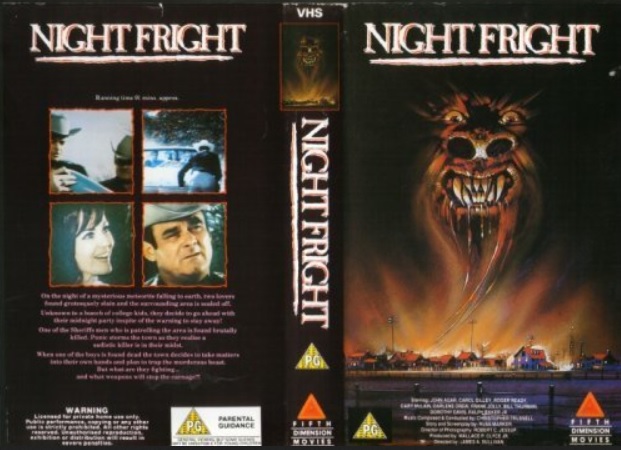
PURE TERROR MONTH: Night Fright (1967)

Oh, yes, ye VHS junkhead: By hook or by crook, Mill Creek will make you watch this, er, ah, “movie,” by golly. It’s not only part of their Pure Terror box set . . . it’s also part of their Sci-Fi Invasion and Nightmare Worlds* box sets.

Let’s unpack this clunker!

“Okay, kid. I want you to make me a film under 80-minutes for $18,000 bucks,” cigar chomps the film executive planting his wing-tips on his desk. “And I got this ratty gorilla suit at an auction . . . they lost the gorilla head, so use this alien mask that I think is left over from 20 Million Miles to Earth . . . and use these reels of NASA stock footage . . . oh, and I can’t afford any lights, so shoot all the night time scenes day-for-night. And you’re using John Agar in the lead.”

“Who’s John Agar?” snivels the fresh-out-of-film-school grad.

“A washed up drunk who boinked Shirley Temple. He comes cheap.”

“Well, sir. Thank you for the opportunity—.”

“Believe me, kid. If I could get Larry Buchanan to shoot this, I would. Now, let’s go to work.”

. . . And so starts this go-go swingin’ adventure: A NASA rocket sent into space filled with test animals flies through a radiation cloud and crashes into the wilds of Cielo, Texas, so a mutated-gorilla monster can munch on a bunch of 18-going-on-30 teenagers in a wooded area known as “Satan’s Hollow.” (Speaking of a “Satan’s Hollow,” check this out.)

“Hey, gang,” head cool kid Chris Jordan calls out. “Let’s go have a swingin’ dance party in the woods! You know, our own ‘private blast’ where that mysterious object crashed!”

“Yeah, and we can do some off-screen shimmy-shammin’ so the Klingon-headed-gorilla space monster can chew us up,” squeals Judy.

“Shit. Let’s go to work, Ben,” says Sheriff Clint Crawford (John Agar) to Deputy Ben Whitfield (Bill Thurman). “It looks like we’re stuck in a movie that’s worse than Robot Monster. Hell, even The Giant Gila Monster.”

“Yeah,” whisky bottle swigs John Agar. “At this rate, we’ll be co-starring in Ed Wood pictures. Damn shame I won’t live long enough to star in an ‘80s SOV stinker. Heck, I would have been great as the detective in Blood Cult.”

“Nah, I’ll do just fine, John. I won’t end up in SOV crap like Spine. Respected directors like Louis Malle, Steven Spielberg, and Lawrence Kasdan will cast me, and I’ll work with Steve McQueen,” chest puffs Bill. “Now go stuff that mannequin with explosives so the dumb space gorilla eats it and we can get the hell out of here and have a beer,” bug neck-smacks Bill Thurman. “And besides, John, don’t you remember? You do that interview in 1986. So it’s not that you died, it’s just that you’ll be so washed up, that the director, Christopher Lewis, wouldn’t want you.”

“Hey, wait a sec . . . Lewis? Loretta’s kid. Yeah, didn’t I bang Loretta Young?”

“Yeah, right, Johnny boy,” says Bill with a back pat. “She married Clark Gable. What would she want with a pug like you? Now, let’s go kill us a space gorilla.”

John Agar was on top of the world. He starred alongside John Wayne in Sands of Iwo Jima, Fort Apache, and She Wore a Yellow Ribbon. He was the toast of tinsel town with his five-year marriage to Shirley Temple. . . . Then the marriage failed and his drinking got worse and he became a stock player for Larry Buchanan at AIP Studios in the low-budget frolics The Mole People and The Brain from Planet Arous.

Night Fright VHS 2

Me: I always cherish Mr. Agar in my late dad’s John Wayne flicks and I’ll always remember John in the Alien precursor and the UHF double-billed, Journey to the Seventh Planet (alongside The Demon Planet, aka Planet of Vampires).

“I don’t resent being identified with B-science fiction movies at all,” Agar reflected in a 1986 interview chronicled at Monster Shack. “Why should I? Even though they were not considered top of the line, for those people that like sci-fi, I guess they were fun. My whole feeling about working as an actor is, if I give anybody any enjoyment, I’m doing my job, and that’s what counts.”

You did, John Agar. You most certainly did. You are at the center of this writer’s Venn Diagram-Borromean Rings of my “Bad Sci-Fi Battle of Evermore.”

In addition to satisfying my John Agar fix, Night Fright also quenches my Bill Thurman completest-compulsions—and gives me an opportunity to talk about Hollywood fringe-obscurity, Brenda Venus.

Brenda Venus, who stars as Sue, grew up to sprout “white nipples” so Eric Swann (Martin Mull) could boink her on the audio mixing console in FM (1978). Oh, you’ve seen Brenda around. She was in Fred Williamson’s blaxploitation spaghetti western, Joshua (1976) and Jack Hill’s Foxy Brown (1974). She starred with Clint Eastwood in The Eiger Sanction (?!) and she endured the wrath of Ankar Moor in Deathsport (1978). Brenda’s Wikipedia is well worth the visit and it directs you to her very cool, official website.

As for Bill Thurman: It’s like shootin’ fish in a Larry Buchanan-AIP barrel. Bill was in everything calculated inside the UHF Venn Diagram of my youth and went on to become the “go-to actor” when you needed a backwoods sheriff or redneck.

He was Sheriff Brad Crenshaw in Zontar, the Thing from Venus.

He was Sheriff Joe Bob Thomas in ‘Gator Bait.

He was Sheriff Billy Carter in Creature from Black Lake. . . .

Night Fright VHS
Watch the trailer.

And get a load of the ‘80s VHS and ‘90s digital-platform repacks of Night Fright: they really are better than the movie. And don’t be fooled by its alternate titles and confuse it with 1958’s Night of the Blood Beast, which is also available on the Mill Creek Pure Terror 50 Box Set (and my condolences to whomever reviews that stinker. Wait. What? I’m the “whomever” reviewing it? Crap!).

So, yeah, Night Fright sucks. But it’s also one of my cherished UHF snowy memories. Thanks, Mill Creek! Let’s swing, kids!!

* For our annual, November “Mill Creek Month” for 2022, we’ve given Night Fright a new, fresh take as part of our unpacking the Nightmare Worlds box set.

About the Author: You can read the music and film criticisms of R.D Francis on Medium and learn more about his rock ‘n’ roll biographies, along with horror and sci-fi novellas, on Facebook.

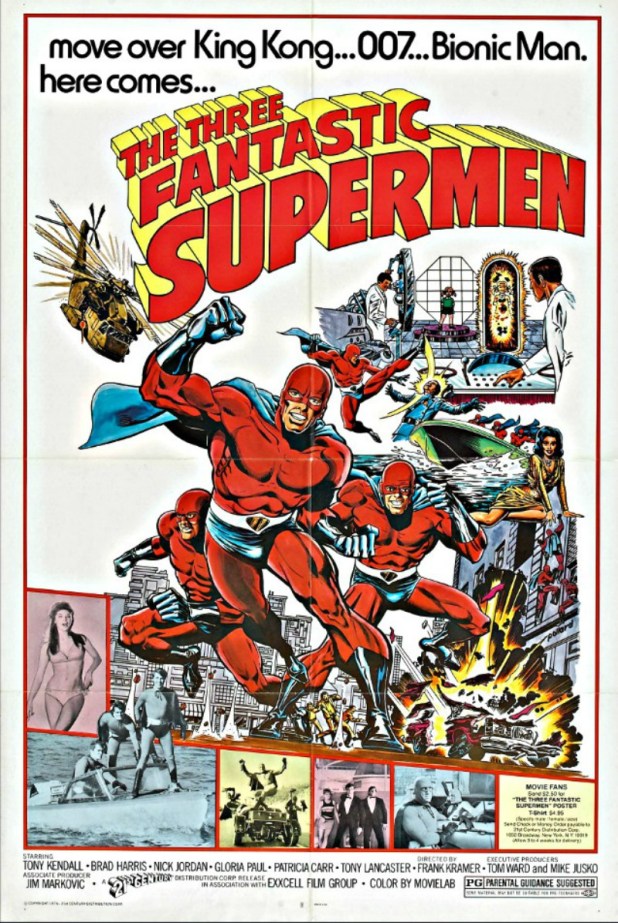
Three Fantastic Supermen (1967)

You gotta love this Amazon description, which assumes that we know who these fellows are:

“FBI agent Brad joins Tony and Nick, the self styled Supermen who battle crime wearing bullet-proof super-suits. They are on a case involving radioactive counterfeit money and people who can be broken down into precious jewels. With some really nice stunts and awesome kung fu, gimmick weapons & gymnastics!”

I mean, I wasn’t interested and then you hit me with gymnastics?

Director Gianfranco Parolini is better known for his Sabata films, as well as God’s Gun. For this movie, he went to Yugoslavia to get the adventures of these three heroes to the big screen. And it wasn’t easy — for one stunt, actor Aldo Canti jumped out of a 20 feet high window, hit a trampoline and then jumped into a truck moving at full speed.

After this movie, the Supermen went around the world: Japan in Three Supermen at Tokyo, Africa in Three Supermen in the Jungle, Hong Kong in the xenophobically titled Supermen Against the Orient,  and seemingly have run out of countries, they went back in time to the wild west in The Three Supermen in the West.

Tony is played by Tony Kendall, who is also in The Whip and the Body and The Return of the Blind Dead, as well as the Kommisar X series of films. And Nick, another of the Supermen, was played by actor/stuntman Aldo Canti, a real-life thief with strong mob ties that was released from jail just to appear in this film. He was replaced by Sal Borgese in the other films in this series before coming back for the Turkish co-production Supermenler in 1979.

You can watch this whole thing on YouTube.

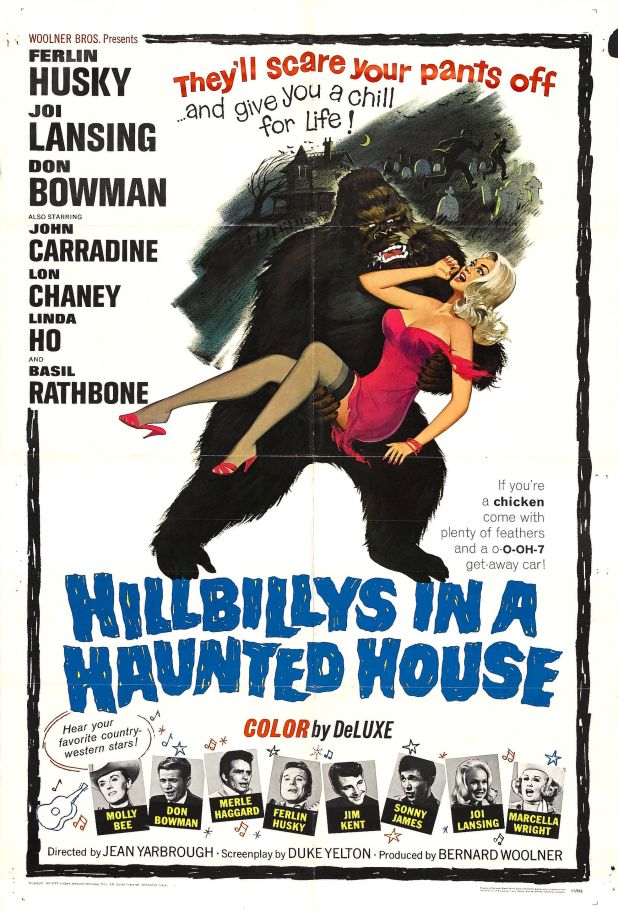
Hillbillys in a Haunted House (1967)

Jean Yarbrough started in the silent era of film, first as a prop man, then rising through the ranks of RKO throughout the 1930’s until his feature debut, 1938’s Rebellious Daughters. Throughout the 1940’s, he was behind some of the most famous horror movies, including The Devil Bat and She-Wolf of London. He also directed Abbott and Costello in Jack and the Beanstalk and Lost in Alaska. 

He soon moved on to television, where he continued working with Abbott and Costello, as well as TV series like GunsmokeThe Addams FamilyMy Favorite Martian  Petticoat Junction. This is his last theatrical movie, a strange mix of comedy, horror and musical numbers.

This is a sequel to 1966’s The Las Vegas Hillbillys, which also featured Country Music Hall of Famer Ferlin Husky. You may not know him, but you may know his song “Wings of a Dove.” That movie features Richard “Jaws” Kiel, Mamie Van Doren and Jayne Mansfield, so you know I’m already hunting down a copy.

Joi Lansing, who famously dies during the first tracking shot of Orson Welles’ Touch of Evil, takes over for Mamie and Jayne here, which is quite a feat. She’s certainly got the looks to pull it off. She’s also way taller than most of the men in this movie!

She and Ferlin Husky, along with their manager Jeepers (Don Bowman, a novelty country singer), are on their way to Nashville when their car (Webb Pierce’s “silver dollar” convertible) breaks down and they end up staying in a haunted house that has Lon Chaney, Jr., John Carradine and Basil Rathbone (in his last role) working in the basement as mad scientists. Country stars Sonny James, Merle Haggard (Husky lived with Haggard’s ex-wife until his death, by the way) and Molly Bee (who sang “I Saw Mommy Kissing Santa Claus”) all show up as well.

There’s also a gorilla, some James Bond spy agencies and evil Asian people. Basically, if you liked Hee Haw and Abbott and Costello meeting monsters, this is the movie for you. I mean, I enjoyed it.

You can watch the Rifftrax verison of this on Amazon Prime.

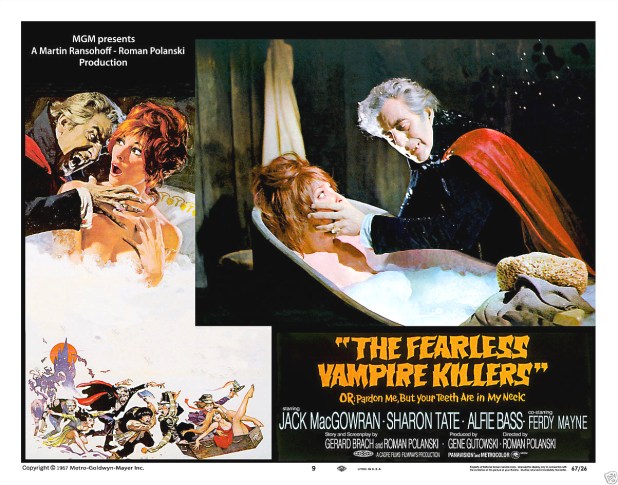
The Fearless Vampire Killers (1967)

Pete Stein asked for this movie and I was happy to write about it. Hope he enjoys this.

Created before Polanski’s U.S. debut, Rosemary’s Baby, this film was marketed by MGM as a farce, with twelve minutes cut from the movie, an animated prologue added, and both protagonists dubbed with cartoony and silly voices. This version was retitled from Dance of the Vampires to The Fearless Vampire Killers, or Pardon Me, But Your Teeth Are in My Neck.

I’ve seen that version of the film, which was the one most commonly seen in the U.S. until it disappeared from circulation in the mid-1970s.

In the early 1980s, MGM found the original cut and released it. This version has garnered new interest and better opinions of the film. I probably need to see that one to evaluate the movie properly, but I’m not sure I could make it through this one again.

Overall, it just feels too cute.

It’s about the adventures of the ancient Professor Abronsius and his apprentice Alfred, played by Polanski. They bumble their way through just about everything they do, which some would take as comedic, but I took as boring and cloying.

They end up in a village filled with angry townsfolk who constantly engage in occult rituals to keep the vampires away. Alfred falls in love with the tavern owner’s daughter, Sarah, but who can blame him? The best part of this movie is the doomed Sharon Tate, who owns every second she’s on screen.

The vampiric Count von Krolock (Ferdy Mayne, who played God in Night Train to Terror) captures her and even turns her father into a vampire. Soon, a convention of vampires and the Count’s gay son enter the story. Yet our heroes are never heroic and simply fail to make it to the movie’s end.

Again, I may need to check out the real version. But I’ve always found this too cheeky. Perhaps that’s the intention, and perhaps it’s just dated. Then again, a few hours of Sharon Tate isn’t the worst thing.

Torture Garden (1967)

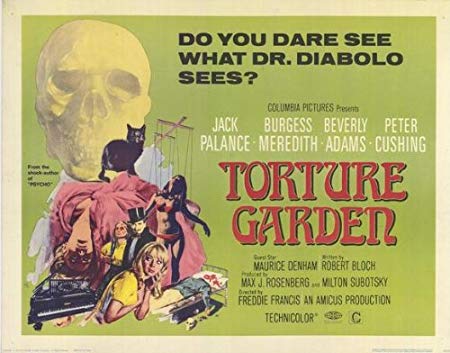
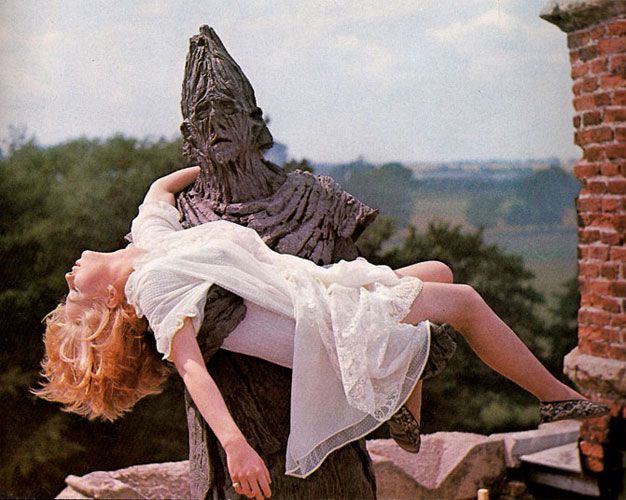
Torture Garden has everything you want in a portmanteau: the Amicus name. Freddie Francis directing. A cast packed with talent like Burgess Meredith, Jack Palance and Peter Cushing. A script by Robert Bloch. And the wraparound story of a sideshow run by Dr. Diabolo (Meredith) who reveals the fortune of five people.

Enoch, the first part, is all about a greedy playboy taking his uncle’s money before a man-eating cat gets involved.

In Terror Over Hollywood, an actress discovers that everyone else in the movie industry is an android. That actress is played by Beverly Adams, who would soon marry Vidal Sassoon and retire from acting. She’s also Lovey Kravezit in the Dean Martin-starring Matt Helm movies.

Mr. Steinway concerns a jealous piano who hates its owner’s new girlfriend.

Finally, in The Man Who Collected Poe, Palance and Cushing go head to head over who has the best Edgar Allen Poe collection. It turns out that Cushing wins, as he has the author himself captive.

Each of the stories has come from the shears of the seer Atropos. The fifth person (Michael Ripper, who appeared in more Hammer movies than any other actor) kills Dr. Diabolo, but it’s all an act. Finally, Diabolo gives Atropos back her shears and, because this is an Amicus film, speaks directly to you at home, telling you that yes, he’s Satan.

Torture Garden isn’t bad. It isn’t Amicus at the level of Tales from the Crypt or Asylum, but it’s still plenty entertaining.

If you’re wondering where Christoper Lee is, Columbia Pictures financed the film and asked for two American stars in the main roles. When this was originally released in the US, you got a pack of seeds to make your own Torture Garden. Those ended up being grass seeds. Also, in its US run, it was paired with the Joan Crawford starring epic Trog (well, in my head).

It! (1967)

This movie is one crazy mix-up of a bunch of other movies that you may love, all in one easy to gulp down cocktail. Take some Hammer mood, squeeze in some modern gothic, a pinch of Psycho, rip off the motorcycle scene from The Great Escape, throw in some nukes and boom — you have It!

After a London museum warehouse burns down leaving behind the Golem of Judah Loew and the dead body of the museum’s curator. His assistant, Arthur Pimm (Roddy McDowall), takes a big interest in the golem, figuring out that it’s the key to getting what he wants out of life.

That Arthur — what a character. He keeps his mom’s dead body in his apartment and steals jewels from the museum for her to wear. And he learns how to use the golem for murder, when all it wants to do is defend its Jewish community.

After the catastrophic destruction of Hammersmith Bridge, which Pimm has already told his love interest, Ellen Grove, that he could do, he tries to destroy the golem. Guess he didn’t read any of the fine print inscribed into the clay monster that says that it can’t be destroyed by fire, water, force or anything man has created.

Ellen eventually falls for another man, Jim Perkins of the New York Museum, who also wants to take the golem away. He turns in Pimm to the police, who then commit him to a sanitarium. He breaks out with the help of the golem and kidnaps Ellen. Luckily, the hero saves the day just before a nuclear explosion wipes Pimm out of existence (let’s be fair, everybody within a few thousand miles is going to get radiation poisoning, but this was the 1960’s and horror movie science). The golem? He’s fine. He just walks into the sea to go away from awhile, Godzilla style.

Man, I love the way the golem looks in this movie. Pre-CGI monsters are always awesome. Just look at this guy! He looks scary as heck!

Even though it was shot in color, the U.S. version is in black and white! Say what? It’s also the screen debut of Ian McCulloch, who always pleases the couch audience in our house in films like Zombie and Contamination.

Want to watch this for yourself? The guys from New Castle After Dark posted it to YouTube!

CHILLING CLASSICS MONTH: The Revenge of Dr. X (1967)

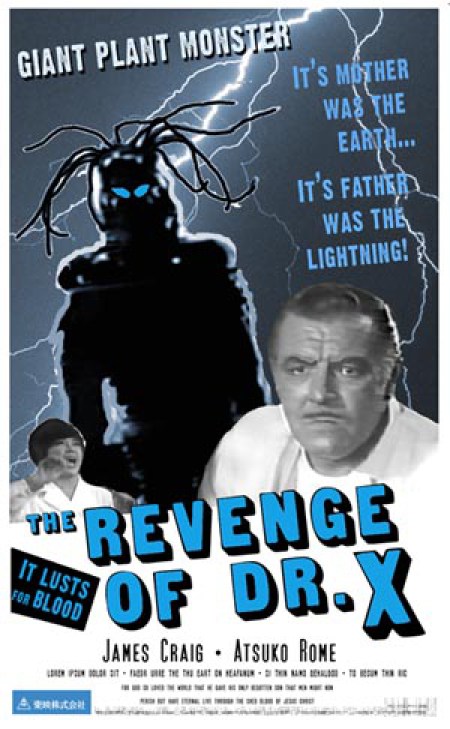
It’s been said that this movie is based on a 1950s screenplay by Edward D. Wood Jr., but he isn’t credited. He probably should be — this has his weird hands all over it. Even stranger, the first American video release had credits for a completely different movie, the 1969 Filipino film The Mad Doctor of Blood Island.

Also known as Venus Flytrap and Body of the Prey, this movie sat unreleased for 3-4 years, depending on who you ask, before it was unleashed on the moviegoing public. Just look at this amazing VHS box art, which has nothing to do with the actual film.

It’s all about Dr. Bragan, a NASA mathematician. After realizing that if his numbers are off by even the slightest decimal point, he could be sending men to their deaths, he has a nervous breakdown. His assistant suggests he goes to Japan to recuperate.

He’s played by James Craig, who was also in Bigfoot and The Tormentors, but his real life is way more interesting than any of the films that he was in. Once heralded as the successor to Clark Gable — indeed he took over many of his roles once Gable was drafted — his life took a turn thanks to drinking and bad relationships. His first marriage to Mary June Ray ended after 15 years due to claims of spousal abuse. His second marriage to Jill Jarman would not last the year, ending with him being threatened with arrest for not attending their divorce hearing. It was alleged that he broke into her home, beat her and cut up all of her clothes. That said, four years later, she’d kill her eleven-year-old son and commit suicide. A third marriage also ended in divorce. After the mid 1970’s, Craig retired to become a real estate agent.

But back to The Revenge of Dr. X. In Japan, Dr. Bragan stays at a hotel with his beautiful assistant, Dr. Hanamura (Kami), whose phonetic dead readings tell us she’s in love with this guy who is way too old for her and acts way too creepy, giving her unnecessary compliments about her looks before he even really knows her. He also begins experiments on a Venus Flytrap plant he brought from America, customs be damned. After he crosses it with a carnivorous undersea plant that he has nude pearl divers get for him — exploitation movie logic — and blasts it with lightning, is it any wonder that it’s soon eating puppies and people?

Come for the stock footage and library music. Stay for the strange plant person. If you think you know what a bad movie is and you haven’t seen this one, well, you don’t know what a bad movie is.

You can catch this on Amazon Prime.