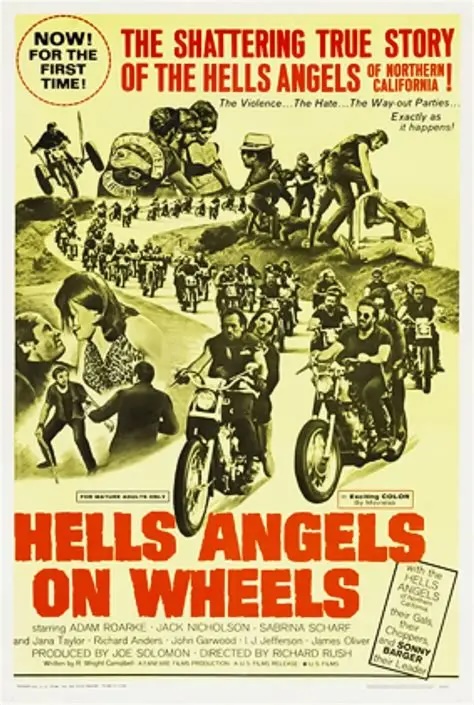
Directed by Richard Rush (The Stunt Man) and written by R. Wright Campbell, this is the tale of Poet (Jack Nicholson), a gas station attendant with a short fuse and a soul-crushing job. When a run-in with the notorious Hells Angels leaves his bike damaged, Poet doesn’t cower. Instead, he demands restitution. This display of suicidal bravery impresses the club’s charismatic leader, Buddy (Adam Roarke), who invites Poet to trade his mundane life for a permanent seat on the open road.
As a “prospect,” Poet is initiated into a subculture of beer-soaked brawls, police harassment, and brutal turf wars. However, the actual danger isn’t the rival clubs or the law; it’s the volatile romantic triangle that forms between Poet, Buddy, and Buddy’s restless girlfriend, Shill (Sabrina Scharf). What begins as a quest for freedom quickly spirals into a claustrophobic power struggle where the code of the road is tested by jealousy and betrayal.
“The violence, the hate, the way-out parties…exactly as it happens!” Roger Ebert said, “The film is better than it might have been, and better than it had to be.” He noted that, unlike so many other biker movies, everyone in this looks filthy, as they should.
Shot on location in Northern California, the film utilized actual members of the Hells Angels (including Sonny Barger) as extras and technical advisors, lending an unsettling air of legitimacy to the way-out parties and chaotic ride sequences. While Nicholson was still a few years away from Easy Rider, his performance here serves as the blueprint for the rebellious, anti-authority persona that would define his career.
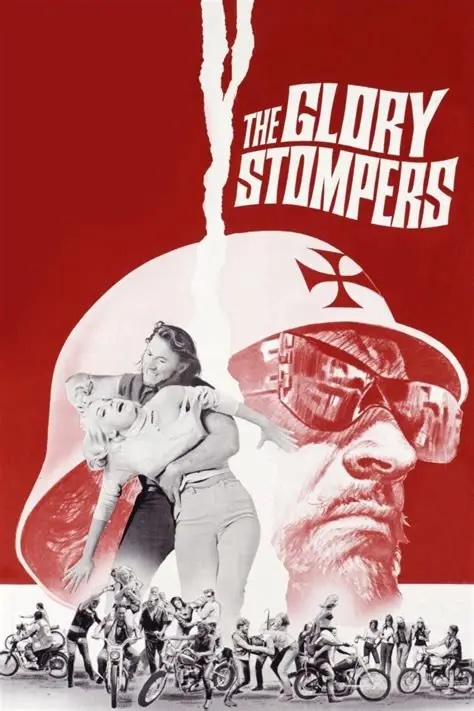
The Black Souls are led by Chino (an absolutely berserk Dennis Hopper), and the Glory Stompers are led by Darryl (Jody McCrea). Chino jumps him and nearly kills Darryl, then steals his girl, Chris (Chris Noel, who has a wild life story. Starting as a model in her teens, she was painted by pin-up artist Gil Elvgren; she was a New York Giants cheerleader; she was in Girl Happy with Elvis and most interestingly, she toured Vietnam eight times, was the only woman to travel through South Vietnam to remote bases in helicopters and lived to tell despite mortar and assault rifle attacks in war zones. She had her own Armed Forces Network radio show and married Green Beret captain Ty Herrington, who sadly took his own life eleven months into their union. She’s continued to help veterans ever since.).
Originally written by James Gordon White (Bigfoot, The Hellcats) as a Western, it was turned into a biker movie, which makes sense, since you just replace horses with motorcycles. Director Anthony M. Lanza adapted another White script into a film, The Incredible 2-Headed Transplant, and edited The Sadistand Wild Guitar.
Joined by ex-Black Soul Smiley (Jock Mahoney), Darryl heads off to save Chris, battling gang members like Mouth (Casey Kasem!), Clean Cut (Jim Reader) and Monk (Bing’s son Lindsey Crosby). Plus, Robert Tessier as Magoo! This also has a great soundtrack by Davie Allen and the Arrows, along with Mike Curb.
What makes this worth watching is Hopper. He’s crazy in this, yelling at everyone and saying man so many times. He talked to Tarantino about this, as it’s one of the director’s favorite movies.
QUENTIN TARANTINO: One of your performances that’s one of my favorites?it’s a wacky, kooky performance?is in The Glory Stompers. I loved you in that. You know, that is the beginning of you as Frank Booth in Blue Velvet right there.
DENNIS HOPPER: Glory Stompers is the American International Pictures movie which actually, I ended up directing. That was my first directorial job because the director had a nervous breakdown. I drove the guy to a nervous breakdown and then I took over the picture.
QUENTIN TARANTINO: You have this one line that’s just so fucking funny in it: when you’re fighting this guy, you beat him up, and then you look around and say, “Anybody else got anything else to say? Turn it on, man, just turn it on.”
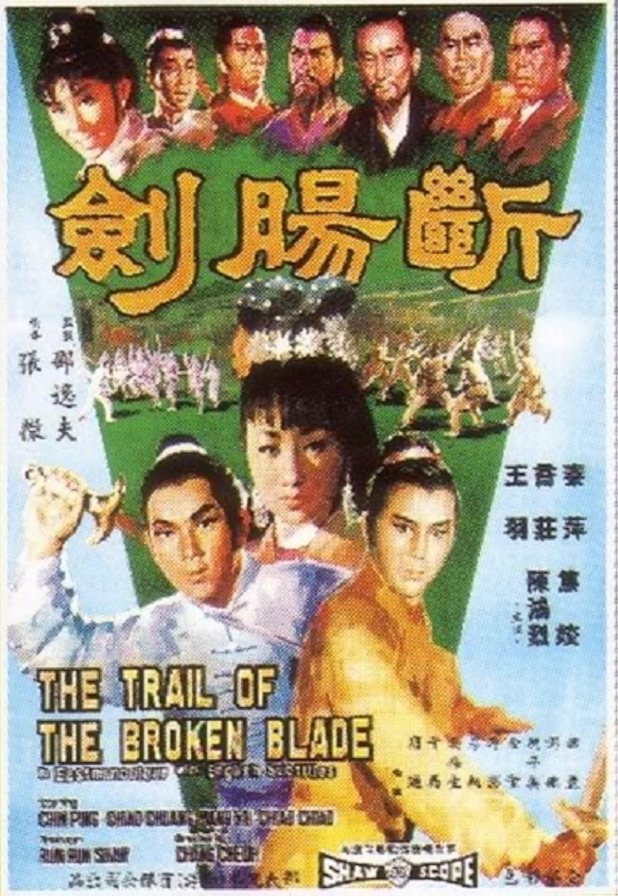
Li Yueh (Jimmy Wang Yu) gets revenge on the man who killed his father. That killer? A high-ranking official, who gets a price on his head and needs him to go into hiding. He doesn’t even tell his girlfriend, Liu (Ping Chin), that he’s disappearing. Later, she meets Fang Chun-chao, a swordsman who defends her from the Flying Fish gang. Fang is hired to train her in swordplay and ends up pining for her. She’s still in love with Li Yueh, however. Because Fang believes in honor, he decides to find her missing love.
The Flying Fish return to hunt down Fang, who is saved by his friend, a lowly stable worker. Of course, that person is Li Yueh. Together, they work to stop the threat of the different gang members. But if you’re a hero — or anyone, really — in a Chang Cheh movie, you may not make it to the end alive.
This Eureka release has a commentary track by film critic David West. You can get it from MVD.
Official synopsis: A private detective is hired to find a woman who has apparently been murdered in a snuff film. It turns out the woman’s not dead, but very much alive, and he gets sucked into a torrid affair that leaves him questioning his sense of reality. An eerie, seedy, dreamlike noir with fractured, time-bending overtones of John Boorman’s Point Blank and Christopher Nolan’s Memento.
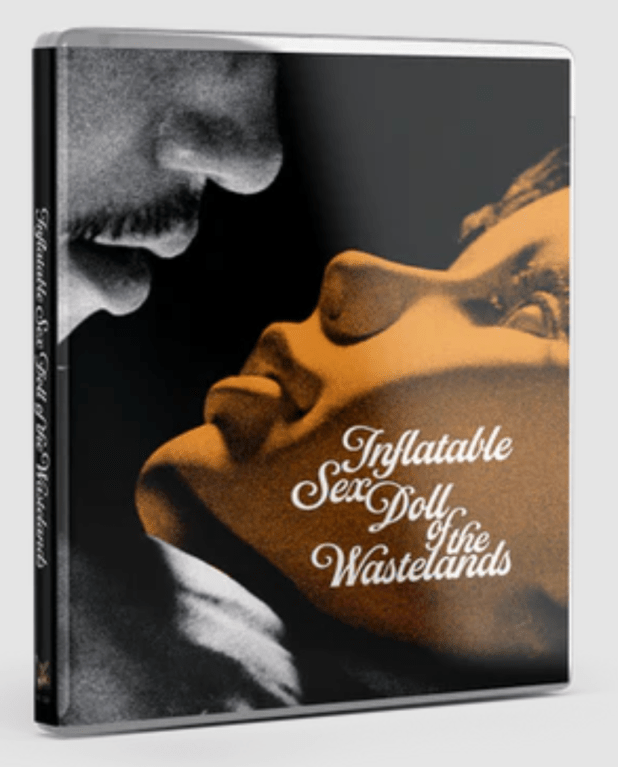
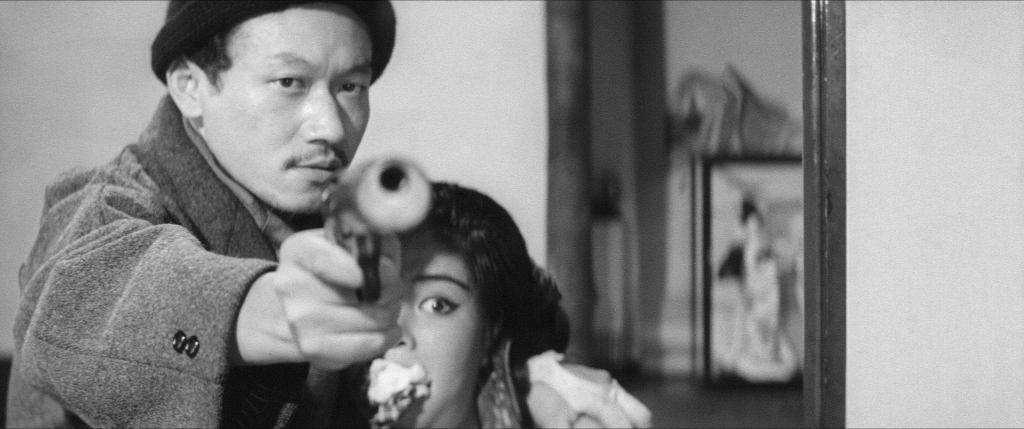
You want odd? Writer/director Atsushi Yamatoya has you covered with Inflatable Sex Doll of the Wastelands, a black-and-white crime feature that boasts both pinku eiga and noir elements. Fair warning: This one is a roughie, with sexual assault and other forms of violence against naked and clothed (if partially so) women.
Hitman/private eye Shō (Yūichi Minato) is hired by real estate agent Naka (Seigi Nogami) to rescue his girlfriend Sae (Noriko Tatsumi) from criminals who film their assaults on her and send the reels to Naka. Among the gang members is bar owner Kō (Shōhei Yamamoto), who assaulted and murdered Shō’s girlfriend Rie (Mari Nagisa). Shō’ finds Kō’s girlfriend Mina (Mika Watari) waiting for him at his hotel, and he roughs her up before giving in to her request for sex. Things get crazier from there — as if they weren’t enough already — and at times I wasn’t quite sure what was going on, but the insanity was so intriguing that the film had my full attention throughout.
Yamatoya, who wrote such screenplays as Branded to Kill and Stray Cat Rock: Sex Hunter, infuses the film with disarming time jumps, arthouse experimentation, and a cool jazz soundtrack. The performances are gripping, even if there isn’t a character to feel comfortable about supporting.
Inflatable Sex Doll of the Wastelands is the type of film that you just have to give into and go along for the discomfiting, eerie ride. You may feel like you need a shower afterward, but you’ll also have seen a historical slice of genre film bravado.
Deaf Crocodile’s restored version of Inflatable Sex Doll of the Wastelands premiered on OVID on October 17, 2025. For more information, visit https://www.ovid.tv/.
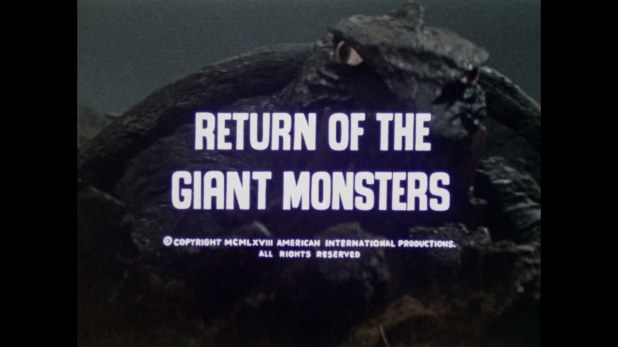
EDITOR’S NOTE: Gamera vs. Gyaos was on Chiller Theater on Saturday, November 30, 1968, at 11:20 p.m. and Saturday, September 12, 1970, at 11:30 p.m. as Return of the Giant Monsters, the title that American-International Television used when they re-edited it.
It all starts when a series of volcanoes go off, attracting Gamera, who enters one of them. This reveals a new monster, Gyaos, named for the sounds he makes. It looks like a giant bat and has wind powers, which he uses to decimate the Japanese Self-Defense Force.
Gyaos is a formidable opponent, as he has beams that cancel out Gamera’s fire breath. He’s also willing to bite off his own toes to save himself from Gamera’s fierce fangs. It takes Gamera dragging Gyaos into one of those volcanoes to kill him.
This film presents a world where money is more important than the lives and needs of the poor, even in the face of a monster ready to kill all of them with no prejudice. Yes, Gamera vs. Gyaos remains a lesson for our time, even as it features men in rubber suits beating each other up.
You can watch this for free on Tubi and Vudu, or on YouTube below:
EDITOR’S NOTE: In the Year 2889 was on Chiller Theater on Saturday, October 17, 1970 at 1:00 a.m. and Saturday, January 15, 1972 at 11:30 p.m.
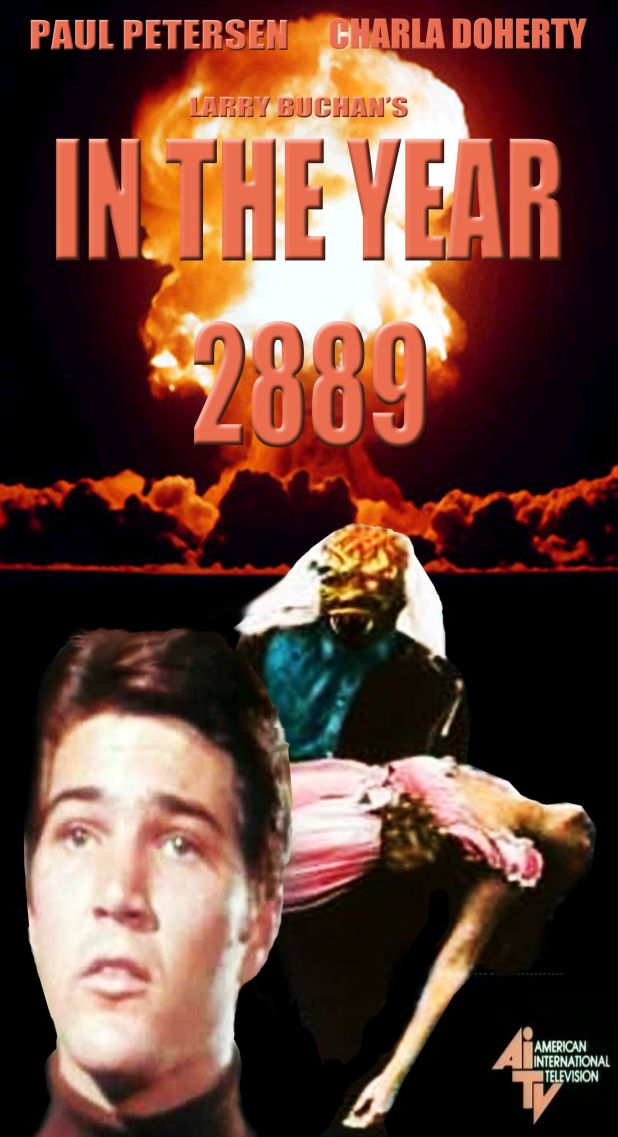
A remake of Roger Corman’s 1956 film Day the World Ended, this started as part of the Larry Buchanon remake series of American-International Pictures films, reshooting them on a low budget in color for TV.
AIP gave Buchanan the original script to use for this film, which ended up being an almost line-for-line, scene-for-scene remake. But why the new name? Well, after AIP made Master of the World, they registered the trademark for a film of the book In the Year 2889, which was written by Jules Verne and his son Michael.
FX artsitPaul Blaisdell, who did the special effects for the original AIP film, saw the movie on a Saturday afternoon and had no idea what it was. In his biography, he said, “I recognized some of the dialogue coming out of the actors’ mouths because it was a direct steal from Day the World Ended. I sat there…staring at it, and i just couldn’t believe it. I was absolutely spellbound. It’s just absolutely unbelievable that they remade) those. I don’t want to know a damn thing about them. I hope I never see them. One was more than enough!”
So yes, this is set in the year 1967. Not 2889. But we have Paul Petersen (The Donna Reed Show) as heroic Steve Morrow; Quinn O’Hara (The Ghost In the Invisible Bikini, Cry of the Banshee) as Jada; Charla Doherty in her final role as Joana Ramsey; Neil Fletcher as Captain John Ramsey; Hugh Feagin as Mickey Brown; Max W. Anderson as Granger Morrow; Bill Thurman as Tim Henderson and Byron Lord, the creature from Creature of Destruction, as a mutant. Lord also wrote Eat, Drink and Make Merrie and played Dean Butts in Co-Ed Fever, a Gary Graver adult film with an all-star cast including Jamie Gillis, Annette Haven, Serene Samantha Fox, Lisa De Leeuw, Vanessa del Rio, John Leslie and Juliet “Aunt Peg” Anderson.
Anyways, this movie is ridiculous and I loved it. The world ends, but only eight people are in it.
Each October, the Unsung Horrors podcast does a month of themed movies. This year, they will once again be setting up a fundraiser to benefit Best Friends, which works to save the lives of cats and dogs across America, giving pets second chances and providing them with happy homes.
ABOUT THE AUTHOR: Adam Hursey is a pharmacist specializing in health informatics by day, but his true passion is cinema. His current favorite films are Back to the Future, Stop Making Sense, and In the Mood for Love. He has written articles for Film Eastand The Physical Media Advocate, primarily examining older films through the lens of contemporary perspectives. He is usually found on Letterboxd, where he mainly writes about horror and exploitation films. You can follow him on Letterboxd or Instagram at ashursey.
Today’s theme: South Korea!
Filmgoers of Korea: We want Godzilla!
Director Kim Kee-duk: We have Godzilla at home!
Godzilla at home:
When I am making my list of films to watch for challenges, I keep several factors in mind. First and foremost, do I have access to the film I want to watch? There is nothing worse than getting excited about watching a movie, only to discover that it is not readily available anywhere. Next, how long is the movie? For example, I really loved The Wailing (a film that would fit into this category), but I do not have 156 minutes to devote to it in October. I have to get through too many films. Third, you want your list to have a nice variety about it. You don’t want 31 slashers. You need some diversity.
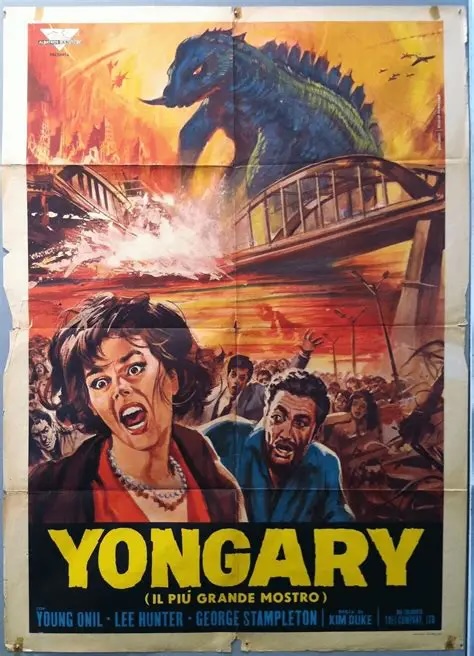
Yongary, Monster from the Deep checks all of the necessary boxes. I own the Vinegar Syndrome 4K (a 4K?) thanks to being a subscriber (a membership I question more and more each year). The film is only 79 minutes long, a blessing. And I can say I threw a kaiju on my list.
Does the movie have to be good? No. Do I have to like every movie on my list? Absolutely not. Am I glad I watched Yongary? Let’s just say that this 4K is going on my sale pile.
The film has its charms for sure. If you love seeing a guy in a rubber suit stomping around a set of miniatures, this is the film for you. If you want to see a monster dance with a precocious little kid, you are in luck. If you want to see a kaiju die by bleeding out of the rectum into a large body of water, no kink shaming here. But for me, this film will fall into that rare category of a film I did not really care for, would not watch again, but will probably never forget. Especially that last part.
EDITOR’S NOTE: Gappa, The Triphibian Monster was on Chiller Theater on Saturday, February 24, 1968 at 1:00 a.m., Saturday, March 15, 1969 at 11:30 p.m. and Saturday, April 25, 1970 at 1:00 a.m. It played as Monster from a Prehistoric Planet.
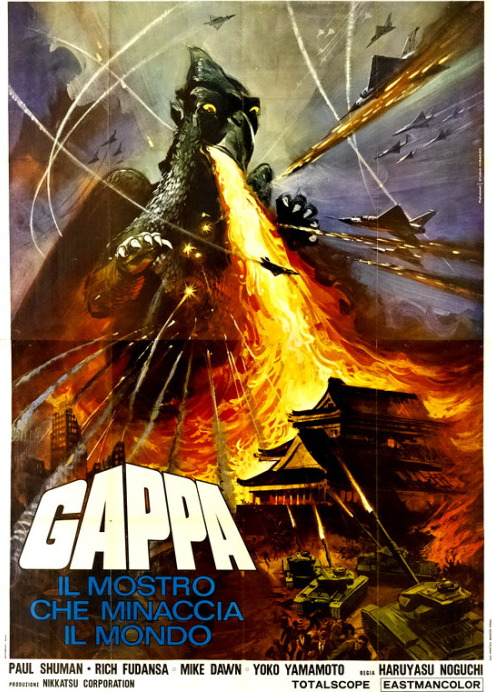
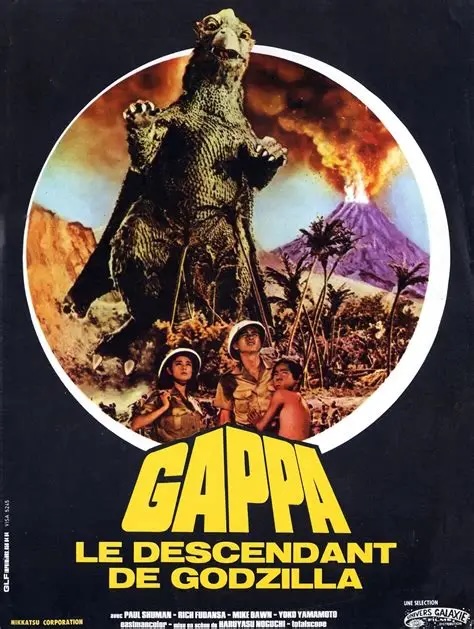
Gappa: The Triphibian Monster, initially released in the U.S. as Monster from a Prehistoric Planet, is essentially Gorgo with monsters drawn from Japanese legend. That’s totally fine with me, because this movie is absolutely gorgeous.
Remarkably, this was the only giant monster movie the Nikkatsu studio produced. After this, it’s all Roman Porno and pinky violence.
An expedition from Tokyo heads to Obelisk Island — you know, just like Skull Island — where the president of Playmate Magazine, Mr. Funazu, wants to make a resort. The natives welcome them warmly until the forbidden zone is breached and the expedition takes a gappa egg with them. They plead that the egg’s parents will do anything to get it, and you know how humans act in Japanese kaiju films. That means that before you know it, we have two giant bird/turtle/lizard monsters going wild all over Japan to get their baby back.
This is a movie that could never be made today, because all of the natives of Obelisk Island are basically Japanese actors in blackface. Plus, the actions of the civilized people can additionally cause the Gappas to ignite the volcano and destroy every single villager except Sa, killing the men painted brown.
Speaking of racism, there was an urban legend that Nikkatsu’s international English translation had the line, “The monsters are attacking Tokyo. Fortunately, they are attacking the Negro section of town.” This is not true.
Akira Watanabe left Toho to work on the special effects for this movie. He’s known for finishing the designs of Baragon and King Ghidorah. There must not have been any bad blood, because he returned to serve as the art director for movies like King Kong Escapes, Son of Godzilla, and Prophecies of Nostradamus.
Each October, the Unsung Horrors podcast does a month of themed movies. This year, they will once again be setting up a fundraiser to benefit Best Friends, which works to save the lives of cats and dogs across America, giving pets second chances and happy homes.
ABOUT THE AUTHOR: Adam Hursey is a pharmacist specializing in health informatics by day, but his true passion is cinema. His current favorite films are Back to the Future, Stop Making Sense, and In the Mood for Love. He has written articles for Film Eastand The Physical Media Advocate, primarily examining older films through the lens of contemporary perspectives. He is usually found on Letterboxd, where he mainly writes about horror and exploitation films. You can follow him on Letterboxd or Instagram at ashursey.
Today’s theme: Lon Chaney (Jr. or Sr.)
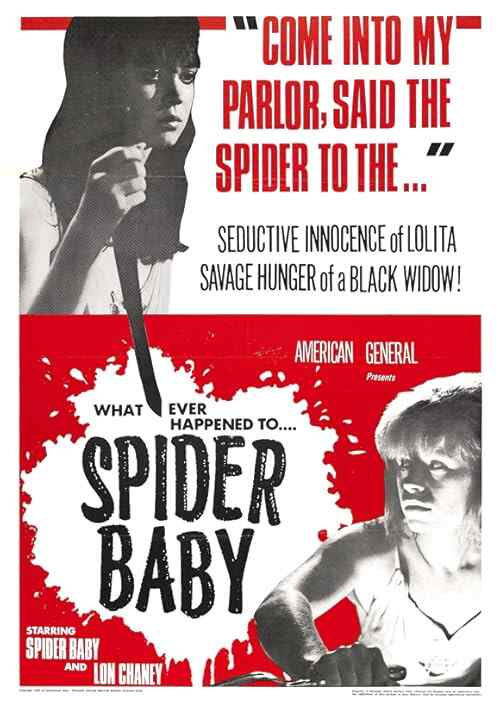
The horror landscape in the mid to late 1960s was a bit fractured, in a sort of limbo, almost waiting for a subgenre to emerge. Hammer had a stranglehold on gothic tales of horror. Herschell Gordon Lewis was busy inventing the splatter film. Jose Mojica Marins brought his boogeyman creation of Coffin Joe to life in Brazil. Mario Bava had planted the initial seeds of giallo with Blood and Black Lace, waiting for Dario Argento to come in and reap the benefits a few years later. For mainstream America, everything changed in 1968 with the release of films like Rosemary’s Baby and Night of the Living Dead. But before those landmark films changed everything, most horror films were pulling from the past rather than pushing the genre forward. Spider Baby is an interesting representation of where horror stood in 1967.
Spider Baby was written, edited, and directed by Jack Hill. Out of the Roger Corman school of filmmakers, Hill would go on to direct some of the most famous exploitation films of the 1970s, including Coffy, Foxy Brown, and The Switchblade Sisters. Prior to Spider Baby, Hill (along with a personal favorite director of mine, Stephanie Rothman) directed the troubled production of Blood Bath (the very first film covered on the Unsung Horrors podcast). For Spider Baby, Hill seemingly pulled from what was popular in horror films at that time—an old, dark gothic house filled with a family who is not quite right, and cast an actor (in this case Lon Cheney Jr.) who might need a sort of comeback vehicle, similar to what Robert Aldrich did in What Ever Happened to Baby Jane?and Hush…Hush, Sweet Charlotte.
Inflicting the family with a fictional genetic condition called “Merrye Syndrome”, where the unfortunate inflicted begin to regress mentally after puberty, Spider Baby is infused with colorful characters where anything can happen. The “children” act in feral ways, particularly Virginia, who captures victims in a makeshift spider web before “biting” them with a pair of knives. Bruno (Cheney Jr.) has taken charge of the siblings as his wards, trying his best to protect them from themselves, and perhaps society from them. Everything changes though when some desperate distant relatives show up, hoping to claim a stake to the family’s inheritance.
While the film might mostly resemble a typical gothic nightmare (spiderwebs, skeletons, and subterranean pits in the basement abound), it also offers aspects not seen in a lot of horror movies at that time. There is definitely a comedic tone to the whole story. A character breaks the fourth wall to directly address the audience at the beginning and end of the story. Perhaps most striking to me was a meta moment where a character at the dinner table references The Wolf Man, Lon Cheney Jr.’s most iconic role.
I’m not sure if Spider Baby is going to be the most memorable film I watch this month, but it is a solid start for sure.
I watched this one on Arrow Player, but it must be in the public domain, because it is streaming just about everywhere.
Bewitched aired throughout the most tumultuous time in modern history — hyperbole, that could also be today, but true, as rehearsals for this show’s first episode were on the day Kennedy was shot and the episode “I Confess” was interuppted by Martin Luther King Jr.’s death — from September 17, 1964, to March 25, 1972. The #2 show in the country for its first season and remaining in the top ten until its fifth season, it presents a sanitized and fictional world that at the time may have seemed contrary and fake to the simmering 60s, but today feels like the balm I need and an escape.
Within the home on 1164 Morning Glory Circle, Samantha (Elizabeth Montgomery) and Darrin Stephens (Dick York, later Dick Sargent) have just had a whirlwind romance and ended up as husband and wife. At some point, she had to tell him that she was a witch, a fact that he disapproved of, and that she should be a normal housewife instead of using her powers. Yet she often must solve their problems — usually caused by her family, such as her mother Endora (Agnes Moorehead) — with a twitch of her nose.
Creator Sol Saks was inspired by I Married a Witch and Bell, Book and Candle, which luckily were owned by Columbia, the same studio that owned Screen Gems, which produced this show. You could use either of those movies as a prologue for this, which starts in media res — I like that I can use such a highbrow term to talk of sitcoms — with our loving couple already settling into the suburbs.
Author Walter Metz claims in his book Bewitched that the first episode, narrated by José Ferrer, is about “the occult destabilization of the conformist life of an upwardly mobile advertising man.” As someone who has spent most of his life in marketing, maybe I should look deeply into the TV I watched as a child. Bewitched was there all the time in my life, wallpaper that I perhaps never considered.
Head writer Danny Arnold, who led the show for its first season, considered the show about a mixed marriage. Gradually, as director and producer William Asher (also Montgomery’s husband at the time) took more control of the show, the magical elements became more prevalent. What I also find intriguing is that with the length of this show’s run, it had to deal with the deaths of its actors and York’s increasing back issues, which finally forced him to leave the show and another Dick, Dick Sargent, stepping in as Darren, a fact that we were to just accept.
That long run, the end of Montgomery and Asher’s marriage and slipping ratings led to the end of the show, despite ABC saying they would do two more seasons. Instead, Asher produced The Paul Lynde Show, using the sets and much of the supporting cast of this show. He also produced Temperatures Rising, which was the last show on his ABC contract, which ended in 1974.
Feminist Betty Friedan’s two-part essay “Television and the Feminine Mystique” for TV Guide asked why so many sitcoms presented insecure women as the heads of households. None of this has changed much, as the majority of sitcoms typically feature attractive women and funny but large husbands, a theme created by The Honeymooners, and the battles between spouses. I always think of I Dream of Jeannie, a show where a powerful magical being is subservient to, well, a jerk. At least on Bewitched, Samantha is a powerful, in-control woman with a mother who critiques the housewife paradigm.
Plus, unlike so many other couples on TV at the time, they slept in the same bed.
Bewitched‘s influence stretched beyond the movie remake. The show has had local versions in Japan, Russia, India, Argentina and the UK, while daughter Tabitha had a spin-off. There was even a Flintstones crossover episode!
Plus, WandaVision takes its central conceit — a witch hiding in the suburbs — from this show. And Dr. Bombay was on Passions!
This is the kind of show that has always been — and will always be — in our lives. Despite my dislike of Darren’s wedding vows of no magic, there’s still, well, some magic in this show. Just look at how late in its run it went on location to Salem for a multi-episode arc, something unthought of in other sitcoms.
You can watch this just for the show itself, to see the differences between the two Darrens and when Dick York had to film episodes in special chairs because of his back pain, when the show did tricks like have Montgomery (using the name Pandora Spocks) playing Samantha’s cousin Serena to do episodes without York or just imagine that the world was changing outside. Yet, magic and laughter were always there on the show, throughout the lives, divorces and deaths of its principals and supporting cast.
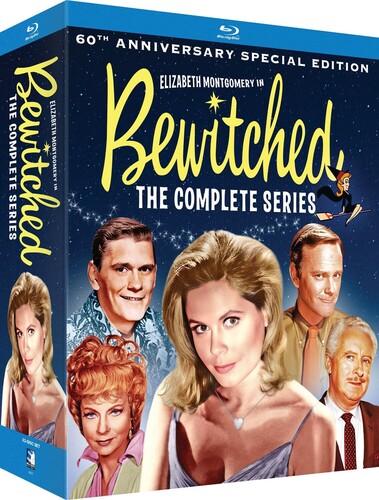
The Mill Creek box set is an excellent, high-quality way to just sit back, twitch your nose and get away from it all. This 22-disc set has everything you’d want on Bewitched, including extras like Bewitched: Behind the Magic, an all-new documentary about the making of Bewitched, featuring special guest appearances by actor David Mandel (Adam Stephens), Steve Olim (who worked in the make-up department at Columbia), Bewitched historian Herbie J Pilato, film and television historian Robert S. Ray, Bewitched guest star Eric Scott (later of The Waltons) and Chris York, son of D. York (the first Darrin). There are also sixteen new episodic audio commentaries, moderated by Herbie J Pilato that include behind-the-scenes conversations with Peter Ackerman (son of Bewitched executive producer Harry Ackerman), David Mandel, Bewitched guest star Janee Michelle (from “Sisters at Heart”), Steve Olim, Robert S. Ray, former child TV actors and Bewitched guest stars Ricky Powell (The Smith Family), Eric Scott (The Waltons), and Johnny Whitaker (Family Affair and Sigmund and the Sea Monsters) and Chris York (son of D. York). There’s also an exclusive 36-page booklet featuring pieces by Bewitched historian Herbie J. Pilato, as well as an episode guide. You can order it from Deep Discount.


 B&S About Movies
You must be logged in to post a comment.