L’intrigo (1964)

John Houseman called director George Marshall, “one of the old maestros of Hollywood … he had never become one of the giants but he held a solid and honorable position in the industry.” He started as an extra and made his first short in 1915 with And the Best Man Won. His career was nearly six decades long and he worked the whole way to an episode of The Odd Couple in 1972, as well as acting in episodes of Police Woman and the Playboy movie The Crazy World of Julius Vrooder. Some of the more recognizable movies in his career include The Ghost BreakersPapa’s Delicate ConditionBoy, Did I Get a Wrong Number! and The Wicked Dreams of Paula Schultz.

Marshall is obviously not an Italian director, but L’Intrigo (AKA Dark Purpose) — co-directed by Vittorio Sala — feels like a giallo.

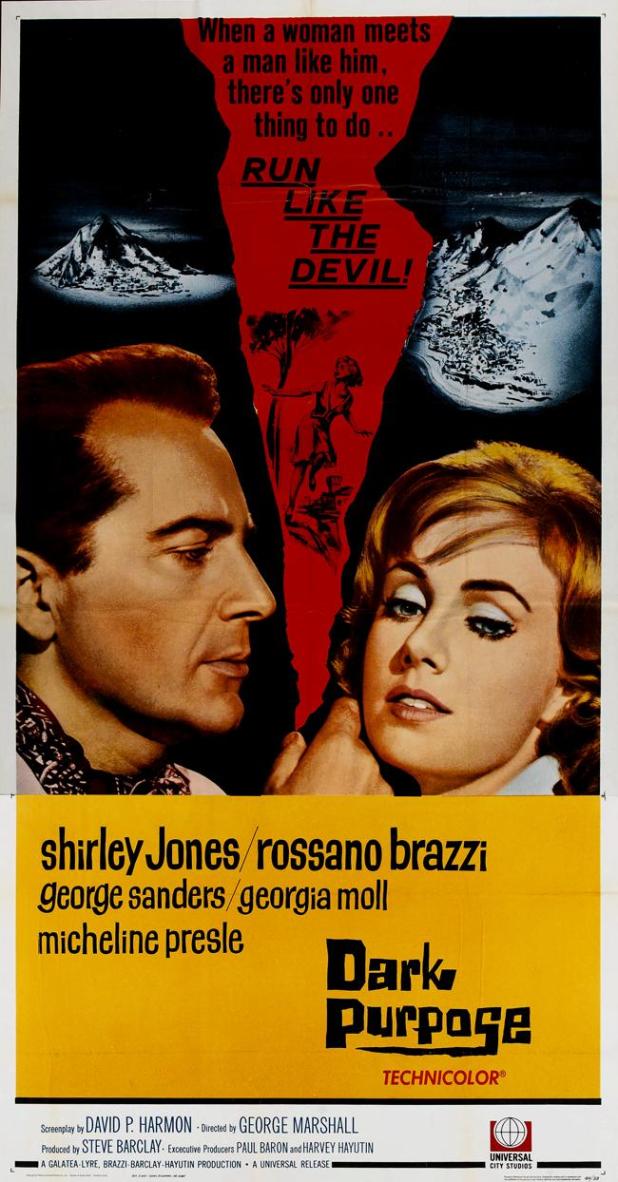
Art historian Raymond Fontaine (George Sanders) and his assistant Karen Williams (yes, that’s Shirley Jones in a giallo) have been brought to Italy by gallery owner Monique (Micheline Presle) to appraise the collection of Count Paolo Barbarelli (Rossano Brazzi). What they don’t know is that the count also has a deranged daughter named Cora (Giorgia Moll) who just might be dangerous to be around. Blame the skiing accident she just had for making her an amnesiac and quite angry that her daddy has found a new American love interest. Good thing — or bad for Karen — that she has a dog who can’t wait to eat a young lady.

Thanks to Suburban Pagans, I learned that costume designer Tina Grani (Blood and Black Lace) worked on this movie, which makes sense, as Jones is constantly the most fashionable young American in Rome. Cora also claims to be Count Paolo’s wife, and not his daughter, then she finds her way to the bottom of a cliff. That’s because Paolo caused her skiing accident and has felt guilt ever since, so he was killing her slowly. Once he met a new and interesting — and outspoken — new love, he got rid of the old one. She’s half his age and he has all the money, so men have never changed. They just get a new model every few years. Not as many outright kill the ex-wife.

This is a giallo as much as The Girl Who Knew Too Much is. By that, I mean that the genre had not found its strangeness yet and was still inspired by Hitchcock. It’s a good movie, but don’t go in expecting neon, black gloves and psychosexual murder.

Che fine ha fatto Totò baby? (1964)

An Italian comedy giallo parody of What Ever Happened to Baby Jane? How did I never know about this?

Directed by Ottavio Alessi, who wrote Emanuelle In Bangkok and Emanuelle In America and made Top Sensation, which dares to have a love scene between Edwige Fenech and Rosalba Neri, then ends with a Bible verse, this stars Toto, whose real name was Antonio Griffo Focas Flavio Ducas Komnenos Gagliardi de Curtis of Byzantium, His Imperial Highness, Palatine Count, Knight of the Holy Roman Empire, Exarch of Ravenna, Duke of Macedonia and Illyria, Prince of Constantinople, Cilicia, Thessaly, Pontus, Moldavia, Dardania, Peloponnesus, Count of Cyprus and Epirus, Count and Duke of Drivasto and Durazzo. “The Prince of Laughter” had a career marked by tragedy, like spurned lovers committing suicide, the loss of a son at a young age and even an eye infection that could have been stopped had he cancelled a show and disappointed his fans. Instead, he went on and lost a percentage of his site for the rest of his life. When he died, there were no less than three funerals, including one given by a local organized crime leader where an empty casket was carried along the packed streets of the small town where he was born.

Step brothers Totò Baby and Pietro (Pietro De Vico) steal suitcases at the train station. One day, they find that one of their stolen cases has a dead body in it. They switch that with two German women, Inga and Helga (Ivy Holzer and Edy Biagetti), but that’s only the beginning of their problems. The women are having an affair with Baron Mischa (Mischa Auer, a Russian-born actor who was a famous silent movie actor in Hollywood before continuing his career in France and Italy), who finds out that our protagonists had the body and blackmails them into murdering his wife (Gina Mascetti).

When they attempt to kill her, she dies of fright instead, but Totò Baby begins to eat salads with marijuana instead of lettuce and becomes a serial killer. His step brother attempts to escape him, but is finally dragged to the brach — yes, like Baby Jane as he’s also put in a wheelchair and served a frog — the police catch them. Totò Baby is committed where he writes the story of his life on an invisible typewriter. After all, his father was a criminal, so he was evil from birth.

If you recognize the home of the Baron, it’s Casale di Santa Maria Nova in Rome, which is where Blood and Black Lace was made.

You can watch this on YouTube.

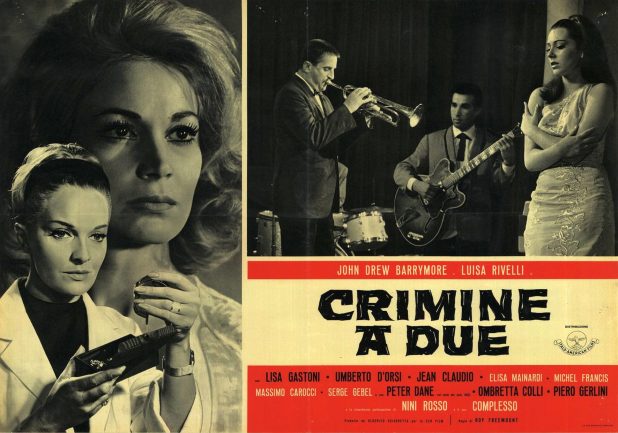
Crimine a due (1964)

A Game of Crime comes from the time before Argento and at the nascent time of giallo on film, following The Girl Who Knew Too Much by just a year. Directed by Romano Ferrara, who also wrote and directed Planets Around UsIntrigo a Los Angeles and Gungala the Virgin of the Jungle, as well as writing Spy In Your EyePaolo e Francesca and Gungala the Black Panther. This was written Ferrara and Marcello Coscia, who also wrote forty films including Yeti Giant of the 20th Century and Red Rings of Fear, and Sandro Continenza (School of Death).

Paolo Morandi (John Drew Barrymore, Death On the FourposterWar of the Zombies) is a gambler in the middle of a run of the worst luck, which means he owes big money to an organized crime boss at the same time that his girlfriend Christine (Ombretta Colli, Snow Devils) has gotten pregnant. He’s also sleeping with Anna (Luisa Rivelli), the wife of his boss Davide (Jean Claudio), who he plans to rip off to pay for an abortion and get ahead of his debts.

Just when Davide suspects that his lover is cheating him and Paolo has taken his cash, he has a heart attack, which places him in the care of Elisabeth Buckner (Lisa Gastoni, War of the Planets). It’s simple for Paolo to kill the man now and all the money goes to Anna, who now has to take care of her husband’s brother Cario, who has been left an invalid after an accident. None of this adds up to Commissario Perrotti (Umberto D’Orsi), who is on the case.

At one point, the characters discuss books and one says that they like anything but giallo, as they are too far fetched. How meta!

You can watch this on YouTube.

Cinematic Void January Giallo 2024: Blood and Black Lace (1964)

EDITOR’S NOTE: Cinematic Void will be playing this movie on January 4 at 7:30 PM ET at The Little Theatre in Rochester, NY. You can get tickets here. For more information, visit Cinematic Void.

There’s no way to calculate the influence of Blood and Black Lace. It takes the giallo from where Bava started with The Girl Who Knew Too Much and adds what was missing: high fashion, shocking gore and plenty of sex. The results are dizzying; it’s as if Bava’s move from black and white to color has pushed his camera lens to the brink of insanity.

Isabella is an untouchably gorgeous model, pure perfection on human legs. But that doesn’t save her as she walks through the grounds of the fashion house and is brutally murdered by a killer in a white mask.

Police Inspector Sylvester takes the case and interviews Max Morlan (Cameron Mitchell!), who co-manages the salon with his recently widowed lover, the Countess Christina Como. Soon, our police hero discovers that the fashion house is a den of sin, what with all the corruption, sex, blackmail, drugs and abortions going on under its roof. Isabella was murdered because she had kept a diary of all the infractions against God that happened inside these four walls.

Nicole finds the diary and tells the police she will deliver it, but it’s stolen by Peggy. As she arrives at the antique store her boyfriend Frank owns, the killer appears and kills her with a spiked glove to the face. The killing is shocking. Brutal. And definitely the forerunner to the slasher genre.

Even after the cops arrest everyone in the fashion house, the murders keep on piling up. Peggy claims that she burned the diary, so the killer burns her face until she dies. Greta is smothered to death. And Tilde is killed in the bathtub, then her wrists are slit open, spraying red into the water and marking her as a suicide.

So who is it? Come on. You’re going to have to watch it for yourself.

The success of Black Sunday and Black Sabbath had given Bava the opportunity to do anything he wanted. His producers thought that this movie would be a krimi film along the lines of an Edgar Wallace adaption. Instead, Bava gave more importance to the killings than the detective work, emphasizing sex, violence and horror more than any film in this form had quite before.

Blood and Black Lace was a failure in Italy and only a minor success in West Germany, the home of Edgar Wallace. And in America, AIP passed on the film due to its combination of sex and brutality. Instead, it was released by the Woolner Brothers with a new animated opening.

Today, Blood and Black Lace is seen as a forerunner of body count murder movies and the excesses of later giallo films. To me, it’s a classic film, filled with Bava’s camera wizardry and love of color. It is everything perfect about movies.

ARROW VIDEO BOX SET RELEASE: Inside The Mind Of Coffin Joe: At Midnight I’ll Take Your Soul (1964)

How badass is Zé do Caixão or as we know him, Coffin Joe?

Can you imagine the audacity to not just create this character but to become him in the midst of a country where more than 60% of the population is Catholic?

Can you even comprehend how upset people were when José Mojica Marins become the long-fingernail-wearing amoral undertaker driven to continue his bloodline by having a son with the perfect woman while murdering and ruining everyone in his wake? How did they deal with a boogeyman who filled their head with doubletalk and Nietzschian statements?

As Coffin Joe would yell, “I challenge your power! I deny your existence! Nothing exists, but life.”

The first appearance of Coffin Joe is in this movie, a film in which the evil undertaker searches for his perfect woman who will bear him the child that will make him immoral. After all, his wife is infertile, so he decides to murder her with a spider. And not just on any day. On a Catholic Holy Day. And then he decides to break another Commandment, coveting Terezinha, the fiancée of his friend Antonio.

Joe and Antonio visit a gypsy who foretells that a tragedy will keep Antonio and Terezinha from being married. This causes Joe to scream at the woman about how the supernatural is a lie, then he makes her warning come true by strangling his friend before drowning him. The very next day, he starts to court Terezinha by giving her a canary. When she resists his advances, he beats her and then assaults her. She curses him and reveals that she will kill herself — one of the gravest sins in the Catholic Church — and come back to pull him into Hell. He laughs, but the next day, she has hung herself.

The police just can’t seem to figure out why all this death is happening in this small village, but Dr. Rodolfo does. Coffin Joe responds by tearing out his eyes with his long fingernails and lighting him on fire. Problem solved. He remains unpunished and even starts to fall for another woman, Marta. On their date, he sees the gypsy who warns him that he will be punished. That night, as he walks home, the cemetery calls him, the place where all of his victims are burning. He opens the grave of Antonio and Terezinha and they begin to open their eyes as their mouths are filled with worms and insects. Coffin Joe begins to scream, as he is trapped between life and death, finally paying for his crimes as the church bells ring at midnight.

This is just the start of how strange these movies would become. If you liked the last ten minutes of this, just get ready. It gets really good from here.

Arrow Video’s limited edition collection of the movies of Coffin Joe is something I’ve been waiting for and it does not let me down in the least. Each movie is packed with so many extras. At Midnight I’ll Take Your Soul has commentary with José Mojica Marins, filmmaker Paulo Duarte and film scholar Carlos Primati in Portuguese with English subtitles, a new video essay by Lindsay Hallam, Damned: The Strange World of José Mojica Marins a documentary on Marins by André Barcinski and Ivan Finotti as well as Bloody Kingdom, Marins’ first short film with director’s commentary and excerpts from early works by Marins. You can get this set from MVD.

Spagvemberfest 2023: Four Bullets for Joe (1964)

Directed by Agustín Navarro and written by Fernando Galiana, Mario Guerra, Julio Porter and Vittorio Vighi, this Italian/Spanish Western comes from just before the genre took off in those countries.

Frank Dalton (Paul Piaget) is out to get vengeance for his dead sister, a woman wrongfully accused of killing her husband. It’s a relatively American Western by way of a murder mystery and is very unlike the Eurowesterns that would come after. There’s also a sheriff (Fernando Casanova) trying to solve who the murderer is and trying to keep Frank out of harm’s way.

Notable cast members include Barbara Nelli (Lady Morgan’s VengeanceBloody Pit of Horror) and Rafael Bardem, the grandfather of Javier. I wish this were a better movie, but there are certainly others to check out. Then again, the appearance of a black-gloved killer in the middle of a Western is always something I am going to watch. There should be more giallo Westerns! I looked up a list on the Spaghetti Western Database and see the following listed that I need to watch:

Killer Caliber .32

Killer, Adios

Ringo, It’s Massacre Time

The Last Traitor

The Masked Thief

The Price of Death

Kill the Poker Player

Revenge of the Resurrected

The Crimson Night of the Hawk

You can watch this on Tubi.

MILL CREEK SCI-FI CLASSICS: The Slave Merchants (1964)

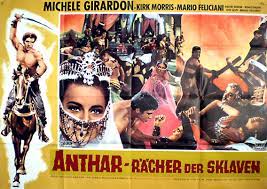
In Italy, this was called Anthar l’invincibile but it was also released as Devil of the Desert Against the Son of Hercules in the U.S. when Embassy Pictures released it to American TV stations as part of their Sons of Hercules package. It also has the AKA titles Anthar the Invincible and Soraya, Queen of the Desert.

It’s directed by Antonio Margheriti and written by Guido Malatesta (Maciste Contro i Cacciatori di Teste), Arturo Rígel and André Tabet. It starts with the evil Ganor, Devil of the Desert (Mario Feliciani) murdering the sultan, nearly doing the same to his son Daikor (Manuel Gallardo) and forcing Princess Soraya (Michèle Girardon) into marriage.

She’s so upset that she jumps out a window, only to be saved by Anthar (Kirk Morris), who just as soon nearly loses her to slavery. Anthar is the level of another shirtless hero in a Margheriti movie, Yor Hunter from the Future, as he gets captured or screws up more often than any other peplum good guy.

The end is amazing, because Margheriti rips off — pays tribute to? — The Lady from Shanghai, which is pretty wild when you think about this movie’s budget and that it was a film that was following the peplum trend and it still has the energy to pull something from Orson Welles.

There’s also a battle between Anthar and a rhino. I mean, where else are you getting that?

Don’t have the box set? You can watch this on Tubi.

MILL CREEK SCI-FI CLASSICS: Santa Claus Conquers the Martians (1964)

ABOUT THE AUTHOR: Nate B. is the man who loved Cat Dancing and the boy with green hair. He has seen too many bad movies and not nearly enough good ones. He is the last active member of the Butch Cassidy and The Sundance Kids Fanclub, and he is currently working on writing a better bio.

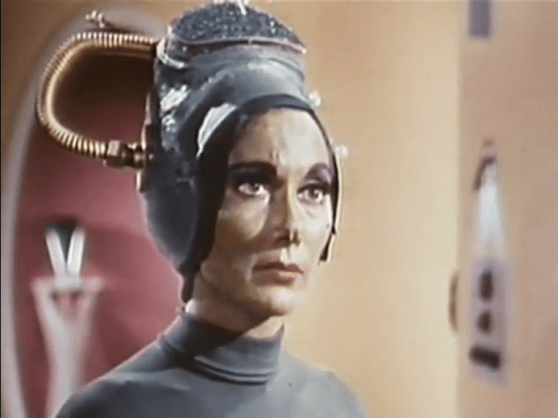
Here we go…a jewel in the crown that is postwar Americana kitsch – Santa Claus Conquers the Martians. Released in 1964 at the height of the space race, this film captures that time period in all the right ways. Not only were we gonna beat the Russians to Mars, not only would we come into contact with alien life, but we would win them over to our side! Not with guns or diplomacy, but with a jolly fat man in a red suit who epitomizes consumerism and capitalism!  It’s the kind of naive innocence from a bygone era that’s charming in its sincerity, especially because it’s a children’s movie. Unlike countless other children’s movies, this one is watchable for the older crowd, too. For a different reason, of course.

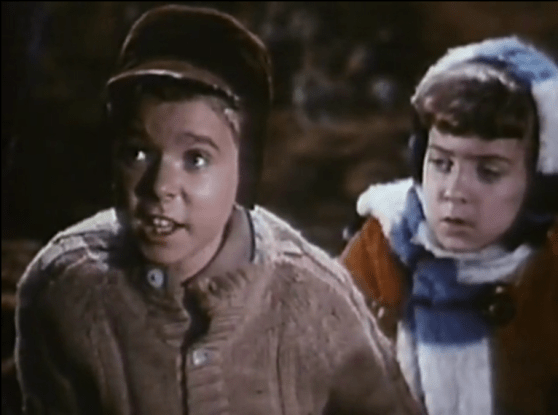
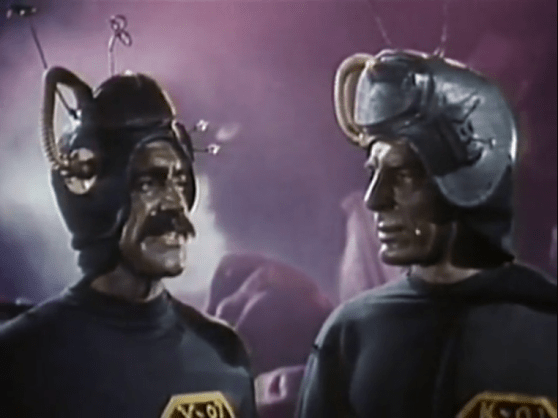
The children of Mars are sad. So a daring group of Martians take it upon themselves to abduct Old Saint Nick and have him start up his toy building and distribution enterprise for them. They pick up two Earth children in the process, and after everyone gets back to Mars they have to contend with a disgruntled jerk Martian who wants to destroy Santa because he believes he’ll make the Martian children soft (of course).

Now, Santa Claus Conquers the Martians may not be quite as technically woeful as Ed Wood films, as the filmmakers had a budget that was higher than $20 (dig that retro-futuristic Martian home!). But it shares the same genuine earnestness to thrill and entertain, which I think is what helped keep it “in circulation” in cult film circles all these years, so to speak. It has a dismally low rating on both IMDB and Rotten Tomatoes, but what do they know? I can’t find it in me to dislike a movie with a line about how the UN plans to save Santa as “the lights burn until dawn.” Not to mention Torg the robot. Or the amazing Polar Bear. Or the stock footage sourced from some Air Force training film. Or the stupidly infectious theme song that opens and closes the movie. Hooray for Santy Claus!

The acting in this movie is surprisingly decent. John Call is as good as you can expect a Santa to be, smoking a pipe (!) and ho-ho-hoing all the way. The guy who plays Kimar is stoic and wooden, which ends up working for an alien character devoid of emotions. Voldar, the anti-Santa Martian mentioned earlier, is great too when he drips with contempt for human concepts like ‘fun’ and’ happiness’, plus he has a terrific mustache. And Droppo, is well, Droppo. Of course, one of the reasons this movie is known is that Pia Zadora is in it.  It was her debut, and for a long while, her swan song until she resurfaced in Butterfly, a movie not as infamous as this one but still reviled in its own right. Oh well, at least she has her cameo in Naked Gun 3 to fall back on. Actually, looking up Pia Zadora on IMDB, apparently she did a movie with Telly Savalas called Fakeout. Now there’s a film that’s going straight to the top of my watch list.

Some people have made it a tradition to watch Die Hard as part of their holiday season. If you’re one of those, why not go old school this year? Santa Claus Conquers the Martians is as low on budget as it is on logic but it’s a great example of why sometimes, despite all reasons not to, a movie just strikes a chord with you through sheer audacity. Plus, it’s in the public domain! There’s a lovely Blu Ray available, but I personally prefer the lower quality prints in this case. Maybe it’s because that’s how I first saw it, and maybe because it adds to the overall vintage vibe and fits the movie’s low budget roots.

MILL CREEK SCI-FI CLASSICS: Hercules and the Tyrants of Babylon (1964)

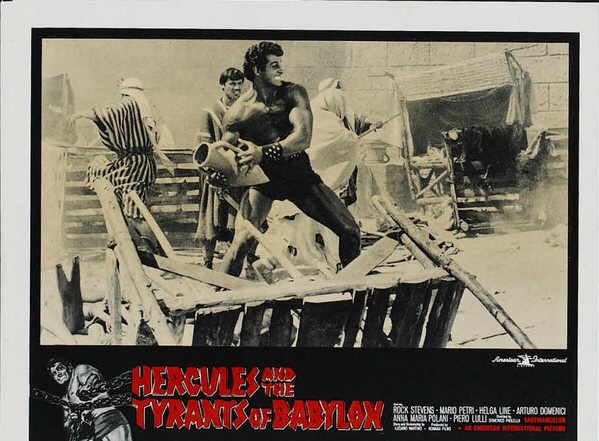
Asparia (Anna-Maria Polani) is the Queen of the Hellenes, and has been captured by the Babylonians. Somehow, she has hidden her royalty and is living as a common slave in Babylon. Hercules (Rock Stevens, who is really Peter Lupus, who played Flex Martian in Muscle Beach Party, Goliath in Goliath at the Conquest of Damascus and Superman in a series of Air Force commercials, a job he lost when he posed fully nude in Playgirl) is on his way to save her.

King Phaleg of Assyria (Mario Petri) comes to Babylon hoping to marry Asparia and unite their kingdoms. That’s stopped by the rulers of the country, Taneal (Helga Line), Salmanassar (Livio Lorenzon) and Azzur (Tullio Altamura). Hercules saves him and continues to Babylon.

When he gets there, the brothers are fighting over who gets to marry Asparia while Taneal destroys her own nation to get its riches. Brother kills brother, King Phaleg shows his true colors and Hercules does what he does best.

This was directed by Domenico Paolella, who directed his first movie,  Gli ultimi della strada, in 1940 and wrote his last, Power and Lovers, in 1994. He also wrote the story with Luciano Martino.

The problem I have with this is that Helga Line, as a murderous maniac, is so much more attractive than Polani. If I had the power of Hercules, I know that my decisions would not be as godly.

Don’t have the box set? You can watch this on Tubi.

MILL CREEK SCI-FI CLASSICS: Hercules the Invincible (1964)

Ercole l’invincibile came to American audiences as Son of Hercules in the Land of Darkness. Of these thirteen movies in the Embassy Pictures package offered to TV channels, two had Hercules, none had his children Alexiares, Anicetus, Telephus, Hyllus and Tlepolemus, and four were Maciste movies.

Ercole, or Hercules, is played by Dan Vadis, a former U.S. Navy sailor and bodybuilder who was a member of the Mae West “Muscleman Revue.” He had already played Hercules in The Triumphs of Hercules and after these movies, moved into Westerns, the films of Clint Eastwood and finished his career in Seven Magnificent Gladiators.

After saving Telca (Spela Rozin, Strange Girls) from a lion, her father Kabol (Ken Clark) offers her hand in marriage if he gets a dragon’s tooth for him. That tooth is impossible to pull out unless the dragon is dead, but a witch (Olga Solbelli) claims she can help make a spear. But that tooth has magic that only works once and the witch also wants the tooth. There is also a tribe of cannibals who eat hearts called the Demulus, led by Ella (Carla Calo).

Director Alvaro Mancori was also the cinematographer of the peplum horror crossover Goliath and the Vampires. He used the name Al World here and in the only other movie he made, the anthology The Double Bed, he was Al Wood.

Don’t have the box set? You can watch this on Tubi.