Some people are content enough to never think about movies all that much. They watch them, they may like them, they may forget them and then they go on about having busy lives, making important business decisions and thinking that they’re a success. And then there’s me, awake in the middle of the night, wondering just how many movies have matriarchal societies (like the earlier Flight to Mars and the later Project Moonbase, and the later Mutiny in Outer Space) within science fiction movies.
I’ve paid for my weirdness in money, depression and a sure future.
Enjoy the benefits of my Prometheus-like ways and join me, all week, as we get into these movies.
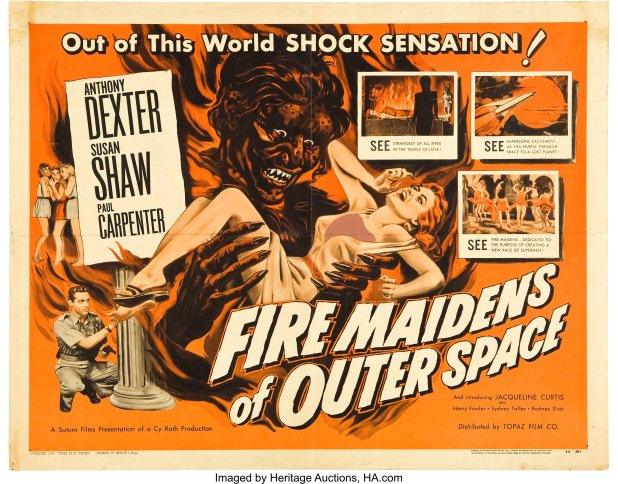
Fire Maidens of Outer Space is the kind of movie where you can see the zipper on the monster and I wouldn’t have it any other way. It’s a British-American co-production and I’m astounded that no one looked at what writer/director Cy Roth had, well, wrought.
You’ll recognize the rocket that launches early in this movie from so many other 1950’s science fiction junk films — such as King Dinosaur. It’s a V-2 rocket that was taken from the Germans, probably as part of Operation paperclip, and launched at the White Sands base in 1946.
Once a new moon of Jupiter is found*, Earth sends five men who are as quick to smoke a cigarette and shoot a gun as they are to attempt diplomacy. This is the most realistic notion that this movie presents. Quickly after landing, they save Hestia (Susan Shaw, whose leading lady status was slowly eroded thanks to alcoholism) from a monster and discover that New Atlantis — a colony of the original! — is about to die out and that there are only sixteen women and one old man left.
They’d like to stick around and help, but once they discover that the leader Duessa (Jacqueline Curtis, The Camp on Blood Island) plans on keeping them as studs to repopulate her race, they try to get home. Of course, the monster gets loose, lots of people die and the remaining women all fall for our dashing crew members, like Luther Blair (Anthony Dexter, who was so frustrated by Hollywood typecasting him in only roles like Valentino — they looked incredibly alike — that he quit to become a high school teacher).
This is basically a much worse Cat-Women of the Moon, except you know, with more cigarettes and thirteen Fire Maidens. And don’t get us started with King Dinosaur, where they just simply nuke the planet before leaving. Oh, and if that meteor shower looks familiar, that’s because it’s pinched from Robert L. Lippert’s Rocketship X-M (which we discuss in our review of Flight to Mars).
*The movie is remarkably accurate in one way — it predicted that we would discover that the 13th moon of Jupiter. We sure did — 18 years later — and named it Thelxinoe.
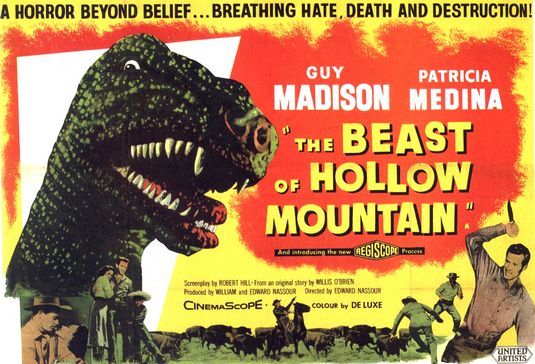
Filmed in both English and Spanish at Churubusco Studios in Mexico City, the American version of this Willis O’Brien (the animator of King Kong) was called The Beast of Hollow Mountain while the Mexican one was named La Bestia de la Montaña.
Cowboys and dinosaurs seem like a pretty natural combination. In this one, Jimmy Ryan (Guy Madison, who played Wild Bill Hickock on TV’s The Adventures of Wild Bill Hickok) finds out that some real life giant lizards are eating all his cattle.
You know how I always complain about movies showing the monster too soon? This waits nearly an hour before you see the dinosaur. That’s having patience. Oh yeah — don’t get attached to the little kid who has an abusive father.
O’Brien also wrote another unproduced script from this concept called The Valley of the Mists, which would later be made as The Valley of Gwangi by Ray Harryhausen, in case you can’t get enough stop motion monsters.
DAY 18. RESURRECTIONISTS: Watch something that came out on one of the many reissue labels that we love like Arrow, Criterion, Bleeding Skull, Scream Factory, Indicator, Vinegar Syndrome, AGFA etc.
The majority of my paycheck? That goes to my wife.
The rest goes to movies.
Arrow Video gets a good chunk of what I have and they’ve been putting out an amazing mix of films this year, including plenty of wonderful Japanese films like 1958’s Uchūjin Tokyo ni arawaru. (Spacemen Appear In Tokyo), which was released in the U.S. as Warning from Space. It was the first color science fiction movie made in that country.
Made by Daei, the same people who would gift us with Gamera, and released in the U.S. eleven years after it came out in Japan, this movie has been pointed to as one that Kubrick watched as he grew fascinated with science fiction.
The Pairan aliens of the film are perhaps the best reason to watch this. They’ve never looked better than now, with the gorgeous remastered transfer that’s on Arrow’s new disk. Designed by avant-garde artist Taro Okamoto, they’re unlike any aliens we’d imagine in the West. Instead of humanoid creatures, they’re stars that dance their strange ballet toward camera as they wonder how to reach Earth’s scientists.
One of those aliens decides to take the form of entertainer Hikari Aozora and reach out to our scientists and World Congress to borrow our nuclear weapons to obliterate another planet in the path of our world called Planet R. As no one decides to listen to her, we’re forced to deal with all the impact of having a rogue planet come closer and closer to us. The whole “listen to science’ mantra that our world is ignoring happens here as well, but sadly, we don’t have human-sized star aliens with one giant eye to right our course.
Trust me, just watch those Pairans bounce around your screen is worth the price of this blu ray. The new Arrow Video edition of this movie also features commentary by Stuart Galbraith IV, author of Monsters Are Attacking Tokyo!, and a newly restored English dub track.
DISCLAIMER: We were sent this film by Arrow Video. That said, we spend a lot of money on movies and don’t change our reviews just because we get review copies. Buy physical media!
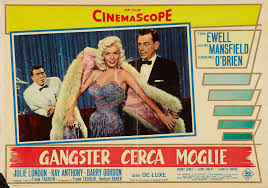
Frank Tashlin made the Looney Tunes and Merrie Melodies cartoons and you know, that’s pretty much what this movie is. It’s a cartoon come beautiful and wonderfully to life. He’d work with Jerry Lewis on six of his solo films (Rock-A-Bye Baby, The Geisha Boy, Cinderfella, It’s Only Money, Who’s Minding the Store? and The Disorderly Orderly) and then work with Jayne Mansfield again on the movie Will Success Spoil Rock Hunter? He also wrote the Don Knotts film The Shakiest Gun in the West.
I knew I would love this movie in the first few seconds, when Tom Ewell introduces the film by showing how CinemaScope and the colors by DeLuxe work. It’s an astounding moment that breaks the fourth wall before it has even been built.
A mobster who runs the slots, Marty “Fats” Murdock (Edmond O’Brien), has one dream. He wants his girl, Jerri Jordan (Mansfield), to be a singer. She has no talent, but he knows that press agent Tom Miller (Ewell, who is best known for The Seven Year Itch and whose last movie was Rodney Dangerfield’s Easy Money) can get the job done. Even better, he never hits on his clients.
Murdock is obsessed with a song he wrote, “Rock Around the Rock Pile,” and Miller has to go to enemy territory and sell the song to another mobster, Wheeler (John Emery, Kronos), who rules the jukeboxes.
There’s all manner of romantic confusion and a gang war over jukeboxes, which was actually a thing once. All ends well, with Jerri confessing that she really can sing and Murdock letting her know that he doesn’t want to marry her, so she can go off and be with Tom, the man she loves. The wedding dress that Mansfield wears here was loaned to her for her wedding to Mickey Hargitay.
Oh yeah — and Juanita Moore, from Imitation of Life, is in this. That’s what normal folks know her from. Me, I recognized her as Momma from Abby right away.
The real reason to watch this — beyond the rainbow of colors ready to bathe your eyes in perfect beauty and majesty — are the performances by Fats Domino, Little Richard, Eddie Cochran, The Platters, Gene Vincent, Eddie Fontaine and more.
In The Beatles Anthology, Paul McCartney discusses how John Lennon learned how to play guitar from watching Cochran in this movie. It meant so much to them that they cut the recording of “Birthday” at Abbey Road Studios short to watch its 1968 British TV debut. Jimmy Page and Jeff Beck also claimed that this movie was a big influence.
Speaking of influence, some feel that Elvis was directly inspired by the dancing for “Rock Around the Rockpile,” which was somewhat of an imitation of him anyway, and may have used the look of this scene when he made Jailhouse Rock. The makers of The Girl Can’t Help It wanted Elvis for this film, but dealing with Colonel Tom Parker proved to be too much to deal with, as his asking price for one Elvis song was too expensive.
Want to love this movie even more? Listen to John Waters discuss it on the British DVD release. He would also tell the Directors Guild of America Quarterly, “This wasn’t a movie that my boy classmates wanted to see or cared about. They weren’t interested in discussing Jayne Mansfield’s complete lack of roots. I really had no one that I could be enthusiastic with about it. So it was a private secret of mine, this movie.”
Waters based so much of the character of Divine — she would even come on stage to the song “The Girl Can’t Help It” — from Mansfield. He also points out that Little Richard’s mustache in this movie had such an impact on him that he’s had it for his entire life.
This film is pure greatness on a level that very few movies ever hope to reach. You can watch it on YouTube.
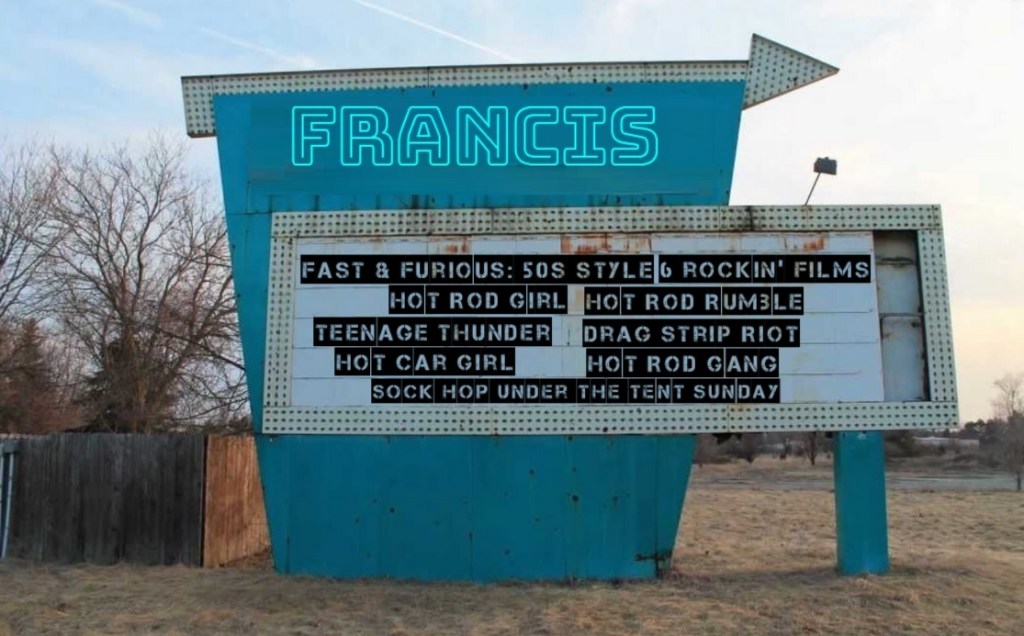
Thank the celluloid gods of the analog netherworlds for giving Sam the idea to commemorate the Fast & Furious franchise, thus granting the opportunity to go ’50s hot roddin’ rock n’ roll crazy with this week’s Drive-In Friday tribute.
Vin Diesel lookalike autograph signing under the tent Friday!
Tonight’s show takes me back to the days when AMC was still known as “American Movie Classics” and aired actual “classic movies,” most importantly, their American Pop! programming block that ran Saturday Nights from 10:00 p.m to midnight from 1998 to 2003.
To say American Pop! carried a USA Network’s Night Flight* aroma is an understatement, courtesy of its programming roster that featured 1950s and 1960s rock n’ roll-oriented films augmented with classic trailers, music videos cut form period musicals, drive-in movie ads, and old drive-in snipes urging you to “visit the snack bar.” The purpose of the programming block was to ramp an AMC-affiliated 24-hour cable channel . . . that never came to fruition.
Ugh. Heart broken by progress, once again.
Oh, and you can thank — or blame — screenwriter Stewart Stern and director Nicolas Ray for these F&F precursors, for each aspire to emulate the film that started it all: the 1955 juvenile delinquency classic, Rebel Without a Cause. But if you’re looking for social commentaries about clueless parents battling the moral decay of American youth, you best go watch a copy of Richard Brooks’s Blackboard Jungle (1955), instead. And if you’re having Marlon Brando flashbacks ala The Wild One (1953) . . . and if all the “teens” look like 30 year olds, they probably are.
So, alright, gang! Let’s get fast n’ furious, crazy baby! Let’s rock to that hot rockin’ beat, daddy-o!
Movie 1: Hot Rod Girl (1956)
“CHICKEN-RACE . . . ROCK ‘N ROLL . . . YOUTH ON THE LOOSE! . . . ARE THESE OUR CHILDREN? . . . Teen-age terrorists tearing up the streets!”
Now if that fine slice-o-copywritin’ doesn’t inspire you to pony up to the cracklin’ speaker and firin’ up that ol’ bug coil, then nothing will.
As with the plot of most of the Fast & Furious knockoffs of century 21: After his kid brother dies in an illegal street race, a champion drag-racer quits racing. When a new hotshot racer comes to town, he’s forced back into racing to retain his title.
Way to splash that testosterone, guys.
The “Natalie Wood” bad-girl, aka the Hot Rod Girl, who plays the two drag racin’ dopes against each other, is Lori Nelson (co-star of the 1957 rock n’ delinquency flick Untamed Youth with Mamie Van Doren), and the cop on the case is . . . Chuck Connors from Tourist Trap? And one of the “teen” thugs is a 23-year-old Frank Gorshin, aka The Joker of TV’s Batman fame, in his acting debut.
“DRAG STRIP SHOCKS! PISTON-HARD DRAMA! ROCK ‘N ROLL LOVE! . . . A scorching story of the slick chicks who fire up the Big Wheels!”
Hey, dad! It’s more rival car clubs and vehicular homicide via illegal street racing with a poor, misunderstood youth being set up for murder. Oh, and there’s always a heart-toying bad-girl adding to the hot rod drama, in this case, (hubba-hubba) actress Leigh Snowden who — by name alone — makes me feel funny, you know like when you take a Garth Algar-climb up the rope in gym class. Leigh’s other claim to fame: the third Gill-man/Black Lagoon movie that no one cares about: 1956’s The Creature Walks Among Us.
“Young love and teenage kiss . . . hot rods and hot tempers.”
As you can see, the copywriters were having a bad day marketing this James Dean-light knockoff. And you’d think cloning the epitome of teen juvies would lead to bigger roles . . . but not for Chuck Courtney: by the turn of the ’60s he was down to background work as a soldier on Spartacusand as a crewmember on TV’s Voyage to the Bottom of the Sea.
He stars as the misunderstood and motherless (typical 27 year old playing an 18-year-old) Johnnie Simpson who lives with his every-criticizing father (see Jim Backus’s in his role as Jim Stark) and Aunt Martha (because aunts are always named “Martha” in the movies). Of course, Johnnie’s family is poor and he can’t afford a fancy hot rod . . . or even a rat rod. But Maurie Weston (hey, that’s Robert Fuller from TV’s Emergency! and Walker, Texas Ranger!), the local town bully-cum-rich kid, has as a set of smokin’ wheels . . . and Jim’s waitress-girlfriend (Melinda Bryon; appeared in 1948’s Kiss the Blood Off My Hands with Burt Lancaster) notices. Yep, Jim’s gotta race for the girl.
Johnnie, my advice: there’s other babes to score at the sock hop. You’ll never win with girls who like the bad-boy. Never. Even when they look like Leigh Snowden.
Now you’re talkin’ Mr. Copywriter. And yes, Mr. Art Director: illegal street racing jousts between Corvettes and Triumph motorcycles is exactly what we want on a poster!
This one has it all: In addition to bike vs. car battles, we have a climatic fishing spear fight scene on the beach, we have (hubba-hubba alert) an on-the-way-up Connie Stevens (of the rockin’ juvie potboilers Young and Dangerous, Eighteen and Anxious, and The Party Crashers issued in ’57 and ’58), and an on-the-way down Fay Wray (do we have to mention her iconic role; she was also in ’56s Rock, Pretty Baby!).
The teen tempers boil when the cleancut members of a sportscar club (complete with sweaters and slacks, natch) runs afoul of a motorcycle gang and it results in the death of one of the instigating bikers. And now they’re out for revenge.
The double hubba-hubba alert comes courtesy of the resident bad-boy chasing femme fatale played by Yvonne Lime, who’s traveled the rockin’ asphalt before in High School Hellcats, Speed Crazy (also a hot rod flick), and Untamed Youth.
“She’s hell on wheels . . . and up for any thrill!”
Seems Mr. Screenwriter dipped the pen into the Shakespearian ink; for this is Othello with hot rods.
Duke (Richard Bakalyan; you’ve seen him across his 150 TV credits into the early ’90s) and Freddie (John Brinkley, who’s traveled this rockin’ road before in Hot Rod Rumble, Teenage Doll, and T-Bird Gang) finance their hot roddin’ lifestyle by stealin’ cars n’ strippin’ auto parts for a fence. When they, along with Duke’s girl, Peg (June Kenney, also of Teenage Doll, but also of 1959’sAttack of the Puppet People and Roger Corman’s Sorority Girl), are goaded into a road race by the resident bad-girl, Janice (Jana Lund, also of High School Hellcats with Yvonne Lime, Elvis Presley’s Loving You, and the rock flick classic, Don’t Knock the Rock . . . but since this B&S About Movies: it’s all about Frankenstein 1970 for our Lundness), a motorcycle cop dies. Let the frames and double crosses, blackmailing and betrayals begin, Desdemona.
Oh, almost forgot: Bruno VeSota is in this as Joe Dobbie (seriously). What ’50s and ’60s film wasn’t the Big V in? Yep, there he is in Attack of the Giant Leeches, A Bucket of Blood, and The Wasp Woman . . . but also of the early rock flicks Daddy-O, Rock All Night, and Carnival Rock. It is actors like you that gives our lives at B&S meaning, Mr. VeSota. We bow to you, sir.
“Crazy kids . . . living to a wild rock n’ roll beat!”
But the “beat” is sung by John Ashley and Gene Vincent???
The ’32 Ford Roadsters as speedin’ fast n’ furious in this tale regarding the trials and tribulations of John Abernathy III, a poor little rich kid who jeopardizes inheriting his father’s wealth with his on-the-down-low, second-rate Elvis crooning with his buddy, Gene Vincent, and his illegal hot roddin’ career. The bad-girl who screws it all up for John is the devilish Lois Cavendish (Jody Fair, best remembered for 1958’s The Brain Eaters, but did the juvie-rock flicks Ghost of Dragstrip Hollow, Girls Town, High School Confidential, and The Young Savages with Burt Lancaster).
And those breasts! Yikes. They’d impale a frail lad like me. No, really.
Hey, those foil hot dog and burger wrappers don’t pick up themselves. And we’ll see you Sunday under the tent for the sock hop! It’ll be a crazy time, dad! (And Leigh Snowden will break my heart, as she goes off with the leather-jacketed and pot smoking Johnny . . . who subsequently abandons her on a bus bench in the middle of nowhere. Guess who comes to her rescue? The heart wants what the heart wants . . . and it’s always bad.)
* We previously paid tribute to the USA Network’s Night Flight with a recent, four-movie Drive-In Friday featurette.
About the Author: You can learn more about the writings of R.D Francis on Facebook.He also writes forB&S About Movies.
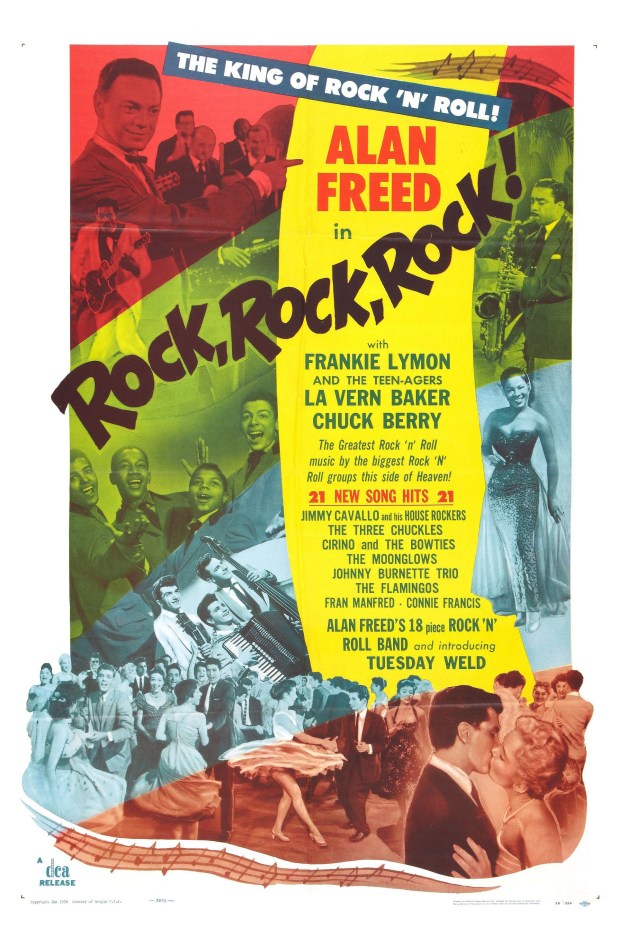
Rock, Rock, Rock! was conceived, co-written and co-produced by Milton Subotsky — he also wrote nine of the songs in the movie — who we all know was half of the team that was known as Amicus (along with Max Rosenberg, who also produced this movie). All hail Amicus! And all hail Sword & Sorcery Productions, Subotsky’s 70’s production team that tried — and sadly failed — to bring Lin Carter’s Thongor in the Valley of Demons and adapations of Creepy and Eerie to the screen. He’d also co-produce Maximum Overdrive, Sometimes They Come Back and The Lawnmower Man.
This is the first rock ‘n roll movie to have its own soundtrack, released on Chess, which features four songs each from three of the label’s artists — Chuck Berry, The Moonglows and The Flamingos — as other bands were signed to different labels, which appear on screen in the credits along with each band at the end. Connie Francis’ songs were released by MGM, for example, and The Teenagers’ songs were on Gee Records.
This film is considered a jukebox musical, where the plot is driven by popular songs. I could give you great stage play versions that everyone in the rest of the world loves, but I’m me, and the examples I give are Nilsson’s Son of Dracula and The Village People’s Can’t Stop the Music.
The story itself is very simple: ori Graham (Tuesday Weld, with Connie Francis’ singing voice) get sinto hijinks as she tries to buy a gown for a big dance. Jack Collins — who was Mr. Brady’s boss — is her dad, who is driven nearly mad by her ridiculousness.
Alan Freed shows up as, well, Alan Freed. He grew up in Salem, Ohio, miles away from my small hometown and his first jobs were on WKBN in Youngstown and WKST in New Castle. He was a rebel, playing mixed raced music and throwing dances that weren’t segregated. He’s perhaps best remembered for popularizing the term rock and roll, describing it in this movie as “a river of music which has absorbed many streams: rhythm and blues, jazz, ragtime, cowboy songs, country songs, folk songs. All have contributed greatly to the big beat.”
His initial big success came in Cleveland, in case you ever wondered what the hell Huey Lewis was singing about and why the Hall of Fame is on East 9th Street. He also started appearing in other movies like this, such as Rock Around the Clock, Mister Rock and Roll, Don’t Knock the Rock and Go, Johnny Go!
Freed’s career was destroyed by the payola scandal, which showed that he had accepted money to play certain songs and even songwriting credits on others, ensuring he would get royalties. That said, The Moonglows did confirm that he did co-write the song “Sincerely.”
But the damage was done. He’d bounce from station to station, unable to promote the rock and roll shows that he loved so much. He died in 1965, at the young age of 43, from the damage that alcohol does to the liver.
He was played by Tim McIntire in the movie American Hot Wax (he also played George Jones in Stand By Your Man), which features tons of artists playing themselves, like Jerry Lee Lewis, Screamin’ Jay Hawkins, Chuck Berry and Frankie Ford.
Times were weird in 1956. Tuesday Weld turned 13 while this movie was being made. Her boyfriend in the film, Teddy Randazzo (who wrote “It’s Gonna Take a Miracle”), was 21.
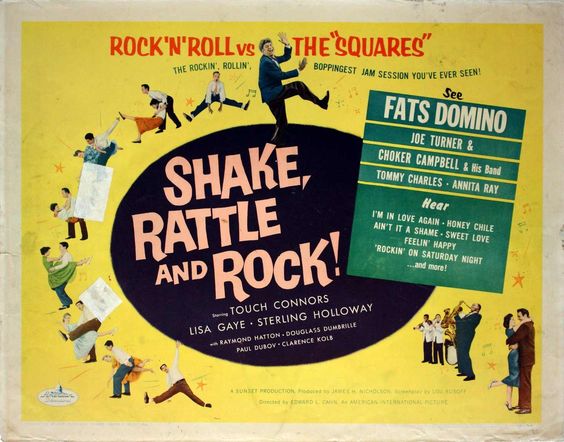
Edward L. Cahn made everything from Our Gang shorts to It! The Terror from Beyond Space and The Four Skulls of Jonathan Drake. He also made this “rock ‘n roll vs. the squares” movie that features Fats Domino and Big Joe Turner.
Playing on a double bill with Runaway Daughters, this was but the start of American-International Pictures reaching out to the teens or more like reaching into their wallets. Most of the films follow the Arkoff Formula:
Action (exciting, entertaining drama)
Revolution (novel or controversial themes and ideas)
Killing (a modicum of violence)
Oratory (notable dialogue and speeches)
Fantasy (acted-out fantasies common to the audience)
Fornication (sex appeal for young adults)
You get a pre-Mannix Mike Connors, Lisa Gaye (who is also in Rock Around the Clock), “fifth Marx Brother” Margaret Dumont and plenty of actors who’d been around Hollywood since before sound was in movies. No matter. The real action here is when the kids defend rock and roll against the old timers in a TV trial.
In 1994, this movie was remade as part of the Rebel Highway series of AIP remakes on Showtime. The new version, directed by Allan Arkush, featured Renee Zellweger in the lead and appearances by Howie Mandel, Max Perlich, the R&B band For Real, Gerrit Graham, John Doe, Riki Rachtman, Nora Dunn, Mary Woronov pretty much playing Ms. Togar from Rock ‘n Roll High School, P.J. Soles playing a square with the last name of Randall (who I sure hope isn’t Riff all grown up) and Dick Miller.
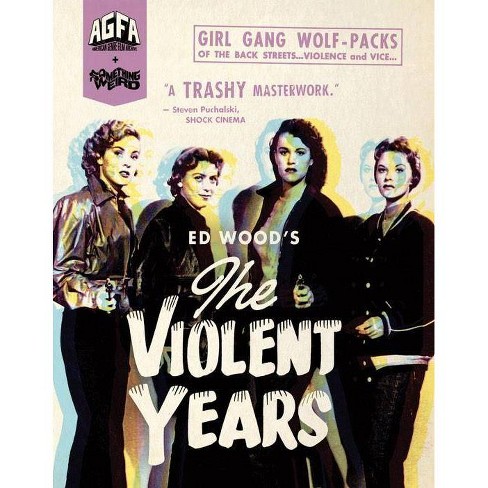
Originally called Teenage Girl Gang or Teenage Killers, this movie is everything I want out of film. If you’ve ever heard the Ministry song “So What,” you’ve heard pretty much the best lines in the movie, most importantly “I shot a cop — SO WHAT!”
This was anonymously written by Ed Wood and was the most financial successful film that he was ever associated with. It was directed by William Morgan, who mainly worked as an editor.
Paula Parkins (Jean Moorhead, Playboy Playmate of the Month for October 1955) might be the rich daughter of a newspaper editor and a socialite, but she gets her kicks by getting her galpals together and dressing like men to rob gas stations and terrorize lover’s lanes. In fact, they go so far as to assault a young man after tying up his girl Shirley. Yes, that was also Ed Wood’s cross-dressing alter ego name, which features prominently in many of his films. And yes, that woman side is being tied up so that the male side can be abused.
These girl gangsters, however, are beyond forward-thinking. You could consider them actual riot-causing girls. In another Wood-written trick, they all have names that can easily be switched from female to male: Paula could be Paul, Geraldine is Gerald, Phyllis or Phil and Georgia can easily change her name to George.
After a makeout party with some male gangsters, the girls decimate a school and even desecrate the flag, totally anarchic behavior for 1956. The cops get called in and two of the girl gang are shot and killed before Paula kills a cop in cold blood.
Finally, after a car chase, Paula crashes through a window, killing the last member of her crew and winding up in the hospital herself, where she dies giving birth to her bastard child. Her parents are denied custody because they’re unfit parents and that child goes into the system, where probably she will turn out just as bad as her mother. So what!
I watched this movie for the first time when I was a teenager and it made me murderously happy and wished that Paula and her gang were real, in my school setting things on fire and ready to slap me around.
God bless you, Ed Wood.
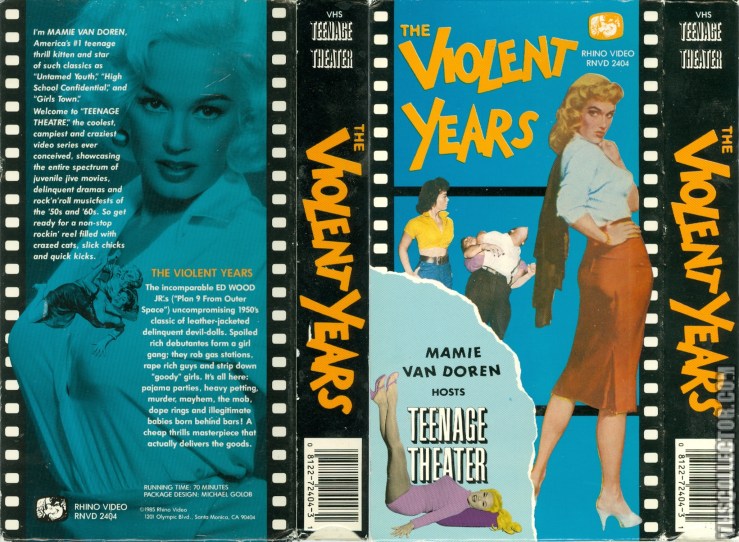
Rhino released this as part of their Mamie Van Doren-hosted Teenage Theater line, along with Teenage Devil Dolls, Naked Youth, Wild Guitar and High School Caesar.
You can watch this on Tubi, The Internet Archive and Amazon Prime. The American Genre Film Archive has also released a bells and whistles packed blu ray complete with a new 4K scan from the original 35mm camera negative and commentary from Frank Henenlotter and Wood biographer Rudolph Grey. Plus, it also has a 2K scan of Anatomy of a Psycho. You can get it at Amazon or Diabolik DVD.
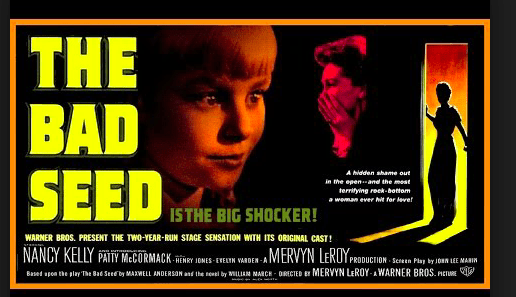
John Waters, in his book Role Models, claimed that he wanted to be Rhoda Penmark, the titular antagonist of The Bad Seed. “I wanted to be Rhoda. I pretended I was her. Why? I wanted to strike fear in the hearts of my playmates.”
There’s really no other movie quite like this one. Sure, we’ve covered plenty of other kids in trouble and kids causing trouble movies over the last two weeks, but this is the ultimate.
Based upon the 1954 play of the same name by Maxwell Anderson — which is based upon William March’s 1954 novel — the entire movie revolves around one person: Rhoda (Patty McCormack). She’s doted on by her parents, but the truth is, she’s quite literally menace incarnate. Who else would be so upset about losing a penmanship contest that she’d be moved to murder?
How did she get that way? Is it because her mother (Nancy Kelly, who won a Tony on Broadway for the play and was nominated for an Oscar) is the daughter of a serial killer who was adopted by a kindly cop? Is it because her father (William Hopper, who was later Paul Drake on Perry Mason and is the son of Hedda Hopper) isn’t around? Is society to blame? Or are some people just plain evil?
In the novel and play, the mother dies and the bad seed survives. The Motion Picture Production Code could never allow crime to pay, so Christine’s life is saved and Rhoda is struck down by the only thing that can really stop her: the hand of God, tossing a bolt of lightning her way. To further keep the censors away, Warner Brothers added an “adults only” warning to the film’s advertising.
This film is packed with great performances. There’s Henry Jones as Leroy Jessup, the caretaker who snarls every line at Rhoda, sure that she’s committed some crime as he sleeps in a bed of excelsior. Or Eileen Heckart as Hortense Daigle, a woman who grief has reduced to a spirit of sheer nothingness. Or Evelyn Varden as Monica Breedlove, an older women who wants to desperately see the good in Rhoda (she’s equally amazing in The NIght of the Hunter). Hey — there’s even Frank Cady here, who would go on to play Sam Drucker in several seventies hicksploitation sitcoms.
I also love the end of this movie, where the entire cast comes out as if they’re still on Broadway and doing their curtain call. After her credit is shown, Nancy Kelly puts Patty McCormack over her knee and gives her a spanking as they both laugh, trying to break the tension because Rhoda is so violently real, more villainous than any cartoon villain you’ll see in every single movie thereafter.
The Bad Seed has led to plenty of remakes and reimaginings. It was remade in 1985 as a TV movie that starred Carrie Welles, Blair Brown, Lynn Redgrave, David Carradine, Richard Kiley and Chad Allen. This version uses the original ending, but isn’t fondly remembered. There was another remake in 2018 that aired on Lifetime. It was directed by Rob Lowe and Patty McCormack even shows up in a cameo.
In 1995, McCormack would star in the first of two Mommy films that are kind of, sort of unofficial sequels. The Lifetime film House of Deadly Secrets, also starring McCormack, is another film that’s a spiritual second to this one. There’s also an off-Broadway musical adaption called Ruthless! and just about every bad kid movie that’s come after 1956 owes this one a debt.
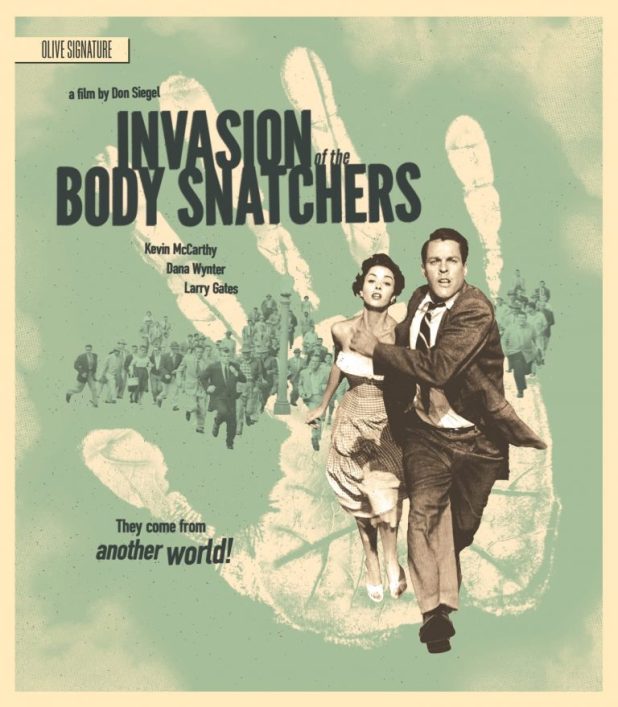
The extraterrestrial invasion of Santa Mira is more than just the event that this film chronicles. No, Invasion of the BodySnatchers has transcended its simple science fiction roots to become a cultural touchstone. We often refer to people acting differently as pod people; those who may have never seen this film or its many sequels intimately know its plot and what it means.
Thanks to this new Olive Films Signature reissue, I’ve had the opportunity to watch this film again and my goal was to evaluate it as if I were watching it when it was first released.
The conceit is simple: Alien plant spores have shown up in a small California town and reproduce exact copies of human beings, taking on the exact physical characteristics, personalities and even memories of those that sleep near them. Within a month, they’ve completely taken over the town and created an untroubled world, a place of no emotion or worry, a place where everyone is one of us.
Near the end of the film, one of the pod people tells our hero, Dr. Miles J. Bennel (Kevin McCarthy) that their way is so much better. “Love, desire, ambition, faith – without them, life’s so simple, believe me.” When he exclaims that he wants no part of this new world, he’s told that he has no choice.
Invasion of the Body Snatchers is bold in its depiction of love in 1956. Both Miles and his former flame Becky (Dana Wynter, Airport) are suffering through divorces and unlike many films of the era, they are not represented as bad people for their actions. Instead, their romance is championed. It may mean nothing to us watching the film 62 years after its release, but the fact that they stay in the same room and have a romance at all was groundbreaking.
Miles and Becky manage to escape the entire town being taken over until a dog is nearly run over. Becky’s emotional outburst alerts the pod people, who blast sirens as our heroic couple races against an army chasing them, up steps, through city streets, across mountains, even with Miles carrying her (there’s a charming moment in the bonus footage on this disk where Wynter says that McCarthy never complained or even got out of breath because he’s a gentleman) in a fruitless attempt to escape. They separate and when they finally find one another, Miles can’t wait to kiss his lover. In horror, he learns that she is now one of them too.
That’s when the most arresting images of this movie appear. Miles runs into the night, a non-stop chase that brings him onto a crowded highway filled with transport trucks loaded with pods bound for the major cities. He screams in vain at passing cars as they narrowly avoid hitting them, his panicked face streaked with sweat and rain and car lights in the deep dark night, bellowing, “They’re here already! You’re next! You’re next!”
This was to be the original ending of the movie, but focus groups — yes they had them back then, too — wanted a happy ending. The promise at the end, where the FBI is alerted and the pods will obviously be stopped, rings hollow. That final image of Miles on the highway in abject panic as the camera pans up and away is just too powerful.
Invasion of the Body Snatchers is filled with talent, with everyone giving their best performance, from the future Morticia Addams, Carolyn Jones, to character actor par excellence King Donovan and even future Wild Bunch director Sam Peckinpah, who has a minor role as a gas meter reader.
Some see a story within a story in this film, a meta-commentary on the dangers facing America such as McCarthyism while others see it as an allegory for the loss of personal rights in the wake of Communism. Several connected with the film state that it had no such aim, but you can graft any story onto any movie if you want.
This was remade in 1978, which is a really great version that goes even deeper (and gorier) into the storyline of this film, as well as Abel Ferrara’s 1993 Body Snatchers and the 2007 film The Invasion. And Santa Mira is, of course, the setting for Halloween 3: Season of the Witch. Obviously, the film is a big influence on John Carpenter, as you can see hints of it in his film They Live.
McCarthy would later reprise his role of Dr. Miles in the 1978 remake, as well as Looney Tunes: Back in Action. He’s also Fred Francis, named for that noted director, in Joe Dante’s The Howling. The interview segments with him on this disk make him seem like quite the likable fellow. Actually, all of the extras are heartwarming, making one feel that they’re sitting around with some movie-loving friends and discussing this together.
Invasion of the Body Snatchers is a film that speaks to audiences with the same confident power that it did in the mid 1950’s. It has lessons within it that should never be lost and I feel that it should be required viewing for all film lovers, even if you dislike science fiction (that said, it’s closer to a horror movie than pure SF).
The new Olive Films Signature release is packed with extras, such as a new high-definition digital restoration of the film, complete with two commentary tracks — one by film historian Richard Harland Smith and the other a roundtable featuring actors Kevin McCarthy and Dana Wynter, and filmmaker Joe Dante. Then there are several documentaries, such as “The Stranger in Your Lover’s Eyes,” a two-part visual essay with actor and son of director Don Siegel, Kristoffer Tabori, reading from his father’s book “A Siegel Film;” “The Fear is Real,” which has Larry Cohen and Joe Dante give their thoughts on the film; “I No Longer Belong: The Rise and Fall of Walter Wanger;” “Sleep No More: Invasion of the Body Snatchers Revisited,” which has comments from fans of the film including John Landis, Mick Garris, and Stuart Gordon; “The Fear and the Fiction: The Body Snatchers Phenomenon,” which delves deep into the production of the film and its many meanings; “Return to Santa Mira,” which explores the shooting locations; “What’s In a Name?” a discussion of the significance of the film’s title; a gallery of rare documents detailing aspects of the film’s production including the never-produced opening narration to have been read by Orson Welles (!); an essay by author and film programmer Kier-La Janisse and the film’s original theatrical trailer.
You can get the new Olive Films Signature release right here. But hurry — it’s limited to only 5,000 copies!
Disclaimer: I was sent this film by Olive Films for review and in no way did that impact this article.


 B&S About Movies
You must be logged in to post a comment.