The inspiration for these annual day long posts of kaiju films come from my childhood and WOR-TV in New York. Every Turkey Day, it would air after King Kong and Son of Kong, making you feel better after the depression of that second movie, until 1985, when RKO General sold Channel 9 to MCA Inc.
I did some reality checking with Wikipedia and learned this: “These WOR-TV Thanksgiving programs started on Thanksgiving Day 1976. On this occasion, Channel 9 broadcast Mighty Joe Young (at 1 p.m.), King Kong vs. Godzilla (at 3 p.m.), and Son of Kong (at 5 p.m.). In the years that followed, WOR broadcast Mighty Joe Young (at 1:00), King Kong (at 3:00), and Son of Kong(at 5:00) in 1977, Mighty Joe Young (at 12:30), King Kong (at 2:30), and Son of Kong (at 4:30) from 1978 to 1980, Mighty Joe Young (at 1:00), King Kong (at 2:45), and Son of Kong (at 4:45) in 1981, King Kong (at 1:00), Son of Kong (at 3:00), and Mighty Joe Young (at 4:15) from 1982 to 1984, and King Kong (at 1:00) and Mighty Joe Young (at 3:00) in 1985.”
The further inspiration for these posts comes from the second part of the day: “The ratings of the 1976 Thanksgiving marathon were good enough for WOR-TV to include the day after Thanksgiving (Friday) into the monster movie line up. Over the next few years the same movies were aired on Thanksgiving Day, but the movies broadcast the day after changed. Several times the movies Godzilla vs The Cosmic Monster, Son of Godzilla, Godzilla vs. the Sea Monsterand Godzilla vs. Megalon were aired on that day.”
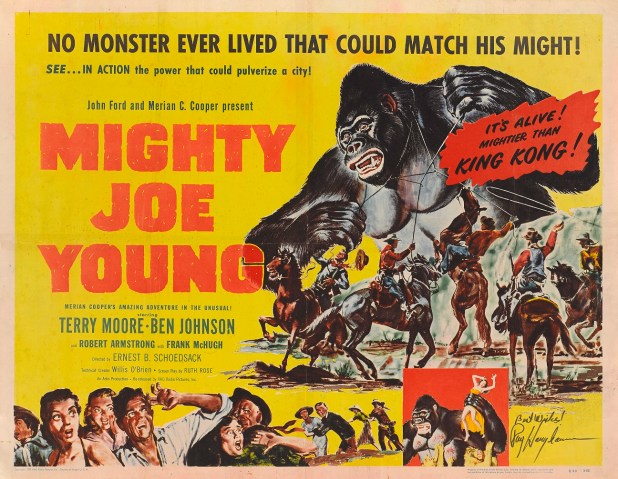
This movie was produced by Arko, a company formed just to make the film, a union of RKO and Argosy Pictures, which was John Ford and Merian C. Cooper. Ernest Schoedsack and Willis O’Brien contributed to the storyline while Schoedsack’s wife, Ruth Rose, wrote the screenplay. It was intended to be a more lighthearted version of King Kong, as it was made by many of the same filmmakers, aided by around ten animators working for fourteen months, along with Ray Harryhausen working on his first movie.
When living in Tanganyika in Africa, seven-year-old Jill Young (Terry Young) adopts a baby gorilla that she names Joe. Ten years later, Max O’Hara (Robert Armstrong) and a cowboy named Gregg (Ben Johnson) find him and want to bring him to America to be a performer, because that always works out so well. Jill needs money to maintain her father’s home, so she agrees. She may also kind of be into Gregg, so that helps.
In Hollywood, Jill plays “Beautiful Dreamer” on the piano while Joe lifts her and outboxes Primo Carnera, who was also a pro wrestler. Joe gets homesick while Jill and Gregg fall in love. Some drunks give him whiskey and then set his hand on fire. He reacts as you’d expect, destroying everything he can. The authorities want to execute Joe, who everyone helps escape, only to find a burning orphanage that Joe and Gregg work together to save. He’s allowed to go home, where they send Max a video of the ranch and the happy — and surviving — Joe.
This had a huge advertising campaign, with 11,000 postcards being mailed by Joe to people — I wish I had one! — and someone dressed as him appearing in several parades. It didn’t help — the movie didn’t perform as well as the films it was inspired by — but it did become part of Flannery O’Connor’s Wise Blood in the character of Gonga the Gorilla and Enoch Emery going to see a movie in which an orangutan rescues children from a burning orphanage.
It did win the first Academy Award for Best Visual Effects and there was almost a sequel, Mighty Joe Young Meets Tarzan. I would have gone crazy over that as a kid. While it doesn’t have the horror at the heart of the first two RKO ape movies, there are some wonderful memories associated with this film.
Roadshow Rarities (June 30 – July 6) In the old days of theatrical releases some of the more lavish movies would be promoted by holding limited screenings in large cities. These roadshow releases would generate hype before the nationwide release and allow producers to tweak the film to the audience’s reaction. This model also worked for low budget productions that may have had no intention of a wide release. These explo roadshows traveled an informal circuit of theaters, churches, revival tents, high school auditoriums and anywhere else they could run a projector. They frequently promised more than they delivered and left town before the angry audience could catch up to them. Through the restoration efforts of SWV many of these movies have survived to piss audiences off to this very day!
According to the Hash, Marihuana & Hemp Museum of Amsterdam and Barcelona, “On September 1, 1948, LA police entered the luxurious home of actress Lila Leeds, investigating an alleged “marijuana party.” Along with her roommate Vicki Evans, actor Robert Mitchum and his friend Robin Ford, the young actress was arrested for marijuana possession. At the time, this was a felony in California. They were released from jail after posting bail of $ 1,000 each, but Lila Leeds’s life had changed forever. After her release, the only acting job she could get in Hollywood was the role of a ‘stoner girl’ in the movie She Shoulda Said No!”
Also known as The Devil’s Weed and Wild Weed, it’s based on her life. It was originally distributed by Eureka Productions who lost money and sold it to Kroger Babb. He originally tried the title The Story of Lila Leeds and Her Exposé of the Marijuana Racket, but that didn’t do well. Babb never gave up and re-released it as She Should Said No. With the tagline, “How Bad Can a Good Girl Get… without losing her virtue or respect???” and telling local governments that this movie was made under the orders of the United States Treasury Department.
The final reel even thanks the government for their help — they gave none — saying that the producers “publicly acknowledge the splendid cooperation of the Nation’s narcotic experts and Government departments, who aided in various ways the success of this production…. If its presentation saves but one young girl or boy from becoming a dope fiend – then its story has been well told.”
Babb also booked Leeds to show up with the film, which I can only assume made the midnight showings a bigger deal.
She plays Anne Lester, who is trying to raise money to put her brother Bob (David Holt) through school. This means that when she meets the drug dealer Markey (Alan Baxter) she easily falls for marijuana and promiscuity. When her brother discovers what his sister is doing, he hangs himself and she goes to jail. Drugs are bad!
Jack Elam is in this, as is Leo Gorcey’s brother David. There’s also Lyle Talbot, who never turned down a role and was one of the first actors to play Superman’s arch enemy Lex Luthor.
Roadshow Rarities (June 30 – July 6) In the old days of theatrical releases some of the more lavish movies would be promoted by holding limited screenings in large cities. These roadshow releases would generate hype before the nationwide release and allow producers to tweak the film to the audience’s reaction. This model also worked for low budget productions that may have had no intention of a wide release. These explo roadshows traveled an informal circuit of theaters, churches, revival tents, high school auditoriums and anywhere else they could run a projector. They frequently promised more than they delivered and left town before the angry audience could catch up to them. Through the restoration efforts of SWV many of these movies have survived to piss audiences off to this very day!
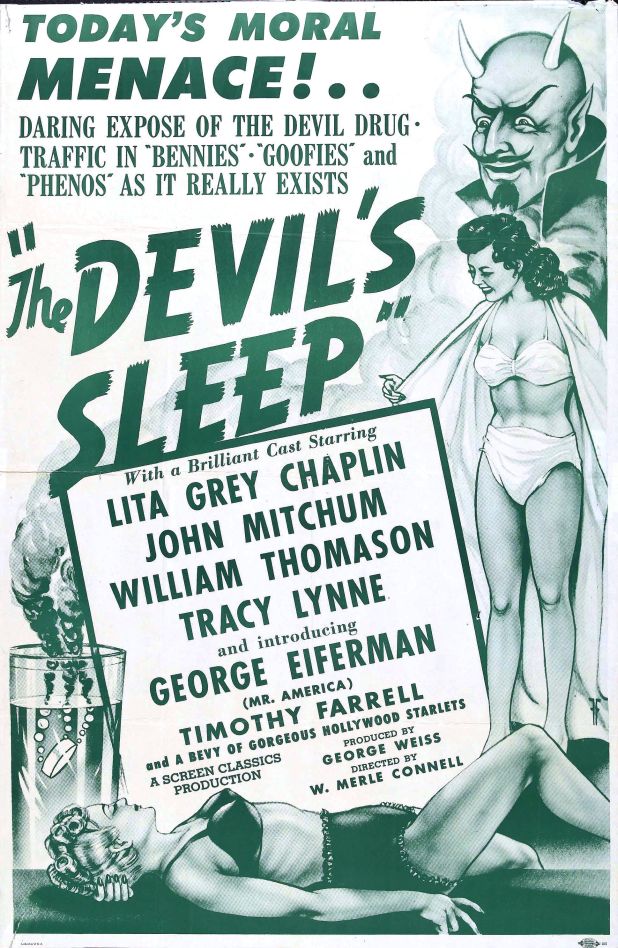
Directed by W. Merle Connell (The Flesh Merchant) and written by Danny Arnold (who created Barney Miller) and Richard S. McMahan, this uses the same cast and crew as Test Tube Babies.
Actor Timothy Farrell made three low-budget exploitation movies in which he played the part of gym owner Umberto Scalli. These films are also all about women wrestlers, such as Racket Girls, Dance Hall Racket and this movie. Scalli may have died at the end of Racket Girls but he came back to life for the other movie.
Scalli is out of prison and has two new scams. One is a health spa where women can get dangerous diet drugs and the other one is to sell amphetamines to teenagers at parties. Judge Rosalind Ballentine (Lita Grey, the second wife of Charlie Chaplin) and Detective Sergeant Dave Kerrigan (William Thomason) try to stop him, but he has photos of the judge’s daughter Margie (Tracy Lynne) nude and drugged out at one of those parties.
“Today’s Moral MENACE ! Daring expose of the devil drug traffic in Bennies, Goofies and Phenos as it really exists.”
Oh it does. This movie was probably really scandalous in 1949 but today, it’s nearly quaint.
Cisco (Duncan Renaldo) and Pancho (Leo Carillo) are at the border of Arizona and Mexico when they see the U.S. Cavalry pursuing some Mexico bandits. As they get to Mexico themselves, they see a bandido fall off his horse, dead. What’s strange is that the Mexican criminal is really an American soldier all dressed up.
That’s because a gang of elites are trying to keep Arizona from becoming a state and they’re using Mexicans and the racism against them to keep it from happening. Things really haven’t changed, I guess.
Directed by Wallace Fox, this was written by Doris Schroeder, who was also an editor and wrote TV show tie-in novels for Disney’s Spin and Marty, Patty Duke, Lassie and the Lennon Sisters.
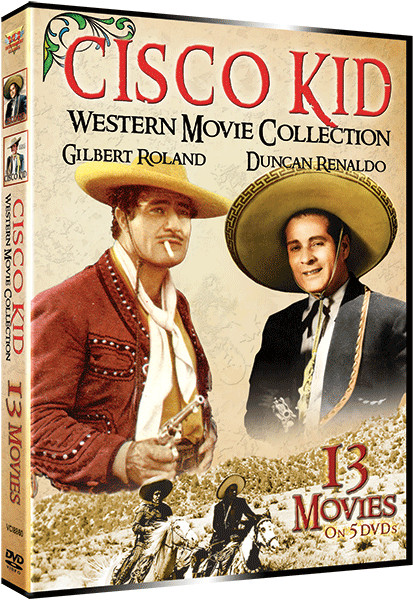
The Cisco Kid Western Movie Collection is available from VCI Entertainment. It has 13 movies and extras like two Cisco Kid TV episodes, interviews with Duncan Renaldo and Colonel Tim McCoy, and photo and poster galleries. You can get it from MVD.
Directed by Wallace Fox and written by Betty Burbridge, this has Cisco (Duncan Renaldo) learn that Pappy Del Rio (David Leonard) is about to be hung for a crime he didn’t do. The Padre (Pedro de Cordoba) thinks he’s innocent as well, as so Cisco and Pancho (Leo Carrillo) break him out. Later, when Cisco talks to Mayor Brady (Stephen Chase), he realizes that he’s really a criminal. There’s also the son of Del Rio, Bobby (Mickey Little), who needs to be saved.
The heroes are against nearly every elite in town. More than just the mayor, it looks like bank president Ed Hodges (Charles Halton) and Marshall Scott (Edmund Cobb) are also in on the crime. Luckily, they’re up against Cisco and Pancho.
The Cisco Kid Western Movie Collection is available from VCI Entertainment. It has 13 movies and extras like two Cisco Kid TV episodes, interviews with Duncan Renaldo and Colonel Tim McCoy, and photo and poster galleries. You can get it from MVD.
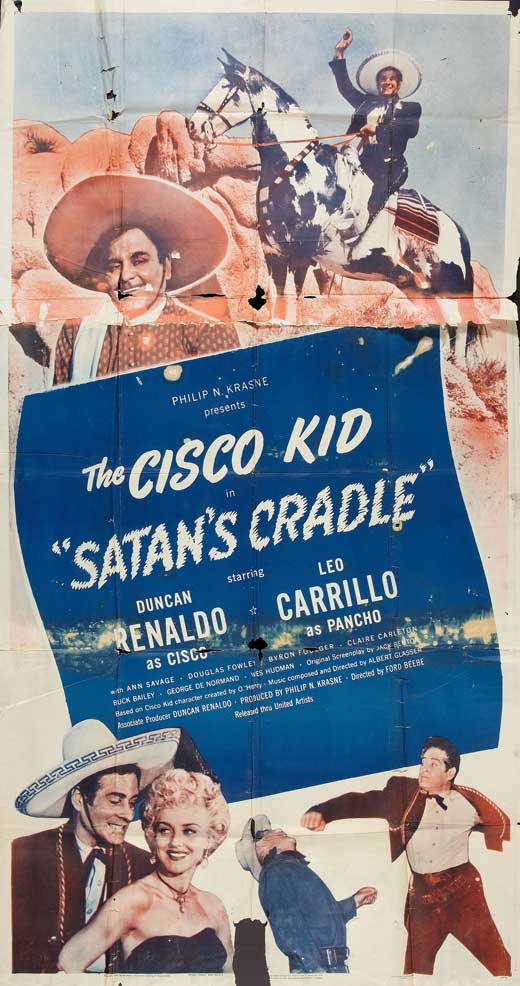
The Cisco Kid (Duncan Renaldo) and Pancho (Lee Carrillo) have to stop Steve Gentry (Douglas Fowley) who has killed Jim Mason (Frank Matts), the well-respected leader of a small town. He takes over all of his businesses and is uses an actress named Lil (Ann Savage, Detour) who pretends to be the man’s widow. How bad are these bad men? They beat up Preacher Henry Lane (Byron Foulger).
Directed by Ford Beebe and written by J. Benton Cheney, this is an hour of your life that will enjoyable go by as you think about how awesome Ann Savage was in Detour and how fun Cisco and Pancho are at playing with their dialogue.
The Cisco Kid Western Movie Collection is available from VCI Entertainment. It has 13 movies and extras like two Cisco Kid TV episodes, interviews with Duncan Renaldo and Colonel Tim McCoy, and photo and poster galleries. You can get it from MVD.
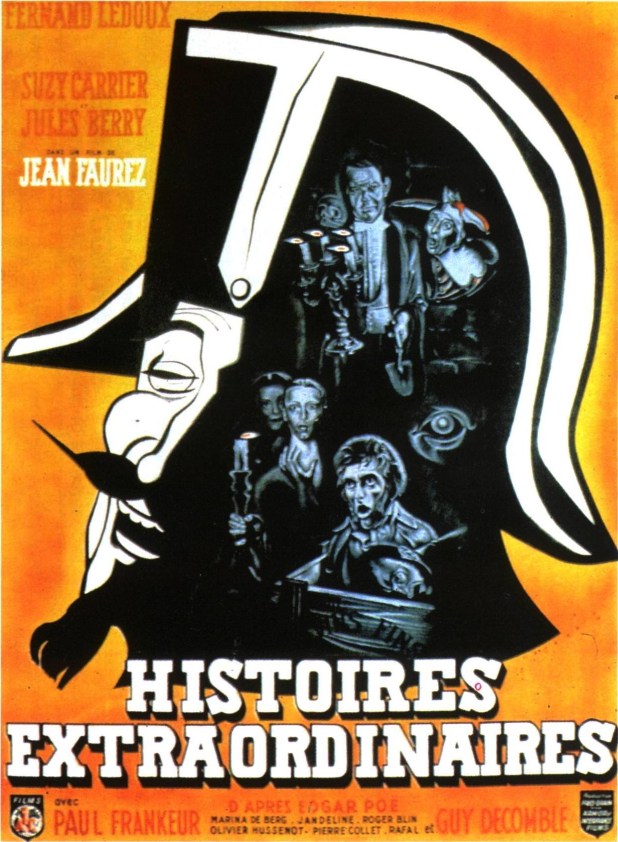
A group of policemen is tracking down the criminals behind three murder cases. There’s a cutthroat killing young women, a madman that hid his deformed landlord’s corpse in the floor and a wine aficionado who has buried his friend alive.
If you read that and said, “Two of those stories sound like “The Tell-Tale Heart” and “The Cask of Amontillado,” you’re right. One of the other stories is based on “Murder Considered as One of the FIne Arts” by Thomas De Quincey, whose book Suspiria de Profundi inspired, well, you can guess from the title, right? He also wrote Confessions of an English Opium Eater. The other story comes from Baudelaire.
I like that this film doesn’t try to just be horror, but instead is a police film with the captain trying to frighten the new recruits with a series of stories.
I’ve watched more than a few Poe movies lately. This isn’t the best, nor is it the worst. Luckily, if you get Severin’s Tales of the Uncanny blu ray you can watch it and enjoy it along with a fun documentary and a few others movies.
Bruce Eder, in the liner notes of the 1989 The Criterion Collection reissue of A Hard Day’s Night, reminds us that, in a 1964 review of that classic Beatles’ film, critic Andrew Sarris described it as “the Citizen Kane of jukebox musicals.”
Since then, the term “jukebox musical” has, in my opinion, gone a wee-bit off the critical rails. I don’t see music-oriented biographies, such as the recent (each a barely one-watch-and-done abysmal) Bohemian Rhapsody (2018) and Rocketman (2019), and the Aretha Franklin bio, Respect (2021), as part of the genre. My opinion carries over to, speaking of the Beatles, Across the Universe (2007) and Yesterday (2019) centered on their catalog. Is the Beatles’ Yellow Submarine (1968) a jukebox musical, as well? Is Harry Nilsson’s Son of Dracula (1974) a jukebox musical or a visualized rock opera, like the Who’s Tommy (1975), which no one considers a jukebox musical?
For me: when you say “jukebox musical,” I reminisce having to watch a singing-and-dancing James Cagney in Yankee Doodle Dandy (1942) while babysat by my Aunt Martha. For me, a jukebox musical means my enjoying Billy Haley and the Comets and the Platters in Rock Around the Clock (1956), the first rock n’ roll musical — of which famed DJ Alan Freed made five*. Then, there’s one of Kentucky Jubilee‘s offspring with the low-budget, major studio cash-in by MGM to jump on the folk music bandwagon with Hootenanny Hoot (1963). And who can forget — oh, how we try — when accordionist Dick Contino graced our screens as a hipster, Elvis-styled leading man in the likes of Daddy-O (1958) and Girls Town (1959) alongside Paul Anka and the Platters. And there’s no way to forget “The King of Swing,” jazz trumpeter Louie Prima (?!), jumpin’ on the jukebox bandwagon with Twist All Night (1961).
Sure, there was a little bit o’ plot n’ action in the frames (e.g., mobsters muscling-in on the club; Louie Prima throws a punch between trumpet blows), but the celluloid raison d’être was to market music (yes, even the outdated Louis Prima). Back in the day, not everyone owned a television set. Not as many people saw Elvis and the Beatles for the first time on television as you think: their first visual experience of both was in a movie theater. Today, going to a concert — now major industry unto itself — is a common place event in our lives, but not back in the day. In fact, to hear my dad tell it: he went to one concert in his entire life: the tragic Buddy Holly tour in 1959 at the Syria Mosque in Squirrel Hill, east of Pittsburgh.
So, the best way for record labels and promoters to expose their artists to the masses: take the acts to the people — by way of a movie. And in most cases, the movie wasn’t so much a “movie” with a plot, but a loosely connected series of pre-recorded “pop clips” of bands inserted into the film (e.g., kids would be sitting in a living room, they’d turn on a television; the Platters would play their latest hit). Unlike a Beatles or Elvis flick, the songs were not original to the film itself, just the latest tune from an artist’s catalog.
Kentucky Jubilee
Let’s bust-out that barn with a “real” jukebox musical!
Such a film is this entry from our ever-expanding, beloved Ron Ormond catalog (Mesa of Lost Women, Girl from Tobacco Row, The Second Coming), himself a filmmaker loosely connected to the Earl “Snake” Richards-starring jukebox rock-musical, That Tennessee Beat (1966), by way of producer Robert L. Lippert.
Remember us calling out the cinematically-challenged Dick Contino and Louis Prima? Well, not only were unfashionable accordion and trumpet players squeezing out their last moments of relevancy via films: even bug-eyed, mustachioed Ritz Brothers knockoffs like the Vaudvillian-bred Jerry Collona (a Bob Hope associate; appeared in 1940’s Road to Singapore) just gotta try. He stars, here, as a music festival emcee involved in — like just about every jukebox musical before or after — a crime caper. Which is even more ludicrous than Louis Prima “getting the drop” — in full comic effect — on the bad guys.
While this was shot-in-Florida with a gaggle of that state’s regional talents, this all takes place in Hickory, Kentucky. (Why not title the film Hickory Dickory Rock? Well, when one of the acts is a one-man band playing oil funnels and a banjo, it’s not rockin’.) And — like just every jukebox musical before or after — a big time, Hollywood director comes to town to find musical acts to make ern’ of dem dere movin’ picktures. This time, instead of having a corner on the jukebox racket, our mobster (Russell Hicks, a Phil Silvers associate; also in the 1950 jukeboxer, Square Dance Kathy) has control of the town’s lone club and its annual jubilee — and he can’t have any big city outsider musclin’ in on the territory.
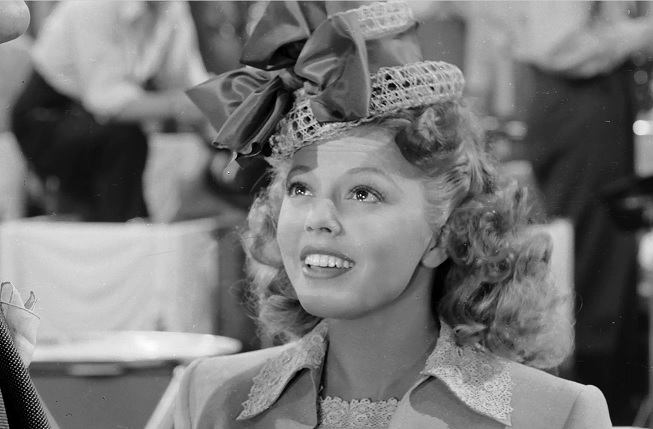
Of course, the director (the equally-hammy Fritz Feld, later of The Phynx and Hello, Dolly!, also Professor Greenleaf in TV’s Batman) and Jerry Colonna, are kidnapped. Why not have the cute blonde, Jean Porter (who made it to the MGM lot by way of winning a Texas talent show), be a damsel-in-distress to spice it all up? Doh!
Making pillbox hats, sexy : GULP! MGM contract player, Jean Porter.
So, a cub-reporter (Jimmie Ellison) sent to cover the shindig, and the members of the fifteen we-never-heard-of-before-or-heard-from-again acts (also finding time to curse us with 25 songs, along with corn-bred comics, contortionists, a whip-act, and vaudeville bits) join forces to save the day. If you know your Ron Ormond westerns, you’ll notice Jimmie “Shamrock” Ellison and Raymond Hatton starred in six Robert L. Lippert westerns directed by Ron Ormond. So, yeah . . . bad jokes, not-so-wise cracks, Colonna sportin’ a turbin and reading a crystal ball, and puddy-faced camera mugging that would give Joe Piscapo pause, ensues.
Hey, scoff if you will, but movies like Kentucky Jubilee were more convenient and cheaper than going to an actually hootenanny or jubilee. And Ron Ormond incorporated all of his well-honed western skills to string together one of the better-plotted jukebox musicals.
Yes, this once, long-lost Ron Ormond film has been digitized (a stellar restore that keeps you watching) for your enjoyment at the Internet Archive.
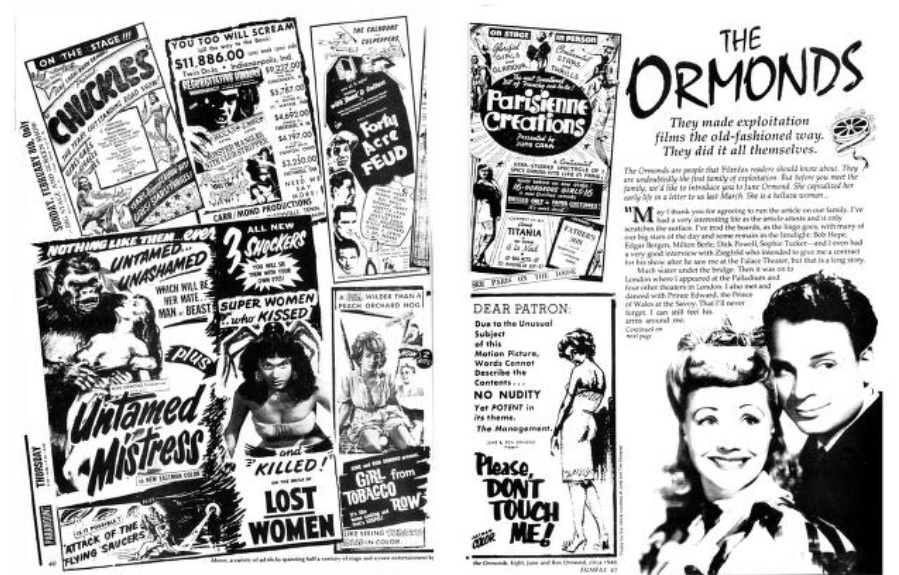
Learn more about the Ormonds in the pages of Filmfax, Issue 27 (1991), preserved on The Internet Archive. (The extensive article begins on Page 40.)
Square Dance Jubilee
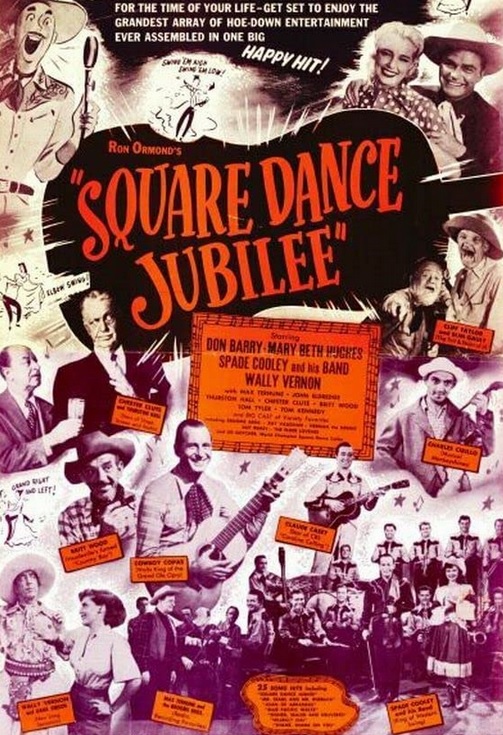
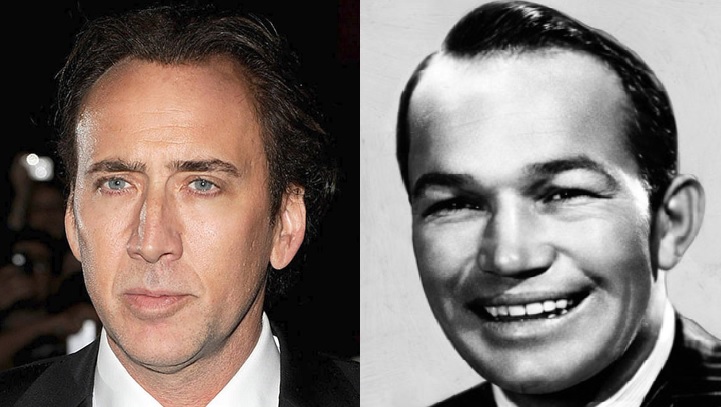
Prior to Ron Ormond writing and directing Kentucky Jubilee — of the seven films he directed that year — he earned his “jukebox musical” stripes writing and producing this “musical western” starring 250-plus credits strong, gruff n’ tough-as-nails western/cop actor Don “Red” Barry (’60s TV’s The Virginian and Surfside 6) and redhead-to-platinum blonde, 20th Century Fox/Universal/MGM B-Movie contract player Mary Beth Hughes. On the musical front, we have the-then-hip fiddler Spade Cooley and his western-swing band. (Laugh, but there’s some serious, Hendrix-styled theatrics with fiddles and upright basses goin’ on up in this ‘ere jubilee.)
As with the later Kentucky Jubilee, the story is the same: In the earliest days of some new-fangled contraption called tele-ee-vish-un**, two talent scouts for a New York-based country music TV show called “Square Dance Jubilee” (hosted by Spade Cooley), are sent out West to find authentic western singing acts for the show. In addition to finding acts, they find themselves mixed in up in cattle rustling and a murder mystery.
If you’re familiar with, and didn’t mind, Rock Around the Clock being retooled as Twist Around the Clock and Don’t Knock the Rock returning as Don’t Knock the Twist, then you have fun as Don “Red” Barry plays the straight man to another, fading vaudevillian in the form of a camera-mugging Wally Vernon (in the Jerry Colonna role) taking care of the crime drama. The Cowboy Copas and Claude Casey handle the tunes. Of course, variety acts also show up, this time with ventriloquist Max Terhune. In a twist: Red Barry croons a tune, “Girl in the Mink Blue Jeans,” and Wally Vernon’s goofy-rubbery soft-shoe must be seen to be believed.
So, what’s not to likey, here? We’ve got Ron Ormond scripting, Robert L. Lippert producing, and a western-driven crime drama threaded by the way of music, vaudeville bits, and comic relief.
Meanwhile, behind the scenes . . . Spade Cooley had a contentious marriage with Ella May Evans, a singer in his band; she’d go on to have an affair with . . . TV and film cowboy Roy Rogers . . . and Cooley was eventually convicted of murdering Ella May. His biggest hits during his ’40s heyday were the #1 “Shame on You,” the #2 “Detour,” and the groundbreaking-influence on popularizing the use of the steel pedal guitar, “Steel Guitar Rag.”
Since Amazon shelved Nicolas Cage’s “Tiger King” project, I wonder if the Cage would be up for doing a Spade Cooley biography flick?
Meanwhile, behind the scenes . . . the twice divorced Don “Red” Barry had an affair with Susan Hayward in the mid-’50s . . . who got in cat fight with another woman visiting his apartment. In July 1980, Barry shot himself in the head, shortly after a domestic dispute with his estranged, third wife, Barbara.
Yeah, sometimes reality, aka truth, is stranger than fiction. And the reality of Don “Red” Barry and Spade Cooley are sad, graphic tales.
Anyway, you can enjoy a very nice, restored rip of Square Dance Jubilee on You Tube.
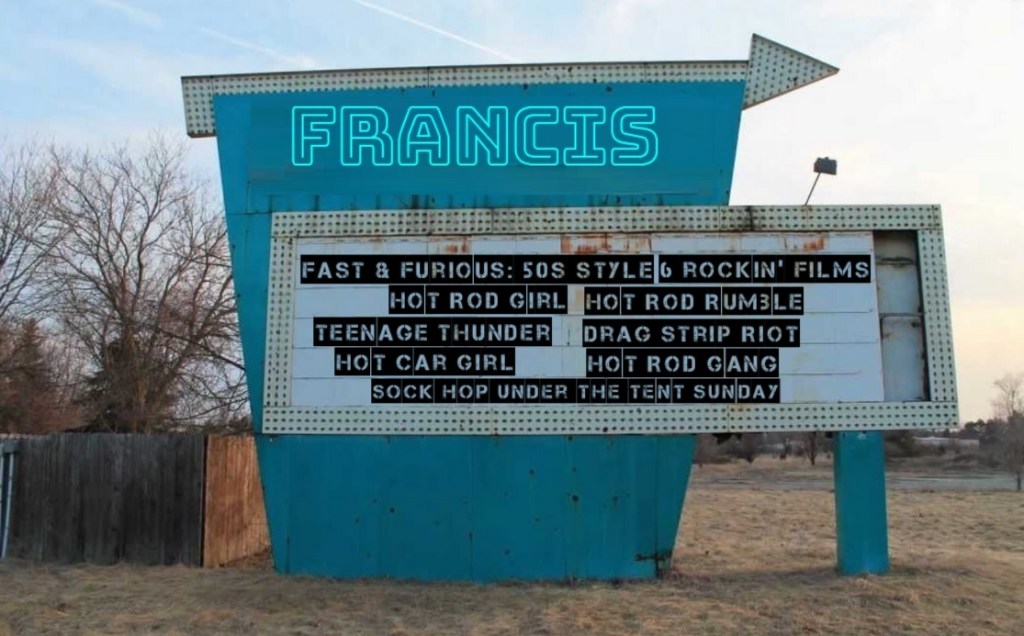
Me and Jean Porter at the sock hop under the tent under the stars . . . heaven. Uh, Mary Beth, er, what are you doin’ here?
“There is no good or evil in science, but it can be used for good or evil purposes.”
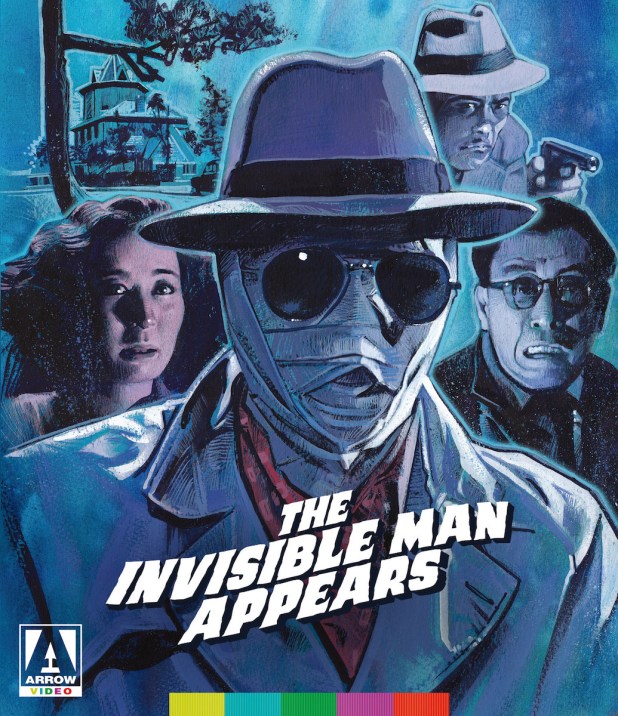
Five years before he did the effects for Godzilla, Eiji Tsuburaya worked on this film, one of the earliest science fiction movies to be made in Japan. Much in the same way that Toho continued the Hammer look in movies like Lake of Dracula, this movie continues the look and feel of the Universal Invisible Man films.
Shunji Kurokawa and Kyosuke Sugi were both working under Professor Kenzo Nakazato to figure out a way to make objects invisible. The two became rivals and the professor said that he would reward whoever came up with the solution; the guys think that it may be for the right to marry their mentor’s daughter Machiko.
Nakazato, however, has had an invisibility serum for a decade, but couldn’t find anyone willing to test it. As if that wasn’t a big enough plot twist, diamond thief Ichiro Kawabe has kidnapped the professor and will only release him if someone steals the Amour Teams, a diamond necklace, for him. Kurokawa comes to his senpai’s aid and ingests the formula, which soon makes him mad with anger. Things get much worse when he catches his rival proposing to the woman they both love.
The madness that overtakes the Invisible Man — who hides in bandages just like Claude Rains (and later Vincent Price) — he continually tries to steal the necklace and even strangles Machiko when she gives them to him, yelling that if she can’t be his, he would rather she be dead. He soon learns that there is no cure for his invisibility and the ensuing mania, which ends with him battling the police in a battle that he cannot win.
I didn’t even know these movies existed until Arrow announced them as their March 2021 releases. Now that I have them, I’m beyond excited by them. Both of the Japanese Invisible Man films feature new transfers and English subtitles and look great for the roughness of the original materials that were available.
This is a piece of film history that you can own now. It’s definitely recommended.
You can get this with The Invisible Man vs. the Human Fly on a new double blu ray from Arrow Video.
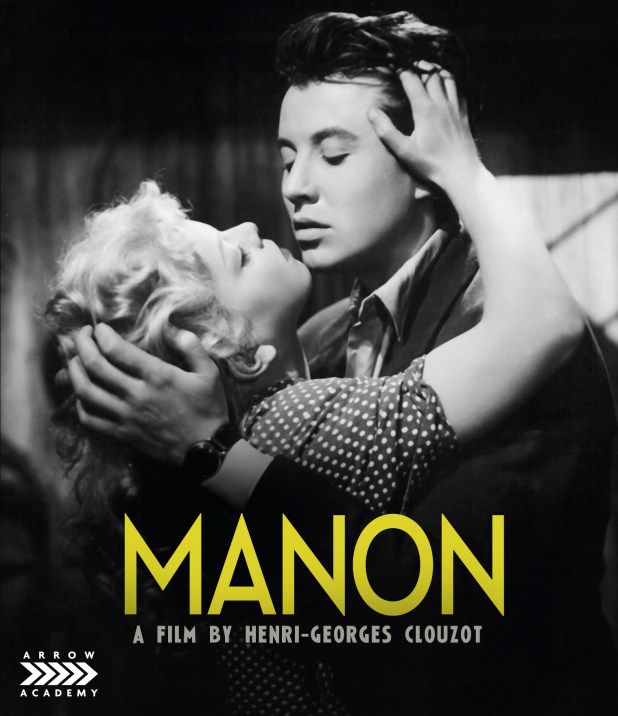
Based on Prévost’s 1731 novel Manon Lescaut, Manon was directed by Henri-Georges Clouzot, who is better known for the thrillers The Wages of Fear and Les Diaboliques.
He moves this tragic romance to the end of World War II, as young Manon (Cécile Aubry, The Black Rose) is accused of working with the Nazis. A former French freedom fighter named Robert Dégrieux (Michel Auclair, The Day of the Jackal) rescues her, but when they get to Paris, they must deal with all manner of sin to just survive. In fact, they’re pretty much doomed.
Manon is a striking indictment of post-World War II France. Where there was once the promise of heaven on Earth, now there’s only profiteering and prostitution. Before the end of the film, Robert leaves that Manon isn’t the angel that he wants her to be. And her amoral and duplicituous ways are about to lead him down the path that all good intentions lead to.
Aubry’s first major film role, she’d only make six more films before marrying a Marrakech prince named Si Brahim El Glaou and becoming a writer. Today, she may be best known for French TV series Belle etSébastien, which also lent its name to the band. Her son Mehdi El Glaoui would play the lead male role on that show.
This is probably the only movie on this site that can claim that it won a Golden Lion in Venice. While this isn’t one of Clouzot’s best-known works, that hasn’t stopped Arrow Video from releasing a version that has all their trademark extras.
Beyond the high def 1080p blu ray presentation, there are also interviews with Clouzot discussing the relationship between literature and the screen, as well as a video appreciation of the film by critic Geoff Andrew.
You can order Manon from Arrow Films, who were nice enough to send us a review copy.





 B&S About Movies
You must be logged in to post a comment.