2025 Scarecrow Psychotronic Challenge Day 11: Mad Max (1979)

11. DYSTOPIAN FUTURE: Polite society just ain’t what it used to be.

George Miller was a medical doctor in Sydney before he made this, his first directing work. He’d worked in an ER and saw so many vehicular accidents and even lost three friends to car crashes as a teenager. So why not take the telekinetic violence of autos and people colliding and make a movie?

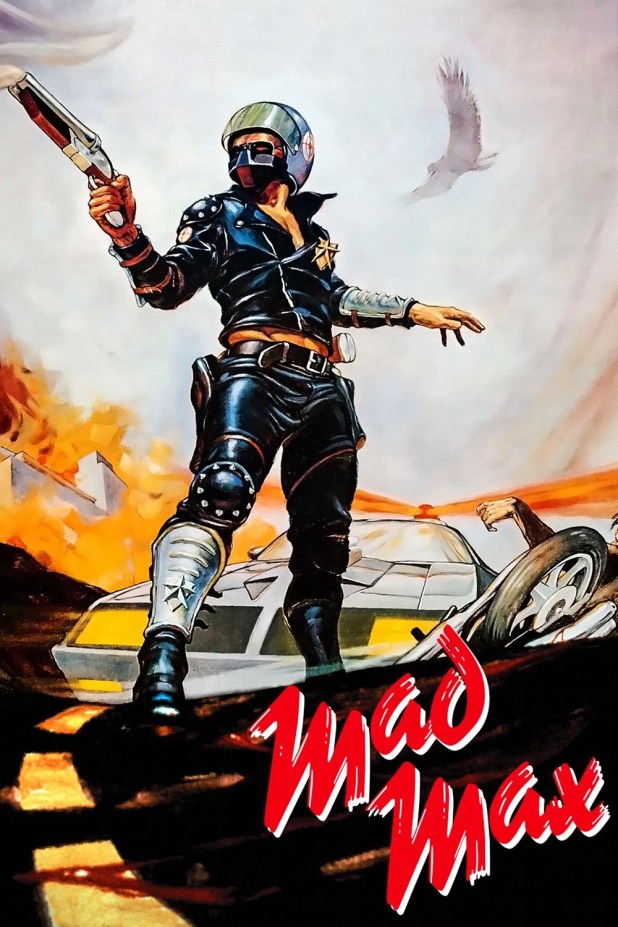
The Main Force Patrol (MFP) is barely keeping order in Australia as the world slides into the end times. Max Rockatansky (Mel Gibson) is exhausted and sick of being on the force, but they bribe him with a new cruiser, a V8-powered monster of a muscle car. After Max kills Nightrider (Vincent Gil) and his girlfriend, the entire gang — Toecutter (Hugh Keays-Byrne), Johnny (Tim Burns) and Bubba Zanetti (Geoff Parry) — run wild, killing almost everyone in their path. The cops try to do their jobs, but the legal system is too lenient on criminals, and soon, they’re back on the streets all over again.

This isn’t a post-apocalyptic film so much as a revenge film. The gang kills Max’s partner, Goose (Steve Bisley), his wife (Joanne Samuel) and their child. He tries to get away, but we know that he can’t keep the thoughts of killing every single one of them out of his mind.

One of the last movies released by American International Pictures, this was redubbed for the U.S. It didn’t do well. In fact, The Road Warrior, the follow-up, is the movie that many point to as having started the trend of end-of-the-world films. That shouldn’t take away from just how good this is.

James Wan and Leigh Whannell credit the film’s final scene — Max handcuffs Johnny’s ankle to an overturned car and gives him a hacksaw to cut off either the handcuffs or his own foot, then blows him up — as the inspiration for Saw.

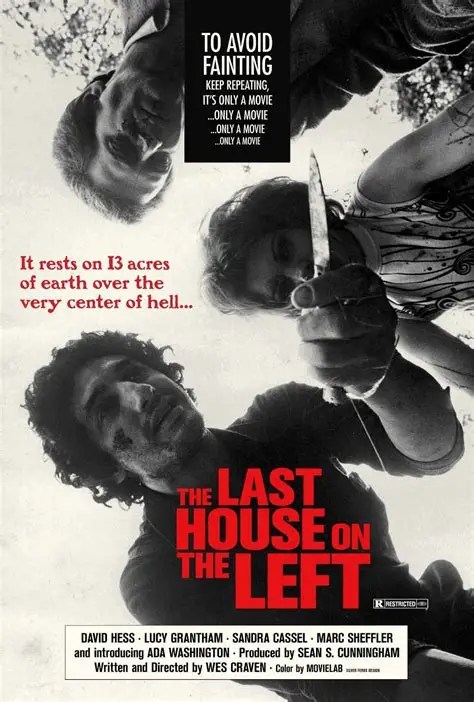
UNSUNG HORRORS HORROR GIVES BACK 2025: The Last House On the Left (1972)

Each October, the Unsung Horrors podcast does a month of themed movies. This year, they will once again be setting up a fundraiser to benefit Best Friends, which works to save the lives of cats and dogs across America, giving pets second chances and happy homes.

Today’s theme: 1970s

Sure, my pick for today’s 1970s theme isn’t groundbreaking. But it’s a blind spot.

Sure, I’ve seen every movie that stole its poster design from this film. I’m wearing a The House That Vanished shirt as I write this. I love that Bay of Blood is also called Last House on the Left – Part IILast House – Part II and New House on the Left.

I’ve seen the movies inspired by it: Last Stop on the Night Train, House On the Edge of the ParkLast House On Dead End Street, The House by the Lake, Hitch-HikeThe Last House On the BeachMadness…I have seen all of them.

I even watched the remake!

There’s no explanation why I have this huge blind spot. So let’s fix that.

Maybe it’s because I am ambivalent, at best, about Wes Craven. But I’ve tried to separate those feelings and experience this as a new movie. And you know what? I get it.

Even the parts people hate, like the wacky music and the goofy cops. It’s ramshackle and kind of all over the place, but it just plain works. When it gets into its meanness —which was unexpected at the time, but now he’s in it today, making you just wait for it— it goes for it in a way that few movies do.

Sean Cunningham made his directorial debut with The Art of Marriage, which came to the attention of Hallmark Releasing. His next film, Together, was an improved take on his first. Wes Craven worked on the film, and he and Cunningham had the opportunity to discuss making movies. They were given a bigger budget to make this, and it was intended to be a hardcore roughie of sorts. Before filming, it was decided to abandon that idea and just make a movie that could play in regular theaters.

We think of elevated horror as a new thing, but Craven wanted to base this on the Swedish ballad “Töres döttrar i Wänge,” which inspired Ingmar Bergman’s The Virgin Spring. This sounds good for the press, you know?

Other than Eleanor Shaw and Sandra Peabody, no one was a professional actor. Well, Fred Lincoln did adult. But maybe that also worked in this film’s favor. Peabody said, “I was upset because I’m an emotional person, and I reacted to what was going on as if it were real. I had a tough time with some of the scenes because I had come out of American Playhouse, where it was all about preparation, and everything had to be real. I ended up doing a horrible job in the film. I was distraught, and I felt like I should have channeled that, but I couldn’t… I was a young actress, and I was still learning to balance any emotions I had from outside of the film into my scene work.” Like a real-life Effects, Peabody was convinced that David Hess was an actual maniac.

As for Hess, he was a musician who also wrote most of the music for this movie with Stephen Chapin. Yes, the man who is Krug — named for a bully of Craven’s, just like Freddy Krueger — wrote music, including “All Shook Up” for Elvis, “Your Hand, Your Heart, Your Love” for Andy Williams and “Speedy Gonzales” for Pat Boone. And then you see him in this, and he’s an absolute lunatic.

Mari Collingwood (Sandra Peabody, who went from movies like this and Massage Parlor Murders! to producing children’s television) and Phyllis Stone (Lucy Grantham) go to a concert and try to score; Junior (Marc Sheffler) brings them back to meet his father Krug (Hess), Sadie (Jeramie Rain, who claimed that she was once picked up by Manson and Tex Watson) and Fred “Weasel” Podowski (Lincoln). While Mari’s parents set up a surprise party, Krug and his family annihilate them, first forcing Phyliss to urinate all over herself (supposedly objectivel) and make love to one another before stabbing them, ending with Krug carving his name into Mari’s chest, raping her and shooting her as she staggers into a lake.

They make the biggest mistake ever by heading to Mari’s parents’ house, where the parents soon realize who they are. The suburban married couple can be just as vicious as Krug, as mom (Eleanor Shaw) bites off Weasel’s cock, Krug gets chainsawed, Junior kills himself, and Sadie is killed in the pool, just as the police arrive.

Newspaper ads screamed, “You will hate the people who perpetrate these outrages—and you should! But if a movie—and it is only a movie—can arouse you to such extreme emotion, then the film director has succeeded … The movie makes a plea for an end to all the senseless violence and inhuman cruelty that has become so much a part of the times in which we live.” It became a video nasty ten years after it was made; there were cuts made by the filmmakers that would have made things much worse, such as more of the forced lesbian sex, Sadie raping Mari, and Mari living long enough for her parents to find her.

Siskell said “My objection to The Last House on the Left is not an objection to the graphic representations of violence per se, but to the fact that the movie celebrates violent acts, particularly adult male abuse of young women … I felt a professional obligation to stick around to see if there was any socially redeeming value in the remainder of the movie and found none.” Ebert, on the other hand, said that it was “about four times as good as you’d expect.”

Watching it for the first time, I was struck by how brutal this film is from the first few moments, as even a kind mailman comments on Mari’s sexuality when we expect that he’s just a nice old man. Everything from then on is a trap; we know that Mari and Phyliss are trapped in a death march, endlessly repeating their demise as this is watched repeatedly. Other than Junior, Krug and his family see them as just something to do, something to throw away, something to destroy. There’s no pressure release like most slashers — well, the cops — but instead, a reminder that to everyone but the parents, these two girls are just as meaningless as they are to the killers.

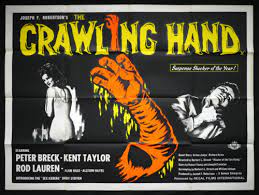
CHILLER THEATER MONTH: The Crawling Hand (1963)

EDITOR’S NOTE: The Crawling Hand was on Chiller Theater on Saturday, December 16, 1967 at 1:00 a.m., Saturday, May 30, 1970 at 1:00 a.m. and Saturday, April 17, 1971 at 11:30 p.m.

If an astronaut crash-lands and says things like, “My hand… makes me do things…. kill…. kill!” At this point, you may say that perhaps this is not a lack of oxygen in the astronaut’s helmet, but rather that he may have a medical issue.

There’s also a medical student named Paul (Rod Lauren was a singer who released the song “If I Had a Girl” before acting; he moved to the Philippines, where he married actress Nida Blanca. He became the lead suspect in her death when she was stabbed in a parking garage, then fought extradition back to the country for years before jumping off a hotel room balcony; sorry to bring everyone down with who Paul really was, who finds the astronaut’s hand and well, keeps it. Because that’s what doctors do: keep desiccated hands that they see from space crashes.

Paul begins to use the power of his hand to attack people he dislikes, becoming increasingly obsessed with it. The police — led by The Skipper Alan Hale Jr. — try to catch him, and the space agency starts to realize that the fingerprints of the dead astronaut are all over the place. So Paul takes the hand to the beach and tries to destroy it, and some cats try to eat it, because that’s the kind of movie The Crawling Hand is.

Somehow, writer Rick Moody used this film as inspiration for his novel Four Fingers of Death, the tale of writer Montese Crandall, who attempts to get over the death of his wife by throwing himself into his work and writing a remake of The Crawling Hand.

Director Herbert L. Strock also made Gog and The Devil’s Messenger, and one of the co-writers was Joe Cranston, the father of Bryan. None of them noticed that at times, the crawling hand is a left hand a right hand at other times.

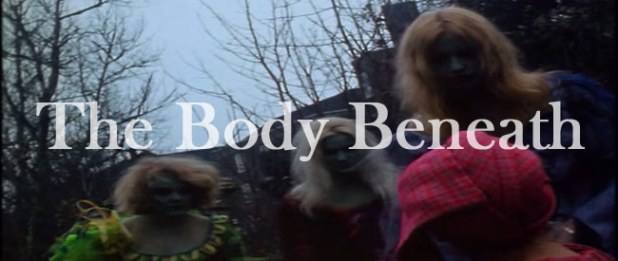
UNSUNG HORRORS HORROR GIVES BACK 2025: The Body Beneath (1970)

Each October, the Unsung Horrors podcast does a month of themed movies. This year, they will once again be setting up a fundraiser to benefit Best Friends, which works to save the lives of cats and dogs across America, giving pets second chances and happy homes.

ABOUT THE AUTHOR: Adam Hursey is a pharmacist specializing in health informatics by day, but his true passion is cinema. His current favorite films are Back to the FutureStop Making Sense, and In the Mood for Love. He has written articles for Film East and The Physical Media Advocate, primarily examining older films through the lens of contemporary perspectives. He is usually found on Letterboxd, where he mainly writes about horror and exploitation films. You can follow him on Letterboxd or Instagram at ashursey.

Today’s theme: 1970s

Diving back into the Andy Milligan box set from Severin Films with The Body Beneath, another one of Milligan’s horror films made during his London period. If you’ve ever watched an Andy Milligan film, you know that your mileage may vary.

Too much inbreeding has caused a degradation in the bloodline of a family of vampires. Led by the Reverend Alexander Ford (Gavin Reed), the brood sets out to gather some fresh blood, namely, relative Susan Ford (Jackie Skarvellis), who has recently disclosed to her boyfriend Paul (Richmond Ross) that she is expecting. After the Reverend takes over Carfax Abbey (obviously an allusion to Count Dracula’s London estate—you could never accuse Milligan of subtlety), he begins a reign of terror, kidnapping Susan for her offspring and others for their blood supply while punishing his hunchbacked servant (there always has to be a character with a hunchback in a Milligan movie). Can Paul rescue Susan before it is too late? 

No one could accuse Milligan about properly pacing a movie either. Fortunately for me, I’m never in any rush to get through one of his films. I never really expected to embrace his films like I have, but there is just something about the bad acting, low production values, and magnificent costumes that keeps me coming back for more. I’m not sure what I will do when I run out of new films to watch in this box set. I mean, I guess I’ll just start over. And I’m perfectly okay with that option. Although Severin did discover a couple of previously lost Milligan films recently. So that release will be something to look forward to. Hopefully soon.

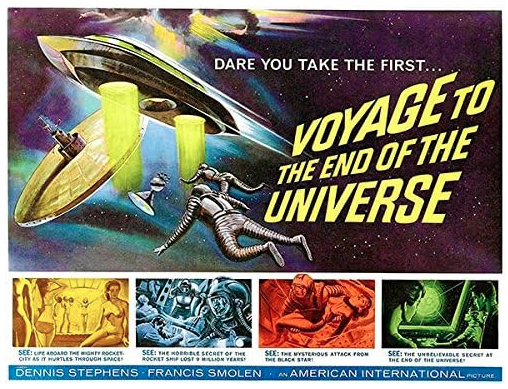
CHILLER THEATER MONTH: Voyage to the End of the Universe (1963)

EDITOR’S NOTE: Voyage to the End of the Universe was on Chiller Theater on Saturday, November 25, 1967 at 11:20 p.m. and Saturday, August 1, 1970 at 11:30 p.m.

What were American audiences thinking when they got this Czechoslovakian movie dubbed into English, once Ikarie XB-1 and now Voyage to the End of the Universe?

I hoped they loved it.

2163: The 40-person multinational crew of the starship Ikarie XB-1 has spent 28 months at light speed — 15 years of human time — to get to the Green Planet, a mysterious body that humans may be able to live on. To get there, they have to deal with an ancient ship packed with nukes, a radioactive dark star and the crew slowly falling to pieces. Like Dark Star. Or even 2001.

American-International cut twenty-six minutes of this (including a scene where a UFO carries dead capitalists), changed the White Planet to the Green Planet and gave it the new name. However, the most significant change is that, at the end of the original, the crew discovers that the planet is inhabited. In this one, they land and see stock footage of the Statue of Liberty, giving it a gimmick ending.

Director Jindřich Polák used the same props from this film for his next project, a 1963 TV series entitled Klaun Ferdinand a raketa. His career went between science fiction and children-friendly movies, along with some crime movies. He based this on the Stanisław Lem book “The Magellanic Cloud” and co-wrote it with Pavel Juráček.

I really enjoyed this, as it seems to get across what it would be like to be a space traveler. The claustrophobia, the worry, the food not being digestible — encompass all the small details that others overlook.

THE IMPORTANT CINEMA CLUB’S SUPER SCARY MOVIE CHALLENGE DAY 10: Mohawk (2017)

October 10. An Indigenous Horror Film

Directed by Ted Geoghegan (We Are Still Here), who co-wrote it with Grady Hendrix, Mohawk is about Mohawk woman Okwaho (Kaniehtiio Horn), a woman torn between two men, Mohawk warrior Calvin (Justin Rain) and British soldier Joshua (Eamon Farren). One is the father of her child. While her tribe is trying to stay neutral in the battles between the U.S. and the UK, their people are being killed by the Americans. Calvin is driven to do something; he sets a fort ablaze and kills more than twenty soldiers. Only six soldiers and a translator Yancy (Noah Segan) survive.

As they plan their revenge, they encounter the Mohawk. In the first battle, Okwaho’s mother, Wentahawi (Sheri Foster) and the American commander, Colonel Charles Hawkes (Jack Gwaltney), are killed. They will not be the last casualties, as Captain Hezekiah Holt (Ezra Buzzington) hunts Calvin, finally killing him, but at the cost of several of his men, including his son Myles (Ian Colletti). In retaliation, he also hunts down Okwaho, shooting her in the chest and killing Joshua.

Somehow she survives and shaves her head before creating armor and, well, killing everyone in her way, including the gigantic Private Lachlan Allsopp (Jonathan Huber, the sadly departed pro wrestler Brodie Lee). Finally, she battles Holt into a tree, leaving him impaled as her people look to her as if she’s a spirit. Maybe she is.

Kaniehtiio Horn is a native Mohawk; Justin Rain is Plains Cree; Sheri Foster is a member of the Cherokee Nation.

I’ve always loved the work of both Geoghegan and Hendrix. In spite of, or maybe even because of, the budget, this succeeds in presenting a violent and unyielding world where the guilty, for once, are punished.

You can watch this on Tubi.

2025 Scarecrow Psychotronic Challenge Day 10: Fuga dal paradiso (1990)

10. ESTIMATION…DECIMATION: Today’s forecast is mushroom cloudy with a 100% chance of radiation.

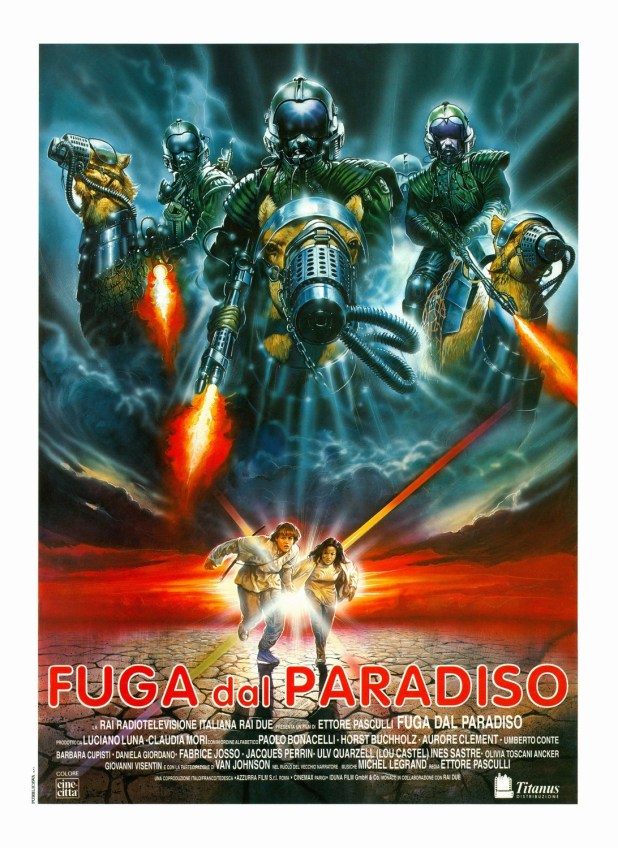
Fuga dal Paradiso has an awesome poster going for it.

Teo (Fabrice Josso) and Beatrice (Inés Sastre) have a mini-disc that they view as a religious talisman and use it as a totem as they leave behind their artificial paradise and attempt to escape Earth. So far, they’ve never met one another, and in an Italian post-apocalyptic film showing us the future, they mostly date via FaceTime. Or whatever it’s called in the world of this movie.

The first thing they do when they leave home? Find a dog named Bear, who, for some reason, has on a shirt and pants. They also find a mall that still has clothes and, of course, punk rockers ready to kill them. Teo’s dad sends Thor (Horst Buchholz), his head of security, to rescue them. Here’s where this gets better: Thor and his crew ride camels and like to roast mutants with flamethrowers. However, he fails at everything he does, and as a result, loses his title.

Van Johnson appears as the old narrator that we see at the beginning and end. You have to feel for the guy, being in this movie.

I do love an Italian end-of-the-world movie, but this one seems nearly tame. Director Ettore Pasculli worked at Cinecittà in the role of advanced cinematographic technologies and was a programmer director for RAI. His film The Steam Factory was one of the first all-digital movies made in Italy.

Barbara Cupisti (The New York RipperCemetery Man), Greta Valiant (The Daughter of Emanuelle) and Daniela Giordano (Four Times That Night) are all in it, at least.

UNSUNG HORRORS HORROR GIVES BACK 2025: Basket Case 3: The Progeny (1991)

Each October, the Unsung Horrors podcast does a month of themed movies. This year, they will once again be setting up a fundraiser to benefit Best Friends, which works to save the lives of cats and dogs across America, giving pets second chances and providing them with happy homes.

Today’s theme: The Sweetest Taboo!

“…Belial suffers through his brother’s neurosis, his girlfriend’s death, and the death of one of his children when the sheriff’s daughter drops it.”

Poor Belial. Three movies in, and he’s still trying to adequately express his emotions.

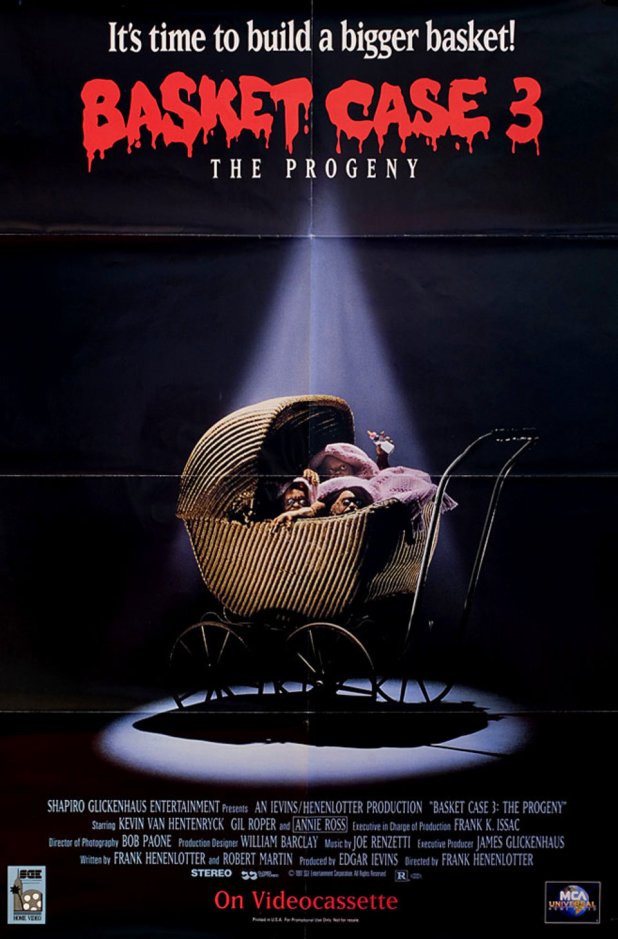
Last time, his brother Duane (Kevin Van Hentenryck) was trying to sew him back on. Now, Duane’s being held by Granny Ruth (Annie Ross), but allowed to go on the bus trip to see his ex, Doctor Hal Rockwell (Dan Biggers), so that Belial’s children with his girlfriend, Eve, can be born. They’ll also see her son, Little Hal (Jim O’Doherty), a multi-armed blob who can also practice health care.

There’s also a bigoted sheriff (Gil Roper) and his bad girl daughter, Opal (Tina Louise Hilbert), to deal with; the cops bust in at one point, guns blazing — realistic — and murder Eve. Then, they take Belial’s children as if they’re a practice run for late-child-stealing government operations. To fight back, Belial has an exoskeleton built that allows him to kill even more people and cause the sheriff to kill his own daughter. Then, they arrived at Renaldo, where they killed the host, and Granny says that freaks will no longer hide in the shadows.

This is a Frank Henenlotter film, and if you know what that means, you’re either going to love or hate this. I loved it, perhaps even more than the last one, because it just gives in and lets go.

As for the song “Personality”, being in this, “the owner reportedly gave them the rights for a dollar after he found out that Annie Ross would be singing it.” I want IMDbs to be true.

B & S About Movies podcast Episode 104: Sergio Martino

Yes, everyone can talk about All the Colors of the Dark and Torso, but let’s get deep into Sergio Martino with four of my favorite weird picks from him.

Uppercut Man finds Sergio in Miami, making a boxing movie that isn’t like any other. Ernest Borgnine, Daniel Greene, Mary Stavin, Giuliano Gemma…Crud Buddies have this posted on YouTube.

American Rickshaw is the most perfect of all late Martino movies: shower sex with the jeans on, rickshaws in Miami, Donald Pleasence as a faith healing warthog…get it from Cauldron Video.

Graffiante desiderio has Sergio going back to the Giallo but also incest and a dummy drop ending. Craving Desire is hard to find but if you’re ready to infest your computer with viruses, go here.

Un orso chiamato Arturo has George Segal and Carol Alt. Yes, in a Sergio Martino movie. It’s on YouTube in Italian, so learn a new language.

Is there a secret prize for finishing this episode? Did I compose a song for it? What are you waiting for? Go listen!

You can listen to the show on Spotify.

The show is also available on Apple Podcasts, iHeartRadio, Amazon Podcasts, Podchaser and Google Podcasts

Important links:

Theme song: Strip Search by Neal Gardner.

Donate to our ⁠⁠⁠⁠⁠⁠⁠⁠⁠⁠⁠⁠⁠⁠⁠⁠⁠⁠⁠⁠⁠⁠⁠⁠ko-fi page⁠⁠⁠⁠⁠⁠⁠⁠⁠⁠⁠⁠⁠⁠⁠⁠⁠⁠⁠⁠⁠⁠⁠.

CHILLER THEATER MONTH: Queen of Blood (1966)

EDITOR’S NOTE: Queen of Blood was on Chiller Theater on Saturday, December 17, 1966 at 11:20 p.m. and Saturday, May 17, 1969 at 11:30 p.m.

Based on the screenplay for the Russian movie Mechte Navstrechu (A Dream Come True) and utilizing the special effects footage from that film and Nebo Zovyot (Battle Beyond the Sun), this American-International Pictures release, directed by Curtis Harrington, likely had some influence on Alien.

Harrington agreed, saying that Ridley Scott’s movie was a “greatly enhanced, expensive and elaborate” take on Queen of Blood.

This movie believed, and it made sense at the time, that by 1990, humans would be traveling in space and have united to form the International Institute of Space Technology. Astronaut Laura James (Judi Meredith) hears strange signals from space, messages that Dr. Farraday (Basil Rathbone) believes are from an alien race sending an ambassador to Earth, yet the ship has crashed on Mars.

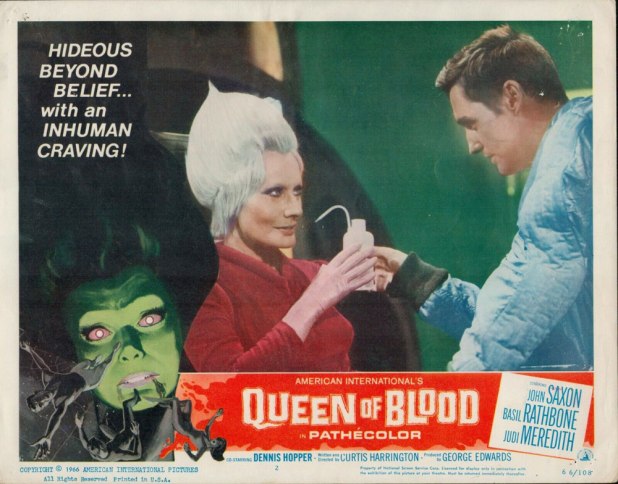
The ship Oceano is sent to rescue the ambassador, but only one dead alien is aboard. They decide that a rescue ship must have picked up the crew, but when they follow what they think is the rescue ship, they find only one being on board, a green-skinned alien (Florence Marly, who made a short sequel to this movie called Space Boy! and is also in The Astrologer) and several eggs.

She refuses to eat food, won’t let them take a blood sample and when left alone with an astronaut named Paul (Dennis Hopper), she hypnotizes him and drains his blood. Soon, she takes over most of the male crew members and plans on making her way to our planet, with only Laura and Allan Brenner (John Saxon) left to oppose her.

This would be the first movie that Harrington would work with George Edwards (as a line producer for this movie). They met when Edwards produced a stage production of Tennessee Williams’ The Glass Menagerie, and this movie impressed Universal enough that they hired Harrington and Edwards to make Games.