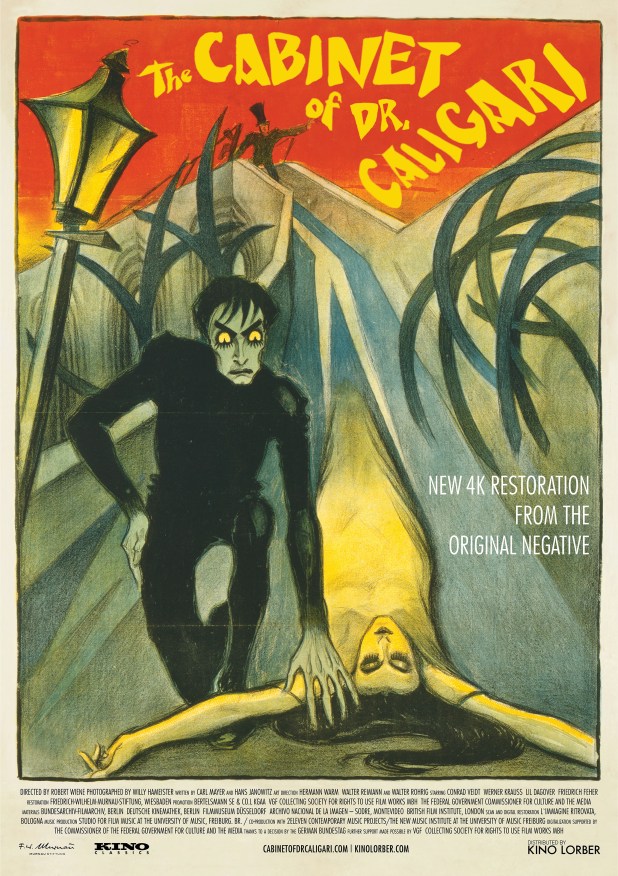
2025 Scarecrow Psychotronic Challenge Day 15: The Cabinet of Dr. Caligari (1920)

15. GOES WITHOUT SAYING: Feast your eyes on something with little to no dialogue at all.

Directed by Robert Wiene and written by Hans Janowitz and Carl Mayer, this is the perfect expression of German Expressionism. Janowitz and Mayer, both pacifists who despised authority after their military experiences during World War I, created something amazing here, which Wiene realized.

Roger Ebert called it arguably “the first true horror film,” and it’s still unsettling to watch today.

Dr. Caligari (Werner Krauss) is a hypnotist who has his own sleeping man, Cesare (Conrad Veidt), whom he uses to entertain — and murder — people. Caligari prophesies that  Franzis’ (Friedrich Feher) best friend Alan (Hans Heinrich von Twardowski) will die by morning. When it happens, Franzis and his girlfriend Jane (Lil Dagover) investigate, which leads to a plot where Caligari may or may not be the head doctor of an asylum.

But ah, the ending! The beginning seems so simple, with Franzis telling his story. Finding out that he’s an unreliable narrator makes this entire movie one to watch again.

Is this a fairy tale? Is it one man trying to make sense of things? Is it Janowitz working out witnessing a murder behind the Holstenwall, which gives the setting its name?

While this is considered a cult movie, it was released as a typical film. But when we see it today, a hundred years later, we think that it had to have been an art film.

UNSUNG HORRORS HORROR GIVES BACK 2025: Crimson, the Color of Blood (1973)

Each October, the Unsung Horrors podcast does a month of themed movies. This year, they will once again be setting up a fundraiser to benefit Best Friends, which works to save the lives of cats and dogs across America, giving pets second chances and providing them with happy homes.

Today’s theme: J &B 

From J&B In the Movies

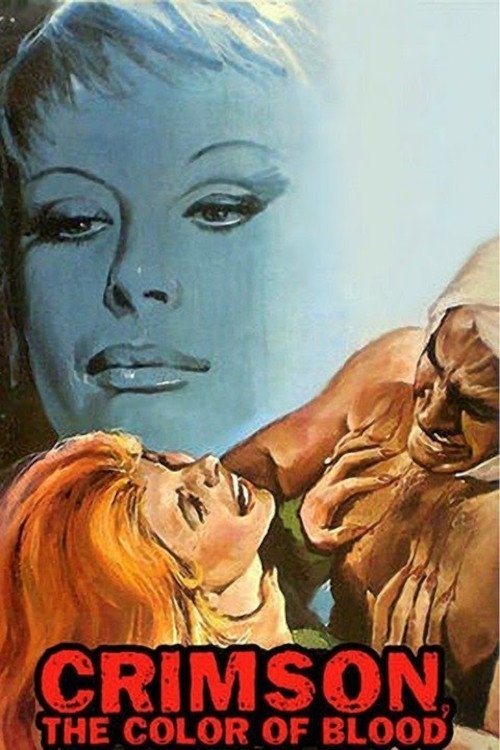
Las ratas no duermen de noche (Rats Don’t Sleep at Night) was released in the U.S. as Crimson, the Color of Blood and The Man With the Severed Head.

After a jewel heist, Jack Surnett (Paul Naschy) is shot in the head. His gang is smart enough to know that there’s a scientist named Professor Teets (Ricardo Palmerola) who can do some pretty wild surgeries, like a brain transplant. However, they use the brain of a serial killer named The Sadist (Roberto Mauri), going out in the middle of the evening to just chop off his head. And by this amazing procedure, Jack becomes even more violent than he was before.

Directed by Juan Fortuny, who co-wrote the script with Marius Lesoeur and H.L. Rostaine, this film features Naschy in what must have been a dream role, as every time he sees a woman, he has to make love to her. Well, not love. Violent killing maniac love. This has plenty of Eurocult goddesses in it, like Evelyne Scott (AKA Evelyne Deher, she’s also in Shining Sex), Silvia Solar (Devil’s Kiss) and Gilda Arancio (Kiss Me Killer).

More of a crime movie than a horror film, this doesn’t have much Nashy, but it does feature random dance scenes, and when he finally does show up, he’s all wrapped up. But I kind of like that it’s a gangster movie. Head transplants were a big thing in 70s!

You can watch this on Tubi.

CHILLER THEATER MONTH: Web of the Spider (1971)

EDITOR’S NOTE: Web of the Spider was on Chiller Theater on Saturday. October 18, 1980 at 1:00 a.m. and Saturday. November 27, 1982 at 1:00 a.m.

After Castle of Blood‘s disappointing box office, Antonio Margheriti felt he could remake the film in color and have it be more successful.

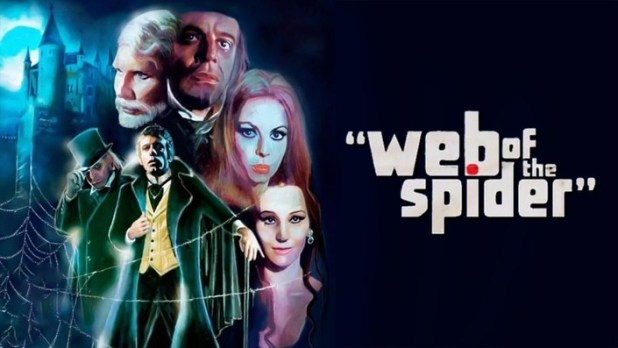
Edgar Allan Poe (Klaus Kinski) is our narrator and Kinski shows up for the beginning and the ending of the movie. He’s interviewed by Alan Foster (Anthony Franciosa), who challenges him as to the truth of his stories. This leads to a bed with Lord Blackwood (Enrico Osterman) about spending a night in his castle, a place where he soon meets Elisabeth (Michèle Mercier, Black Sabbath) and quickly falls into love — and bed — with her before she announces that she’s no longer alive.

There’s also Julia (Karin Field), William Perkins (Silvano Tranquilli) and Elisabeth’s husband,Dr. Carmus (Peter Carsten). The ghosts need his blood to come back to life, but Elisabeth helps him to escape, only for him to impale himself on the gate, dying just as Poe gets there.

I adore that the tagline of this is “Based on Edgar Allan Poe’s Night of the Living Dead.” He did write a poem “Spirits of the Dead” and the 1932 movie The Living Dead was based on Poe’s “The Black Cat” and “The System of Doctor Tarr and Professor Fether” as well as Robert Louis Stevenson’s The Suicide Club. But no, he has nothing to do with Romero’s movie.

I really like the soundtrack by Riz Ortolani but this can’t compare to the black and white — and yes, Barbara Steele appearance — in the original. That said, Kinski is awesome in every second he’s on screen, looking like a complete madman.

UNSUNG HORRORS HORROR GIVES BACK 2025: Carnal Circuit (1969)

Each October, the Unsung Horrors podcast does a month of themed movies. This year, they will once again be setting up a fundraiser to benefit Best Friends, which works to save the lives of cats and dogs across America, giving pets second chances and providing them with happy homes.

Today’s theme: J&B

ABOUT THE AUTHOR: Adam Hursey is a pharmacist specializing in health informatics by day, but his true passion is cinema. His current favorite films are Back to the FutureStop Making Sense, and In the Mood for Love. He has written articles for Film East and The Physical Media Advocate, primarily examining older films through the lens of contemporary perspectives. He is usually found on Letterboxd, where he mainly writes about horror and exploitation films. You can follow him on Letterboxd or Instagram at ashursey.

Stop the press!

I originally had a different film in this slot—Night Angel, which I ended up moving to a different category. The J&B element was not very strong in Night Angel. Just a scene where you can see a bottle on a shelf behind a bar. I realized that, somehow, I did not have a single Italian film on my list this year. When I reviewed a Letterboxd list that so kindly compiled films that feature the iconic Scotch whiskey, I discovered a film I somehow missed when I dove into Alberto De Martino’s filmography last year. Carnal Circuit, a film most definitely worthy of inclusion in any forgotten giallo set.

Alberto De Martino is probably my favorite Italian director not named Fulci. It is a hill I’m willing to die upon. He is probably best known for rip-offs of more successful films. The Antichrist is a rip-off of The Exorcist. Holocaust 2000 is a rip-off of The Omen. I guess you could say Pumaman is a Superman rip-off. Maybe his reputation for knock-offs lessens his cache among cinephiles. If so, it’s their loss. If they take it, toss it, and leave it, as Sir Mix-a-Lot so wisely said, I’ll pull up quick to retrieve it.

Carnal Circuit is an early example of the giallo. No black glove clad killer to be found here. But we do get the trope of a “common” man (not affiliated with the police) entering his sleuthing era, trying to get to the bottom of a murder mystery. In this film, Paolo (Robert Hoffman) is a newspaper reporter who gets caught up in the mystery thanks to a friend from his past, Giulio (Roger Fritz). Thugs are out for Giulio, the current face of an advertising campaign for the International Chemical corporation. But why would anyone want to rough up such a beautiful mug? Turns out that Giulio has made some enemies on his way to the top, as one does. But now Giulio has turned up dead, killed in a vehicle accident. Or was it an accident? Seems as if everyone on the International Chemical board had a reason for revenge against Giulio. But enough to kill? Perhaps his diaries give an answer, and it is up to Paolo to find them on his quest for the truth.

I do have a soft spot in my heart for these giallo films that were made before Dario Argento put his stamp on the subgenre, forever changing the way they are perceived. Carnal Circuit is similar to Fulci’s Perversion Story (or One on Top of the Other). Both films bring their story to California, although Fulci is more interested in framing his tale through the lens of Vertigo. De Martino’s film spends a good deal of its running time slowly revealing the change in Giulio (and seeing how much female flesh he can expose along the way—really putting the carnal in Carnal Circuit).

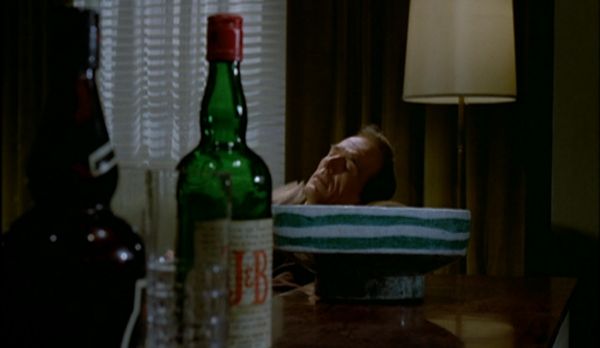
Unfortunately, the J&B component in this film was no different from Night Angel. Simply a scene where the former spokesperson for International Chemical makes a drunken display at a company party. He stands in front of a bottle of J&B before plummeting to his death out of a window (a missed opportunity for a dummy drop). 

At any rate, this film has been one of my favorite watches of the month, and another piece of ammunition in my battle to champion Alberto De Martino.

CHILLER THEATER MONTH: The Night Evelyn Came Out of Her Grave (1971)

EDITOR’S NOTE: The Night Evelyn Came Out of Her Grave was on Chiller Theater on Saturday. November 1, 1980 at 1:00 a.m.

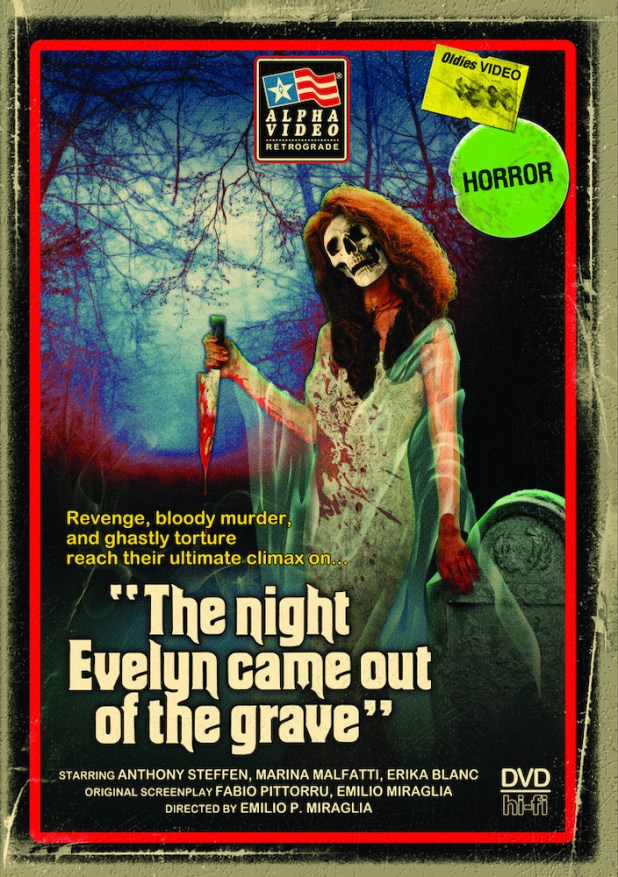
Emilio Paolo Miraglia created two giallo — this film and The Red Queen Kills Seven Times. This one goes more into the horror realm than the typical themes of the genre.

Lord Alan Cunningham starts this movie off by running away from an insane asylum, a place he’s been since the death of his redheaded wife, Evelyn, whom he caught having sex with another man. To deal with his grief, Alan does what any of us would do — pick up redhead prostitutes and strippers, tie them up, then kill them.

A seance freaks Alan out so badly he passes out, so his cousin — and only living heir — Farley moves in to take care of him, which basically means going to strip clubs and playing with foxes. Alan nearly kills another stripper before Farley gives him some advice — to get over Evelyn, he should marry someone who looks just like her. Alan selects Gladys (Marina Malfatti, All the Colors of the Dark) as his new wife and comes back home.

Sure, you meet someone one night and marry them the next. But nothing could compare to the weirdness of living in an ancient mansion with a staff of identical waitresses, Evelyn’s brother, and Alan’s wheelchair-bound aunt. Our heroine is convinced that Evelyn is not dead. And the other family members get killed off — Albert with a snake, and Agatha is eaten by foxes!

Gladys even looks at the body in the tomb before Alan catches her and slaps the shit out of her, as he is going crazier and crazier. Finally, Evelyn rises from her grave, which sends him back to a mental institution.

The big reveal? Gladys and Farley were in on it all along. But wait, there’s more! Susan, the stripper who survived Alan’s attack, was the one who was really Evely, and Gladyshads had been poisoned! Before she dies, the lady who we thought was our heroine wipes out the stripper, and Farley gets away with the perfect crime.

But wait! There’s more! Alan had faked his breakdown and did it all so that he could learn that it was Farley who was making love to his wife and killed her when she refused to run away with him. A fight breaks out, and Farley gets burned by acid. He’s arrested, and Alan — who up until now was pretty much the villain of this movie — gets away with all of his crimes!

This is a decent thriller, but it really feels padded in parts and tends to crawl. That said, it has some great music, incredibly decorated sets and some twists. Not my favorite giallo, but well worth a Saturday afternoon watch. There are some moments of sheer beauty here, such as the rainstorm where Alan sees Evelyn’s ghost rise.

WEIRD WEDNESDAY: Dixie Dynamite (1976)

Directed by Lee Frost, who wrote the script with Wed Bishop, this starts with Tom Eldridge (Mark Miller) running into trouble with the law, thanks to running moonshine. The law being Sheriff Marsh (Christopher George!) and Deputy Frank (Bishop), who screws up and shoots the man and as a result, his daughters Dixie (Jane Anne Johnstone) and Patsy (Kathy McHaley) lose the farm to banker Charlie White (R.G. Armstrong). And there’s also crime boss Dade McCrutchen (Stanley Adams) to deal with. Luckily, they know Mack (Warren Oates), a racer who can help them get the revenge they need.

Somehow, Jane Anne Johnstone and Kathy McHaley were never in a film before or after this, which surprises me. They’re pretty good in it and actually own most of the film, as Oates is in it for like ten minutes. And if you’re looking for that secret Steve McQueen cameo, good luck. He has a motorcycle helmet on. Supposedly, he hadn’t been in a movie for some time, was bored and showed up to be in the dirt bike racing scene.

The soundtrack — Duane Eddy played on it — and the stunts are the reason to watch this one. It’s very proto-Dukes of Hazzard as the girls play Robin Hood, stealing from the crooks to give to the poor. There’s also a crook getting blown up real good while on the toilet, which is something I’d like to see more of.

Frost also made The Thing With Two Heads, Witchcraft ’70 (U.S. version), The Black GestapoLove Camp 7Hot Spur and so many more wonderful films. He also wrote Race with the Devil.

You can watch this on Tubi.

THE IMPORTANT CINEMA CLUB’S SUPER SCARY MOVIE CHALLENGE DAY 14: Visitors from the Arkana Galaxy (1981)

14. A Croatian Horror Film

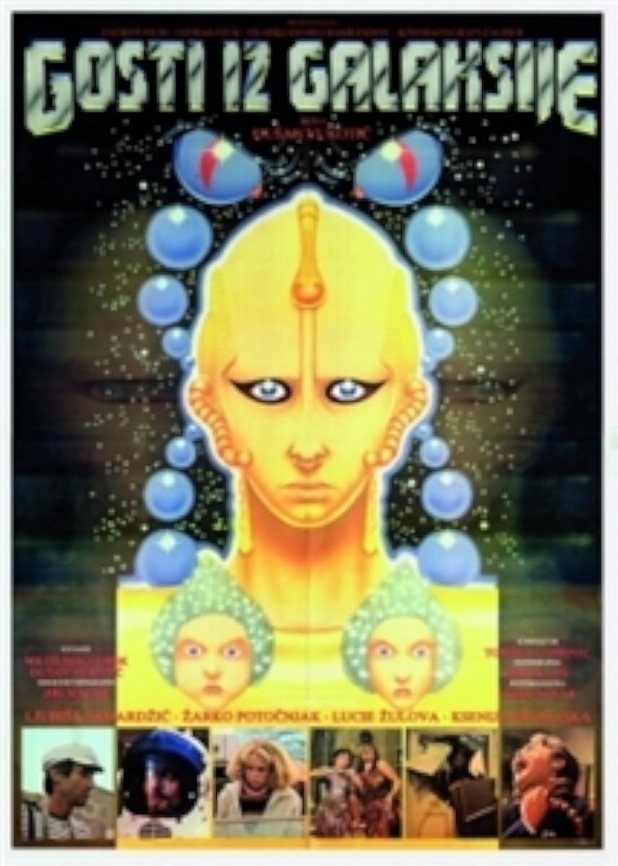
Here’s how Deaf Crocodile sold this: “Imagine if Troma Films had been hired to make a Sid & Marty Krofft Saturday morning kids’ show, and if you have some idea of the unspeakable strangeness of Visitors from the Arcana Galaxy, a truly gonzo Croatian sci-fi/fantasy about a struggling writer, Robert (Zarko Potocnjak), who dreams up a story of gold-skinned alien androids named Andra, Targo and Ulu from a distant planet.”

But is it a horror movie? Let’s allow Deaf Crocodile again to describe the Mumu Monster, which was created for the film by legendary Czech animator Jan Svankmajer: “A rubber-suited, multi-tentacled creation that destroys a wedding party, ripping off heads and spouting plumes of toxic green smoke while a blind accordion player blithely plays his squeezebox.”

Director Dusan Vukotic, while born in Yugoslavia, was one of the founding members of Zagreb Film, a Croatian film studio that often worked in animation. What emerges here is pure fantastic filmmaking — a movie where Robert has his head in the clouds, dreaming of being a science fiction writer. This is a goal that his girlfriend Biba (Lucié Žulova) and friend Tino (Ljubiša Samardžić) think is silly.

Somehow, that same imagination is able to bring robotic Andra (Ksenija Prohaska) and space children Targo (Rene Bitorajac) and Ulu (Jasminka Alic) to Earth. That’s because Robert has tellurgia, which allows him to think of things long enough for them to become real. For example, when he was hungry as a child, his father grew breasts to feed him.

A series of wild adventures emerges, including Robert falling in love with Andra, Andra leaving a Mumu monster in her purse that sprays her roommates with its deadly blood, and time travel that solves almost any mistake.

As Yugoslavia and Czechoslovakia no longer exist, I guess this is a Croatian film. Whatever it is, it’s terrific —sheer lunacy caught on film —a movie that shows how a foreign culture would create a space adventure that has nothing to match what we expect.

You can watch this on Tubi or buy it from Deaf Crocodile or MVD. Extras on the physical release include a new scan with restoration by Craig Rogers for Deaf Crocodile, a new commentary track by film historian Samm Deighan, a new essay by film historian and professor Jennifer Lynde Barker and five rare short films by director Dusan Vukotic.

2025 Scarecrow Psychotronic Challenge Day 14: Halloween TV version (1981)

14. “SHUT THE FACE UP”: Watch a TV edit of an R-rated movie, you fairy godmother.

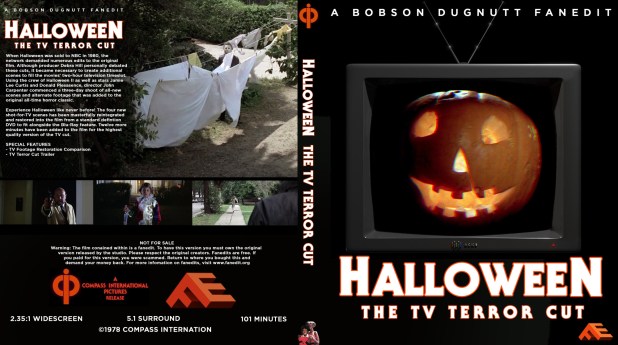
While the Halloween TV cut is an edited version of the 1978 movie with limited gore, not that Halloween had much, and re-dubbed swear words. That left around 12 minutes to extend the film, and luckily, John Carpenter was on the set of Halloween II.

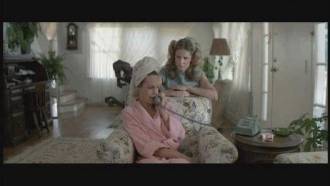
The new moments hint at the revelation of the second movie, as we see that Michael has written “sister” on a door, there are moments in the high school, Dr. Loomis discusses young Michael’s dangerous nature at Smith’s Grove, Loomis talking to young Michael about fooling the doctors but not him as they move him to minimum security, and a moment where “Lynda visits Laurie Strodes at home and borrows a blouse just as Annie calls trying to borrow the same blouse.” Also, the final confrontation with Michael was retooled so you can only hear the gunshots and not see the shooting.

All of this footage was re-worked into an extended edition for home video.

There was once a TV edit of Halloween II that had tons of differences, too. There’s a messy cut of Mrs. Elrod’s death, as, instead of seeing the blood on her hands, the camera cuts to Michael’s face. This moment was taken from Michael killing Karen at the hospital, so he looks as if he’s in green lighting, unlike the rest of this scene.

According to 45 Lampkin Lane, there’s also:

  • A deleted scene of Janet and Jimmy talking to one another in the hallways. Janet informs Jimmy that Laurie cracked a bone and that she’s going to have a scar on her shoulder. Jimmy asks if she’s still awake, to which Janet replies that Dr. Mixter gave her a double dose. “If she can keep her eyes open, she’s made out of steel.”
  • Bud’s filthy version of “Amazing Grace” is changed to “Amazing grace, come show me your face. Don’t make me cry, I tell no lie.”
  • An added scene where Jimmy tells Karen that he’s going to see the Ben Tramer car crash.
  • The hammer killing Mr. Garrett is removed.
  • A less gross take of the autopsy of Ben Tramer.
  • A dream sequence where Laurie, as her younger self, meets Michael at the sanitarium.
  • Karen’s death is less intense.
  • The theatrical cut ends after Laurie gets into the ambulance. On TV, a white sheet rises inside the ambulance, but it’s Jimmy. They smile at one another as the ambulance drives away.

Here’s the original 1981 airing with commercials!

UNSUNG HORRORS HORROR GIVES BACK 2025: The President Must Die (1981)

Each October, the Unsung Horrors podcast does a month of themed movies. This year, they will once again be setting up a fundraiser to benefit Best Friends, which works to save the lives of cats and dogs across America, giving pets second chances and providing them with happy homes.

Today’s theme: Unsung Horrors Rule (under 1,000 views on Letterboxd)

The last documentary produced by Sunn Classic Pictures, The President Must Die, is a fairly groundbreaking film, one that explores the conspiracy theories related to the assassination of President John F. Kennedy.

Urban legend says that it was tested in theaters in Arizona and Virginia in January 1981, but performed poorly. It was ultimately shelved and is now considered a piece of “lost media.” Just a few months later, the real-life assassination attempt on President Ronald Reagan made it an impossible movie to market.

Or so they say.

I interviewed James Conway, this film’s director, for an upcoming issue of Drive-In Asylum and got to ask about this movie, one that has fascinated me for years:

DIA: One last question about that era. What happened with The President Must Die?

JAMES: It was sort of the end of our believing in the market research and testing of ideas. Because when we tested that – making some trailers – it received incredibly high ratings. Everybody wanted to see this movie. We made the movie and did an excellent job. I mean, it’s absolutely authentic based on the time. I flew all over the country, interviewing all these people who you’ll see in the movie, and when it opened, nobody cared. Nobody came to see it.

DIA: In my research, I’ve heard that it was pulled from theaters in the wake of Reagan being shot. Is that true?

JAMES: I know it didn’t perform. I’m not sure about the Reagan thing. 

I’ll tell you a funny story. Though. We moved the company from LA to Park City, Utah when we did Grizzly Adams in 1976 and I moved there as well. I moved back to Los Angeles in 1982, but kept a home there. It’s where I live now, several months a year. 

We did the post-production for The President Must Die in Park City and we’re flying with all the reels to go to LA to do the mixing and have all the boxes with all the reels. And in those days, I don’t know how old you are, but when you used to do sound effects and music, you’d have 30-40 reels for each movie. Each of these boxes had The President Must Die marked on them, ready to be sent on a United Airlines plane to the sound editors in LA.

Somebody who saw the boxes saying The President Must Die called the FBI, and the people who were flying to LA with those boxes were pulled off the plane as soon as they hit the ground. But once they explained what it was, they were let go. But isn’t that fun? (laughs)

At the end of the interview, as I was fact-checking a few things, I told him that this movie was one of my holy grails.

“Do you want to see it?” Conway asked. “Check your email.”

Imagine my joy at hearing the dulcet tones of Brad Crandall again, a voice I figured I’d heard everything from in all of the other Sunn films. Now, he’s setting up the story of JFK and how he was changing America. Unlike so many other conspiracy films, this begins and ends with positivity.

You also have to understand that in 1981, there weren’t many other, as I said, conspiracy films.

Conspiracy wasn’t what it is today. It was in photocopied sheets and by word of mouth. There was no internet. There were just pockets of this information, and you had to hunt for it. A relatively mainstream film espousing the idea that Kennedy was killed by one of the many groups it could have been (in fact, at one point, Crandall says, “Who would want to kill someone as popular as Kennedy?” and nearly answers himself by suddenly naming at least five groups that absolutely hated him and had a motive.

This movie shows the Zapruder film from a time when you couldn’t just look it up on your phone.

The only evidence, for years, that it even existed was a Bantam tie-tin paperback co-written by Sunn’s Charles E. Sellier, Jr.

But it’s real.
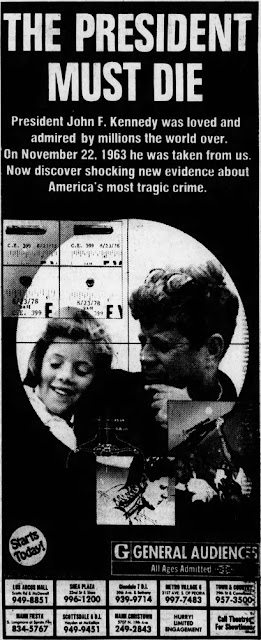
In the February 2-3 issue of Parade, an article, “Making Movies the Computer Way,” was published. In it, this film is discussed:

“Once the most popular ideas are collated, Sunn’s research teams are sent out again. This time, the man on the street is asked to help flesh out the concepts. Take, for example, the research conducted for The President Must Die, a docu-drama on the assassination of John F. Kennedy.

“After feeding our data into the computer,” explains screenwriter Brian Russell, “we went with the conspiracy theory – the premise that was closest to what the majority believed.” What if the computer had pinned the blame solely on Oswald? “We would have gone with that angle instead,” Russell says. “We’re interested in drama, not politics.”

(This appeared on Temple of Schlock.)

We all know the Magic Bullet Theory now, probably by heart. But to see a much younger Cyril Wecht discuss it in detail is incredible. What did people in 1981 even think? I mean, what did I think the multiple times I saw Wecht speak live, where he would gather four audience members, create the seating arrangements of Kennedy’s death car (which is now in Michigan).

This is from a time before when our own President espoused conspiracy theories and gave dog whistles to Q-Anon, using it when it benefited his cause and rapidly disposing of it. We’re to care and not care about conspiracy; today it feels as if it’s transitory and can come and go as easily as the wind. How did the ear grow back? Was the election fixed or wasn’t it? Is Project 2025 real or not? Everything is truth and fiction at the same time; feelings and emotions matter more than evidence.

Here is this documentary from a time past Watergate that recognizes that the innocence of the nation — one that had not yet discovered that the Third Reich studied Jim Crow laws as inspiration — was damaged by the deaths of JFK, RFK, Malcolm X and Martin Luther King, Jr., as well as both Nixon leaving the office and Ford nearly being assassinated twice, once by Manson Family member Lynette “Squeaky” Fromme and the second by a radicalized Sara Jane Moore. Crandall even wonders, aloud, if America can ever find hope again.

In the past, you were a kook for believing that the Warren Commission could lie to you (as an aside, I still hate the line in Bull Durham, “I believe Lee Harvey Oswald acted alone,” but then again, Kevin Costner was also Jim Garrison). You were more sane to believe in the Warren’s Single-Bullet Theory, one that argues that “a single bullet struck Kennedy in the back, exited his throat, and then wounded Governor Connally, who was seated in front of him.”

In James Shelby Downard’s “King-Kill/33: Masonic Symbolism in the Assassination of John F. Kennedy,” the conspiracy theorist (artist?) wrote, “Most Americans are beyond being tired; the revelations have benumbed them.”

Downard claimed, way back thirty years or more ago, “Never allow anyone the luxury of assuming that because the dead and deadening scenery of the American city-of-dreadful-night is so utterly devoid of mystery, so thoroughly flat-footed, sterile and infantile, so burdened with the illusory gloss of ‘baseball-hot dogs-apple-pie-and-Chevrolet’ that it is somehow outside the psycho-sexual domain.” I have lived by those words since I read them, as well as his belief that “Only the repetition of information presented in conjunction with knowledge of this mechanism of Making Manifest of All That is Hidden provides the sort of boldness and will which can demonstrate that we are aware of all the enemies, all the opponents, all the tricks and gadgetry, and yet we are still not dissuaded, that we work for the truth for the sake of the truth. Let the rest take upon themselves and their children the consequences of their actions.”

We work for the truth for the sake of the truth.

I may hide inside movies and explore the archaeology of what was lost, but I dream of what could be. This film reminds me of that.

This was an interesting movie to watch in the wake of several political and business-based killings this very year. Much like The Killing of America, the questions asked in this movie haven’t been answered. They probably never will be.

But I’ve solved one of my own conspiracies.

I’ve actually got to see this. Thanks, James.
CHILLER THEATER MONTH: Kiss of the Tarantula (1975)

EDITOR’S NOTE: Kiss of the Tarantula was on Chiller Theater on Saturday. November 22, 1980 at 1:00 a.m. and Saturday, August 6, 1983 at 1:00 a.m.

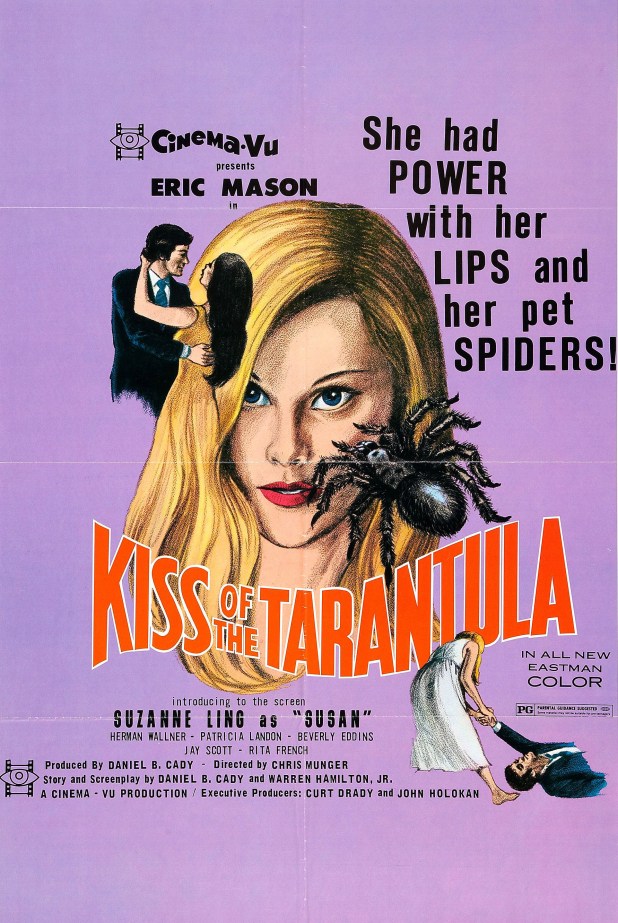
Also known as Death Kisses and Shudder, this gender and species swapped cover version of Willard is all about Susan Bradley, a little girl who can control spiders, which she does to kill her mother — well, she was gonna kill daddy — before taking out anyone else who displeases her. Susan really loves her spiders — to the point that one scene almost suggests that she loves them biblically. Oh 1975, what a magical time you were to be alive.

The big issue is Walter, Susan’s creepy uncle and a dirty cop. He has evidence that his niece has killed at least two people, but he covers it up and even kills to protect her, all so he can get the chance to aardvark with this little arachnophile. Guess what? She’s not a habit of it. Oh yeah — Walter was also sleeping with her mom and helping her plan to murder his own brother. Whew!

You kind of have to love a movie where a little girl kills an entire VW worth of teenagers at the drive-in. This movie checks almost all the boxes for our site: murderous children and animals gone wild. If only there was an acid sequence, a Satanic ritual and George Eastman dressed as a big hairy tarantula.

Writer and producer Daniel Cady would go on from this to write and produce several adult films, such as Soft PlacesReflections and Tomboy under the name William Dancer. He also produced the regional shocker Dream No Evil.m ader Chris Munger would also direct Black Starlet and The Year of the Communes, a documentary narrated by Rod Steiger.