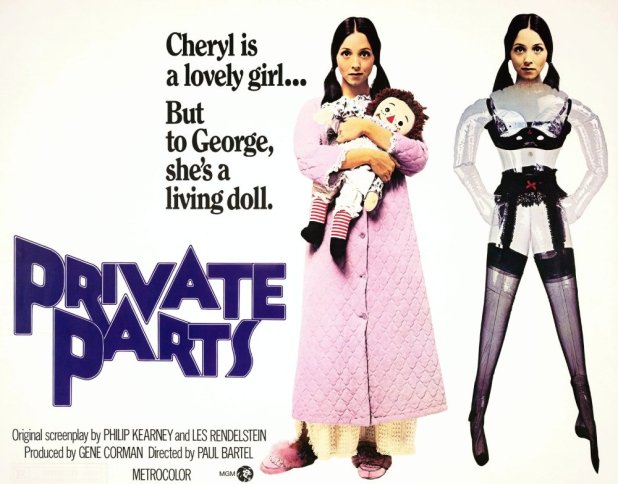
RE/SEARCH Incredibly Strange Films: Private Parts (1972)

Paul Bartel is a bonafide hero here at B & S About Movies. From his cameos in movies like Gremlins 2: The New Batch and Chopping Mall to the films he directed like Death Race 2000 and Eating Raoul, every time he turns out on the screen it makes us happy.

Cheryl and her roommate get in a fight, so instead of going back home, she decides to move into her aunt’s run down hotel in downtown Los Angeles. Suffice to say that shenanigans ensue.

Aunt Martha is a strange lady, played by Lucille Benson, who was on TV’s Bosom Buddies and played Mrs. Elrod in Halloween 2, as well as time on Broadway. She’s obsessed with funerals and given to moralizing. Her hotel is packed with maniacs and there are also a series of murders going on, with Cheryl as the best chance to be the next victim.

Get this — the role of Aunt Martha was originally written for Mary Astor (The Maltese FalconHush…Hush, Sweet Charlotte)!

Cheryl wants to be a woman and experience her sexuality, which leads her into George’s orbit. He’s a photographer who longs for love, but also sleeps with a water inflated doll that he often injects with human blood and covers with a photo of Cheryl’s face. He’s somehow not the strangest person in the hotel. And oh yeah, to add to the whiff of perversion in the air, he’s her cousin.

Stanley Livingston, Chip Douglas from TV’s My Three Sons, also is in this movie, playing Jeff, another tenant. He would be a better mate for Cheryl, but she’s already too deep. And it’s pretty crazy to see Laurie Main, who hosted and narrated Disney’s Welcome to Pooh Corner, as a gay priest. That said, he also shows up in some other strange places, like Larry Cohen’s Wicked Stepmother and as the narrator of Cheech & Chong’s The Corsican Brothers.

There was also a model named Alice that once lived in Cheryl’s room that nobody wants to talk about. And a whole bunch of keys that open other rooms so that our voyeuristic heroine can spy on all of them.

Private Parts began with the working title Blood Relations, but its new title was rough on the film, as some newspapers wouldn’t promote it with that name, some even calling it Private Arts. Some ads even said that the title was too shocking to print and asked people to call the theater to learn the name of the film!

It really was shot in a skid row hotel, the King Edwards Hotel in downtown L.A and all of the people in it were based on people that writers Philip Kearney and Les Rendelstein met in LA in the 1960s. It’s still around, having been purchased in 2018 with plans to convert it into low-cost single-occupancy transitional housing.

This is a movie that fits in well with other blasts of 70’s odd like The Baby. Like that movie, Private Parts may not explicitly have sex and violence, but it just feels off and as if it came from another universe that might appear to be ours, but has scum and strangeness in every corner.

Leonard Maltin said this about Private Parts: “If Andy Warhol’s Chelsea Girls had co-directed by Alfred Hitchcock and John Waters, it would come close to this directorial debut by Paul Bartel.” That sums this up quite well.

RE/SEARCH Incredibly Strange Films: Mr. Sardonicus (1961)

Baron Sardonicus (Guy Rolfe) was once Marek Toleslawski, a farmer like his father. He lived a quiet existence with his wife Elenka (Erika Peters), working is father’s land. Before his father died, he had purchased a ticket for a national lottery. He won, but was buried with the ticket. Elena says that if Marek loves her, he will open the grave and get the ticket. When the coffin opens, he is so upset by the rotted and grinning face of his dead dad that his face is stuck in the same manner, leaving him unable to speak or eat food for some time. His wife is so upset that she kills herself. Despite his wealth giving him a title, he is stuck with his face. After hiring experts, he is able to eat and speak, but needs Sir Robert (Ronald Lewis) to give him his face back.

Despite being married to Maude (Audrey Dalton), Sardonicus has been kidnapping and torturing young women with his wealth protecting him. He also has an assistant Krull (Oskar Homolka) who has lost an eye for making Sardonicus angry. If Sir Robert can figure out how to fix this, he will be saved — his face is now threatened — and numerous people will be protected. Can he do it?

This is a William Castle movie, so it needed a gimmick. At the conclusion, audiences took part in a “Punishment Poll” where they held up a glow-in-the-dark card with a thumbs up or down to determine if Sardonicus would die. Castle hosts the poll within the movie.

In his book Step Right Up! I’m Gonna Scare the Pants Off America, Castle said that the two different endings came from the Columbia Pictures hating the dark ending. He said,  “I would have two endings, Columbia’s and mine, and let the audience decide for themselves the fate of Mr. Sardonicus. Invariably, the audience’s verdict was thumbs down… Contrary to some opinions (just in case the audience voted for mercy) we had the other ending. But it was rarely, if ever, used.”

I’m going to disagree with Castle and say that that ending was never filmed. There was also said to be a drive-in ending with headlights flashing the votes.

Mr. Sardonicus was based on a book (it was originally published in three parts in Playboy) and stage play by Ray Russell, who also wrote The IncubusZotz!The Premature BurialChamber of HorrorsThe Horror of It All and X: The Man with the X-Ray Eyes.

You can watch this on YouTube.

RE/SEARCH Incredibly Strange Films: The Little Shop of Horrors (1960)

Drected by Roger Corman, written by Charles B. Griffith and made under the name The Passionate People Eater, this movie was made in two days for $28,000 on the same sets as A Bucket of Blood. Playing double features with Black Sunday and Last Woman On Earth, it became a cult film and that continued once it aired repeatedly on TV.

Gravis Mushnick (Mel Welles) and his two employees, Audrey Fulquard (Jackie Joseph) and Seymour Krelboined (Jonathan Haze), run a flower shop that seen better days. When Seymour screws up an order for dentist Dr. Phoebus Farb (John Shaner), he’s fired until he shows his new plant, which he claims he grew from a seed that he was given by a Japanese gardener over on Central Avenue. He names it Audrey 2 and before you know it, it lives on human blood and then people. Yet it brings people into the store and becomes famous. Gravis calls Seymour son now.

Of course, Gravis eventually sees Seymour feeding a dead homeless man — it was an accident, but still — to Audrey 2 and then Dr. Farb, who he killed in self defense. But the crimes are getting worst and the police — named Fink and Stoolie — and the Society of Silent Flower Observers of Southern California wants to give Seymour an award. All he wants is the original Audrey, but the plant hypnotizes him and makes him continue bringing him food.

The movie was actually written at a coffee house. Corman said, “We ended up at a place where Sally Kellerman (before she became a star) was working as a waitress, and as Chuck and I vied with each other, trying to top each other’s sardonic or subversive ideas, appealing to Sally as a referee, she sat down at the table with us, and the three of us worked out the rest of the story together.”

This is also an early Jack Nicholson movie — the actor said that “I went in to the shoot knowing I had to be very quirky because Roger originally hadn’t wanted me. In other words, I couldn’t play it straight. So I just did a lot of weird shit that I thought would make it funny.” — and as you know, went on to become even bigger when it was made into a musical and remade in 1986. There was even a cartoon, Little Shop, that was on Fox Kids and had Corman as a consultant. As for this one, Corman was so sure it wouldn’t do well that he never got a copyright and let it go into public domain.

Dick Miller really did eat that flower.

You can watch this on Tubi.

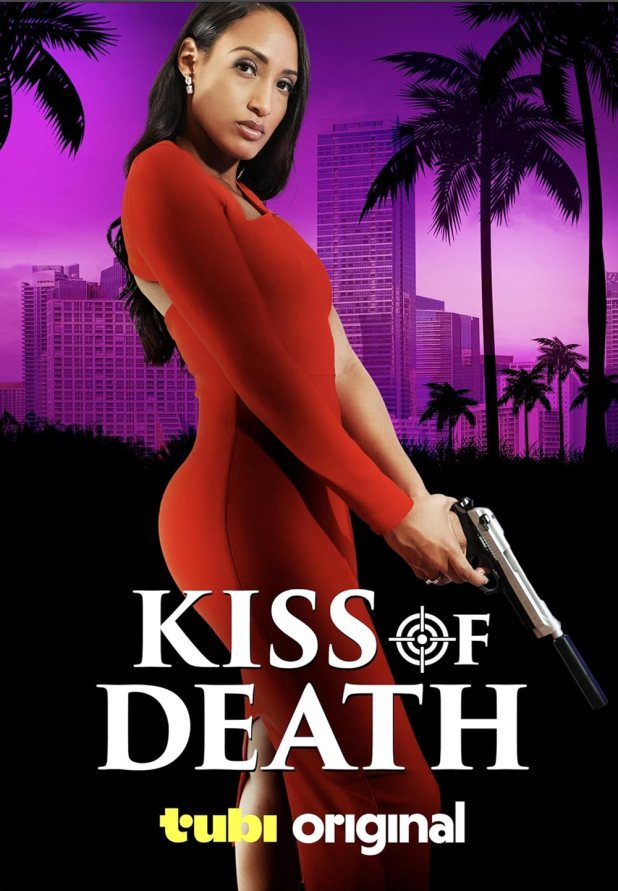
TUBI ORIGINAL: Kiss of Death (2024)

Mykah Jones (Sheila Leason) is a wife and mother, as well as a hit woman. None of these things are working out together, because her husband thinks that she’s cheating on her, probably because her cover story of being a photographer keeps getting all messed up when she does things like forget her camera. Instead, she’s out acting like an escort and strangling strange men and getting all sorts of injuries that she can’t explain.

Once she takes on her last assignment, she learns just how important her family is and that goes beyond the marriage counseling that she’s been struggling through with her husband Jamieson (Kevin Blake Chandler). Little does she know that most of her life has been a lie and that she was turned into a killer by her father’s former partner Lady (Cheryl Frazier) who is trying to do the same with her daughter Malia (Anmalya Delva).

Directed by Christian Sesma and written by Karen R. Hardin, this has hints of Kill Bill but from the side that hired killers are good people and do it all for noble reasons. So will Mykah kill her target Dyson (Dontelle Jackson), as she’s being blackmailed by Chauntell (Kyle Kankonde), who has photos of her seducing a target that she plans to send to Jamieson? Being a hired killing machine seems difficult, if this movie is based on reality.

I enjoyed Kiss of Death. It has a few twists that make it different and sure, it’s very similar to True Lies, but that’s not a bad thing.

You can watch this on Tubi.

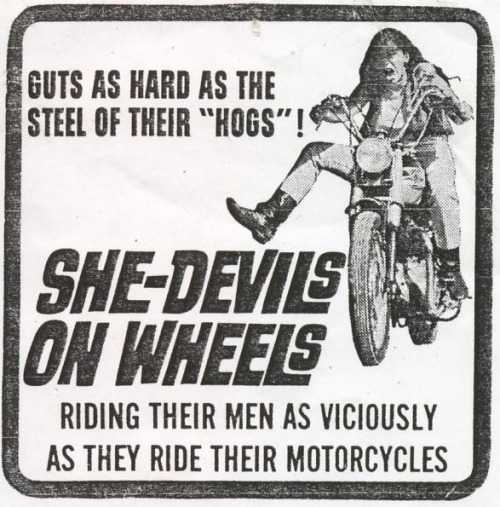
RE/SEARCH Incredibly Strange Films: She-Devils on Wheels (1968)

As the Godfather of Gore states in that intro to this film in its Arrow Video release, this is the one movie that rivals Blood Feast for box office and was his answer to the question, “Why don’t you stop cutting up all those girls and kill some men?”

This time through, I watched the film with commentary by H.G. Lewis and Something Weird’s Mike Vraney. This commentary track is a real joy, with Lewis quite honest about his faults as a filmmaker while giving tips for would be exploitation creations for how to film things properly. I wasn’t sure how much more I could love this movie, but this release exponentially increased my ardor.

Filmed with a legitimate cast of biker riding women, this movie is years ahead of its time. Heck, it’s years ahead of its time now. These women outride, outfight and dominate every man they meet with no apologies whatsoever. Even Karen, our would-be protagonist, after being forced to kill a lover by dragging him behind her hog, still stays with the Maneaters. They terrorize Florida and every human being they meet because they’re outside of the scope of humanity. They’re superheroes — well, supervillains — who can’t be stopped.

I love that Lewis realizes that adding on a post-credits scene in 1968 was a mistake. It was often trimmed or audiences left before they saw it. The film can’t end with the Maneaters in jail. They speak almost directly to the camera, promising more chaos. It’s as if they’re the biker gang Avengers years before anyone would think to film such a sequence.

I also love that Karen rejects the straight world and her ex-boyfriend Joe, who wants things to be the way they always were. The women in this movie reject the roles their gender has enforced upon them and instead have no issues slicing, dicing, tearing and maiming their way through their rival gang, led by Joe Boy. The fact that he’s a slice of mom and pop Americana, with bleached blonde good looks and it’s astounding — not to be a broken record — that the film ends with her rejecting white picket fences and a certain future.

H.G. Lewis made 33 films between 1962 and 1972. Those films would run in drive-ins for years before the adventure of the VCR and Something Weird would bring them back to viewers. Most of these movies had lower budgets than this and less time ($60,000 spent over two weeks), but they all exhibit a zeal and love for shock and showing you something different than you’ve ever seen before. Lewis remains affable and happy throughout the commentary, the kind of uncle you wish you had who’d done some crazy things in his past and wasn’t shy about sharing them with you. The loss of both he and Mike Vraney are palpable.

You can watch this on Tubi.

RE/SEARCH Incredibly Strange Films: The Abominable Dr. Phibes (1971)

Church of Satan founder Anton Szandor LaVey claimed that the main character in this Vincent Price film was based on him. Well, his name is Dr. Anton Phibes and he’s an organist, researcher, medical doctor, biblical scholar and ex-vaudevillian who has created a clockwork band of robot musicians to play old standards at his whim. Seeing as how nearly all of these things match up with LaVey, I can kind of see his point.

Director Robert Fuest started by designing sets. While working on the TV show The Avengers, he got excited about directing and ended up working on seven episodes of the original series and two of The New Avengers. Soon, he’d be working in film more and more, starting with 1967’s Just Like a Woman. Between the two Phibes films, And Soon the Darkness, The Final Programme and The Devil’s Rain!, he became known for dark-humored fantasy and inventive sets, several of which he designed himself.

This movie is one I can’t be quiet about. It’s one of the strangest and most delightful films I’ve ever seen.

Dr. Anton Phibes died in Switzerland, racing back home upon hearing the news that his beloved bridge Victoria (an uncredited Caroline Munro) had died during surgery. The truth is that Phibes has survived, scarred beyond belief and unable to speak, but alive. He uses all of the skills that he’s mastered to rebuild his face and approximate a human voice. Also, he may or may not be insane.

Phibes believes that the doctors who operated on his wife were incompetent and therefore must pay for their insolence. So he does what anyone else would do: visit the Biblical ten plagues of Egypt on every single one of them.

Phibes is, of course, played by Vincent Price. No one else could handle this role. Or this movie. There’s hardly any dialogue for the first ten minutes of the movie. Instead, there are long musical numbers of Phibes and his clockwork band playing old standards. In fact, Phibes doesn’t speak for the first 32 minutes of the movie. Anyone who asks questions like “Why?” and says things like “This movie makes no sense” will be dealt with accordingly.

After the first few murders, Inspector Trout gets on the case. He becomes Phibes’ main antagonist for this and the following film, trying to prove that all of these murders — the doctors and nurse who had been on the team of Dr. Vesalius (Joseph Cotten!) — are connected. Phibes then stays one step ahead of the police, murdering everyone with bees, snow, a unicorn statue, locusts and rats, sometimes even right next to where the cops have staked him out.

Dr. Phibes is assisted by the lovely Vulnavia. We’re never informed that she’s a robot, but in my opinion, she totally is. Both she and the doctor are the most fashion-forward of all revenge killers I’ve seen outside of Meiko Kaji and Christina Lindberg.

Writer William Goldstein wrote Vulnavia as another clockwork robot with a wind-up key in her neck. Fuest thought that Phibes demanded a more mobile assistant, so he made her human, yet one with a blank face and mechanical body movements. I still like to think that she’s a machine, particularly because she returns in the next film after her demise here. Also — Fuest rewrote nearly the entire script.

After killing off everyone else — sorry Terry-Thomas! — Phibes kidnaps Dr. Vesalius’ son and implants a key inside his heart that will unlock the boy. However, if the doctor doesn’t finish the surgery on his son in six minutes — the same amount of time he had spent trying to save Phibes’ wife — acid will rain down and kill both he and his boy.

Against all odds, Vesalius is successful. Vulnavia, in the middle of destroying Phibes’ clockwork orchestra, is sprayed by the acid and killed while the doctor himself replaces his blood with a special fluid and lies down to eternal sleep with his wife, happy that he has had his revenge.

If you’re interested, the ten plagues Phibes unleashes are:

1. Blood: He drains all of Dr. Longstreet’s blood

2. Frogs: He uses a mechanical frog mask to kill Dr. Hargreaves at a costume party

3. Bats: A more cinematic plague than lice from the Biblical plagues, Phibes uses these airborne rodents to kill Dr. Dunwoody

4. Rats: Again, better than flies, rats overwhelm Dr. Kitaj and cause his plane to crash

5. Pestilence: This one is a leap, but the unicorn head that kills Dr. Whitcombe qualifies

6: Boils: Professor Thornton is stung to death by bees

7. Hail: Dr. Hedgepath is frozen by an ice machine

8. Locusts: The nurse is devoured by them thanks to an ingenious trap

9. Darkness: Phibes joins his wife in eternal rest during a solar eclipse

10. Death of the firstborn: Phibes kidnaps and the son of Dr. Vesalius

I love that this movie appears lost in time. While set in the 1920’s, many of the songs weren’t released until the 1940’s. Also, Phibes has working robots and high technology, despite the era the film is set in.

There’s nothing quite like this movie. I encourage you to take the rest of the day off and savor it.

How does Phibes live up to being a Satanic film? In my opinion, Phibes embodies one of the nine Satanic statements to its utmost: Satan represents vengeance instead of turning the other cheek. The men and woman whose negligence led to the loss of Phibes’ wife were never punished. Phibes had to become their judge, jury and yes, destroyer.

On the other hand — or hoof, as it were — Phibes is the exact antithesis of the ninth Satanic sin, Lack of Aesthetics, which states that “an eye for beauty, for balance, is an essential Satanic tool and must be applied for greatest magical effectiveness. It’s not what’s supposed to be pleasing—it’s what is. Aesthetics is a personal thing, reflective of one’s own nature, but there are universally pleasing and harmonious configurations that should not be denied.” So much of what makes this film is that Phibes’ musical art is just as essential as his demented nature and abilities. Music is the core of his soul, not just revenge.

Another point of view comes from Draconis Blackthorne of the Sinister Screen: “This is an aesthetically-beauteous film, replete with Satanic architecture as well as ideology. Those who know will recognize these subtle and sometimes rather blatant displays. Obviously, to those familiar with the life of our Founder, there are several parallels between the Dr. Anton Phibes character and that of Dr. Anton LaVey – they even share the same first name, and certain propensities.”
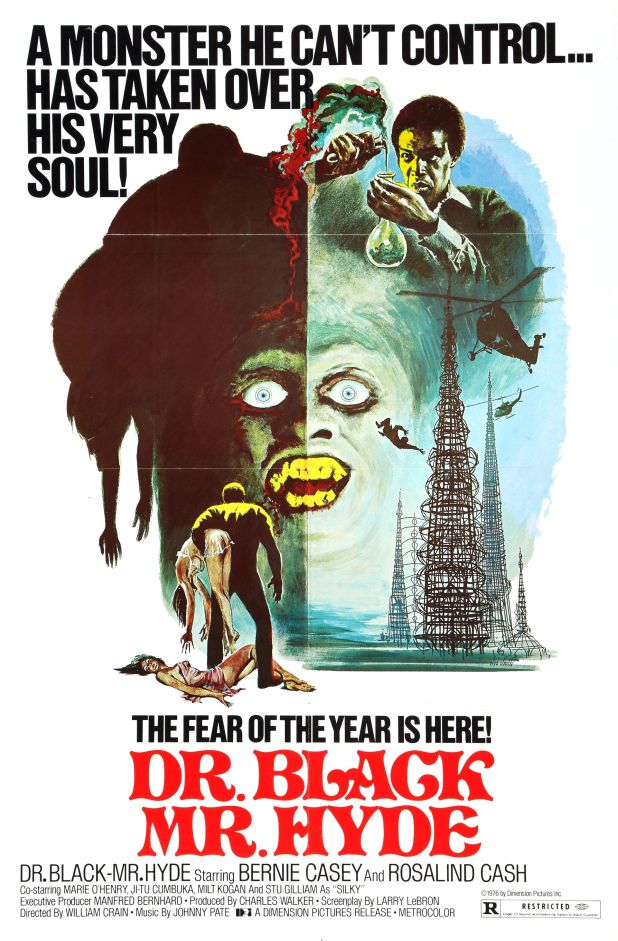
RE/SEARCH Incredibly Strange Films: Dr. Black, Mr. Hyde (1976)

American-International Pictures’ Blacula was a big success. Its director, William Crain, and AIP wanted to make more black films that were classic stories retold for a new audience. What’s interesting here that while adapting Strange Case of Dr. Jekyll and Mr. Hyde by Robert Louis Stevenson, the evil side of Dr. Henry Pride (Bernie Casey) appears to be a mix of King Kong, Frankenstein’s Monster and an evil white man.

Pride may be a celebrated and wealthy African American medical doctor, but as he fails to discover a cure for cirrhosis of the liver — along with his colleague Dr. Billie Worth (Rosalind Cash) — he begins to experiment on himself and others. Coming just a few years after the way our government treated the Tuskegee airmen with their syphilis experiments, this feels like not only a crime against nature, but a black man attacking his very race.

By the end, he’s killing sex workers and their pimps, leading the police to Watts Towers, where he climbs upward — again, like King Kong — before being shot and falling to his death.

This also had the working titles The Watts MonsterHydeSerum and Decision for Doom. Along with the aforementioned BlaculaScream Blacula ScreamSugar HillBlackensteinJD’s RevengeAbbyGanja and Hess and Petey Wheatstraw, there are some other black-themed horror films from this era but not enough. Later films in the genre that I would recommend are BonesDef by Temptation and Tales from the Hood.

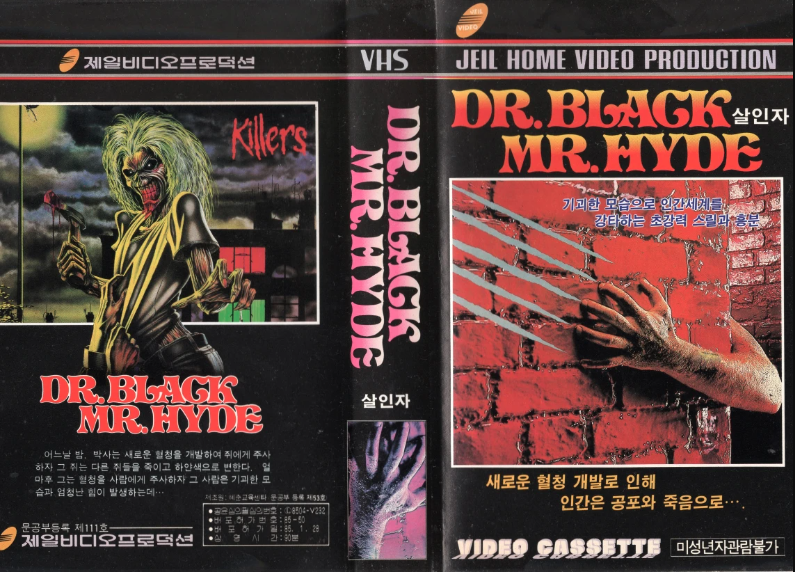
How incredible is it that the South Korean VHS release of this had the Iron Maiden artwork from Killers on its back cover?

You can watch this on Tubi.

RE/SEARCH Incredibly Strange Films: Last Date (1950)

Jeanne (Joan Taylor, 20 Million Miles to Earth) has just dumped boring — and safe driving — Larry (Robert V. Stern) and hooked up with hot ro racer Nick (Dick York!), who drives 55 MPH which is three times the speed limit. Nick and everyone in his car celebrate his great football game and the school dance by racing over a hundred miles an hour, blasting right into a truck and killing everyone but Jeannie, ruining her face forever or at least until a mad scientist can go all Eyes Without a Face on her.

This movie has a radio DJ who reminds us about teenicide, which is “the fine art of killing yourself, and maybe someone else, before you reach the age of 20. You do it with an automobile.”

They never show the destroyed face of Jeannie but we’re left to imagine just how horrible it is.

Last Date was directed by Lewis D. Collins, who made 127 movies, including Jungle Goddess. It was written by Bruce Henry. I don’t know if it will make you slow down.

You can watch it on YouTube.

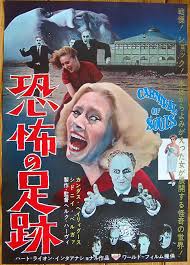
RE/SEARCH Incredibly Strange Films: Carnival of Souls (1962)

This 1962 American independent horror film is literally an auteur production: it was written, produced and directed by Herk Harvey, as well as featuring him in the role of the spectral figure that haunts its heroine.

While teaching and directing plays at the University of Kansas, Harvey started working for the Centron Corporation as a film director, writer, and producer on industrial films and commercials. He was lauded for his special effects techniques and ability to work under budget.

After the success of low budget films by Elmer Rhoden Jr. and fellow industrial filmmaker in nearby Kansas City, Harvey secured $33,000 in funding to make his lone film, although he attempted to film several others. Because the company that distributed the film went bankrupt, it wasn’t seen much in initial release but soon gained an audience at drive-ins and via late night showings.

For the rest of his life, Harvey continued creating industrial films and acting, even appearing in the harrowing made-for-TV movie, The Day After. Luckily, he did live to see people recognize this film as a classic. He died weeks after the soundstage at the University of Kansas was renamed the Herk Harvey Sound Stage.

Mary Henry gets involved in a drag race with her car going off the bridge. The police drag the waters for three hours before she rises, unsure how she could have survived.

Our heroine movs to Utah, a place where can’t connect to anyone and can only get organ music on the radio. Her journey to her new home is marked by appearances by “The Man” (Harvey), a spectral figure that comes and goes, and an abandoned pavilion on the Great Salt Lake that begs for her to visit it in the twilight.

Mary begins to disappear from the world, becoming invisible and unheard by everyone around her, as if she weren’t there. And on her first day at her new job as a church organist, when she begins to play an eerie tune, The Man and a group of corpses begin to dance until the minister begins to scream, “Profane! Sacrilege!” Truly, diabolus in musica — those demonic tritones are afoot.

Every attempt to escape the town is stopped by The Man and his dead people, including them taking over an entire bus. Finally, Mary makes her way back to the pavilion, where she watches them dance and notices that a ghoul version of herself is with The Man. She runs, but they catch her. The minister, a doctor and the police try to find Mary, but as they follow her footprints in the sand — is this when God was carrying her? — they end with no trace. Back in Kansas, her car is finally found beneath the water with her dead body still inside.

The US release of Carnival of Souls failed to include the copyright on the prints, automatically placing them in the public domain. That’s how numerous TV stations would show different prints of this movie, cut however they wished to fit its timeslot. Again, it wasn’t until the late 1980’s that this film would be recognized as the arty horror that it is, a precursor to the work of artists like David Lynch and George Romero, who specifically said that it inspired him to make Night of the Living Dead.

In turn, this is a movie inspired by the silent films of the past, with parts where Mary is in one of her altered mental states being tinted cyan while all the scenes of reality appear in black and white. Later, the tinted scenes become distorted in both sound and picture. There’s also an original organ score by composer Gene Moore that makes this movie feel trapped in cinema’s past.

The Church of Satan’s leader Anton LaVey spoke glowingly of this movie: “Carnival of Souls is another richly evocative film that has been completely lost until recently. Producer/director Herk Harvey did industrial films and this was his brilliant excursion into the world of nightmares.”

You can watch this for free on Tubi.

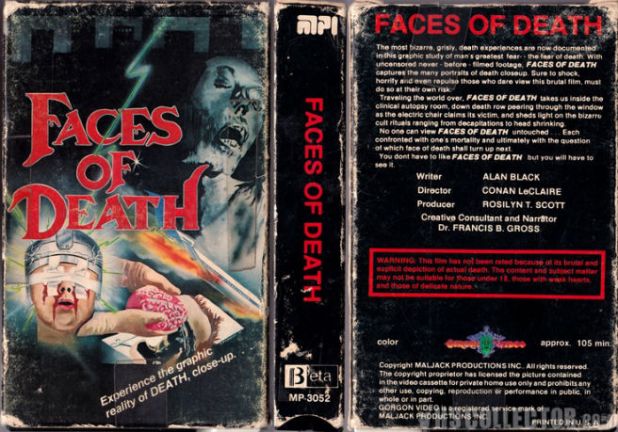
RE/SEARCH Incredibly Strange Films: Faces of Death (1978)

I’ve discussed the video store of my youth often, but no movie in Prime Time Video inspired such dread as Faces of Death, its gigantic clamshell package covered with a note scrawled in sharpie: YOU MUST BE 18 TO RENT.

This feels like a movie made from VHS, as where were people going to see this in 1978?

Written and directed by John Alan Schwartz (using the name Alan Black for the screenplay and Conan LeCilaire for directing, as well as Johnny Getyerkokov for second unit and appearing with no screen name for his role as the leader of the cannibal cult), this film made $35 million at the box office, despite being outlawed in the UK and made a video nasty. It was not banned in forty countries, no matter what the box art may scream at you, and it really doesn’t contain all that much real death either.

Try telling that to the kids in my hometown in the mid-80s.

They believed that pathologist Francis B. Gröss — actually portrayed by Michael Carr — was a real doctor who was using video to explore the phenomena of death itself. They spoke breathlessly of the moments in this movie and it was another torture test film, one people bragged about surviving.

As this was a non-union film, there weren’t many credits, so it could have seemed real. But today, so many people have come forward discussing how they were involved in the movie. Estimates are that 40% of the film is fake, but the death scene of the female cyclist is real and the alligator scene also shows up in Naked and Cruel.

In today’s world, we have the internet, which has non-stop access to the kind of footage that Faces of Death could only dream of having access to getting. As such, we are numb to the kind of panic and worry that one would have with this movie staring back at them from the shelves of a mom and pop video store.

Is it any wonder that Legendary is rebooting this film series but making it friendlier? Here’s the logline for the film: “A female moderator of a YouTube-like website whose job is to weed out offensive and violent content and who herself is recovering from a serious trauma, who stumbles across a group that is re-creating the murders from the original film. But in the story primed for the digital age of online misinformation, the question is: Are the murders real or fake?”

Nobody is going to have nightmares about that movie.