CBS LATE MOVIE MONTH: Dracula A.D. 1972 (1972)

EDITOR’S NOTE: Dracula A.D. 1972 was on the CBS Late Movie on March 18, 1981. You can download the full episode with commercials at the Internet Archive.

Warner Brothers and Hammer saw how well Count Yorga, Vampire did with young moviegoers and decided that it was time to make a modern Dracula.

While today, many associate Christopher Lee and Peter Cushing with their roles as Dracula and Van Helsing, this was the first time that Cushing played the role since Brides of Dracula. And while this was the sixth time Lee played the Count, the two had not battled since the original Hammer Dracula. It would be the next to last time they faced off in the roles and the next Hammer Dracula, The Satanic Rites of Dracula, would be the last for them to both play these characters.

It opens with Count Dracula and his nemesis Lawrence Van Helsing battling atop a carriage that crashes, impaling Dracula. With his mortal wounds about to end his life, Van Helsing finally destroys his archenemy. This is a thrilling opening — kind of like a Bond movie — but to Hammer continuity lovers, this invalidates the last few movies and starts a new timeline.

In 1972, Jessica Van Helsing (Stephanie Beacham, And Now the Screaming Starts!) and her hippie friends are convinced to come and watch Johnny Alucard (Christopher Neame, The Love Factor) perform a Black Mass — set to White Noise’s “Black Mass: An Electric Storm in Hell” — at the deconsecrated St Bartolph’s, the same church where her descendent Van Helsing and Dracula were both buried.

He soon draws the blood of Laura Bellows (Caroline Munro!) and brings Dracula back from the dead, as the Count quickly drains the lifeblood of the young girl. Then, they start to turn all of Jessica’s friends like Bob (Philip Miller) and Gaynor Keating (Marsha Hart) into vampires, all to draw her back to the Lord of the Vampires so that he can keep getting revenge on Van Helsing, who has a descendent, Lorrimer (also Cushing), the grandfather of Jessica.

This movie features controversial Page Three girl Flanagan — who was the Kray Twin’s mother’s hairdresser and campaigned for their release — and Concord, CA ten-piece band Stoneground. Three members of that group — Cory Lerios, Steve Price and David Jenkins — would later form Pablo Cruise. They were in the movie to replace The Faces, which would have been wild.

In the U.S., a brief clip was played before this movie in which Barry Atwater (Janos Skorzeny from The Night Stalker) rises from a coffin and swears the entire audience in as members of the Count Dracula Society as part of a HorroRitual.

This played as part of some great double features with TrogTwins of Evil and Crescendo.

CBS LATE MOVIE MONTH: Zabriskie Point (1970)

EDITOR’S NOTE: Zabriskie Point was on the CBS Late Movie on August 5, 1977.

Another movie that I only knew as bad because that’s what the Medveds said, it took me nearly forty years from when I first read their books to finally watch this. In The Fifty Worst Films of All Time. they wrote that it was “the worst film ever made by a director of genius.” As always, they were wrong.

Michelangelo Antonioni was known at the time for a trilogy of films — L’Avventura, La Notte and L’Eclisse — as well as Blowup and The Passenger. In 1994, he was given an Honorary Academy Award “in recognition of his place as one of cinema’s master visual stylists” presented by Jack Nicholson.

Zabriskie Point was savaged by critics and performed poorly yet has been re-evaluated today. Antonioni was inspired by an article he read about a young man who stole an aircraft and was killed when he tried to return it. He wrote the first draft and then had Sam Shepard, Franco Rossetti, frequent collaborator Tonino Guerra and Clare Peploe all write drafts. Stars Mark Frechette and Daria Halprin were hired because of an argument Frechette had in a bus station and Halprin’s appearance in the documentary Revolution. Neither had been screen tested.

The film was controversial before it was even shot. Rumors were out that Antonioni would gather 10,000 extras in the desert for a real orgy; instead the scene is highly choreographed with actors from The Open Theatre. Believing this, the United States Department of Justice investigated whether this violated the Mann Act, which forbids taking women across state lines for sexual purposes. No sex was ever filmed and the production was always in one state, California. However, police in Sacramento were waiting to arrest the director and the FBI and Oakland police also were sure that he staged a riot and wanted to arrest him for that.

The only movie that Antonioni made in the U.S., it was seen as “a noble artistic impulse short-circuited in a foreign land” by Vincent Canby, David Fricke wrote that it was “was one of the most extraordinary disasters in modern cinematic history” and Roger Ebert said of the protagonists, “Their voices are empty; they have no resonance as human beings. They don’t play to each other, but to vague narcissistic conceptions of themselves. They wouldn’t even meet were it not for a preposterous Hollywood coincidence.”

During a college strike, Mark leaves, claiming that he is “willing to die, but not of boredom.” As he’s arrested outside, real estate salesman Lee Allen (Rod Taylor) is working on ads for his new Sunny Dunes resort, which will be sold with mannequins instead of humans. Mark gets out of jail and watches a police officer die in another riot — Harrison Ford is briefly in one of these scenes — and runs to an airport where he steals a plane and flies away.

Daria is driving through the desert in a big Buick to meet Lee, who may be her boss or lover. She meets Mark first as he buzzes her car. They walk to Zabriskie Point and make love, along with thousands of others. She begs him not to fly back to L.A., but he does and is killed. She makes it to Lee’s new Sunny Dunes home and she’s not the same person she used to be. Leaving, she imagines that the mansion — which was recreated on a soundstage; Antonioni was amazed by how wasteful American moviemaking was compared to Italy — blows up.

The soundtrack was filled with music of the time, unlike many movies, with songs from Pink Floyd, The Youngbloods, Kaleidoscope, Jerry Garcia, Patti Page, Grateful Dead, the Rolling Stones, John Fahey and a love theme — “So Young” — by Roy Orbison. There was so much music that some never ended up in the movie. Richard Wright of Pink Floyd wrote a song called “The Violent Sequence” for the end of the movie, but Antonioni used a re-recording of the band’s “Careful with That Axe, Eugene”, retitled “Come in Number 51, Your Time Is Up.” Roger Waters said that the suggested song was “too sad” and sounded like church. It was revised by the band and became “Us and Them” on Dark Side of the Moon. Antonioni also visited The Doors while they were recording Morrison Hotel and while the recorded the song “L’America” for this, it went unused.

Frechette lived and died much like his character. He and Halprin also became romantically involved during the film’s long shooting schedule with Mark’s wife consent. After his divorce, Daria didn’t want to live in a commune like Mark so they also broke up. When they were on The Dick Cavett Show, Cavett said that he hadn’t seen the movie. Frechette replied, “Save your money.” Cavett laughed and said, “Well that’s the first time an actor has been on this show to unplug his movie.”

Three years after this movie played theaters, he was imprisoned for his part in a bank robbery in Boston. Two years later, he died in prison when a weightlifting barbell fell on his neck. It’s thought that he was one of several victims of sexual abuse by Rev. Laurence Francis Xavier Brett of the Roman Catholic Diocese of Bridgeport in Connecticut. What a wild life, as he was trying to raise money to make a movie and some think that’s why he was involved in the bank robbery.

Antonioni’s original ending was a shot of an airplane skywriting the phrase “Fuck You, America.” Obviously, that was cut. But this was the first studio film to have the word motherfucker in it.

CBS LATE MOVIE MONTH: The Wicked Dreams of Paula Schultz (1968)

EDITOR’S NOTE: The Wicked Dreams of Paula Schultz was on the CBS Late Movie on March 8, 1977; January 30 and November 9, 1978.

Director George E. Marshall’s career saw him make movies with Laurel and Hardy, Bob Hope, Jerry Lewis, W. C. Fields, Jackie Gleason and Will Rogers. Before that, he was a combat cinematographer with the U.S. Army Signal Corps in France during World War I. He also acted in several films and TV shows. Working from a script by Albert E. Lewin (the director of the 1945 The Picture of Dorian Gray), Nat Perrin (head writer of The Addams Family) and Burt Styler (a TV veteran who wrote the “Edith’s Problem” episode of All In the Family) — based on a story by Ken Englund — this was made on a summer hiatus for Hogan’s Heroes and stars three cast members: Bob Crane (Col. Robert E. Hogan), Werner Klemperer (Col. Wilhelm Klink and a U.S. Army veteran), John Banner (Sergeant Hans Georg Schultz; a Jewish Austrian, he defended being on the show by saying, “Schultz is not a Nazi. I see Schultz as the representative of some kind of goodness in any generation.”) and Leon Askin (who was General Burkhalter and whose parents died in an actual German concentration camp).

Paula Schultz (Elke Sommer, Baron Blood, Lisa and the Devil) has been training for the Olympics as part of the East German team. The truth is that she has been learning the pole vault so she can go over the Berlin Wall where she’s taken by con man Bill Mason (Crane) to his friend in the CIA, Herb Sweeney (Joey Forman).

Bill isn’t into the West vs. East Cold War. Instead, he loves money. He’s willing to take money from either side for Paula and she loves him. Crushed, she goes back to her home, only for him to realize that he had Elke Sommer and then he goes back to her homeland dressed as a woman to win her back.

This has even deeper Hogan’s Heroes connections as several of the actors in it played guest roles on the show. Theodore Marcuse had three roles, General Freidrich von Heiner, Pierre and Ludwig Strasser, as did Larry D. Mann, who was Illyich Igor Zagoskin, SS General Brenner and Doctor Vanetti. Overachiever John Myhers was in four different  episodes as Colonel Schneider, Dr. Hermann Felzer, General Wittkamper and Field Marshal von Heinke. Barbara Morrison was in just one as Mrs. Gretchen Schultz.

Not many would remember this movie today if it wasn’t for Quentin Tarantino. Chapter 7 (“The Lonely Grave of Paula Schultz”) in Kill Bill Vol. 2. comes from this movie, as does the name of Dr. King Schultz’s (Christoph Waltz) wife in Django Unchained.

The Sizzlin’ Something Weird Summer Challenge 2024: The Terror of Tiny Town (1938)

Roadshow Rarities (June 30 – July 6) In the old days of theatrical releases some of the more lavish movies would be promoted by holding limited screenings in large cities. These roadshow releases would generate hype before the nationwide release and allow producers to tweak the film to the audience’s reaction. This model also worked for low budget productions that may have had no intention of a wide release. These explo roadshows traveled an informal circuit of theaters, churches, revival tents, high school auditoriums and anywhere else they could run a projector. They frequently promised more than they delivered and left town before the angry audience could catch up to them. Through the restoration efforts of SWV many of these movies have survived to piss audiences off to this very day!

Sam Newfield directed around 250 movies. He didn’t specialize in a genre. He made about twenty movies a year. He made so many movies that he also used the names Sherman Scott and Peter Stewart so that it wouldn’t seem like he had made so many.

In fact, Fred Olen Ray even used the name Sherman Scott to make Tomb of the Werewolf, Haunting Desires, Super Ninja Doll, Girl with the Sex-Ray Eyes, Bikini-A-Go-GoThe Bikini Escort Company, Bikini Cavegirl, Bad Girls from Mars and The Prophet. He used Peter Stewart for 13 Erotic GhostsDear Santa and Mom’s Outta Sight.

Newfield heard someone say, “If this economic dive keeps going, we’ll be using midgets as actors.” That’s why he made a Western with little people.

It starts with a man (Stephen Chase) introducing the movie and stars Buck Larson and Bat Haines getting ready to fight before the story has even played. In that story, Haines and his gang are stealing the Shetland ponies of Buck’s father and selling them to another farmer, Tex Preston. Buck also falls in love with that man’s niece, Nancy (Yvonne Moray).

Buck was played by Billy Curtis, who started his career in the vaudeville and pro wrestling. In his fifty year career, he was in everything from The Wizard of Oz (as the Munchkin city father) to the AIP small person gang film Little Cigars and High Plains Drifter. He also played Mayor McCheese, Bark Bent and Superpup in the wild pilot The Adventures of Superpup, a Martian in The Angry Red Planet, a child ape in Planet of the Apes and appears in Eating Raoul.

The bad guy is played by “Little Billy” Rhodes, who was the Barrister in The Wizard of Oz, which also had Charlie Becker (the cook in this movie) play the mayor, John T. Bambury (Buck’s dad) was a soldier, Joseph Herbst (the sheriff) was a soldier, Nita Krebs (a vampire in this movie!) was one of the Lullaby League, George Ministeri (the blacksmith) was a villager, Fern Formica (Diamond Dolly) was a sleepyhead, William H. O’Docharty (The Old Soak) was a villager and Jerry Maren was a townsperson in both movies. He was also the last surviving cast member of The Wizard of Oz with an identifiable speaking or singing role before dying in 2018.

Many of the actors were former members of the performing troupe The Singer Midgets — I apologize for having to keep using that racially horrible term — which was founded by Leopold Singer. He even created Liliputstadt, a special town at the Venice in Vienna amusement park, where they could perform. Singer provided 124 actors and stand-ins to play Munchkins. While his employees called him Papa, some say he kept half their money. This movie’s star, Billy Singer, said that he “had a reputation for cheating his midgets.”

This is another movie that Harry Medved and Randy Lowell listed in The Fifty Worst Films of All Time (And How They Got That Way). It also won he P.T. Barnum Award for Worst Cinematic Exploitation of a Physical Deformity in the Medveds’ The Golden Turkey Awards.

As always, they are wrong.

This was written by Clarence Marks and Fred Myton, who wrote over 170 movies, including Nabonga.

You can watch this on Tubi.
CBS LATE MOVIE MONTH: The Uncanny (1977)

EDITOR’S NOTE: The Uncanny was on the CBS Late Movie on May 29, 1980 and December 11, 1981.

In 1977, legendary Amicus co-founder Milton Subotsky joined with  Canadian producer Claude Héroux (Scanners, Videodrome) to create a portmanteau movie in the grand Amicus style. The uniting story for this concerns a paranoid writer played by Peter Cushing who is trying to convince a publisher (Ray Milland) that cats are evil and that his book is the only way to save the human race.

Directed by Denis Héroux (Naked MassacreValerie) from a screenplay by Michel Parry (Xtro), this is a film that I’ve neglected over the past few years and can happily say lived up to my hopes for a fun anthology film.

The film begins the Montreal of 1977, as writer Wilbur Gray (Cushing) visits publisher Frank Richards(Milland) to discuss his new book. The writer is convinced that cats are actually Satanic creatures here to destroy humanity. He tells three stories to explain:

London 1912: Miss Malkin rewrites her will, leaving everything to her cats instead of her ne’er do well nephew Michael. The maid Janet, who is in love with Michael, tries to steal the will, but Miss Malkin catches her. Janet kills her, but the cats avenge her death.

Quebec 1975: Lucy (Katrina Holden Bronson, the adopted daughter of Charles Bronson and Jill Ireland) is an orphan who now lives with her aunt Mrs. Blake (Alexandra Stewart, who is also in Because of the Cats, which is appropriate). Her parents have died in a plane crash so she is allowed to keep her cat Wellington, who is an awesome fat black cat. However, her cousin covets the cat and any attention she can get. She’s played by Chloe Franks, who was the go to young girl in horror for this era, with appearances in Trog, The House That Dripped Blood (she’s Christopher Lee’s daughter), Whoever Slew Auntie Roo? and Tales from the Crypt (she’s Joan Crawford’s daughter). This section combines two of my horror loves — evil kids and Satanic hijinks.

Hollywood 1936: Actor Valentine De’ath (Donald Pleasence) replaces the blade of a fake pendulum to kill his actress wife, which gives him the opening he needs to give his young mistress a chance at acting. He didn’t count on her cat avenging her. This chapter features Samantha Eggar (DemonoidWelcome to Blood City), Sean McCann (Starship Invasions) and the always awesome John Vernon (CurtainsNational Lampoon’s Animal House).

This story has one of my favorite movie tropes, as when Cushing discusses Pleasence’s character, he holds up a photo that is in truth a publicity still of the actor as Blofeld and his cat Tiddes from You Only Live Twice.

For all the cat love in this, cinematographer Harry Waxman (The Wicker ManThe Beast In the Cellar) threatened to leave the film when he felt that the production was abusing cats.

That said — this is pretty much everything you want from an anthology. Modern filmmakers littering on demand services with their short films all assembled into one movie should take a moment and watch this to see how it’s done.

You can get this from Severin and watch it on Tubi.

CBS LATE MOVIE MONTH: Golden Needles (1974)

EDITOR’S NOTE: Golden Needles was on the CBS Late Movie on October 8, 1980 and May 29, 1981.

Golden Needles begins with an elderly asian man being treated to various needles that literaly rise both him — and his member — back from the dead, at which point his grinning harem guides him out of the room just in time for a group of flamethrower-spraying masked troopers to kill every single person with fire.

That’s how you start a movie.

As for the actual film, well, various groups are fighting amongst themselves to gain possession of a very special statue that has golden needles within it. If they inserted in the right areas on a man, he will gain super sexual skills. Or die, if things are done wrong.

Director Robert Clouse made Enter the Dragon and this finds him teaming up again with Jim Kelly, along with 70s sex symbol — I mean, I guess — Joe Don Baker. God bless American-International Pictures for making this movie and getting the cast they did, which includes Elizabeth Ashley (Windows) as Baker’s love interest and one of the people who wants the statue, Burgess Meredith as the nude man painting bad guy and Ann Sothern as a brothel owner.

You have to love a movie that has the credit “Jim Kelly’s Fight Sequence Choreographed By Himself” and then realize that that fight is filled with nude men trying to take a shower and their rear ends being used for comedy.

This movie is just the way I like them: filled with Joe Don Baker love scenes, karate and a PG rating for a film that starts with fire murders in a massage parlor.

CBS LATE MOVIE MONTH: Mitchell (1975)

EDITOR’S NOTE: Mitchell was on the CBS Late Movie on October 1, 1980.

Mitchell reveals a lot of misconceptions.

First: Joe Don Baker was once presented as the kind of sex symbol who didn’t just get Linda Evans in bed, he was kind of angry about it.

Second: Mitchell was not intended to be riffed on. And yet here we are, with a movie that most people know from the final episode that Joel was on Mystery Science Theater 3000.

Then again, critics hated this when it came out in 1975. Vincent Carnaby said, “Mitchell, starring Joe Don Baker as a hard-nosed Los Angeles detective named Mitchell, has a lot of over-explicit violence, some gratuitous sex stuff and some rough language, yet it looks like a movie that couldn’t wait to get to prime-time television. Perhaps it’s a pilot film for a TV series, or maybe it’s just a movie that’s bad in a style we associate with some of the more mindless small-screen entertainments.

Mitchell spends what seems to be the greater part of the film climbing in and out of automobiles, driving automobiles, chasing other automobiles, parking automobiles, and leaning against the body of automobiles that are temporarily at rest. Once he smashes a hoodlum’s hand in the door of an automobile.

The climax, for a giddy change of pace, features a police helicopter in pursuit of a high-speed cabin cruiser. Automobiles sink when driven onto water.”

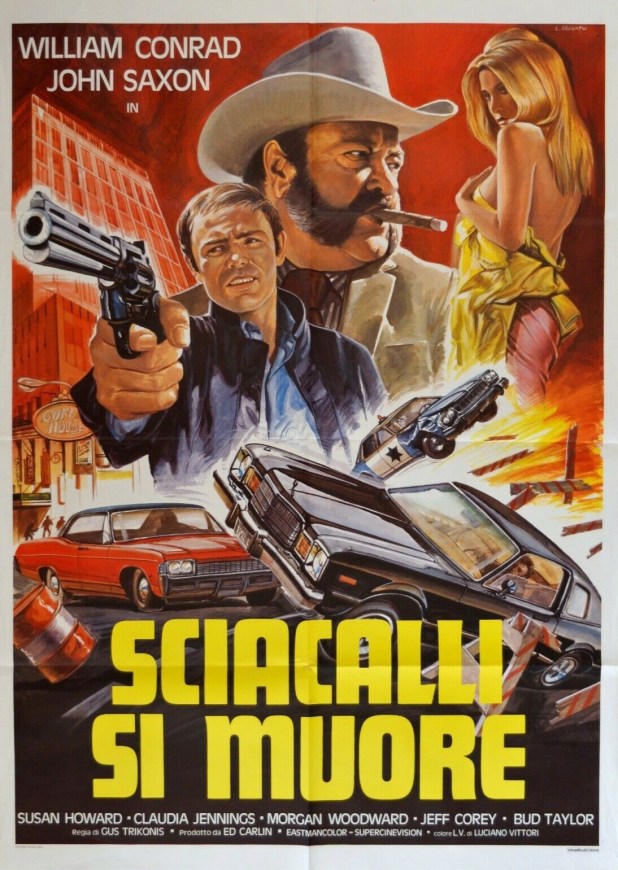
He could have been right. After all, the cut that aired on the CBS Late Movie was heavily edited with scenes shot just for TV, eliminating most of the violence, nudity and profanity. It also has the death of John Saxon’s character happen off screen, where we hear about his death on the radio. Keep in mind that he’s presented as Mitchell’s arch enemy.

Mitchell (Baker) is after Saxon’s character, Walter Deaney, but learns from the Chief of Police (Robert Phillips) tells Deaney is wanted for “every federal law violation in the book” and  “FBI property.” This doesn’t stop Mitchell, who wants to go after him instead of staking out James Arthur Cummins (Martin Balsam), a crime boss shipping in heroin. To get him off the case, Deaney hired $1,000 a night call girl Greta (Linda Evans) to keep him busy. Instead, Mitchell arrests her for possession and even turns down a bribe. Soon, Deaney and Cummins are working together to kill our slovenly hero.

If you enjoy larger men battling, this has Baker fighting Merlin Olsen. I mean, we’ve already imagined a world where a high priced sex worker wants to sleep with Baker for free. Why not?

Directed by Andrew V. McLaglen (The Wild GeeseThe Sea Wolves, Sahara) and written by Ian Kennedy Martin, this also has a great theme song, “Mitchell” by Hoyt Axton.

“My my my my Mitchell
What do your Mama say?
What would she do
if she knew you
were fallin’ round and carryin’ on that way…
Crackin’ some heads, jumpin’ in and out of beds
and hangin’ round the criminal scene…
Do you think you are some kind of a star like the guys on the movie screen…

Well oh my my my Mitchell
What would your captain say?
If he knew you was hangin’ round
Eatin’ with the crooks and shootin’ up the town
Know you been out there, roundin’ up the syndicate
succeedin’ where the others have failed
Oh my my my Mitchell
You shoot ’em just to get ’em in jail
When they take a look in the record book, they’ll find you got a lot of class…

The whole shebang, arrestin’ painted ladies for a little grass
Oh my my my Mitchell!”

Supposedly, Baker was so upset by this being on Mystery Science Theater 3000 that he threatened to fight anyone from the show if he saw them. That didn’t stop them from also doing another of his movies, Final Justice — another movie in which he uses an orange to prove how he is going to destroy someone — on the show.

You can watch this without riffing on Tubi. They also have the Mystery Science Theater 3000 version.

The Sizzlin’ Something Weird Summer Challenge 2024: She Shoulda Said No (1949)

Roadshow Rarities (June 30 – July 6) In the old days of theatrical releases some of the more lavish movies would be promoted by holding limited screenings in large cities. These roadshow releases would generate hype before the nationwide release and allow producers to tweak the film to the audience’s reaction. This model also worked for low budget productions that may have had no intention of a wide release. These explo roadshows traveled an informal circuit of theaters, churches, revival tents, high school auditoriums and anywhere else they could run a projector. They frequently promised more than they delivered and left town before the angry audience could catch up to them. Through the restoration efforts of SWV many of these movies have survived to piss audiences off to this very day!

According to the Hash, Marihuana & Hemp Museum of Amsterdam and Barcelona, “On September 1, 1948, LA police entered the luxurious home of actress Lila Leeds, investigating an alleged “marijuana party.” Along with her roommate Vicki Evans, actor Robert Mitchum and his friend Robin Ford, the young actress was arrested for marijuana possession. At the time, this was a felony in California. They were released from jail after posting bail of $ 1,000 each, but Lila Leeds’s life had changed forever. After her release, the only acting job she could get in Hollywood was the role of a ‘stoner girl’ in the movie She Shoulda Said No!

Also known as The Devil’s Weed and Wild Weed, it’s based on her life. It was originally distributed by Eureka Productions who lost money and sold it to Kroger Babb. He originally tried the title The Story of Lila Leeds and Her Exposé of the Marijuana Racket, but that didn’t do well. Babb never gave up and re-released it as She Should Said No. With the tagline, “How Bad Can a Good Girl Get… without losing her virtue or respect???” and telling local governments that this movie was made under the orders of the United States Treasury Department.

The final reel even thanks the government for their help — they gave none — saying that the producers “publicly acknowledge the splendid cooperation of the Nation’s narcotic experts and Government departments, who aided in various ways the success of this production…. If its presentation saves but one young girl or boy from becoming a dope fiend – then its story has been well told.”

Babb also booked Leeds to show up with the film, which I can only assume made the midnight showings a bigger deal.

She plays Anne Lester, who is trying to raise money to put her brother Bob (David Holt) through school. This means that when she meets the drug dealer Markey (Alan Baxter) she easily falls for marijuana and promiscuity. When her brother discovers what his sister is doing, he hangs himself and she goes to jail. Drugs are bad!

Jack Elam is in this, as is Leo Gorcey’s brother David. There’s also Lyle Talbot, who never turned down a role and was one of the first actors to play Superman’s arch enemy Lex Luthor.

You can watch this on Tubi.
CBS LATE MOVIE MONTH: Billy Jack (1971)

EDITOR’S NOTE: Billy Jack was on the CBS Late Movie on November 14, 1980 and November 20, 1981.

You may have thought that Billy Jack was dead after The Born Losers, shot in the back while trying to do the right thing. The truth is, he was just getting started. An anti-authority film, this movie struggled to be made, with American International Pictures pulling out while it was being made. Then, 20th Century Fox stepped in but refused to distribute the film. Auteur Tom Laughlin would not release the sound for the film, making it unreleasable until he could own the film himself, getting Warner Brothers to distribute it. He was unhappy with how Warner Brothers sold the film, so he sued them and finally released the movie himself.

At the heart of the film, the movie presents a conundrum: the only way to achieve peace is to repeatedly beat the stuffing out of people.

Also, the Navajo Green Beret Vietnam War veteran and hapkido master known as Billy Jack is played by director (as T.C. Frank), producer (as Mary Rose Solti) and co-writer (as Frank Christina) Tom Laughlin, who is totally white. That said, the role of Billy Jack is anything but the way that Native Americans had been portrayed up until the early 70s.

Laughlin was also a muckraker, really in the best of ways. He’d written the film nearly two decades before after seeing the way Native Americans were treated in Winner, South Dakota, the home of his wife Delores Taylor. What took so long to get it to screen? Well, beyond building his acting career, Laughlin also quit acting in 1959 to start a Montessori preschool in Santa Monica, California.

After the school went out of business, he went back into acting and after the Billy Jack series, he was set to change the world with Billy Jack Enterprises, which had plans for a new Montessori school, a record label, an investigative magazine, books, a distribution company and more message-laden movies, including films for children. Yet the last movie, Billy Jack Goes to Washington, didn’t connect with audiences. Or, as Laughlin charged, it was the fault of Warner Brothers illegally selling the television rights to his films. Or even Senator Vance Hartke, who he said told him that, “You’ll never get this released. This house you have, everything will be destroyed.” in front of Lucille Ball, angered that the film correctly pointed out how senators were owned by lobbyists.

There was going to be a fifth film, The Return of Billy Jack, that ended in the 2000s when Laughoun got hurt and the money ran out. He claimed for years that it would get made with the title changing to Billy Jack’s Crusade to End the War in Iraq and Restore America to Its Moral PurposeBilly Jack’s Moral Revolution and Billy Jack for President, with the plan to have Billy Jack and President George W. Bush debate each other.

Man, I wish that was made.

That said, the original Billy Jack is an incredibly strange movie, a film made of a singular vision.

Billy Jack is the defender of the Freedom School, a school full of happy children taught my Laughlin’s real-life wife Delores, who are assaulted from all sides by the horrible folks of the redneck town where, for some reason, they have decided to make their home. A movie this strange demands a run-on sentence like that to describe it.

This is the kind of movie where the hero must face off with a snake and purposefully be bitten with venom so that he can become brothers with the snake, as well as have a theme song “One Tin Soldier (The Legend of Billy Jack),” which was recorded by Jinx Dawson and her band Coven, whose album Witchcraft Destroys Minds & Reaps Souls is as metal as it gets, even featuring a black mass as its second side.

You don’t really watch Billy Jack. It washes over you. The words I use to describe it aren’t enough. It’s absolutely ridiculous in the finest of ways and I really want you to experience it.

CBS LATE MOVIE MONTH: The Ultimate Warrior (1975)

EDITOR’S NOTE: The Ultimate Warrior was on the CBS Late Movie on July 2 and November 24, 1982 and February 6 and July 15, 1986.

There had been post-apocalyptic movies before — End of the World came out in 1916 — and the genre was already a big deal by 1975, following The Omega Man and Soylent Green. So when most people believe that end of the world movies started in 1979 with Mad Max, they’d been around long before.

The Ultimate Warrior is pretty much a western — all good post-apocalyptic movies are — with a frontier town under attack. That town would be a small fort in what’s left of New York City, a place led by Baron (Max Von Sydow). One of his followers is a former scientist named Cal (Richard Kelton), who has developed plague resistant seeds that grow in the dead soil, creating a desert in the wasteland.

And, just like every western — and again, post-apocalyptic movie — there are gangs of bad people making the lives of good people hard. One of those gangs is led by Carrot (William Smith!) and Baron is so worried about them that he hires on a loner gunslinger — or fighter — named Carson (Yul Brynner).

Even with his abilities, the settlement is still doomed. So Baron sends his pregnant daughter Melinda (Joanna Miles) away from the citty with the goal of building a new world on a North Carolina island. But escaping the city isn’t easy and it costs nearly everyone their lives and Carson his hand, but the ultimate warrior is nothing if not resilient. Or deadly.

Director and writer Robert Clouse knew how to make a movie with fights as the main draw, as he directed Enter the Dragon and Game of Death with Bruce Lee, as well as Black Belt Jones with Jim Kelly, Golden NeedlesForce: FiveThe Big Brawl with Jackie Chan, Gymkata with Kurt Thomas, two China O’Brien movies with Cynthia Rothrock and Ironheart with Bolo Yeung. He also made the animal attack movies The Pack and the rats on the loose film Deadly Eyes.

And yes, this movie is where the wrestler got his name from.