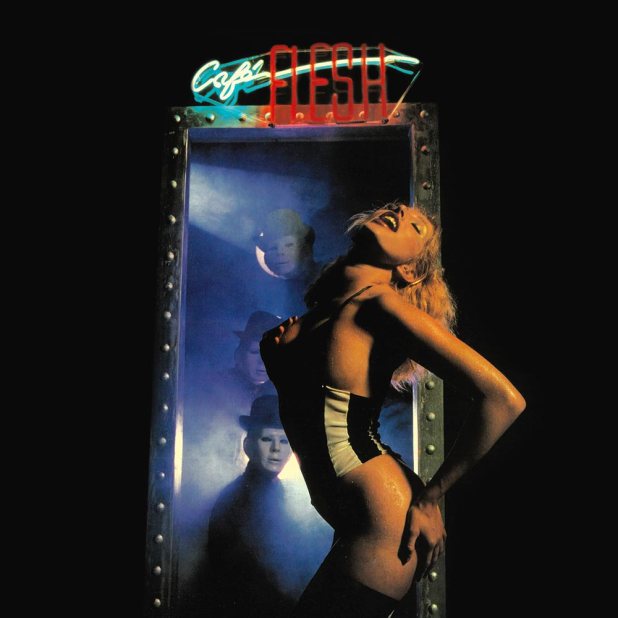
MOVIES THAT PLAYED SCALA: Café Flesh (1982)

Thanks to the British Film Institute, there’s a list of films that played Scala. To celebrate the release of Severin’s new documentary, I’ll share a few of these movies every day. You can see the whole list on Letterboxd

The story of X may have been three years early, but the video revolution — driven, as all technology is, by sex — changed the world of pornography, moving it from the fleshpots of 42nd Street and dirty book stores into suburban living rooms. In 1982, there was still the glimmer of hope that the Golden Age of Porn — that starts with Bill Osco’s Mona and ends sometime around 1984 or so with The Dark Brothers’ 1984 mind-twisting New Wave Hookers — would find new life, better budgets and a more appreciative audience.

Yet videotape would open up adult for everyone and by the 90s, few films had a storyline, instead given to gonzo explorations of “can you top this” madness with few exceptions, such as the output of John Stagliano (who may have popularized gonzo, but could also create a coherent and interesting narrative film like Buda), the glossy Michael Ninn glamour movies, Andrew Blake’s Night Trips, Phillip Mond’s Zazel, John Leslie’s Chameleons and Curse of the Cat Woman, the aforementioned Dark Brothers and ridiculous parodies of existing films.

Yet in 1982, a movie could be made that transcends its adult origins and uses them to make you as the viewer complicit in the action on screen.

Stephen Sayadian only made seven adult films (this film, as well as two sequels to Nightdreams, two Untamed Cowgirls of the Wild West and two Party Doll-a-Go-Go films which take the staccato editing and weird dialogue to its absurd limit on sets that had to cost absolutely nothing yet with a cast of all-stars such as Raven, Madison Stone, Patricia Kennedy, Bionca, Jeanna Fine, Nikki Wilde and Tianna Collins and yes, I wrote that from memory) as well as the somewhat spiritual sequel — or at least next steo — to this movie, the mainstream — yet still delightfully insane — Dr. Caligari. A veteran of advertising and design — he worked on the posters for The Fog, The Funhouse, Ms. 45 and Dressed To Kill which took inspiration from the iconic The Graduate poser — Sayadian used the alter ego of Rinse Dream to make his films, much as Gregory Dark would adopt a new name for his porn changing efforts.

The script — yes, adult movies can have a script — was written by Herbert W. Day, who is really Pittsburgh native Jerry Stahl, the son of a coal miner who later became Pennsylvania attorney general and a federal judge. He found that he had a talent for writing short stories, was the humor editor for Hustler and also discovered a love of hardcore drugs. To fuel that, he started writing for TV shows like MoonlightingTwin PeaksThirtysomethingNorthern Exposure and, perhaps most intriguingly, ALF. He’s also written ten episodes of CSI which have been the most aberrant examples of that show to middle America, which is wild as he introduced viewers of the grandparent network CBS to furries, infantilism, a measured story about transgendered people and introduced Lady Heather, the potential bad girl love interest of lead Gil Grissom, who was played by Return of the Living Dead III star Melinda Clarke. His autobiographical novel Permanent Midnight was a success and made into a movie starring Ben Stiller.

Years after a nuclear war, nearly every survivor is a Negative, often shambling zombie-like humans who become vomitous if they attempt to copulate. To attempt any hope at remembering what human contact was like, they come to Café Flesh, a place where Positives make love while they watch, often engaging in surrealist scenes that defy the ability of the viewer to become titillated.

That’s the point. Where the goal of nearly all pornography is to get the viewer off, Cafe Flésh casts you as a Negative, stuck at home with no one next to you, as far from true warmth and, well, flesh as the puking crowd — Richard Beltzer is one of them — gathered to watch and watch and watch.

It also feels like the vaudevillian stage of the men’s club gone to Hell, as Max Melodramatic (Andy Nichols, who also played the doctor in Nightdreams) introduces live sex acts with people dressed as rats or milkmen surrounded by men dressed as demonic babies. Even the typical jerk-off scenario of a female oil tycoon lies with a gigantic pencil while her secretary repeatedly intones, “Do you want me to type a memo?”

Is the film making light of the fact that male performers had often become interchangeable, their faces are obscured for most of the movie?

Angel (Marie Sharp) came from Wyoming, where they found that she was Positive and she’s been forced into the slavery of the club, performing with each man that they bring on stage. However, one of the audience members, Lana (Michele Bauer, using her Pia Snow name here before she would go on to appear in so many horror movies like DemonwarpEvil ToonsSorority Babes in the Slimeball Bowl-O-Rama and Jess Franco’s Lust for Frankenstein and Mari-Cookie and the Killer Tarantula In Eight Legs to Love You) has been keeping have Positive diagnosis a secret as she doesn’t want to hurt her boyfriend Nick. Yet as she watches the famous Positive Johnny Rico (Kevin James, who speaking of nuclear war is also in the porn parody Dr. Strange Sex) — someone liked Robert Heinlein — go through his motions with Angel,  her frustrations take hold and she takes the stage.

Screen Slate has an amazing article that details the music of this movie, which Sayadian describes as “…like an Elmer Bernstein score from the ’50s, only played with the most modern synthesizers available at the time. I thought: old vibe, new technology.” There’s a lot to learn about composer Mitchell Froom — and the rest of the film’s creators — at that site.

By the way — Sayadian didn’t direct Rockwell’s “Someone’s Watching Me” video. That would be  Francis Delia, who directed Nightdreams as F.X. Pope. Seeing as how Stahl and Sayadian wrote that movie, I can see how some may make the mistake. Delia was a producer on this film as well as the director of photography.

Café Flesh isn’t for someone who is looking to get off. I can’t even imagine those that were confronted by it in adult theaters, as it punches you in the face with its AIDS allegory while daring you to find a single erotic thing in it. Strangely enough, I’d always heard that an R-rated edit was made so that mainstream audiences would see it at midnight shows, but Sayadian stated — in the above linked Screen Slate piece — that the movie was an “R-rated movie, funded by X-rated people” and that he was forced to add the sex scenes by the money men behind the budget.

He said, “I got financing from three guys — two were hardcore producers and one was a Harvard business grad who somehow got lost in the porno world.” After adding in the adult scenes, he told Froom, “I want you to extend some of these pieces because we may have to put porn in there. And all I can say is, I want the music to be as disturbing as possible. I don’t want it to be hot or sexy or anything like that.”

That said, the moans of joy that came from this movie show up in a place that many have heard them, White Zombie’s Blade Runner quoting song  — “Yeah I am the nexus one I want more life” — “More Human than Human.”

MOVIES THAT PLAYED SCALA: El Topo (1970)

Thanks to the British Film Institute, there’s a list of films that played Scala. To celebrate the release of Severin’s new documentary, I’ll share a few of these movies every day. You can see the whole list on Letterboxd

A combination of exploitation film, spaghetti (well, maybe chili con carne given its origins), art film and quest for enlightenment, El Topo is either the greatest movie you’ve ever seen (me) or complete bullshit that seems to go on forever and ever (my wife).

El Topo and his son are traveling the desert when he instructs his son that he is now a man and must bury his first toy and a photo of his mother. The naked child — either symbolizing purity or just a lack of wardrobe budget — rides with our protagonist as he walks through a town that has been decimated.

The black-clad gunfighter finds those responsible and destroys them, including castrating their leader, the Colonel. Rescuing that man’s woman, who he calls Mara, El Topo learns of four gunfighters that cannot be defeated. He abandons his son and goes with her on a quest.

From here on out, it’s a mix of religious and sexual interplay as well as gunfights that grow more and more mystical. There’s also a no legged man riding a no arms having man, a master who can catch bullets in a butterfly net, a dude who can stop bullets with his body, a woman who sounds like birds when she screams, hundreds of dead rabbits, people spontaneously going up in flames and their graves secreting honey and bees, and so much more. Throughout each gun battle, El Topo grows weaker as he must rely on trickery instead of skill. Each win feels more like a loss, particularly as Mara becomes more demanding and grows fonder of the unnamed woman with the voice of a man who has been riding with them.

El Topo visits the sites of each of his four battles and is shot numerous times by the woman as he crosses a bridge. His body is taken by dwarves and mutants as the first part of the film ends. Becca was sure this was the end of the movie and I didn’t have the heart to tell her that there was much, much, much more to come.

Our protagonist has been born again as a Christ-like figure who has meditated for at least 20 years in the caves of an inbred group of mutants. He is now cleaned and shaved as he promises to return them to the light (the mole, who El Topo is named for, constantly claws its way to the sun, but is then blinded). To get there, he and his new bride, a dwarf woman, must beg and be part of a series of skits that take advantage of them, climaxing with them being forced to make love in a room full of the town’s men.

And this town — it’s covered with Illuminati imagery, worships guns, takes slaves and destroys them to the cheers of an adoring crowd. It also feels a lot like America.

Of course, El Topo’s son is now a monk in this town and when he and his bride attempt to marry, he tries to kill his father for leaving him behind. He agrees to spare the old man’s life until he frees his people.

Finally free, the mutated cavepeople run to the town, thinking it is their salvation. Instead, they are massacred and El Topo is shot numerous times. Remembering what he learned from the gun battles, he rises and kills every single one of them. Then, he sets himself on fire (“I kind of figured this would happen sooner or later,” said my wife) as his child is born. His grave also releases honey and bees as his sons and wife ride on into the distance (there was once hope of a Sons of El Topo movie with Marilyn Manson as the star, but it has not happened. There was, however, a comic book, which will be released in the US in December of 2018).

El Topo has inspired legions of fans, from John Lennon (who championed the film and had Allen Klein, manager of The Beatles, buy it and show it nationwide at midnight screenings, then produced the follow-up The Holy Mountain) to David Lynch, Dennis Hopper, Gore Verbinski (citing that debt in his animated film Ringo), Nicolas Winding Refn and Suda 51, whose video game No More Heroes has a similar plot about finding and destroying the best assassins in the world.

A midnight movie staple for years, El Topo disappeared in the 1980’s and 90’s, as Allen Klein would not give up his rights to the film. I searched for years, as Heads Together (a long lost and lamented rental store in Pittsburgh) had the only copy in town, one that was constantly checked out. This was 1994 — nearly pre-internet and not the time when you could easily stream or order and film. It wasn’t until another sadly lost shop, Incredibly Strange, opened in Dormont that I was able to get a copy of the Japanese laser disc release. Since then, I’ve acquired the blu ray of the film, which makes it totally convenient to view at any time.

You can imagine my excitement when the movie was playing a midnight show at Row House, a theater in Pittsburgh’s Lawrenceville neighborhood. Before the film, the owners and programmers of the theater sat on stage and apologized for showing it, as they had just learned of the rape scene in the film and that Jodorowsky had claimed in past interviews that it was real (to be fair, he’s also said that it was consensual and that he penetrated her). This scene lasts around 30 seconds or less of screen time and shows no actual sex. I’ve read tons of books on the film and watched it so many times over the years and never really dealt with this controversy myself.

They said that they debated not showing the film — keep in mind before this talk, they did a trivia contest to give away tickets, which is kind of darkly humorous that they would put something that was quite literally trivial before such a big discussion and announcement — then said that they decided to show the film and donate its proceeds to a charity that they literally could not remember the name of. Then, they talked about future movies coming to the theater and couldn’t remember much of next month’s schedules other than Tokyo Tribes, which was described with the world rap more than five times.

At the risk of sounding like an asshole, this whole affair came off as handwringing and hand washing at the same time. If the theater had an issue with this, they should have not shown the film. Upon further research, no one is sure whether or not this scene is an actual rape. In interviews, Jodorowsky has been given to mania, saying things that any normal person would think is insane, such as using his proposed Dune to create a prophet and actual drugs on celluloid. I’m not giving the man a pass in the interest of hero worship (full disclosure, I am a fan of several of his movies), but the actress that played Mara (Mara Lorenzio) supposedly couldn’t be found to be paid and was on LSD for most of the production (this doesn’t suggest consent, just setting up that the film was shot during very different times). She did, however, make an appearance in the documentary Midnight Movies: From the Margin to the Mainstream where this was not discussed.

I will share that years after making the movie, Jodorowsky felt that he stole of some son’s childhood by making him take part in such a violent film. He flipped the opening of the film and had him dig up the teddy bear and a photo of his mother and told him, “Now you are 8 years old, and you have the right to be a kid”.

I don’t think this absolves him of whatever happened in this film. But the whole incident with the theater has left a bad taste in my mouth. I feel like they should have offered refunds (I wouldn’t take one), but instead by giving proceeds to charity, they took that choice away. They still advertised the movie up until hours before it went on with no mention of this controversy. And I overheard one of the people on stage mention that he’d never seen the film, only having seen The Holy Mountain and was interested to see what it was all about.

Again — I’d have more respect for them if they took an actual stand and didn’t show the film. It just felt like they were absolving themselves of it and almost challenging the audience to witness an actual rape if we wanted to stay and watch it. I realize that we’re evolving and changing as a society and I feel that it’s a great thing. And I can’t really collect my thoughts and properly express them here — I’ve tried — but it just all felt messy. And I guess that’s how these things are. The whole way that the affair was conducted didn’t give me any faith or trust in Row House as a theater, to be perfectly honest.

Sorry for the soapbox, but I had a lot to get off my chest. So what can we learn from this film? Well, “too much perfection is a mistake,” is a good start. I also learned “moderation in everything, even in moderation” from a fortune cookie last week. So there’s that.

I’ve also learned that the more I try and go out and experience film with others, I’m reminded that thanks to blu ray and my high def TV, I often feel a lot better just watching them at home. That’s what dooms most second run and boutique theaters, the apathy, along with the fact that I can spend money on a blu that’s equal to my ticket and get a better experience at home. Theaters should be selling that something extra and giving you more — again, a soapbox and I want to see these places succeed.

PS – The group they claim to have donated to was PAAR, Pennsylvania Action Against Rape. It’s one of the oldest rape crisis centers in the country and a totally worthwhile charity. It’d have felt a lot more genuine and honest if they could have remembered their name and told us something about them then stumbled through a speech that certainly needed nuance and actual notes.

I also understand that men have traditionally been horrible to women and this behavior could certainly have happened. The truth isn’t completely sure here and it’s a very difficult issue to maneuver. I just wanted to call out that I felt it was handled in a ham-fisted way and that there are better ways to handle such topics. I’m not justifying the actions of the filmmaker or the words he’s said (or changed over the years).

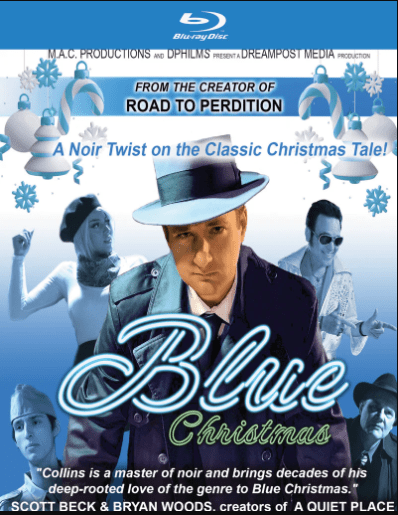
25 DAYS OF CHRISTMAS CHALLENGE and VCI PICTURES BLU RAY RELEASE: Blue Christmas (2024)

Max Allan Collins took over Dick Tracy for Chester Gould in 1977 and stayed on it for 15 years while also writing the Nathan Heller books — he won the Best Novel Shamus award for Stolen Away — as well as the graphic novel Road to Perdition (which became a movie), the comic books Ms. Tree and Wild Dog, and has directed four movies: MommyMommy 2: Mommy’s DayReal Time: Siege at Lucas Street Market and Eliot Ness: An Untouchable Life. If that isn’t enough, he’s a two-time member of the Iowa Rock ‘n’ Roll Hall of Fame and has written several movie novelizations, including the last two G.I. Joe movies and books based on CSICriminal Minds and Bones.

This story came along at a bad time for its creator. “The day before Thanksgiving 1992, I was notified by mail in a letter from a particularly odious editor at Tribune Media Services that my services as writer of the Dick Tracy strip were no longer required. I had done the writing of the strip, taking over for creator Chester Gould, since late 1977 – a fifteen-year run plus a few months.”

The same day, he lost his contract with Bantam books.

It was this story that broke his writer’s block after all that happened.

On Christmas Eve 1942, private eye Richard Stone (Rob Merritt) is celebrating. He’s gotten out of the draft with a bribe, which may cost him his secretary and girl Katie Crockett, whose brother is oversees fighting the war. His employee Joey (Tommy Ratkiewicz-Stierwalt) is getting sick of spying on cheating husbands and wives. And then there’s his partner Marley (Chris Causey), who was killed a year ago, a crime that he didn’t even try to solve.

That night, Stone is visited by Jake Marley, on leave from Purgatory so that he can convince Stone to solve his death. He brings three ghosts with him: the Ghosts of Christmas Past (Bonnie Parker, played by Alisabeth Von Presley), Present (a recently killed soldier, Hank Ross, played by Keith Porter) and Future (The King, who isn’t even old enough to be Elvis Presley yet, but ghosts don’t conform to the space time continuum; he’s played by Scot Gehret).

Sure, you know the story A Christmas Carol, but you’ve never seen it as a film noir. This is a really interesting movie and it’s awesome to see it come to life, knowing that Collins has been wanting to get back to making movies for several years. Go in knowing it had a small budget, but be wowed because it has big ideas at its heart. I’m definitely adding this to my annual holiday film rotation.

This VCI Pictures blu ray has extras including commentary by Collins and Producer/Editor Chad T. Bishop, Q & A highlights from advanced theatrical screenings and a documentary featuring Collins. You can get it from MVD.

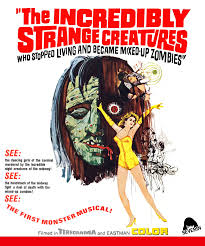
MOVIES THAT PLAYED SCALA (AND SEVERIN BLU RAY RELEASE): The Incredibly Strange Creatures Who Stopped Living And Became Mixed-up Zombies!!? (1964)

Thanks to the British Film Institute, there’s a list of films that played Scala. To celebrate the release of Severin’s new documentary, I’ll share a few of these movies every day. You can see the whole list on Letterboxd

Made for $38,000, this film beat The Horror of Party Beach as the first monster musical by just a few months. It was the brainchild of the man known as Sven Christian, Sven Hellstrom, Harry Nixon, Wolfgang Schmidt, Cindy Lou Steckler, R.D. Steckler, Michael J. Rogers, Michel J. Rogers, Ray Steckler, Cindy Lou Sutters and, of course, Ray Dennis Steckler.

Before he became a B movie director, supposedly Steckler worked at Universal, where he bumped into an A-frame and dropped it onto Alfred Hitchcock. This ignominious exit would soon lead him to a world where he’d make baffling films like The Thrill KillersRat Pfink a Boo Boo and The Hollywood Strangler Meets the Skid Row Slasher. His adult film titles read like the kind of movies that exist only in my dreams, such as Sexual Satanic Awareness and Sexorcist Devil.

Jerry (Cash Flagg, another name for Steckler, auteuring it up by starring in his own movie), Angela and Harold decide to head out to the carnival, where they watch Marge (Carolyn Brandt, Steckler’s wife; their station wagon is also in the film) dance.

Marge is spooked by a black cat, which leads her to consult with Estrella, a fortune-teller who is throwing acid in peoples’ faces and making them zombies under her control. She predicts death for Marge, as well as a death near water for someone Angela knows.

Jerry falls in with the carnies because Estrella’s sister Carmelita stares him down and does her bad girl dancing to hypnotize him into acts of murder. You know how it goes. Of course, the zombies soon break loose, nearly everyone dies and Jerry is shot on the beach in front of his one true love, making that earlier prediction come true.

Also — dance numbers!

Steckler was a real showman, taking this movie on the road and constantly retitling it with outlandish names like The Incredibly Mixed-Up Zombie, Diabolical Dr. Voodoo and The Teenage Psycho Meets Bloody Mary. The posters proclaimed that the movie was made in Hallucinogenic Hypnovision, which really meant that at some point, maniacs in rubber masks would run around the theater. If you guessed that Steckler was one of those maniacs, you’d be right.

It was shot at The Film Center Studios, a former Masonic lodge owned by Rock Hudson — yes, I realize that this sounds like the start of a conspiracy story.

Perhaps most strangely — incredible strangely? — the cinematography and camera operating crew included three men who would go on to become major figures in the field.

Joseph V. Mascelli, who also worked on The Thrill Killers and Wild Guitar, wrote The Five Cs of Cinematography. Laszlo Kovacs would work on movies as disparate as A Smell of Honey, a Swallow of Brine and Easy Rider; he was considered a guiding light in the American New Wave. And then there’s Vilmos Zsigmond, whose work on Close Encounters of the Third Kind would win an Oscar (he also worked on The Deer Hunter and Heaven’s Gate).

In his 1987 book Psychotic Reactions and Carburetor Dung, Lester Bangs wrote an essay called “The Incredibly Strange Creatures Who Stopped Living and Became Mixed-Up Zombies, or, The Day The Airwaves Erupted.” Within, he’d state, “…this flick doesn’t just rebel against, or even disregard, standards of taste and art. In the universe inhabited by The Incredibly Strange Creatures Who Stopped Living and Became Mixed-Up Zombies, such things as standards and responsibility have never been heard of. It is this lunar purity which largely imparts to the film its classic stature. Like Beyond the Valley of the Dolls and a very few others, it will remain as an artifact in years to come to which scholars and searchers for truth can turn and say, “This was trash!”

Even more astounding, Columbia Pictures threatened to sue over this movie’s original title, The Incredibly Strange Creature: Or Why I Stopped Living and Became a Mixed-up Zombie. Supposedly the title was too close to the Kubrick film Dr. Strangelove or: How I Learned to Stop Worrying and Love the Bomb. Steckler called the studio and demanded to speak to Kubrick, a crazy move, and of course, Kubrick answered and agreed to the new title and the lawsuit was dropped. This whole story feels so insane that it has to be true.

The Severin blu ray release of this film has three hours of bonus features, including an introduction by Joe Bob Briggs, two commentaries (one by Ray Dennis Steckler and the other by Joe Bob), an interbiew with Carolyn Brandt, deleted scenes, a VHS trailer and a re-release trailer and a radio ad for Teenage Psycho Meets Bloody Mary. You can get this from Severin.

MOVIES THAT PLAYED SCALA (AND SEVERIN BLU RAY RELEASE): Satan’s Sadists (1969) and Angel’s Wild Women (1971)

Thanks to the British Film Institute, there’s a list of films that played Scala. To celebrate the release of Severin’s new documentary, I’ll share a few of these movies every day. You can see the whole list on Letterboxd

Satan’s Sadists (1969): Al Adamson made his breakthrough with this movie, going on to direct Dracula vs. FrankensteinCinderella 2000Nurse Sherri and one of the most legitimately unhinged movies I’ve ever survived, Carnival Magic. Even stranger, he was murdered and buried beneath his hot tub in 1995, killed by his live-in contractor Fred Fulford in a plot that could have been one of his films.

However, today we’re talking about his contribution to biker films.

The Satans are a motorcycle club who roam the American Southwest, led by Anchor (Russ Tamblyn, TV’s Twin Peaks) and including Firewater (John “Bud” Cardos, Breaking Point), Acid (Greydon Clark, who directed Satan’s Cheerleaders), Romeo (Bobby Clark, TV’s Casey Jones), Muscle, Willie and Gina (Regina Carrol, Adamson’s wife who appears in nearly all of his films). We’re introduced to the gang as they beat up a man, rape his girlfriend and then push them and their car off a cliff.

They have the bad luck to get in the way of hitchhiker Johnny Martin, a Vietnam vet who is just trying to figure it all out. He gets picked up by Chuck Baldwin (Scott Brady, the sheriff from Gremlins) and his wife Nora. The old man’s a cop and wants to help the young Marine as he travels the highways. They all go to a diner, where we meet Lew (Kent Taylor, half of the inspiration for Superman’s alter ego), the owner, and Tracy, a waitress.

The Satans show up and ruin the budding romance between Johnny and Tracy, as they earn the ire of Chuck and his wife, who tosses a drink in one of their faces. Chuck tries to pull his gun, but the old man’s authority means nothing to the hardened toughs who beat the fuck out of him and rape his woman. Then, they kill all three — but not until Anchor screams out a totally inspired rant:

“You’re right, cop. You’re right, I am a rotten bastard. I admit it. But I tell ya something. Even though I got a lot of hate inside, I got some friends who ain’t got hate inside. They’re filled with nothing but love. Their only crime is growing their hair long, smoking a little grass and getting high, looking at the stars at night, writing poetry in the sand. And what do you do? You bust down their doors, man. Dumb-ass cop. You bust down their doors and you bust down their heads. You put ’em behind bars. And you know something funny? They forgive you. I don’t.”

The Satans don’t leave witnesses. Well, except for our hero and the waitress, who just escaped from Muscle and Romeo. Meanwhile, the gang meets three young girls and start partying with them. Gina can’t take seeing Anchor with other women, so she jumps off a cliff.

Willie tries to kill our heroes, but a rattlesnake saves them (!). Meanwhile, Firewater finds his body and comes to tell Anchor, who has gone insane and murdered all three girls. They fight and Firewater leaves the leader for dead. As he finally finds Johnny and Tracy, he is killed by a landslide (again, nature itself is against the bikers).

Finally, Anchor catches up to them and goes nuts, giving another soliloquy about being Satan. He raises Chuck’s gun to kill everyone, but Johnny simply throws a switchblade at him. “In Vietnam, at least I got paid when I killed people,” he says and at that, he and Tracy ride off on the villain’s cycle.

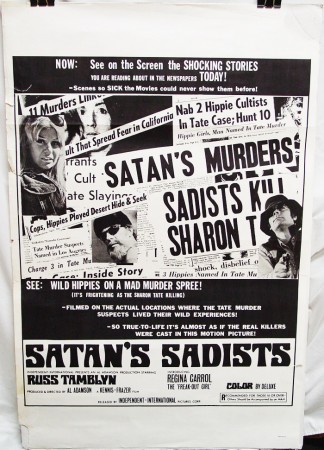
Satan’s Sadists was filmed at the Spahn Movie Ranch in Simi Valley, CA, at the same time the Manson Family lived there. Some movies would hide this fact. This poster will prove that this one wears it on its bloody sleeve.

Truly, this is a movie that does not give a fuck. Just about no one gets out alive or unscarred. Any moments of pleasure are stolen or taken by force. The poster promises human garbage and this film delivers.

Angel’s Wild Women (1971): After two men assault one of her girls, Margo (Regina Carrol) finds him and whips him. In between this movie being Screaming Eagles and tough women in foreign prison movies getting hot, this was reshot and re-edited to make it fit into the changing world of exploitation. Another thing that changed was while movies had been shot by Al Adamson at the Spahn Ranch for a while, now the specter of the Manson Family hung over everything. So when cult leader King (William Bonner) makes life tough for the bikers and also controls the ranch’s owner Parker (Kent Taylor), you get taken out of the movie and wonder how much of this is based on things Adamson and his crew actually experienced.

Sam Sherman told Filmfax: “We even had some members of the Manson gang in it, people who had been hanging around. I don’t know if they were killers or not. What happened in this instance was one of those things you can’t imagine or even predict.”

Ross Hagen is the hero, as much as anyone in a biker movie can be the hero.

Also known as Commune of Death, a title that leans into the Manson parts of this movie, this is a film that ends with Hagen dropping his motorcycle off a cliff and onto a car, which inexplicably explodes.

Both films are available on one blu ray from Severin. Extras include commentary on both movies by producer/distributor Samuel M. Sherman, outtakes, trailers and TV and radio commercials. You can get this from Severin.

25 DAYS OF CHRISTMAS CHALLENGE: Saint Nick (2024)

Directed by Justin Knodel, who wrote it with Chris Levine (who stars as Nick) and Christopher McGahan, Saint Nick is about Diane (Rachel Alig), who has a business trip over the holidays. Her son Trevor’s (Alex Lizzul) father can’t pick him up, so she’s forced to ask her brother Nick to watch him.

Nick spends all of his time in a bar and is the last person you’d want to watch your kid. But as you’ll learn, spending a week together over the holidays is probably the best thing that could happen to the two of these characters.

Everyone goes above and beyond in this indie comedy to make it way better than you’d expect. It makes fun of the schmaltz of Hallmark holiday movies without falling into the same problems. I had fun with it and if you’re looking something new over the holidays, this might be it.

You can learn more at the official site.

You can watch it on Amazon.

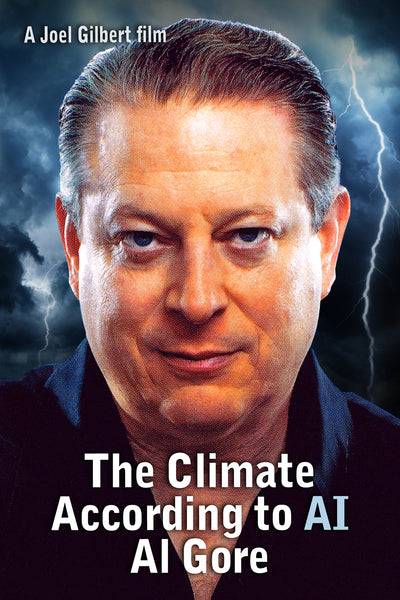
HIGHWAY 61 ENTERTAINMENT DVD RELEASE: The Climate According to AI Al Gore (2024)

This film promises “An AI generated “Al Gore” exposes the climate scare as a political tool to undermine capitalism and impose big government socialist ideals upon voters.”

Except that the AI for it is from Eleven Labs, the same site I use to create voiceovers for my podcast. It’s AI as much as it’s a program that does voices but it isn’t a program that can take on the mind of another human being and answer questions as them.

Director Joel Gilbert, who worked for Gore when he was a Senator, has learned that Harvard professor Roger Revelle was the source of Gore’s climate alarmism, in spite of Revelle supposedly rejecting those theories.

You may watch this and start to believe that, but there’s also the 2014 movie Merchants of Doubt, in which its explained that alate in his life, Revelle agreed to coauthor a paper with Austrian-born American physicist and emeritus professor of environmental science at the University of Virginia Fred Singer.

Soon after he agreed to write it, Revelle had a near-fatal heart attack. Singer then wrote most of the paper, including several sections arguing that climate change wasn’t the threat everyone says that it is nor is it understood enough for the government to be involved.

After Revelle’s death, Singer began telling people that Revelle shared his views on climate change. Revelle’s family and graduate student Justin Lancaster claim that Revelle regretted working with Singer and saw global warming as a serious issue up until his death.

Singer sued Lancaster over his claims, but some believe that these lawsuits were to undermine scientific evidence and prevent the public from distinguishing between legitimate and sham research.

Alright, two claims down.

But anyways…

Let me give Joel Gilbert a break and keep on explaining this movie.

Gilbert learned that the real origin of Al Gore’s climate apocalypse came from his time at Vanderbilt Divinity School and also explains how Gore plagiarized a radical environmental book from the 1940s to produce his 1992 manifesto, Earth in the Balance.

Most of this movie is Gilbert confronting what they refer to a an AI generated ‘Al Gore about his entire life story, such as his struggle to fulfill the political ambitions laid out for him by his parents.

Again, if you look at the credits, the AI is used to simulate the voice of Gore. Perhaps it was used to write some of the script, but almost every word feels inserted into the former Vice President’s mouth. There’s also a credit for the lip animation, which is why the “AI” Al Gore looks like he’s saying the words.

By the end of this movie, Gilbert believes that he has exposed “the climate scare as nothing more than a political tool used by groups who wish to undermine free-market capitalism and impose big government socialist ideals upon unsuspecting voters.”

Gilbert is also from Pittsburgh, just like me, so we need to get a beer and talk about the movies he’s made that I’m more interested in, like Paul McCartney Really Is Dead: The Last Testament of George Harrison and Elvis Found Alive. In no way to I want to talk about The Trayvon Hoax: Unmasking the Witness Fraud that Divided America or Atomic Jihad: Ahmadinejad’s Coming War For Islamic Revival And Obama’s Politics of Defeat. He’s also made several — many, many — Bob Dylan movies.

I mean, maybe I don’t want that beer. Look at this, from Wikipedia: “In 2019, George Zimmerman, represented by Larry Klayman, filed an unsuccessful lawsuit against Trayvon Martin’s parents (Sybrina Fulton and Tracy Martin) as well as Attorney Ben Crump, who had represented the family. Zimmerman’s lawsuit was based on the allegations made in Gilbert’s book.” He also made Dreams from My Real Father, in which he claimed that President Obama’s “real father was Frank Marshall Davis, a communist from Chicago, and that Obama’s mother posed for nude photography.”

He’s also classified his Paul and Elvis movies as mockumentaries before going into political films.

Are we now in a world where we can interview people we always wanted to even if they don’t want to be interviewed, all so they can say exactly what we want them to say?

Seems like it. Ugh.

You can get this from MVD.

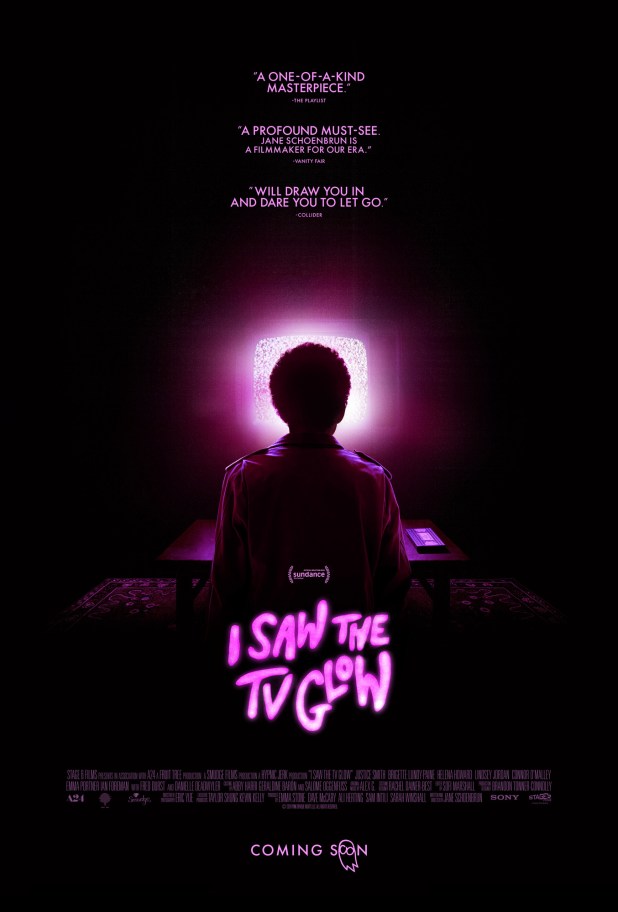
I Saw the TV Glow (2024)

I watched Jane Schoenbrun’s We’re All Going to the World’s Fair and didn’t enjoy myself, saying “Am I too old? Did I not grow up on Twitch?”

There were some very interesting comments that I read that explained why it meant something to other people. I went into I Saw the TV Glow with an open mind, as I was hoping I’d find something here that was missing for me.

Happily, I found it.

In 1996, Owen (Justice Smith) and Maddy (Brigette Lundy-Paine) feel isolate yet bond over a show called The Pink Opaque, which has Isabel (Helena Howard) and Tara (Lindsey “Snail Mail” Jordan) using their psychic powers to save themselves from Mr. Melancholy (Emma Portner), who can warp reality.

Owen’s parents are strict and he’s not allowed to stay up late, so he sneaks over to Maddy’s house to watch it. When he can’t, she gives him VHS tapes of it. She confesses that the show is more real to her than life itself.

Two years later, the two decide to run away. Maddy has an abusive stepfather who won’t leave her alone and she gets out. Owen stays behind as people wonder where Maddy went with her mother dying of cancer never seeing her daughter again. The TV show is cancelled. Life moves on.

Ten years later and Owen is still living with his father Frank (Fred Durst) and working in a movie theater. One night, Maddy appears and claims that she’s been living in the show for eight years. She makes Owen rewatch the tape of the last episode, as Mr. Melancholy buries the heroes alive and traps them in the Midnight Realm. He has a nervous breakdown and puts his head through his TV set.

Maddy reveals that she is Tara and that the episodes they watched are the real stories of their lives and reality is the Midnight Realm. She tries to bury Owen alive to show him the truth but he doesn’t go with her again and never sees her again.

Years later, after his father has died of a stroke and he’s moved on to work at an arcade, he watches The Pink Opaque and it isn’t how he remembered. It’s boring and a bit silly, but he has bigger things like being an adult to worry about.

Sixteen years later, Owen is still working in that arcade when he feels like he’s going to die. He makes his way to the bathroom and slices his chest open to reveal a TV playing the show. He staggers back out into the real — is it real? — world, apologizing to everyone.

What would is real? I wonder, Maddy refers to her friend Amanda as a “secret agent sent here to make my life miserable.” Amanda is played by Emma Portner, who is also Mr. Melancholy, Marco and the evil clown. Maybe Maddy is on to something.

If The Pink Opaque came back for a sixth season, its heroines would have climbed out of their own graves, just like Buffy did in season six, episode one of her show.

25 DAYS OF CHRISTMAS CHALLENGE and MILL CREEK DVD RELEASE: A Bluegrass Christmas (2024)

Katie Pendleton’s (Amanda Jordan) horse sanctuary may be forced to close unless she can convince her grandfather Ben (Stuart Johnson) to show up at a Christmas benefit concert. Yet the one-time bluegrass star has been hiding for years. Why is it closing? Because the Breckenridge family — Jim (Mike Shara) and Grant (David Pinard) — want to race a horse named Chocolate and Katie won’t allow them, so they take all their money away.

Well, Grant actually isn’t all that bad. And he wants to date Katie and learn more about her grandfather because he loves bluegrass. I have no knowledge of this music genre — or horses — so I am the perfect person to review this.

Her grandfather refuses to perform, so he gets country star Claire Crosby (Chelsea Green) to show up. Now this is something I do know. She’s a pro wrestler who used to be Laurel Van Ness in Impact and Reklusa in Lucha Underground, as well as wrestling for Pro WrestlinG Stardom in Japan. Before she came to WWE full-time, she was Daniel Bryan’s physical therapist Megan Miller and in an angle said he cheated on his wife Brie Bella with her.

This has nothing to do with Christmas, horses or bluegrass.

Almost every movie director Marco Deufemia has worked on is a holiday film. Writer Chris Dowling directed and wrote the series Blue Ridge. If you’re looking for a holiday movie that has a concert and horses, well, you came to the right stable.

You can buy this from Mill Creek Entertainment at Deep Discount.

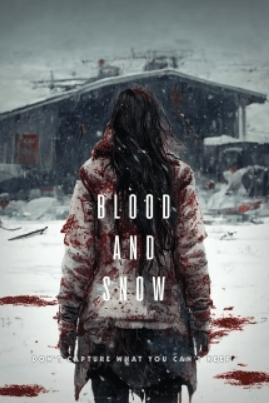
CLEOPATRA ENTERTAINMENT BLU RAY RELEASE: Blood and Snow (2023)

Directed by Jesse Palangio and written by Rossa McPhillips and Simon Phillips, Blood and Snow is going to invite critical comparisons to The Thing, as its about a meteor landing near an oil well in Canada and a woman named Marie (Anne-Carolyne Binette) who is infected by it. She’s taken back to the base by Sebastian (Michael Swatton) and Luke (Simon Phillips) and — as you probably guessed by now — something isn’t right.

It’s always nice to see Vernon Wells in a movie. Here, he’s The Professor, one of the few scientists who might be able to figure this out. As for Marie, she wants to spread the virus inside her, starting with the rescue team that is coming to save everyone.

This obviously has nowhere near the budget that it needs to have, nor does the way too quick ending close things up the right way. But for what it cost — and tempered expectations — it’s a fine cold weather alien movie. There’s hardly any gore, either. Movies don’t need it, but when you’re expecting something based on what this is cribbing notes from, a little guts would be lovely.

The Cleopatra Entertainment blu ray of this movie has a trailer and slide show. You can buy it from MVD.

You can also watch it on Tubi.