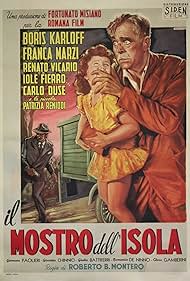
Il mostro dell’isola (The Monster of the Island) brought Boris Karloff to Cinecitta Studios to play Don Gaetano, who may speak softly but is also the leader of a gang of black market thieves and drug dealers who have kidnapped Fiorella (Patrizia Remiddi), the daughter of Detective Mario Andreani (Renato Vicario), who has come from America to Ischia, a small island off the Italian coast. Yes, that same undercover man’s wife, Giulia (Jole Fierro), has come along as well, jealous over her man and putting everyone in danger.
If his wife had stayed home, Mario would be romancing Gloria D’Auro (Franca Marzi), a member of the gang who sings at a nightclub. Don Gaetano may seem like a kindly man who runs a home for sick children, but he has no worries about straight-up kidnapping the little girl, even if she’s dubbed by an adult and it sounds like she’s related to Bob from The House by the Cemetery. For some reason—a lack of synced sound—Karloff is also dubbed, and it’s the most low-level impression of him ever.
Director Roberto Bianchi Montero would go on to make Una donna per 7 bastardiand The Slasher…Is the Sex Maniac!, as well as Caligula’s Hot Nights, Savana: Violenza carnale and Le notti segrete di Lucrezia Borgia. He wrote it with Carlo Lombardo and Alberto Vecchietti. There’s no monster, but you already figured that out.
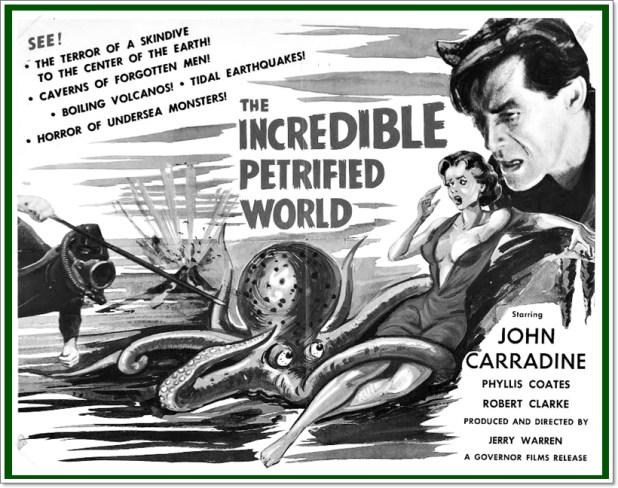
Jerry Warren sat on this movie for two years before playing it with Teenage Zombies. Shot in Colossal Cave in Tucson, Arizona, the monster costume looked so bad that Warren didn’t use it. Let’s think about that for a minute. An effect so bad that Jerry Warren wouldn’t use it.
Professor Millard Wyman (John Carradine) has sent Paul Whitmore (Allen Windsor), Craig Randall (Robert Clarke), Lauri Talbott (Sheila Noonan) and Dale Marshall (Phyllis Coates) to the bottom of the ocean, but their vehicle becomes lost. They swim — in scuba suits at crushing depths — into a cave where only Matheny (George Skaff), an old sailor, is still alive.
Professor Wyman’s brother, Jim (Joe Maierhauser), has luckily built another vehicle, because Matheny is looking at the ladies like a man who has been in a cave for more than a decade and suddenly has a gypsy girl from” Beast from the Haunted Cave” and Lois Lane right within staring distance. Before he can say, “You know, I killed a man,” a volcano goes live, he dies under some rocks, and all the white scientists celebrate their good fortune above the surface, and no one gets the bends.
Warren sold this with “A Nightmare of Terror in the Center of the Earth with Forgotten Men, Monsters, Earthquakes and Boiling Volcanoes!” I mean, yes, it has those things, but it’s…maybe not as exciting as the ads make it sound. The petrified world is the movie itself.
Professor Sir Alexander Saxton — or is that Sir Professor, anyway, he’s played by Christopher Lee — is a British anthropologist taking the Trans-Siberian Express from Shanghai to Moscow. He’s not alone. He has the frozen remains of a caveman he found in Manchuria, which he believes are the missing link. Peter Cushing plays his rival, Dr. Wells, who is also on board, as is Count Marion Petrovski (George Rigaud), his wife, Countess Irina (Silvia Tortosa), their spiritual advisor, Father Pujardov (Alberto de Mendoza), and Inspector Mirov (Julio Peña).
What no one knows is that the caveman also has an evil alien inside him, one that starts moving from person to person. While it’s been on Earth for millions of years, the monster wants to repair its ship and go back home. Captain Kazan (Telly Savalas) is able to stop it for some time, but Pujardov believes that the alien is Satan and pledges his soul to it, allowing himself to be possessed. Then, it raises all of the past victims as zombies.
Phillip Yordan supposedly made this movie because he had bought the miniature train from the film Nicholas and Alexandra. Director Eugenio Martín said, “He came up with the idea of writing a script just so he would be able to use this prop. Now, at that time, Phil was in the habit of buying up loads of short stories to adapt into screenplays, and the story for Horror Express was originally based on a tale written by a little-known American scriptwriter and playwright.”
However, producer Bernard Gordon, who also worked with Martin and Savalas on Pancho Villa, claimed that the train was made for that movie.
Lee and Cushing were the big draw for this movie, but Cushing nearly quit, as this was made during the first holiday season since the loss of his wife, Helen. According to an article by Ted Newsome, “Hollywood Exile: Bernard Gordon, Sci Fi’s Secret Screenwriter,” Lee fixed this by placing Cushing at ease, “talking to his old friend about some of their previous work together; Cushing changed his mind and stayed on.” It’s also said that he suffered from night terrors, so Lee would sleep in the same bed as him.
Strangely, when the U.S. rights were sold to Scotia International, the proceeds were $50,000 short of the budget. This led to the original camera negative being impounded. The theatrical prints show in America had to be struck from the workprint, which is why 70s TV and 80s VHS prints looked so dark.
Of all the great things about this movie, the fact that they can look inside a caveman’s mind and see dinosaurs is the most charming.
Also: As we all know, Phillip Yordan also made the best train movie of all time, Night Train to Terror.
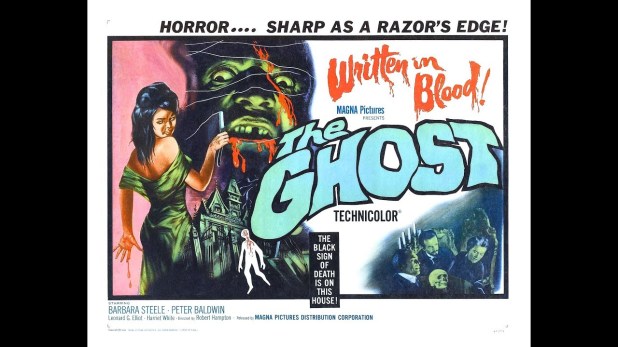
An Italian horror remake of 1955’s Les Diaboliques, I’ll give you one reason to watch this movie: Barbara Steele. Otherwise, it’s a brooding take on murder and gaslighting. And while this is directed by Riccardo Freda, stars Steele and has a character named Dr. Hichcock, it is not the same movie as The Horrible Dr. Hichcock. While this movie was shot right around the same time, it is also not a sequel per se. There are some people who care about these kind of things. Like me.
The ailing Dr. Hichcock and his housekeeper Catherine are engaged in a seance whole his wife Margaret (Steele) is having a love affair with Dr. Livingstone (Peter Baldwin, who in addition to acting in this movie and I Married a Monster from Outer Space, went on to become a director, being behind the camera for TV movies such as the aborted Revenge of the Nerds TV show pilot, The Harlem Globetrotters on Gilligan’s Island, The Brady Girls Get Married and The Brady Brides series follow-up).
Soon, the doctor is dead and Catherine, Margaret and Livingstone get none of the money. And the key to his safe? Well, he’s literally taken it to the grave. Every time they think they get close or find the money, they’re thwarted. And soon, Catherine the maid is possessed and throws shade on the lovers, convincing Margaret that she should kill the not so good doctor.
The close is where this movie turns the screw. Hichcock has been alive and well the entire time and he murders Catherine, his co-conspirator, and incriminates Margaret. She had been planning suicide and poured a glass of poison, which Hichcock thinks is poison. He begs for the antidote, but she walks away to be arrested for Catherine’s murder. As the movie closes, Hichcock seals himself away inside his castle to die.
Directed by Riccardo Freda and written by Oreste Biancoli, this is another movie that reminds me of how much I love Italian Gothic horror.
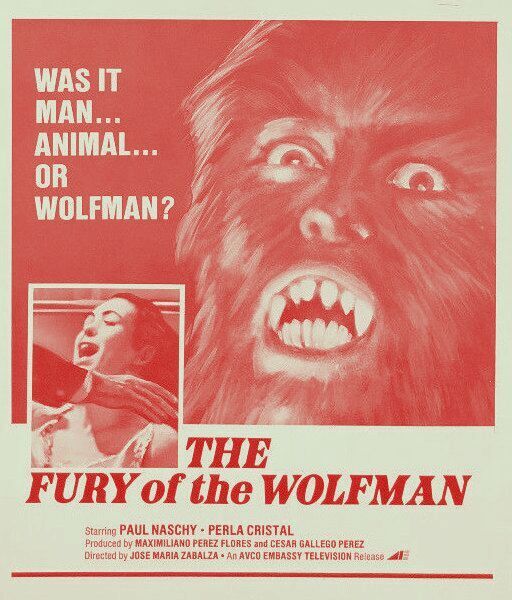
La Furia del Hombre Lobo is a 1970 Spanish horror film that is the fourth in the saga of werewolf Count Waldemar Daninsky, played as always by Paul Naschy. It was not theatrically released in Europe until 1975, yet an edited U.S. version played on television as early as 1974 as part of the Avco Embassy’s “Nightmare Theater” package, along with Naschy’s Horror from the Tomb and The Mummy’s Revenge.
This time, Daninsky is a professor who travels to Tibet, only to be bitten by a yeti which seems like not the werewolf origin that you’d expect. He then catches his wife cheating on him, so in a fit of passion, he murders them both before being killed himself. But this being a Spanish horror movie, that’s just the start of the trials that El Hombre Lobo must struggle through.
Daninsky is revived by Dr. Ilona Ellmann (Perla Cristal, The Corruption of Chris Miller), who wants to use him for mind control experiments. Soon, however, our hero learns that she has a basement filled with the corpses of her failed experiments. To make matters even worse, she brings back his ex-wife from the dead and turns her into a werewolf too!
There’s a great alternate title to this movie: Wolfman Never Sleeps. How evocative! That’s the Swedish version that has all of the sex that Franco’s Spain would never allow.
Naschy claimed that director José María Zabalza was a drunk, which may explain how this movie wound up padded with repeat footage from Frankenstein’s Bloody Terror and some stunt double continuity antics that nearly derail this furry film.
Tibby, the wife of Samuel Sweetland (Jameson Thomas), dies, and his daughter marries and leaves home. Now on his own, he decides to remarry with the help of his housekeeper, Minta (Lillian Hall-Davis). The women he chooses are too independent, too nervous or think he’s too old. You can see where this is going. Tibby and Minta are meant to be together.
Based on the play by Eden and Adelaide Phillpotts, this is an early Hitchcock film. He made this after The Ring, and it’s totally not a movie that feels like one of his. This play was a long-running one, but its lead is such a boor that it’s difficult to be on his side. Minta could do much better.
I love that this is on the Mill Creek Legends of Horror set, as it’s a Hitchcock movie, yes…but not anything close to a horror film.
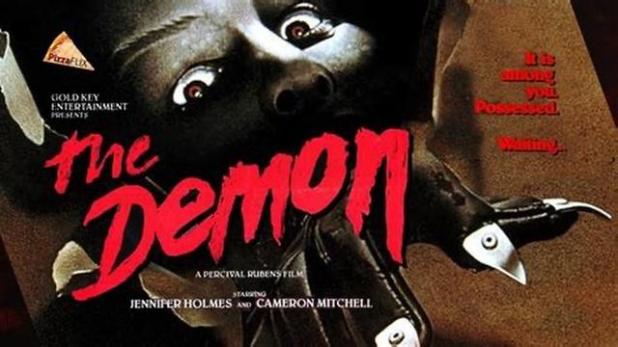
Imagine a movie that starts with a fourteen year-old girl being killed by a faceless maniac wearing a black leather glove with razor-tipped fingers. If you’re ready for that before the first credits roll, then you’re ready for The Demon.
That very same killer then kills a trucker, steals all his money and gets a place in a sleazy hotel in Johannesburg. Emily’s parents are frustrated by the police and turn to Bill Carson (Cameron Mitchell, the whole reason why I picked this movie), a psychic detective who was once a U.S. Marine. Of course.
Emily’s mother just wants to know if her daughter is alive or dead. Her father, though, wants revenge. Carson replies that its best for the Parkers if they don’t find the killer, telling them that he’s pure evil. I mean, you should believe a dude who can tear up a bed like this.
The killer has moved on to an American schoolteacher named Mary (Jennifer Holmes, who was on TV’s Newhart before being replaced by Julia Duffy). She first sees him outside her classroom window, as he can seemingly appear and disappear at will. And when she’s not seeing killers, she’s hanging out with her South African cousin who is dating Dean Turner, a rich American playboy that Mary hates.
Jo is out having fun and poor Mary is stuck at home, getting phone calls with heavy breathing and menacing knocks on her front door. Is it the killer? Or is he happy to be at home grunting, groaning, doing push-ups and shredding porno mags?
The Demon also likes to go out and try and pick up ladies. And where does he go? Boobs Disco! Yes, this was a real place. And yes, it was really called that.
We even get to hear some of Lipps Inc.’s “Funkytown” in this scene, as the killer is stopped from raping a girl by two motorists, one of whom is slashed and the other gets his motorcycle blown up real good.
Meanwhile, Cameron Mitchell is getting the most out of his ten minutes of screen time. I guess that’s all the producers could afford. He creates a faceless sketch of the killer and tells the Parkers where the man lives. He warns Mr. Parker one more time, but the guy just can’t listen and gets his neck snapped pretty much immediately, then thrown off a balcony.
Children are playing in the woods when they find Emily’s remains, which brings Carson back to Mrs. Parker, telling her that he’s sorry, but the time of The Demon is drawing close. She accuses him of being behind all of this to keep his career going as a psychic and shoots him in the face. Well, that had really nothing to do with the other half of this film, which is becoming a riff on Halloween.
Mary and Jo go out on dates that night while The Demon gets ready for them. Mary tells Bobby, her man, that she’s been getting stalked late at night. And she’s right — The Demon has, for reasons known only to him, broken in to kill Jo and rich guy Dean, then hide in the house.
You know, if I had a cool razor glove, I wouldn’t suffocate people with a plastic bag like The Demon. But hey — I’m just a writer on a web site.
It’s time for this movie to go full Halloween, with The Demon chasing Mary all over the house — up and down the stairs, through a closet, into the attic and finally through a hole in the roof. She finally makes it to the bathroom, where she builds a trap with scissors, the shower and shampoo. That’s right — The Demon is the first masked killer I’ve seen that is basically killed by slipping in the shower.
If you’re watching this movie based on the description Mill Creek gives, you’re going to be disappointed. Cameron Mitchell never gets to be the Australian Dr. Loomis, instead being felled by a housewife with a handgun. And I know that I give generous berth to the transfers on these, but even I was amazed by how long scratches would appear on the footage.
If you enjoy scenes that having nothing to do with the overall film being given the same importance as major facts, then let me recommend The Demon. Come for Cameron Mitchell, stay for Boobs Disco.
This Universal movie serial — told in twelve parts — shares some similarities with the earlier serial The Vanishing Shadow, including the inventions of an invisibility belt and a remote-control robot.
That makes sense — at the time, Universal was all about recycling. This movie contains stock footage from The Invisible Ray and The Vanishing Shadow, as well as music from the Flash Gordon serials and Frankenstein movies, plus car chase footage that had been used in several other serials and newsreel footage taken from the Hindenburg disaster.
Eight years after his star turn in Dracula, Bela Lugosi’s career was in decline. He had been typecast as a horror star and was not seen as talented as his co-star — and possible rival — Boris Karloff.
This career downturn had many factors behind it. Universal changed management in 1936, and due to a British ban on horror films, they dropped the once-popular films from their production schedule. Lugosi found himself consigned to Universal’s non-horror B-film unit, the same team that made serials like this. And while the actor was busy with stage work, he had to borrow money from the Actors Fund to pay the hospital bills for the birth of his son, Bela George Lugosi, in 1938.
However, that year brought Bela back. California theater owner Emil Umann revived Dracula and Frankenstein as a special double feature, a bill so successful that it played to sellout crowds and Lugosi himself came to host the movies. The actor would say, “I was dead, and he brought me back to life.” Universal took notice of the tremendous business and launched its own national re-release, as well as hiring Lugosi to star in new films.
The Phantom Creeps — yes, we’ll get back to this movie in a minute — was the last of the five serials that the actor would make, shot right after he returned from making Dead Eyes of London. It was released a week before his comeback vehicle, Son of Frankenstein.
Sadly, by 1948, the parts dwindled again and severe sciatica from Lugosi’s military service was treated with opiates, causing a downward spiral that the actor would never really emerge from. He appeared in movies like Bela Lugosi Meets a Brooklyn Gorilla and Ed Wood’s Bride of the Monster. After making that movie, he checked himself into rehab, one of the first celebrities to publicly do so. According to Kitty Kelley’s His Way: The Unauthorized Biography of Frank Sinatra, “Old Blue Eyes” helped with expenses, despite never meeting Lugosi before and visited him at the hospital.
The actor died of a heart attack in 1956, having just married his fifth wife. And yes, he was buried in his Dracula cape.
In this film, he plays Dr. Zorka, a man who loves to make weapons and refuses to sell them to anyone or any country. This upsets all manner of people, like Dr. Fred Mallory, his former partner, and government man Captain Bob West.
Dorothy Arnold, who plays love interest Jean Drew, was the first wife of baseball star Joe DiMaggio. Look for Edward Van Sloan, who always played the doctor battling the supernatural in Universal films. He’s Van Helsing in Dracula, Dr. Muller in The Mummy and Dr. Waldman in Frankenstein. In fact, that movie begins by him warning the audience that they can leave now if they’re too frightened. And Ed Wolff, the seven-foot-four-inch actor who played the robot, was also in Invaders from Mars and The Return of the Fly.
Speaking of the robot, you may have seen him in Rob Zombie’s work. The song “Meet the Creeper” is based on the movie and the robot often appears in the singer’s music videos and stage shows.
Based on the 1924 play by Noël Coward, this Alfred Hitchcock-directed movie opens with Larita Filton (Isabel Jeans) testifying at her divorce trial as she leaves her husband, Aubrey (Franklin Dyall). The scandal of it all is that Claude Robson (Eric Bransby Williams), an artist, is in love with Larita and a mistaken moment leads to him being shot. She leaves town, goes to Europe and instantly marries John Whittaker (Robin Irvine) after he hits her in the eye with a tennis ball.
Of course, his mother (Violet Farebrother) hates her, as she wanted him to marry Sarah (Enid Stamp Taylor). She does everything she can to turn the entire family — and her son — against Larita, who finally just gives in and allows her husband to divorce her.
At the end, as photographer take her picture outside of court, she says, “Shoot! There’s nothing left to kill.” Hitchcock said it was the worst thing he ever wrote. Sadly, this was a financial failure.
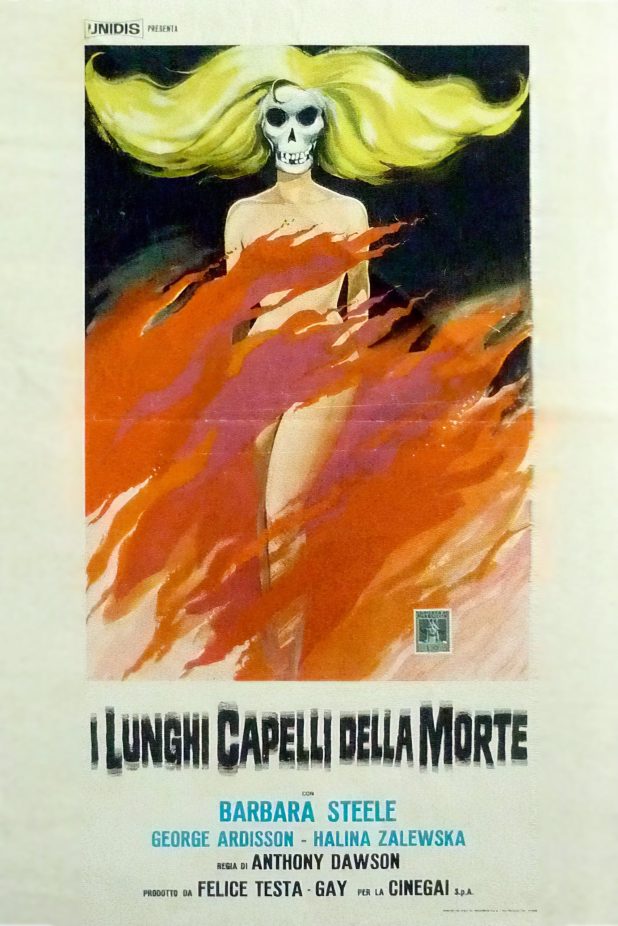
Adele Karnstein (Halina Zalewska, An Angel for Satan) is accused of witchcraft and burned, but really it’s because she wouldn’t sleep with Count Humboldt (Giuliano Raffaelli). When her daughter Helen (Barbara Steele) confronts him, she even offers her body to him to save her mother. The Count still watches as her mother is burned alive and tosses Helen off a cliff. To add even more pain to the Karnestein family, her sister Lisabeth (also Halina Zalewska) is taken in by Humboldt and eventually marries his nephew, Kurt (George Ardisson).
As a plague destroys the country, a storm blows in on the night of the Count’s death, bringing Mary (also Barbara Steele) who inspires Kurt to kill his wife and be with her. Bad idea Kurt. This is an Italian Gothic and all men are morons who must be destroyed by the female ghosts of past tragedy and the curses of mothers whose daughters could not save them.
I mean, Barbara Steele is a ghost whose skeleton is reanimated by lightning. Can movies get any more magical? Do you know how much it makes me fall into a dream of movie drugs to have Steele walking through a cobwebbed castle in a white nightgown holding blazing candles?
While written by Ernesto Gastaldi and Tonino Valerii, neither had enough experience to direct — or so said producer Felice Testa Gay — which brought in Antonio Margheriti to make the film. For as much as Margheriti is known for his miniature-rich war movies, he had a talent for making movies like this. Just check out Castle of Blood, The Virgin of Nuremberg, The Unnaturals and Web of the Spider.




 B&S About Movies