Night Gallery Season 3 Episode 14: The Doll of Death (1973)

Alec Brandon (Barry Atwater) is about to marry his trophy wife Sheila Trent (Susan Strasberg). He’s rich, he owns a mansion in the West Indies and he has guests coming in from all over the world for their wedding. Well, they were getting married. But Raphael (Alejandro Rey), Sheila’s lover of years past, comes in and takes her away from all this. This won’t stand.

Brandon gets his valet Andrew (Jean Durand) to get him a voodoo doll and right in the middle of lovemaking, red hand marks appear on Sheila’s back. She decides to go back and confront her near-husband and finds that he’s already killed Andrew, who tried to get him to stop attacking her, and is given a ring that can end all of this.

“The Doll of Death” was directed by John Badham and written by Jack Guss from a story by Vivian Meik. It’s not the best Night Gallery story. It’s not even the best doll Night Gallery story. That would be “The Doll.” But still, it does have its charms and Strasberg is good in her role.

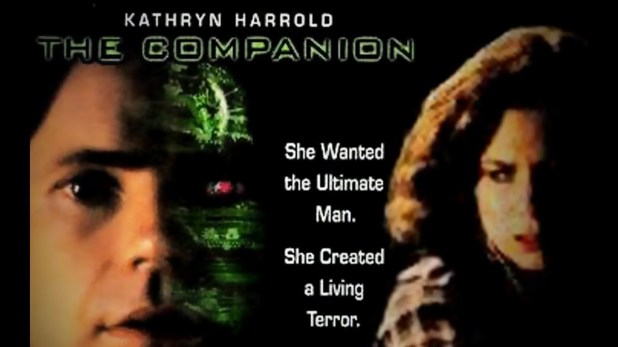
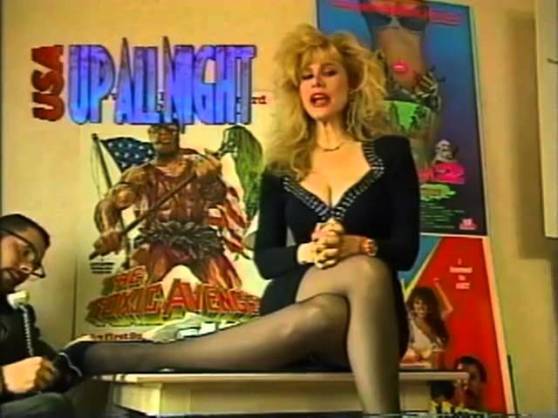
USA UP ALL NIGHT MONTH: The Companion (1994)

EDITOR’S NOTE: The Companion aired on USA Up All Night on December 31, 1996.

Of all the Terminator clones, who knew that I’d be watching one with Bruce Greenwood — Pike from the later Star Trek movies — as a male companion named Geoffrey?

Romance novelist Gillian Tanner (Kathryn Harold, Raw Deal and Yes, Giorgio) has her agent Charlene (Talia Balsam) inform her that perhaps she should give up men — she just got cheated on by Bryan Cranston! — and get with the future. Yes, she is embracing the fourth point of the Church of Satan’s five-point program for Pentagonal Revisionism: Development and production of artificial human companions: The forbidden industry. An economic “godsend” which will allow everyone “power” over someone else. Polite, sophisticated, technologically feasible slavery. And the most profitable industry since T.V. and the computer.

At first, she’s cold to Geoffrey who is too perfect, too good looking and too willing to cater to her every need. It even puts off her friend Ron Cocheran (Brion James, cast as a reference to Blade Runner?*) and his way too young girlfriend Stacey (Joely Fisher). But when she allows Geoffrey to mess with his programming so that he can become more surprising and therefore her perfect man, Gillian learns that maybe she likes men that are bad for her whether they’re human or machine.

Director Gary Fieder would go on to make Things to Do In Denver When You’re DeadKiss the Girls and Don’t Say a Word. You can see he was meant for bigger things when you watch this. It was written by Ian Seeberg, who also wrote and narrated The Naked Peacock, a documentary on nudist camps, and the movie Temptation.

The cast also has James Karen, always a good thing, as the robot salesman, and Earl Boen — as a holographic talk show host — and he was in Terminator, which is a nice reminder that this is referencing that movie.* Plus you get a quick roles for Stacie Randall (Lyra from Trancers 4 and 5), Courtney Taylor (Mary Lou in Prom Night III: The Last Kiss), Brenda Leigh (Scanner Cop) and Bob the Goon himself, Tracey Walter.

It was shot by Rick Bota (who also worked with Fieder on Kiss the Girls), who directed a few movies of his own, including three Hellraiser movies: Hellseeker, Deader and Hellworld. He was also the director of photography for twenty-three episodes of Tales from the CryptHouse On Haunted Hill and Valentine.

The special effects at the end — Scott Wheeler (300Big FishUsThe ManglerDemon Wind and so many more movies — look really good. Understated and very T800-like, but for a TV movie, it looks great. I had no expectations of The Companion when it started and I ended up really liking it. It feels like the kind of movie that a studio would make today and here it is, a low budget made-fot-TV movie that played on USA.

*Kind words to Matty Budrewicz from the incredible The Schlock Pit site for pointing this out.

You can watch this on YouTube.

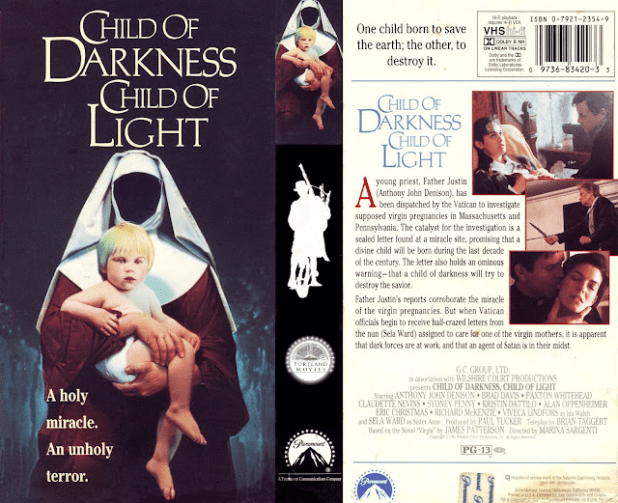
USA UP ALL NIGHT MONTH: Child of Darkness, Child of Light (1991)

EDITOR’S NOTE: Child of Darkness, Child of Light aired on USA Up All Night on June 11, 1993.

Based on the James Patterson novel Virgin (which has been retitled Cradle and All), Child of Darkness, Child of Light was directed by Marina Sargenti, who made one of my favorite early 90s movies, Mirror, Mirror. It was written for TV by Brian Taggert, who had some solid credits of his own in The SpellVisiting HoursOf Unknown Origin, the two mini-series, The New KidsWanted Dead or AlivePoltergeist IIIDeadly Family Secrets and Omen III and IV.

Father Rosetti (Paxton Whitehead) is sent by the Vatican to a small city in Pennsylvania — it’s shot in Portland, so no luck having any Pittsburgh actors in the cast — to investigate a report of an impending virgin birth. He’s injured by bikers and left in a coma, so the Vatican also sends Father Justin O’Carroll (Tony Denison) without telling him that this virgin birth was prophesized by a vision of the Virgin Mary.

O’Carroll meets pregnant 15-year-old teen Margaret Gallagher (Sydney Penne) who is constantly being attacked by people when she claims that she’s having a virgin birth. She’s also able to transfer her visions to people who attack her, giving them mysterious wounds. And oh yeah, polio is back. Locusts show up. You know how that end of the world stuff gets.

The priest also goes ot Boston to meet Kathleen Beavier (Kristin Dattilo), who is also a virgin expecting a baby. Her child? Well, it just might be the Antichrist. And wow! Viveca Lindfors plays her maid. This also has small roles for Brad Davis, Eric Christmas (Principal Carter from Porky’s!), Richard McKenzie (Archie Bunker’s brother Fred), Sela Ward (as a nun, so you know how I felt about this movie) and Brendan Fraser.

It’s a USA TV movie, so let that guide your watching.

You can watch this on YouTube.

Night Gallery Season 3 Episode 13: Whisper (1973)

Directed by Night Gallery regular Jeannot Szwarc and written by David Rayfiel from a story by Martin Waddell, “Whisper” has Sally Field and Dean Stockwell as Irene and Charlie Evans. He used to work as an architect, but his wife hasn’t been herself. Literally.

Irene and Charlie have moved to rural Mississippi because she channels the personalities of deceased people, a fact that he has just come to understand and deal with. After all, she always comes back and is herself again after being possessed. She’ll always come back to being Irene, he figures, he just loans her out. Right?

One of the spirits in her head is Rachel, a woman who keeps coming back and begins to obsess Irene. She starts referring to Charlie as Johnny and makes him dig up something — a dead child? — buried under some rocks. He goes back to his wife when he’s done but she tells him. “Oh, Charlie, I can’t get back. I can’t get back!”

Is Irene gone forever? Or is she just a victim of mental illness? There are no answers from this Night Gallery.

Three years later, Sally Field would gain more critical praise for another TV program about multiple personalities, Sybil. As for this episode, Szwarc proves why he’s the best director on the program and even has moments of Stockwell narrating directly to camera, as if this is all a dream or a memory.

The third season is rough but as always, when it works — like in “Whisper” — it gets it right.

Night Gallery Season 3 Episode 12: Death On a Barge (1973)

Ron (Robert Pratt) and Jake (Lou Antonio) sell fish on the pier during the day and at night, Ron visits Hyacinth (Lesly Anne Warren), a woman who refuses to see him when the sun is up. She also fears crossing running water, but as the barge she lives on is in a slowly draining canal, she promises to visit soon. Ron already has a girlfriend, Phyllis (Brooke Bundy), who goes into the barge and watches her competition go to sleep in a coffin. She barely escapes with her life. Jake, however, soon falls for her and both men are willing to give their lives to this gorgeous supernatural being.

“Death On a Barge” was directed by Leonard Nimoy and was one of his first directing jobs, as he had a one-year contract with Universal to act and direct whatever he could find. Working in the low budget of Night Gallery, he had to shoot a story that’s set at night — literally on the show Night Gallery — day-for-night. He also had to deal with the Universal tour constantly driving by and the drivers yelling while he was trying to film.

This episode was written by Halsted Welles and is based on the short story “The Cana;” by Everil Worrell.  Worrell spent most of her life working for the U.S. Department of Treasury and wrote for pulps like Weird Tales.

Night Gallery Season 3 Episode 11: Something in the Woodwork (1973)

Molly Wheatland (Geraldine Page) left her husband and found the bottle. But at least she has somewhere to live, a place that was cheap because everyone thinks that Jamie Dillman (John McMurtry) was shot by the police there when his criminal career ended. He’s been in the attic ever since, but Molly doesn’t care. She kind of likes having him around.

Directed by Edward M. Abroms (who directed tons of TV and also edited Street FighterCherry 2000 and You’ll Like My Mother) and written by Rod Serling based on the story “Housebound” by R. Chetwynd-Hayes, “Something In the Woodwork” has Molly push and push Dilman to kill her ex-husband Charlie (Leif Erickson) until she goes too far and gets what she wants.

Geraldine Page was in three Night Gallery episodes (along with this one, she’s in two episodes in Season 2, “Stop Killing Me” and “The Sins of the Fathers”) and she really makes this one of the best stories of season 3. Abroms mostly worked as an editor — he edited the pilot — but he really shows some great work here, particularly some handheld shots that look quite good.

Night Gallery Season 2 Episode 21: The Sins of the Fathers/You Can’t Get Help Like That Anymore (1972)

I apologize.

As I was working on Season 2, I totally skipped this episode.

And how could I? It’s one of the most memorable in the entire series.

Anton LaVey specifically called out this episode. But more importantly, whenever people talked about the scariest movies that they had watched, my father always went back to “The Sins of the Fathers.”

“The Sins of the Fathers” was directed by series workhorse Jeannot Szwarc and written by Halsted Welles from a story by Christianna Brand. It stars Geraldine Page as Mrs. Evans, the wife of the Sin Eater of the town of Cwrt y Cadno, Wales. What is a sin eater and his task? Well, they must eat a meal in the company of a dead person, taking on their sins so that the deceased can go to meet God with a clean conscience.

Her husband is too sick to perform the ritual, so her son Ian (Richard Thomas) must go in his place. He fears the pain of accepting all of these sins, much less feasting from the chest of a dead person. But Mrs. Evans and her family have been hungry since the plague has taken Mr. Evans, so she comes up with a plan. Ian will conduct the ritual but hide the food, bringing it home to her family.

Ian barely escapes from the funeral rite and the widow (Barbara Steele!) who wants to watch him conduct the ceremony. The tragedy is that he arrives home to a dead father and must now consume that food — and the food around his lost patriarch — and now take on the sins, the many sins, of the Sin Eater.

Working with art director Joseph Alves, Szwarc pretty much made a legitimate theatrical experience with this short story. NBC wasn’t sure they would even air it, so for once I have to give credit to series producer Jack Laird, who stood behind his talent and pushed for the episode to air. Beyond talent like Page, Thomas and Steele, he also had Michael Dunn as a servant obsessed by the food.

It’s probably the most memorable Night Gallery episode. It has no blood, no special effects and just mood and theatrical acting by all. It just plain works.

“You Can’t Get Help Like That Anymore” was directed by Jeff Corey and written by Rod Serling. It has quite the cast — Broderick Crawford, Cloris Leachman, Lana Wood, Severn Darden — and a great story. The Fultons (Crawford and Leachman) take their rage out on everyone around them, including their robotic maids, which often come back to the Robot Aids, Inc. storeroom in pieces. Dr. Kessler (Darden) worries that soon the robot help will evolve to the point that they turn the tables on the couple.

He’s right, as Model 931 (Wood) responds to the pinching sexual impropriety and outright physical attacks of the Fultons by decimating them. By the end, the robots have even replaced Kessler with a new model and are quietly sending their models into the suburbs to take over the world.

I love the 1970s future that appears in this story too. The makeup gave the production issues, but you’d never know it, as I really love just about everything in this Serling parable.

Again — apologies for missing this episode. I honestly feel like it’s the best of the entire series, so I appreciate you waiting for it.
Night Gallery Season 3 Episode 10: She’ll Be Company for You (1972)

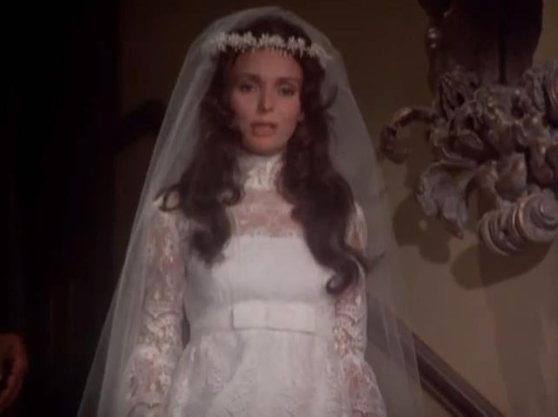
Henry Auden (Leonard Nimoy) is dealing with the loss of his wife, who died after years of a prolonged illness, a time in which he played caregiver. All he can feel is relief, but it’s a strange place to be in, a man who has been more nurse than a husband to a woman who was once his lover.

Barbara (Lorraine Gary) is Margaret’s best friend and she’s unconvinced that Henry is grieving enough. She leaves her orange tabby Jennet for company, which he claims he doesn’t need. And then he hears the bell that his wife used to use to summon him.

Now sure that a gigantic cat is loose in his house, Henry starts to sleep at the office. At every turn, his dream of a single life does not appear. The secretary he planned on being with, June (Kathryn Hays), seems to savor the idea that now that he can finally have her, she wants nothing to do with him.

Henry goes home and battles two of the big cats that are loose around his house, but finally realizes that he has to die. He walks to his room and when we see him again, he’s covered in blood and Jennet is licking a red pool in the carpet.

Directed by Gerald Perry Finnerman (the director of photography for sixty episodes of the original Star Trek) and written by David Rayfiel (Lipstick) and based on a short story by Andrea Newman, this is a story that really goes nowhere and has a resolution that makes no sense. It feels like someone just threw together some ideas and hoped that it would make more sense than it does.

Strays (1991)

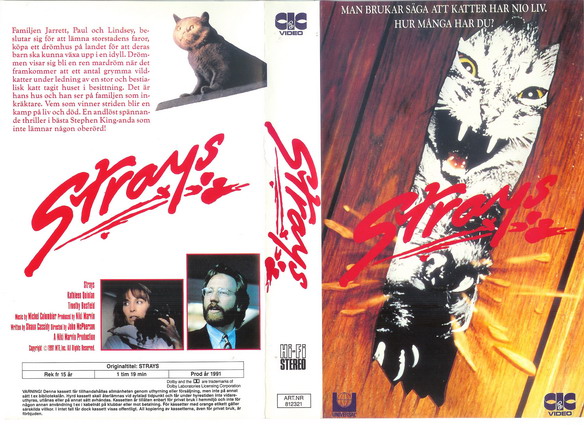
Paul Jarrett (Timothy Busfield), his wife Lindsey (Kathleen Quinlan) and their daughter Tessa (played by Heather and Jessica Lilly) have gotten a house for an amazing price — too good to be true — away from the big city and that’s because, yes, it’s filled with stray cats that kill humans. But they’re so cute!

Directed by John McPherson, who directed several TV movies and was the cinematographer of Jaws: The Revenge, and written by former teen idol Shaun Cassidy — whose career second act saw him created some great stuff like American Gothic and Invasion — Strays is a movie about murder-inclined feral cats and yet it’s boring.

How is this possible? Then again, my mom has an army of orange tabby feral cats that live outside her house and far from wanting to kill people, all they want is pets and food.

But if the pets stop…the death begins.

Night Gallery Season 3 Episode 9: Finnegan’s Flight (1972)

Charlie Finnegan (Burgess Meredith) is serving a life sentence but dreams of escape. He sees jet planes fly over the yard he’s spent most of his life in. Yet Pete Tuttle (Cameron Mitchell), a fellow inmate, claims he can help him to get out.

“Finnegan’s Flight” is directed by Gene R. Kearney and written by Rod Serling, who has always turned to Meredith for big roles, like “Time Enough at Last” and “The Obsolete Man” on The Twilight Zone and “The Little Black Bag” from the first season of Night Gallery.

The first hypnotic trick that Tuttle tries on Finnegan is to convince him that his hands are indestructible and that he can punch his way out of the walls. This leads to a stay in the infirmary as Finnegan breaks both his hands. Prison psychiatrist Dr. Simsich (Barry Sullivan) is amazed by the power of suggestion that Tuttle can employ and arranges for the two men to experiment in his office.

Convinced that he’s flying a plane high into the clouds, Finnegan starts to run out of air and eventually crashes his plane, causing a real explosion. But at the end of it all, despite this tragedy, Tuttle knows that his friend is somewhere else, hopefully somewhere happier than living his life inside a jail.

This episode is interesting but feels not as important as past Serling tales. Yet by this point, it feels like he’d been pretty beat up by this show and perhaps was just doing his best to finish the script.