Directed and written by Yosuke Goto, Bldg. N is based on actual events that happened in a Gifu Prefecture apartment complex in 2000.
Shiori (Minori Hagiwara) is a college student that has a fear of death known as thanatophobia which keeps her from sleeping but also haunts her every waking moment. To try and escape her constant depression, she joins her ex-boyfriend Keita (Yuki Kura) and his current girlfriend Maho (Kasumi Yamaya) to film a rural housing plan where rumors of ghostly activities have been reported.
The three college students lie and explain that they are looking for a place to live. Invited to a welcome party, they learn that the building’s residents live with ghosts quite literally. As their leader Kanako (Mariko Tsutsui) explains, that means trying to understand them. Then someone runs over a rail and kills themself.
This would be the time to leave.
So you end up with a death cult meeting up with a girl whose fear of death leads her to be irrational about everything. While she’s also quite tiny, she’s also a killing machine. And while the film eventually becomes a more standard J-horror movie than the opening may promise and its characters make some of the dumbest decisions ever, at least Hagiwara is great as the lead and it looks interesting.
I watched this film as part of The Bucheon International Fantastic Film Festival (BIFAN). You can learn more at their official site.
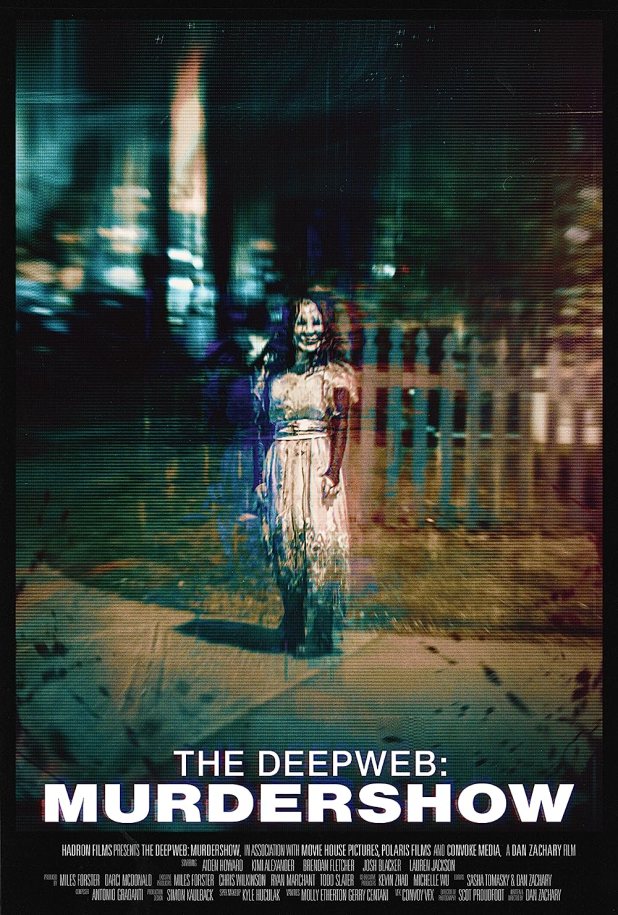
Ethan Newton (Aiden Howard) is a podcaster who doesn’t just track down true crime stories; he also reveals the lousy police work and abuse that happens along the way. Perhaps that doesn’t make him very popular, but he feels he has a mission to expose things. One evening, after recording his latest episode, he gets a call from Seattle, the home he left behind. His sister is dead. Now, the world of true crime is more accurate and personal than it ever has been before.
After spending some time there and reconnecting with his estranged mother, Ethan discovers that the cops missed a cipher in his sister’s apartment, which leads him to the dark web—ominous music, please—and the Murdershow, a live killing floor that his sister Amanda “Mandy” Newton (Lauren Jackson) and her friend Kate (Kimi Alexander) watched once in their battle to scare one another.
It turns out that this dark web group is run by clowns who look like they stepped out of The Purge or The Strangers wearing generic Spirit store Slipknot costumes — indeed, you can buy the Twisty the Clown, Dollmaker and Doxy masks from this movie on Trick or Treat Studios which claim this movie was actually made in 2020, because they’re on clearance — who took Mandy, crucified her and then sliced her up with a chainsaw while they lived in a haunted house that looks like it’s sponsored by Hot Topic. Also, much of this movie feels like it happened sometime in the 2000s.
Of course, the cops — like Detective Sawchuk (Josh Blacker) — are no help, but they all hate Ethan and his show. So he has to go into business for himself, working with Kate (Kimi Alexander), who he’s always had a crush on, and his hacker friend Shadow (Brendan Fletcher).
It turns out that the news reports in the beginning that this is a death cult are accurate, and soon, Ethan and Kate know way more than they ever wanted to know about the Murdershow.
So many moments in this movie feel like they are taken whole cloth from Ed Piskor’s comic book Red Room, even calling the room such. I know that these urban legends have been around before the comic, but between the chat windows and what people are saying within the room, as well as having people pledge crypto to watch people die, it’s a bit too close to be a coincidence.
There’s also a not-so-shocking twist ending that really feels more like the expected ending, but you know that going into straight-to-streaming horror these days, right?
I don’t really want to speak ill of the dead, as director and writer Dan Zachary died on New Year’s Eve of last year after a brief and unexpected illness. He also made American Conjuring, Mortal Remains and Darkest Hour.
This is rather polished for a Tubi Original, but if there’s one mean thing I can say, they should have given Aiden Howard a few more takes for his funeral scenes. It might be amongst the worst emoting I’ve seen, and I exist on a steady diet of Claudio Fragasso and Bruno Mattei movies.
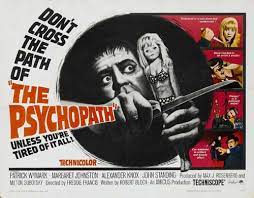
Directed by Freddie Francis for Amicus, this film revolves around a series of murders in which each victim is found with a doll that looks exactly like them attached to their body.
It embodies the early elements of Giallo cinema, highlighted by a striking scene of a room filled with dolls. If it had some stylish fashion, a jazzy soundtrack, a few bottles of J&B, and a touch of nudity, it could easily fit into that genre. I would also consider it a slasher, and I’d support your choice in that classification.
Patrick Wymark, known for Blood on Satan’s Claw, plays Inspector Holloway. Margaret Johnson, from Night of the Eagle, portrays the mysterious, wheelchair-bound doll maker Mrs. Von Sturm. John Standing, known for his role in The Elephant Man, plays her obsessive son Mark.
If you’re reading this and thinking, “A movie where a man with mommy issues turns into a murderer sounds a lot like Psycho, you’d be right—this was written by the same author, Robert Bloch.
EDITOR’S NOTE: 7 Faces of Dr. Lao was on the CBS Late Movie on June 22 and December 14, 1973; June 30, 1975 and May 27, 1976.
The last film directed by George Pal was written by Charles Beaumont, who wrote many Twilight Zone episodes, Queen of Outer Space, Burn, Witch, Burn! and The Masque of the Red Death. Pal said that the writer had “a kooky mind like mine.” It was based on The Circus of Dr. Lao by Charles G. Finney.
Abalone, Arizona, is, well, falling to pieces. Clinton Stark (Arthur O’Connell) knows that the railroad is coming to town, so he’s trying to buy it out from under the townspeople. He’s opposed by only librarian Angela Benedict (Barbara Eden) and newspaper editor Ed Cunningham (John Ericson).
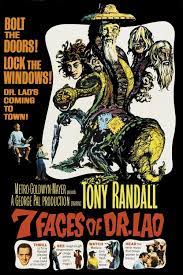
Then, the enigmatic Dr. Lao (Tony Randall) and his mesmerizing circus, brimming with magical wonders, grace the town for a fleeting two days, casting a spell of fascination over the townspeople.
Dr. Lao, a 7,321-year-old sage, arrives with his circus, assuming the roles of Merlin, Pan, a giant serpent, Medusa, Apollonius of Tyana, and the Abominable Snowman. He imparts his profound wisdom, ‘This is the circus of Dr. Lao. We show you things that you don’t know. Oh, we spare no pains, and we spare no dough; oh, we want to give you one hell of a show. And youth may come, and age may go, but no more circuses like this show.‘ His teachings are a revelation, a beacon of enlightenment for the town.
He also takes a moment to explain life to Ed’s son Mike (Kevin Tate):
Dr. Lao: Mike, let me tell you something. The whole world is a circus if you know how to look at it. The way the sun goes down when you’re tired comes up when you want to be on the move. That’s real magic. The way a leaf grows. The song of the birds. The way the desert looks at night, with the moon embracing it. Oh, my boy, that’s…that’s circus enough for anyone. Every time you watch a rainbow and feel wonder in your heart. Every time you pick up a handful of dust, and see not the dust, but a mystery, a marvel, there in your hand. Every time you stop and think, “I’m alive, and being alive is fantastic!” Every time such a thing happens, you’re part of the Circus of Dr. Lao.
Mike: I don’t understand.
Dr. Lao: Neither do I.
Despite the henchmen of Stark destroying the newspaper office — look for Royal Dano as one of them — the entire building is unharmed in the morning.
That night, during the second show, Lao shows the town a magic lantern show that relates their town to Woldercan, a kingdom destroyed by greed (and using special effects from past Pal effects movies like Atlantis, the Lost Continent and The Time Machine). The town is saved by this lesson while the henchmen decide to destroy the circus. As they break a fishbowl, it unleashes the Loch Ness Monster, who chases them away.
As the circus departs, it leaves behind a town transformed, its inhabitants filled with newfound hope and understanding, ready to embrace the magic of life.
EDITOR’S NOTE: Wuthering Heights was on the CBS Late Movie on April 20, 1973 and April 8, 1974.
American-International Pictures, known for its exploitation films, took a surprising turn when the 1968 adaptation of Romeo and Juliet proved to be a box office hit. This success prompted AIP to venture into the realm of classic romance adaptations, with Wuthering Heights being their next ambitious project.
Robert Fuest — yes, the director of Dr. Phibes and The Devil’s Rain! — would direct. He told the Evening Standard, “We shall show Heathcliff as a man completely fascinated by Catherine’s passion, sexuality, jealousy and cruelty. And the tempestuous Catherine will be seen as a woman hypnotized by Heathcliff’s violence, brutality and sadistic vengefulness.” This interpretation, with its controversial themes, aimed to stay closer to the book than the 1939 movie and saw the story as one about the generation gap that has always existed.
Producer Louis Heyward cut to the chase: “Heathcliff was a bastard and Cathy a real bitch, and that’s how they’ll be in this film.”
Unfortunately, the film did not resonate with either critics or audiences. The harsh reviews and lackluster box office performance led to the cancellation of AIP’s plans for future literary adaptations, includingReturn to Wuthering Heights, Camille, The House of Seven Gables, and A Tale of Two Cities.
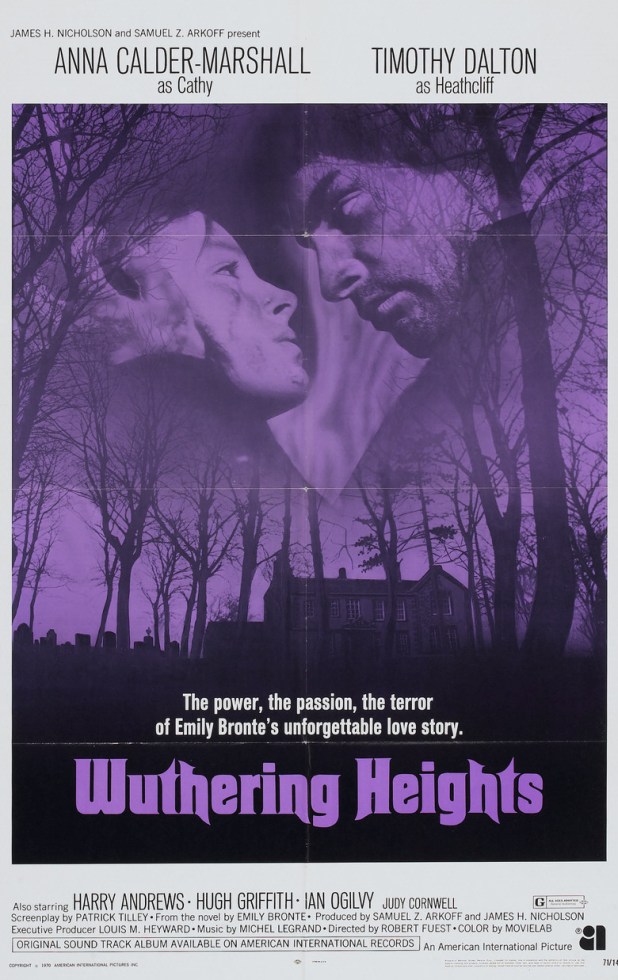
If you read the book, you may know the story. Mr. Earnshaw (Harry Andrews) returns from a trip to the city with Heathcliff, who grows up to be played by Timothy Dalton. Earnshaw’s son Hindley (Julian Glover) detests his adopted brother of sorts, yet the ragamuffin grows to become the companion to Hindley’s sister Catherine (Anna Calder-Marshall). After the Earnshaws die, Heathcliff and Catherine are wild and in love on the moors — you’ve seen them run toward one another even if you don’t know the reference — as Hindley stews in resentment. But then Catherine meets a new love, Edgar (Ian Ogilvy). Heathcliff disappears for years, learning how to be more refined and cruel in the big city and comes back to not only pine for Catherine but to marry Isabel (Hilary Heath).
The significant difference from the book is that Hindley is more sympathetic. And, oh yeah, he gets to kill Heathcliff, who reunites with Catherine when they’re both ghosts. This unexpected twist, along with the controversial themes, forces writer Patrick Tilley (The Legacy) to contend with the ghost of Emily Bronte and the derision of English teachers everywhere.
That said, this movie is a visual feast, with lush cinematography that brings the moors to life. It also introduces the first open discussion that perhaps Heathcliff is the illegitimate son of Mr. Earnshaw, which makes Heathcliff and Catherine half-siblings. That sounds closer to the paperback trash and Italian movies that usually make it on this site, not works of Gothic romance.
EDITOR’S NOTE: Vigilante Force was on the CBS Late Movie on February 13, 1981.
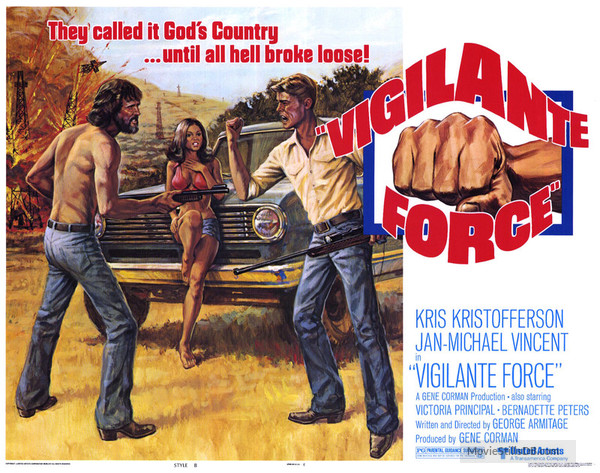
The town of Elk Hills, California, has been getting rough ever since the oil field workers stuck around. Ben Arnold (Jan-Michael Vincent) joins the police to try and keep things safe while his brother Aaron( Kris Kristofferson), a Vietnam vet, hires mercenaries — his war buddies Beal (Charles Cyphers), Viner (Shelly Novack) and Selden (Carmen Argenziano) — to deal with the problem. But much like what happens after someone hires cats to get rid of the mice, who gets rid of the cats? The mercenaries — and Aaron — are now out of control and take over the town.
Director and writer George Armitage said that the film was a “very slightly coded reference to the Revolutionary War…although what I was really doing there was Vietnam.” Jan Michael-Vincent’s character was named after Benedict Arnold, while Kristofferson’s was named after Aaron Burr.
If the town where all this goes down seems familiar, it’s the Mayberry back lot set at Desilu Studios in Culver City, California.
Ben’s also a widower who falls for schoolteacher Linda (Victoria Principal), and Aaron gets with bar singer Little Dee (Bernadette Peters); who can blame either of them? Plus, David Doyle, Dick Miller and Loni Anderson all appear.
This movie gets wild because it’s almost a white version of Bucktown and has a bizarre ending where Kristofferson and his buddies dress as a marching band to rob a bank. I can’t think of another movie that ends with the guy who wrote “Sunday Morning Coming Down” standing on top of an oil tower blasting townsfolk with a machine gun while dressed like a drum major.
Produced by Gene Corman, this fine exploitation film has an above-average cast. It’s also nearly a modern Western, with an ending that pits brother against brother, and only one can walk away.
Sri Asih was created in 1953 by RA Kosasih, the father of Indonesian comic books. According to the Bumilangit Cinematic Universe Wiki, this is her origin: “Nani Wijaya, is the daughter of a wealthy family, is a bead of Goddess Sri from the Kahyangan Kingdom. As an adult, Nani works as an agent of the Bureau of Criminal Investigation to defend truth & justice. However, when he struggles, Nani can transform herself into Sri Asih by translating “Goddess Asih!”” This allows her to access her powers as the reincarnation of Dewi Sri, the goddess of rice and fertility still worshiped in Java, Bali, and Lombok islands.
Her powers include strength, speed, durability, flight, duplication, a healing factory and the ability to grow in size. As a BCI agent, she already had martial arts and detective skills, adding to her superhuman powers.
Sri Asih was such a popular character that her first movie, directed by Tan Sing Hwat and Turino Djunaedy, was made a year after her debut. Unfortunately, the first superhero movie made in Indonesia is lost.
This version of Sri Asih is the second installment of the Bumilangit Cinematic Universe, a series of superhero films based on more than 500 comic book characters in the library of Indonesian publishing company Bumilangit, which started with 2019’s Gundala.
Directed by Upi, who co-wrote the screenplay with Gundala director Joko Anwar, this tells the story of the third Sri Asih, who is Alana at the start of the movie (Pevita Pearce). She’s been a fighter for her entire life and had to hold back the rage inside her. That makes sense, as she was nearly killed by the volcano that made her an orphan when she was just an infant.
After being raised by a female martial artist, she becomes an MMA fighter in her adulthood, which brings her into the cage against the privileged Mateo (Randy Pangalila). By the end, she will have to battle one of the top five villains of the BCU — the five commanders of the Goddess of Fire — known as Evil Spirit.
I may not know these characters at all, but I think it’s awesome that other cultures are attempting to leverage their own comic book mythologies. That’s why I hate that people talk down on comic book movies—they are no different than the myths of any culture throughout time—and translate them to the screen and give themselves representation.
This might not have the budget of a Marvel movie, but the fights look better, and the CGI looks just as good. At the end of this movie, there’s even a post-credits cameo. Much like Sri Asih showed up at the end of Gundala, Mandala appears briefly.
For those of us in the U.S., Shout! Factory has the rights to this and will release it this year. Check it out when you can because it’s such an incredible opportunity to learn about the heroes of other places and see them in action.. The series
I watched this film as part of The Bucheon International Fantastic Film Festival (BIFAN). You can learn more at their official site.
There’s a sound—a nearly imperceptible sigh—that my wife makes when a film displeases her. I’ve heard it sitting next to her in quiet theaters, and I know that I don’t even have to ask if she liked the movie.
During this film, I heard it more than a few times.
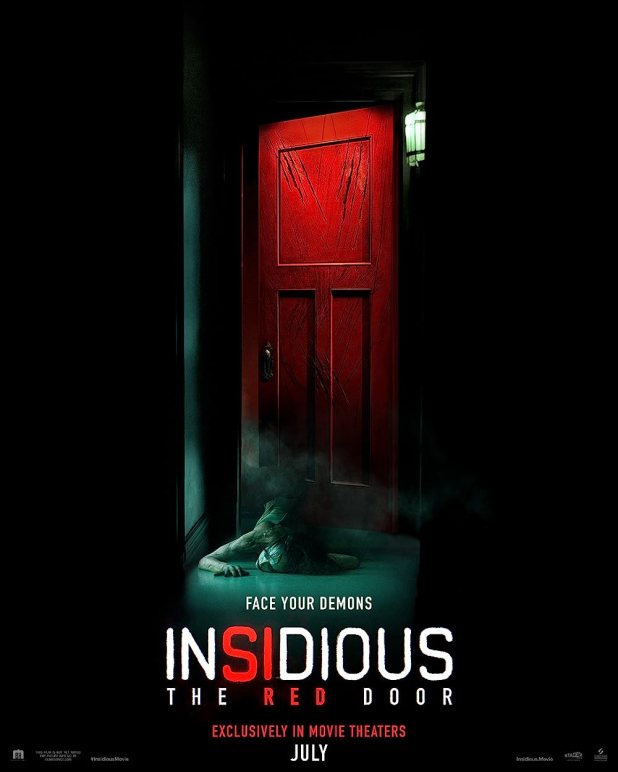
As someone who mainly loves either drive-in era movies, foreign horror or films out to test the audience’s gag reflex with a torrent of upsetting scenarios and body decimation, it took some time for me to begrudgingly respect the ghost and possession cycle of James Wan, starting with 2010’s Insidious, followed by 2013’s The Conjuring and then alternating each year or so between these franchises. Both of these series are marked by his quality eye for direction and some truly well-delivered art direction, something that’s lacking in so many modern horror movies.
But as it goes, franchises get stale. The Conjuring will hit nine movies this fall — and two shorts — while this is the fifth Insidious film. Created by Leigh Whannell (who also worked on Saw and Dead Silence with Wan and directed the underappreciated Upgrade), the first two films center on Josh and Renai Lambert (Patrick Wilson and Rose Byrne) and their children Dalton, Foster and Cali. They’re, as usual in long franchises, the best in the overall series.
A review, for those that haven’t seen the film: Dalton encounters an entity in the attic of the family home and goes into a coma, but is genuinely trapped in a realm past life and death called The Beyond, err, The Further. That place nearly trapped Josh when he was a child, a fact that he learned from his mother Lorraine (Barbara Hershey), and required the help of psychic Elise Rainier (Lin Shaye). Now, she must come back, along with paranormal investigators Specs and Tucker (Whannell and Angus Sampson), and figure out how to rescue the Lambert family.
The events of this movie—and the second, which was predestined based on the shock ending of the original—run deep within every moment of this reimagining, sequel, and restart of the franchise, the first film in the series in seven years.
Spoilers for everything after the trailer…
Directed by Wilson and written by Scott Teems—more on him in a bit—this movie opens with tragedy. Lorraine has died, Josh and Renai have divorced, Dalton (Ty Simpkins, who played the role in the original, and Andrew Astor as Foster) and his father are distant, and Josh seems to have spent the last few years in what he calls a fog. Even an attempt at connecting by driving Dalton to college fails.
While there, the young artist goes through a memory exercise in class and unlocks memories of The Further, drawing the red door at the entrance. Along with his roommate — by accident, she’s played by Sinclair Daniel and is accidentally placed in his dorm — he begins to investigate his ability to astral project and avoid ghosts at frat parties. There is a cute scene where Specs, Tucker and Elaine appear on YouTube.
Meanwhile, Josh attempts to discover why he’s felt lost most of his life. Between a CAT scan gone jump scare and a memory game—also gone jump scare—he finally has to talk to his ex-wife and learn that he once menaced the entire family with a hammer while possessed by Michelle Crane, the Woman in White, and the Lipstick Demon.
Those same entities have trapped Dalton—cue the red room, start “Tiptoe Through the Tulips,” and start the fog—and the father must save the son.
The issue with this movie is what you want it to be. Do you want closure for a family that has dealt with the paranormal and blocked it out of their lives until the act of forgetting it splits them? Or do you want a scary film that takes ordinary people into the frightening unknown of The Further? This film series has always dealt with loss and grief and the missing spaces caused by those gone from our lives — Josh’s father, Elaine’s husband — but this goes further (pardon the pun) by spending nearly an hour in the miserable lives of a family that has failed to connect before it seemingly remembers that oh yes, this is also a possession movie.
Wilson does fine for a first-time director, but it’s a challenging walk emulating the footprints of Wan. I watched the original right after we got home from the theater, and it’s striking how much bigger and richer the first movie is. As for the script, well, Scott Teems has somehow gotten to write a Firestarter reboot, the excoriable Halloween Kills and is now set to write The Exorcist: Believer, all based on a few shorts and some TV work, as far as I can tell. The height of his wit is named a character, Nick the Dick, after a scene in Bachelor Party, and really, that’s the limit of creativity in a film that outright restages scenes from the second movie.
This is less a movie that is out to scare you as a summer thrill ride and more one that brings closure to a family constantly dealing with decades of missing people and trying to process grief. The film that it wants to be is not always compatible with the type of movie it is sold as. It needs defter hands to pull that off, and instead, we are like the characters in The Further, wandering the fog for 90 minutes or so until the lights come on and we can finally go home. The film’s attempt to bring closure to the family’s long-standing issues gives a sense of resolution, even if it’s not always successful.
PS: A man literally screamed out things while we watched this movie, frightened by almost every jump scare, and he wasn’t joking. I hope that if you see this movie, he’s in the audience with you because he’s the best part of the film.
At the height of sheer Q-Anon craziness — I think probably when a shaman in red, white and blue facepaint led an army of people into government buildings, and people defecated on the walls, maybe — people were grasping for straws and pearls and wondering, “How could this happen?”
I’m here to tell you that this has always been here.
In the 1980s, high school me was the same as old me. I was always in black, with long hair, and I only cared about music, movies and studying weird things. As such, I was brought into the Core Group, a team of teachers led by an occult expert cop who studied which students could be worshipping Satan. This group was led by my godmother.
The Satanic Panic wasn’t started by Michelle Remembers, but it felt like it was. The union of Canadian psychiatrist Lawrence Pazder and his psychiatric patient (and eventual wife, but we’ll get to that) Michelle Smith. In the mid-70s, while treating Michelle for depression due to a miscarriage, she confessed to him that she knew that something horrible had happened to her and could not recall what it was. Using hypnosis, Michelle was soon screaming for 25 minutes non-stop and speaking in the voice she had as a child. 14 months and 600 hours later, a conspiracy was found: Michelle’s mother and other citizens in Victoria were members of a worldwide Church of Satan.
At one point, Michelle was part of a ritual that lasted 81 days that Satan himself showed up for, and during that time, she was tortured, raped, witnessed others get killed and was covered with the blood of murdered babies until St. Michael the Archangel, Mary and Jesus appeared, healing all of her scars and blocking all of her memories of the years of Satanic desecration of her body and soul.
None of these stories were challenged, even a decade after, when Michelle and Laurel Rose Willson, who wrote Satan’s Underground about being a breeder for Satanists and having two of her children killed in snuff films, were on Oprah Winfrey and at no moment did Oprah challenge either of them, in 1989. The year, I was repeatedly questioned and challenged and told that I was giving my soul to Satan.
I was a white kid from a small town, and in no way have I ever dealt with racism, sexism, transism or any isms in any other way again. This experience, however, showed me a small, tiny glimpse into what it’s like to know you’re right and everyone is sure you’re wrong based on no facts at all.
By the 80s, Pazder was an occult expert, consulting in the McMartin preschool trial and appearing on a 20/20 segment called “The Devil Worshippers” that stoked the flames of the Satanic Panic. That report claimed that movies like The Godsend, The Incubus, Amityville II: The Possession, Exorcist II: The Heretic, The Exorcist, The Omen and Omen 2 allowed people to visualize and be inspired by the devil. This aired in prime time on ABC, a major cable network. They also refer to The Satanic Witch as a book filled with evil rites. And then, of course, heavy metal. As Anton LaVey was in his era of not speaking to the media, this also has footage taken from Satanis.
As part of the Cult Crime Impact Network, Pazder got into business working with police groups and consulting on Satanic ritual abuse, while lawyers used his book while doing cases, and social workers used Michelle Remembers as their training manual.
According to NPR host Ari Shapiro, “One reason these fictions were so appealing was that they gave people a sense of purpose. They had a mission – to defend the innocent.”
This is what’s happening today. It’s why trans people are grooming children, why Democrats are eating babies, andwhy elections are being seen as conspiracies. Because the truth — the idea that things happen randomly for no reason — is less frightening than Satanism or Q-Anon.
Man, did I digress?
In Satan Wants You, filmmakers Sean Horlor and Steve J. Adams explore the history of Michelle Remembers and what most people don’t know, such as how Pazder and Smith left their families to be together and how the book was debunked. It would be one thing if their sessions led to a book and some press, but it would be another if they kicked off an entire movement.
The directors have stated: ““This is the first time that Michelle’s sister, Larry’s ex-wife, and Larry’s daughter have gone on the record to tell their side of this story. This was a once-in-a-lifetime opportunity to combine all these stories together to reveal the true origins of the Satanic Panic and show how they connect to the Pizzagate and QAnon conspiracies of today.”
This movie must be seen, even if we’ve entered a time when feelings matter more than facts. But did facts ever matter?
This film also found an anonymous source sending Michelle’s actual tapes, which have never been heard until now.
I don’t discount that she went through some trauma. Yet, how many lives were destroyed along the way?
The sad fact is that no one has learned anything. That same refrain of “protecting the children” exists today. And yes, that’s a noble endeavor. But as someone who grew up in a town of 7,500 people that had more than one Catholic priest abusing children in the last fifteen years of my life, Often, the abuser is someone the abuser has known and trusts.
Just like a worldwide Satanic network — paging Maury Terry and The Family, a book that lost a court case to the Process Church over false claims — and a public ritual lasting 81 days seems complicated to swallow, so do all the claims of the far right today.
Back when I was a kid getting grilled over my slasher movie magazines and love of Danzig, I figured, “Well, someday soon, all of these close-minded people will die off, and we can get past racism, and we can learn how to be more open-minded together.” But now, everyone is close-minded. No one seemingly wants to learn. And this movie is a great teaching tool — it’s a must-see, an intense documentary worthy of rewatching — because it happened before, and yes, it’s going on all over again. The message may have shifted, but it’s still the message.
And it’s still wrong.
I watched this film as part of The Bucheon International Fantastic Film Festival (BIFAN). You can learn more at their official site.
EDITOR’S NOTE: The Dunwich Horror was on the CBS Late Movie on May 7, 1973; July 1 and August 28, 1975.
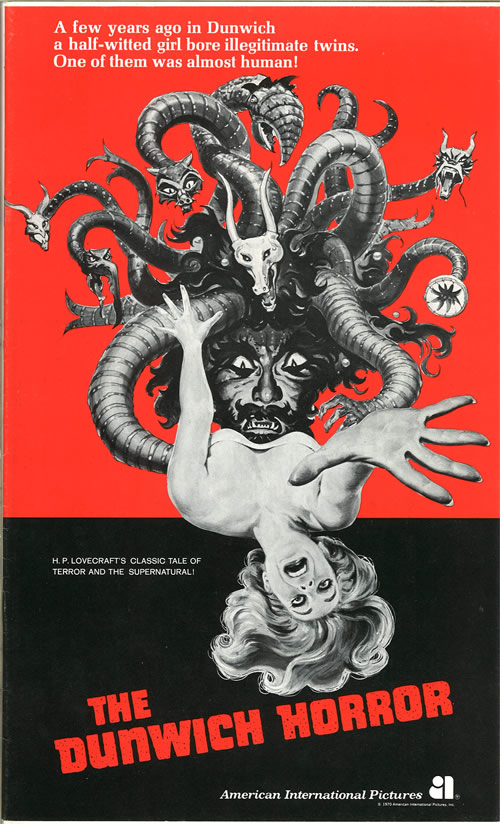
Following the triumph of the Poe movies, Roger Corman and American International Pictures embarked on a series of films inspired by H.P. Lovecraft. The announcement of The Dunwich Horror in 1963, set to be filmed in Italy by Mario Bava and starring Boris Karloff and Christopher Lee, sparked immense anticipation. However, a setback occurred when Dr. Goldfoot and the Girl Bombs failed, causing a delay in the production of this movie.
It took several years to make this movie happen—probably Rosemary’s Baby’s success is one reason why occult movies really started to come out in the early 1970s—and when it was made, Daniel Haller was hired to direct.
Daniel Haller, who started his career as an art director and designed the sets for Corman’s House of Usher and The Pit and the Pendulum, was a perfect fit for the director role. His first movie, Die, Monster, Die!, was based on Lovecraft’s The Colour Out of Space, further solidifying his suitability for this project.
At the Miskatonic University in Arkham, Massachusetts, a setting often used in Lovecraft’s stories, Dr. Henry Armitage (Ed Begley) gives a rare copy of Necronomicon to his student Nancy Wagner (Sandra Dee, breaking her Universal Pictures contract and making her first “adult” movie, so to speak) to return to the library. She’s followed by Wilbur Whateley (Dean Stockwell), a man who hypnotizes her to sneak a glance at the dreaded grimoire. Unlike everyone else in Arkham, Nancy is kind to the man and gives him a ride despite him, you know, staring into her soul.
I mean, maybe she should have because he soon drugs her and convinces her to stay the night inside the horrifying home of his ancestors.
It turns out that within the home, Wilbur’s twin brother from a demon father is waiting and will soon be let loose in town. Wilbur also lives up to all of the townsfolks’ fears as he attempts to sacrifice Nancy to the Old Ones. This leads to a dramatic spellcasting battle between him and Dr. Armitage, a scene heightened by a violent thunderstorm.






 B&S About Movies
You must be logged in to post a comment.