In 1971, drive-ins across America and the maniacs inside the cars wanted more of the Blood Island movies. But hey — the guys behind them were busy, so Hemisphere said, “What if Al Adamson made a Blood Island ripoff outside of the Philippines?”
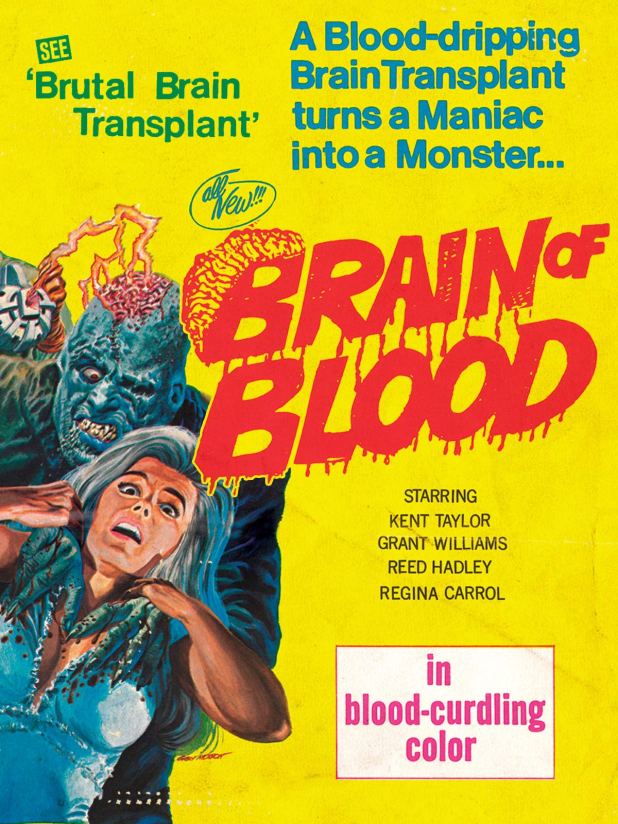
Brain of Blood is the result. The gory, ridiculous and totally awesome result.
Amir (Reed Hadley, one of the actors who played Red Ryder and also someone who narrated Department of Defense films during World War II) is the ruler of Kalid and is dying, but a scientist named Dr. Trenton (Kent Taylor, who shows up in all the Blood Island series) has different plans, thanks to the requisite dwarves and chained up women. Can Amir’s pal Bob (Grant Williams, who starred in The Incredible Shrinking Man, in his last role) and his wife Tracey (Al Adamson’s wife Regina Carrol) save the day?
Angelo Rossitto plays the evil Dorro. This small-sized actor also shows up in Scared to Death, From A Whisper to a Scream, The Trip, Freaks, Galaxina and nearly seventy other films, including a turn as Master in Mad Max Beyond Thunderdome. He’s also on the cover of Tom Waits’ album “Swordfishtrombones.”
John Bloom also shows up, who you may remember as Reaper in The Hills Have Eyes II, as well as playing Frankenstein’s Monster in Adamson’s borderline insane Dracula vs. Frankenstein, the recipient of The Incredible 2-Headed Transplant, Big Foot in Angels’ Wild Women, The Dark in, well, The Dark and appearances in Bachelor Party, The Great Outdoors and Up Your Alley.
You can get the blu ray from Severin. There was also a Cinematic Titanic riffed version of this under the title The Oozing Skull. The title was changed as Sam Sherman was concerned that multiple versions of the film could create marketplace confusion.
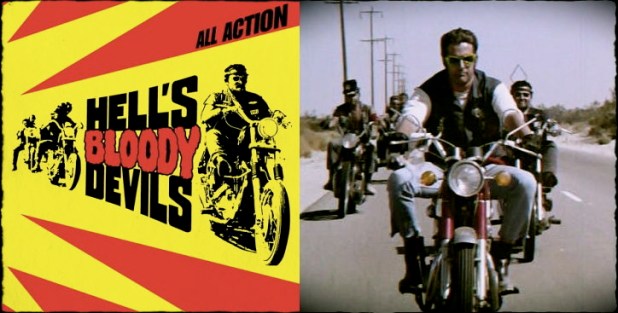
It just makes sense that the Third Reich would regroup in Las Vegas, I guess. FBI agent Mark Adams (John Gabriel) poses as a member of a Sin City organized crime gang to get into the world of war criminal Count von Delberg (Kent Taylor) and stop him from his plan to counterfeit U.S. dollars. He’s helped by Israeli agent Carol Bechtal (Vicki Volante) whose parents were killed by von Delberg during the war. But the Count hasn’t slowed down or not gotten with the times. He’s working with the Bloody Devils, a motorcycle gang, to make his plans work.
This started as a spy movie called Operation M before it was The Fakers and then a few years later, bikers — real bikers, the kind that get busted for weapons charges during filming — joined the cast.
You know who else is in there? Colonel Sanders. He’s in one of his KFC restaurants. The Colonel had sold the restaurants in 1964 but retained ownership of the Canadian stores and was a brand ambassador, even if he started to despise the way the new owners made his chicken cheaper and not to his taste. In 1975, he said, “My God, that gravy is horrible. They buy tap water for 15 to 20 cents a thousand gallons and then they mix it with flour and starch and end up with pure wallpaper paste. And I know wallpaper paste, by God, because I’ve seen my mother make it. There’s no nutrition in it and they ought not to be allowed to sell it. Their fried chicken recipe is nothing in the world but a damn fried doughball stuck on some chicken.” KFC has paid for product placement in this movie, which may seem strange, but the Colonel also shows up — as does his chicken — in some Herschell Gordon Lewis movies. The Godfather of Gore used to serve up the original recipe as his craft service. The Colonel is also in Blast-Off Girls, The Big Mouth and The Phynx.
John Carradine plays a pet shop owner. That’s enough to make me watch.
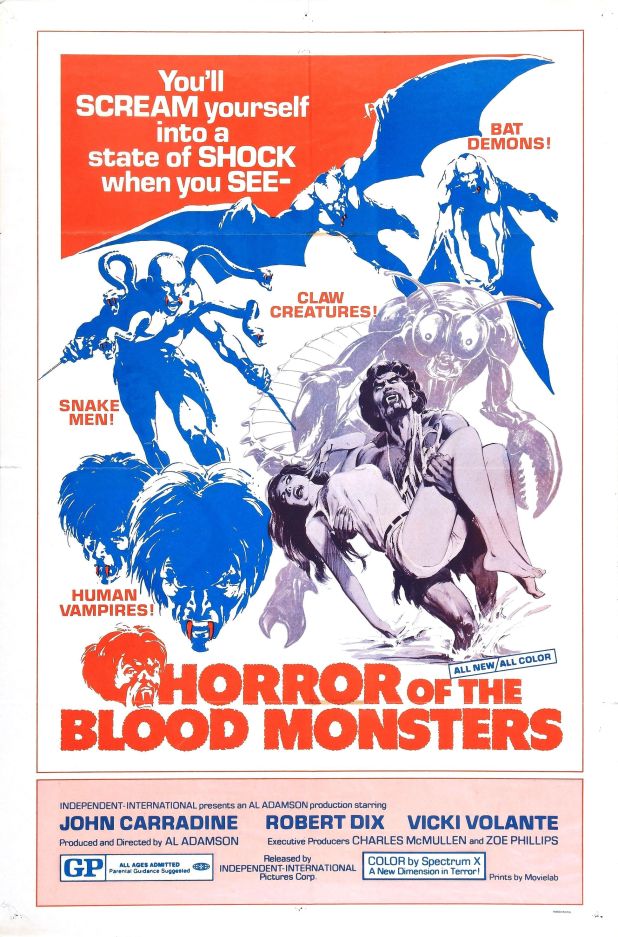
Al Adamson was remixing movies back in 1970. Invasion of the Blood Monsters has footage from Robot Monster, Unknown Island, One Million B.C., the Filipino movie Tagani and The Wizard of Mars. By the time it was ready for drive-ins and theaters, that black and white footage looked old. Adamson used a process called Spectrum X that made everything a single color. It’s really strange when mixed with full color footage yet I kind of enjoy it.
Exploitation heroes like Gary Graver and Adamson play vampires in the beginning as we listen to Brother Theodore tell us what has happened to our home world and why a rocket must go into space and John Carradine will lead humans in their quest to save Earth.
Jennifer Bishop is the beautiful girl who will help them fight snake men, lobster people and more vampires — hey, Bud Cardos — and oh yeah, bat people! Sam Sherman produced this and it was originally started in 1966 with reshoots in 1970. It was getting renamed all the way up until it was a Star Wars clone — well, in title only — under the AKA Space Mission of the Lost Planet.
I just read a bad review of this movie and it made me dislike the person who dare say anything mean about this film. From the moment the Independent International logo shows up, I was happy. Like, deliriously joyous. How can you not love a movie like this? What’s next, people don’t like Brain of Blood?
Directed by Al Adamson and written by Robert Dix, who plays Ben Thompson, Five Bloody Graves is about Ben battling Satago (John “Bud” Cardos), the man who scalped his ex-girlfriend Nora (Vicki Volante) and her husband (Ken Osborne). Cardos is also Joe Lightfoot, Satago’s brother, who is half-white and half-Native American.
Ben was a former lawman and now, he wanders the Wild West — including an amazingly named town Goblin Valley, Utah, which is a real place — before he helps holy man Boone Hawkins (John Carradine) and a stagecoach full of showgirls like Kansas Kelly (Paula Raymond) and Althea Richards (Darlene Lucht) through Native American territory while death itself (Gene Raymond) narrating explaining how Ben and Satago are his messangers on Earth. It’s all very metal.
This also looks pretty great thanks to cinematographer Vilmos Zsigmond, who went on to win an Oscar for Best Cinematography for Close Encounters of the Third Kind, as well as filming McCabe & Mrs. Millers, The Deer Hunter, Deliverance, The Black Dahlia and many more.
The tagline “Lust-Mad Men and Lawless Women in a Vicious and Sensuous Orgy of Slaughter!” is enough to get me in the drive-in for this.
Al Adamson made his breakthrough with this movie, going on to direct Dracula vs. Frankenstein, Cinderella 2000, Nurse Sherri and one of the most legitimately unhinged movies I’ve ever survived, Carnival Magic. Even stranger, he was murdered and buried beneath his hot tub in 1995, killed by his live-in contractor Fred Fulford in a plot that could have been one of his films.
However, today we’re talking about his contribution to biker films.
The Satans are a motorcycle club who roam the American Southwest, led by Anchor (Russ Tamblyn, TV’s Twin Peaks) and including Firewater (John “Bud” Cardos, Breaking Point), Acid (Greydon Clark, who directed Satan’s Cheerleaders), Romeo (Bobby Clark, TV’s Casey Jones), Muscle, Willie and Gina (Regina Carrol, Adamson’s wife who appears in nearly all of his films). We’re introduced to the gang as they beat up a man, rape his girlfriend and then push them and their car off a cliff.
They have the bad luck to get in the way of hitchhiker Johnny Martin, a Vietnam vet who is just trying to figure it all out. He gets picked up by Chuck Baldwin (Scott Brady, the sheriff from Gremlins) and his wife Nora. The old man’s a cop and wants to help the young Marine as he travels the highways. They all go to a diner, where we meet Lew (Kent Taylor, half of the inspiration for Superman’s alter ego), the owner, and Tracy, a waitress.
The Satans show up and ruin the budding romance between Johnny and Tracy, as they earn the ire of Chuck and his wife, who tosses a drink in one of their faces. Chuck tries to pull his gun, but the old man’s authority means nothing to the hardened toughs who beat the fuck out of him and rape his woman. Then, they kill all three — but not until Anchor screams out a totally inspired rant:
“You’re right, cop. You’re right, I am a rotten bastard. I admit it. But I tell ya something. Even though I got a lot of hate inside, I got some friends who ain’t got hate inside. They’re filled with nothing but love. Their only crime is growing their hair long, smoking a little grass and getting high, looking at the stars at night, writing poetry in the sand. And what do you do? You bust down their doors, man. Dumb-ass cop. You bust down their doors and you bust down their heads. You put ’em behind bars. And you know something funny? They forgive you. I don’t.”
The Satans don’t leave witnesses. Well, except for our hero and the waitress, who just escaped from Muscle and Romeo. Meanwhile, the gang meets three young girls and start partying with them. Gina can’t take seeing Anchor with other women, so she jumps off a cliff.
Willie tries to kill our heroes, but a rattlesnake saves them (!). Meanwhile, Firewater finds his body and comes to tell Anchor, who has gone insane and murdered all three girls. They fight and Firewater leaves the leader for dead. As he finally finds Johnny and Tracy, he is killed by a landslide (again, nature itself is against the bikers).
Finally, Anchor catches up to them and goes nuts, giving another soliloquy about being Satan. He raises Chuck’s gun to kill everyone, but Johnny simply throws a switchblade at him. “In Vietnam, at least I got paid when I killed people,” he says and at that, he and Tracy ride off on the villain’s cycle.
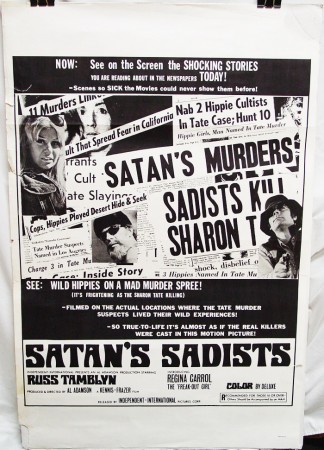
Satan’s Sadists was filmed at the Spahn Movie Ranch in Simi Valley, CA, at the same time the Manson Family lived there. Some movies would hide this fact. This poster will prove that this one wears it on its bloody sleeve.
Truly, this is a movie that does not give a fuck. Just about no one gets out alive or unscarred. Any moments of pleasure are stolen or taken by force. The poster promises human garbage and this film delivers.
ABOUT THE AUTHOR: Jennifer Upton is an American (non-werewolf) writer/editor in London. She currently works as a ghostwriter of personal memoirs for Story Terrace London and writes for several blogs on topics as diverse as film history, punk rock, women’s issues, and international politics. For links to her work, please visit https://www.jennuptonwriter.com or send her a Tweet @Jennxldn
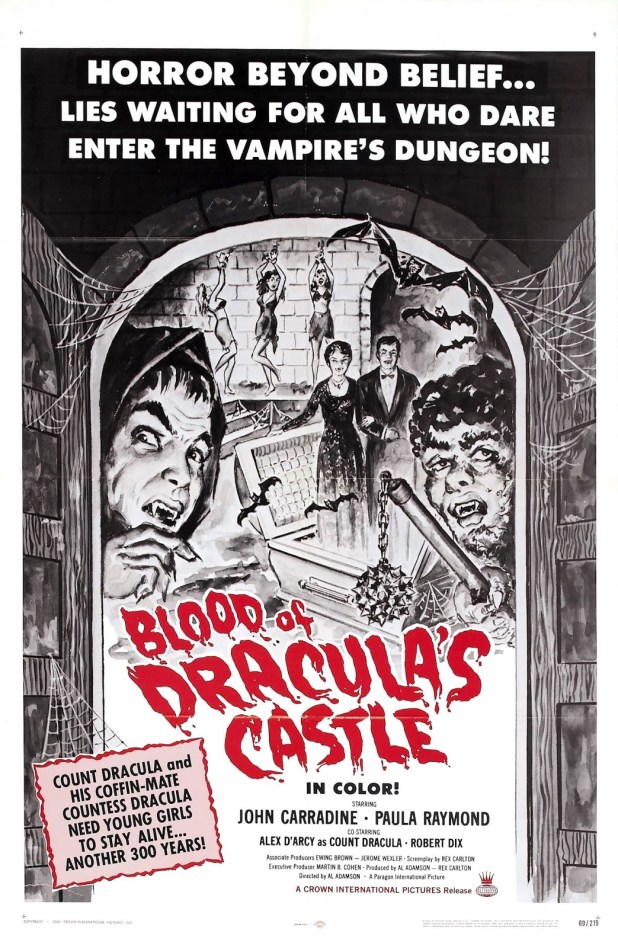
Blood of Dracula’s Castle (1967) is truly a boring film, even for Al Adamson, who is not known for making great films. The most exciting bit of action in this movie was the scene-stealing walrus in the opening scene shot at the old Marineland in Palos Verdes, California. That walrus puts in a more energetic better performance than any of the human actors.
The story concerns Mrs. and Mrs. Count Dracula, who have essentially retired as “The Townsends” to a castle in the California desert (Falcon Rock Castle Antelope Valley, California.)
Now free from a life of killing villagers in Europe their new life is one of leisure. There’s no more hunting for these two elites! Their new bougie diet consists mostly of bloody cocktails prepared for them by their butler George played by John Carradine, a priest in a cult who worships Luna the Moon God along with the Townsends.
The blood comes from the various girls kept chained in the basement, most of whom are collected from the nearby highway and brought home by their deformed Igor-like caretaker Mango played by Ray Young. A tall stunt actor better known as the boulder-throwing half of The Kroft Supershow staple Bigfoot and Wildboy (1976.)
The Townsends and also have a strange relationship with a local serial killer named Johnny (Robert Dix). Although how he came to be close with the Townsend’s is never explored, they seem to have a reciprocal relationship. One in which he brings them victims for promised initiation into vampirehood. In the alternate television version (yes, there are two versions of this snorefest – both available online) Johnny is a werewolf.
After escaping from a mental institution, Johnny kills a few people just for the hell of it on the way home to the castle. Here, the added werewolf scenes actually make sense. Somewhat. In the original version Johnny mentions repeatedly how he can’t control his murderous urges when there’s a full moon. The problem with the new inserts lies in the fact that they were clearly shot years later. The hairstyle and wardrobe of the victim places it squarely in the ‘70s and the electronic music bears no resemblance to the music in the rest of the film.
One would think that a police pursuit of a serial killer/werewolf would be exciting. It isn’t. That’s the problem with this movie. Even when things happen it doesn’t feel like it. There’s an utter lethargy to the acting, camera placement and editing. During the chase, the screen direction is completely off and there is very little foley to bring the soundtrack to life.
Once reunited, the Townsends, Johnny, George and Mango now have a new problem to contend with. They must find a new place to live. Sadly, after a nice, calm, sixty-year tenancy, their 108-year-old landlord has died, leaving the castle to his nephew. The new landlord – a photographer named Glenn Cannon and his perpetually complaining model fiancé Liz decide they’re going to live there.
When they show up to inspect the place, instead of chaos, we are treated to a series of long civil discussions between the characters. Most disappointing of all is that the vampires never do anything. They’re far too spoiled and sophisticated. Count Townsend (played by Horrors of Spider Island star Alex D’arcy) is so nonchalant that at one point he tells a potential victim, “Oh, no. We won’t kill you. We need your blood,” with the calm tone of a man making small talk. They don’t even fight when Glenn ties them up in the finale. They’re far too used to being looked after by their staff to do anything as vulgar as defend themselves. If the Howell’s on Gilligan’s Island were vampires, this is exactly how they’d behave. The effect is equally as comical. However, they don’t go as gently into the ether as one might think. After sacrificing a girl on the beach to Luna, aging and turning to dust when the morning sun shines through the window, two bats emerge from the vampires’ fancy party clothes and fly off. Perhaps to rent another castle somewhere else and start over. George and Johnny are dispatched by our heroes.Glenn saves Liz. Mango gets shot, axed and thrown off a cliff. It should be exciting. It isn’t.
Dr. Howard Vanard (John Carradine) implants a strange electronic machine into the brain of ‘Nam survivor Joe Corey (Roy Morton) who becomes a psychotic killer.
This is the same story that we saw in The Fiend With the Electronic Brain.
Joe Corey steals some diamonds and the jewels are thrown into the back of a pickup truck. They end up in a doll, which is taken by Linda and her daughter Nancy to a cabin. A cop saves them by shooting Joe and the villain falls off a cliff to his demise.
This is the same story that we saw in Psycho-A-Go-Go.
Seven years later, Dr. Vanard’s daughter Susan (Regina Carrol) begins to get psychic prank calls from Elton Corey (Kent Taylor) and his zombie Akro. Elton is the father of Joe and wants revenge on everyone connected with the death of his son. Sgt. Cross (Tommy Kirk) gets his partner’s head in the mail and tracks down the witch doctor mad scientist just in time to watch Akro kill Corey and die himself. Also, for some reason, they age Susan and turn her into a zombie but she gets better.
This is not the same story.
The Man With the Synthetic Brain, however, is pretty much the same story without all the nightclub moments. That was Sam Sherman’s version for TV.
I have a weird way of thinking about movies. If a major studio did this, I would be angry. But when it’s Independent-International, I am so pleased with their ingenuity.
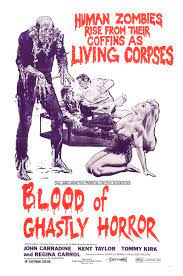
The Fiend with the Electronic Brain is — sort of — Al Adamson’s 1965 movie Psycho-A-Go-Go which is also — sort of — Blood of Ghastly Horror.
Psycho A-Go-Go is all about Joe Corey taking part in a diamond heist with the stolen contraband hidden inside a little girl’s doll when it isn’t about Tacey Robbins singing.
This remix has Joe Corey’s madness explained as he is an injured Vietnam vet who is experimented on by Dr. Vanard (John Carradine). Everything that happened in the first version also happens here but Joe is off the hook, I guess, because of the surgery on his mind.
Venard wanted to heal the soldier’s shrapnel injuries with electric shock therapy, but he turned Joe into a woman-killing monster who is now hunting him down. He straps Dr. Vanard to his own lab equipment and electrocutes him before we somehow find ourselves back in that jewel robbery, the diamonds in the doll and the forest haunting of the woman and her daughter, all before Joe gets shot and falls off a cliff.
Beyond also being Bloof of Ghastly Horror and also The Man with the Synthetic Brain, a Sam Sherman retitling for TV. You could see this movie four times and be taken every time as you’re seeing the same story with little tweaks along the way with footage being Xeroxed over and over and over.
I get upset when Spielberg or Lucas comes back and meddles with their movies but I am in no way upset that Al Adamson just kept trying to make this movie better. Arguably, he didn’t. He tried and you have to give it to him for that.
Bubble Bath: Hungarian director György Kovásznai’s wildly idiosyncratic animated musical is one of the most indescribably strange, personal and totally irresistible cartoon features ever made. A walking ball of anxieties, shop window decorator Zsolt (voiced by Kornél Gelley, with Albert Antalffy singing) bursts into the apartment of his fiancée’s best friend Anikó (voiced by Vera Venzcel, with Kati Bontovits singing), paralyzed with fear at his impending marriage. Zsolt is like a stoned hippie alleycat, or an Eastern European Frank Zappa in a tux; medical student Anikó a more curvaceous and leggy post-modern Betty Boop – and both unsure of their attraction to each other, of the choices they’ve made, of what life has in store for them.
A truly insane mash-up of styles, from 1920s Art Deco to 1960s Psychedelia to late 1970s louche Roxy Music decadence, Bubble Bath is incredibly restless and creative, the bohemian love-child of Bill Plympton’s off-kilter individualism and Ralph Bakshi’s wonderfully warped, rubbery visual style. In other words: it’s not quite like any animated film you’ve ever seen before. Sadly, this was director and animator Kovásznai’s only feature film — he died of leukemia in 1983. Bubble Bath has been beautifully restored by the National Film Institute in Hungary for its first-ever U.S. release by Deaf Crocodile. In Hungarian with English subtitles.
World War III: The official Iranian entry for Best International Feature Film at the 2023 Academy Awards, and the Winner of the Orizzonti Awards for Best Film and Actor at the Venice Film Festival 2022, director Houman Seyedi’s savage, mysterious thriller/drama World War III is one of the darkest, most enigmatic portraits of class inequality, desperation and murder since Lee Chang-dong’s Burning and Bong Joon-ho’s Parasite. Mohsen Tanabandeh delivers an unforgettable performance as Shakib, an anonymous day laborer still grieving the deaths of his wife and son who’s given a job guarding the set of a film about the Holocaust. When the lead actor playing (yes) Hitler is struck ill, Shakib is enlisted to wear the costume and mustache – and for the first time in his life, he has a little money, respect and a place to sleep. Unexpectedly, his sex worker “girlfriend” (Mahsa Hejazi) shows up, threatening to upset his tenacious hold on prosperity. What starts out as a dark satire of the Iranian film industry quickly evolves into a near-Hitchcockian thriller of the underclass struggling violently to be heard, to be seen – with an apocalyptic ending that is truly something to behold. Rated 100% Fresh on Rotten Tomatoes. In Persian with English subtitles.
Plus they have a movie up for preorder!
The Mysterious Castle In the Carpathians: A unique and almost indescribable mix of Gothic fiction, steampunk gadgetry (designed by Czech animation wizard Jan Švankmajer), slapstick comedy and romantic opera, director Oldřich Lipský’s wonderfully bonkers delight has elements of The Fearless Vampire Killers, Terry Gilliam, Mel Brooks and The Benny Hill Show. Based on an 1892 Jules Verne novel The Carpathian Castle (which partially inspired Bram Stoker to write Dracula), the film follows Count Teleke of Tölökö (Michal Dočolomanský) on the trail of the count’s lost lover, opera singer Salsa Verde (Evelyna Steimarová) – only to discover she’s been abducted by fiendish Baron Gorc of Gorceny (Miloš Kopecký), whose castle home is filled with the bizarre inventions of mad scientist Orfanik (Rudolf Hrušínský). Littered with puns, sight gags and non-sequiturs – “Later, in Werewolfston”, an invented dialect, a detached golden ear for eavesdropping, a staff topped by an enormous TV eyeball – Mysterious Castle was the third fantastical film from the team of director Lipský and writer Jiří Brdečka after their much-loved musical western spoof Lemonade Joe (1966) and their detective/horror satire Adela Has Not Had Supper Yet (1977), both major Czech cult hits. (Note that actor Miloš Kopecký and Jiří Brdečka worked on the supernatural anthology Prague Nights, also released by the Národní filmový archív, Deaf Crocodile and Comeback Company.)
Bonus features include:
New restoration of Mysterious Castle by Craig Rogers for Deaf Crocodile.
New video interview with Czech film critic and screenwriter Tereza Brdečková on her father, Jiří Brdečka, writer of Mysterious Castle. (In English).
New essay by film historian and expert on Eastern European cinema Jonathan Owen.
New audio commentary by Tereza Brdečková and Czech film expert Irena Kovarova of Comeback Company.
Two eerie and stunningly beautiful Jiří Brdečka animated short films: Vzducholoď a láska (Love and the Dirigible) (1948, 9 min.) and Třináctá komnata prince Měděnce (Prince Copperslick aka Prince Měděnec’s Thirteenth Chamber) (1980, 9 min.) Both in Czech with English subtitles.
A feature-length documentary on the life and career of filmmaker, animator, screenwriter and illustrator Jiří Brdečka, covering his childhood, his work as a screenwriter with Jiří Trnka, Karel Zeman and Oldřich Lipský, and his own acclaimed work as an animator and director. In Czech with English subtitles.
Blu-ray authoring by David Mackenzie of Fidelity In Motion.
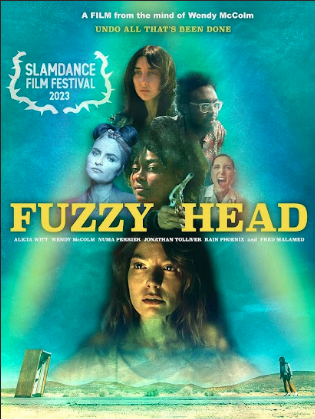
A film with a perfectly fitting title, writer/director/star Wendy McColm’s Fuzzy Head is a surreal genre-film meditation on lifelong trauma that began with childhood abuse.
Insomniac Marla (McColm) may or may not be interacting with others, viewers may or may not be witnessing actual events or imagined ones from her life, and the nonlinear framework of the film makes things even less clear as the young woman tries to piece together whether she murdered her mother, who once made her walk on broken glass as a childhood punishment. But if things were clear to us, we couldn’t sympathize with Marla’s plight as much as we do — and hers is the type of character, thanks to McColm’s work behind the camera and in front of it, that we ultimately want to see come out of everything okay.
McColm is great in the role, with her character going through the wringer, and her supporting cast — particularly Alicia Witt as Marla’s mother — is solid throughout. If you enjoy symbolism and dream interpretation in your cinematic choices, Fuzzy Head should keep you busy. There’s more than a little David Lynch influence at play here, along with influences from other filmmakers, but McColm’s film is its own unique work, boasting plenty of oddness and intriguing visuals.
Fuzzy Head is a heavy, heady, often uncanny character study with thriller elements that should leave viewers with plenty to chew on long after the ending credits roll.
Fuzzy Head, from Gravitas Ventures, is currently available as a streaming release.



 B&S About Movies
You must be logged in to post a comment.