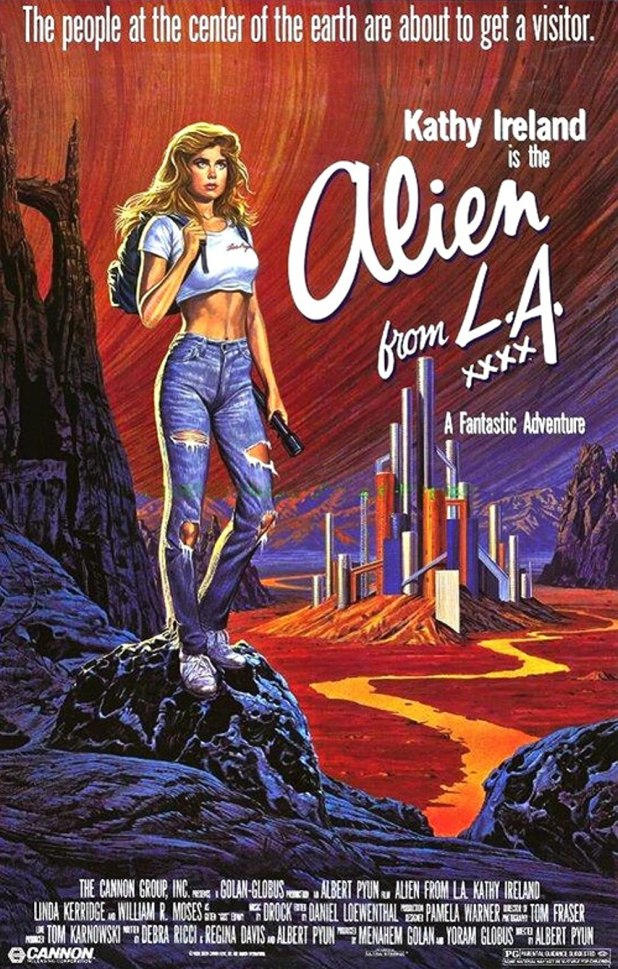
CANNON MONTH: Alien from L.A. (1988)

Based — loosely based! — on Jules Verne’s Journey to the Center of the Earth with a little part of The Wizard of Oz as several actors play parts above and below ground, Albery Pyun’s science fiction fantasy tells the story of Wanda Saknussemm (Kathy Ireland), a nerd — as if — who gets dumped for not having a sense of adventure. That’s when she learns that her archaeologist father has fallen down a bottomless put near Zamboanga and before you know it, we have Atlantis, a thousand-year-old alien spaceship and a journey literally to, you guessed it, the center of the Earth.

So where does the title come from? When Wanda finds her way inside the inner Earth, she becomes the alien, at odds with gangster Mambino (Deep Roy) and Lord Over while falling for charming Charmin’ (Thom Mathews, who I always call Tommy Jarvis). Hey! There’s Linda Kerridge from Fade to Black as Wanda’s aunt and a bar owner!

Pyun and Ireland would return for the direct-to-video sequel Journey to the Center of the Earth, which suffered the Cannon curse of cuts and budget woes. The pre-production work and storyboards were wasted as the final film bears little resemblance to the script, which is why it started as a movie made Rusty Lemonrande — the producer of Yentyl and Captain EO — and Pyun coming on and this turning into a sequel. Nobody was happy with how it ended up. But it does have Emo Phillips in it.

This ran on cable pretty often when I was young. Now you can get it from Vinegar Syndrome.

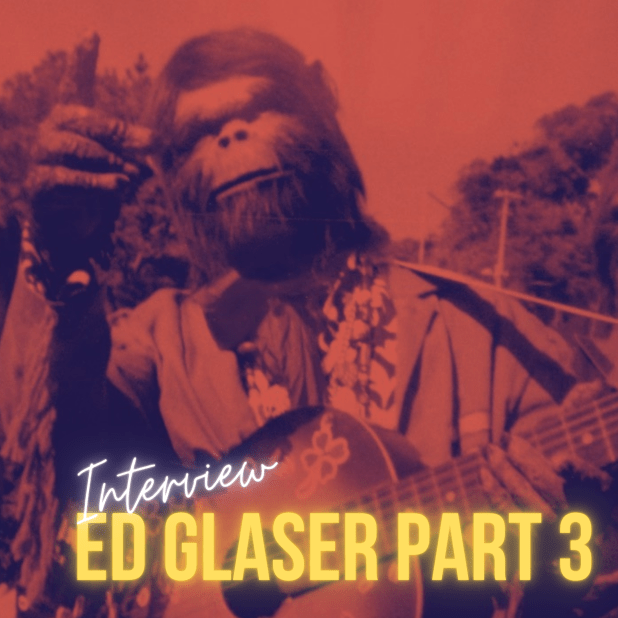
Interview with Ed Glaser, author of How the World Remade Hollywood part 3

In the second part of this interview, we learned from Ed Glaser, the author of How the World Remade Hollywood, exactly what Santo, post-apocalyptic movies and sharks have to do with remake and remix cinema.

Today, it’s all about Italian movies and if riffing ruins a film.

B&S: But sometimes in the midst of these mercenary endeavors, there’s art. Sometimes, right? Like Shocking Dark ends up being quite good.

Ed: I have no excuse to love it as much as I do. But I do. Because I think by all objective measures it’s slow, boring, and not especially interesting. And yet you have this polluted futuristic Venice, a gigantic mega corporation called the Tubular Corporation, a group of mercenaries called Megaforce who go in and try to find out what’s going down in the tunnels under Venice. And then it’s also this wild rip-off of Aliens and Terminator smooshed together.

B&S: Well, it is Terminator 2

Ed: Claudio Fragasso’s wife Rossella Drudi was basically given the brief, “I want it to be Terminator and Aliens,” and she mostly pulled from the latter.

It’s really true, though, about these films being mercenary productions. The producers want to make money — which, I mean, of course — but they’ll hire creative professionals who want to do more, or have their own particular passions. So they use those mercenary opportunities to pursue other things. 

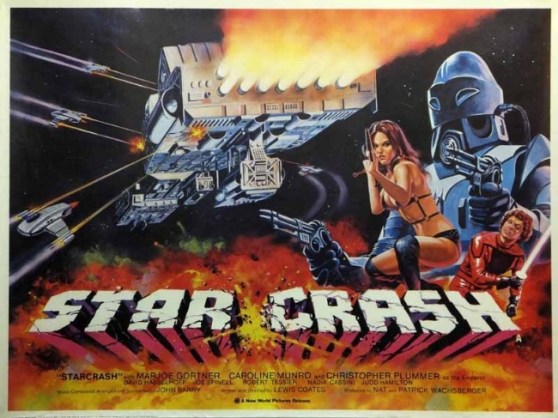
Like Starcrash

Luigi Cozzi loves science fiction. And he’d wanted to make a science fiction movie for years, but nobody would put up the money. It wasn’t going to sell, they said. And then suddenly, Star Wars comes out. And a producer calls him and says, “I need you to make Star Wars.”

Cozzi hadn’t even seen Star Wars when he wrote Starcrash. It hadn’t come out in Italy yet. He had the novel, though, and that was extremely useful. But he was more interested in doing what he called “Sinbad on Mars.” So that’s what he did. He pulled from swashbuckling adventure movies and science fiction authors that he loved. Yes, the film is unmistakably Star Wars in many ways because he had to meet the brief, but it’s so much more than that.

\

B&S: With Starcrash and Saru no Gundan (Time of the Apes), the only exposure so many people have had with these movies is seeing them riffed on Mystery Science Theater 3000

Ed: Time of the Apes is a great deal of fun if you love Planet of the Apes. The entire show is terrific. Yes, it was made on a tight budget as these things were but there’s a lot of really interesting stuff there.

There’s kind of a tug of war tug of war between movie fans when it comes to the Mystery Science Theater treatment. There are some that love it. There are some that think that it denigrates the films it features. But there are a couple of things that help swing the pendulum for me. Are the movies being riffed affectionately and not derisively? And then, as an audience member, does your interest in the film end when the episode ends?

My first exposure to Danger: Diabolik was on Mystery Science Theater. Later, as I learned more about Mario Bava, I saw the movie through new eyes and was delighted by it. I never thought the film was terrible. I thought it was kind of goofy. But I wasn’t “done” with it after MST3K

I think that, yes, there’s certainly that risk if you’re not familiar with a movie that if you first see it riffed then you’ll write it off as a bad film. But I hope that more often than not, that’s not the case. I hope you want to know more.

B&S: Maybe I’m being too precious about the movies that I love.

Ed: I think that the folks behind Mystery Science Theater really have evolved their technique over the years. The ones that went on to do RiffTrax have even done universally-beloved films like Casablanca or the original Star Wars. You can poke fun at just about any kind of movie; it doesn’t have to be mean-spirited.

B&S: There’s a tendency for people to say that a movie is so bad that it’s good. And I don’t subscribe to that. You don’t have to apologize for liking movies.

Ed: I mentioned that in my introduction in the book. I’m also not a big fan of the idea of guilty pleasures. There’s an excellent documentary from the UK called Guilt-Free Pleasures that interrogates what “guilty pleasure” really means. It also suggests that, if we continue to use the phrase, it might be better suited to movies that are in some way morally problematic; not merely “bad.” But saying that a movie is so bad that it’s good, it’s cheating. You’re having your cake and eating it too. Or maybe just saying “this cake sucks” but eating the whole thing because it’s delicious.

It’s just kind of arrogant and obnoxious. If you enjoy the film, then enjoy the film. It can be weirdly shot or technically wonky or awkwardly written, but if you’re enjoying the film, maybe it’s not actually a bad film.

Tomorrow, Ed and I wrap things up.

You can get Ed’s book, How the World Remade Hollywood, from McFarland Books. To see some of these movies and hear from Ed, check out Deja View: Remakes and Rip-Offs of Your Favorite Films.

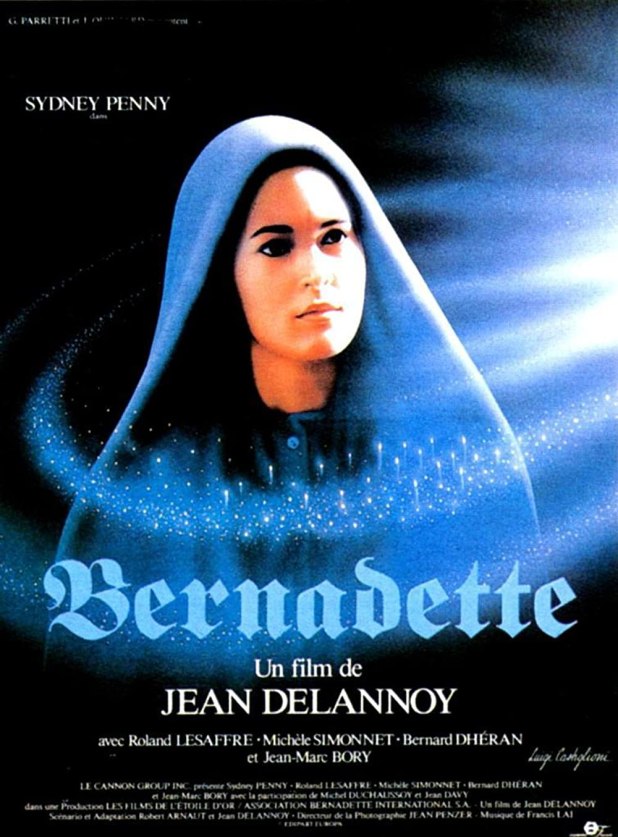
CANNON MONTH: Bernadette (1988)

Leave it to Golan and Globus to make a Catholic movie.

In 1858, a 14-year old asthmatic and illiterate girl named Bernadette (Bernadette Soubirous) saw a light with a beautiful young woman inside. You may know the miracle by the town she lived in, Lourdes.

Made two years after Alain Cavalier’s Thérèse, this Cannon-produced movie was filmed in both English and French. We may never see what she sees, but we come to believe that in the face of unbelievers, including the church, Bernadette must be telling the truth. Director Jean Delannoy’s also made a sequel, The Passion of Bernadette, so if this seems to end before the story does, that could be the reason.

This movie plays non-stop in one of the shrines in Lourdes, so it must be pretty faithful. No pun intended.


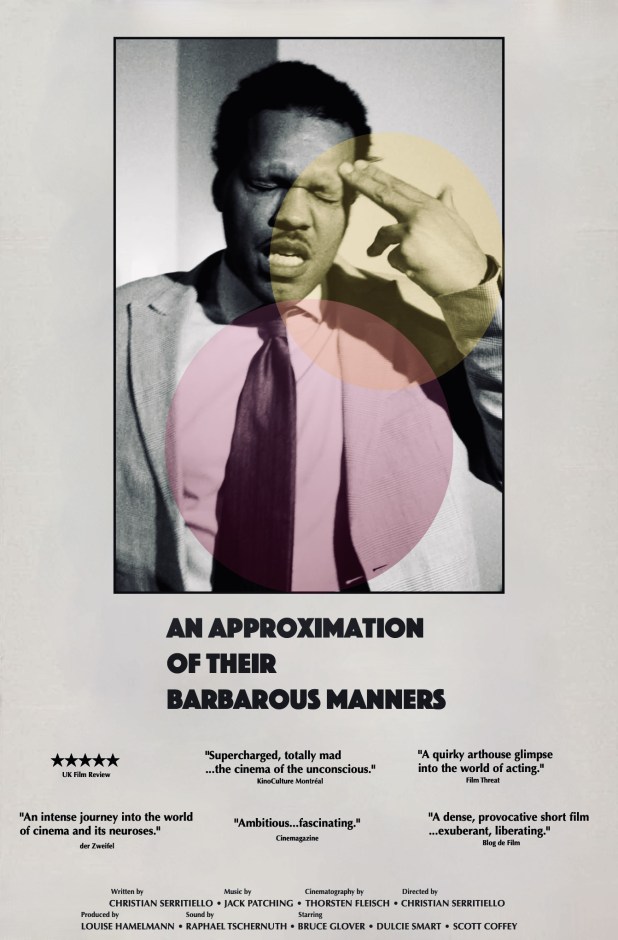
An Approximation of Their Barbarous Manners (2021)

Director, writer and actor Christian Serritiello has made a movie that revolves around the making of a movie, one that features 87-year-old American character actor Bruce Glover missing from the first day of shooting and the cast and crew unravelling.

Other than the video of his audition and a phone call, Glover is absent from the movie, as everyone else struggles to deal with the loss, from James (Scott Coffey, who directed Adult World) retreating into his comforting spirit animals, Jeremy (Daniel Brunet) giving into anger, and a director (Bruce A. Woolley) coming apart to the female cast members, Anjelica (Kristen Bush) and Gloria (Dulcie Smart), who deal with things in much more adult ways.

This made me wonder: did Glover just blow off the production and this ended up being the artistic cover? Or is this the actual film? When someone is made this well, I’d lean toward the latter, as the sell material would probably push the former.

This black and white short is just the right length for the story it tells. It doesn’t overstay its welcome and is worth your time.

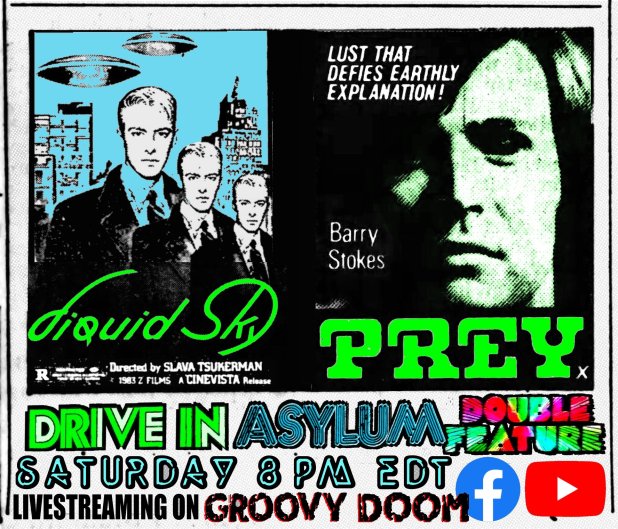
SPACE IS THE PLACE FOR THE DRIVE-IN ASYLUM DOUBLE FEATURE!

I won’t be around this weekend — Becca’s father’s celebration of life is Saturday and family will be in nearly all week — but you should join Bill and GG Graham Bill and me this Saturday at 8 PM on the Groovy Doom Facebook and YouTube page!

Up first is the singular wonder that is Liquid Sky. You can watch that on YouTube.

Each week, we discuss each film, show an ad gallery and enjoy a drink themed to the movie. I may not be there to make this week’s drink, but perhaps you can make it yourself.

Liquid Sky (adapted from this recipe)

  • 1 oz. Cointreau
  • 1 oz. blue curacao
  • 4 oz. lemonade
  • 2 oz. club soda
  1. Pour ingredients over ice in this order: Cointreau, cuacao, lemonade and then soda.
  2. Stir and keep your eyes on the stars.

The second movie is Prey which is just as incredible. You can also watch that on YouTube.

Here’s the drink for the second movie.

Cocktail Ad Amityville Park (based on this recipe)

  • 2 oz. gin
  • 1/2 tsp. simple syrup
  • 1/2 tsp. maraschino cherry juice
  • 2 dashes orange bitters
  1. Pour the gin, orange bitters, simple syrup and maraschino juice into a mixing glass half-filled with cracked ice.
  2. Stir well and strain into a cocktail glass.

Enjoy the film! I’ll miss you all.

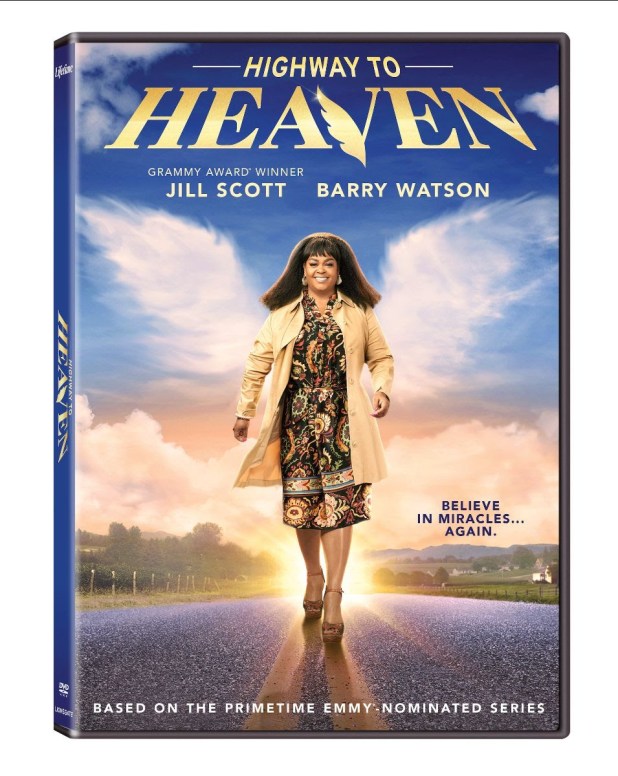
LIONSGATE DVD RELEASE: Highway to Heaven (2021)

Highway to Heaven was a TV series that ran on NBC from September 19, 1984 to August 4, 1989. It starred Michael Landon as Jonathan Smith, an angel who walks the Earth, helping souls along with retired cop Mark Gordon, who was played by Victor French, Landon’s co-star from Little House on the Prairie.

Sadly, French died two months before the final episode aired. Landon went on to appear in two films — including a pilot for a new series — before he died in 1991.

This reboot has Angela Stewart (singer Jill Scott) as the angel sent down here to help people in need. In the premiere movie — one assumes there will be more — she takes on the role of a temporary school counselor and gets involved in the lives of junior high school principal Bruce Banks (Barry Watson from 7th Heaven and the Boogeyman reboot) and troubled student Cody (Ben Daon).

This was written by Angelica Chéri, Cathryn Humphris and Michael Landon’s son Christopher.  It was directed by Stacey K. Black, who has directed episodes of Major Crimes, the new version of Walker and Station 19.

If you enjoy faith-based dramas with heart, well, you may not be reading our site.  But if you do, you’ll find something to love here.

Highway to Heaven is available on DVD for the suggested retail price of $14.98.

CANNON MONTH: Going Bananas (1987)

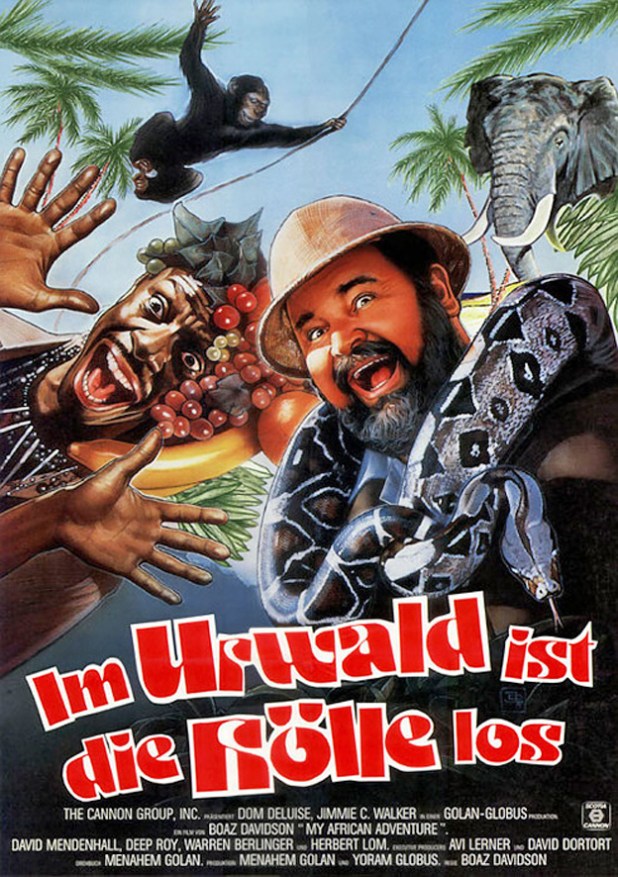
This movie sure had some changes before it got to the screen. Bonzo was going to be a real ape* before Deep Roy was cast, while Big Bad Joe Hopkins was going to be played by Bud Spencer — on the 1986 Cannon reel of upcoming films this was called Ben, Bonzo and Big Bad Joe — and Menahem Golan — who wrote the script, based on the Kofiko books by Tamar Bornstein-Lazar — and Sam Firstenberg were going to direct until Boaz Davidson was picked.

What emerges is pure Cannon.

Benjamin (David Menden-Hall, who if he annoyed you in Over the Top is ready to destroy your mind and play with it) is on an adventure with his guardian Joe (Dom DeLuise) and friend Mozambo (Jimmie Walker) in Africa. Specifically Momba-Zomba Land.

There, he meets Bonzo, a talking monkey who can not only fly a plane, but can practically fly — or if we follow the old TSR Marvel Super Hero rules, he’s like The Hulk who has Class 5000  Hyper-Leaping — and the whole story is about Herbert Lom as a cop stealing the monkey and putting him in a circus and that never works out whether it’s King Kong or Conquest of the Planet of the Apes. Or Going Bananas.

A lot of people debate, “What’s your favorite Cannon movie?”

No one has picked this one.

*Clyde the Organgatan from Every Which Way but Loose and Any Which Way You Can has a meeting at Menahem Golan’s office and there was an attempt to sign him as a Cannon actor, if you can believe that. When it fell through, Golan introduced Deep Roy to Davidson and said, “Meet your new monkey!” This story seems like it isn’t true, but it’s Cannon, so it probably is.

Also, according to Electric Boogaloo: The Wild, Untold Story of Cannon Films, Golan asked a publicist of Clyde, “Would you fuck this monkey?”

CANNON MONTH: Mercenary Fighters (1988)

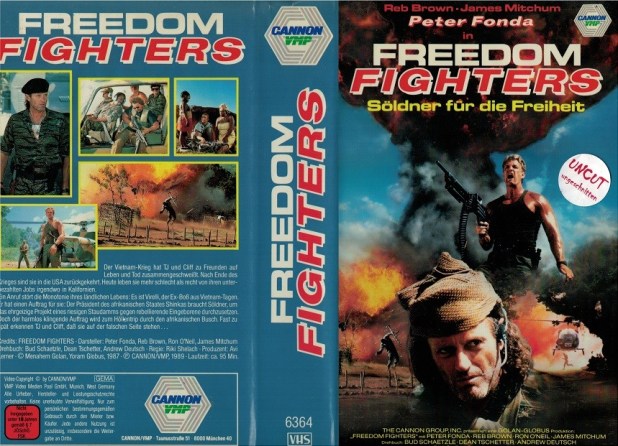
Colonel Kjemba (Robert DoQui, Sgt. Reed from RoboCop) has called in Vietnam vets Virelli (Peter Fonda), T.J. Christian (Reb Brown, forever Yor) and Cliff Taylor (Ron O’Neal, forever Youngblood Priest) who join up with Wilson Jeffords (James Mitchum, forever Robert’s son) and ) to stop a rebel uprising, but you know, sometimes you never know what side of the battle you’re really on.

In Richard Kiel’s autobiography Making it Big in the Movies, he claims to have only turned down four roles in his whole career. Peter Fonda’s part in this is one of them.

I mean, this is Avatar 21 years earlier and around a few hundred million less in the budget. But does that movie have Peter Fonda being racist and Reb Brown screaming at the top of all of his lungs?

CANNON MONTH: Gor (1987)

EDITOR’S NOTE: We originally wrote about this on March 6, 2020. Now it’s back for Cannon Month.

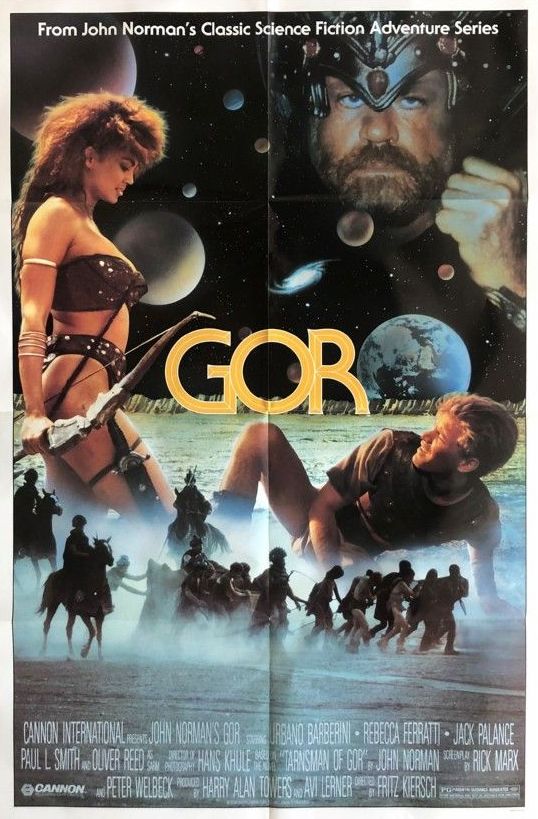
John Norman is a professor of philosophy and the creator of the Gor series of books, which are basically male-dominated bondage science fiction fantasies that also feature critiques of modern society and the exploration of philosophical themes from a Nietzschean view. And you thought incels were a brand new thing, huh?

The series began in 1966 with Tarnsman of Gor — which this movie is based on — and was put on hold when DAW refused to publish the twenty-fifth installment, Magicians of Gor in 1988. The series returned in 2001 with Witness of Gor. There’s also an entire subculture called Gorean flourishes online, as you can only imagine that it would.

So yeah. Somehow, this got made. And so did a sequel, Outlaw of Gor.

Professor of physics Tarl Cabot (Urbano Barberini, DemonsOpera) is pretty much a loser with the ladies until he gets a magical ring that sends him to the world of Gor. Think Den from Heavy Metal and you have the picture.

He also comes into conflict with Oliver Reed, playing the priest-king known as Sarm, who is looking for the Home Stone to create more paths to Earth. Our hero accidentally kills Sarm’s son before he’s knocked out and left for the buzzards. Luckily, he’s saved by Talena (Playboy Playmate of the Month for June 1986 Rebecca Ferratti, who is also in Cheerleader Camp and Embrace of the Vampire), the barbarian princess of Ko-ro-ba.

Of course, while Cabot strikes out at home, he somehow scores with this vision of womanhood because on Gor, men are the rulers. But he’s still a moron and activates the Home Stone, sending him home to, one assumes, spill his seed, hack the carrot and sail the seas of mayonnaise all by himself.

Gor at least has some great character actors like Jack Palance, Paul Smith (Bluto from Popeye and the landscaper in Pieces) and a young Arnold Vosloo.

Norman almost didn’t get the movie made, as his publisher wanted nothing to do with it. He told the fanzine The Gorean Voice, “Ballantine Books refused to do movie tie-ins to either film; they failed even to answer my letters. My attorney finessed his way around Ballantine’s rights department and contacted the legal department at Random House. The movies were made by going over the heads of the censors.”

It was produced by Harry Alan Towers (who you may remember ran a vice ring that implicated the United Nations, JFK, Peter Lawford and several others when he wasn’t producing Jess Franco movies) and action film impresario Avi Lerner. Direction was provided by Fritz Kiersch, who also brought us Children of the Corn and Tuff Turf.

If you ever played lots of D&D and wondered why the popular girls liked jerks and figured, “I’m going to treat them badly, too!” Good news. You are the target audience for this movie.

You can listen to The Cannon Canon episode about Gor here.

Interview with Ed Glaser, author of How the World Remade Hollywood part 2

In the first part of this interview, we learned how Ed Glaser, the author of How the World Remade Hollywood, discovered remakesploitation films as well as some of why so many of these films come from Turkey and Italy. Here’s the next part of our interview, which gets into Santo, post-apocalyptic movies and sharks.

B&S: I think we’re still getting our heads around sampling in some ways. Isn’t it interesting that both Italy and Turkey have a crossover with Kilink, which is also Diabolik, which is also Fantomas. These characters cross between so many countries but are nearly the same.

Ed: Yeah, absolutely. You’re talking about characters, comics, or photo novels that were extremely popular throughout Europe, but not at all in the States. So it’s fun to see these characters iterated and reiterated on. There were like a dozen Kilink movies that came out of Turkey that all had sort of different slants on the character. And it’s likely that as an American viewer who is interested in international cinema, you may see those before you discover the photo novels, of which only like, half a dozen have been reprinted in English. 

B&S: Santo is like that too. I think it’s really interesting that in 3 Dev Adam (Three Giant Men) that Santo’s on the same level as the other heroes. His movies had become huge around the world, but maybe not as much in America outside of the Samson movies that K. Gordon Murray translated. But in this movie, Santo’s on the same level as Spider-Man and that’s kind of mind-blowing.

Ed: Spider-Man was basically unknown there. His comics came to Turkey briefly in the 70s, but not seriously until the 80s. So for a while audiences were more likely to be familiar with Spider-Man from the handful of episodes of the American TV series that were repackaged as self-contained movies internationally than they would have been from the comics. And that was still years later, after 3 Dev Adam, so Santo would have been substantially bigger.


B&S: We always apply our culture to others and don’t think that way. I just did it! That’s why I love these movies, because they make you less western-centric and explore how another culture sees pop culture and the world. 

Ed: With Spider-Man, it feels like they simply thought, “This guy looks cool. He can be a cool villain. We can do this with him.” I think that’s really hard for modern American pop culture fandom to wrap its head around, because there’s a real obsession with canon. And at the same time it’s wonderful because we get to see, as you say, something that we’re very familiar with but through a very different lens.

B&S: I’m really impressed with your book because so many of my favorite movies are in it and that just makes me happy. For example, I love all the Bronx Warriors movies and I actually think they’re somewhat of the best of the post-apocalyptic genre. 

My theory is that the Italians are the best at making post-apocalyptic movies followed by the Philippines. Of all those movies, the Bronx series synthesizes so many movies at once – The Warriors, Mad Max, all at once.

Ed: Hollywood studios didn’t fall in love with the genre the way that other countries did. I mean, you had the Mad Max films come over from Australia and then you had low budget versions from, for instance, Roger Corman, some of which were shot in the Philippines. But that was kind of it. 

You didn’t get a ton, whereas in Italy and the Philippines, you have sort of waves of those films. Post-apocalypse is one of those movie threads in Italy, where one film launches an iterative process where you get movie after movie after movie, just like the spaghetti westerns and the pepla and Eurocrime movies.

B&S: It’s nearly the United Nations of exploitation because giallo comes from Agatha Christie and Edgar Wallace in England, which turn into Hitchcock movies and krimi German-made films and then those migrate to Italy and become giallo and then eventually become slashers. 

Two or three years, the Italian film industry has taken one movie and made a hundred movies like it.

Ed: We forget that while there are hundreds of spaghetti westerns, the biggest years of them were a flash in the pan.

B&S: My theory is that the Italians are really good at it because they’re essentially just replacing the horse with the car in post-apocalyptic movies. They’re shot on the same sets from ten years before that are now destroyed and loners with no name having to come into these towns and rescue them.

Ed: There really is something to be said about the post-apocalyptic film as modern futuristic western. Even if you look at American examples like Steel Dawn, that’s just Shane set in the post-apocalypse.

B&S: So Jaws is a hit and Italy responds.

Ed: With The Last Shark, one of my favorites. And that movie doesn’t just rip off the story, but even gets cheeky with character names, like “Peter Benton” as a play on “Peter Benchley.” And with Vic Morrow looking and sounding exactly like Quint. I have a number of friends who love that movie too and they’ve developed a sort of playful fandom around Italian shark star “Squalo.”

There’s also Deep Blood, Cruel Jaws

Tomorrow, Ed and I discuss more Italian remakes, Luigi Cozzi and if riffing ruins a movie.

You can get Ed’s book, How the World Remade Hollywood, from McFarland Books. To see some of these movies and hear from Ed, check out Deja View: Remakes and Rip-Offs of Your Favorite Films.