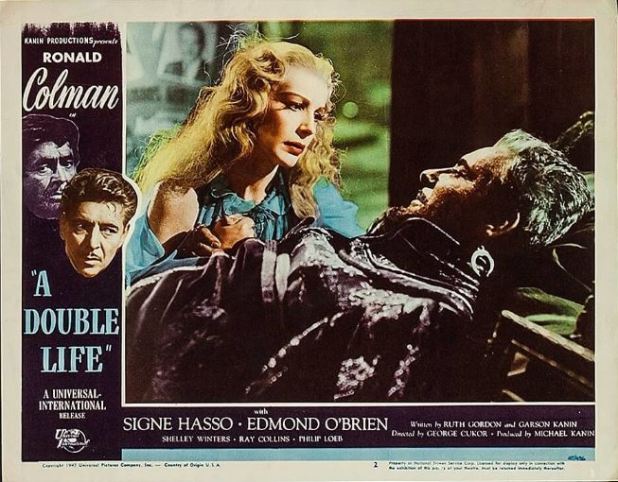
George Cukor may have been replaced as the director of Gone with the Wind, but he went on to direct some of Hollywood’s most famous films: Gaslight, Adam’s Rib, the 1954 version of A Star Is Born and My Fair Lady. Here, he tells the story of Anthony John, a celebrated stage actor who is the ultimate Method actor, fully taking on the role of whomever he plays.
Ronald Coleman, who is the lead in this, is literally the actor’s actor. He won both the Academy Award for Best Actor and the Golden Globe Award for Best Actor for this movie and was the very right people to be awarded a star on the Hollywood Walk of Fame (the others are Olive Borden, Louise Fazenda, Preston Foster, Burt Lancaster, Joanne Woodward, Edward Sedgwick and Ernest Torrence). Interestingly, Ruth Gordon got the first of her three Oscar nominations for writing with this movie. She also won the Oscar for acting with Rosemary’s Baby.
For Tony, the worst possible role would be playing Othello. But that’s exactly what happens and all hell literally breaks loose. This movie portrays the difference between the rich world of the theater and the squalor of the world surrounding it — especially the apartment of Shelley Winters’ Pat Kroll. It also calls out the fact that actors must experience and live all of the emotions that make up their roles and somehow not be damaged by them.
Film noir isn’t always detectives and evil women. Sometimes it can take place inside the mind, where darkness and duplicity may run rampant.
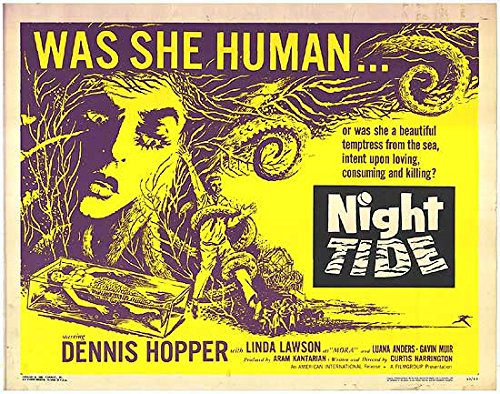
Written and directed by Curtis Harrington — one of the leaders of New Queer Cinema and also the director of Queen of Blood, What’s the Matter with Helen?, Who Slew Auntie Roo?, Ruby and so many more — this film was always one I wanted to see as it features Marjorie Cameron in a small role.
Harrington had also shot a documentary about her — The Wormwood Star — and I’ll forgive you if you have no idea who she is. Cameron was many things — an artist, poet, actress, and probably most essentially, an occultist. A follower of Crowley’s Thelema, she was married to rocket pioneer and nexus point of all things 20th century occult, Jack Parsons. In fact, Parsons believed that he had conjured Cameron to be the Whore of Babylon/Thelemite goddess Babalon as part of his Babalon Working rite, which he conducted alongside L. Rod Hubbard. No, really. It may have also opened our world to the aliens that have obsessed us since Kenneth Arnold reported a UFO in 1947.
After a suicide attempt and being institutionalized, Cameron gathered a group of magic practitioners around herself that she called The Children, whose sex magic rituals were to create a moonchild. She was now pregnant with what she referred to as the Wormwood Star, but that ended in miscarriage. Many of The Children soon left, as her proclamations of the future had grown increasingly apocalyptic.
Cameron’s orbit — much like her husband’s — unites both the worlds of art and the occult, straddling appearing in the films of Kenneth Anger, working with UFO expert and contactee George Van Tassel and appearing in Wallace Berman’s art journal Semina.
Why did I tell you all this? Because it fascinates me that she’s in Night Tide.
Johnny Drake (Dennis Hopper!) is a young sailor on shore leave who meets Mora (Linda Lawson, who is also in William Castle’s Let’s Kill Uncle), a woman who makes her living appearing in a sideshow. They fall in love before he learns that her past boyfriends have drowned under mysterious circumstances. That may — or may not — be because Mora is a siren, a legendary creature who exists to lure men to their deaths. Adding to her suspicions is the mystery woman (Cameron) who calls to her and demands that she follow her destiny.
One evening, under a full moon, she invites him deep sea swimming, but cuts his hose, forcing him to surface so that she isn’t tempted to kill him. She then swims into the depths of the ocean, fulfilling the call of the mystery woman. And when he returns to the boardwalk, her dead body is still in the mermaid sideshow, now there for visitors to gawk at her dead eyes.
Despite a police confession as to who the killer is, the strange woman in black and her call to the sea is never explained.
Anton LaVey discussed this film in Blanche Barton’s The Secret Life of a Satanist: The Authorized Biography of Anton Szandor LaVey. “There’s a whole genre of films that are just little evocative low-budget gems that I certainly wouldn’t call schlock but that are also being revived as a consequence of more attention in those directions. Director Curtis Hanington’s first movie, Night Tide filmed around the Santa Monica Pier and Venice. California in the late ’50’s, is a psychologically intricate story about a young sailor (Dennis Hopper) who falls in love with a mermaid It’s just wonderful to see these precious works of art being finally given the attention they merit.”
According to Spencer Kansa’s Wormwood Star: The Magickal Life of Marjorie Cameron, Anger introduced Cameron and LaVey, who was delighted to meet the actress, having been a fan of the film.
You can download this movie from the Internet Archive or buy the Kino Lober blu ray. Or check out the gorgeous restored version at Nicholas Winding Refn’s ByNWR site. Refn also owns the film’s original print.
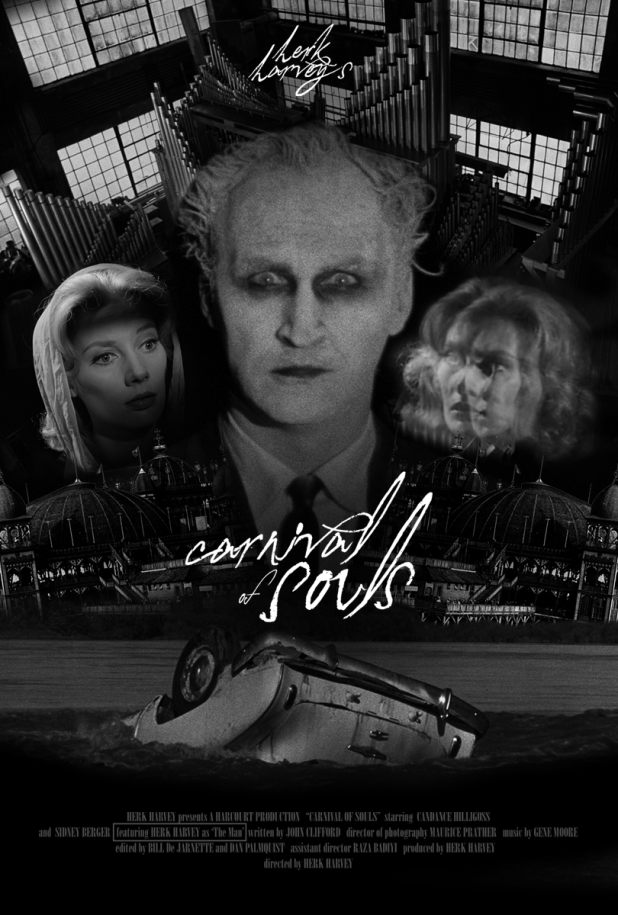
This 1962 American independent horror film is literally an auteur production: it was written, produced and directed by Herk Harvey, as well as featuring him in the role of the spectral figure that haunts its heroine.
While teaching and directing plays at the University of Kansas, Harvey started working for the Centron Corporation as a film director, writer, and producer on industrial films and commercials. He was lauded for his special effects techniques and ability to work under budget.
After the success of low budget films by Elmer Rhoden Jr. and fellow industrial filmmaker in nearby Kansas City, Harvey secured $33,000 in funding to make his lone film, although he attempted to film several others. Because the company that distributed the film went bankrupt, it wasn’t seen much in initial release but soon gained an audience at drive-ins and via late night showings.
For the rest of his life, Harvey continued creating industrial films and acting, even appearing in the harrowing made-for-TV movie, The Day After. Luckily, he did live to see people recognize this film as a classic. He died weeks after the soundstage at the University of Kansas was renamed the Herk Harvey Sound Stage.
Mary Henry gets involved in a drag race with her car going off the bridge. The police drag the waters for three hours before she rises, unsure how she could have survived.
Our heroine movs to Utah, a place where can’t connect to anyone and can only get organ music on the radio. Her journey to her new home is marked by appearances by “The Man” (Harvey), a spectral figure that comes and goes, and an abandoned pavilion on the Great Salt Lake that begs for her to visit it in the twilight.
Mary begins to disappear from the world, becoming invisible and unheard by everyone around her, as if she weren’t there. And on her first day at her new job as a church organist, when she begins to play an eerie tune, The Man and a group of corpses begin to dance until the minister begins to scream, “Profane! Sacrilege!” Truly, diabolus in musica — those demonic tritones are afoot.
Every attempt to escape the town is stopped by The Man and his dead people, including them taking over an entire bus. Finally, Mary makes her way back to the pavilion, where she watches them dance and notices that a ghoul version of herself is with The Man. She runs, but they catch her. The minister, a doctor and the police try to find Mary, but as they follow her footprints in the sand — is this when God was carrying her? — they end with no trace. Back in Kansas, her car is finally found beneath the water with her dead body still inside.
The US release of Carnival of Souls failed to include the copyright on the prints, automatically placing them in the public domain. That’s how numerous TV stations would show different prints of this movie, cut however they wished to fit its timeslot. Again, it wasn’t until the late 1980’s that this film would be recognized as the arty horror that it is, a precursor to the work of artists like David Lynch and George Romero, who specifically said that it inspired him to make Night of the Living Dead.
In turn, this is a movie inspired by the silent films of the past, with parts where Mary is in one of her altered mental states being tinted cyan while all the scenes of reality appear in black and white. Later, the tinted scenes become distorted in both sound and picture. There’s also an original organ score by composer Gene Moore that makes this movie feel trapped in cinema’s past.
The Church of Satan’s leader Anton LaVey spoke glowingly of this movie: “Carnival of Souls is another richly evocative film that has been completely lost until recently. Producer/director Herk Harvey did industrial films and this was his brilliant excursion into the world of nightmares.”
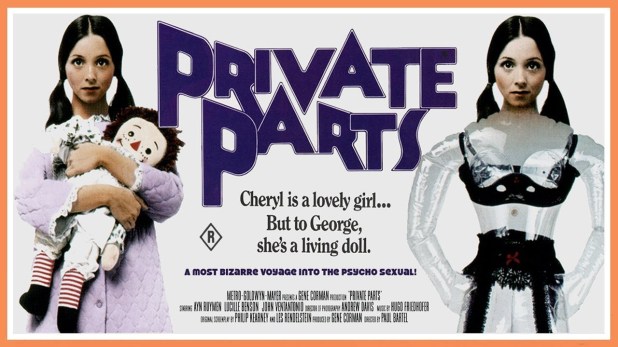
Cheryl and her roommate get in a fight, so instead of going back home, she decides to move into her aunt’s run down hotel in downtown Los Angeles. Suffice to say that shenanigans ensue.
Aunt Martha is a strange lady, played by Lucille Benson, who was on TV’s Bosom Buddies and played Mrs. Elrod in Halloween 2, as well as time on Broadway. She’s obsessed with funerals and given to moralizing. Her hotel is packed with maniacs and there are also a series of murders going on, with Cheryl as the best chance to be the next victim.
Get this — the role of Aunt Martha was originally written for Mary Astor (The Maltese Falcon, Hush…Hush, Sweet Charlotte)!
Cheryl wants to be a woman and experience her sexuality, which leads her into George’s orbit. He’s a photographer who longs for love, but also sleeps with a water inflated doll that he often injects with human blood and covers with a photo of Cheryl’s face. He’s somehow not the strangest person in the hotel. And oh yeah, to add to the whiff of perversion in the air, he’s her cousin.
Stanley Livingston, Chip Douglas from TV’s My Three Sons, also is in this movie, playing Jeff, another tenant. He would be a better mate for Cheryl, but she’s already too deep. And it’s pretty crazy to see Laurie Main, who hosted and narrated Disney’s Welcome to Pooh Corner, as a gay priest. That said, he also shows up in some other strange places, like Larry Cohen’s Wicked Stepmother and as the narrator of Cheech & Chong’s The Corsican Brothers.
There was also a model named Alice that once lived in Cheryl’s room that nobody wants to talk about. And a whole bunch of keys that open other rooms so that our voyeuristic heroine can spy on all of them.
Private Parts began with the working title Blood Relations, but its new title was rough on the film, as some newspapers wouldn’t promote it with that name, some even calling it Private Arts. Some ads even said that the title was too shocking to print and asked people to call the theater to learn the name of the film!
It really was shot in a skid row hotel, the King Edwards Hotel in downtown L.A and all of the people in it were based on people that writers Philip Kearney and Les Rendelstein met in LA in the 1960s. It’s still around, having been purchased in 2018 with plans to convert it into low-cost single-occupancy transitional housing.
This is a movie that fits in well with other blasts of 70’s odd like The Baby. Like that movie, Private Parts may not explicitly have sex and violence, but it just feels off and as if it came from another universe that might appear to be ours, but has scum and strangeness in every corner.
Leonard Maltin said this about Private Parts: “If Andy Warhol’s Chelsea Girls had co-directed by Alfred Hitchcock and John Waters, it would come close to this directorial debut by Paul Bartel.” That sums this up quite well.
The Satanic nature of this film ties in well with Anton LaVey’s 1988 Pentagonal Revisionism. George’s preference for his doll ties in well with the Church’s realization of the need for the development and production of artificial human companions, which LaVey referred to as “the forbidden industry.”
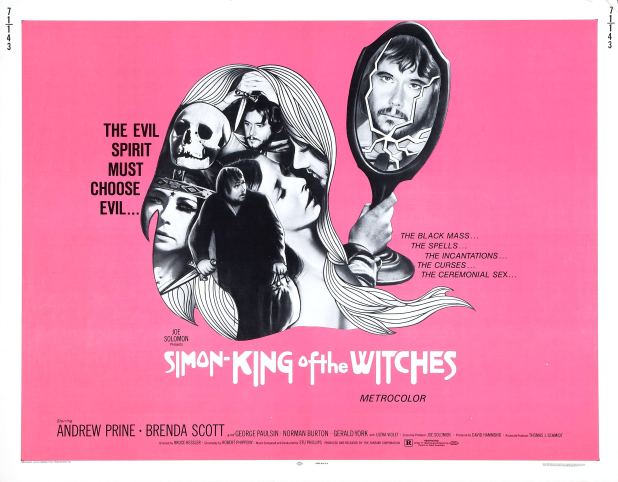
Andrew Prine is an exploitation superstar. Just look at a few of his films: Grizzly, a bonkers ripoff of Jaws with a bear instead; The Town That Dreaded Sundown, a movie that can’t decide if it wants to be a comedy or a brutal slasher and ends up being both while being awesome; Amityville II: The Possession, the scummiest movie perhaps ever put out by a major studio; and many more. Like this one, a film that skewers the youth culture of the early 1970’s.
In this crazy slice of lunacy, Prine is Simon Sinestrari, the king of the witches who lives in a storm sewer. He sells his magic for money, just like his friend Turk sells his body. Together, they explore the world of drugs, parties and fake Satanic rituals thrown by Warhol superstar Ultra Violet. Meanwhile, Simon falls in love with a rich man’s daughter and has to decide whether or not he wants to ascend to godhood.
The ad campaign is what killed this movie. It promised a Manson-like Satanic sex orgy and the movie delivers only brief nudity and no blood. I personally adore it, as it’s such a time capsule of when it was made and such an accurate depiction of magic.
That may be because screenwriter Robert Phippeny was an actual practicing warlock. I can’t find much other information about him, only that he only wrote one other movie, 1969’s The Night of the Following Day. Director Bruce Kessler did much more, with a rich career in TV, including being behind the Night Stalker episode “Chopper,” as well as the TV movie Cruise Into Terror.
As for Andrew Prine, he’s beyond perfect in this movie. He considered his time making as if he were in the circus. The fun he was having is infectious.
Simon represents perhaps one of the most Satanic heroes the screen has ever witnessed. He lives up to nearly all of the Nine Satanic Statements as well as being aware of the Nine Satanic Sins. He fights against stupidity, pretentiousness and herd mentality.
Magus Peter H. Gilmore of the Church of Satan was kind enough to weigh in on this film: “The producers actually approached Anton LaVey and offered for him to play the part of Simon. They didn’t grasp LaVey’s own ideas of pride and self-deification, so the prospect of playing a homeless warlock living in a storm drain with a naïve male hustler was really not a role he’d have relished. That Simon attends a neo-pagan rite and mocks the stilted ceremony would have echoed some of LaVey’s feelings about contemporary occultists.”
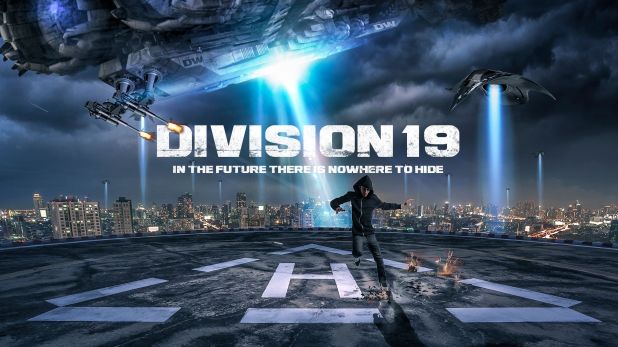
Sometime in the very near future, prisons have become online portals where paying subscribers vote on what felons eat, watch, wear and who they fight. This is Panopticon TV and it’s so successful that it’s about to become a franchise. However, the most downloaded felon — pretty much a rock star — has escaped and the authorities want to bring him back in. And they’re willing to do anything it takes, even arrest his little brother.
Director S.A. Halewood is determined to get the most out of her low budget, but so much of this movie feels like another I’ve seen before, whether those movies are The Running Man, Gamer or District 9. There’s also a moment where someone is smoking and a drone says, “Smoking is not permitted in the street. You have ten seconds…” and I was waiting for it to end with “to comply” to finish this riff on Demolition Man.
Nielsen (Alison Doody from Indiana Jones and the Last Crusade) leads Panopticon and she’s aided and abetted by Premier Lyndon, the COO of Central Control and pretty much the world leader. He’s played by Linus Roache who was such a great bad guy in Mandy. Clarke Peters is also pretty decent as a tech guru who removes our hero’s double neck implants, showing off his acting chops from Treme and The Wire.
They got to battle with hackers and influencers and people spouting all manner of technobabble through the streets of Detroit, which obviously RoboCop will forever be right about, even if so much of it was shot in Pittsburgh.
There are some big ideas here. The story may suffer and it may feel like movies that came before, but it certainly looks nice in parts. It’s a great start, really. Hopefully, things get better from this crew of filmmakers from here.
Starting April 5, you can see Division 19 On Demand and also on the big screen in the following cities:
LA: Laemmle Music Hall
Chicago: AMC South Barrington 24
Atlanta: AMC Southlake Pavilion 24
Dallas: AMC Grapevine Mills 30
Houston: AMC Gulf Pointe 30
Cleveland: Tower City Cinemas
San Francisco: AMC Deer Valley Stadium 16
Philadelphia: PFS Roxy Theater
Phoenix: AMC Arizona Center 24
Detroit: AMC Fairlane 21
I mentioned some time back how many movies I learn about because they’re sampled by My Life with the Thrill Kill Kult. In their song “Rivers of Blood, Years of Darkness” from Confessions of a Knife, the words “Blood! Blood!” and “Drown our useless age in blood!” come from the film.
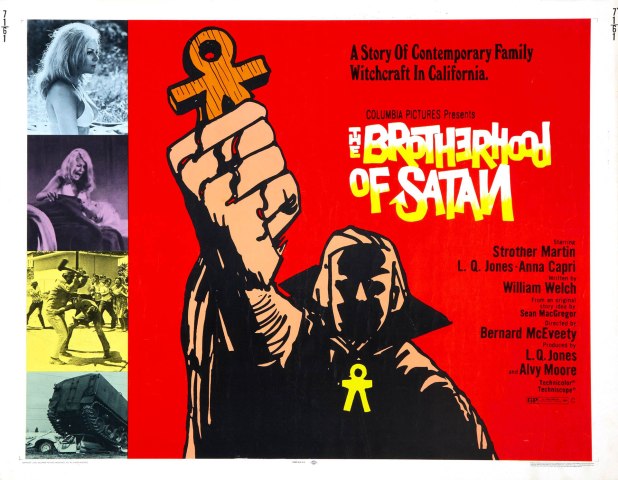
I’ve always loved the box art for this movie and never gave it a chance. I’m glad I did!
Ben, his girlfriend Nicky (Ahna Capri, Han’s secretary from Enter the Dragon), and Ben’s daughter K.T. (Geri Reischl, the fake Jan Brady!) are on their way to K.T. grandmother’s house on a highway that takes them through the American Southwest.
They come across an accident and report it to the sheriff (L.Q. Jones, who wrote and produced this movie) before the locals go crazy and almost kill them. That’s because no one can leave town and nearly all of their children have gone missing.
It turns out that a coven of old Satanists have been taking the children, teaching them to follow the left hand path and are trying to use their bodies as receptacles for their elderly souls. If anyone gets close, they use the kids’ toys to murder them. A local priest figures it all out, but he’s driven crazy after seeing a murder.
It turns out that kindly Doc Duncan — played by Strother Martin who said “What we have here is a failure to communicate” in Cool Hand Luke — is either the leader of the cult or Satan himself. There’s an awe-inspiring scene where hooded men with flaming swords kill the old people so they can go inside the children’s’ bodies. When their parents finally get there to save them, it’s too late. Everything goes to blackness, with only the words “Come in, children” on the screen.
When Brotherhood of Satan was shown, audience members were given a packet of “Satan’s Soul” seeds. Each envelope — illustrated with the movie’s logo — contained two seeds, which were, according to the instructions, supposed to provide protection from the Black Magic of The Brotherhood of Satan. If you think movies are better in 2019 than they were in 1971, I have news for you.
Much like Evilspeak, this is a film on the list that presents the powers of Satan succeeding against the forces of good. It’s pretty much exactly as the rest of the world perceives how Satanists act. Of course, Anton LaVey encouraged this type of shadow play and making fun of the rest of the straight world.
Yeah, we love this film and then some . . . that’s why R. D and Dustin Fallon from Horror and Sons also reviewed it with their takes. Watch it.
Night of the Demon was a movie that scared the hell out of me when I was a kid. That iconic shot of the demon from the end was always in books about horror and issues of Famous Monsters. I’d always hide my eyes from it while still being fascinated.
Little did I know that the issue of the demon being in the film was a major point of argument between producer Hal E. Chester versus director Jacques Tourneur (I Walked with a Zombie, Cat People) and writer Charles Bennett (The 39Steps) on the other. Chester ended up jamming in the special effects monster over the objections of the writer, the director, and lead actor Dana Andrews.
Even worse, 12 minutes were removed from the British version of this film and it was renamed to Curse of the Demon. Tourneur later said, “The scenes where you see the demon were shot without me…the audience should never have been completely certain of having seen the demon.” Bennett, also about the changes to the script, said “If [Chester] walked up my driveway right now, I’d shoot him dead.”
Based on the M.R. James story “Casting the Runes,” the story begins with Dr. Julian Karswell being visited late in the night by a rival who begs him to remove the curse he’s placed. After learning that the patchment he gave the man was destroyed, Karswell rushes the man from his house just as a giant demon materializes in the trees, a shocking effect even today. The professor tries to escape but his car crashes into powerlines and he’s electrocuted.
Dr. John Holden (Dana Andrews, Airport 1975) arrives in England to attend the convention where the dead professor had intended to expose Karswell and his Satanic cult. Holden believes that there’s no such thing as the supernatural while the dead professor’s niece (Peggy Cummins, Gun Crazy) believes the opposite.
Later, when a windstorm destroys a party, Karswell takes the blame and Holden mocks him. The older man grows angry and predicts Holden’s death within three days. Soon, the same parchment of protection is found by our hero and he slowly becomes convinced that the demon is on his trail as well.
The end of the film, where the demon changes his target from Holden to Karswell, is harrowing. As he runs up the train tracks, the demon manifests itself and chases the magician. When his corpse is discovered, the police believe that it was a train dragging him, not the demon.
Holden goes to inspect the body, but the professor’s niece tells him that that sometimes, “it’s better not to know.” He walks away with her.
In the movie The ‘Burbs, Ray finds a book called The Theory and Practice of Demonology in the basement of the Klopeks. Its author? None other than the villain of this film, Julian Karswell. It’s also mentioned in “Science Fiction Double Feature” in the Rocky Horror Picture Show: “Dana Andrews said prunes gave him the runes, but passing them used lots of skills.”
According to BrightMidNight on the Sinister Screen, “This movie is a true Satanic classic because it exposes the devil worshiper for what he is. Anytime you have to rely on someone or something else to help you to be a success in life, you’re diminishing your own self-worth. People who do this are basically saying, “I’m not good enough to get these things on my own; I need some kind of outside force.””
They go on to say: “Satanists viewing this movie should understand that YOU are in charge of your own destiny — and no one else. Asking some devil or some imaginary demon for favors only causes problems in the end. Satanism strives on individualism. The Satanist is his or her own God. There is no need to ask other entities for help.”
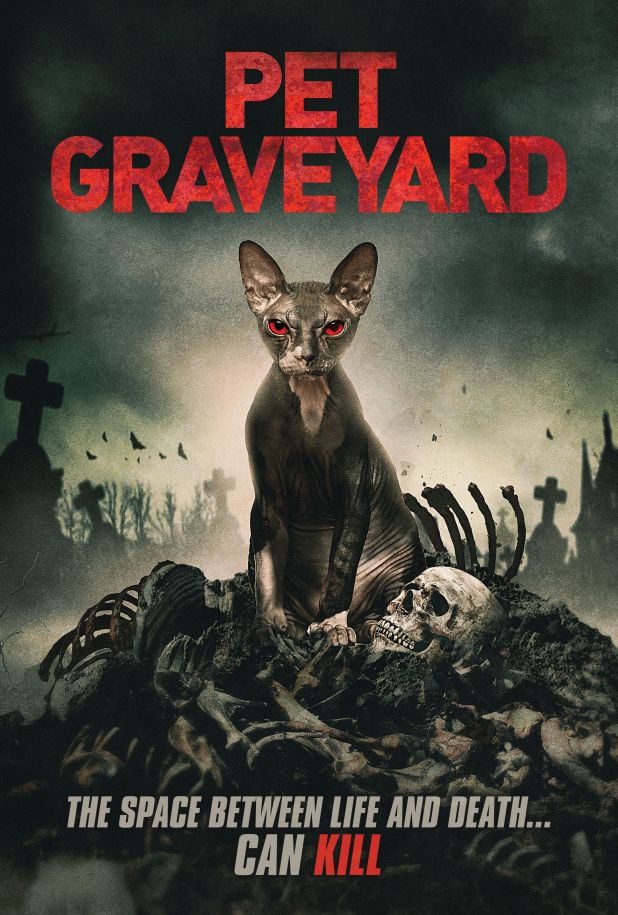
Honestly, if all Pet Graveyard had going for it were its name and poster, I would love it in the same unconditional way that I love all animals. But this movie does something so audacious, even I’m kind of shocked. It isn’t content to ripoff just Pet Sematary. No, it also decides to double up and absorb parts of Flatliners into its narrative. Bravo!
A group of friends decides to do an experiment where they all die for just long enough that they can see the dead. That means that in the universe of this film, neither the 1990 or 2017 versions of Flatliners exist. However, Death doesn’t like them playing with the afterlife, so he dons his cape and brings along his red-eyed sphinx cat who is so adorable that I couldn’t be frightened by him. I kept wishing he were watching the movie with me so I could pet and cuddle him.
Pet Graveyard is the directorial debut of Rebecca J. Matthews, who produced Mandy the Doll and several other direct to video efforts. The results aren’t bad — there’s a story here after all, but I was kind of hoping that the actual movie would be beyond crazy to live up to the riffing on past films and the impressive title.
I was expecting animals rising from the dead and killing clones of Julia Roberts in her dreams, but British people dealing with family issues. But hey — the box art and title more than did their job, right?
But just look at how cute this little fellow is!
Pet Graveyard is scheduled for release on DVD and digital on April 2.
DISCLAIMER: We were sent this movie by its PR firm, but that doesn’t impact our review.
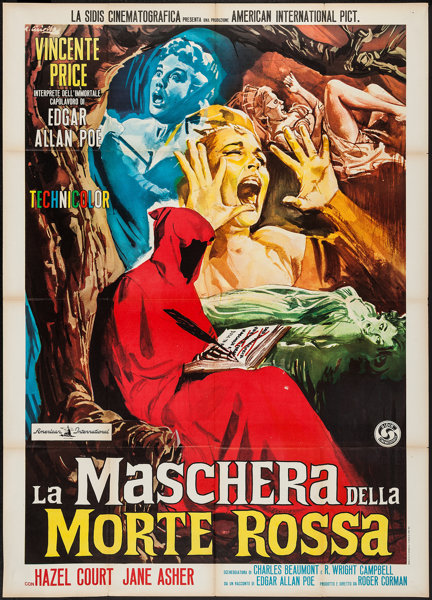
For all the chiding I write about Roger Corman’s later producing efforts, you have to admit the man knows how to direct a movie. This is the best case I can make for his skills, a film packed with delirious visions and gothic menace. It’s everything you want it to be and more.
The seventh in a series of eight Edgar Allan Poe adaptions by Corman, this movie also incorporates part of the Poe story Hop-Frog and some of Torture by Hope by Auguste Villiers de l’Isle-Adam. Corman had wanted this movie to follow 1960’s House of Usher, but worried that people would think he was stealing from Bergman’s The Seventh Seal.
Corman liked an early script by Charles Beaumont, who also wrote The Seven Faces of Dr. Lao and more than twenty Twilight Zone episodes, which had Prince Prospero as a Satanist. Beaumont was too ill to come to England to finish the script (he died at a very young age), so R. Wright Campbell finished writing it.
On a mountain in medieval Italy, we see an old woman receive a white rose that becomes covered with blood from a red-cloaked man who soon returns to shuffling his Tarot cards.
Prince Prospero (Vincent Price, never more perfect) visits the village that he lords over and is confronted by two angry young villagers. He sentences them both to death, even as one of their daughters begs for their lives. That’s when the evil man learns that the red figure was the plague called the Red Death and it has spread from the old woman to the entire village. Prospero demands that the village be burned down and takes the man’s daughter, Francesca, to his castle. She’s played by Jane Asher, who was once famously the girlfriend of Paul McCartney.
Back at the castle, Francesca is tutored and dressed in the finest clothes by Prospero’s jealous mistress Juliana (Hazel Court, Devil Girl from Mars). Meanwhile, nobles have gathered and are being entertained by the dwarves Esmeralda and Hop-Toad. One of them even strikes the poor girl to the anger of her would-be lover.
Juliana wants to be part of Prospero’s Satanic cult and that night, she lies with him in his Black Room while Francesca watches, overcome by either lust, fear or some combination of both.
Meanwhile, the two men who were condemned to death known as Gino and Ludovico are being trained in the art of being gladiators for the nobles’ amusement. As Prospero continues seducing Francesca, Juliana pledges her soul to Satan, gives our heroine the key to the men’s cell and tells her to leave the castle.
As they try to escape, they end up killing three guards, acts of which Prospero finds humorous as they are supposed to be good men. Since they refuse to fight one another, the villain asks them to play a game: they will cut themselves with daggers. Only one has poison on it and Ludovico draws the final blade. But he doesn’t get a chance to use it — Prospero quickly stabs him. He then sends Gino out of the castle to be infected by the Red Death.
In the woods outside, Gino meets the red-cloaked figure, who gives him a tarot card that he says represents mankind. While that weirdness is going on, Juliana has her final initiation in a psychedelic sequence that sees periods from across history stab her as she lies on an altar. After this self-sacrifice, she declares herself the bride of Satan. She then walks into a room and is killed by a falcon.
Yes, I just typed that sentence. As the nobles gather about her body, Prospero laughs and says that now she really is married to Satan.
The villagers try to get into the castle, dying from the red death, while Prospero orders them all killed, except for a small girl. As the rest of the guests gather for a masked ball, Hop-Toad tricks his nemesis Alfredo into dressing as an ape. He covers the man in brandy and sets him on fire before running into the night.
As Gino tries to rescue his love, the red-cloaked figure tells him to stay there and he will send the girl out to him. The party has grown depraved, but all Prospero is interested in is the red-cloaked figure who has broken the only rule of the party: no one is to wear that color. He and Francesca follow it into the Black Room, where the evil man thinks he is about to actually meet an emissary of Satan.
Prospero asks to see its face, but is told that there is no face of Death until the end as the entire party becomes a dance of death, as the nobles succumb to the plague as they keep swaying to the beat. Prospero asks for Francesca to be spared and given the same title he will have at Satan’s side, but even she knows what he can’t grasp. This isn’t Satan. It’s death. She tenderly kissing him goodbye as she runs toward freedom.
Prospero’s beliefs won’t stop the plague. Under the cloak is Prospero’s own dead and blood-spattered face. He has finally seen his own death and despite trying to run, his duplicate is always in front of him before he finally strikes him down.
At a drive-in viewing, the end of this movie screwed with me so badly I started shaking. All the colors of Death meet and reveal how many they have killed, with the red figure saying, “I called many…peasant and prince…the worthy and the dishonored. Six only are left.”
Only Francesca, Gino, a young girl, an old man, Hop-Toad and Esmeralda survive as the figure states, “Sic transit gloria mundi” or Thus passes the glory of the world.”) By the time the cloaked figures moved out in a formation and the words “And darkness and decay and the Red Death held illimitable dominion over all,” were said, I was quaking in my car. That said, I may have been ingesting all manner of substances and it was 4:52 AM on a foggy night. The perfect time to see a film and the perfect way to embrace it to its fullest!
One of the many reasons this film looks like nothing else is because of cinematographer Nicolas Roeg, who would go on to make Don’t Look Now and The Witches. Another is that the sets were all left over from the Academy Award-winning film Becket.
Interestingly enough, I learned that each of the colors of death at the end personifies a different plague of the Middle Ages. Black = Black Death, Gold = Leprosy, Violet = Porphyria, Blue – Cholera, Yellow = Yellow Fever, White = Tuberculosis and Red – Rabies. That was some IMDB trivia with no citation, so feel free to disprove that.
So how is this a Satanic film? Well, Prospero, despite being the villain, does follow one of the Eleven Satanic Rules of the Earth: Do not harm little children. He also follows one of them even more to the letter: If a guest in your lair annoys you, treat him cruelly and without mercy.
He also follows many of the points of LaVey’s Pentagonal Revisionism: A Five-Point Program:
Stratification: There can be no more myth of “equality” for all—it only translates to “mediocrity” and supports the weak at the expense of the strong.
The opportunity for anyone to live within a total environment of his or her choice, with mandatory adherence to the aesthetic and behavioral standards of same: The freedom to insularize oneself within a social milieu of personal well-being. An opportunity to feel, see and hear that which is most aesthetically pleasing, without interference from those who would pollute or detract from that option.
But to me, the most inherently Satanic moment in this film is in the words of the Red Death: “Each man creates his own God for himself. His own Heaven, his own Hell.”
Magus Peter H. Gilmore of the Church of Satan was kind enough to send some thoughts on this work of art: “In The Masque of the Red Death, while Prince Prospero is a Devil worshipper, he does have an essentially Satanic monologue wherein he deals with the human condition. As he brings Francesca into the purple room, at about 19 minutes into the film…”
“The practice of creating one’s own environs (a “total environment”) apart from current societal norms, as a way of satisfying aesthetics and as a means of limiting unwanted interaction with others, operates in many of the list’s films. As does the acceptance of mortality and often the loneliness of the individualist who blazes his own way apart from most others.
Romantic obsession, too, figures powerfully, for such drives can lead to passions that heighten existence, even if the consequences might shorten one’s life span. As is said by Satan (Nick) played by Claude Rains in Angel on My Shoulder (1946) “Live fully while you may and reckon not the cost. Deny yourself nothing, flame and blaze like a torch and toss the fire about you!””


 B&S About Movies
You must be logged in to post a comment.