WATCH THE SERIES: Friday the 13th part 3

After years of hating the franchise, Paramount finally decided to give the Friday the 13th series a higher quality of budget and directors. Hey — it only took six movies!
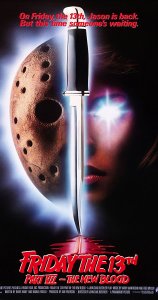
Friday the 13th Part VII: The New Blood  (1988)

Associate producer Barbara Sachs helped dream up several concepts for this film and according to writer Daryl Haney, “She wanted it to be unlike any other Friday the 13th movie. She wanted it to win an Academy Award.” GQ ran a great article on this film.

Originally intended as a crossover with Freddy Krueger, the logline for this film was, “What if Carrie fought Jason?” What ended up happening was one of Becca’s favorite films in the series.

Directed by John Carl Buechler (TrollThe Dungeonmaster), who also contributed to the special effects, this film establishes the definitive Jason. This is also because it’s the first appearance of Kane Hodder in the role.

Jason is still at the bottom of Crystal Lake, but as Tina Shepard watches her alcoholic father abuse her mother, her mental powers emerge and she drowns her father.

Fast forward and she’s a teenager (Lar Park Lincoln, House II) whose mother (voiceover artist Susan Blu) and Dr. Crews (Terry Kiser, Bernie from Weekend at Bernie’s!) have taken her back to that house to study (exploit) her powers.

Dr. Crews bedside manner is, in a word, the shits. He screams at Tina until her powers start working. She gets upset and runs outside, wishing that she could bring her father back from the dead. The only problem? She brings Jason back instead.

There is also — can you even be surprised at this point — a house of teens throwing a party for Michael (William Butler, 1990s Night of the Living Dead). They include Russell, Sandra (Heidi Kozak, Slumber Party Massacre 2), Kate, Ben, Eddie (Jeff Bennett, the voice of Johnny Bravo), David, Maddy, Robin (Elizabeth Kaitan, who was in the Vice Academy movies), Nick and Melissa.

Tina can foresee that they will all die and Jason lives up to her visions. She’s the Final Girl and has to lose everything, even her mother. As she fights back with her powers, she pulls the mask off his face, revealing it to be decayed and near demonic. Finally, her father rises from the dead and drags Jason back underwater. Yet even after all of that, we can still hear the theme song as someone finds the killer’s mask.

The working title for this film was Birthday Bash, but the original script was even titled Jason’s Destroyer. There were 9 different cuts sent to the MPAA to avoid an X rating, which is still amazing to me. Even more upsetting is that Paramount threw away all of the cut footage, so there’s little to no chance that an uncut version will ever be seen. I still think that the rumored 1989 Dutch release on VHS, which includes all the gore, is an urban legend.

A cool bit of trivia for Friday the 13th fans: the narration in the beginning of the film is by Walt Gorney, who played Crazy Ralph in the first two films.

Kane Hodder really proves why he should be Jason here, as he almost died in a stunt where he fell through the stairs and achieved the record for the longest uninterrupted on-screen controlled burn in Hollywood history at 40 seconds.
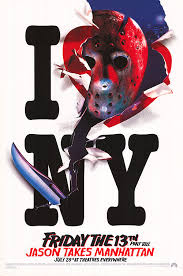
Friday the 13th Part VIII: Jason Takes Manhattan (1989)

Just like a band that continually says that they are going to retire, this was also intended to be the final film in the series. It takes Jason out of his element and features probably one of the greatest horror movie trailers ever:

It’s just so ridiculous that you have to see the film, you know?

Well, it’s not the last film in the series, but it’s the last one that Paramount would produce until 2009, as New Line Cinema would take over after this. And the working title? Another Bowie song, Ashes to Ashes.

The movie starts with a teenager playing a prank on his girlfriend, dressing like Jason. But the boat they are on reanimates him and he kills them both.

Soon, the SS Lazarus is setting sail from Crystal Lake to New York City to celebrate the graduation of the senior class. Along for the ride are biology teacher Dr. McCulloch and his niece Rennie, English teacher Colleen Van Deusen, J.J. (Saffron Henderson, the voice of Kid Goku and Kid Gohan on Dragonball Z), boxer Julius Gaw, popular girls Tamara and Eva (Kelly Hu, The Scorpion King) and video student Wayne. Oh yeah! And Toby the dog!

Everyone but McCulloch, Van Deusen, Rennie, Julius, Toby and Sean are killed, so they escape aboard a life raft to New York City, where Jason stalks them in the Big Apple.

This movie is packed with some audience pleasing moments, like J.J. getting killed by her own guitar, Julius’ head getting punched into orbit after trying to outbox Jason, a gang that gets Rennie high and makes her even more freaked out by Jason, her uncle getting killed after it’s revealed that he tried to drown her as a child…oh man, this one is packed with greatness. And then Jason drowns in a sewer.

Due to the box office results of this film, Paramount sold the series to New Line. We’d have to wait 4 years for the results. That said — this movie made $14,343,976 with a budget of $5,000,000. That’s not horrible numbers.
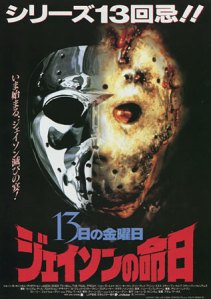
Jason Goes to Hell: The Final Friday (1993)

At Camp Crystal Lake, an undercover government agent lures Jason into a trap, blowing him up real good. I saw this scene in a movie theater in Youngstown, OH (former murder capitol of the US!) and the crowd cheered their name being mentioned as a place Jason had been seen.

Soon after, the body is being examined by a coroner who is moved to eat the heart and ingest the spirit of Jason. He goes right back to Crystal Lake and right back to killing him. And now comes the part of the story that no one has ever figured out until now, making the story just like Halloween (again!): Creighton Duke (Steven Williams, Dr. Detroit) is a bounty hunter who learns that only members of Jason’s bloodline can truly kill him. Even worse, if he can possess a member of his family, he’ll become invincible.

The only living relatives of Jason are his half-sister Diana Kimble (Erin Gray!), her daughter Jessica, and Stephanie, the infant daughter of Jessica and Steven Freeman (John D. LeMay, who played Ryan Dallion on the otherwise unrelated Friday the 13th: The Series).

Jessica is now dating tabloid TV reporter Robert Campbell (Steven Culp, Rex Van de Kamp from Desperate Housewives), yet it is Steven that saves her from Jason. He gets blamed for her mother’s death and just Robert is about to take advantage, Jason goes into his body, all with the goal of impregnating his half-sister and making a perfect Jason baby. Oh incest, we were waiting for you to show up.

Meanwhile, Jason wipes out most of the police in town. But then Duke the bounty hunter steals the baby and demands that Jessica meet him at the Vorhees house alone, so that he can give her the mystical dagger that can kill Jason. Now this film has become The Omen.

Despite all this, the heart that is Jason grows into a demonic infant and then crawls into a dead woman’s vagina and is reborn. Yes, you just read that sentence correctly. And man, I said that 5 was the scummiest entry in the series!

It all works out — the dagger releases all of the souls that Jason has accumulated and demonic forces drag him into hell. At the end of the movie, a dog finds Jason’s mask and of all things, Freddy’s gloved hand pulls it into the ground!

Mike McBeardo McPadden wrote about watching this scene on 42nd Street, where the crowd went wilder than any he’d ever experienced and that a man screamed to no one in particular, in the dark, “Freddy wants somebody to play with … IN HELL!!!!” Man, I wish I was there for that. You should also totally grab his Heavy Metal Movies right here at Bazillion Points Books.

Finally, after all these years, Freddy and Jason were set to battle. But guess what? We’d have to wait ten years for it to happen. Because after all, Jason had to go to space first.
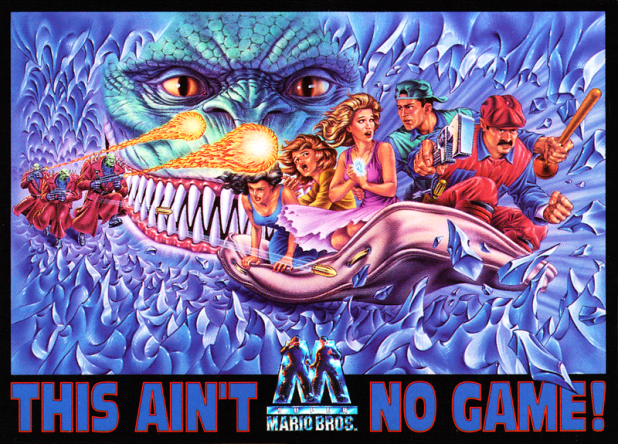
VIDEO GAME WEEK: Super Mario Brothers (1993)

My wife has never played Super Mario Brothers. She first saw this film at the now Hollywood Theater in Dormont as a child and it became one of the many films she rewatched over and over again as she grew up.

I’ve never seen the movie Super Mario Brothers, but the Mario character was a big part of my childhood and I played every one of his games as I grew up.

Together, we watched the film and came at it from two very different perspectives. Imagine, if you will, someone who has no bias toward this movie for how different it is from the property that inspired it and only sees it as a film about two adopted plumber brothers battling a parallel world ruled by dinosaurs.

When seen through those eyes, perhaps Super Mario Brothers is a good movie. To everyone else, it’s either a movie they hate — like lead actor Bob Hoskins — or one they can’t even begin to understand.

Producer Roland Joffé pitched the film to Nintendo, telling them that they’d have more control over the film working with his small Lightmotive company. Draft after draft of the film was made with Harold Ramis being considered as the director. Finally, the husband and wife team of Rocky Morton and Annabel Jankel (who created Max Headroom) were selected.

At that point, they jettisoned everything that came before. The original script, by Jim Jennewein and Tom S. Parker, was a more fairy tale retelling of the plot of the video games. Instead, the new directors wanted the film set in Dinohatten, a dark alternate version of New York City where dinosaurs ruled. Here’s the first issue — this world appears nowhere in the universe of the Super Mario Brothers games. The team wanted a dark satire instead of a bright, colorful world. Amazingly, they convinced the producers and Nintendo to go along with their vision.

Over the next year, five scripts were written by nine writers. Sets were built and scripts were even written without the directors being on board that tried to soften their narrative ideas and make a more kid-friendly film. That said — the sets had already been built.

None of the original script remained when filming started. The principal actors, Bob Hoskins as Mario and John Leguizamo as Luigi, began drinking through much of the filming. This led to an incident where Leguizamo crashed the plumbing van and broke Hoskins’ hand (he wore a flesh-colored cast for the rest of the production). Dennis Hopper, playing the lead villain Koopa, had open contempt for the directors, seeing them as control freaks.

Yet there was a great early buzz for the film, with an L.A. Times article comparing the set design favorably to Blade Runner (they share production designer David L. Snyder). Then Disney bought on to the film. And then the directors were shut out of reshoots and lost their final cut.

Everyone believed that kids would love the movie. Mario was such a big deal to them, this was a can’t miss bet. Kids will watch anything, right? Even if what they come to see has nothing in common with the video games and cartoons and the actual property that they loved so much, right?

Let’s get into it. The film starts with a poorly animated retelling of how the dinosaurs died off. I’m not sure if this is supposed to look like a video game or have been created in Mario Paint, but with the budget of the film, it sure feels weird. We learn that the meteorite that crashed into Earth made another dimension where dinosaurs rules.

In present day New York City, Mario and Luigi are struggling plumbers who are getting put out of business by the Scapelli Company. Those guys are also messing with an NYU sponsored dig where dinosaur bones are found under the Brooklyn Bridge by an orphaned archaeology student named Daisy (Samantha Mathis, Pump Up the Volume). While on a date, the villainous Iggy and Spike (Fisher Stevens from Short Circuit and character actor Richard Edson, who was also Sonic Youth’s original drummer) kidnap Daisy and take her to the dinosaur dimension.

This leads to King Koopa (Hopper) and his minions trying to get both Daisy and her necklace so that they can take over our world. Daisy ends up being the princess of the other side, with her father being devolved into a fungus (he’s played by an unrecognizable Lance Henriksen).

Along the way, Spike and Iggy realize that their cousin Koppa is evil and help the Mario brothers, all while Daisy meets Yoshi and Toad (Mojo Nixon!) is introduced as a musician who writes anti-Koopa music before being devolved into a Goomba. And Fiona Shaw shows up as Koopa’s would-be love interest who really wants to show him up by enacting his plans.

The two worlds become merged, with Koopa devolving the owner of the Scapelli Corporation into a monkey before Mario attacks him with a Bob-omb (one of the few video game references that happen in the film). Koopa then becomes a human Tyrannosaurus Rex before getting filly devolved into slime and Daisy’s father being saved. Whew!

Luigi tells Daisy he loves her (you know, Mario’s usual role) but she can’t leave her home behind. But weeks later, she returns, dressed as a warrior and asking them to return.

Want an example of how weird the film is? Hoskins didn’t even realize he was working on a video game adaption until his son asked him what he was working on. When he told him the title, he showed his dad the game on his Nintendo.

Here’s another father and son story: when asked why he did the film by his son, Dennis Hopper replied, “So you can have shoes.” His son replied, “Dad, I don’t need shoes that badly.”

Hoskins further described the shooting of the film in a 2011 interview with The Guardian:  “It was a fuckin’ nightmare. The whole experience was a nightmare. It had a husband-and-wife team directing, whose arrogance had been mistaken for talent. After so many weeks their own agent told them to get off the set! Fuckin’ nightmare. Fuckin’ idiots.” In that same interview, he also used the movie as the answer to the questions “What is the worst job you’ve done?”, “What has been your biggest disappointment?”, and “If you could edit your past, what would you change?”

Ryan Hoss, the webmaster of the Super Mario Brothers Movie Archive, says that the end result of the film is, for some, “an interesting, unusual, entertaining, compelling, and inspired look into this fantastical world. Others have had a hard time accepting the way the 8 and 16-bit games were adapted onto celluloid, calling the movie a complete disaster and disgrace to the video games. The goal of this website is to help its visitors better understand an often misunderstood film. What the filmmakers were trying to do with this movie had never been done before, so we think it’s important to appreciate the immense amount of thought and respect that went into creating the final product. In the end, the filmmakers did something wildly revolutionary—by making the first ever theatrical feature based on a video game property.”

We’ll talk to Ryan soon and learn more about how the site was created and how he was able to transform so many people’s love for this film into a blu-ray release.

As for my take on the film, I think I’d love it if I saw the film like Becca, as a youngster with no idea who any of the characters were supposed to be, just ready to enjoy a world where two plumbers battled evil dinosaurs. Perhaps if we all see it that way, the film is a little but better.

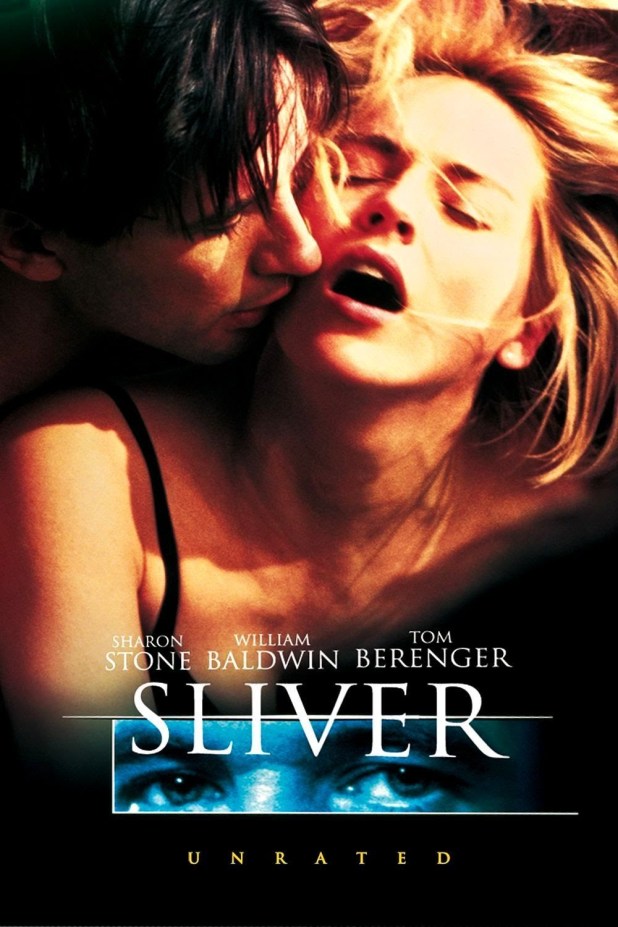
AMERICAN GIALLO: Sliver (1993)

Remember Joe Eszterhas? The writer who pretty much owned the theaters in the late 80’s and early 90’s with films like FlashdanceBasic InstinctJade and Showgirls?  In addition to Sliver, at least two of the films above — Basic Instinct and Jade — could qualify as giallo-style films. When reviewed through the lens of 2018, his films seem puerile at worst and silly at best, gradually becoming goofier the sexier they claim to be.

Directed by Phillip Noyce (Dead CalmThe Saint), based on a novel by Ira Levin (Rosemary’s BabyNo Time for SergeantsDeathtrapThe Stepford WivesThe Boys from Brazil…man, did Ira have his finger on the pulse of pop culture or what?) and produced by Robert Evans (Ever wonder who owns the IOU on my writing style? Wonder no longer, baby. Also, watch The Kid Stays in the Picture to learn how the producer of The Godfather and Rosemary’s Baby was often more interesting than the stars of his films), Sliver was originally rated NC 17 due to its sex scenes and some male frontal nudity. Also, there was an original ending — we’ll get to it in a bit — that audiences hated.

Carly Norris (Sharon Stone, Basic Instinct) is a book editor that never seems to go to her job. While she is there, she spends most of her time gossiping and bemoaning the fact that she never gets to have sex, despite being oh so fashionable and, you know, looking like Sharon Stone in 1993.

Somehow, she gets to immediately move into the best New York apartment ever, as the previous tenant (Naomi Singer, who looks exactly like Carly, which is a giallo staple if I’ve ever heard of one) has recently fallen to her death from her balcony.

Everyone in the building wants to get to know her, no one more than Zeke (William Baldwin, Flatliners). Within, oh let’s say a day or two, they’re having sex all over the place and talking about flying a plane into a volcano. He says that he designs “computer video games” and she’s just happy to have a younger man interested in her, despite the fact that she has a six-figure clothing budget (giallo fashion alert) and, you know, looks like Sharon Stone in 1993.

Carly also has another suitor, a writer named Jack (Tom Berenger, Major League) who is the most sexist character in the film, but certainly not in Eszterhaus’ oeuvre. As more neighbors begin to die, she begins to distrust both Zeke and Jack.

Oh yeah — there’s also Vida Warren, who is a model, but also a hooker, and also has the worst cocaine snorting scene in the history of film, treating it as a child would Pixie Stix.

At the close of the film, we learn that Jack killed Naomi, the original tenant because he was jealous of Zeke, who actually designed and owns the building. Zeke knew Jack killed her because of his network of security cameras, but he didn’t want his secret getting out.

Zeke invites Naomi to enjoy the cameras, but she eventually destroys his control room, telling him to get a life before she leaves both him and her home.

Joe Eszterhas’s original ending — where Zeke turns out to be the killer, revealed to a sympathetic Naomi as they fly over and perhaps into a volcano — was “incomprehensible to test audiences,” which led to Eszterhas writing five different endings. The re-shot ending, where actors Tom Berenger and Polly Walker wear S&M fashions, had to be filmed with body doubles as the actors did not agree to this in their contracts. Eszterhas hates the film, particularly the new ending and final line.

The sex scenes were a big deal when this came out. During the filming of them, Sharon Stone bit William Baldwin’s tongue “with such force that he couldn’t talk properly for days afterwards.” This may be why neither actor would speak to one another by the end of the filming. What remains on the screen is coupling that is at best robotic and at worse, ridiculous. It’s still not the worst sex scenes in an Eszterhaus film.

Sliver is filled with that trademark Eszterhaus wit. Witness dialogue like Carly saying, “You’ve been spending too much time with your vibrator.” Her friend’s reply? “I certainly have – I’ve been getting a plastic yeast infection!” By wit, I mean copious amounts of the kind of sex talk that CEO’s that have been removed thanks to modern thinking and the #MeToo movement would find humorous or normal.

Oh yeah! Martin Landau is in this and utterly wasted! There’s no reason for him to even be in this movie! He does absolutely nothing other than make you look at the screen and say, “Martin Landau is in this.”

The giallo themes that the film starts with — Carly being a dead ringer for a murdered woman, high fashion, the promise of kink — pretty much go nowhere. The film was a commercial, if not an artistic success. But it seems like there was so much promise that goes undelivered and the film begs for an Argento or even DePalma touch. Even a late in the movie knife murder reminds you that this film could be all masked faces and black leather gloves, but never goes all in.

STEPHEN KING WEEK: Needful Things (1993)

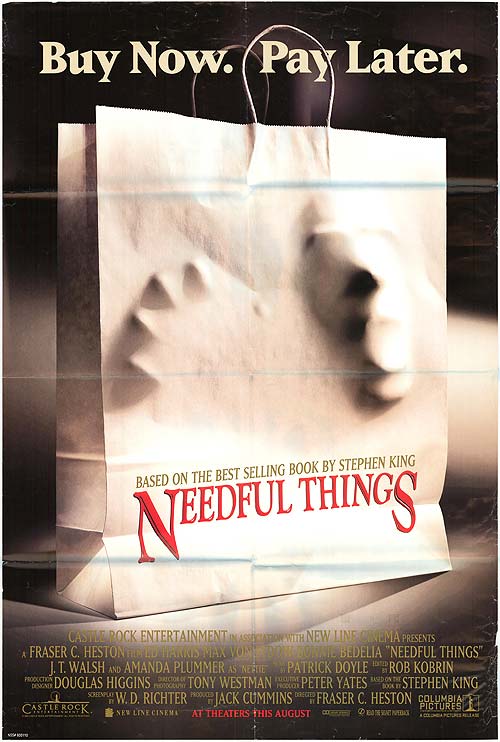
Leland Gaunt has come the whole way from Akron to Castle Rock to open an antique store called “Needful Things.” Everything he sells gives you exactly what you want, but you need to pay him back with a favor. If that’s not the most Stephen King sentence ever — minus 50’s slang like daddy-o or references to comics and rock and roll — then I’m not sure what is.

This 1993 movie was directed by the baby Moses. No, seriously, director Fraser C. Heston played that role alongside his father in The Ten Commandments.

Anyways, Leland (Max von Sydow, who will forever be Ming from Flash Gordon) gets the townsfolk to play pranks on one another, like when Brian Rusk has to play one on Wilma Wadlowski Jerzyck (Valri Bromfield, former comedy partner of Dan Aykroyd and one of the first Second City stage members) for a Mickey Mantle card. Or how he helps Danforth Keeton pay off his gambling debts. From books that people have always dreamed of to helping continue the rivalry between a Catholic priest and a Baptist minister, Leland’s objects get into the hands of nearly everyone in town.

This brings everyone into conflict with one another, in particular, the battle between Nettie Cobb (Amanda Plummer, So I Married an Axe Murderer) and Wilma, which is so intense that they end up killing one another.

Leland even cozies up to Sheriff Pangborn by giving his fiancee Polly (Bonnie Bedelia, Die HardSalem’s Lot) a necklace that cures her arthritis. When Pangborn tries to warn Polly that Leland may not be what he seems, Gaunt ends up seducing her and reveals to her that the Sheriff has been stealing money from the town, so she breaks off their engagement. 

Keeton becomes afraid that everyone — including his wife Myrtle– is out to get him, and Gaunt convinces him that he is his only ally. From attacking deputy Norris by kicking him in the dick to killing his wife with a hammer, Keeton takes things a bit too far to say the least.

Paranoia takes over the town and people start to kill one another with the guns that Leland sells them. Oh yeah, they start blowing up churches, too. A riot breaks out and only the Sheriff can stop the insanity.

Even after Keeton gets redemption by strapping a bomb to himself, blowing up the Needful Things shop, Gaunt walks away unscathed. He even tells Pangborn and Polly that they make a cute couple and promises to see their grandson in 2053. He gets in his black car and leaves.

While it’s not in the movie, the novel featured the return of Ace Merrill, the bully played by Kiefer Sutherland in Stand by Me. And Ed Harris’ character also appears in The Dark Half, where he was played by Michael Rooker.

The theatrical version of this film is about 2 hours long, but there’s also a TNT version called More Needful Things that is over three hours in length. It has never be released on video.

I’ve always wondered why King wrote this book, especially after Salem’s Lot, which is also about a mysterious shop opening in a small New England town. But hey — I’m writing a blog and that dude makes millions every time he types something. And if he was writing this blog, this would have about ten thousand more words in this review.

That said — this is another of Becca’s favorite movies.