DAY 12. THE FRACAS AND THE FUZZ: Something revolving around cops and criminals.
But what if the Maniac Cop found love?
This is the question we must answer.
Aren’t we all worthy of adoration?
Even those of us who have risen from the grave and killed numerous people in an obsessive quest for bloody revenge?
But first, the problem of bringing back the Maniac Cop, Officer Matthew Cordell, played once again by Robert Z’Dar. Leave that to Houngan Malfaiteur, played by Julius Harris from Hell Up In Harlem, Black Caesar and Superfly. I love the character names that Harris had in movies, like Tee Hee Johnson in Live and Let Die, Gravedigger in Darkman and Speedbagger in Prayer of the Rollerboys. He uses the dark powers of voodoo to bring our favorite boy in blue back from the beyond.
Meanwhile, there’s also another cop named Katie Sullivan (Gretchen Becker, who is also in Firehead and was Martin Landau’s partner until the end of his life) who gets shot in a convenience store holdup. Thanks to more police corruption, she’s painted as using excessive force and the man who shot her is due to go free, which upsets investigating officer Sean McKinney (the returning — and always awesome — Robert Davi).
It also upsets the Maniac Cop, who shows up to the hospital ready for mayhem. He kills one guy with defibrillator paddles and another with straight-up x-ray radiation. And the four reporters who joined in on Kate’s frameup? Toast.
McKinney joins up with Doctor Susan Fowler (Caitlin Dulany, who along with Jesica Barth, formed Voices in Action after the multiple accusations against Harvey Weinstein) to investigate the murders and Kate’s strange behavior, even though she’s braindead.
The Maniac Cop is interested in Kate, who Houngan claims refuses to return from the land of the dead. So he does what any of us would do. He sets everything — including himself — on fire.
Despite getting blown up real good, the body of the titular protagonist survives enough to hold Kate’s charred hand, even in the morgue.
This movie is packed with talent, including The Breakfast Club‘s Paul Gleason, one-time Freddy Krueger actor Jackie Earle Haley as holdup man Frank Jessup, and Doug Savant from Melrose Place and Robert Forster as doctors.
Maniac Cop III: Badge of Silence had a troubled production. Despite director William Lustig’s rough cut clocking in at just 51 minutes, he refused to shoot the additional scenes the producers wanted. That’s why the Blue Underground release has Alan Smithee listed as director. To fill in the gaps, there are several scenes that are obvious outtakes from Maniac Cop 2.
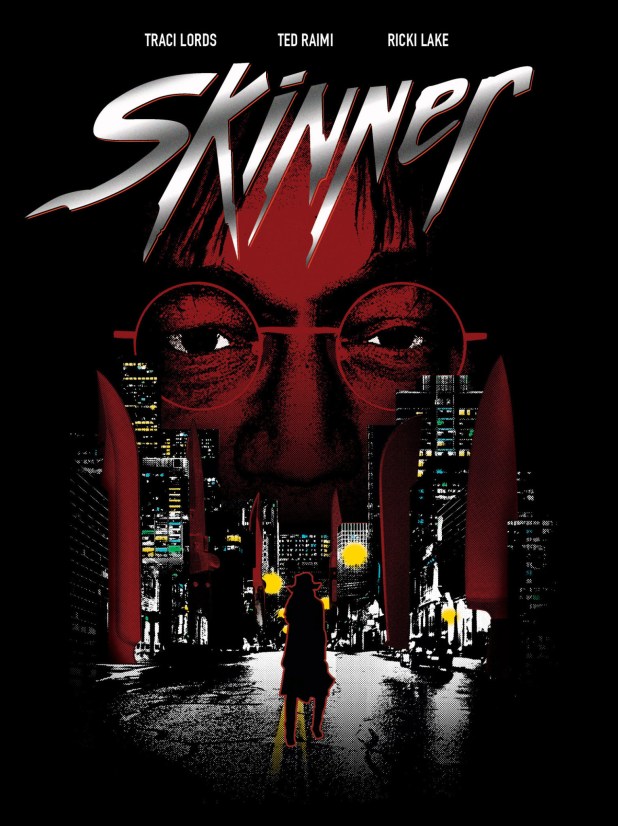
Dennis Skinner (Ted Raimi) has moved into the Tate household, helping them with their financial situation while widening the gap between husband and wife. He seems nice enough, but a disturbing childhood — he only ripped his mother’s face off after his father forced her to watch him conduct her autopsy before punching him in the face — has led to him becoming a skid row slasher. However, Dennis’ past sins have come back to haunt him in the form of Heidi (an insanely perfect Traci Lords), a bad girl with a secret — horrible scars as she’s survived being flayed alive thanks to the power of her will and no small amount of narcotics — who won’t stop until he gets her horrible revenge.
Skinner was the kind of movie that haunted the video stores in my early 20’s. It almost made it into theaters, as well, because a newly reformed Cannon Pictures almost gave it a limited theatrical run. However, this new Cannon fell into bankruptcy before Skinner made it to screens.
It’s just as well — this is a movie made for home video. It’s gloriously scummy, revelling in darkness, grue and gore courtesy of Pittsburgh hometown heroes KNB. Where films like Silence of the Lambs only hint at the skin suits that their killers are making, Dennis Skinner creates muliple flesh fashions that he walks around in.
Former Hairspray lead and daytime talk show host Ricki Lake plays the lonely Kerry Tate, who lives a near-seperate life from her husband Geoff (certainly named for the former Queensryche frontman). As mentioned before, Traci Lords grabs every scene she’s in by the literal balls and leaves the viewer begging for more.
This whole paen to slicing up hookers was brought to us by Ivan Nagy, who may know a thing or two about the world’s oldest profession, as he was the ex-boyfriend of Hollywood madam Heidi Fleiss. In addition to directing episodes of CHIPs and HBO’s The Hitchhiker, Nagy also cooked the books for the mob. His work on Skinner would pair nicely with a film like Fulci’s The New York Ripper, providing a west coast glimpse of neon-hued squalor.
You can get Skinner in the most perfect form it’s ever been released in from Severin. It comes complete with interviews with Nagy, Raimi, screenwriter Paul Hart-Wilden and editor Jeremy Kasten, as well as alternate scenes and a trailer. As always, Severin goes above and beyond to deliver essential physical media. You can also watch this on Amazon Prime.
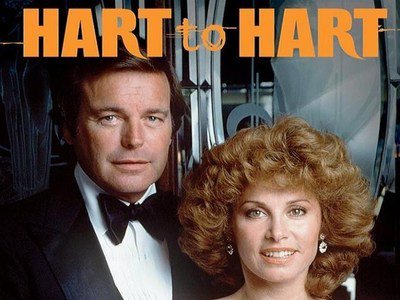
Hart to Hart aired from 1979 to 1984 and was all about Jonathan and Jennifer Hart, a married rich couple who — much like The Thin Man or McMillan and Wife — solved mysteries together. Much like Jessica Fletcher, every single person they come into contact with usually dies.
Screenwriter and novelist Sidney Sheldon created the show — it was originally going to be a CBS TV movie called Double Twist — in the 1970’s before it was finally bought by Aaron Spelling and Leonard Goldberg. Tom Mankiewicz, who directed the Dan Aykroyd version of Dragnet and also wrote Diamonds Are Forever, Live and Let Die, The Man With the Golden Gun and Superman: The Movie, was brought in to update the script and get it ready to be a prime time show. Mankiewicz made his directorial debut with the pilot episode and remained a creative consultant throughout the shows original run.
Spelling and Goldberg’s initial choice for the role of Jonathan Hart was Cary Grant, but since he was retired, they felt that Robert Wagner had the same style. Wagner wanted his real life wife Natalie Wood to play his wife, but the producers suggested Suzanne Pleshette, Kate Jackson and Lindsay Wagner before they settled on Stefanie Powers.
Wagner wanted boxer Sugar Ray Robinson to portray Max the butler before Lionel Stander was cast. He’d worked with Wagner on his older series It Takes a Thief, also playing a lifelong friend named Max. Strongly liberal and pro-labor, Stander was an outspoken political activist and helped found the Screen Actors Guild. He also spent nearly twenty years blacklisted from Hollywood, a true tragedy that served no purpose other than to advance political careers. While in Europe, he was in Leone’s Once Upon a Time In the West and Boot Hill. Hart to Hart was actually the reason why he moved back to the United States. He’s also in one of my favorite ridiculous TV movies, the Larry Cohen written and directed, Bette Davis starring Wicked Stepmother.
As Jonathan Hart contemplates what to give Jennifer for their anniversary, a murder is committed and Jonathan is being set up to take the fall. There’s some corporate espionage and all manner of red herrings thrown about before our loveable heroes resolve things and kiss.
This episode has plenty of fun guest stars. Just like Murder, She Wrote half the fun of these shows is seeing if you can name who everyone is. Mike Connors — Mannix himself — plays Johnathan’s old Air Force buddy Bill McDowell and Lance Guest — yes, from Halloween 2 — pays his son Peter. Paul Williams shows up in several of these Hart to Hart films as a tipster and Kevin Brophy (Hell Night and the wolf-themed 1970’s quasi-superhero show Lucan), Ken Howard (The White Shadow) and Dakin Matthews (Colonel Cochrane from Childs Play 3) all show up.
Sadly, Freeway the dog is deceased, but his son Freeway Junior shows up. Obviously, Lionel Stander is really old in these. It’s kind of sad, but it’s also great that he got to be in five of these movies before he passed on.
You can get this movie as part of the new Mill CreekHart to Hart Movies Are Murder Collection, along with seven other Hart toHart mysteries. I love this set and definitely recommend that if you love made for TV murder shows, you should totally pick it up.
DISCLAIMER: This set was sent to us by Mill Creek. That said, we probably would have bought it.
This movie didn’t start out being about rock climbing.
Carolco Pictures had originally signed Sylvester Stallone to appear opposite John Candy — of all people — in Bartholomew Vs. Neffa, a John Hughes written and directed comedy about feuding neighbors. That movie was dropped, but Stallone stayed on for two more projects.
Isobara: Written by Jim Uhis (who adapted Fight Club and also wrote Jumper), this movie was about a genetically created monster set loose on a high-speed runaway train. Stallone and Kim Basinger were set to star with either Ridley Scott or Roland Emmerich directing. However, artistic disagreements between Carolco and producer Joel Silver caused this movie to get canceled.
Gale Force: Described as “Die Hard in a hurricane,” Renny Harlin was set to direct Stallone in a film where he’d play an ex-Navy SEAL battling modern pirates in the midst of a large scale hurricane. It went through numerous re-writes over several years of development. In fact, they even brought Joe Eszterhas in for a rewrite and spent $500,000 on him turning the movie into an erotic thriller, which isn’t what anyone wanted. The budget spiraled out of control and the film was canceled two weeks before production was to begin, but Harlin kept his pay or play deal worth $3 million.
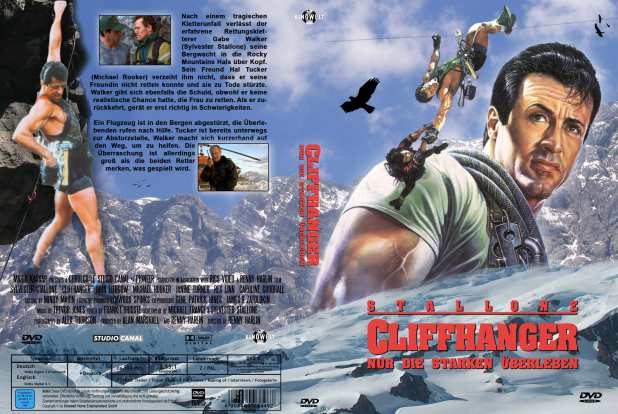
Somehow, Carolco then decided to spend double of Gale Force‘s budget on Cliffhanger and brought Harlin back to direct it.
Due to Carolco’s debt issues. half of the film’s budget was paid for by TriStar Pictures in exchange for complete distribution rights in North America, Mexico, Australia, New Zealand, Germany, and France. Rizzoli-Corriere della Sera, Le Studio Canal+, and Pioneer Electric Corporation also helped finance the film, which meant that even when it was successful, Carolco saw nearly none of the money. Trivia note: This is the last movie to show the Tri-Star Pictures logo.
Honestly, between Gale Force, Cliffhanger and Cutthtroat Island, Renny Harlin pretty much decimated Carolco. I’m shocked people didn’t try to have him killed.
Mountain rangers Gabriel “Gabe” Walker (Stallone) and Jessie Deighan (Janine Turner, Northern Exposure) race to save their fellow ranger Hal Tucker (Michael Rooker) when his knee gives out and he’s trapped in the Colorado Rockies with his girlfriend Sarah (Michelle Joyner, Outbreak). Despite their best efforts, her harness breaks and her hand slips from her glove as Gabe tries to rescue her. Hal blames him for her death and he leaves for nearly a year.
Gabe returns to gather his remaining possessions and try to talk Jessie into leaving with him. A distress call from a group of stranded climbers comes in, so Hal and Jessie go to help, persuading Gabe to come with them. Hal remains angry and even threatens Gabe’s life at one point, but they soon learn that the distress call was a fake.
It turns out that U.S. Treasury agent Richard Travers (Rex Linn, CSI Miami) stole three suitcases full of uncirculated bills valuing over $100 million. However, their plane has crashed and now he and a gang of criminals — led by John Lithgow as an ex-military intelligence operative — plan on using the rangers to locate the missing money. Lithgow took over for Christopher Walken, who left the production a few days before shooting started. Harlin’s first choice for the role? Davdi Bowie.
Stallone would later say of the film, “The director’s cut was met with a lot of disapproval at the screening and received some alarmingly low scores. Mainly because the stunts were absurdly overblown. For example, the average man can jump maybe twelve feet across a gorge, and the stunts had me leaping maybe three hundred feet or more, so situations like that had to be pared down and still then were fairly extreme… so you’re probably better off with this cut. By the way, the 2nd unit crew that filmed the majority of the action was extraordinary.”
One of the recuts involved the scene where the rabbit gets shot at. Audiences hated seeing the rabbit die so much that Stallone spent $100,000 of his own money for a reshoot.
There’s also the issue of the Piton gun, which fires pitons directly into rock. Usually, in reality, climbing requires rock-drilling and piton-hammering. If the Piton gun were real, there would be shattered rock and shrapnel with each shot. But hey — when you’re hanging off a mountain and making a movie, why worry about those kinds of things?
That said — this is a surprisingly violent movie, as one scene where a henchman attacks Hal is incredibly bloody. Not a lot of people discuss this movie, but it holds up pretty well more than a quarter century after its initial release.
The film is still in the Guinness Book of World Records for the costliest aerial stunt ever performed, a stunt in which Simon Crane jumps between two planes at 15,000 feet with no trick photography. Obviously, in the pre-CGI days, you did stunts like that. The insurance company refused to insure this stunt, so Stallone — man, he was just giving away what I make in five years to get this made — reduced his fee for the movie by the final cost of this stunt.
TriStar Pictures planned to make a sequel called Cliffhanger 2: The Dam, which would have had Gabe defend the Hoover Dam against terrorists. This project almost made it to the screen in 1994 and 2008 before StudioCanal would make a remake of the film. That project was in development for nearly a decade before a female-centric reboot was announced in 2019 that will be written by Sascha Penn (Creed 2) and directed by Ana Lily Amirpour (A Girl Walks Home Alone At Night).
Marco Brambilla is a Milan-born, New York City-based video collage and installation artist, which doesn’t make him a natural choice to direct a Sylvester Stallone movie. He also directed Excess Baggage, Dinotopia and the upcoming Abominable, but if you said, “Who should direct a slam-bang action film?” I would not answer with a video installation artist who comments on visual overload through his work.
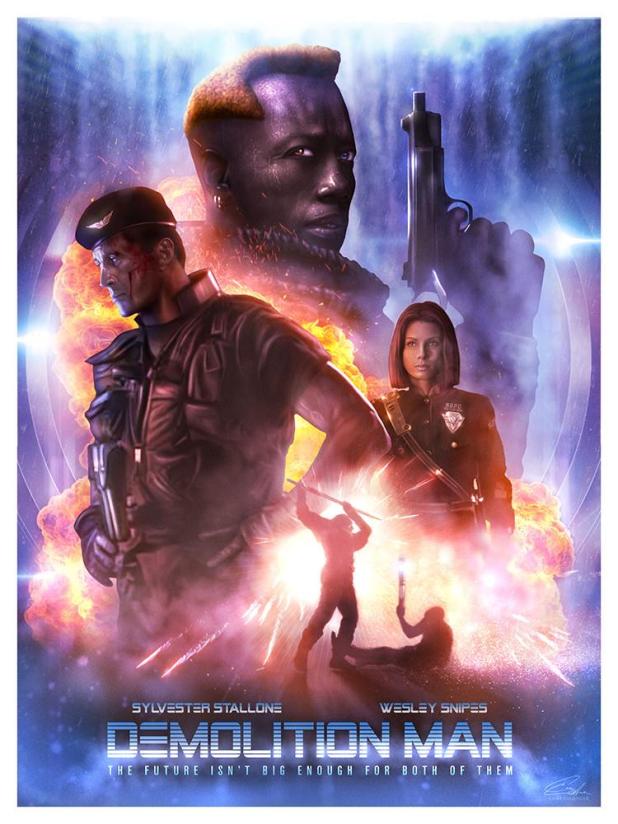
1996: maniac Simon Phoenix (Wesley Snipes) kidnaps a number of hostages and hides in an abandoned building (the Belknap Hardware and Manufacturing Company in Louisville, Kentucky, which was scheduled for demolition, substitutes for a Los Angeles building). This lures in LAPD Sgt. John Spartan (Stallone) — “Send a maniac to catch one” — who jumps out of a helicopter directly into combat. Spartan had done a thermal scan and no bodies were found, so he goes in guns blazing.
Unfortunately, the hostages were already dead and their bodies are found in the rubble of the exploded building. Phoenix claims that Spartan knew he had hostages and attacked anyway. The question of why does the court believe a man who has killed numerous people over a cop comes to mind here, but if you’re going to ask questions that make sense, you’re not ready for 1990’s action films.
Phoenix and Spartan are incarcerated in the California Cryo-Penitentiary, where they are frozen and given subliminal rehabilitation techniques while they sleep.
2032: Phoenix has a parole hearing and escapes, armed with the skills he needs to survive in the future, like computer hacking. Remembering that it takes a maniac to catch one, Lieutenant Lenina Huxley (Sandra Bullock, who took over the role from Lori Petty after just two days of filming) thaws out Spartan.
Spartan wakes up to the peaceful world San Angeles — Los Angeles, San Diego, and Santa Barbara all in one city, kind of like Mega-City One from Judge Dredd — and discovers that he is a man out of time. It’s the most politically correct world ever, a place where physical contact and swearing are illegal and anything unhealthy is banned.
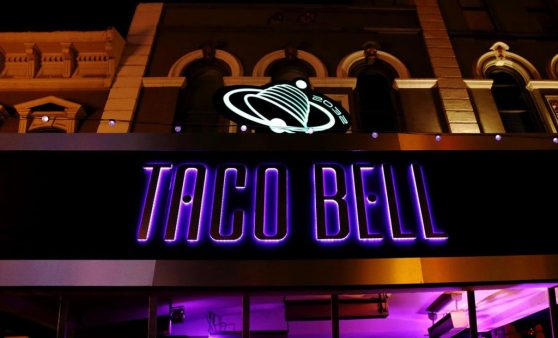
It’s also a place where Taco Bell is the only survivor of the Franchise Wars and is now considered the finest restaurant in the world. In Europe, where Taco Bell is less known, this movie substitutes Pizza Hut.
Taco Bell did a Demolition Man pop up to celebrate the film’s 25th anniversary at the 2018 San Diego Comic Con.
Spartan and Phoenix battle at a museum that has outlawed weapons, where the villain meets Dr. Raymond Cocteau (Nigel Hawthorne, who lent his voice to The Black Cauldron and The Plague Dogs). Cocteau is an evangelic peace-loving ruler who has been in charge of San Angeles since the Great Earthquake of 2010. Phoenix finds that he can’t kill him because the leader is the one who programmed him while he was in cryosleep.
He did all this so that Phoenix will murder Edgar Friendly (Dennis Leary), the leader of the Scraps, an underground gang that resists his absolute power. Huxley figures this all out and Spartan tries to stop him. Unfortunately, Phoenix also has an army of dethawed criminals. He taunts Spartan by telling him that he killed all the hostages before the bombs went off, doomed the hero cop to 36 years of cryo-prison for no reason.
Phoenix kills Dr. Cocteau, thanks to one of his men not being programmed, and tries to take over the future. Spartan stops him and blows up the cryo-prison in the process. He suggests that the peaceful future can only succeed if the Scraps and the above ground people learn to work together. He kisses Huxley and they walk away together.
It’s pretty amazing how much Judge Dredd took from this film, like Rob Schneider’s character and Adrienne Barbeau as the voice of the computer. It’s an early pass at that film and actually a million times better. It doesn’t feel dated at all, despite how silly it is at times. And by silly, I mean awesome.
Fred Dekker (The Monster Squad, Night of the Creeps) actually did some uncredited rewrites to the film. It was his idea to show the two adversaries in 1996, saying “If you don’t show Kansas, Oz isn’t all that special.”
Of all the ridiculous ideas in this film, the bathroom seashells take the prize. Stallone has explained them by saying that the first two seashells were to be used like chopsticks to pull waste from the body and the third was used to scrape what was left. I mean, just the thought of how the three seashells work makes me pause this movie every time and try to comprehend what they’re all about.
The real explanation comes from screenwriter Daniel Waters, who wanted a scene where even the bathroom in the future would cause Spartan problems. So he called another screenwriter and asked for ideas. The answer? “I have a bag of seashells on the toilet as a decoration.” Waters replied, “OK, I’ll make something out of that.”
Hungarian science fiction writer István Nemere claims that most of that script was based on his 1986 novel Holtak Harca (Fight of the Dead), in which a terrorist and a soldier are frozen and then awaken to a society that has outlawed violence. He’s alleged that there is a conspiracy where a man has been illegally selling the ideas of Eastern European authors to Hollywood after the fall of the Iron Curtain.
According to this article at The Toy Box, the Mattel action figures that came out for this film basically took the body parts from The New Adventures of He-Man figures and added new heads. That said — where else can you find a Dennis Leary action figure?
There are tons of small roles in here filled with actors and personalities that I love, like Jesse Ventura and Jack Black. Jackie Chan was Stallone’s first choice to play Simon Phoenix, but Jackie doesn’t play bad guys, even when they planned a sequel to this.
I know I said earlier about ignoring plot holes, but there’s a major moment that isn’t touched on in the film. After Spartan learns that his wife died, he asks about his daughter before being cut off. In truth, before the Wasteland battle, he meets a Scrap named Kate (Vasilika Vanya Marinkovic, Jacklyn Hyde from the 2000’s reboot of Women of Wrestling) who he learns is his daughter. You can see him protecting her during the battle and she also stands next to Friendly when he’s introduced to Associate Bob at the end (I kind of adore Associate Bob, who constantly says “greeting and salutations” a line from another Daniel Waters movie, Heathers).
In fact, there’s a ton of this movie that was cut to achieve a more teen-friendly rating, including more of the scene where Phoenix rips out Warden Smithers’ eye, Phoenix spraying a crowd with machine gun fire, Phoenix killing Zachary Lamb and a battle between Jesse Ventura’s character — who has been overdosed with adrenaline — and Spartan. All of these cuts make the continuity of the battle scenes in the Scraps underground lair and the cryo-prison an absolute mess.
Best of all, when this movie in Kuwait, it was called Rambo the Destroyer. That’s a carnie movie that even Italian film producers would have to applaud.
I love Demolition Man, a film that gets its title from a song by The Police that Grace Jones sang on. It’s big, dumb, loud and completely insipid — and inspired — in all the best of ways.
So here I am . . . sitting in a theatre watching Professor Q’s ninth directing effort, Once Upon a Time in Hollywood, 25 years after the release of a movie that proved Quentin Tarantino’s Reservoir Dogs wasn’t a fluke: Pulp Fiction, a film which served as his third film overall—and his second directorial effort.
While us Tinoheads awaited for Pulp Fiction to drop—and courtesy of Reservoir Dogs’ success—Quentin sold two of his pre-Reservoir Dogs screenplays that came to be directed by others: Tony Scott’s True Romance (based, in part, on Tarantino’s unreleased 1987 short film, My Best Friend’s Birthday), and Oliver Stone’s Natural Born Killers. Sadly, when discussing Tarantino’s oeuvre, Tony Scott’s True Romance is brushed aside in favor of Stone’s Natural Born Killers.
Why?
Is it because Tony Scott—the younger brother of Ridley Scott (Blade Runner, Alien)—started his career on the “A-List” backed by producer-action guru Jerry Bruckheimer and directed Tom Cruise (Top Gun and Days of Thunder), Kevin Costner (Revenge), and Eddie Murphy (Beverly Hills Cop II) in flashy, MTV-kinetic brain freezes, while Stone’s writing and directing debut was the trashy, VHS-freak out, Seizure (1974)—featuring a balaclava-and-bondage-geared axe killer under the thumb of an ex-Bond girl adorned in Mortica Addams garb with a knife-wielding Hervé “Tattoo” Villechaize as her side kick?
Yeah, we know how it is with you Iron City-swillin’ (oh, you’re not from Pittsburgh; okay, Old Milwaukee then) snobs who troll B&S Movies: Sir Michael Caine’s hand going “Hands of Orlac” across Canada courtesy of Stan Winston’s make up work (The Hand; 1981) is “the shit” while Bruckheimer’s MTV dive-bombing F-14s is “shit”. Hey, this reviewer gets it: When given a choice, the stench of the undergroundsploitation route gets my Scooby-Doo a doin’ a cinematic shoe-scrape too.
Regardless of the then newly-formed Tinohead-contingent rejecting True Romance—because Tarantino didn’t direct it, it lacked his obscure, 45-rpm singles-romance, and was it was devoid of the characteristic, non-linear plotting of Reservoir Dogs and Pulp Fiction—the film none the less received a 1993 Saturn Award (The Academy of Science Fiction, Fantasy and Horror Awards) nod for best screenplay.
In a June 2009 interview for Cinema Blend, Scott reflected that all six of his films with Bruckheimer received bad press and, after his debut feature, The Hunger, he stopped reading his reviews. While he completed True Romance at the Tinsel Town bargain-basement price of 13 million dollars, which one would think would ensure a guaranteed box office success, the film grossed less than its production budget and is considered a box office failure. Today, critics review the film in high regard, with the British film magazine Empire ranking it at # 83 on its Top 500 list. Indie Wire lists the Tarantino-Scott collaboration as one of the essential Top 5 films of Tony Scott—in a consortium with his debut, The Hunger (1983), Crimson Tide (1993; a sub-suspenser that Tarantino script-doctored), Brad Pitt’s Spy Game (2001), and the runaway-train romp, Unstoppable (2010).
While the film noir element of Reservoir Dogs remains for the what-is-now-customary, hypnotic cocaine hit with a Red Bull chaser that is Tarantino, this time Professor Q dips into the obscure world of Cold War-era Romance comic books from the ‘50s with their soap-operatic, love-dysfunctional plots. (Remember, in addition to being a film and music freak like you and me, The Q loves comic books.)
Drawing from his life experiences as a video store clerk, Tarantino crafted a tale about an Elvis Presley-obsessed, kung-fu loving comic book store clerk, Quentin Tarantino . . . uh, I mean, Clarence Worley (Christian Slater), who “scores” with a fellow kung-fu flick lover, Alabama Whitman (Patricia Arquette).
Now wait just a dang-gum minute, Tarantino. Not in all my years of trolling vintage vinyl outlets, comic book and video stores, and their related conventions and swap meets. . . . Seriously. Call John de Lancie. This shit only happens in the Q Continuum. . . . Oh, shit . . . we just entered the hicksploitation zone: It’s another wimpy-reluctant miscreant and social malcontent not gutsy enough to run ‘shine or long-haul contraband who meets a badass Sally “Frog” Field packing a shitload of shit-storm baggage.
Yep, Zed! Cue the Gimp! We’re off on one of Tarantino’s celluloid-pastiche mind fucks layered with fast-on-their-feet characters zinging each other with pop-culture dialog twisted on multiple narrative threads. After a Violent Femmes-styled “just one fuck,” Alabama and Clarence get hitched . . . with Val Kilmer’s Elvis-apparition (The K-Man portrayed The King of Rock ‘n’ Roll and progressive rock’s piped piper, Jim Morrison? You rock, Val. Batman need not apply.) convincing Clarence to murder Drexl (Gary Oldman!), Alabama’s pimp—and unknowingly steals a suitcase of cocaine. The chase is on.
As with any Tarantino film, there’s that one iconic (hell, two or more!) scenes: In Pulp Fiction: It’s Christopher Walken in “The Gold Watch” and Zed and Maynard being scamps in a pawn shop’s basement. In Reservoir Dogs: It’s Michael Madsen’s soft-shoe mutilation to an old Steelers Wheel tune . . . and in True Romance: It’s “The Sicilian Scene” with Dennis Hopper and Christopher Walken.
So how does this romance between Tarantino’s “substance and style” colliding with Tony Scott’s-cum-Jerry Bruckheimer’s “style over content,” popcorn-tent pole oeuvre end? As all fine wines and champagnes do: That bottle of Dom Tony Scott aged gracefully.
Tarantino claims that after his 10th written and directed film—possibly a Star Trek sequel (Kirk MUST have a soft-core porno fling with a green-skinned alien babe)—he’s retiring. I don’t believe Quentin Tarantino will ever tranquilize the pop-culture driven, dialog synapses firing in his analog-celluloid inebriated brain. He has to tell stories. I want him to keep telling stories. We all do.
And if he does—fingers crossed—True Romance is proof that any script—starting with #11—will be in capable hands to quench our romance with Professor Q.
Oh, don’t forget: While spending the week with Quentin on this B&S Movies’ spotlight on his career, please surf over for a video store ‘80s history lesson with “The 37 Movies that Make Up Kill Bill.” It’s Sam’s—our illustrious proprietor of the video orphans you love—master thesis of Quentin’s love of the films we love. As for my own master thesis, I unpack Q with my “Exploring” feature on his Rolling Thunder reissues shingle. For Quentin is us, and we are he, and he’s is the Walrus, and we’re the pigs from the gun sitting on a cornflake waiting for his next film.
Do you more from The Slate? Oh, hell yes you do! He rules! Check out our review and a Slate career round up for his 2012 outing, Playback.
In July 2022, Arrow reissued True Romance as an 4k Ultra HD, Blu-ray and Steelbook, which we’ve spotlighted.
About the Author: You can read the music and film reviews of R.D Francis on Medium and learn more about his work on Facebook.
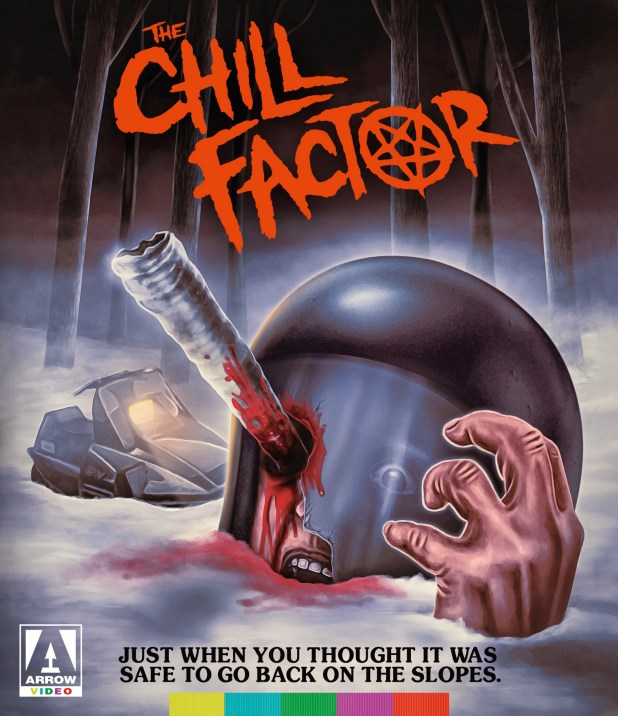
Have you ever wondered, “What would happen if The Exorcist and the Winter Olympics came together in a 1980’s VHS rental horror film?” Good news. Arrow Video has brought back this barely seen film, originally known as Demon Possessed, for your viewing pleasure.
This movie produced and directed by Christopher Webster (the producer of Hellraiser, Heathers, Meet the Applegates, The Inheritor, Mindwarp and more, but this is his only directorial credit) with a screenplay from Julian Weaver (The Inheritor and another recent Arrow Video release Trapped Alive). Here, they’ve created the only hybrid snowmobile racing/Evil Dead ripoff hybrid that I feel has ever — and probably will ever — be made.
For a group of young couples — no less than two people and the narrator explain to us that it’s a big deal that one of them is mixed race — a snowmobiling trip has turned tragic when one of them is launched into a tree during a race. Looking for shelter in the cold, they discover an abandoned summer camp filled with religious artifacts and an Ouija board. If you’re thinking, “This seems like a bad idea,” you’ve watched too many slasher films.
I’ve never seen a movie before where someone races a demon on a snowmobile. And if you’re a fan of movies where someone gets an icicle in their eye — shockingly, there is no IMDB list of this — you should probably check this out. Upon further research, the only other icicle to the eye movies I can come up with are Die Hard 2 and Jack Frost, although an icicle kills someone in the remake of Black Christmas.
This disk features a brand new 2K restoration from the original film elements, along with brand new audio commentary from special effects artist Hank Carlson and horror writer Josh Hadley. Arrow has also filmed new interviews with makeup artist Jeffery Lyle Segal, production manager Alexandra Reed and stunt coordinator Gary Paul. Like all of their releases, they always put plenty of effort in, no matter what film they release.
The Chill Factor is available from Arrow Video on July 16. You can grab it from MVD.
DISCLAIMER: This movie was sent to us by Arrow Video, but that has no bearing on our review.
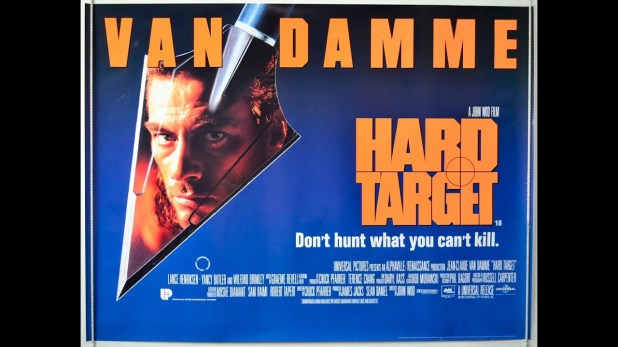
Was there some kind of boot camp that Hong Kong directors had to go through to make movies for Chinese audiences that required them to work with Jean-Claude Van Dam? Tsui Hark, Ringo Lam and John Woo all made their first Western movie with the actor. It seems like too much of a coincidence to believe otherwise.
Chuck Pfarrer wrote the script, which is based on the 1932 film adaptation of Richard Connell’s 1924 short story The Most Dangerous Game. He also wrote or contributed to the films Darkman, Navy SEALs (based on his own time as a SEAL), Barb Wire, The Jackal, Arlington Road, Shooter and The Green Hornet.
Beyond Hard Target being Woo’s first American film, it was also the first major Hollywood film ever made by a Chinese director. Universal Pictures was nervous about having Woo direct a feature, which kind of blows my mind. By this point in his career, he’d already made A Better Tomorrow, The Killer, A Bullet In the Head and The Killer by this point, movies that are legendary action movies that are more memorable than any action Hollywood was churning out in the 1990’s.
They sent Sam Raimi to look over the film’s production and possibly replace Woo if he started to fail. That said, Raimi was a big fan of the director and confident in his skills, saying, “Woo at 70% is still going to blow away most American action directors working at 100%.”
Kurt Russell was Woo’s original choice of a star, but he was too busy. The director then went with Universal’s selection of Van Damme, which allowed him to ramp up the action.
Amazingly, it took twenty different cuts of the film to secure an R rating. While all that was going on, Van Damme hired his own editor to create his own cut of the film. Van Damme’s version cuts out whole characters while including more close-ups of himself. When asked why, Van Damme said, “People pay their money to see me, not to see Lance Henriksen.”
The movie begins with a homeless veteran (scriptwriter Pfarrer) being hunted by Emil Fouchon (Lance Henriksen), Pik van Cleef (Arnold Vosloo, The Mummy and Zartan from G.I. Joe: The Rise of Cobra and Darkman in two direct to video sequels), Stephan (Sven-Ole Thorsen, Conan the Barbarian), Peterson (Jules Sylvester, a noted snake wrangler) and a businessman who has paid half a million dollars for the chance to hunt a human being. The man is killed before the credits roll.
We soon meet his daughter Natasha (Yancy Butler, TV’s Witchblade), who is looking for her father. She hires homeless martial artist and ex-Marine Chance Boudreaux (who would be in that role other than Van Damme?) to be her guide and bodyguard.
What follows is a veritable smorgasbord of fight scenes and bullets being fired by all manner of guns, including an amazing sequence inside a Mardi Gras float graveyard. Somewhere out there exists the original 116-minute long cut — outside of bootleg releases — that has even more mayhem still intact. That said, what survived is still action-packed.
I was let down when this movie was released, but realize that Woo still had some adjusting to do when it came to Hollywood — beyond improving his English. Last year, he told the Hollywood Reporter that “…in Hard Target I was too ambitious, and tried to do everything in one film. This is unlike any traditional films in the States, so the audience didn’t understand what’s going on with these techniques. It’s not a typical Hollywood action movie. And slow motion. And also the violent moments, too, the audience couldn’t take it. And some people left the theater in the middle of the movie. Although the film didn’t achieve great success, it sold well.”
Looking back on it a quarter century later, I can appreciate a lot more of the film. Arnold Vosloo and Lance Henriksen make the perfect team of bad guys. And any movie that gives you both Van Damme with a magnificent mullet and Wilfred Brimley kicking ass as JCVD’s Uncle Douvee really made me enjoy this way more than I remembered. I mean, how many movies will you see this year where the hero shoots a bad guy five times with an upside down gun and then still spin kicks him?
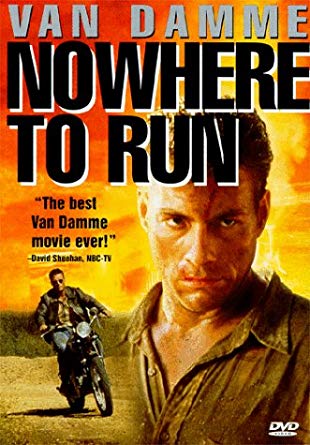
Robert Harmon directed The Hitcher and the Tom Selleck starring Jesse Stone series of TV movies. Here, he guides JCVD to a much more dramatic tale than he’s normally in. No worries — the film stays true to the Van Damme trope that it must explain to you that he’s another nationality. Here, he’s Sam Gillen, a Québécois convict who escapes from Federal custody thanks to his partner. Yes, Van Damme is not a good guy here and his actions directly lead to the death of his friend.
In their last heist, that very same partner killed a bank guard, a crime for which Sam was ultimately convicted. Sam moves on alone, camping on a piece of farmland owned by Clydie Anderson (Rosanna Arquette), who is a widow with two kids, Mookie (Kieran Culkin) and Bree.
After some sneaking around, Sam ends up saving the family from some ruffians. That’s when he learns that she’s been holding out on selling her property to Franklin Hale (Joss Ackland!), who for some reason will go out of business without having Clydie’s property to build tract homes. I have no idea how real estate works, people.
Hale gets Mr. Dunston (Ted Levine!) to try and oust Clydie and the corrupt Sheriff Lonnie Poole (Edward Blatchford, who played the cool brother of Mr. Belding in a very important and special episode of Saved By the Bell) is all into Clydie. He gets the dirt on Sam and forces him to leave, but still sends the cops after him.
While all that is happening, Hale forces Clydie to sign over her home and sets it on fire. Sam comes back just in time to kill Dunston and turns himself over to the police, having learned that running away is never the right thing to do.
Nowhere To Run was originally called Pals and was written by legendary wildman Joe Eszterhas and director Richard Marquand. He told The Guardian, “The script was taken and destroyed many years later by Jean-Claude Van Damme as Nowhere to Run. It lost its sensitivity, it lost everything. I don’t like to remember that movie.”
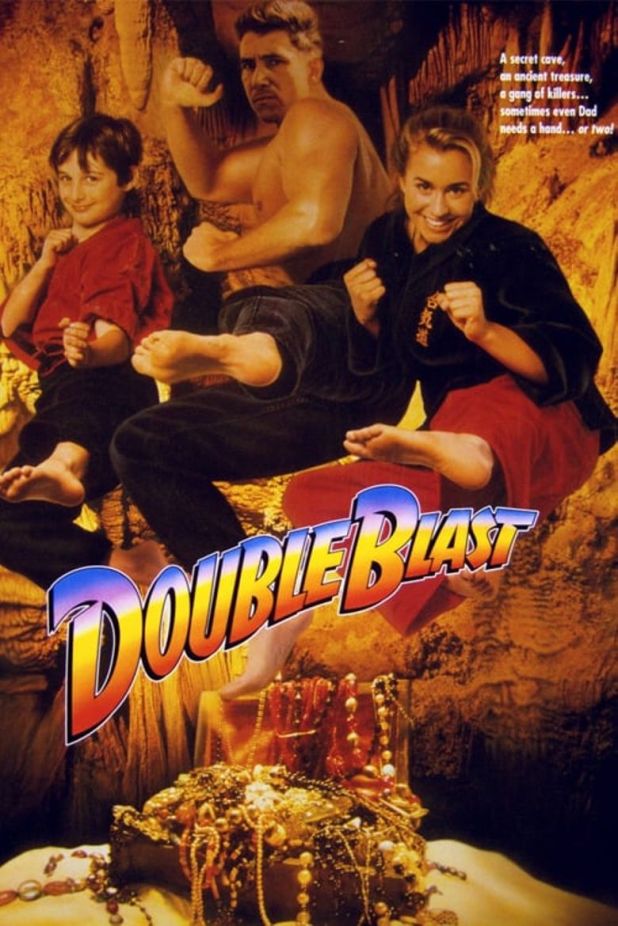
I won’t lie, seeing that Vidmark Entertainment logo made a tear slowly creep down my face. We’re a worse off people for the loss of direct to video companies like this and the warm hazy feel of a rented VHS tape. This is the movie that you never wanted to rent — the kid-friendly movie — when you really just wanted to watch Laserblast or Bleeders, the only rental I’ve ever seen that had blood inside the cover art that you could play with. But hey — for the dads, here’s some Linda Blair to assuage your pain.
Jimmy and Lisa (Jimmy got a special thanks in 3 Ninjas, the film this rips off the most) get into trouble when their dad (Dale Cook from American Kickboxer 2 and numerous other kick and punch films with numbers in their titles) goes away for a tournament. They witness some bad guys kidnap an archaeologist named Claudia (if you’re gonna get kidnapped in a movie like this, chances are you’re Linda Blair) and decide to save her.
The main bad guy is named Nadir and he’s played by Joe Estevez, the Sheen brother who never got the chance to make opposites attract with Paula Abdul or have tiger blood in his DNA. No, he was too busy putting his head down and appearing in films like Soultaker, The Roller Blade Seven, Legend of the Roller Blade Seven, Karate Raider, Baby Ghost, Blood Slaves of the Vampire Wolf (where he plays Joe Estevez) and the eventual Return of the Roller Blade Seven. Joe’s a worker — his IMDB count is at 285 movie appearances.
Of course, the other bad guys all pretty much are lifeless, minus Maniac Cop himself Robert Z’Dar, whose face is the best special effect ever.
There’s some nonsense about a stolen tablet and the kids have to outwit guns and hardened criminals with their magical kung fu. I started watching this at 4 AM and fell asleep at some point — it could have been 3 or 33 minutes, much like how time is distorted in heaven or hell — and my wife came down, watched a minute and fell asleep, only to wake up repeatedly to the same scene and the same fight. Truly, this is the movie that never ends. Even as I write this review, I’m worried that this is all going to end like Jacob’s Ladder and I’ll be back on my couch, watching Double Blast all over again.





 B&S About Movies
You must be logged in to post a comment.