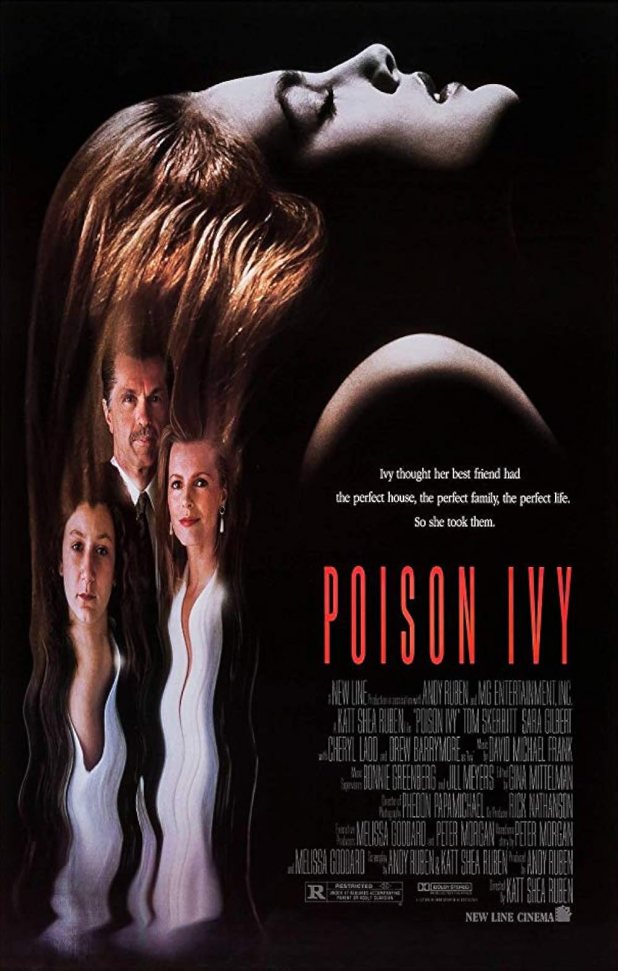
Katt Shea launched her directing career with Stripped to Kill, which is, as I always say, way better than it should be. She followed that up with several movies for Roger Corman — Dance of the Damned, Stripped to Kill 2: Live Girls and Streets, which led to this movie. Since then, she’s made The Rage: Carrie 2, Nancy Drew and the Hidden Staircase and the Netflix movie Rescued by Ruby. She draws on her acting past to help inform her films and can turn what should be exploitation movies into exploitation art movies. She doesn’t forget where she came from but still rises above it.
This won the Grand Jury prize of Best Film at Sundance, but it became a success on video and cable. In 88 short minutes, we meet misfit Sylvie Cooper (Sara Gilbert), watch her become friends with Ivy (Drew Barrymore) and then everything falls to pieces.
Sylvie doesn’t fit in at her rich school, paid for by her TV newsman father, Darryl (Tom Skeritt). Her mother, Georgie (Cheryl Ladd), is close to death, stuck on an oxygen machine and barely there most of the time. Ivy senses that there’s a place she can belong here, as a poor girl at the school on a scholarship. She shows her legs to Dad, fixes Mom’s oxygen and lets Sylvie think that she has someone with whom she can fit in with. Maybe that mercy killing of a dog was intense, but Ivy seems like she could be good, right?
Ivy moves in and slowly becomes a part of the entire family’s life, replacing Georgie in Darryl’s bed. The first time, she drugs Sylvie and has Daryll kneel between her young thighs. Soon, she’s wearing his wife’s clothes, and even the dog chooses her as a favorite over Sylvie.
Then she shoves Sylvie’s mom off the balcony, and no one suspects her because Georgie is mentally ill and near death. Finally, Sylvie confronts her, which ends up with a car accident, a hospital visit and her almost death, Ivy becomes her mother as she fights her way through the pain and the drugs, and they kiss…only for Ivy to shove her tongue in Sylvie’s mouth, ending the dream and bringing back the reality where this friend has murdered her mother and stolen her father.
Shea never presents Ivy as the villain. She does horrible things, but we understand her and the fact that she wants love. Everyone in this wants love. The original ending — this had four of them — saw Ivy getting away with it, and New Line — who wanted a teenage Fatal Attraction — needed a square-up reel where the villain needed to be punished. She dies, even though Shea wanted to make sequels. That said, there are sequels, but not with her characters, Alyssa Milano, Jamie Pressly and Miriam McDonald starring.
That said, Ivy only exists in this movie as the manifestation of the desire that others have. For Dad, she’s a younger version of his wife who wants to have sex and isn’t dying. For Sylvie, she’s a best friend who she can come out to. But what does Ivy want? Love. To be a mother. I think she’s been played as much as she’s playing everyone else.
The strangest thing? This movie is based on truth. Producer Melissa Goddard had a friend stay with her and her family when she was young, and that friend slept with her stepfather, Mike Medavoy, the co-founder of Orion Pictures.
I know we all get old, but when I see Drew Barrymore in ads for phone games, I get sad. For most of my teen years, she was my ideal, a strange creature who was barely understood, someone who would bring trouble into your life, like a manic pixie femme fatale. I hate seeing her selling crock pots at WalMart. You used to ruin families. Now you have a talk show.
You can download this from the Internet Archive.






 B&S About Movies
You must be logged in to post a comment.