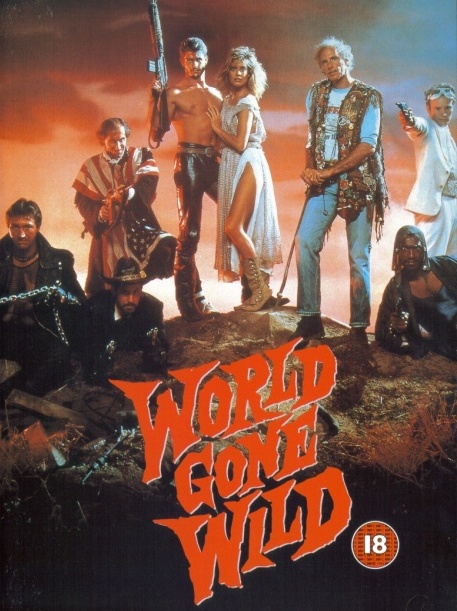
In 1970, Lee Katzin made The Phynx, a nearly lost film about a rock band’s influence on world politics. It’s packed with names, with everyone from Warhol superstar Ultra Violet to Edgar Bergen, Charlie McCarthy, Busby Berkeley, Leo Gorcey, Colonel Sanders, Harold Sakata and the inventor of the Bloody Mary, George Jessel. Just as oddly, Katzin would make his contribution to post-apocalyptic films nearly two decades later with this film.
2087. Earth has been decimated by nuclear war and water is the most precious thing there is. The Lost Wells outpost has survived, but now an evil group of renegades, led by Derek Abernathy (Adam Ant), wants to take over.
This is a film packed with plenty of interesting actors, like Bruce Dern and Michael Paré (Streets of Fire) as the heroes, along with Catherine Mary Stewart (The Apple, The Last Starfighter, Night of the Comet), Julius Carry (Sho’Nuff from The Last Dragon) and Alan Autry Jr. ( Captain Bubba Skinner from TV’s In the Heat of the Night).
That said — this is a flimsy film, unsure what it wants to be. When you hear something like “Bruce Dern against Adam Ant after the end of the world,” you want it to be awesome. Sadly, it falls short. If only an Italian director was in the chair, ready to throw rats at everyone in the cast or bring in George Eastman!
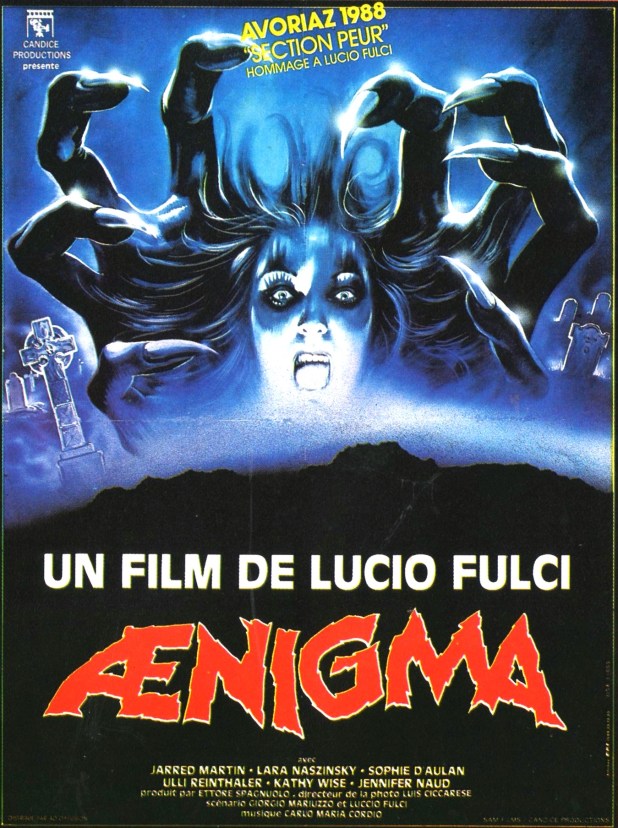
When will young kids learn that you can’t pull murderous pranks without supernatural reprisals? Take the girls of St. Mary’s College, for example. They set up skinny, unattractive Kathy with Fred Vernon, that hunk of a gym teacher. But it’s all a trick — the minute Kathy starts jumping Fred’s bones, cars surround them and begin flashing their lights and honking their horns. Kathy runs from the embarrassment directly into the path of an oncoming car.
Now, Kathy is stuck in a coma while her weird mother, Mary, cleans the school and mopes. A new student, Eva, arrives and meets all of the girls. But Eva is possessed by Kathy and here to get revenge, starting with Mr. Vernon. While he styles and profiles in front of a mirror in preparation for a date with Eva, his own reflection strangles himself. The next morning, a police detective (hello, Lucio Fulci!) states that he died of a heart attack. Virginia, the next victim, is killed by snails (oh Fulci!). And every time someone is killed — or Eva suffers trauma — Kathy’s body reacts.
Dr. Robert Anderson notices. And he also notices Eva, who takes him on a date and seduces him. But their relationship is super intense, including dreams where Eva basically fucks him to death. Luckily, Eva’s mom takes her home and he can start dating Jenny, the only girl who has any remorse for what happened to Kathy.
And the other girls? Glad you asked. One of them is killed by a marble statue come to life! And Eva makes Kim see visions of her boyfriend being decapitated, ending by shoving her out a window. The camera pauses on a poster of Tom Cruise in Top Gun for no reason at all! And then Kim’s boyfriend is decapitated, with his severed head landing next to his girlfriend’s dead body! Fulci, you’ve gone and done it again!
At the hospital, Jenny meets the doctor for a late night date. However, she gets lost in the building and ends up confronting Evain the morgue. A battle ensues between the doctor and Eva, who suddenly falls to the floor, dead. Why? Turns out that Karen’s mother has finally pulled the plug, sending Kathy’s soul to Heaven.
Aenigma is not Fulci’s best work. But even his middling efforts — save some of his much later films — have something interesting within them. This pastiche of Carrie is a fine time waster. Just don’t expect it to be on the level of past glories.
You can find this at Diabolik DVD, along with all your Fulci needs.
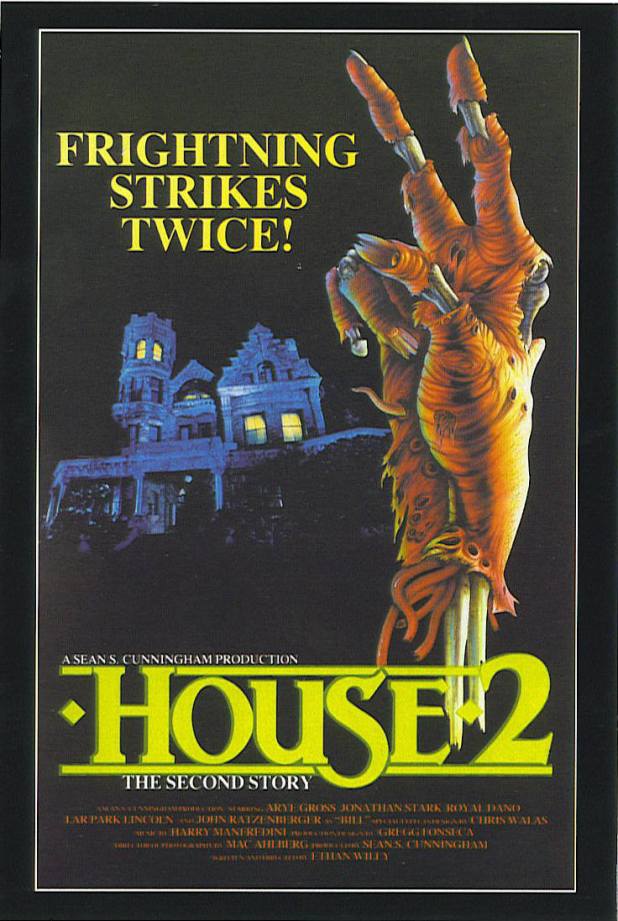
Ethan Wiley, who injected the humor into the original House script, returns to direct the sequel, which comes from a story by Fred Dekker that Wiley adapted. If you disliked the comedy in the original film, well, get ready. This one has no interest in being serious.
Prologue: a young couple gives up their child before an undead gunman murders them in their mansion. That baby grows up to be Jesse (Arye Gross, who was the original voice of Kevin Arnold on The Wonder Years before Daniel Stern took over), who decides to move back into that house with his girlfriend Kate (Lar Park Lincoln, Friday the 13th Part VII: The New Blood). They’re soon joined by goofball friend Charlie (Jonathan Stark, Fright Night) and his wannabe rock star girlfriend Lana (Amy Yasbeck, who met husband John Ritter on the set of Problem Child).
Jesse has insomnia, which leads to him digging through the basement. He discovers a photo of his great-great-grandfather (Royal Dano, who starred in plenty of cowboy films) standing in front of an Aztec temple with a crystal skull in his hand. In the background is Slim Reeser, his one-time partner turned enemy over the ownership of the skull.
At this point, anyone would be happy to discover this photo and move on with their life. But that’s normal life. Here, Jesse and Charlie decide to dig up his ancestor’s grave to find the skull. Imagine their surprise when Gramps is still alive inside his coffin. Compound that with the fact that he wants to bond with his grandson.
It turns out that the house was built with stones from an Aztec temple and that it contains gateways into other time periods with the skull acting as the remote control, if you will. The forces of evil are drawn to the skull, though, so the boys better be ready to defend it.
Meanwhile, a Halloween party ends up with the boys losing their girls and an appearance by Bill Maher as a record exec. A caveman also attacks the party guests looking for a skull and a baby pterodactyl and a caterpillar-dog come along for the ride.
To compound the film’s weirdness, Bill (John Ratzenberger, who like George Wendt in House was a star on TV’s Cheers) comes to inspect the wiring, but he’s really an adventurer with a sword in his toolbox. He leads the guys through a portal — he’s incredibly nonchalant about the proceedings — and helps them save a virgin who is about to be sacrificed.
During a meal where Jesse embraces his new family — yes, a family that includes a dinosaur and a dog-headed caterpillar — Slim makes his return, rising out of a serving dish. He shoots Gramps, who reveals that this is the man who killed Jesse’s parents. Jesse defeats the evil gunfighter, but can’t save Gramps, who tells him that its time to say goodbye.
The cops come to the house, alerted by all the gunfire, and prepare to fire on Jesse. He uses the skull to go back in time to the Old West, taking his friends and pets with him. The film ends with him burying Gramps and using the crystal skull to make his grave, as he follows the old man’s dying advice and doesn’t become addicted to the skull’s magic.
Interestingly enough, Marvel Comics did an adaption of the film!
House 2 is something else. It’s never sure what kind of movie it wants to be, but it gets so strange that you just feel like you have to go along for the ride. The scenes with Bill are great fun and the ending drama always makes me tear up. And you have to love the caterpuppy.
If you’re confused by the fact that this movie has nothing to do with the original House, the way the movie was released in Italy is going to blow your mind.
The Evil Dead was called La Casa there and Evil Dead II followed that numbering. But as we all know, Italian filmmakers are fond of making their own sequels. That’s what led Joe D’Amato to make La Casa 3, which was released here as Ghosthouse*. Don’t worry — we’ll cover that one tomorrow and it’s well worth the wait.
Two other sequels in name only, La Casa 4 (released in the US as Witchery) and La Casa 5 (Beyond Darkness) followed. Yes, those are coming up this week as well!
So here’s where it gets confusing. Our House 2 is La Casa 6. And The Horror Show, a movie that is pretty much the same film as Shocker, is La Casa 7. But in the US, The Horror Show was sold as House 3, despite having nothing to do with any of the other movies. Huh? What? A final sequel with William Katt reprising his Roger Cobb role would come out in 1992.
You can grab a copy of the great Arrow Video re-release of this film at Diabolik DVD. They also have the box set of the first film, this one and a book about them here.
I totally love how confusing things like this can be. And I love the La Casa series! I can’t wait to share even more of it tomorrow with you!
*Even more confusing — The House of Witchcraft is called Ghosthouse 4.
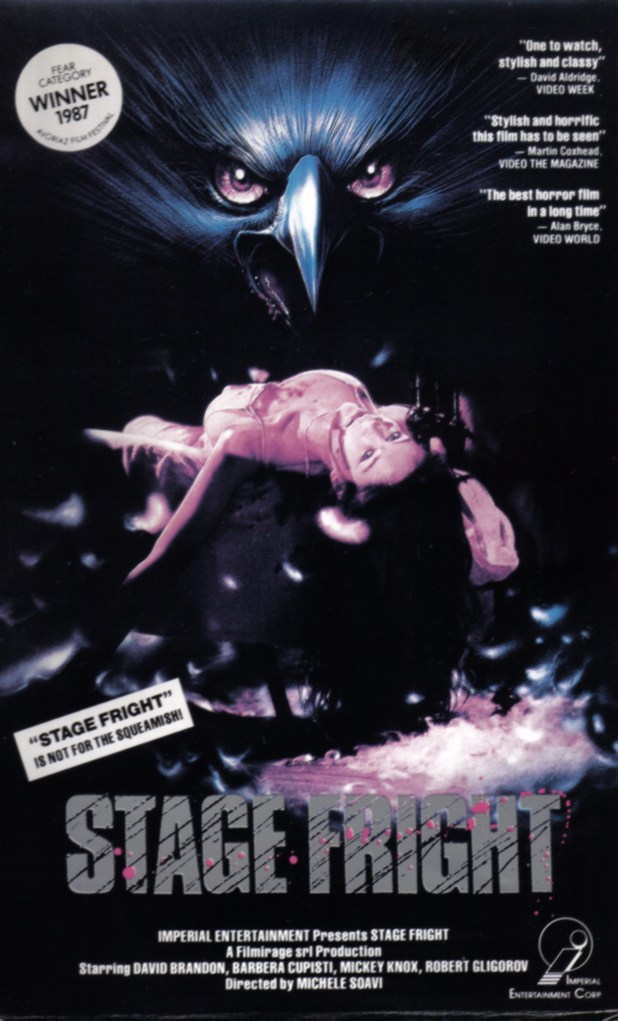
There was a moment two minutes into this movie, when a slasher like scene turned into a Cats-like play, that my mind was blown. And there was a moment halfway through where a body was torn in two that I jumped off my couch, screaming, “Soavi, I love you!”
There’s no other way to say it — this movie is completely crazy. Is it because of Michael Soavi’s (The Sect, Cemetary Man) direction? Or the script from George Eastman (better known Nikos Karamanlis from Antropophagus and, well, kinda sorta Nikos in Absurd, a movie so brutal that it inspired a murderous black metal band)? Why ask questions? Why not just sit back and enjoy the mayhem?
The entire movie takes place in a theater, where actors and a crew are creating a musical about the Night Owl, a mass murderer. Alicia (Barbara Cupisti, The Church, Cemetary Man) sprains her ankle, so she and Betty sneak out to a mental hospital to get some help. While there, they see Irving Wallace, a former actor who went on a murder spree, which has continued in the insane asylum. He uses a syringe to kill an attendant and hides in Betty’s car.
Because Alicia left, the director fires her while Betty is killed with a pickaxe outside. Alicia finds the body and calls the police (one of them is Soavi, who spends an extended scene asking if he looks like James Dean), who lock them inside the theater and guard the premises. Because, you know, that’s the way the police handle these things.
The director is inspired — the play will now be about Irving Wallace and everyone must stay the night to rehearse, even the rehired Alicia. While rehearsing the first scene, Wallace dons the killer’s owl costume and strangles, then stabs one of the other actors in front of everyone.
Then, Wallace cuts the phone and starts killing one person at a time. It’s at this point that this movie goes off the rails and does some rails. A power drill going through someone? Yep. Hacking someone up with an axe? Yep. A woman cut in half that sprays blood all over an entire room full of people? It’s got that, too. A dude getting chainsawed until the saw runs out of gas and then getting decapitated? Oh yes.
Wallace takes all of the bodies and blares the theme from Sergei M. Eisenstein’s Battleship Potemkin while feathers fall. Alicia finds the key to escape and a gun while Wallace pets a black cat, his face covered by the owl mask.
Alicia has no idea how a gun works and can’t take the safety off. Wallace chases her, even stabbing him in the eye ala Halloween. The higher in the theater Alicia climbs, Wallace keeps following, in a POV shot that makes it feel like he’s climbing toward us. She cuts the cord he is climbing and he falls to his death. But this is a slasher — albeit one through the eyes of Soavi — and the killer comes back until he is set on fire.
The next day, Alicia goes back to the theater to find her watch. Willy, the janitor, tells her that they took eight bodies out, which makes her realize that Wallace is still alive. He shows up, unmasked, and tries to kill her all over again. After hearing Willy tell her how she didn’t even have to think to kill him and that the gun would do it all once the safety is off, she unloads a bullet “right in-between the eyes.”
Alicia wanders out of frame, toward a bright white doorway that we first saw just before Wallace attacked her. And in this scene, we can really see why Soavi stands ahead of the pack when it comes to horror. That doorway offers escape, not just from Wallace, but from the film itself, as her fictional character, her final girl, is removed from our minds. The killer lives long after the victims and survivors, so the camera pans down to reveal Wallace, blood pouring from behind his eyes, and he begins to laugh. Soavi said that he intended this to be a wink to the conventions of the slasher, where the killer never really dies.
This film was produced by Joe D’Amato, who had a scene from this movie play within his 9 1/2 Weeks rip-off Eleven Days, Eleven Nights. Also known as Aquarius and Deliria, it features an amazing soundtrack by Simon Boswell. And Soavi — in his first time as a director — shines with intricate camera work (it’s very Argento), complete with a wordless final twenty minutes of Alicia fighting against Wallace.
The end of this film approaches near surrealism within the horror narrative. This gets the highest review I can give. It’s a slasher that transcends the genre to become real art.
Six people are stranded at a mansion in the English countryside — David Bower and Rosemary Bower (Carolyn Purdy-Gordon, wife of Stuart Gordon), two totally selfish and uncaring parents, and their daughter Judy. Plus, we have nice guy Ralph and two British punk rock hitchhikers, Isabel (played by Bunty Bailey, who starred in two landmark music videos for the band A-Ha) and Enid.
The mansion is owned by Gabriel and Hilary Hartwicke (Hilary Mason, the blind psychic from Don’t Look Now), toy makers who fill their home with their creations. As Judy had to give up her old teddy bear by her evil stepmother, they give her a new doll, Mr. Punch.
We soon discover that the dolls are alive and love to destroy humans — the eviler the better. The two girls try to steal antiques and get their faces smashed in and shot by toy soldiers before becoming dolls themselves. Rosemary is attacked by the dolls, then leaps out a window to her death. Her body is brought back to the house, leading David to believe Ralph is a killer.
Meanwhile, Judy reveals to Ralph that the dolls are alive and talks them into saving his life. David attacks, knocking out his daughter and the man he blames for his wife’s death, but the dolls save them. Mr. Punch battles David but is destroyed.
The old owners of the house reveal themselves and explain that the house tests people. Either they pass — like Ralph and Judy. Or they fail, like everyone else, and are turned into dolls. It just depends on who believes in the power of childhood. David now becomes Judy’s new doll, Judy picks Ralph to be her new dad and she leaves for home.
Meanwhile, we see all the evil folks as dolls on the shelf as new people get stuck outside the house and the cycle begins again.
Dolls is a Stuart Gordon (Re-Animator, Honey, I Shrunk the Kids, Castle Freak) film and feels like a test run for the Demonic Toys movies. There are some moments of great invention, like the giant evil teddy bear and the eyeballs popping out of the punk girl. It was a theatrical release that actually didn’t do well, but found new life on video — where a young version of my wife found it and rented it just about every day.
Interestingly enough, the house where the movie was filmed once belonged to Dino De Laurentiis. It was an actual two-story house, but the outside of the house featured remnants of other De Laurentiis films, including Barbarella!
You can listen to us discuss this film on our podcast right here! https://youtu.be/OinZmF4art8
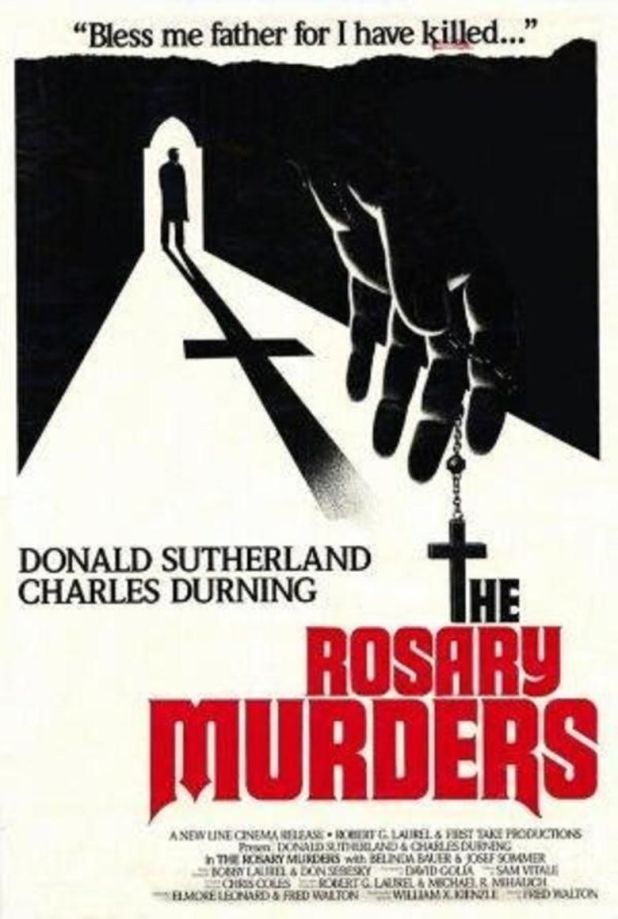
Is this a giallo? A neo-noir? A detective story? Let’s not play with labels. Let’s just see it for what it is — a whodunit where priests and nuns are the victims of a serial killer who leaves a black rosary on their dead bodies.
Directed by Fred Walton (When a Stranger Calls) and adapted by Elmore Leonard, this is a dark, rough take on William X. Kienzie’s novel (Kienzie left the Catholc priesthood in 1974 after 20 years due to the Church’s refusal to remarry divorced people). This may have been the only movie concerning the detective skills of Father Robert Koesler (Donald Sutherland), but the character appeared in twenty three more novels from Kienzie.
The character is a progressive priest — even falling for a reporter, Pat Lennon (Belinda Bauer, RoboCop 2, Flashdance). He serves with Father Ted Nabors (Charles Durning, Tootsie), who is the exact opposite — a racist throwback to pre-Vatican 2 who follows the Church to the letter of the law.
The central dilemma of the film? The killer confesses to Koesler, who can’t do anything about it, thanks to the Church’s Seal of Confession. But what if other lives — maybe even his own — are in danger?
The film was shot on location at Detroit’s Holy Redeemer Parish, and if you look hard enough, you’ll see an uncredited Jack White — years before The White Stripes — as an altar boy. That feels like it should be an urban legend, but it is true.
The film has what some describe as a leaden pace. There are some great moments in it, such as when Koesler hears the killer in a cemetery and the ending, where the real killer is revealed. I’m always debating with myself whether or not to spoil the ending. It’s a thirty year old movie, but I feel weird doing so here. Must be the Catholic in me.
If this was made today, it wouldn’t be seen as controversial as it was in 1987. Today, it feels like a lost movie, were it not for Becca, who watched it on cable as a kid. Keep in mind, my wife was born in 1984, so the chances that she watched this gritty tale at the age of 7 or 8 hover around 100%.
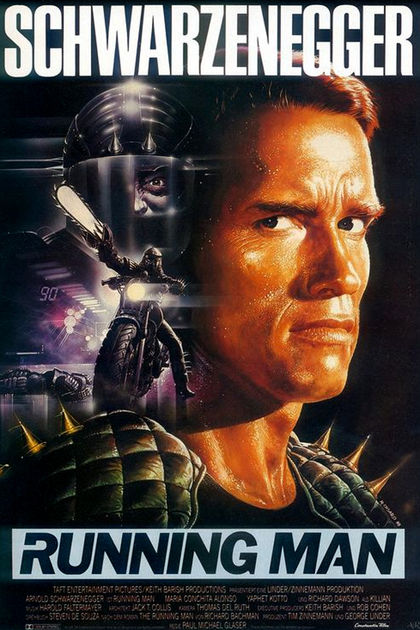
There are three things I want to immediately say that I’ve learned upon rewatching this film: Mick Fleetwood is playing himself, it’s aged worse than movies with a much smaller budget, and most importantly, so much of the dystopian future of this movie isn’t as bad as the world we live in right now.
Wait — what, what and what the fuck?
Let’s back up a bit. The Running Man was a troubled production, with original director Andrew Davis (Under Siege, The Fugitive) being replaced a week into filming by former Starsky and Hutch actor, Paul Michael Glaser (he’s gone back to acting, but not before giving us the magic that is Kazaam). In his book, Total Recall, Arnold wrote that this was a horrible decision, as the director “shot the movie like it was a television show, losing all the deeper themes. In fairness, Glaser just didn’t have time to research or think through what the movie had to say about where entertainment and government were heading and what it meant to get to the point where we actually kill people on screen. In TV they hire you and the next week you shoot and that’s all he was able to do.”
Written by Steven E. de Souza (who had a hell of a run, writing Commando, 48 Hrs. and the first two Die Hard films, while also adapting Mark Schultz’s Xenozoic Tales for TV as Cadillacs and Dinosaurs) from the Richard Bachman book (Bachman was and is, of course, Stephen King, who was using a pseudonym to see if his success was due to talent or luck. A Washinton, D.C. book clerk named Steve Brown discovered the truth before an answer could be found. In fact, Bachman’s next book was to be Misery, which ended up becoming a King novel. The Dark Half, which became a George Romero movie, is based on this experience.). In the original book, hero Ben Richards is anything like the physical description of Arnold, who is near super-heroic.
The film starts that in 2017 — a time that we’re all sadly too familiar with — the U.S. has become a police state post worldwide economic collapse — perhaps not as close to home, but uncomfortably nearby. Actually, it’s way too fucking close to reality, as the opening text tells us that the “great freedoms of the United States are no longer, as the once great nation has sealed off its borders and become a militarized police state, censoring all film, art, literature, and communications.”
Within two years, the only thing that keeps the populace under control is The Running Man, a game show where convicted felons battle for their lives against the Stalkers, who are presented as pro wrestling/American Gladiators style stars. Damon Killian (Richard Dawson of TV’s Family Feud and Hogan’s Heroes, as well as one of the first people in the U.S. to own a VCR) hosts the proceedings and remains one of the enduring reasons to enjoy this film. One gets the idea that Dawson was keen to parody his years of hosting game shows and he cuts through this film, making his role so much better than it deserves to be, whether it’s his ads for Cadre Cola or the way he shits on everyone in his path, even lowly custodians. IMDB states that plenty of folks who worked with Dawson on Family Feud claim that he was exactly like this character, but that seems like the sour grapes of hearsay. Anyways, worried that ratings may slip, Killian pushes for Ben Richards, the “Butcher of Bakersfield,” (actually, it was all a setup and he was wrongly convicted of killing citizens during a food riot) to be the next runner.
Ben gets caught because instead of staying at a resistance camp — post-prison break where people’s heads get blown up real good — with fellow escapees Weiss (Yaphet Kotto from Alien and Live and Let Die) and Laughlin, he decides to find his brother. Instead, his brother has been taken in for re-education. In his place is Amber Mendez (Maria Conchita Alonzo, Predator 2, The Lords of Salem), the composer of the music for The Running Man.
Richards takes Amber hostage, but she knees him in the little Arnold and he’s caught with a big net. Oh yeah — we also meet Mick Fleetwood as a resistance leader here. Remember how I said he played himself? Here’s my evidence. He states that the government has “burned my music” and his second-in-command is named Stevie, after Fleetwood Mac band member and former flame Stevie Nicks (but is played by Dweezil Zappa, who is also in Pretty in Pink and Jack Frost). In exchange for Killian not putting his friends into the game, Richards enters the contest, only to learn that it’s all a lie and they’ll all be part of The Running Man.
The game begins and immediately, Richards does something that’s never been done. No Runner has ever killed a Stalker, but he bests and kills Subzero (former pro wrestler Professor Tory Tanaka, who played just about every Asian henchman ever. He’s the butler in Pee Wee’s Big Adventure, he’s one of the heavies in The Last Action Hero, he’s Rushmore in 3 Ninjas and his IMDB filmography has many roles that simply list him as “sumo wrestler” or “bodyguard.”).
Meanwhile, Amber learns from the news that the media’s presented truth does not line up with her memories — Richards is accused of killing numerous people that she did not see him murder. Her detective work gets her caught and now, she’s on the show.
Buzzsaw (Gus Rethwisch, Arnold the Barbarian from House 2) kills Laughlin before Richards dispatches him. Dynamo (played by Erland van Lidth, a classically trained baritone opera singer, swho is actually singing the aria that introduces himself), another Stalker, kills Weiss before Richards flips his buggy, trapping him. However, Richards refuses to kill him, which increases his popularity. As the downtrodden people of the U.S. regularly bet on the game, they suddenly stop betting on the Stalkers and bet on a Runner for the first time — to the anger of Killian.
Killian offers Richards a Stalker role, but gets turned down. In retaliation, he sends Fireball, one of the most famous Stalkers, after Ben and Amber. He’s played by Jim Brown, who knows about the world of blood and circuses, seeing as how he is a former NFL football star. Plus. he was also in The Dirty Dozen and Mars Attacks! Fireball’s pursuit takes them into an abandoned factory where they find the charred remains of past winners — all lies, as they were really killed by Fireball, who is killed by his own weapon.
Totally losing his mind, Killian wants to send the game’s biggest star, Captain Freedom (Jesse “The Body” Ventura from Predator) to take on Richards. Freedom refuses, so the show creates a CGI version of reality where Captain Freedom wins by killing off Richards and Amber.
Meanwhile, Mick Fleetwood finds our stars and helps them get into the control room, where Amber kills Dynamo and Richards reveals the truth. Killian begs for his life, as all he was doing was giving the people what they want — death and chaos. Ben refuses, sending Killian into the game zone, where his rocket sled hits a Cadre Cola billboard and explodes. Boom — a happy ending, as Ben and Amber romantically walk into the sunset, until you realize that their victory has changed absolutely nothing and society will just keep on being the same exact way.
Remember when I said this movie hasn’t aged well? I’d argue that it looks worse than the much smaller budgeted Warriors of the Year 2072. The costumes look cheap, the video screens look sadly composited and everything feels woefully low budget for a film that cost $27 million dollars to make.
And what of the claim that this film’s post-apocalyptic future is better than our own? One only has to watch the scene where Richards is caught at the airport. Today’s post 9/11 security checkpoints are way worse than anything the hero of this film encounters — he’s never frisked and the tourists freely walk onto the tarmac of the airport, just like folks once could.
Honestly, director Glaser was in well over his head. If a director like Paul Verhoeven was at the helm — like Arnold’s Total Recall — the sheer ridiculous nature of a game show controlling the world could have really been a winner. As it stands here, this is a fun film that makes you wish that it could be so much more — kind of like eating Buffalo wing flavored chips and wishing that they were really Buffalo wings.
In truth, life imitated art in this film, as it inspired the aforementioned American Gladiators and the dance routines were choreographed by future reality game show hostess Paula Abdul. And the Adidas sponsored costumes of the Runners hints at the days when everything would have a branded logo.
Other films like Death Row Gameshow, Gamer, Battle Royale and The Hunger Games would play in the same game zone as The Running Man. Of all the 80’s remakes, this one feels like the best case for a new, better version. Sadly, I think we’re going to see it in real life before we see it on the screen.
I’m 2:25 into this movie and I’m already screaming at the TV in glee. A farmhouse, somewhere that feels like Canada, with a mother — who has hair that feels like the 80s — is making eggs and calling everyone to eat. Then, a scream, to which her husband replies with all the intensity of someone answering a telemarketer. He opens the stove to a skull-faced demon and screams as his son watches.
Cue the credits — it’s time for Rock ‘n Roll Nightmare!
This film stars Jon Mikl Thor, who Wikipedia tells us is “the first Canadian to win both the Mr. Canada and Mr. USA titles. During his bodybuilding career, he has achieved over 40 titles around the world. As a musician, he is the frontman for the heavy metal band Thor, billing himself as “The Legendary Rock Warrior.” Thor used to appear in the back pages of 80s metal mags like Hit Parader and Circus, but no one I knew had ever heard any of his albums (here’s the video for 1977’s “Keep the Dogs Away“). You may know him from this insane clip of him dancing and singing that the Found Footage Festival has uncovered:
Let me further quote from Wikipedia: “Thor started the concept Thor in 1973. He combined strength feats, props, costumes and showmanship with music: his feats included bending solid steel bars in his teeth and having solid concrete blocks smashed off his chest with a sledgehammer.” Seriously, Thor sounds like the greatest man who has ever lived. And his latest band is called Thor and the Ass Boys, so he has that going for him. Seriously, I do believe Thor himself descended from Asgard, down the Rainbow Bridge and used Mjolnir to write his very own Wiki page.
Getting back to the movie, the credits sequence ranks among the longest and worst shot credits I’ve ever seen in my entire life. It’s even worse than the credits in fellow Canadians Bob and Doug McKenzie’s Mutants of 2051 A.D. It’s shot after shot of pre-Go Pro footage of a camera racing along a dark house, as if we are to find some terror in the accouterments and candles and bric a brac.
What follows next can only be described as fetishistic shots of a white custom van — complete with DUCKER license plate — as it grooves and grinds and rocks its way down the highways and byways of Canada, complete with the ever beefy Thor at the wheel. I’m writing this at 5 AM and my reality is always a bit skewed, but these shots go through more than one song, which is like a wrestling match lasting three commercial breaks. It just isn’t done. If the director’s intent was to show us how remote the farmhouse they’re traveling to is, he succeeded with three and a half minutes of watching a white van slowly drive. I’m shocked we didn’t get a slow-motion scene of turn signals going on and off or break lights slowly being depressed. These are the moments in genre films where you wonder: am I watching an auteur or a complete hack…and do I even know the difference any longer?
Just when you think that this will be an entire film of all establishing shots, the band emerges from the van to learn that they’ll be staying at this farmhouse for 5 weeks of recording. It has gas. It has electric. It doesn’t have a phone or TV…but it does have a 24 track recording studio! The band has grown soft in the city and needs Toronto to make it happen — no hot tubs or Dynasty! After a “comedic” sequence about what bands have been to the farmhouse, I have been led to wonder if this is what life is always like in Canada. Keep in mind — my brief time in the Great White North has not debased me of my belief that everything and everyone is from SCTV and Kids in the Hall.
You know how in most films, they’ll do a brief cut to something ominous to change the tone? This film has these cuts lasting two to three minutes — dark skies, Omen like choirs, more dark skies and wind. These scenes stretch off into eternity.
Rod, Max, Stig and Thor — and their respective lady friends — have a meal with awkward toasts as we get to know all about them. But now, it’s time for them to tune their weapons and play us a song. Also — their manager has cooked from them and is wearing a paper burger hat (he also had on a sweet Archies leather jacket earlier, so for some reason he’s the 1950s element of the band).
Instead of the band playing, as would normally follow such a setup, we’re presented with the manager and girls doing a synchronized dishwashing scene. Thor emerges outside to tell them they’re almost ready. For some reason, he’s changed into his stage clothes, exposing his pecs in a costume that can only be compared to the High Energy garb of Canuck superstar Owen Hart.
If you loved the long musical sequences in, oh, let’s say Son of Dracula, you’re in for a treat here. “We Live to Rock” is played in its entirety while band groupies get angry, a band wife sews and a weird flesh/sockpuppet pukes in a cup of coffee. A broken drumstick later and manager Phil has to go to the basement to get more. Phil is like if Harry Anderson wore pork pie hats and did competitive improv. Lynn, Stig’s groupie, meets him and comes on to him.
Lynn takes her top off in the most awkward, unsexy manner that I’ve ever seen in a film. Seriously, she gets he outfit stuck and it takes a really long time for her to get it off. One wonders if perhaps a second take would have improved this scene. The chemistry between her and Phil can only be described as impalpable. She takes a huge bite out of his shoulder and Phil’s gone. So’s the van. It looks like Triton is totally trapped in Toronto!
The band retires to their bedrooms. Thor’s girl can’t get him to stop reading lyrics. The keyboard player comes to talk to the guitarist. but he passes out on her. The married couple is making out. And Stig rawdogs Lynn, yelling “As usual, the best!” before going to “drain the dragon, baby! Yeah! I’ll be back!” He then goes to the bathroom where he speaks in a combination of Arnold and Australian, making me yearn for his death. I’m rewarded as a blood puking zombie gives him a clawhold, which possesses him and makes him a better lover. Zombie Stig goes back and the noises of their lovemaking wake up the whole house.
Just then, groupies arrive to the strains of a ripoff of the theme to Phantasm. They’re let into the farmhouse by Phil, who we all thought was dead. He tells them that the band is tired from all the cocaine, but it’s 2 AM and they’ll be down in twenty minutes, so it’s time for them to “whip out those breasts, girls.” He yells at them that they need to cut the cocaine, scream in the crowd and keep the clothes looking good — there are positions to fill! They run off into the b roll night as we slowly — ever so slowly — pan to Phil’s zombified hand. To quote Jack Chick, “HAW! HAW! HAW!”
The married couple is washing dishes, but they’re quickly taken by a zombie. I was thinking, would this director be so bold and/or stupid to have the zombie’s hand come back in frame to shut off a boom box? I was rewarded with a hearty fuck yes, he would.
The first 44 minutes of this movie feel like 44 weeks. Would another music video performance help speed things up? Of course not. Allow me to share the lyrics for the song “Energy” with you:
I live by one simple rule I don’t let nothing get by I sometimes act like a fool But that has kept me alive
I set my goals and I pace myself I land out of all of my needs And when I’m ready to just give You give something I need
YOU GIVE ME ENERGY THAT’S WHAT YOU DO YOU GIVE ME ENERGY YOU GET ME STARTED EVERYDAY
That’s “Energy” by Thor, everyone. Or Triton. Or whatever. I hope you are all as inspired as I am. And the wives. And the girlfriends.
Have you ever seen a couple and thought, “I hope that I never have to watch these people have sex?” Prepare to say that again, times three, as the various couples break off as yet another Thor tune blares onto the soundtrack. Seriously, for those of you who love Thor — I know that at least one of you found the hidden SEO/SEM codes I wrote in here — this is your boner fuel of a movie.
Stig and Lynn go to a very private part of the lake, where a demon claw emerges from his stomach, just as she quickly gets naked and instantly covers up. Too late — that claw grabs a knocker and she’s a goner. Then, the keyboardist and guitar player have a romp that’s about as sexy as eating a Pop Tart. Seriously, this makes the Showgirls hot tub scene look like Last Tango in Paris by comparison. Thor’s woman also gets him to take a shower with her to the strains of Thor’s “Somewhere Rises the Moon.” Thor makes love like some kind of lizard man — he kisses with the tip of his tongue, not his lips. He also moves like some kind of robot. And not the sexy fembot kind of robot. No, like a 1950s Robot Monster kind of robot. Meanwhile — in the midst of the sex scene — the camera moves to give us a clear three second shot of the shower head. No sex — just a shower head doing its job. I have no idea what the fuck kind of directorial choice that was, to be honest.
Hey! Remember that little kid from the beginning? Me either. He’s back, though and breaks up a romantic moment between the guitar and keyboard couple. For some reason, pan flutes start playing louder than the dialogue at this point. Oh man — just what this movie needs. A precocious child. Actually, he’s another demon, which the couple finds out after giving chase. Man. Thor’s gonna need a new band at this rate. Only he and his girl are left, as nobody else shows up for dinner.
Just because the script says that Thor is going to do the dishes does not mean we need to see him do the dishes. But that said — the next scene is Thor doing the dishes for nearly a minute. Narrative flow doesn’t mean shit in the world of Rock ‘n Roll Nightmare. Thor also acts like someone who constantly reminds you they are acting. When he needs a Coke in a scene, he says, out loud, “I need a Coke. Gotta get a Coke. Yeah. A Coke.” Meanwhile, a piece of chicken comes to life and tries to bite his hand. Luckily, he’s so focused on that Coke!
He sits down to write lyrics while his girl is attacked upstairs, but he’s got his own problems. A penis-like monster with an eyeball where the peehole should be is stalking him (look — I can write mellifluous prose and use my vocabulary and come off as well educated at times, but when a penis demon looks like a penis demon and when it has an eyeball in its peehole, you have to call a penis demon a penis demon). Another demon, this one looking like a plucked bird, attacks just in time for Thor to drop his pen. Somehow, this movie has gone from horror to slapstick. Finally, his girl comes back to tell them that everyone is dead in a demon voice. HOLY SHIT! Now she’s a demon! And she commands an army of penis demons!
Here’s where this movie decides to blow my mind. Thor keeps ignoring the demon, calling him bub, then starts telling him all of his real names. Turns out that no one else in this movie was real, that his entire band and the girls were all shadows that Thor created, based on horror movies, to draw out Beelzebub. “I AM THE INTERCESSOR!” yells Thor, revealing his full stage majesty, all chain, a cape and bare chest and wind machine aided hair. He then makes the same faces I do when I’ve eaten a lot of cheese and can’t properly go number two. “I AM TRITON THE ARCHANGEL!”
Have you ever wanted to see a claymation demon battle a jacked up dude in a metal bikini? Then have I got the movie for you!
Thor defeats the demon, who leaves when a roman candle goes off in front of him. He then goes to a graveyard, where he says, “Vengeance is mine, sayeth the Lord. If you’ve died in vain — I, His messenger — have avenged your deaths.” We then cut to a totally different house as weird music plays. Roll the credits.
Wow.
I was wondering, what kind of maniac makes this movie? John Fasano, that’s who. He also made Black Roses, which was featured this week, along with writing things as diverse as one of Tom Selleck’s Jesse Stone movies and Another 48 Hours. Well, this is a veritable masterpiece. I daresay you’ve never seen a film quite like this. Watch it and be forever changed.
PS – There’s a sequel called Intercessor: Another Rock ‘N’ Roll Nightmare. I’m not sure that I’m ready to watch it yet, but I will.
PSS – You should just watch the end of the movie for yourself.
And if you make it through that “battle,” then you can check out full movie on You Tube.
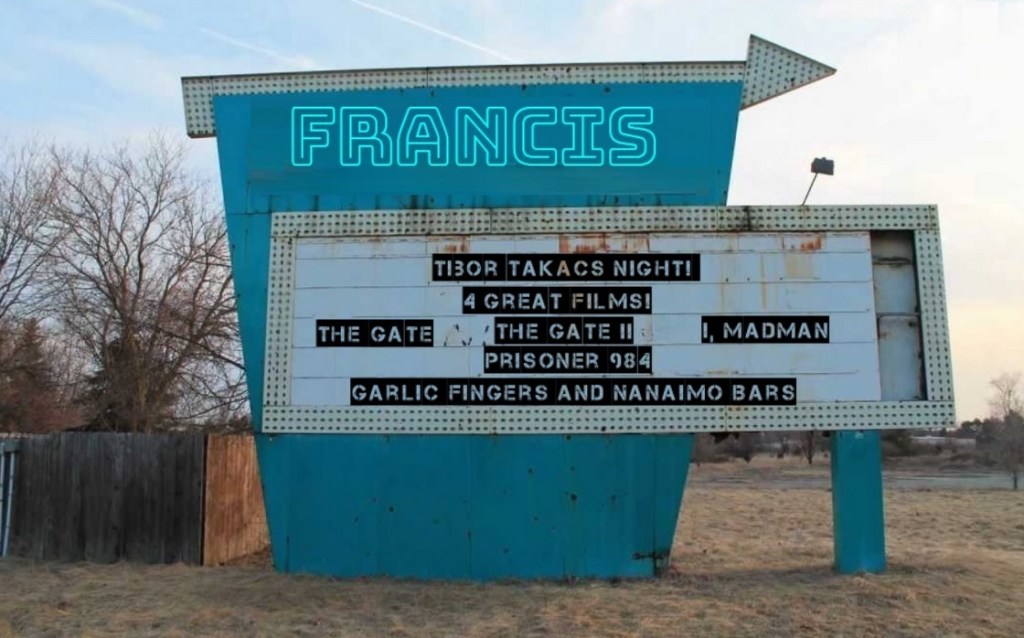
Tibor Takács (director of I, Madman) and a young Stephen Dorff take pre-teen trauma and metal love to the limit in this one. (And thanks to Scarecrow Video’s 2020 Psychotronic Challenge for October, it’s now off the list!)
Glen (Dorff, who smokes those blu cigs in commercials and makes Becca sigh and was also bad ass in Blade) has constant nightmares and a weird best friend named Terry (who is totally the most metal geek kid in cinema forever and ever). Together, they find a geode in the backyard and get blood on it. Because that’s what you do.
When Glen’s folks leave for the weekend and put his sister Al the sitter, you know there’s going to be boys coming over and parties. No shock there. What is shocking is that they decide to read some incantations and break open the geode, which leads to Terry’s dead mom coming back from the grave. Or maybe it was just Glen’s dog Angus, who dies as a result of the monkeyshines.
Terry’s awesome — a D&D loving, occult-obsessed kid that I totally identify with — and he believes that a metal album is the key to Terry’s backyard, which he believes is a domain of evil gods. They actions opened the gate to the netherworld and it’s a good thing they didn’t make a sacrifice. Just then, one of Al’s friends dumps the dead dog in the backyard. Oh no. Oh yes.
All sorts of Satanic pandemonium follows — a swarm of moths, devilish parents, demonic arms dragging Al under her bed, the dead dog in Terry’s bed, the Bible’s Psalm 59 being used to close a demon-filled hole, demons pulling kids into walls, an evil version of Terry that gets stabbed in the eye, one big demon being smashed into many smaller ones, an eyeball inside a kid’s hand and a bottle rocket that saves everything. Oh yeah — the dog lives, too.
This film, thanks to Terry, is rife with metal. The Dark Book album is the logo of Canadian band Sacrifice. The kid even has a Killer Dwarves patch on his jacket. And his room is just packed with posters and albums. He also looks like a child version of my buddy Dillon, who always has a hand-painted Psychomania vest on when I see him at bars.
There’s a sequel, which I haven’t seen, but if it’s anything like this, I better get on with searching for it. Funny enough — people suggest this as a good first horror movie for kids. It’s pretty nightmare-inducing, to be perfectly honest. My first grown-up fright flicks were Nightmare on Elm Street 3: Dream Warriorsand Fright Night, in case you wonder.
You can get this on blu ray from Vestron Video at Diabolik DVD.
And be sure to join us as we examine Tibor’s career and films with our “Drive-In Friday” featurette.




 B&S About Movies
You must be logged in to post a comment.