H. Rider Haggard’s She, A History of Adventure pretty much set the rules for the Lost World genre and presented a white goddess warrior queen named Ayesha who rules a kingdom in the middle of Africa. It’s been adapted many times for the screen, starting in 1899 with Georges Méliès’ The Pillar of Fire. Probably the best-known version is the 1965 Hammer film, She, which features Ursula Andress, Christopher Lee, Peter Cushing and John Richardson.
This movie? It’s inspired by She but if you were expecting something close to the book — or something normal — you’ve picked the wrong film.
This movie is a quest, or a series of quests, and it’s packed with fully realized worlds and costumes that are on screen long enough to get you invested before they go away. It’s literally a Jack Kirby Fourth World comic come to celluloid realization with none of Kirby’s storytelling panache. Sandahl Bergman (Conan the Barbarian) plays She, who is traveling with Tom and Dick (Harrison Muller, 2020 Texas Gladiators), two brothers looking to save their kidnapped sister. Shandra, She’s sidekick, comes along too.
There are werewolves who just want to fuck. Nazis who just want to kill. Communist mutants with mental powers who just want to do BDSM whip torture to She. Mummies with chainsaws. The film alludes to the fact that its 23 years after Cancellation, a nuclear war, so it’s post-apocalyptic whole also referencing sword and sorcery, yet it was made before Conan turned Italian film backlots into ancient carbon copies of Cimmeria. It is one weird film, never sure if it wants to be a comedy or an action film.
Honestly, have you ever played Dungeons & Dragons on LSD? This is how I imagine that this movie was created. They just got people in a room, got them high and gave them a few D10s and a Monster Manual.
This is all directed by Avi Nesher, who brought us the batshit crazy Doppelganger with Drew Barrymore before becoming a critical darling in his home country of Israel. Obviously, this movie is not one he’d care to bring up.
Also, this movie is packed with strange music choices, like a song from Justin Hayward of the Moody Blues during the credits, along with contributions by Motörhead and Rick Wakeman.
Have I properly conveyed just how strange this all is? Then you’re probably wishing you could see it. The gray market and YouTube are your friends. Yes, in a world where nearly everything gets a blu-ray high-end release, this one remains unreleased.
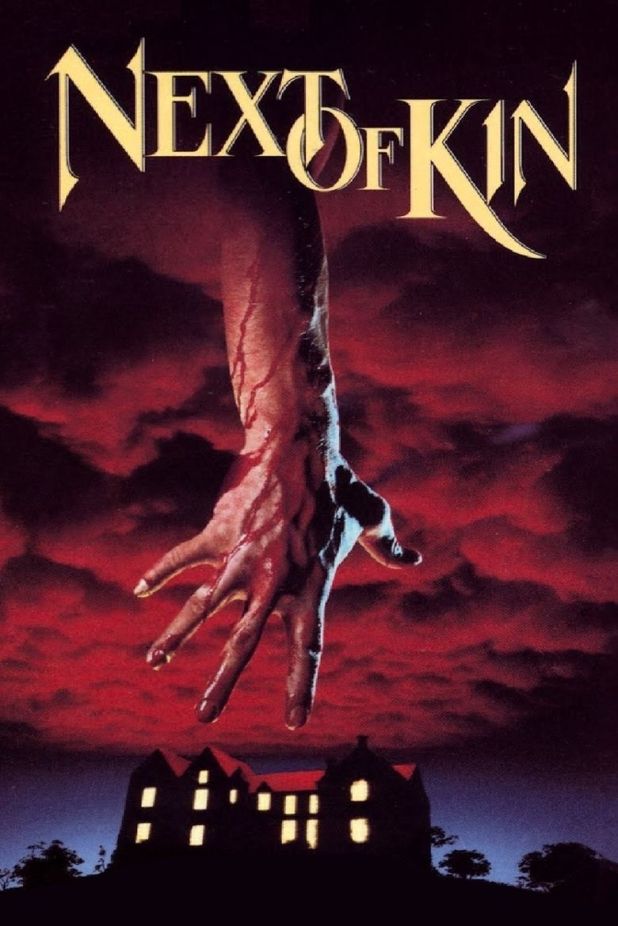
What if The Shining wasn’t in the snowy hills of Oregon, but instead found itself in Australia? What if a woman found herself repeating the same horrors that her mother had faced twenty years before? And what if we decide to watch Next of Kin, today’s movie of the day?
Linda inherits Montclare, a retirement home that belonged to her mother. When she comes back to her hometown to settle her affairs, she feels unwelcome, with only Barry, an old boyfriend (John Jarratt, the evil Mick Taylor in the Wolf Creek series of movies), being understanding.
Things certainly aren’t helped by Montclare’s staff, including Connie and Dr. Barton (Alex Scott, The Asphyx), who have been conducting a secret affair and may be conspiring to drive Linda insane. Or perhaps the house is truly haunted, as drowned corpses appear at will and windows mysteriously open. No matter what, there’s something wrong and it’s probably due to the years of madness and murder that Linda’s mother has covered up.
There’s an amazing moment near the end where Linda has gone near insane, barricading herself within the diner, where she builds a pyramid of sugar cubes as the forces of evil gather themselves to do her in. It’s strangely gorgeous. And not the only original sight in a film that seemingly would only be a rip-off.
Throw in an amazing score by Tangerine Dream’s Klaus Schulze and you have a film that’s quite worthy of experiencing.
Sadly, there’s been no official U.S. DVD or blu-ray release of the film. You can find it on YouTube and through the gray market. And you totally should. It’s nothing like the poster promises and is instead a psychologically rich trip through past sins and a family curse.
UPDATE: Of course, if one company is going to release an amazing horror movie that has never been out in the U.S. before and do it right, it’s going to be Severin. Their new blu ray of Next of Kin can be ordered now.
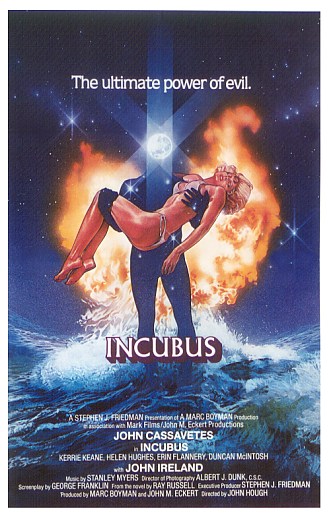
Based on Ray Russell’s novel of the same title, Incubus is all about demon rape. There’s really no other way to say it. If you’re looking for the definitive word on the subject, this movie would probably be your best choice. And hey, John Cassavetes is in it!
The film opens in a rock quarry where Mandy and her boyfriend are swimming. More likely, they’re fooling around until an unseen force caves in the dude’s head and attacks her, putting her in the hospital with a ruptured uterus. While all this is going on, Tim Galen, a local teen, dreams of hooded men tying a woman down and torturing her.
Dr. Sam Cordell (Cassavetes) is treating the girl and we soon learn a lot about his life. His wife has recently died, he’s relocated to the town of Galen following a scandal and his daughter, Jenny, doesn’t really get along with him. Oh yeah — and she’s also dating Tim.
Sheriff Hank Walden (John Ireland, whose career stretches from classics like All the King’s Men and I Saw What You Did to Satan’s Cheerleaders) and reporter Laura Kincaid are on the case too, which expands when a librarian is killed and murdered. It turns out that she has red semen inside her body — so much semen that she’s literally been filled up and destroyed by it. If you’re thinking this is a totally scummy storyline, well, buckle up.
The rapes and murders continue and every single time, young Tim is having the dream while they happen, including an attack at a movie theater where he’s gone to try and distract himself. Look for an appearance by a really young Bruce Dickinson singing for his pre-Iron Maiden band Samson in this scene!
What is Dr. Sam doing? Oh, you know, showing Laura photos of his recently deceased second wife — the reason why he left wherever it was he lived before — and she looks exactly like the reporter. She has some news, too. The town of Galen has a long history of Satanic activity and these rape crimes are nothing new.
Is Tim the killer? Was his mother a witch? Or is his family part of a long line of witch hunters? Is the real killer a shapeshifting incubus, which rapes women in their dreams?
We get our answers pretty quickly. Sam tries to induce Tim’s demonic state while Laura takes Jenny up to bed. Tim tries to attack Laura with a witch hunting dagger his grandmother has given him, but Sam stops the boy and kills him. That’s when we learn that Laura had been the incubus all along. As she lovingly holds Sam, he looks to the bed where his dead daughter is bleeding between the legs.
Yes. That’s really the ending. I warned you that this film was rough, didn’t I?
Incubus was directed by John Hough, who was behind one of my favorite movies of all time, Twins of Evil. He also helmed The Legend of Hell Houseand both of Disney’s Witch Mountain movies. It’s written by Ray Russell, who also wrote plenty of other horror fiction that was made into movies and screenplays, including X the Man with the X-Ray Eyes, Mr. Sarndonicus, Zotz! and Roger Corman’s The Premature Burial.
While this movie moves slow and some subplots go nowhere, the last few minutes are exactly what you want the movie to be and Cassavetes is — as always — better than the material.
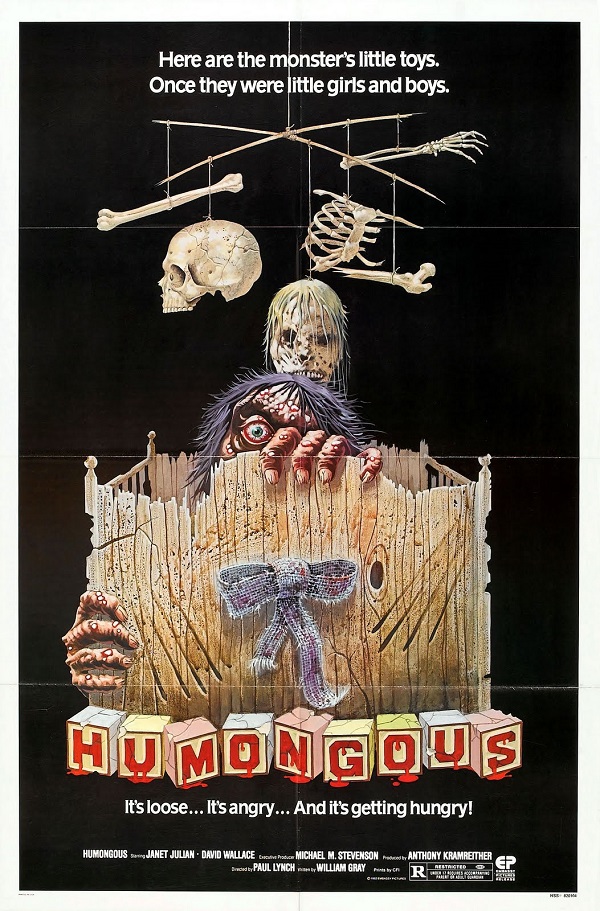
Director Paul Lynch also brought us the Canadian cutter Prom Nightand here, he starts the action off with a bang: on Labor Day weekend 1946, a drunk (Page Fletcher, the title character from HBO’s The Hitchhiker) rapes Ida Parsons at a party her rich father is throwing. She is saved by her dogs, who attack the man before she smashes his brains out with a rock.
36 years later, preppy bros Eric (David Wallace, Mazes and Monsters, Mortuary) and Nick are taking their father’s yacht on a weekend getaway with their girlfriends, Sandy (Janet Julian, who was TV’s Nancy Drew when Pamela Sue Martin left the series) and Donna (Joy Boushel, Terror Train) and their sister, Carla (Janit Baldwin, ‘Gator Bait, Phantom of the Paradise).
After a day of staring at girl’s asses while feeling up other asses (this movie has more nudity in the first 11 minutes than nearly every movie that will come out this year), fog comes in and the boys save a shipwrecked fisherman named Bert. As he recovers from hypothermia, he tells them of Dog Island, the home of lumber baroness Ida Parsons (remember her?) who lives on the island with only her wild dogs for company. It’s at that point that Nick wrecks the boat into — DA DA NA — Dog Island!
Bert gets wounded. Carla gets lost. Nick walks into the woods and gets killed by a gigantic shadowy character. Meanwhile, Sandy and Eric attempt to find Ida Parsons.
While all this is going on, Bert goes into shock so Donna tries to warm him up by stripping nude. As you do. As she lies across his frozen body, the shadowy thing tosses her into the rocks and then rips off Bert’s head.
In the middle of all this, Sandy and Eric discover not only Ida’s house, but Carla, who is alive. You know who isn’t? The dogs of Dog Island, who are all skeletons inside cages.
Our protagonists find a nursery full of dusty toys and a cobwebbed crib, as well as Ida’s diary, filled with frightening photos and insane scribblings of her sick child, who she intended to keep free from sin. And oh yeah — they also find her skeleton.
Everyone wises up and decides to leave Dog Island. They gather some supplies and make their way to the basement, where they find the bodies of Nick and Donna.
So the story everyone decides to go with is that this shadowy monster is Ida’s son, who somehow lived, and has been driven insane by his mother’s death. He’s incredibly strong, an amazing tracker and sees any outsiders as a threat. You’d think they’d get the fuck away from the house, but no, they go back to get matches and Eric gets killed. His back gets broken all Bane style and Sandy runs to Ida’s room to hide.
When the shadowy man gets there, she wraps a blanket around her head and acts as if she is Ida. I love this scene so much, as we never see the monster and only a brightly lit Sandy. Her words are measured and forceful, but as we look at her face, we can tell she’s never been more afraid in her life.
Just when Sandy thinks she’s safe, she tries to leave the room. However, the mutated man-child realizes her ruse and chases her to the boathouse, where he crushes Carla’s head along the way. Even setting this maniac on fire won’t stop him, because it’s 1982 and this is a Canadian slasher film.
You know what does stop him? A big signpost that impales him. Usually, slashers get stopped by impalement, have you ever realized that?
At the end, Sandy is left alone on the dock, decimated by the fact that she’s had to kill a human being and feeling the loss of her friends. And we notice — she now looks a lot like Ida.
Humongous is sleazy and bloody fun, with a unique killer and plenty of atmosphere. Sure, it’s a slasher, but it has a way better premise than kids stuck at a summer camp or a cursed calendar date. I’ve heard comparisons to Joe D’Amato and George Eastman’s Antropophagus, but this has none of the over the top gore of that film. That’s not to say that there isn’t plenty here.
There’s also a minimalist score by John Mills-Cockell, which really sets the tone and amps up the mood. He also worked on Terror Train and was one of the first people to purchase a Moog synthesizer.
Want to see this one? Ronin Flix has the Scorpion Releasing blu-ray reissue of the film, complete with the American R-rated and Canadian unrated cuts.
Thanks to Paperbacks from Hell, I’ve learned all about James Herbert, the British horror author whose four The Rats novels pretty much defined the evil rats against man genre. Imagine my surprise in finding this Canadian horror film that pretty much takes Herbert’s story and runs away with it (or gets away with it).
Paul Harris is a divorced high school teacher and basketball coach who is dealing with rats the sizes of small dogs that have been found living in buildings containing steroid-rich grain (ripped from today’s headlines!) that the health department orders burned. Now that the rats are homeless, they’re looking for a new home and new eats, too.
First, they surround a baby in a high chair and make him a snack. Then, they get a senior citizen. Soon, they’re chasing down Scatman Crothers and eating him, too! Oh no, Scatman!
Even spraying the rats with gas does nothing. Nope, instead they attack a bowling alley and a movie theater showing a Bruce Lee movie (director Robert Clouse also directed Lee’s Enter the Dragon and Game of Death). None will be spared as the rats feed. Not Trudy (Lisa Langlois, Happy Birthday to Me), the cheerleader in love with Paul. Not her best friend Martha (Lesleh Donaldson, Curtains, Funeral Home, Happy Birthday to Me). And certainly not the mayor who acts like he’s in the Canadian version of Jaws and then has a party on a subway train that gets infested by rats. Finally, Paul, his love interest Kelly and his son make it through the rats’ nest only to get on the same train as the mayor’s dead body.
So how did they get the rats for this movie? By putting dachshunds in fur suits, a The Killer Shrews plan if I ever heard one. Sadly, one of the dogs died during shooting as it was suffocated by its suit.
Herbert referred to this film as “absolute rubbish.” Sadly, we’ve yet to see the definite adaption of his work. We’ll have to make due with this, I guess. Where I disconnect with the film is that I could see it happening in New York, but Toronto? That’s the cleanest city I’ve ever been in. I bet the rats could do much better elsewhere.
Shout! Factory put this out on blu-ray a few years ago, but it’s now sadly out of print. Do what you can to find it — you can put on a loop in your home, along with other “always on HBO” fare like Flash Gordon, Superfuzz, Midnight Madness, The Car, Sharkey’s Machine, Modern Problems, Scavenger Hunt, They Call Me Bruce, Electric Dreams…Home Box Office in the early 80’s, what a time to be alive!
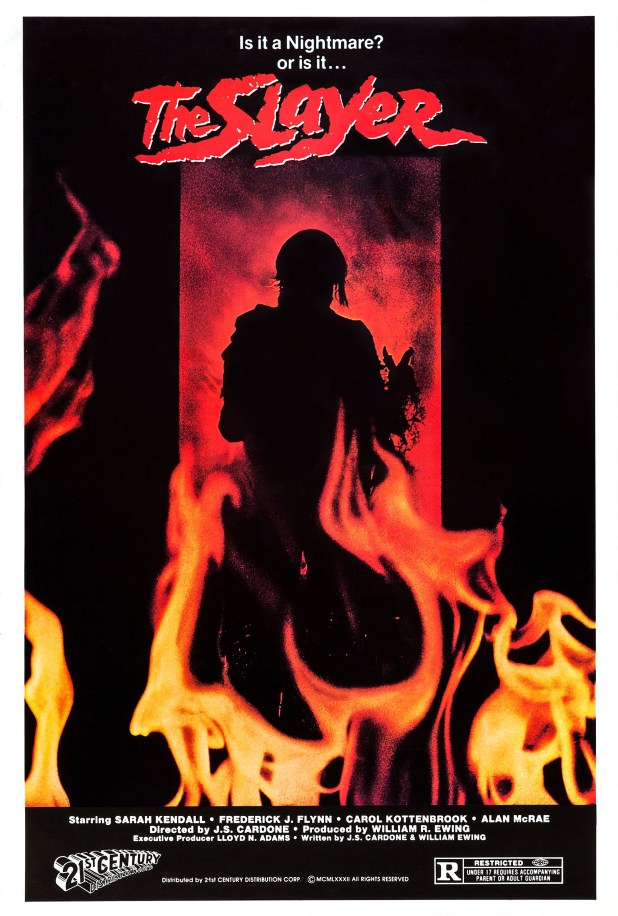
Since childhood, Kay has constantly suffered from horrifying dreams, some of which are just frightening landscapes that leave her feeling uneasy and others that show loved ones being killed by a supernatural force. Those dreams have come and gone, but now they are happening more often, growing in intensity and impacting her work as an artist.
Worried that all of this stress may hurt her newfound success as an abstract artist, Kay decides to vacation on a small island, along with her husband David (Alan McRae, Three Ninjas), her brother Eric and his wife Brooke. As their pilot drops them off on the island, he mentions that a hurricane is on the way and he has to leave as soon as possible. Even stranger is the fact that the island — which they expected to be a resort town — is a deserted ruin. And not just any ruin, but the one in Kay’s dreams, leading her to feel that everyone is in danger.
David, Eric and Brooke are then killed one after the other. But who killed them? The film gives us three possible stories, each of which are plausible: the pilot never left the island and just dropped them off there to kill them (a theory that is somewhat proved when the pilot is seen later); Kay believes that a monster from her dreams can cross over into reality thanks to the island (which could be true, as the murders only happen when she is asleep) and finally, that Kay is really the killer, falling into a trance and acting out repressed resentment.
After everyone else dies, Kay locks herself into the beach house and tries to stay awake, even burning herself with cigarettes. But that night, the pilot makes his way into the house. She shoots him with a flare gun, killing him and sending the house up in smoke. As she tries to leave, a flaming skeleton is waiting for her.
But wait! It was all a dream, as Kay awakes on Christmas morning in bed. After telling her parents about the dream, they hand her a black cat to her horror. Huh? Supposedly Kay is killed by the Slayer and this is a flashback, but it certainly doesn’t seem that way.
Director J.S. Cardone says that he was inspired by H.P. Lovecraft and the idea of dreams versus reality, but the movie doesn’t have much to do with Lovecraft. That said, this movie looks way more expensive than its budget would lead you to believe, there are some good death scenes and it has a bleak atmosphere.
You can get the Arrow Video reissue at Diabolik DVD.
Here’s a drink.
Hurri-Kay
2 oz. white rum
2 oz. dark rum
2 oz. passion fruit juice
2 oz. orange juice
.5 oz. grenadine
.5 oz. simple syrup
.25 oz. lime juice
Maraschino cherry
Add all your ingredients — other than the cherry — in a shaker filled with ice.
I’m always searching for movies. After the April Ghoul’s Friday night, I headed back to our room and watched this movie on TCM and wanted to add it to my collection. It’s out of print, with prices going anywhere from $90 to $120 for the DVD. Imagine my happiness when I found it for $4 at an antique store!
The film opens with a dream sequence where Byron “Preacher” Sutcliff (Martin Landau, forever Bela Lugosi and John Koenig to me) finds himself in a diner where he is chopped in half by a demented short order cook (Donald Pleasence!).
That cook turns out to be Dr. Leo Bane, who runs a psychiatric hospital that is able to reach the unreachable. Sure, his methods are practically surreal and he randomly smokes weed during the day. But they work.
Dr. Dan Potter (Dwight Schultz, Murdock from TV’s The A-Team) is the new doctor in town, the replacement for Dr. Harry Merton who has moved to another hospital in Philadelphia. He’s brought his wife Nell and daughter Lyla (Elizabeth Ward, who played the original Carol Seaver in the pilot for TV’s Growing Pains before Tracey Gold won the role) to town and is preparing for a visit from his punk rock, post-nervous breakdown having sister Toni.
The really dangerous people in Dr. Leo’s care are all on the third floor. We already met the preacher, who loves setting things on fire. Then there’s the paranoid prisoner of war Frank Hawkes (the transcendent Jack Palance), child molester Ronald Elster (Erland van Lidth, Dynamo from The Running Manwho was also in Stir Crazy) and John “The Bleeder” Skagg (Phillip Clarke, The Reincarnation of Peter Proud ), a killing machine who bleeds from the nose when he kills. No one has seen The Bleeder’s face, as he hides it from everyone but his close friends.
Dan learns from security guard Ray Curtis (Brent Jennings, Witness) that the third-floor men all believe that he killed Dr. Merton and want revenge. He blows this off.
A night at the punk rock club — a place that Dan hates — ends after the power goes out, as a nuclear power plant has caused a regional blackout. Lyla is at home with Bunky, her babysitter. And the men from the third floor kill their way out of Dr. Leo’s hospital, with all three but The Bleeder staying together.
Preacher makes the first move, trying to deliver a telegram to the Potter house. Then, Nell and Toni go to protest the nuclear power plant but are arrested, forcing them to bring in Bunky to babysit. However, Ronald gets there first and teaches Lyle origami. As for Bunky, well, she calls over her boyfriend Billy for some sex, but Preacher and Ronald kill them in a scene that has a disconcerting bit with a knife emerging from the bed.
When Dan bails out Nell and Toni, they bring along Tom Smith, a man they met in jail. The police are all over the house, investigating the murders of Bucky and Billy. Luckily, Lyle was in bed sleeping the whole time after playing with Ronald.
What follows is a night of murder and mayhem, with cops getting killed by crossbow bolts, Dr. Leo trying to reach out and hug the Preacher (he had previously told him that if he didn’t settle down he would cut him in half, leading to the nightmare we saw at the start of the film) before getting killed with an axe, a fire in the basement, the reveal of The Bleeder and so much more.
“It’s not just us crazy ones who kill,” says Dan at one point. The end of the film and the closing scene are harrowing. I’m not giving it away. You need to hunt this down for yourself.
Co-written and directed by Jack Sholder (The Hidden, the near franchise realigning of A Nightmare on Elm Street 2: Freddy’s Revenge and The Omen TV movie remake) along with additional writing from producer and New Line co-chair and co-CEO Robert Shaye (who worked on the first two Elm Street movies), this was New Line’s first release. It also features a quick effect from Tom Savini.
One of the members of the band in the movie, The Sick Fucks, said that he ran into Jack Palance years after the movie. He told him he was one of The Sick Fucks from Alone in the Dark and Palance replied, “We were all sick fucks in that movie.” He’s right — Palance is awesome in this. He went so far into character that he refused to film a scene where he would kill the driver outside the Haven. He said that the audience didn’t need to see him kill the man to know how dangerous he was. He was totally right.
Alone in the Dark was written off as just another slasher in the early 1980’s. It’s basically disappeared as there hasn’t been a major re-release by a label like Shout! Factory or Arrow Video. That’s a shame — it’s an intelligent film that is as comfortable discussing the existential philosophy of R.D. Laing as it is with showing people get skewered.
Sometimes, a movie is so perfect that you can’t objectively discuss it. Creepshow is that kind of movie — a perfect combination of portmanteau, E.C. comics, goopy special effects and gross-out humor. It’s also the perfect melding of some of the greatest talents in horror — George Romero, Tom Savini, Bernie Wrightson and Stephen King.
This film is King’s screenwriting debut and consists of five short stories (two based on King stories) and a framing element where Billy (played by King’s son Joe Hill) fights with his father (Tom Atkins!) over his horror comics. Soon, the Creep himself comes to his window, asking Billy to come closer as he transforms from a practical effect (that uses a real human skeleton) to animation (done by Pittsburgh-based group The Animators, who also did the Tom Petty video for “Running Down a Dream”).
In the first story, Father’s Day, Nathan Grantham is the old man of the family, rich from a life of murder, fraud and extortion. Finally, on Father’s Day, his long-suffering daughter Bedelia (Viveca Lindfors, A Bell from Hell) finally rises up against a lifetime of abuse and torture (he even killed the only man she ever loved) and kills him.
Every year on Father’s Day, his family gathers to celebrate his life. And by that, I mean that they talk about how much they hated him. There’s Sylvia (Carrie Nye, wife of Dick Cavett), Richard, Cass and Cass’s husband Hank (Ed Harris, showing up in another Romero film after his star turn in Knightriders).
Bedelia is late, but she has to stop at the cemetery and see the grave. She’s drunk — again — and spills her whiskey all over the headstone, which brings her horrible father back from the dead. One by one, he wipes out his family, all while screaming for his Father’s Day cake. Well, he gets it.
Some minor trivia here — Nathan’s corpse is played by John Amplas, who is a noted theater teacher in Pittsburgh. However, you may know him better as the title protagonist of Romero’s classic Martin.
Up next, The Lonesome Death of Jody Verrill is nearly a one-man show for King. Based on his story Weeds, it’s a Lovecraftian tale (think The Colour Out of Space) of a meteor destroying a simple man. It also has some great old WWWF footage and an appearance by Pittsburgh stage legend Bingo O’Malley.
Something to Tide You Over is a very E.C. Comics story, where a wife (Gaylen Ross) and her lover (Ted Danson from TV’s Cheers) finally get caught by her husband (Leslie Nielsen in a rare villainous role). It’s a simple story told well with incredible effects from Savini, as instead of just zombies, he creates seaweed and salt water damaged undead monsters.
The Crate is the real crowd pleaser of the film and is based on the King short story of the same name. Between Hal Holbrook, Fritz Weaver and Adrienne Barbeau, it’s packed with star power. And the actual beast inside the crate is a Savini tour de force, a perfect monster. There’s also a cameo by Romero’s ex-wife, Christine Forrest.
Finally, in They’re Creeping Up on You, E.G. Marshall rules the screen as Upson Pratt, a Howard Hughes-like man who lives in a sealed apartment because he’s deathly afraid of insects. As in any E.C. Comics story, what you fear the most is what will destroy you.
There’s an interesting object that keeps showing up throughout the film — a marble ashtray that shows up in nearly every scene. It’s the one used to kill Nathan in the first story, but it keeps reappearing. Is it the Loc-Nar of Creepshow?
If you’re from Pittsburgh, Creepshow is a tour of home. There’s an abandoned girl’s school in Greensburg that was used for the majority of the shoot, as well as Carnegie Mellon University, Romero’s own backyard in Shadyside and a mansion in Fox Chapel. The only non-Pittsburgh setting was a New Jersey beach for the drowning scenes.
Soon after the film was released, a comic book adaption was released, with art by comic legend Bernie Wrightson. It was a prize possession of mine throughout my teen years and I dog-ear read it, nearly tearing off the cover.
The prop comic in the film was actually created by E.C. Comics vet Jack Kamen, as was the poster for the film. King had wanted “Ghastly” Graham Ingels, but he refused and Kamen was recommended by former E.C. owner (and publisher of MAD) William M. Gaines.
People love this film. There’s a Creepshow Museum dedicated to the movie that’s packed with replicas, posters and autographs from the stars of the film. And there’s a ton of merch for the film — Fright Rags has released numerous t-shirts; I’ve worn out this one from Pizza Party Printing; Horror Merch Store has masks of Fluffy from The Crate and Nate, as well as the soundtrack; and there’s even action figures of Nate, Harry and Becky (from Something to Tide You Over) from AmokTime!
Synapse Films even released Just Desserts, a making-of film that has interviews with nearly everyone involved that you can find right here.
Creepshow truly is the most fun you’ll ever have being scared. It was followed by two sequels of diminishing quality, but it’s held up for over thirty years. It’s a movie I bring out and watch at least once a year. And now that Shudder is celebrating featuring Stephen King movies on their streaming service, you can watch it whenever you want!
UPDATE: The Creepshow Museum doesn’t just have replicas! They have screen used props, original production materials and many one-of-a-kind items as well. I really appreciate them reaching out to us and setting the record straight!
Let’s say there’s this island where drugs come from. Also, there’s a white slavery ring that trades in pretty girls. Additionally, a Nazi who looks a lot like Hitler is interested in the place. And oh yeah — it’s also the burial ground for disgraced martial artists who will one day be raised from the dead by the strange monks who live there. Got all that? Throw in Cameron Mitchell as a boat captain and you’re ready for the pure batshit piece of trash that is Raw Force.
But wait — the film is also a travelogue of the worst parts of the Far East, as the members of the Burbank Karate Club make their way to the island. Bar fights. Dens of ill repute. Strip clubs. And then the film becomes the Love Boat, but then people start getting killed.
Toss in a nude scene of Camille Keaton (I Spit On Your Grave, What Have You Done to Solange?) while she’s in the bathroom (she’s billed as “Girl In Toilet” and was paid in cash for her part) and a final act where the zombie martial artists all rise and begin killing everything and everyone (and are dressed as Mortal Kombat castoffs ten years before that game even came out), as well as piranhas and you, have quite the stew.
Originally written as Kung-Fu Zombies, the film ends with a To Be Continued… The sequel would have featured Jonathan Winters (!!!) as Hope Holiday’s ex-husband and of course, Cameron Mitchell would have returned.
This is a delirious cocktail of everything you want to watch while at the drive-in or inebriated in the middle of the night: sex, chop sockery, zombie gore, Nazis, mayhem, more sex, more gore, bad kung fu and daring airplane hijinks. Luckily, it’s easy to find on Shudder. Or you can grab a blu ray from the awesome people at Vinegar Syndrome.
I can’t overemphasize how much fun this movie is. Director Edward Murphy claims that he was making a film for seventeen-year-old boys. He succeeded beyond my wildest dreams.
If a movie is a great film, does it matter who made it? I come from advertising, where it’s hard at best to figure our credit and uncouth to loudly demand it. So the controversy about this film — whether Spielberg or Hooper directed it — doesn’t really matter to me Because the important thing is that it’s a great movie.
Steven and Diane Freeling (Craig T. Nelson from TV’s Coach and the voice of Mr. Incredible from The Incredibles and JoBeth Williams, Stir Crazy) are living the American dream. After all, Steve is a successful real estate developer. They have three great kids. And they’ve recently moved into a planned community called Cuesta Verde. Sure, the newer houses in the plan look much better. And you can’t even watch a football game without losing what channel you’re on because the houses are so close together. But it’s the American Dream, right?
That TV is the fixation of America in this movie, starting with the National Anthem and continuing with the people inside the TV that fascinate their youngest daughter, Carol Anne (who would sadly die at the age of 12 of cardiac arrest and septic shock caused by a misdiagnosed intestinal stenosis). The connection between the hand that emerges from the TV and the young girl is so powerful that it shakes the entire town before she announces the film’s best-known line, “They’re here.”
All hell breaks slowly loose over the following day. A glass of milk breaks out of nowhere, drenching daughter Dana (Dominique Dunne, daughter of writer Dominick and brother of Griffin, she would be killed by her stalker ex-boyfriend John Thomas Sweeney at the age of 22). The son, Robbie (Oliver Robins, Airplane 2), has his silverware twist and turn after he uses it. Furniture slides and rearranges at will, even in front of more than one person.
Here’s the beauty of this film. These teases start slow and you expect the Val Lewton jump scare model, where the pressure will be let off after a minor scare. But once a tree emerges from the backyard to crash through the window and pull Robbie outside, the movie jumps onto a rollercoaster track. While saving their son, Carol Anne disappears into the closet and can only be heard through the TV set.
They turn to parapsychologists Dr. Lesh (Beatrice Straight, Chiller), Ryan (Richard Lawson, Scream Blacula Scream, Sugar Hill) and Marty, who discover that there is more than one ghost. That info is confirmed when Steven finds out from his boss Lewis Teague (James Carren, The Return of the Living Dead, Invaders from Mars) that Cuesta Verde was built over an Indian cemetery.
Dana and Robbie are sent away and Tangina Barrons (Zelda Rubinstein, Teen Witch, Behind the Mask: The Rise of Leslie Vernon), a spirit medium, is called in for help. She explains how they have to get Carol Anne back from spirits that are not at rest. There’s also another ghost, the Beast (which uses the same sound effect as the MGM lion roar), who has their daughter restrained. Diane enters a portal to the beyond to bring her daughter back and they both emerge covered in ectoplasm as the house is said to be clean.
Steven believes that it’s anything but, so he gets the family ready to move. On their last night there, he goes to quit his job while Dana goes on one last date before leaving town. The Beast attacks, turning Robbie clown doll into a demon and pushing Diane all over the walls of her room before throwing her into the backyard hole that is due to be a swimming pool. The bodies of the dead begin to explode from the ground, some in coffins, some just covered with filth and rot. Steven screams into his boss’s face that he may have moved the cemetery’s headstones, but the bodies were left behind. Finally, the house collapses within itself as the family drives away. As they stay in a Holiday Inn, unsure of their future, the TV is pushed outside.
Alright. Let’s get into that discussion of who really directed this film. Going the whole way back to a 1982 Fangoria article, there were rumors that the film wasn’t really Hooper’s. And Spielberg didn’t help Tobe’s case when he said, “Tobe isn’t a take-charge sort of guy. If a question was asked and an answer wasn’t immediately forthcoming, I’d jump in and say what we could do. Tobe would nod agreement, and that became the process of collaboration. I did not want to direct the movie-I had to do E.T. five weeks after principal photography on Poltergeist. My enthusiasm for wanting to make Poltergeist would have been difficult for any director I would have hired. It derived from my imagination and my experiences, and it came out of my typewriter (after re-writing the Grais/Victor draft). I felt a proprietary interest in this project that was stronger than if I was just an executive producer. I thought I’d be able to turn Poltergeist over to a director and walk away. I was wrong. If I write it myself, I’ll direct it myself. I won’t put someone else through what I put Tobe through, and I’ll be more honest in my contributions to a film.”
The Directors Guild of America investigated the film, checking to see if Hooper’s official credit was hurt by Spielberg’s comments, which seemed to claim some level of ownership.” Frank Marshall, the co-producer, told the Los Angeles Times that Spielberg was the creative force of the film and designed every storyboard. Plus he was on the set for all but three days.
Finally, an open letter from Spielberg to Hooper was sent to The Hollywood Reporter, which stated, “Regrettably, some of the press has misunderstood the rather unique, creative relationship which you and I shared throughout the making of Poltergeist. I enjoyed your openness in allowing me… a wide berth for creative involvement, just as I know you were happy with the freedom you had to direct Poltergeist so wonderfully. Through the screenplay you accepted a vision of this very intense movie from the start, and as the director, you delivered the goods. You performed responsibly and professionally throughout, and I wish you great success on your next project.” He also sent a letter to Time where he stated, “While I was creatively involved in the entire production, Tobe Hooper alone was the director.”
Over the years, this controversy has gone back and forth. Zelda Rubinstein claimed that Spielberg directed every day that she was on set, with Tobe working almost as a DP who would set up the shots. Assistant cinematographer John R. Leonetti (who would go on to direct Annabelle) reported that due to an upcoming strike, he was trying to get every movie he wanted to film done (he was also working on E.T. The Extra-Terrestrial at the same time). Hooper was happy to be there, had some input but it was basically not his film.
Jo Beth Williams stated that “Steven was there every day. He had very clear and strong ideas about what he wanted done and how he wanted it done. Even though Tobe was there and participating, you felt Steven had the final say on everything. Sometimes Steven would tell us one thing and Tobe another. But they soon realized that was doing us more harm than good, so they stopped. Later on, whatever discussions Tobe and Steven had, they held in private and then came to us with their decisions.”
At the time of filming, Hooper said, “I don’t understand why any of these questions have to be raised. I always saw this film as a collaborative situation between my producer, my writer, and myself. Two of those people were Steven Spielberg, but I directed the film and I did fully half of the storyboards. I’m quite proud of what I did. I can’t understand why I’m being slighted. I love the changes that were made from my cut. I worked for a very good producer who is also a great showman. I felt that was a plus, because Steven and I think in terms of the same visual style.”
He’d grow tired of the controversy in later years, claiming that “the genesis of it came from an article in The L.A. Times: When we were shooting the practical location on the house, the first two weeks of filming were exterior, so I had second-unit shots that had to be picked up in the front of the house. I was in the back of the house shooting Robbie [actor Oliver Robins] and the tree, looking down at the burial of the little tweety bird, so Steven was picking those shots up for me. The L.A. Times arrived on the set and printed something like, “We don’t know who’s directing the picture.” The moment they got there, Steven was shooting the shot of the little race cars, and from there the damn thing blossomed on its own and started becoming its own legend.”
Composer Jerry Goldsmith and casting agent Mike Fenton claimed that they worked directly with Spiegberg as if he were the director.
However, others were more upset than Hooper let on. Craig T. Nelson said, “Tobe gave me a lot of direction. It’s not fair to eliminate what Tobe did. He gave me a tremendous amount of support because he’s a warm, sensitive, caring human being. Tobe was simply pushed out of the picture after turning in his cut.”
You can read even more in-depth analysis in the three articles I referred to for this article, “Who REALLY directed Poltergeist?” at the Poltergeist Fan Site.
The film did get an R rating, which was eventually changed to PG. It would have definitely got an R if the original draft was filmed, where Carol Ann was going to get killed in the first act and subsequently haunt the house in the second. As it stands now, only one death occurs in the film: the bird who gets buried in the beginning.
Poltergeist is really a must see horror film. It sets up so much so effectively and does a great job of paying off each scare. It’d be followed by two sequels and a TV series, which we’ll definitely be getting to.
You must be logged in to post a comment.