EDITOR’S NOTE: Cinematic Void will be playing at the Little Theater in Rochester, NY on Thursday, Jan. 29 at 7:30 PM (tickets here). For more information, visit Cinematic Void.
By 1982, Dario Argento had moved beyond the constraints of the giallo genre he had helped popularize and started to explore the supernatural with Suspiria and Inferno. According to the documentary Yellow Fever: The Rise and Fall of the Giallo (which is on the Synapse blu ray of this film), the failure of Inferno led to Argento being kindly asked — or demanded — by his producer to return to the giallo with his next film.
Tenebre is the result and while on the surface it appears to be a return to form, the truth is that it’s perhaps one of the most multilayered and complicated films I’ve ever seen. And while I’ve always believed that Phenomena is Argento’s strangest film — a girl who can talk to bugs befriends a monkey to battle a cannibal child in a foreign country — I have learned that Tenebre just might be even stranger.
To start, Argento intended for the film to be almost science fiction, taking place five years after a cataclysmic event, in a world where there are less fewer people and as a result, cities are less crowded and the survivors are richer. Argento claims that if you watch Tenebre with this in mind, it’s very apparent. While he only hinted that the survivors wanted to forget some mystery event, in later interviews he claims that it takes place in an imaginary city where the people left behind try to forget a nuclear war.
In truth, this could be an attempt to explain why Argento decided to show an Italy that he never had in his films before. Whereas in the past he spent so much time showing the landmarks and crowded streets that make up The Eternal City, he would now move into a sleek futuristic look, a Rome that exists but that films had never shown its viewers before. This pushes this film away from past Argento giallo such as his animal trilogy and Deep Red, as well as the waves of imitators that he felt undermined and cheapened his work. There is no travelogue b-roll time wasters in this movie — the actual setting is there for a reason; stark, cold and alienating.
Argento had started that he “dreamed an imaginary city in which the most amazing things happen,” so he turned to the EUR district of Rome, which was created for the 1942 World’s Fair, and intended by Mussolini to celebrate two decades of fascism. Therefore, more than showing a Rome that most filmgoers have never seen, he is showing us a Rome that never was or will be; a world where so many have died, yet fascism never succumbed.
Instead of the neon color palette that he’s established in Suspiria or the Bava-influenced blues and reds that lesser lights would use in their giallo, production designer Giuseppe Bassan and Argento invented a clean, cool look; the houses and apartments look sparse and bleached out. When the blood begins to flow — and it does, perhaps more than in any film he’d create before or since — the crimson makes that endless whiteness look even bleaker.
Tenebre may mean darkness or shadows in Latin, but Argento pushed for the film to be as bright as possible, without the shadowplay that made up much of his past work. In fact, unlike other giallo, much of the plot takes place in the daytime and one murder even takes place in broad daylight.
Again, I feel that this movie is one made of frustration. As Argento tried to escape the giallo box that he himself had made, he found himself pulled back into it in an attempt to have a success at the box office. In this, he finds himself split in two, the division between art and commerce.
As a result, the film is packed with duality. There are two killers: one who we know everything about and is initially heroic; another who we learn almost nothing about other than they are an evil killer. Plus, nearly everyone in this film has a mirror character and soon even everyday objects like phone booths and incidents like car crashes begin happening in pairs.
Peter Neal (Anthony Franciosa, Julie Darling) is set up from the beginning of the film as the traditional giallo hero: he is in a foreign place, deaths are happening all around him and he may be the inspiration or reason why they’re happening. He has more than one double in this film, but for most of it, his doppelganger is Detective Giermani. The policeman is a writer himself and a fan of Neal’s work, claiming that he can never figure out who the killer is in his books. Their cat and mouse game seems to set up a final battle; that finale is quick and brutal.
This conversation between the two men sums up the linguistic battle they engage in throughout the film:
Peter Neal: I’ve been charged, I’ve tried building a plot the same way you have. I’ve tried to figure it out; but, I just have this hunch that something is missing, a tiny piece of the jigsaw. Somebody who should be dead is alive, or somebody who should be alive is already dead.
Detective Germani: Explain that.
Peter Neal: You know, there’s a sentence in a Conan Doyle book, “When you have eliminated the impossible, whatever remains, however improbable, must be the truth.”
This last sentence is of great interest to me when it comes to giallo. Normally, these films are not based upon Sir Arthur Conan Doyle, but instead, use Edgar Wallace as a touchpoint. They are also filled with red herrings and nonsensical endings where the impossible and improbable often becomes the final answer to the mystery.
Even the movie’s plot is split in half and mirrors itself. This next sentence gives away the narrative conceit of the film: the murders are solved in the first half, belonging to Christiano Berti (John Steiner, Shock), a TV critic who interviews Neal. The second murders are all Neal’s, who uses an axe instead of a straight razor, and his crimes are personal crimes of passion that aren’t filled with the sexual aggression of Berti’s; they are quick and to the point. Much of giallo is about long, complicated and ornate murder, as well as trying to identify the killer. As the film goes on, with the main killer revealed and the murders becoming less flashy, it’s as if Argento is commenting on the increasing brutality of the genre he helped midwife.
The movie itself starts with the book Tenebre being burnt in a fireplace with this voiceover: “The impulse had become irresistible. There was only one answer to the fury that tortured him. And so he committed his first act of murder. He had broken the most deep-rooted taboo and found not guilt, not anxiety or fear, but freedom. Any humiliation which stood in his way could be swept aside by the simple act of annihilation: Murder.”
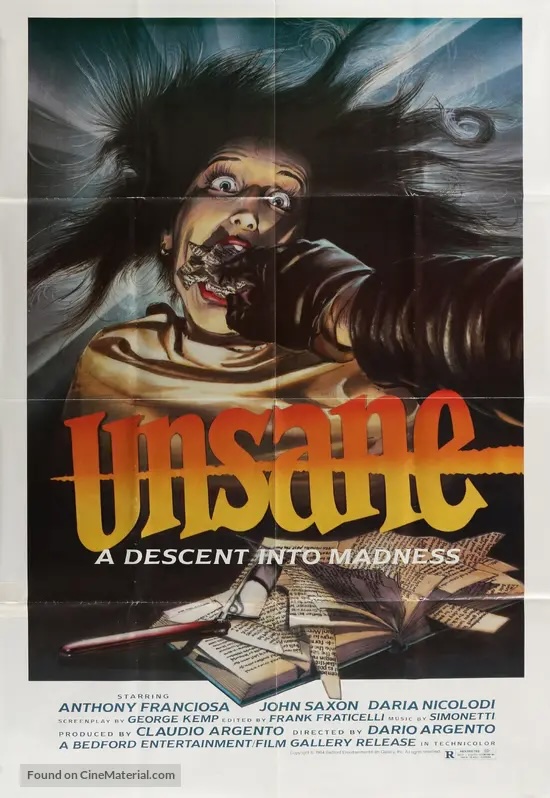
That’s when we meet Neal, an American in Rome, here to promote his latest work of violent horror, Tenebre. This bit of metafiction is but the first bit of a film that fuses the real and fictional worlds. Joined by Anne (Fulci’s wife Daria Nicolodi) and agent Buller (John Saxon!), Neal begins his press tour.
Before he left, Neal’s fiancée Jane vandalized his suitcase. And moments prior to him landing in Rome, a shoplifter (Ania Pieroni, the babysitter from The House by the Cemetery) who stole his book has been murdered by a straight razor, with pages from said book — again, Tenebre — stuffed into her mouth. Neal has received an anonymous letter proclaiming that he did the murder to cleanse the world of perversion.
Throughout the film, we see flashbacks of a man being tormented, such as a woman chasing down a young man and forcing him to fellate her high heel while other men hold him down. Later, we see the stereotypical giallo black gloved POV sequence of her being stabbed to death.
Next, one of Neal’s friends, Tilde and her lover Marion are stalked and killed. This sequence nearly breaks the film because nothing can truly see to follow it. In fact, the distributor begged Argento to cut the shot down because it was meaningless, but the director demanded that it remain. Using a Louma crane, the camera darts over and above the couple’s home in a several-minutes-long tracking shot. Any other director would film these murders with quick cuts between the victim and listener in the other room or perhaps employ a split-screen. Not Argento, who continually sends his camera spiraling into the night sky, high above Rome, across a maze of scaffolding; a shot that took three days to capture and lasts but two and a half minutes. In one endless take, the camera goes from rooftop to window, making a fortress of a home seem simple to break into; it’s as if Argento wanted to push the Steadicam open of Halloween to the most ridiculous of directorial masturbation. It’s quite simply breathtaking.
Maria, the daughter of Neal’s landlord, who is presented to us as a pure woman (much of giallo, to use Argento’s own words in Yellow Fever: The Rise and Fall of the Giallo, is split between the good girl and the bad woman), is killed when she discovers the killer’s lair. Neal mentions that Berti, the TV personality, seemed obsessed with him and his words echoed the letters from the killer. As Neal has now become the giallo hero, he must do his own investigation, taking his assistant Gianni (Christian Borromeo, Murder Rock) to spy on the man. They discover him burning photos that prove he is the killer.
As Gianni watches, Berti says, “I killed them all!” before an axe crashes into his skull. Whomever the second murderer is, the young man can’t recall. He finds his boss, Neal, knocked out on the front yard and they escape.
That night, Neal and Anne make love, the first time this has ever happened between the two. And the next morning, Neal leaves his agent’s office and discovers his fiancée Jane is secretly sleeping with someone he once considered his best friend.
Giermani asks Neal to visit Berti’s apartment, where they find that the dead man was obsessed with the writer, but don’t discover any of the burnt evidence. The idea that someone could become so obsessed with your work that they’d kill comes directly from Argento’s life. In Los Angeles in the wake of Suspiria‘s surprising international success, an obsessed fan called Argento’s room again and again. While those calls started off nicely enough, by the end, the fan began explaining how he wanted “to harm Argento in a way that reflected how much the director’s work had affected him” and that in the same way that the director had ruined his life, he wanted to ruin his. Argento hid out in Santa Monica, but the caller found him, so he finally went back to Italy. He claimed that the incident was “symptomatic of that city of broken dreams.”
Back to the real story — or the movie story — at hand: Neal decides to leave Rome. Jane receives a pair of red shoes, like the ones we’ve seen in the flashbacks. Bullmer is waiting for Jane in public before he is murdered in broad daylight. And then Neal’s plane leaves for Paris.
Gianni, however, is haunted by the fact that he can’t remember the crime. He returns to Berti’s apartment and it all comes flooding back to him. This moment of visual blindness — and eventually recovery — suggests that Gianni will be pivotal in the resolution of the film and become a hero; ala Sam in The Bird with the Crystal Plumage or Marcus in Deep Red. Not so in the world of Tenebre, as he’s killed within moments.
Argento’s callbacks to his past films are not complete — Jane enters her apartment and walks past a sculpture, again directly and visually recalling The Bird with the Crystal Plumage. She’s called Anne and has a gun, so one assumes that she now knows that she’s not the only unfaithful one in her relationship. An axe shatters the scene and the window as Jane’s arm sprays blood everywhere, almost like some demented surrealist painting. This scene was the cause of numerous cuts with Italian censors and the uncut version still packs plenty of punch.
A quick note — for a movie where Argento was supposedly answering his critics that his work had become too violent and anti-female — the fact that he answers them with an inversion of even more gore and dead women is either the most metacomment of all time or he truly does not give a fuck.
Inspector Altieri enters and is also killed, revealing Neal as the murderer. Anne and Giermani arrive, just in time for Neal to testify to killing Berti and everyone afterward before he slits his own throat.
The flashbacks return and we realize they were Neal’s. While Argento never outright shows it in the film, the girl in the flashbacks was played by transgender actress Eva Robin’s (who got her name from Eva Kant from Danger: Diabolik and the author Harold Robbins), so this further adds to the mirrored theme, as one of Neal’s foremost sexual experiences was not just one of humiliation, but of sublimation and even the greatest heterosexual male fear, penetration. That repressed memory of his childhood sexual trauma and revenge, for some reason unlocked, restoked the bloodlust that he had kept in check for years.
As the detective returns inside, we’re gifted with one of Argento’s most arresting pieces of imagery: as Giermani studies the murder scene, his body contains the shape of Neal, who had faked his death. As he looks down and moves out of frame, the killer is revealed. In essence, the inverse doppelganger is revealed. Brian DePalma, a director who trods the same psychosexual violent domain as Argento, used –stole? — a similar shot in his 1992 film, Raising Cain.
Neal waits for Anne to return. When she opens the door, she knocks over the metal sculpture that referenced Argento’s past work and the sculpture impales the killer. This sequence was copied nearly shot for shot in Kenneth Branagh’s Dead Again, a movie just as influenced by Argento’s work, but also one that would receive much more critical praise.
Surrounded by unending horror, Anne simply screams into the rain, unable to stop. This is another meta moment that we can view on multiple levels:
A. Her character is reacting to the hopelessness of the film’s climax in the only way she has left.
B. Nicolodi, like the other Italians in the film, had little to no character to work with. Frustrated, she bonded with lead actor Franciosa over Tennessee Williams plays, leading to her husband Argento growing increasingly jealous as filming progressed (the couple would split three years later). Therefore, her screams are a genuine reaction to the hopelessness she was feeling for real and took the entire crew by surprise.
C. Asia Argento, the daughter of Dario and Nicolodi, has stated that this scene and her mother’s commitment to it, would prove to her that she should be an actress. As she matures in age, it’s notable that Argento’s films make a shift toward female protagonists (and even Asia in that lead role in his movies Trauma, The Stendhal Syndrome, The Phantom of the Opera and the final film in the Suspiria Three Mother’s cycle, The Mother of Tears).
I’ve written nearly three thousand words on this film and feel like I could type so many more. It strikes me on so many levels. According to the audio commentary on the Tenebre blu ray by Kim Newman and Alan Jones, one of Argento’s reoccurring theme is that art can kill. You can take this literally — certainly the sculpture at the end ends Neal’s life — or you can see how the darker art gets, the more it impacts the life of its creator (see Fulci’s Cat in the Brain and Craven’s New Nightmare for variations and mediations on this same theme).
Here, the critic Berti’s obsession with the creator Neal’s work compels him to kill in homage to the writer. Is this Argento’s metacommentary that critics — who have never been kind to his work — can only aspire to slavish devotion to his themes and no new creation of their own? That said, the artist isn’t presented as much worthier of a person. He believes that his violent acts of fiction and violent acts of reality are one and the same, all part of the same tapestry of unreality. When he’s finally confronted by what he’s done, all he can do is yell, “It was like a book … a book!”
The second event in Argento’s real life that informs this film comes from a Japanese tourist being shot dead in the lobby of the Beverly Hilton while the director stayed there. Combined with a drive-by shooting that he saw outside a local cinema — which has to feel like a killing outside of a church to a devotee like Argento — the sheer senselessness of murder in America was another reason that Dario left the country.
He would later remark, “To kill for nothing, that is the true horror of today … when that gesture has no meaning whatsoever it’s completely repugnant, and that’s the sort of atmosphere I wanted to put across in Tenebre.”
I can see some of that, but for someone who has presented murder as works of art — perfect preplanned symphonies of mayhem — the stunning realization that real life death is ugly and imperfect must have punched Argento right in the metaphorical face.




 B&S About Movies
You must be logged in to post a comment.