St. Helens (1981)

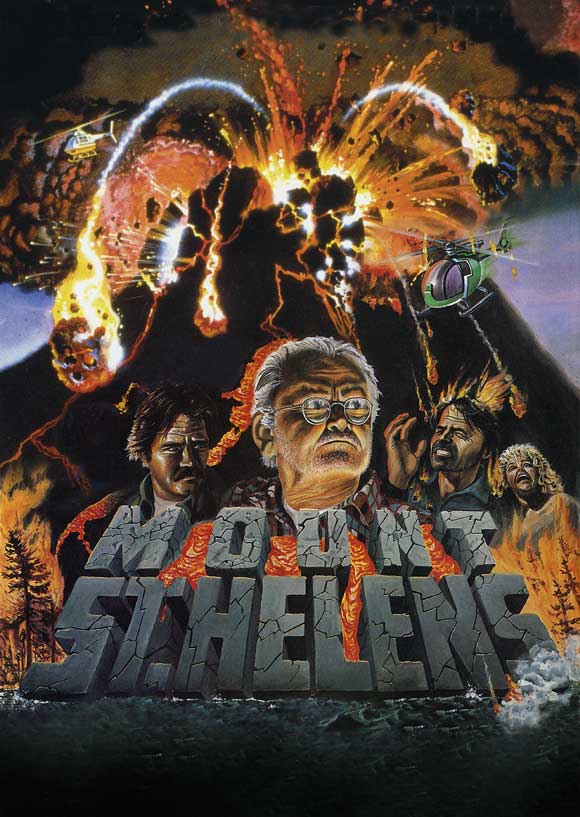
Directed by Ernest Pintoff, written by Peter Bellwood and Larry Ferguson and based on a story by Michael Timothy Murphy and Larry Sturholm, St. Helens aired on HBO on May 18, 1981, a little more than a year after the real eruption.

St. Helens begins on March 20, 1980 with an earthquake measuring 5.1 on the Richter scale being unleashing by the volcano, the first activity in more than a hundred years. It causes Otis Kaylor (Ron O’Neal) to nearly crash into some loggers as he makes an emergency landing.

United States Geological Survey volcanologist David Jackson (David Huffman) soon shows up to learn more. He’s actually playing someone very close to David Johnston, a scientist who died in the actual volcanic eruption. His parents were angry that not only was her son portrayed as a daredevil but also how much the movie got wrong about the science. Before the movie aired, 36 scientists who knew Johnston signed a letter of protest against the film, saying that “Dave’s life was too meritorious to require fictional embellishments” and that he “was a superbly conscientious and creative scientist.”

He soon becomes friends with a waitress and single mom named Linda Steele (Cassie Yates) and upsets her boss Clyde Whittaker (Albert Salmi) and the locals at Whittaker’s Inn about the danger of the eruption, all while Sheriff Dwayne Temple (Tim Thomerson) tries to keep law and order.

Watching this movie in 2024, it’s amazing how MAGA the people of the town are. It’s no accident that Bill McKinney from Deliverance is one of them. The loudest is the owner of the Mount St. Helens Lodge, Harry R. Truman (Art Carney), who refuses to leave the blast radius and becomes so famous for his stand that he basically can’t leave if he wants to live up to the character that he has created for himself. His sister, Gerri Whiting, served as a historical consultant for the film. According to her, Harry Truman and David Johnston were friends.

At 8:32 a.m. PDT on May 18, 1980, David hikes to find a massive bulge that has been growing on the north face of the mountain while Harry goes fishing in Spirit Lake. As David promised to the locals, they are both annihilated by a force similar to a nuclear bomb going off in their faces.

Sadly, the David who played David — David Huffman — died a sad death as well. He was only 39 years old when he was stabbed twice in the chest while fighting with a would be car thief. He died near instantly.

Why would I watch a movie so surrounded by death and sadness? Because it’s the first Hollywood movie scored by Goblin. Let me tell you, there’s nothing that says the Pacific Northwest more than Italian prog rock.

You can watch this on YouTube.

Sexo sangriento (1981)

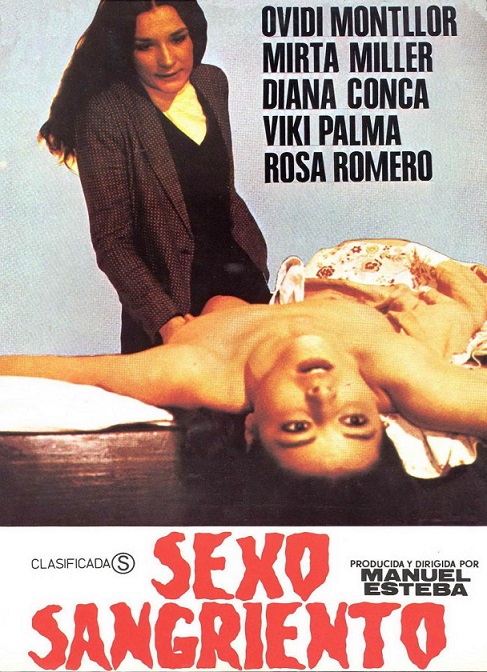
Directed by Manuel Esteba (El E.T.E. y el Oto), who wrote the story with Xavier Flores, Sexo Sangriento is about the home of María Domènech (Mirta Miller), a place where she lives with her strange son (Ovidi Montllor). Psychology student Norma (Rosa Romero) convinces her friends Laura (Diana Conca) and Andrea (Viki Palma) to go to that house, thinking that it has been empty since the end of the Second World War. They have the plan to do a seance there before breaking down — bad omen — and having María, a painter, offer to host them in her ancient manor — even worse omen — for the evening.

Shot mostly handheld, this feels a bit Italian gothic as well as giallo what with the ghost in the basement. Then again, it also has someone wandering around before death with a knife stuck in their stomach, strange bloody paintings and a tomb beneath it all. This has the reputation for being sleazy but it’s actually a decent movie. Maybe because it has a lead lesbian couple? Then again, one of the murders does get rather rough.

A lot of the music in Bloody Sex comes from the CAM Music Library, selecting some of the same songs that are in Pieces and Ring of Darkness. And you’ll recognize Goblin’s “L’alba dei morti vivirti” from Dawn of the Dead/Zombi, which Mattei reused for Virus – l’inferno dei morti viventi.


The Monster’s Christmas (1981)

What are the holidays like in New Zealand? Maybe this movie will tell us all we need to know.

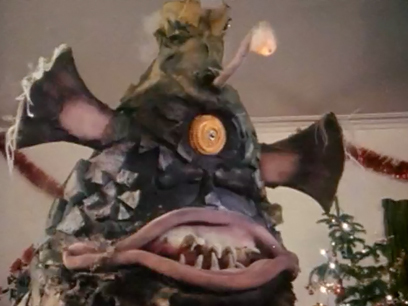
A little girl reads The Monster’s Christmas to her teddy bear before she hears Santa. Except that it’s not him. It’s one of the monsters from her book and he needs her help to get the voices of his friends back so that they can all sing Christmas carols again, as an evil witch was jealous of their singing and has stolen their voices.

Every monster in this is awesome looking, as is the witch, who has turned her hair into a hat and also wears a t-shirt that says WITCHES RULE. Yes, they do. So does the weird synth by Dave Fraser, who played on the soundtrack of The Quiet Earth and Battletruck.

Director Yvonne Mackay has mainly worked in New Zealand TV. Writer Burton Silver also made the book Why Paint Cats and was the creator of New Zealand’s longest-running published cartoon series Bogor.

My words won’t tell you how amazingly wild and frightening this movie for children is. I mean, there are monsters everywhere on the level of Yokoi Monsters but they’re also singing and dancing. At the end, they all get together to sing “Silent Night” and the idea that somewhere out there there’s a savior monster that died for them — or did Jesus die for all of us — is something I’d love to see a movie all about. I can only imagine that this movie warped every child from New Zealand — the country that gave us Flight of the Conchords, Dead Alive and The Bushwhackers — whenever the season came around again. “Look kids, it’s the man dressed as a bat walking backward! It won’t be long until Santa is here!”

You can watch this on Tubi.

Notturno con grida (1981)

The only copy I can find of Screams In the Night is, as nicely as I can put it, beat to shit. Whole sections of it turn into static and digital noise, the quality is at least fifth generation and the sound is barely listenable. There are no subtitles, either. And yet, in a world of 4K everything, I appreciate these analog moments when a movie looks bad and you need to fit to make it matter.

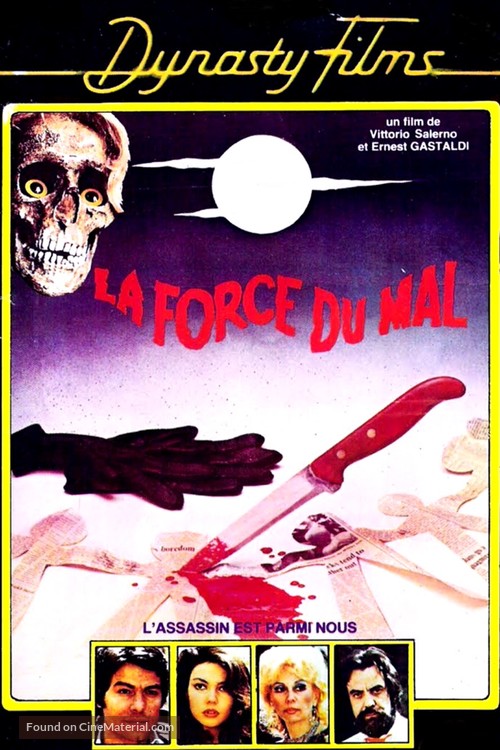
A medium named Brigitte (Mara Maryl, the wife of co-director and writer Ernesto Gastaldi), her husband Paul (Luciano Pigozzi, the Peter Lorre of Italy) and their friends Gerard (Gerardo Amato, The Red Monks), his fiancée Eileen (Martine Brochard, Top Model) and Sheena (Gioia Scola, Obsession: A Taste for Fear) have invoked the spirit of the long dead Christian (Franco Molè), who was killed ten years ago in this very room. He was once the husband of Eileen and in a few days, he will finally be declared dead, so she can use his money to build residential spaces on his property with Gerard.

Everyone has a secret. As for Gerard, he’s sleeping with Sheena and plans to kill Eileen. Paul used to be a priest. And Brigitte? Well, as everyone dies around them, she just may be a witch.

Gastaldi, who was the writer of so many Italian films, joined director Vittorio Salerno (he directed Libido as Julian Berry Storff), who hadn’t made a movie in five years. One day, while hunting in the woods — according to Roberto Curti’s Italian Gothic Horror Films 1980-1989 — he found a gigantic petrified formation known as a trembling stone. He couldn’t stop thinking about it until one night, he finally had an idea. Five people — lost in the woods and who all hate each other —  find the stone. It becomes “the amplifier of their bad desires, their projects of mutual duplicity … and mysteriously, no one will get out of the woods alive.”

To fund the movie, they got a 60 million lire grant from the Ministry of Spectacle by submitting the movie as La coscienza and pretending it was an art film. After they got the money, they formed a co-op with the cast, basing their salaries on the money the movie made from distribution.

Shot in three weeks with just four technicians, which included director of photography and cameraman Benito Frattari, his nephew Marco, a sound man and a local handyman to carry things who was provided for free by the mayor of the town where they shot, Soriano nel Cimino. Unlike many Italian exploitation movies, it was shot with direct sound. It also has nearly all natural light, which may be why it was set and shot outside. It is a frugal film, as you can tell.

If you have seen Libido, this is something of a spiritual sequel. It takes scenes from that movie and treats them in sepia, using them as flashbacks. In 1965, Mara Maryl was tied to a bed, an image that appears on that film’s poster. In 1981, it’s a rock in the woods. Pigozzi fell off a cliff to his death in the earlier film; here he claims it just broke his legs.

Perhaps most strange here is how much this movie prefigures the ideas within The Blair Witch Project. I’m not insinuating theft, just that the collective unconsciousness is a strange place. The woods are constantly changing, reality is shifting and there is no way out. However, this was shot on 16mm, not video, and even with a small crew looks professional and not the work of twentysomethings in the woods with a handheld.

As for the score, it has material lifted from The Suspicious Death of a Minor and improvised flute music by Severino Gazzelloni, whose ode to Pan was composed and recorded in six hours, giving the movie an hour of music to use.

I would treat this as a curiosity unless you have an obsession — you know me — with Italian film.

You can try to watch this on YouTube.

Fantasma d’amore (1981)

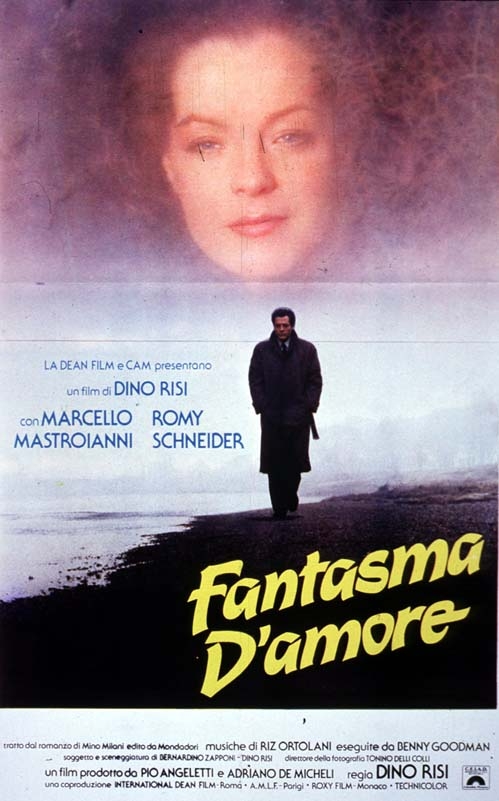
Nino (Marcello Mastroianni) is a married man who does taxes. His life is, well, quiet and somewhat boring. And then one day he sees Anna (Romy Schneider), a woman he was in love with decades ago. Time has not been kind to her. He pays for her busfare and she disappears, only to call him that night and offers to repay him. He meets her at her dilapidated apartment, only to learn that she has died three years ago.

His wife Teresa (Eva Maria Meineke) is growing upset with his obsession with the past. Despite him being sure that she is gone, she calls again and asks him to visit her mansion. When she answers the door, she is the same woman he knew years ago, young and vital. She tells him that she still loves him, but can’t make love to him, as she is married to the man who owns this gigantic home, Conte Zighi (Wolfgang Preiss). She changes her mind and says that they should take a boat to where they once would get away to be with one another, except that she disappears by falling into the water. When Nino informs the police, his wife leaves him and a tearful Conte Zighi tells him that his wife died three years before. His servant even takes him to see her gravestone.

At the end, Nino is in a wheelchair in his senior home, watching the sun set. A gorgeous woman comes to bring him inside. It is Anna.

Directed by Dino Risi (Anima persa), who wrote the script with Bernardino Zapponi based on the book by Mino Milani, Fantasma d’amore is about a man who has no passion left, a life which has no joy and only memories, which have become colored by the idea that they are the past, of a great love lost for good to keep him warm in the dark nights of the soul. Yet Anna says to him, “You really believe time exists…time which makes us age, which consumes us, that indeed exists. But inside of me, I’m not aged at all.” The fact that this woman, for a time, loved him is enough to sustain him all the way to the loneliness of the grave.

Speaking of age and remaining young through memory, the Riz Ortolani score features a 72-year-old Benny Goodman playing clarinet.

Bollenti spiriti (1981)

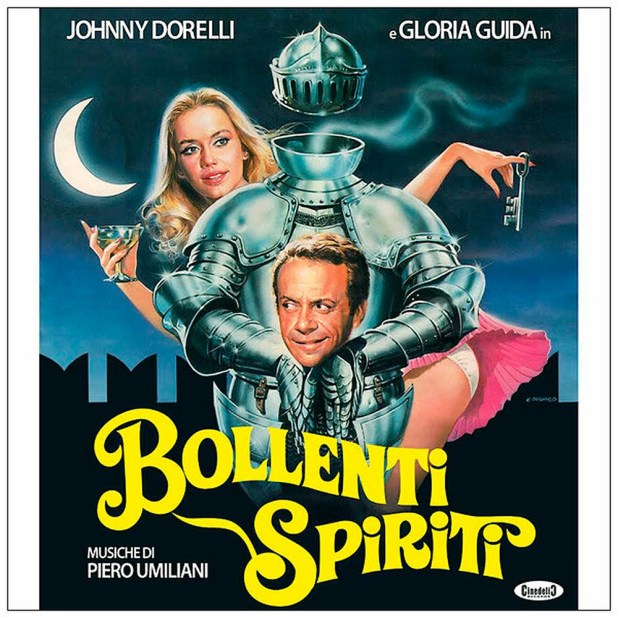
Giovanni (Johnny Dorelli) has inherited a castle from his uncle Ubezio and this will help him escape all his many creditors as a company already wants to buy it for a luxury hotel. The problem? The nurse who took care of his uncle, Marta (Gloria Guida, La casa stregata), has been given a percentage of the property. He works on talking her out of her share so that he can sell, but falls in love. There’s also the problem of the randy ghost of his ancestor Guiscardo (also played by Dorelli) who has had sex and has stayed in the castle for three centuries. And oh yeah — the buyer of the castle? His wife Nicole (Lia Tanzi) is Giovanni’s latest girlfriend.

Directed by Giorgio Capitani and written by Franco Marotta and Laura Toscano, this feels a lot like the other sexy haunted house movies of this time, C’è un fantasma nel mio letto and La casa stregata. There’s also some funny — and sexy — moments with Lory Del Santo (The Great Alligator) as a sex worker hired to relieve the ghost of his virginal burden.

C’è un fantasma nel mio letto (1981)

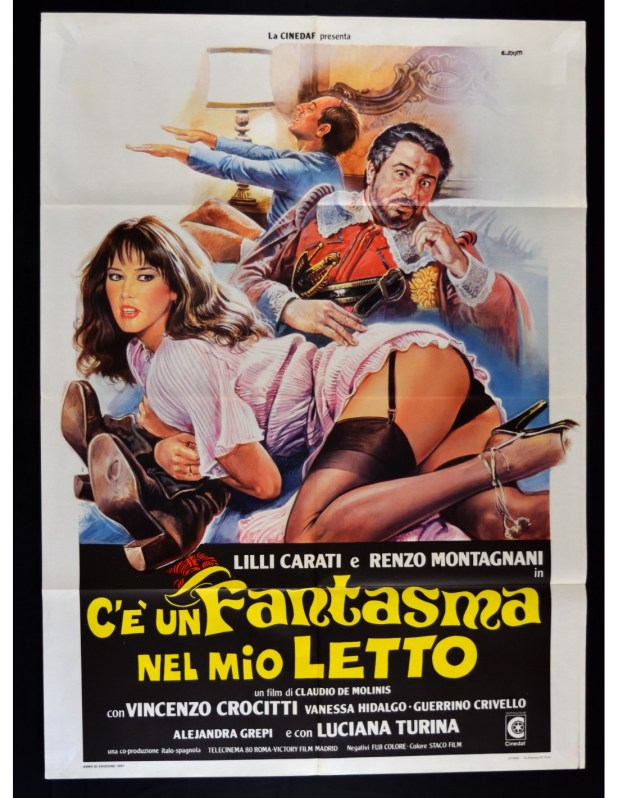
There Is a Ghost in My Bed was directed by Claudio Giorgi, who worked as an actor in fotoromanzi or photo comic books. It was written by Luis Maria Delgado and Jesus Rodriguez Folga and it’s in the genre of both Italian Gothic and commedia sexy all’italiana.

Camillo (Vincenzo Crocitti) and Adelaide (Lilli Carati) are on their honeymoon in Scotland. They can’t find a place to stay and get lost in the fog, finally finding the ancient castle of the Baron of Black Castle (Renzo Montagnani) and his servant Angus (Guerrino Crivello). Despite being a ghost, the Baron still wants to make love to Adelaide and I mean, have you seen Lilli Carati? Can you blame him? How did Camillo keep from sleeping with her during their five-year engagement?

Carati started her career as the runner-up for the 1975 Miss Italy contest. She started work as a fashion model before starting her career with La professoressa di scienze naturali. Her work was mainly in “school” movies where she was a young teacher or a student who was often nude. She also starred with Tomas Milan in Squadra antifurto and had her biggest success in the film Avere vent’anni (To Be Twenty). She was in four Joe D’Amato movies —  La Alcova, Christina, The Pleasure and A Lustful Mind — before acting in adult films in the late 80s. At that point, she was addicted to cocaine and heroin. She retired from public life in 1990 but returned to acting to play an occultist in Violent Shit: The Movie, which was dedicated to her as she died before it was released.

THE MOVIES OF AL ADAMSON: Carnival Magic (1981)

Al Adamson should have never made a children’s film. This is the man who made Psycho a Go-Go, two different softcore movies with flying hostesses (The Naughty Stewardesses and Blazing Stewardesses), the staggering Dracula vs. Frankenstein and a Filipino horror movie that was dubbed, tinted in neon hues and released as Horror of the Blood Monsters. And oh, by the way, his film Satan’s Sadists was shot Spahn Ranch and he was not shy about using that fact to promote the film. And how can we forget his rip off of Eddie Romero’s Blood Island films, the impressive Brain of Blood?

But yeah. So then he decided to make a movie for the kids, it failed, he went into real estate and then ended up murdered by a contractor and buried in the cement under a new hot tub.

So are you ready for Carnival Magic? No. I really don’t think you are.

According to an article in the Austin Chronicle, even the way that film was discovered is unsettling. Alamo Drafthouse programmer Zack Carlson said, “I didn’t know about the movie until I already owned it. It was an entire movie on one giant reel, and written on the side of it, in Sharpie, it said Carnival Fucking Magic. It completely decimated everyone. We couldn’t understand what the movie was, because although it’s made under the guise of a children’s film, it features domestic abuse, vivisection, and, even more uncomfortably, it just has this pervasive air of stale, alcoholic uncles. It’s the most quietly inappropriate kids’ movie ever made. You can tell it was made by people who have never spent any time around children.”

At face value, the movie is all about Markov the Magnificent (Don Stewart, who was on the soap opera Guiding Light for sixteen years), a magician and mindreader whose career has hit the skids. However, when he teams up with a talking chimp — after a while, no one is really all that amazed that monkeys can speak — named Alexander the Great, their dirt poor Stoney Martin Carnival finally has a chance to be a success. Then again, Kirk the alcoholic lion tamer (Joe Cirillo, who played cops in everything from Maniac Cop 2 to SplashGhostbusters and Death Wish 3) and the doctor who wants to examine Alexander’s brain may screw it all up.

Of course, Al’s wife Regina Carrol shows up. But what you don’t expect is that the monkey loves women’s bras and stealing cars. You might wonder what child would want to see this or how they’d react being dropped off at the theater in 1981 by their parents and having to confront this film. I’m in my forties and barely survived it with my insanity intact (to be fair, I’ve gone back more than a few times to try and watch it again).

See, there’s a war brewing between Markov and Kirk. Our hero doesn’t like telling many people, but he was raised by Buddhist monks who taught him hypnosis, levitation and how to talk to animals. The main problem is, the more he talks to Kirk’s animals, the less they take our villain as their master.

Speaking of talking, that’s pretty much all this movie does. Everyone talks, about losing their wives, potentially losing their daughters, leaving behind their old lives and worries of their future. I’m not really sure what children want to see the inner workings and turmoil of a ratty circus. After all, we’ve all come to realize just how sinister the big top is and this movie will do nothing to dissuade you from that notion.

I really have no idea who this film is really for. But yet, that’s part of the charm. Every year, there are so many movies made for kids that just fade away. Somehow, this oddity won’t go away, even if the print for it stayed hidden for decades. Beyond all rational reasoning, Carnival Magic is available to watch on Netflix — albeit with riffing from Mystery Science Theater 3000 — and ready to mess with anyone’s brain that stumbles across it.

You can get this from Severin.

SUPPORTER DAY: The Tale of Tiffany Lust (1981)

EDITOR’S NOTE: Today’s movie is brought to you by AC Nicholas, who has graciously become a Big B&S’er, a monthly supporter of the site and got to pick an entire week of movies. Would you like to have me write about the movies of your choice? It’s simple!

  1. Go to our Ko-Fi site and donate. There’s no set amount and I won’t tell you what to do. In fact, if you just keep reading for free, we can still be friends.
  2. Join as a monthly member for just $1. That makes you a Little B&S’er.
  3. As a Medium B&S’er at just $3 a month, if you pick a movie or a director, I’ll write about them for you. In fact, I’ll do one for each month you subscribe and even dedicate the post to you.
  4. For $5 a month, you basically get some major power. As a Big B&S’er, I’ll write an entire week on any subject you’d like. How awesome would that be? In fact, I’ll do it for every month you’re a member. Do you think any of your other movie sites will do that for you?

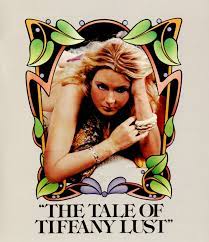
Directed by Gérard Kikoïne and Radley Metzger and shot at the same time as Aphrodesia’s Diary, this finds Betty (Veronica Hart) suggesting that her friend Tiffany (Dominique Saint Claire using the name Arlene Manhattan) that she attend a taping of the talk show of Florence Nightingale (Vanessa Del Rio). Within the audience, people are encouraged to live out their fantasies.

Some of those people acting on them are a very young Ron Jeremy, Desiree Cousteau, Samantha Fox and Candida Royalle. When she gets home, Tiffany discovers that her husband (George Payne) has been cheating on her with Misty Regan.

Metzger had hoped that his film The Cat and the Canary would be a mainstream success which is why Kikoïne is the only director in the credits.

This was the first release of Mélusine, Vinegar Syndrome’s adult label.

SUPPORTER DAY: Heartbeeps (1981)

EDITOR’S NOTE: Today’s movie is brought to you by Chris Salazr, who made a $5 donation and got to pick the movie of his choice. 

Would you like to have me write about the movies of your choice? It’s simple!

  1. Go to our Ko-Fi site and donate. There’s no set amount and I won’t tell you what to do. In fact, if you just keep reading for free, we can still be friends.
  2. Join as a monthly member for just $1. That makes you a Little B&S’er.
  3. As a Medium B&S’er at just $3 a month, if you pick a movie or a director, I’ll write about them for you. In fact, I’ll do one for each month you subscribe and even dedicate the post to you.
  4. For $5 a month, you basically get some major power. As a Big B&S’er, I’ll write an entire week on any subject you’d like. How awesome would that be? In fact, I’ll do it for every month you’re a member. Do you think any of your other movie sites will do that for you?

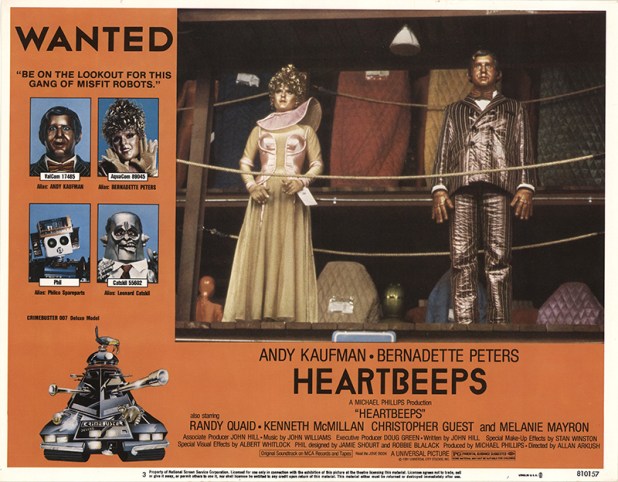
As they await repairs, Val Com 17485 (Andy Kaufman), a robot valet with a specialty in lumber commodities, falls in love with Aqua Com 89045 (Bernadette Peters), a hostess companion robot who is made for poolside parties. They assemble a robot named Phil (Jerry Garcia) who they treat as their child and take with them a comedian robot, Catskil-55602 (Jack Carter).

They are pursued by Crimebuster (Ron Gans), a broken police drone that wants to bring them into to be erased. They are and yet they keep reverting back to their new programing as the love between them has become too strong.

The story sounds good but the actual movie, well…

In his book Andy Kaufman: Revealed, Bob Zmuda wrote that Kaufman and Zmuda had “pitched” the The Tony Clifton Story to Universal Studios. They were concerned that Kaufman had not acted in films except for a small role in God Told Me To, so they arranged for him to star in this movie as a test. It was a disaster and Kaufman even apologized on Late Night With David Letterman for making it.

When I spoke with director Alan Arkush about this movie, he was very honest about it.

B&S: Can you tell me about Heartbeeps?

ALLAN: I got offered this big studio movie. And I really have to say that I totally misread the situation. I didn’t really understand the script or maybe it didn’t indicate that it could be a wacky comedy. I seized on the idea that it could be this big story about robots falling in love and making it a Frank Borzage movie (a bizarre idea and nothing like what the studio wanted). He was big on love conquers death, love is a spiritual thing and I thought that’s what the situation was with these robots. Maybe that’s an intellectually good solution but it’s not the movie they wanted.

I made so many bad choices like a pace that was WAY too slow for comedy. I should have just turned Andy Kaufman loose, used many many more special effects and taken more advantage of the genius of my FX team Stan Winston and Albert Whitlock. We recently did a commentary for the Kino Lorber rerelease and that was both eye opening and painful, but useful to me as an artist, not unlike when I critique a film at the AFI.

B&S: But you had a great cast! I mean, Jerry Garcia is in it.

ALLAN: Yes, Jerry was someone I knew really well. And I asked him to do one of the robot voices on the guitar. I was trying to borrow stuff from other parts of my life to shoehorn in. The studio cut ALL of Jerry’s work out.

At least Arkush was able to get Paul Bartel, Mary Woronov and Dick Miller in the movie, as well as Kenneth McMillan and Randy Quaid as repairmen. But otherwise, this movie seems like it’s going somewhere at first and then just sits there forever, despite being only around 75 minutes. I’ve put off watching it for years because I’ve heard just how bad it is and I’d hoped that it would surprise me.

It was written by John Hill, who also wrote Quigley Down UnderLittle Nikita and episodes of Quantum Leap and L.A. Law. He also scripted Steel Justice, a TV movie in which monster truck robot Robosaurus teams with a police officer. Do you think he told people, “I did Heartbeeps so I am a natural to write this movie about a child who brings back his dead cop dad as a fire-breathing transforming dinosaur?”

What is great is the makeup by Stan Winston.

The artist had been sought after he created the makeup for the Tin Man in The Wiz. Winston said, “I hadn’t been all that happy with the final results of the Tin Man makeup, which was made up of foam rubber appliances, painted to look like metal. I wanted to see if I could come up with something better for Heartbeeps, appliances that would have an intrinsic metallic quality, rather than one that was just painted on.”

He used gelatin appliances that were painted with metallic colors. However, the heat of shooting meant that the makeup needed near-constant touch-ups. This almost ruined Winston’s sanity.

“I had created the look I wanted and I had done something that no one had ever seen before. The downside was that, on a daily basis, I didn’t know whether or not we were going to get through the shoot! These were very difficult makeups to maintain, very labor-intensive. Every day at lunch we had to replace the lip appliances, for example, because they were starting to melt on us. Vince Prentice and Zoltan Elek, the makeup artists who actually applied the prosthetics, constantly had to stay on top of the problems with the gelatin. I was a wreck through the entire shoot.”

It did teach him an essential lesson.

“I was in a stressed-out state, which was fairly typical of me at that time, and Bernadette Peters said to me, “Relax, Stan. It’s just a movie.” Here she was, going through this grueling process of having these prosthetics applied to her, and she had to calm me down. It should have been just the opposite. To this day, I thank Bernadette Peters for putting my attitude in perspective. In this work, there are always going to be very real responsibilities and pressures — but it’s just a movie, and there’s nothing to be gained by being a walking stress factory. Ever since that time, I’ve tried to bring positive energy and lightheartedness to the set.”

Resources

Stan Winston School. Heartbeeps: Behind the Scenes at Stan Winston Studio.